
制度型开放

Search documents
中央经济工作会议精神学习:平稳过渡,结构优化
Minmetals Securities· 2025-12-15 02:44
Economic Strategy - The Central Economic Work Conference emphasized the importance of "five musts" for economic growth, including fully tapping economic potential and combining policy support with reform innovation[2] - The focus has shifted from simple scale expansion to precise efficiency improvement, with a projected fiscal deficit rate of 4% for the coming year[3] Investment and Consumption - The meeting highlighted a transition from investment-driven growth to consumption-led growth, with plans to implement a rural and urban income increase program[9] - Investment will focus on quality rather than quantity, with an emphasis on urban renewal and infrastructure improvements[10] Technological Innovation - The conference stressed the importance of "AI+" in reshaping industries, aiming to integrate AI technology across traditional sectors[12] - National strategic resources will be concentrated in key innovation hubs like Beijing, Shanghai, and the Guangdong-Hong Kong-Macau Greater Bay Area[12] Structural Reforms - The meeting called for deep reforms to address structural contradictions in the economy, including the establishment of a unified national market and the elimination of "involution" in competition[14] - Financial supply-side structural reforms will focus on quality over quantity, with an expected wave of mergers among small financial institutions[15] Risk Management - The conference underscored the need to stabilize the real estate market and manage local government debt risks through optimized restructuring methods[24] - Measures will be taken to ensure food security and stabilize agricultural product prices to protect farmers' incomes[19]
统筹推进深层次改革和高水平开放
Zheng Zhou Ri Bao· 2025-12-15 00:46
Core Viewpoint - The article emphasizes the importance of deepening reforms and expanding high-level openness as key strategies for achieving modernization in China, particularly in the context of Zhengzhou's development as a national central city and a hub for domestic and international dual circulation [1][2][4]. Group 1: Reform and Development - The need to deepen reforms to enhance advantages and build a dual circulation hub is highlighted as a strategic choice for Zhengzhou to fulfill its responsibilities as a national central city [2]. - Zhengzhou is one of three cities in China designated as pilot cities for comprehensive market-oriented allocation of factors, indicating its role in leading reform initiatives [2]. Group 2: Open Economy and Market Integration - The article stresses the importance of integrating into the national unified market to leverage the advantages of a large market scale and unlock development potential [2]. - Zhengzhou aims to strengthen its position as a comprehensive international transportation hub and enhance its modern commercial logistics capabilities [2][3]. Group 3: Infrastructure and Connectivity - Zhengzhou is positioned as a critical transportation hub with a high-level international status, featuring a comprehensive high-speed rail network and international air transport capabilities [3]. - The city is recognized for its strategic resources that connect various regions, making it a vital manufacturing base and an inland opening window [3]. Group 4: Systematic Reform and Innovation - The article advocates for a unified approach to reform and openness, suggesting that deeper reforms will necessitate higher levels of openness and vice versa [4]. - It calls for innovative thinking to expand institutional openness and actively participate in the construction of a unified national market [4].
中国国际经济交流中心副理事长胡晓炼:未来海南以推进边境后制度型开放为主要任务 更强调与国际高标准经贸规则对接
Mei Ri Jing Ji Xin Wen· 2025-12-14 13:07
Group 1 - The official launch of the Hainan Free Trade Port's full island closure on December 18 marks a new phase in its development and accelerates China's high-level opening-up [1] - The core concept of high-level opening-up is institutional opening, focusing on aligning domestic systems with international high-standard economic and trade rules [2][5] - The Central Economic Work Conference emphasized the need to steadily advance institutional opening and optimize the layout of free trade pilot zones, particularly in Hainan [2] Group 2 - Over the "14th Five-Year Plan" period, nearly 200 institutional innovation achievements have been formed across 22 free trade pilot zones, with over 110 pilot measures launched to align with international high-standard economic rules [3] - The Ministry of Commerce is promoting pilot projects in Hainan to align with international high-standard economic rules, including temporary importation of repaired and remanufactured products [3] - The upcoming closure of Hainan Free Trade Port is expected to enhance the free flow of various production factors, creating a strong magnet for global resource allocation [4] Group 3 - Ensuring fair competition among market participants is crucial, with a focus on anti-monopoly and preventing unfair competition [4] - A fair market environment requires equal treatment for state-owned, private, and foreign-invested enterprises in market access, bidding, and subsidies [4] - High-level institutional opening involves not only the input of rules but also a two-way alignment with international economic and trade rules, promoting domestic reforms and exporting successful practices [5]
重磅嘉宾齐聚 共探开放发展新机遇与数智转型新路径
Mei Ri Jing Ji Xin Wen· 2025-12-14 12:57
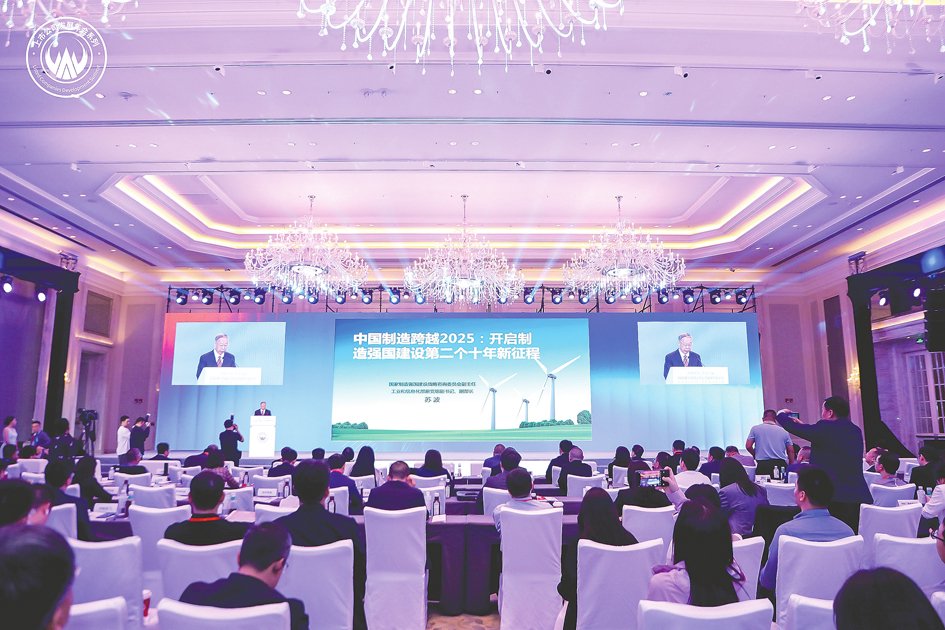
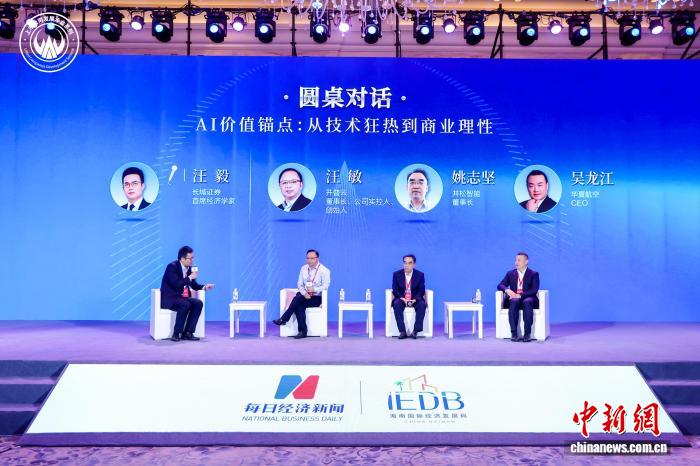
Group 1 - The conference "2025 14th Annual Meeting on the Development of Listed Companies and Hainan Free Trade Port Opportunities Exchange Conference" was successfully held in Haikou, with over 400 listed companies and more than 20 institutions participating, discussing policy paths and global opportunities under the new customs closure [1][3] - Hainan Free Trade Port's core policy is characterized by "one line open, two lines controlled, and free within the island," offering three major benefits: zero tariffs, low tax rates, and greater freedom for enterprises [3][4] - After the customs closure, 6,637 imported goods will be subject to zero tariffs, and enterprises in encouraged industries will enjoy a 15% corporate income tax rate [3][4] Group 2 - The conference focused on the theme "Embracing Diversity, Open Cooperation," aiming to build a platform for collaboration and explore innovative paths for project implementation [4] - The former Vice Minister of the Ministry of Industry and Information Technology highlighted that the next five years will be a critical period for the digital transformation of industrial enterprises, emphasizing the need for deep integration of the real economy and digital economy [5] - The analysis from the capital market perspective indicated that high-tech sectors in the stock market are expected to lead the market, as a healthy market ecosystem requires a group of long-term performing listed companies [5] Group 3 - The first roundtable discussion focused on AI's value propositions, with industry leaders emphasizing the importance of understanding target customers and industry data governance [6][7] - The second roundtable highlighted the strategic planning of companies in the robotics industry and the importance of understanding local cultures when expanding into international markets [7] - The discussions on new consumption trends emphasized the shift from production-driven to consumption-driven models, with a focus on creating new consumer experiences and emotional value [8][9]

中央财办韩文秀重磅发声!明年将根据形势变化出台实施增量政策
Zhong Guo Ji Jin Bao· 2025-12-13 23:51
Core Viewpoint - The Chinese economy is expected to perform better than anticipated in 2025, with a projected GDP of approximately 140 trillion yuan, and incremental policies will be implemented in 2026 based on evolving circumstances to promote stable economic growth [1][3]. Economic Performance - The year 2025 is highlighted as significant for China's modernization, with major economic indicators expected to meet targets, and a growth rate of around 5% is forecasted for the year [2]. - China's economy has shown resilience and vitality, with strong performance in employment, foreign trade, and advancements in modern industrial systems, particularly in AI, biomedicine, and robotics [2][3]. Policy Implementation - Incremental policies will be introduced in 2026 to enhance macroeconomic governance, focusing on both existing and new policies to foster economic stability [4]. - A proactive fiscal policy will be maintained, ensuring necessary fiscal deficits and expenditures while enhancing local financial autonomy and optimizing expenditure structures [4][5]. Monetary Policy - A moderately loose monetary policy will continue, with an emphasis on maintaining liquidity and supporting key sectors such as technology innovation and small to medium enterprises [5]. - The alignment of fiscal and monetary policies will be reinforced to ensure cohesive economic measures [5]. Economic Strategy - Five key principles for economic work have been outlined: maximizing economic potential, balancing policy support with reform, effective regulation, combining investments in physical and human capital, and strengthening internal capabilities to face external challenges [6][7]. - The focus will be on expanding both exports and imports to promote sustainable foreign trade development [8]. Income and Employment - Efforts will be made to synchronize income growth with economic growth, with initiatives to boost consumer spending and enhance employment quality, particularly for vulnerable groups [9][10]. - Green development will be prioritized, with plans for energy transition and carbon emission control to support high-quality growth [10].

400多家上市公司海口共探开放发展新机遇与数智转型新路径
Zhong Guo Xin Wen Wang· 2025-12-13 16:42
中新网海口12月13日电 (记者张茜翼)2025第十四届上市公司发展年会暨海南自贸港开放机遇交流大会12 日在海口举办。超过400家上市公司、20多家机构赴会,政产学研精英共话封关新局下的政策路径、全 球化机遇。 苏波表示,未来5年工业企业数字化转型是推进智能制造、实现制造业创新发展的主战场,需促进实体 经济与数字经济深度融合,加快数智技术创新,强化算力、算法、数据高效供给,建立健全数据要素基 础制度,以数智技术赋能千行百业。 中国国际经济交流中心副理事长胡晓炼聚焦海南开放特质指出,海南的开放是高水平开放,核心是制度 型开放——通过推进规则、规制、标准、管理与国际高标准经贸规则和良好实践相容衔接,从降低关 税、放宽市场准入等边境开放,转向更注重对接国际通行规则、完善国内制度体系的边境后开放。 大会还邀请国内行业领军企业围绕"AI价值锚点"与"新出海范式"展开智慧风暴,分享一线经验与思考。 (完) (文章来源:中国新闻网) 12月18日,海南自贸港将迎来全岛封关运作。海南国际经济发展局局长唐华在主会场致辞与推介环节表 示,海南自贸港的政策核心是"一线放开、二线管住、岛内自由"的制度型开放,叠加"零关税、低税 率 ...
2026年中国经济怎么干?这场重磅年会最新解读
Yang Shi Xin Wen· 2025-12-13 09:45
Core Viewpoint - The 2025-2026 China Economic Annual Conference highlighted the significance of this year in the context of China's modernization process, with expectations of achieving major economic and social development goals [2][5]. Economic Performance - China's economic output is projected to reach approximately 140 trillion yuan this year, reflecting a robust performance that exceeds expectations [4][5]. - Many institutions forecast a GDP growth rate of around 5% for the year, positioning China as the largest engine of global economic growth [5]. Trade and Policy - The conference emphasized the need to expand both exports and imports, promoting sustainable foreign trade development [7][8]. - There is a focus on enhancing service exports and developing digital and green trade [8]. Income and Economic Growth - The government aims to synchronize the growth of residents' income with economic growth, implementing proactive fiscal policies and maintaining a stable macroeconomic environment [9]. - Policies will include maintaining necessary fiscal deficits and debt levels while ensuring the stability of the RMB exchange rate [9]. Consumption and Market Dynamics - The "old for new" consumption policy has spurred rapid sales growth in related goods, with the penetration rate of new energy vehicles nearing 60% [11]. - There is a plan to implement actions to boost consumption and increase the supply of quality goods and services [11]. Green Development - The conference underscored the importance of green development as a foundation for high-quality growth, with plans to accelerate the construction of a new energy system and expand the application of green electricity [12]. Education and Employment - There is a need to increase the supply of ordinary high school places and improve undergraduate enrollment in quality universities to adapt to changes in the school-age population [13]. - Employment policies will focus on stabilizing job opportunities for key groups, including college graduates and migrant workers [13]. Corporate Environment - The government will continue to address issues related to overdue payments to enterprises and enhance the regulatory environment to foster fair competition [14].
中央财办韩文秀,重磅发声!
Zhong Guo Ji Jin Bao· 2025-12-13 08:27
Core Viewpoint - The Chinese economy is expected to perform better than anticipated, with a projected GDP of approximately 140 trillion yuan in 2025, and the implementation of incremental policies in 2026 to support economic stability and growth [1][3][4]. Economic Performance - Major economic indicators have exceeded expectations, with a predicted annual growth rate of around 5% for this year, positioning China as the largest engine of global economic growth [3][4]. - The economy has shown resilience and vitality, with stable employment, rapid growth in foreign trade, and significant advancements in modern industrial systems, particularly in AI, biomedicine, and robotics [3][4]. Policy Implementation - The government plans to implement a series of incremental policies in 2026 based on evolving circumstances, aiming to enhance macroeconomic governance and maintain economic stability [5][6]. - A more proactive fiscal policy will be adopted, maintaining necessary fiscal deficits and total debt levels while optimizing expenditure structures to support major national strategies [6][7]. Five Musts for Economic Work - The central government emphasizes five essential strategies for economic work: 1. Fully explore economic potential by expanding consumption and investment [9]. 2. Combine policy support with reform innovation to address intertwined economic issues [10]. 3. Balance deregulation with effective management to enhance productivity [10]. 4. Integrate investments in physical and human capital to promote overall development [10]. 5. Strengthen internal capabilities to face external challenges and enhance self-reliance [10]. Trade and Market Development - The government aims to deepen the construction of a unified national market and address issues like corporate debt [12]. - There is a commitment to expand both exports and imports, promoting sustainable foreign trade development and enhancing the resilience of international trade [13]. Income and Consumption Growth - The focus for 2026 includes synchronizing income growth with economic growth, enhancing consumer spending through targeted policies, and improving the quality of employment [15]. - Initiatives will be taken to boost consumption, particularly in sectors like new energy vehicles and tourism, while optimizing the environment for inbound consumption [15]. Green Development - Green development is highlighted as a cornerstone of high-quality growth, with plans to advance energy transition and carbon emission control measures [16].
财信研究院宏观团队|目标积极务实,政策提质增效,内需主导强化——2025年中央经济工作会议解读
Xin Lang Cai Jing· 2025-12-13 07:10
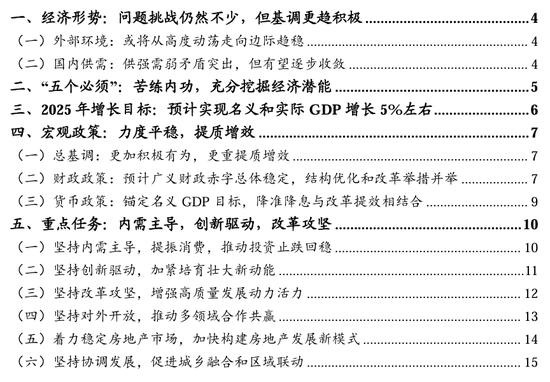
Economic Situation - The economic situation is characterized by persistent challenges, but the overall tone is becoming more positive. The external environment is expected to stabilize marginally, while domestic supply-demand imbalances are highlighted as a significant issue [2][10]. - The meeting emphasizes the need to address "development and transformation" issues, indicating that many challenges can be resolved through concerted efforts [10]. Five Musts - The meeting outlines "Five Musts" to enhance economic potential, focusing on internal capacity building to respond to external challenges and the importance of policy support alongside reform innovation [2][18]. - Key strategies include ensuring effective market regulation while promoting investment in both physical and human capital [19]. 2025 Growth Target - The growth target for 2026 is set at approximately 5% for both nominal and real GDP, reflecting a pragmatic approach to align with long-term goals and current economic conditions [3][21]. - The transition of growth drivers is expected, with the "three new economies" projected to surpass the real estate sector historically [21]. Macroeconomic Policy - The macroeconomic policy framework is shifting from "promoting stability through growth" to "enhancing quality and efficiency," indicating a focus on structural optimization rather than mere expansion [4][26]. - Fiscal policy is expected to maintain a deficit rate around 4%, with a focus on improving the efficiency of spending rather than just increasing the scale [30][31]. - Monetary policy will remain moderately accommodative, with expectations for potential rate cuts and targeted support for key sectors [36][40]. Key Tasks - The emphasis on domestic demand is paramount, with strategies to boost consumption and stabilize investment growth projected at 2-3% for 2026 [5][46]. - Innovation-driven growth is prioritized, with plans to strengthen the integration of education, technology, and talent development [6][50]. - Reforms will focus on eliminating barriers to development, enhancing market dynamics, and improving the business environment [7][57]. Real Estate Market - The policy focus is shifting towards stabilizing the real estate market, moving from demand stimulation to a balanced supply-demand approach [8][63].
中央财办发声!明年将根据形势出台增量政策
Di Yi Cai Jing Zi Xun· 2025-12-13 06:17
Core Viewpoint - The Chinese economy is expected to perform better than anticipated, with a projected GDP of approximately 140 trillion yuan for 2025, and policies will be implemented in 2026 to further stimulate economic growth [1][3]. Economic Performance - Major economic indicators in China are showing better-than-expected results, with a projected annual growth rate of around 5%, making China the largest engine of global economic growth [2]. - The economy has demonstrated resilience and vitality, with stable employment, rapid growth in foreign trade, and significant advancements in modern industrial systems [2]. Economic Projections - The GDP is expected to reach around 140 trillion yuan this year, marking a significant milestone in the "14th Five-Year Plan" [3]. - International institutions, including the IMF and Goldman Sachs, have raised their economic growth forecasts for China for the next two years [3]. Policy Implementation - In 2024, new incremental policies will be introduced based on changing circumstances, aiming to synergize existing and new policies to promote stable economic growth [4]. Risk Mitigation - Positive progress has been made in mitigating risks in key areas, including the orderly replacement of local government hidden debts and the completion of housing delivery tasks [5]. Economic Work Guidelines - The central economic work meeting outlined five essential principles for economic work under new circumstances, emphasizing the need to explore economic potential, combine policy support with reform, and ensure effective management [6][7][8]. Income and Economic Growth - In 2026, efforts will focus on synchronizing income growth with economic growth, maintaining stability in employment and prices, and implementing proactive fiscal policies [9]. Trade and Openness - China aims to expand both exports and imports, promoting sustainable foreign trade and enhancing service sector openness [10]. Innovation and Technology - The focus will be on innovation-driven growth, with plans to expand international science and technology innovation centers to foster original innovation [11]. Consumer Market Development - Policies will be optimized to stimulate consumption, including enhancing the supply of quality goods and services and improving the inbound consumption environment [12]. Corporate Debt Management - Measures will be taken to address corporate debt issues and ensure a healthy market order through regulatory actions [13]. Education and Employment - There will be an increase in high school enrollment and quality university admissions to adapt to demographic changes and improve employment quality [14]. Green Energy Initiatives - The construction of a new energy system will be accelerated, with a focus on expanding green electricity applications and promoting carbon emission control [15][16].