PPI

Search documents
国家统计局:9月供需结构改善带动部分行业价格明显企稳 输入性因素影响国内石油相关行业价格环比下降
Di Yi Cai Jing· 2025-10-15 01:44
Core Insights - The Producer Price Index (PPI) remained stable month-on-month for two consecutive months, indicating a stabilization in prices across various industries driven by improved supply-demand dynamics [1][2] - Year-on-year, the PPI decreased by 2.3%, but the decline was less severe than the previous month, reflecting the positive impact of macroeconomic policies and structural adjustments in certain industries [2] Group 1: Month-on-Month PPI Analysis - The PPI showed notable month-on-month price increases in coal processing (up 3.8%), coal mining and washing (up 2.5%), and black metal smelting and rolling (up 0.2%), all of which have risen for two consecutive months [1] - Prices for photovoltaic equipment and components shifted from a decrease of 0.2% last month to an increase of 0.8% this month, indicating a recovery in this sector [1] - Conversely, prices in the petroleum-related industries declined due to falling international oil prices, with oil extraction prices down 2.7% and refined petroleum product manufacturing prices down 1.5% [1] Group 2: Year-on-Year PPI Trends - The year-on-year decline in PPI was influenced by a lower comparison base from the previous year, with several industries showing reduced price declines, including coal processing and black metal smelting [2] - The construction of a unified national market has led to improved price stability in various sectors, with significant reductions in price declines for coal processing (down 8.3%), black metal smelting (down 3.4%), and coal mining (down 3.0%) [2] - Upgrades in industrial structure and the release of consumer potential have resulted in price increases in specific sectors, such as aircraft manufacturing (up 1.4%) and electronic materials (up 1.2%) [2]
国家统计局:2025年9月份核心CPI同比涨幅持续扩大 PPI同比降幅继续收窄
Yang Shi Wang· 2025-10-15 01:43
9月份,消费市场运行总体平稳,居民消费价格指数(CPI)环比上涨0.1%,同比下降0.3%,扣除 食品和能源价格的核心CPI同比上涨1.0%,涨幅连续第5个月扩大。全国统一大市场建设纵深推进,市 场竞争秩序持续优化,工业生产者出厂价格指数(PPI)环比继续持平;同比下降2.3%,降幅比上月收 窄0.6个百分点。 央视网消息:国家统计局城市司首席统计师董莉娟解读2025年9月份CPI和PPI数据。 CPI同比下降0.3%,降幅比上月收窄0.1个百分点。CPI同比下降,主要是翘尾影响所致。本月CPI-0.3% 的同比变动中,翘尾影响约为-0.8个百分点,今年价格变动的新影响约为0.5个百分点。分类别看,食品 和能源价格下降。其中,食品价格下降4.4%,降幅比上月扩大0.1个百分点,影响CPI同比下降约0.83个 百分点,是影响CPI同比下降的主要因素。食品中,猪肉、鲜菜、鸡蛋和鲜果价格分别下降17.0%、 13.7%、13.5%和4.2%,合计影响CPI同比下降约0.78个百分点;牛肉和羊肉价格分别上涨4.6%和0.8%, 其中羊肉价格为连续下降44个月后首次转涨。能源价格下降2.7%,影响CPI同比下降约0.2 ...
国家统计局解读2025年9月份CPI和PPI数据
Guo Jia Tong Ji Ju· 2025-10-15 01:42
Group 1: CPI Analysis - The Consumer Price Index (CPI) increased by 0.1% month-on-month in September, reversing from a flat performance in the previous month [2] - Year-on-year, the CPI decreased by 0.3%, with the decline narrowing by 0.1 percentage points compared to the previous month [3] - Core CPI, excluding food and energy, rose by 1.0% year-on-year, marking the fifth consecutive month of growth [3] Group 2: Food and Energy Prices - Food prices increased by 0.7% month-on-month, contributing approximately 0.13 percentage points to the CPI increase, with seasonal price rises observed in fresh vegetables, eggs, fresh fruits, lamb, and beef [2] - Year-on-year, food prices fell by 4.4%, primarily driven by significant declines in pork, fresh vegetables, eggs, and fresh fruits [3] - Energy prices decreased by 2.7% year-on-year, impacting the CPI by approximately 0.20 percentage points [3] Group 3: PPI Analysis - The Producer Price Index (PPI) remained flat month-on-month for two consecutive months, with a year-on-year decline of 2.3%, narrowing by 0.6 percentage points from the previous month [4][6] - Improvements in supply-demand structures have stabilized prices in certain industries, such as coal processing and black metal smelting, which saw price increases [4] - The decline in PPI is influenced by external factors, including falling international oil prices, which affected domestic oil-related industry prices [5] Group 4: Industry-Specific Insights - The construction of a unified national market has led to a reduction in the year-on-year price decline across various industries, with notable improvements in coal processing, black metal smelting, and photovoltaic equipment manufacturing [6] - Upgrading industrial structures and releasing consumer potential have contributed to price increases in specific sectors, such as aircraft manufacturing and electronic materials [6] - The demand for quality and upgraded consumption has led to significant price increases in artisanal and ceremonial goods, as well as sports equipment [6]
中国9月CPI同比 -0.3%,前值 -0.4%
Hua Er Jie Jian Wen· 2025-10-15 01:32
中国9月PPI同比 -2.3%,前值 -2.9%。 风险提示及免责条款 市场有风险,投资需谨慎。本文不构成个人投资建议,也未考虑到个别用户特殊的投资目标、财务状况或需要。用户应考虑本文中的任何 意见、观点或结论是否符合其特定状况。据此投资,责任自负。 ...
9月物价前瞻:翘尾因素拖累减弱,PPI同比降幅有望收窄
Xin Lang Cai Jing· 2025-10-14 11:09
Group 1 - The core viewpoint is that the decline in pork prices continues, but the core CPI is expected to maintain its growth, leading to a potential narrowing of the year-on-year decline in CPI for September [2][3] - Predictions for September's CPI year-on-year growth from various institutions range from -0.3% to -0.1%, indicating a consensus that the decline may be less severe than in August, which saw a 0.4% drop [2] - The wholesale price of pork is expected to continue weakening, with a year-on-year decline widening from 25.0% to 26.3% due to oversupply in the market [2] Group 2 - The decline in the Producer Price Index (PPI) is anticipated to narrow in September, influenced by a reduction in the drag from base effects [3] - Predictions for September's PPI year-on-year growth from various institutions range from -2.5% to -2.3%, reflecting expectations of a slight recovery [3] - The base effect from the previous year is expected to contribute to a narrowing of the PPI decline, with the drag from the base effect decreasing to -0.1% in September [3] Group 3 - The Purchasing Managers' Index (PMI) for September indicates a slight decline in the main raw material purchasing price index and the factory price index compared to August, suggesting a potential further weakening of PPI [4] - Brent crude oil prices have shown a slight recovery, with a year-on-year decline narrowing from 14.7% to 7.3% in September, influenced by OPEC+ production adjustments and geopolitical uncertainties [4] - Domestic commodity prices are experiencing mixed performance, with coal prices rebounding due to local production checks, while rebar prices are declining due to weak demand and inventory pressures [4]
薛鹤翔:中美欧PPI为什么脱钩?
Sou Hu Cai Jing· 2025-10-14 06:31
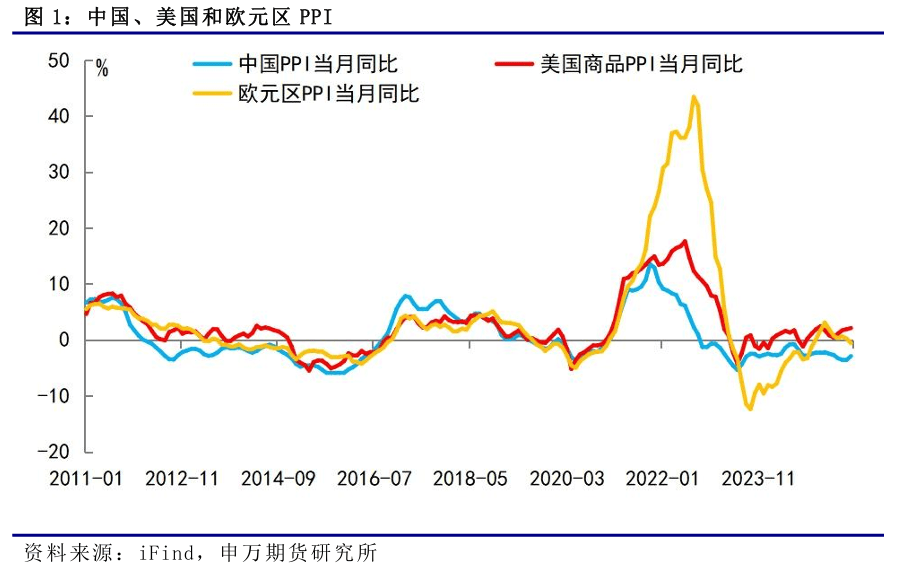
Core Insights - The PPI trends in China, the US, and Europe have diverged significantly post-pandemic, with China experiencing low PPI, the US maintaining relatively high PPI, and Europe showing considerable volatility. This divergence is primarily attributed to differences in energy structures and demand dynamics across these regions [1][4]. Energy Structure Impact - China's PPI is highly sensitive to coal prices, which are currently low due to weak demand and expanded supply. The domestic coal production has exceeded historical levels, and the demand from traditional sectors like real estate has decreased, leading to a prolonged low PPI [8][18]. - The US has a strong energy independence, primarily relying on oil and natural gas. The PPI is less affected by energy price fluctuations compared to Europe, with stable natural gas prices and a significant impact from rising oil prices due to global supply and demand dynamics [11][13]. - Europe's PPI has been significantly influenced by volatile natural gas prices, especially following the Russia-Ukraine conflict, which led to a sharp increase in energy costs. The subsequent measures to reduce dependency on Russian gas have also contributed to PPI fluctuations [14][22]. Demand Dynamics - In China, the transition from traditional to new economic drivers is underway, with the real estate sector in a downturn. This has led to reduced demand for related products, suppressing PPI. However, new economic drivers are beginning to support a gradual recovery in PPI [2][16]. - The US has shown strong demand resilience due to substantial fiscal stimulus during the pandemic, which increased disposable income and consumer spending. Despite rising labor costs and interest rates, the PPI has only seen moderate declines [19][20]. - Europe is experiencing a mild recovery in demand post-pandemic, but high energy costs and external demand declines have previously suppressed PPI. Recent economic recovery efforts and fiscal policies are expected to support a gradual increase in PPI [15][22].

渤海证券研究所晨会纪要(2025.10.13)-20251013
BOHAI SECURITIES· 2025-10-13 01:35
Macro and Strategy Research - The U.S. government is in a shutdown due to a lack of agreement on a temporary funding bill, leading to a focus on private sector data as official reports are absent. The ADP employment numbers for September showed a larger-than-expected decline, indicating a continued weakening trend in employment. Manufacturing PMI has unexpectedly rebounded but remains in contraction territory, with new orders reflecting weak demand in the manufacturing sector. Non-manufacturing PMI is also not optimistic, with price components slightly rising due to tariff cost transmission [2][3] - In Europe and Japan, political instability is evident with the resignation of the French Prime Minister and the election of a right-leaning leader in Japan, creating uncertainty in the political landscape. The European Central Bank has no immediate plans for rate cuts, while the Bank of Japan's rate hike process may slow down due to policy direction [3] - Domestic consumption has been boosted by the Mid-Autumn Festival and National Day, with service consumption growing faster than goods consumption. However, the real estate market shows signs of weakness, particularly in first-tier cities, and the central bank is expected to adopt a more flexible and anticipatory policy approach in the fourth quarter [2][3] Fixed Income Research - In Q3 2025, the central bank maintained support for the market with significant net injections through reverse repos and MLF, keeping funding prices low. The issuance of government bonds decreased, but net financing remained high due to reduced maturity volumes. The bond market showed a bear steepening trend, with investor confidence in buying bonds remaining low [5][6] - Looking ahead to Q4, the bond market is expected to remain under pressure, but the situation is anticipated to improve compared to Q3. The key indicators to watch include PPI, which will influence bond pricing. The central bank's continued support and potential resumption of bond purchases are expected to stabilize interest rates [6][7] Industry Research Metal Industry - The steel industry is expected to see a gradual recovery in demand post-holiday, but supply may also increase, making significant improvements in the fundamentals unlikely. The upcoming Fourth Plenary Session of the 20th Central Committee is a key event to monitor for industry developments [8] - For copper, global supply remains tight, providing support for prices, but general demand and high prices may pressure future price increases. Aluminum prices are expected to face limitations due to high costs affecting purchasing sentiment [8][9] - Gold prices are influenced by the U.S. entering a rate cut cycle and political risks from the government shutdown. If the shutdown is resolved and economic data remains strong, gold may face short-term corrections [9][10] - Lithium supply concerns have eased with approvals for resource reports, but short-term oversupply pressures may affect prices. Rare earth prices are expected to remain volatile, influenced by domestic export policies and overseas demand [9][10] Pharmaceutical and Biotechnology Industry - The recent World Lung Cancer Conference highlighted the R&D capabilities of Chinese pharmaceutical companies. The National Medical Products Administration has initiated the 11th round of centralized drug procurement [12][13] - The medical care CPI for August showed a 0.9% year-on-year increase, while the pharmaceutical manufacturing PPI decreased by 2.9%. Cumulative revenue and profit in the pharmaceutical manufacturing sector have declined by 2.0% and 3.9%, respectively, in the first eight months of 2025 [13] - The pharmaceutical sector experienced a pullback in September, with a focus on the upcoming ESMO conference and third-quarter earnings reports. There is potential for improvement in fundamentals, particularly in innovative drugs and medical devices [14][15]
机械设备行业跟踪:工程机械行业韧性足,内外销整体边际改善
Mai Gao Zheng Quan· 2025-10-10 14:13
Investment Rating - The industry rating is "Outperform" compared to the market [1][118] Core Viewpoints - The engineering machinery industry shows strong resilience with improvements in both domestic and international sales [1] - The macroeconomic environment indicates a slight recovery in manufacturing, with the PMI index at 49.4% in August 2025, still in the contraction zone, but production PMI at 50.8% indicates expansion [2][6] - Fixed asset investment in China reached 326,111 billion yuan from January to August 2025, with infrastructure investment growing by 5.4% and manufacturing investment by 5.1% [14] Summary by Sections 1. Macroeconomic Tracking - The manufacturing PMI for August 2025 is 49.4%, a 0.1 percentage point increase from the previous month, indicating marginal improvement but still in contraction [2][6] - The PPI decreased by 2.9% year-on-year in August 2025, ending an eight-month decline, while the CPI fell by 0.4% [11] - Fixed asset investment from January to August 2025 totaled 326,111 billion yuan, a 0.5% year-on-year increase, with infrastructure investment up 5.4% and real estate investment down 13.2% [14] 2. China Engineering Machinery Sales Overview - From January to August 2025, excavator sales reached 154,181 units, a 17.2% increase year-on-year, with domestic sales up 21.5% [19][26] - Sales of various machinery types showed mixed results, with tower cranes down 34.5% and high-altitude work vehicles up 40.5% [27][41][100] - Overall, the sales of construction machinery reflect a structural divergence, with some categories like excavators and loaders performing well while others like tower cranes are struggling [51][56]
开源晨会-20251008
KAIYUAN SECURITIES· 2025-10-08 14:42
Group 1: Macro Economic Insights - The U.S. government is facing a shutdown due to budget disagreements, which has led to a rise in gold prices, while domestic consumption remains stronger in volume than in price [4][6] - Japan may see its first female Prime Minister, which could positively impact the Japanese stock market [4] - The global economy shows signs of weakness, with the U.S. ADP employment figures declining and manufacturing PMIs in the Eurozone and Japan decreasing [6] Group 2: Industry Performance - The top-performing sectors recently include non-ferrous metals, defense, real estate, electric power equipment, and pharmaceuticals, with respective gains of 3.224%, 2.590%, 2.123%, 1.714%, and 1.405% [3][4] - The manufacturing sector is experiencing a recovery, with the PMI for September at 49.8%, indicating a slight improvement [19][20] - The non-manufacturing PMI remains stable at 50.0%, reflecting a balanced economic environment [22] Group 3: Investment Strategies - The report emphasizes a focus on technology sectors, particularly AI and semiconductor industries, as key investment themes [12][14] - There is a recommendation to explore opportunities in gaming, media, and the Huawei supply chain as potential growth areas [12][15] - The report suggests a diversified asset allocation strategy, favoring short-term bonds, undervalued convertible bonds, and gold assets [38][39] Group 4: Company-Specific Insights - Hengxin Life is highlighted as a leading company in biodegradable food packaging, with significant production capacity and strong ties to major global brands [56] - Hanhigh Group is recognized for its strong market presence in the home hardware industry, leveraging a multi-channel approach for market penetration [57] - Jiyuan Group is noted for its comprehensive capabilities in the dietary supplement industry, being a major supplier for several well-known brands [58] Group 5: Health Insurance Sector - The health insurance sector is expected to see significant growth driven by new regulatory guidelines aimed at enhancing product offerings and market accessibility [60][61] - Major insurance companies are increasingly integrating health management services into their offerings, which is anticipated to improve profitability and market share [62] - The report recommends key players in the health insurance space, including China Ping An and China Taiping, as beneficiaries of these trends [62]