人才红利

Search documents
特朗普紧急发文称输不起,他想不通,中国何以威胁美国
Sou Hu Cai Jing· 2025-11-06 18:43
Core Viewpoint - The article highlights the escalating tensions between the United States and China, particularly focusing on Trump's urgent communications regarding the potential consequences of the ongoing tariff war, suggesting that a loss could lead to the U.S. becoming a "third-rate country" [1][4][5]. Group 1: Tariff War Dynamics - The tariff conflict began in April when the U.S. imposed a 34% tariff on all goods from China, prompting a swift and strong retaliatory response from China [7]. - Trump's expectation of negotiations was thwarted by China's immediate and firm countermeasures, which matched the tariff amounts imposed by the U.S. [7]. - China's response included a temporary suspension of a 24% tariff on U.S. goods for 90 days while maintaining a 10% tariff, showcasing a strategic and flexible diplomatic approach [7]. Group 2: China's Institutional Advantages - China's ability to withstand U.S. pressure is attributed to its unique institutional advantages, including a long-term planning system that ensures strategic continuity [9]. - The country has established comprehensive mid- to long-term technology development plans, which are crucial for addressing weaknesses and enhancing strengths in key sectors [9]. Group 3: Global Cooperation and Economic Resilience - Amid U.S. unilateralism, China is actively promoting international cooperation, exemplified by a significant tripartite summit with ASEAN and the Gulf Cooperation Council [10][12]. - China's manufacturing sector demonstrates remarkable resilience, accounting for 31.6% of global manufacturing output, with significant advancements in robotics and renewable energy [13]. - The country is transitioning from a manufacturing powerhouse to a manufacturing stronghold, driven by sustained technological innovation and industrial upgrades [13]. Group 4: Talent and Cultural Resilience - China's innovation capacity is bolstered by a vast talent pool, with 22 million individuals in the workforce and over 5 million STEM graduates annually, leading the world in research and development personnel [15]. - The enduring nature of Chinese civilization contributes to a collective resilience against external pressures, as evidenced by the unified response to challenges such as supply chain disruptions [17].


义务教育年限要延长了!学前还是高中?影响几何?
2 1 Shi Ji Jing Ji Bao Dao· 2025-11-03 13:26
Core Viewpoint - The article discusses a significant educational reform in China, proposing to extend the compulsory education period, which has sparked discussions among experts and the public [1][2]. Group 1: Reasons for Reform - The global trend is moving towards longer compulsory education, with 55.6% of countries having more than 9 years of compulsory education as of 2018 [1]. - Finland has increased its compulsory education age from 16 to 18, covering the entire high school stage, aiming to support vulnerable groups who need help [1]. Group 2: Current Status in China - China's enrollment rates for preschool education and high school have reached 92%, indicating a solid foundation for extending compulsory education [2]. - Local governments have previously experimented with extending compulsory education, such as Zhuhai City in Guangdong Province, which waived high school fees for local students since 2007 [2]. Group 3: Financial Considerations - The central government has initiated a policy to waive fees for all kindergarten students starting this year, benefiting 12 million children [2]. - The financial burden for economically disadvantaged regions will be supported by the central government, covering 80% of costs, ensuring sustainable implementation of the policy [2]. Group 4: Expert Opinions on Extension - Experts have differing views on whether to extend compulsory education to preschool or high school, with some advocating for a focus on the final year of preschool education [3]. - The reform aims not only to extend the duration of education but also to improve the quality of education, shifting from merely having access to quality education [3]. Group 5: Strategic Implications - The educational reform is seen as a systemic project to transition from an education powerhouse to an education stronghold, ensuring every child receives suitable quality education [3]. - This initiative reflects the enhancement of national economic strength and the improvement of public welfare, aligning with China's future strategic planning [3].
广东连续7年位列第一生育大省
2 1 Shi Ji Jing Ji Bao Dao· 2025-10-28 06:25
Core Insights - Guangdong has maintained its position as the top province for birth rates in China for seven consecutive years, with a birth population of 1.13 million in 2024, an increase of 100,000 from the previous year [1][6] - The province's population growth is driven by both natural increase and migration, with a total population increase of 740,000 in 2024, comprising 470,000 from natural growth and 270,000 from migration [3][6] - Guangdong's strong population growth is attributed to its robust industrial foundation, favorable talent policies, and regional cultural factors that encourage higher birth rates [3][4] Population Dynamics - In 2024, Guangdong's permanent population reached 128 million, contributing 11.8% of the national birth population while accounting for 8.9% of the total national population [6][7] - The province's labor force is predominantly young, with 66.38% of the population aged 16-59, which is higher than the national average [7] - Cultural factors, such as strong family values in regions like Chaoshan, contribute to higher birth rates, with these areas consistently outperforming the provincial average [7][8] Economic Implications - The continuous population growth in Guangdong is expected to positively impact industrial development and consumer markets, creating a virtuous cycle that stimulates economic growth [4][14] - The province's diverse industrial system and emerging industries, such as artificial intelligence and new energy vehicles, create significant demand for high-quality labor, attracting more migrants [9][13] - In the first half of the year, Guangdong's retail sales reached 22,932.66 billion yuan, reflecting a 3.5% year-on-year growth, supported by a strong consumer base driven by population dynamics [14] Talent and Industry Development - Guangdong's large and youthful labor force is crucial for industrial upgrades, providing a substantial reserve of skilled workers and engineers [13] - The province has implemented various talent attraction policies, such as the "Million Talents Gather in South Guangdong" initiative, successfully attracting over 1 million college graduates to work and start businesses in the region [9][15] - The focus on aligning talent development with industrial needs is essential for maintaining competitive advantages in advanced manufacturing and high-tech industries [15]

广东连续7年位列第一生育大省
21世纪经济报道· 2025-10-28 06:19
Core Viewpoint - The article highlights Guangdong's population growth as a result of both natural increase and migration, showcasing its unique advantages in maintaining a high birth rate and attracting talent amidst a national trend of declining birth rates and aging population [1][3][4]. Population Growth Dynamics - In 2024, Guangdong's birth population increased by 100,000 to 1.13 million, marking the seventh consecutive year as the top province for births [1][7]. - The province's total population reached 128 million, with a natural increase of 470,000 and a mechanical increase of 270,000 from migration, demonstrating a "dual-driven" growth model [3][7]. - Guangdong's labor force is predominantly young, with 66.38% of the population aged 16-59, which is higher than the national average [7][8]. Cultural and Economic Factors - The strong birth culture in Guangdong, particularly in regions like Chaoshan, contributes to higher birth rates, supported by a robust economic foundation and favorable social environment [8][9]. - The province's diverse culture and strong family values promote a stable reproductive culture, which is essential for maintaining population growth [8][9]. Talent Attraction and Policy Support - Guangdong has implemented various talent attraction policies, such as the "Million Talents Gather in South Guangdong" initiative, which has successfully attracted over 1 million college graduates to the province [9][12]. - The province's industrial base, covering all major categories and featuring nine trillion-yuan industrial clusters, creates a strong demand for high-quality labor, further enhancing its attractiveness to migrants [9][12]. Economic Impact of Population Growth - The interaction between population growth and economic development in Guangdong fosters a positive feedback loop, driving economic vitality and consumer market expansion [4][14]. - In the first half of the year, Guangdong's retail sales reached 2.293 trillion yuan, reflecting a 3.5% year-on-year increase, supported by a growing population [14]. Challenges and Future Directions - Despite the impressive population growth, Guangdong faces challenges in converting its population advantage into quality advantages, such as improving the proportion of high-quality talent and ensuring balanced population distribution [14][15]. - The province aims to strengthen its industrial planning and enhance regional collaboration to optimize resource distribution and stimulate coordinated development across different areas [15][16].

连续七年成第一生育大省,广东人口“双料冠军”的经济密码
2 1 Shi Ji Jing Ji Bao Dao· 2025-10-28 01:28
Core Insights - Guangdong has maintained its position as the top province for birth rates in China for seven consecutive years, with a birth population of 1.13 million in 2024, an increase of 100,000 from the previous year [2][5] - The province's population growth is driven by both natural increase and migration, with a total population increase of 740,000 in 2024, comprising 470,000 from natural growth and 270,000 from net migration [5][6] - The demographic structure in Guangdong is favorable, with a high proportion of working-age population (66.38%) and a relatively low elderly population (10.18%), contributing to its robust birth rates [6][10] Population Growth Dynamics - Guangdong's population growth is characterized by a "dual-driven" model of natural and mechanical growth, contrasting with other provinces like Zhejiang, which relies primarily on migration [3][5] - The province's strong economic foundation, large base of reproductive-age population, and favorable cultural attitudes towards childbirth contribute to its high birth rates [3][6] - The influx of young migrants into Guangdong, particularly in the Pearl River Delta region, is a significant factor in its population growth, supported by the province's economic and social development [3][7] Economic and Industrial Implications - The continuous population growth in Guangdong is expected to positively impact industrial development and consumer markets, creating a virtuous cycle that stimulates economic growth [3][9] - Guangdong's advanced manufacturing and high-tech industries account for significant portions of its industrial output, with advanced manufacturing value-added accounting for 57.1% of industrial value [10] - The province's labor market is bolstered by a large pool of skilled workers, with over 20 million skilled workers and millions of high-skilled talents, facilitating industrial upgrades and innovation [10][12] Talent Attraction and Retention Strategies - Guangdong has implemented various talent attraction policies, such as the "Million Talents Gathering in South Guangdong" initiative, which has successfully attracted over 1 million college graduates to the province [12] - The province aims to transform its population advantage into a talent advantage by enhancing the quality of its workforce and aligning talent development with industrial needs [11][12] - The government is focusing on improving living conditions and job opportunities to retain talent, emphasizing the importance of a supportive environment for both local and migrant populations [8][11]

二十届四中全会公告解读:科技自强、文化自信
Lian He Zi Xin· 2025-10-24 12:17
Economic Strategy - The 20th Central Committee emphasizes the importance of economic growth, reaffirming that "economic construction is the central task" and focusing on quality improvement and reasonable growth rates during the 14th Five-Year Plan period[6] - The entity economy is prioritized, with a focus on building a modern industrial system centered on advanced manufacturing, aiming for intelligent, green, and integrated development[8] - The "high-level self-reliance in technology" is now deemed essential for survival, with a shift in focus towards domestic market opportunities in response to external pressures, particularly in the semiconductor industry[9] Macro Control and Development - The macro control system will be enhanced, focusing on a demand-driven growth model, improving residents' income, and stimulating consumption to leverage the advantages of a large market[11] - The report highlights the need for a comprehensive security system that integrates political, economic, technological, and ideological security, reflecting the complex international environment[15] - The commitment to green development is reinforced, with China positioned as a leader in renewable energy technologies, creating significant employment and export opportunities[14] Cultural and Social Development - The integration of information technology in cultural innovation is emphasized, aiming to enhance China's cultural influence globally through digital platforms and new cultural industries[12] - Investment in human capital is prioritized, focusing on improving public services across the lifespan and enhancing the quality of the workforce to meet the demands of industrial upgrades[13]
北京发布“青创十条” 全力打造青年创新创业沃土
Bei Jing Shang Bao· 2025-10-17 10:20
Core Insights - The article discusses Beijing's transition from a "demographic dividend" to a "talent dividend" era, emphasizing the importance of youth talent in driving innovation and high-quality development [1] - A comprehensive policy package titled "Ten Measures to Further Support Youth Talent Innovation and Entrepreneurship" has been introduced to enhance Beijing's attractiveness as a global innovation and entrepreneurship hub [1] Policy Measures - The "Ten Measures" focus on the entire talent lifecycle, including attracting, nurturing, utilizing, and retaining youth talent, with specific initiatives in housing, entrepreneurial space, and government services [1][3] - The policy aims to address 14 identified issues faced by youth talent, including high living costs and insufficient growth ecosystems, based on over 3,000 surveys conducted earlier this year [3] Housing Initiatives - To tackle the issue of high housing costs, the policy plans to provide approximately 30,000 youth talent apartments with targeted rent reductions [3] - The "Yujian Xishan" project in Haidian District has already offered 922 furnished apartments at 60% of market rent for recent graduates, with future plans allowing for the withdrawal of housing provident fund for actual rent paid [3] Office Space Solutions - The initiative aims to provide 3 million square meters of free or low-cost office space to alleviate high operational costs faced by over 50% of youth talent [3] - Changping District has identified 26 incubation platforms, releasing 2,500 free workstations in key innovation areas, including artificial intelligence [3] Financial Support - A youth talent development fund of approximately 30 billion yuan will be established, along with products like "Talent Investment" and "Talent Loans" to support young entrepreneurs [3] Talent Development - At least 70% of the city-level talent plan will be allocated to youth talent, with outstanding individuals recommended for senior professional title assessments [4] - The integrated circuit industry education and training base has been established, covering 105,500 square meters and accommodating 2,000 graduate students and 350 teachers [4] Government Services - The city will deploy 3,000 dedicated service managers to provide personalized support, addressing issues related to policy accessibility [4] - The upgraded "Easy Beijing" app will connect with offline international talent service platforms to resolve common pain points [4] Community and Environment - Beijing plans to create around 20 innovation and entrepreneurship districts and 30 youth talent lounges, along with special cultural and recreational activities [4] - Chaoyang District has already provided exclusive benefits such as amusement park tickets and shopping mall memberships for youth talent [4]


以技能培训赋能人才成长
Ren Min Ri Bao· 2025-10-12 22:10
Core Insights - The articles emphasize the importance of vocational skills training in enhancing employment opportunities and income for workers, thereby addressing structural employment challenges and fostering high-quality economic development [1][2][3] Group 1: Importance of Vocational Skills Training - Vocational skills training is crucial for workers to secure jobs, increase income, and change their life trajectories [1] - The government aims to provide subsidized training for over 30 million people from 2025 to 2027, focusing on high-demand industries and key employment groups [2] - Training programs are designed to align with the needs of emerging industries, ensuring that workers possess the necessary skills for new job opportunities [2] Group 2: Role of Enterprises in Training - Companies are encouraged to take the lead in vocational training, as they are best positioned to identify their talent gaps and needs [3] - Successful training initiatives by enterprises and training institutions can significantly enhance workers' skills and employment prospects [3] - The transition from a "demographic dividend" to a "talent dividend" highlights the need for improved labor quality through vocational education and training [3]
中国经济转型升级蕴含重大机遇(习近平经济思想指引下的中国经济专论)
Ren Min Ri Bao· 2025-10-02 22:13
Core Insights - China's economy continues to maintain stable and healthy development, providing certainty and positive energy for global economic growth. Despite some perceptions that investment opportunities are diminishing, China's economic transformation and upgrading present unprecedented opportunities for countries worldwide [1] Group 1: Industry Transformation and Upgrading - China's manufacturing sector remains the largest globally for 15 consecutive years, with 80% of it comprising traditional industries such as metallurgy, chemicals, machinery, light industry, and textiles. The acceleration of high-end, intelligent, and green development will release investment opportunities in these areas [1] - New industries such as artificial intelligence, robotics, and biomedicine are rapidly emerging, with China leading in several AI models and maintaining the largest industrial robot market for 12 years. The country is fostering the development of future industries and is open to sharing investment opportunities with global partners [1] Group 2: Technological Innovation and Talent Dividend - China is quickly rising in the global technology innovation landscape, with R&D expenditure exceeding 3.6 trillion yuan in 2024, approaching the OECD average. The country leads in high-level international journal publications and invention patents [2] - The integration of technological and industrial innovation is accelerating, with increasing patent conversion rates and the transformation of cutting-edge technological achievements into new productive forces. China produces over 5 million STEM graduates annually, enhancing the talent dividend, particularly in engineering [2] Group 3: Consumption Expansion and Upgrade - China's per capita GDP exceeds $13,000, with a steadily expanding market size. The retail sales of consumer goods are expected to surpass 50 trillion yuan by 2025, solidifying China's position as the world's second-largest consumer market [3] - Online retail sales have ranked first globally for 12 consecutive years, with significant sales in automobiles and air conditioners. Service consumption is becoming a new growth engine, with the proportion of per capita service consumption expected to reach 46.1% in 2024 [3] Group 4: Infrastructure Development - China's vast territory necessitates significant infrastructure development, particularly in the central and western regions where railway and road density is lower than in the eastern coastal areas. Traditional infrastructure construction and upgrades will yield long-term economic and social benefits [3] - Investment demand remains high for intercity railways and cross-river, cross-sea bridges, which improve transportation logistics and regional economic development. Rapid growth in new infrastructure areas such as computing networks, mobile communications, and smart cities will create vast market opportunities [3] Group 5: Urbanization and Social Welfare - China's urbanization is transitioning from rapid growth to stable development, focusing on improving quality and spatial layout, developing urban clusters, and modernizing cities. Urban renewal projects will create significant investment opportunities [4] - The demand for social welfare services, including childcare, education, elderly care, and healthcare, is increasing. By 2025, China aims to provide 4.5 childcare spots per 1,000 children under three, addressing gaps compared to developed countries [4]
各项民生事业取得长足发展
Jing Ji Ri Bao· 2025-09-28 01:17
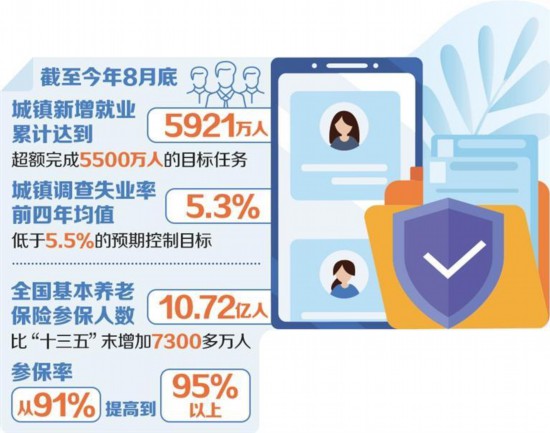
Employment and Social Security - The employment situation in China during the "14th Five-Year Plan" period is generally stable, with a cumulative urban new employment of 59.21 million by the end of August, exceeding the target of 55 million [1] - The urban survey unemployment rate averaged 5.3% over the past four years, lower than the expected control target of 5.5% [1] - A comprehensive policy framework has been established, including fiscal incentives, tax reductions, and financial support, to enhance employment [1] Social Insurance Reform - The number of participants in the basic pension insurance reached 1.072 billion, an increase of over 73 million compared to the end of the "13th Five-Year Plan," with the participation rate rising from 91% to over 95% [2] - The total scale of the three social insurance funds reached 69.27 trillion, with a cumulative balance of 9.81 trillion, indicating a stable support capacity for social security [2] - The investment operation scale of the basic pension insurance fund is 2.6 trillion, doubling since the end of the "13th Five-Year Plan," with an average annual investment return rate of 5.15% [2] Talent Development - The gradual implementation of a delayed retirement age policy is underway to transform demographic dividends into talent dividends [3] - Over the past five years, 92 million people have received subsidized vocational skills training, and 72 new occupations have been introduced [3] - The total number of skilled workers exceeds 220 million, with over 72 million high-skilled talents, providing strong support for technological independence and modern industrial system construction [3]