
促消费政策

Search documents
招商证券:促消费政策频发&休闲需求稳中向好 关注出行链布局机会
Zhi Tong Cai Jing· 2026-01-19 06:01
Group 1: Tourism Industry - The tourism market is expected to grow by over 10% in 2025, driven by the continuous release of leisure travel demand and the rise of experiential consumption [1] - Domestic tourism revenue and visitor numbers are projected to increase by 12% and 18% year-on-year in Q1-Q3 2025, respectively [1] - Recommended stocks in the tourism industry include China Duty Free Group, Jin Jiang Hotels, ShouLai Hotels, Tongcheng Travel, and Trip.com Group [1] Group 2: Restaurant Industry - Offline consumption is gradually recovering, with domestic restaurant revenue reaching 519.9 billion and 605.7 billion yuan in October and November 2025, showing year-on-year growth of 4.99% and 4.40% [2] - The recovery of leading restaurant companies is faster than the industry average, with a focus on stocks like Green Tea Group and Haidilao [2] Group 3: Tea Beverage Industry - Since Q4 2025, same-store sales for leading tea brands like Gu Ming and Hu Shang A Yi have continued to grow at a high rate of 15-20%, aided by delivery subsidies and brand expansion into coffee and breakfast categories [3] - Despite a slight decrease in delivery subsidies, leading brands are accelerating their expansion, highlighting the advantages of top brands [3] Group 4: Online Travel Agency (OTA) Industry - The recovery of travel demand is ongoing, with OTA performance improving due to increased domestic leisure travel demand, hotel supply growth, and rising online penetration [4] - The performance of OTAs is expected to remain stable with long-term growth potential, particularly with the high growth in outbound travel [4] - Recommended stocks in the OTA sector include Trip.com Group and Tongcheng Travel [4] Group 5: Hotel Industry - In Q4 2025, hotel room supply is expected to grow by 6-8% year-on-year, with RevPAR remaining stable compared to 2024, benefiting from increased holiday traffic and low base effects [5] - Leading hotel companies are expected to have significant earnings elasticity in a cyclical environment, with recommendations for Jin Jiang Hotels and ShouLai Hotels [5]


国家统计局局长康义:居民消费正从商品消费为主向商品和服务消费并重转变,服务消费潜力不断释放
Jin Rong Jie· 2026-01-19 04:07
Core Insights - The core viewpoint of the articles emphasizes the significant role of service consumption in China's economic performance in 2025, highlighting a shift towards a more balanced consumption structure between goods and services [1][2]. Group 1: Economic Performance - In 2025, China's total retail sales of consumer goods exceeded 50 trillion yuan, marking a 3.7% increase from the previous year, with a growth acceleration of 0.2 percentage points compared to 2024 [2]. - The contribution rate of final consumption expenditure to economic growth reached 52%, an increase of 5 percentage points from the previous year, establishing it as a primary driver of economic stability [2]. Group 2: Service Consumption - Service retail sales grew by 5.5% in 2025, outpacing goods retail sales by 1.7 percentage points, indicating a shift in consumer spending towards services [2][3]. - The proportion of service consumption expenditure in per capita household consumption reached 46.1%, reflecting the increasing importance of services in consumer spending [2]. Group 3: New Consumption Trends - Online retail sales increased by 8.6% in 2025, with physical goods online retail sales growing by 5.2%, accounting for 26.1% of total retail sales [3]. - New retail models, such as unmanned stores and warehouse membership stores, maintained double-digit growth, while green consumption, including electric vehicles, continued to expand [3]. Group 4: Goods Consumption - Retail sales of goods rose by 3.8% in 2025, with significant growth in essential goods like food and upgrades in sports and communication products [3]. - Policies promoting the replacement of old consumer goods with new ones have been implemented to encourage high-quality durable goods in daily life, with notable growth in categories like cultural and office supplies, furniture, and home appliances [3]. Group 5: Future Outlook - Despite challenges, the consumption market is expected to grow steadily in 2026, supported by a large middle-income population and ongoing consumption upgrade trends [4]. - Continued implementation of consumption-boosting policies and improvements in the consumption environment are anticipated to further stimulate consumer spending [4].
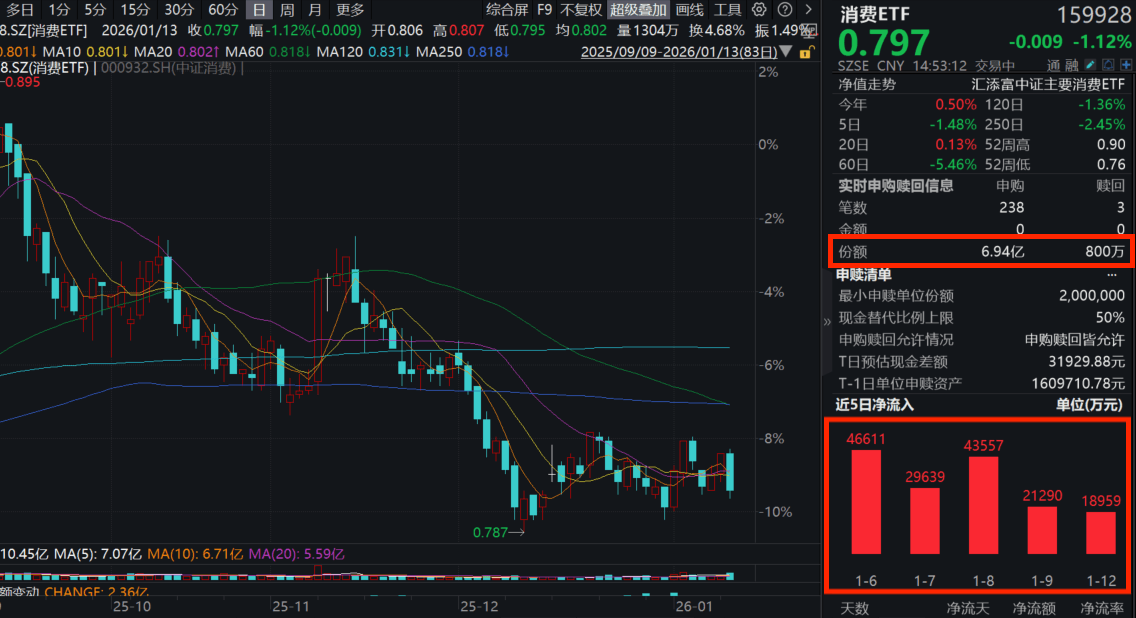
上海促消费新政重磅落地,积极布局内需消费!消费ETF(159928)回调超1%,大举揽金超6.8亿份!此前5日累计“吸金”超16亿元!
Sou Hu Cai Jing· 2026-01-13 07:04
Group 1 - The Shanghai Composite Index experienced fluctuations and a decline, with the consumer sector retreating, as the Consumption ETF (159928) corrected over 1% after two consecutive days of gains, with trading volume exceeding 1 billion yuan [1] - The Shanghai municipal government issued measures to enhance service quality and stimulate consumption, focusing on 28 policy initiatives aimed at optimizing supply and expanding consumption, particularly in key sectors like finance, transportation, and entertainment [3] - Moutai 1935 may implement a new pricing system, with both the payment price and retail price expected to decrease, indicating a potential gross margin of nearly 10% even after the price adjustment [4] Group 2 - The Hong Kong Stock Connect Consumption 50 ETF (159268) fell by 0.86%, with major stocks like Pop Mart and Li Ning experiencing declines of over 3% [6] - Domestic consumption is becoming a key driver of economic growth, with a shift in consumer behavior towards personalized and emotional spending, creating numerous niche opportunities [8] - The Consumer Price Index (CPI) rose by 0.8% year-on-year in December 2025, reflecting the effectiveness of consumption policies and increased consumer demand [9] Group 3 - The Consumption ETF (159928) has a strong resilience to economic cycles, with the top ten constituent stocks accounting for over 68.55% of its weight, including major liquor brands and agricultural companies [10] - The top holdings in the ETF include Yili, Moutai, and Wuliangye, with significant representation from the food and beverage sector [11] - The Hong Kong Stock Connect Consumption 50 ETF (159268) offers efficient access to the consumer sector, particularly targeting the Z generation's spending trends [12]

2025年12月CPI同比上涨0.8% 物价低位温和回升
Jin Rong Shi Bao· 2026-01-12 03:16
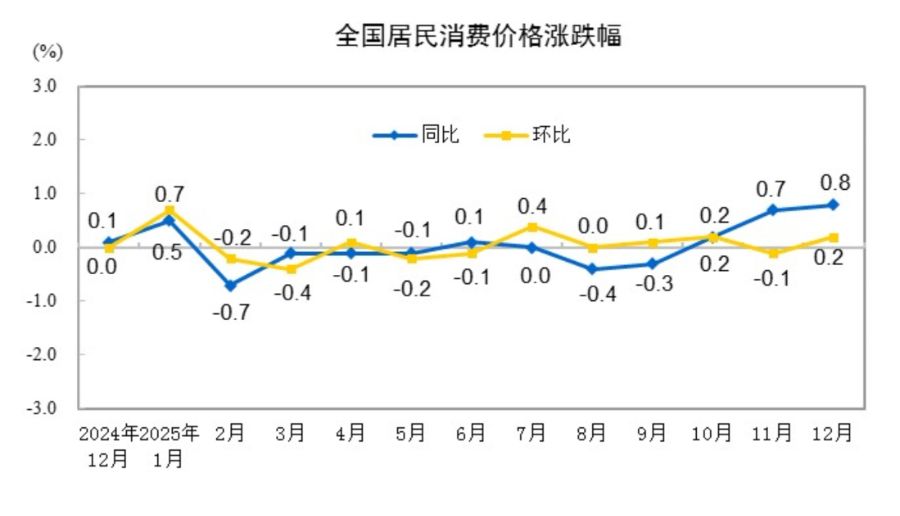
Group 1 - The Consumer Price Index (CPI) in December 2025 increased by 0.8% year-on-year, marking the highest level since March 2023, driven primarily by rising food prices [2][3] - The core CPI, excluding food and energy, rose by 1.2% year-on-year, remaining above 1% for four consecutive months, supported by consumer promotion policies and price improvements in appliances and automobiles [3][4] - The Producer Price Index (PPI) increased by 0.2% month-on-month, marking three consecutive months of growth, while the year-on-year decline narrowed to 1.9%, indicating reduced downward pressure on industrial prices [4][5] Group 2 - The increase in CPI was attributed to a combination of effective consumption policies and seasonal demand during the holiday period, leading to a rise in consumer spending [2][4] - The PPI's month-on-month increase was influenced by improved supply-demand dynamics and rising prices in certain industries, particularly in coal mining and processing [4][5] - Experts suggest that the changes in CPI and PPI reflect a stable and improving economic environment in China, with a gradual recovery in demand and ongoing optimization of supply structures [5]
CPI同比创2023年3月以来最高
2 1 Shi Ji Jing Ji Bao Dao· 2026-01-09 23:30
Group 1: Consumer Price Index (CPI) Insights - In December 2025, the Consumer Price Index (CPI) increased by 0.2% month-on-month and 0.8% year-on-year, with the year-on-year growth rate reaching its highest since March 2023 [1][3] - The rise in CPI was primarily driven by an increase in food prices, which rose by 1.1%, contributing approximately 0.17 percentage points to the year-on-year CPI increase [4] - The overall CPI for 2025 remained flat compared to the previous year, indicating a relative lack of effective consumer demand and a mismatch between supply and demand [2][6] Group 2: Producer Price Index (PPI) Insights - The Producer Price Index (PPI) saw a month-on-month increase of 0.2% in December 2025, marking the third consecutive month of growth, while the year-on-year decline narrowed to 1.9% [7] - Key industries such as coal mining and lithium-ion battery manufacturing experienced price increases, reflecting improvements in supply-demand structures and ongoing capacity management policies [7][8] - The PPI's year-on-year decline is expected to continue narrowing due to the implementation of macroeconomic policies and improvements in market competition [7][9] Group 3: Future Outlook - The gradual release of "stabilizing growth and promoting consumption" policies is anticipated to lead to a moderate increase in CPI in 2026, surpassing the flat growth of 2025 [2][6] - Positive factors for 2026 include the expected improvement in upstream mining and extraction sectors due to "anti-involution" policies and the construction of a unified national market [9] - The complex domestic and international economic environment may drive up prices for upstream raw materials, contributing to an increase in PPI in 2026 [9]
2025年物价低位温和回升
Xin Lang Cai Jing· 2026-01-09 22:52
Group 1: CPI Analysis - In December 2025, the Consumer Price Index (CPI) increased by 0.2% month-on-month and 0.8% year-on-year, with the core CPI (excluding food and energy) rising by 1.2% year-on-year, marking a stable recovery in demand [1][2] - The year 2025 saw the CPI remain flat compared to the previous year, while the PPI decreased by 2.6% year-on-year, indicating a low and moderate recovery in price levels [1][4] - The increase in CPI was primarily driven by rising prices of industrial consumer goods, with a notable increase in prices for communication tools, baby products, and entertainment durable goods, which rose between 1.4% and 3.0% [1][2] Group 2: PPI Analysis - The Producer Price Index (PPI) rose by 0.2% month-on-month in December 2025, marking three consecutive months of increase, influenced by improved supply-demand dynamics and ongoing capacity governance in key industries [2][3] - Year-on-year, the PPI decreased by 1.9%, but the decline was less severe than in previous months, reflecting positive changes in certain industries due to macroeconomic policies [3][5] - The PPI's year-on-year decline was initially exacerbated by insufficient external demand and structural adjustments, but improved market competition and policy effects led to a narrowing of the decline in the latter half of the year [5] Group 3: Economic Outlook - The changes in CPI and PPI in December 2025 indicate a stable and improving economic environment, with demand gradually recovering and supply-side structural optimization continuing [3][5] - The implementation of consumption-boosting policies and the deepening of the unified national market are expected to support a moderate and stable price environment moving forward [3][5] - Looking ahead to 2026, a more proactive macroeconomic policy is anticipated to foster economic growth and reasonable price recovery, with the potential for PPI to enter a recovery phase, although it may take time to turn positive [5]
渤海轮渡:随着国内经济持续恢复和促消费政策发力,客运需求有望稳步回暖
Zheng Quan Ri Bao Zhi Sheng· 2026-01-09 13:44
(编辑 袁冠琳) 证券日报网讯 1月9日,渤海轮渡在互动平台回答投资者提问时表示,随着国内经济持续恢复和促消费 政策发力,客运需求有望稳步回暖;同时在航线腹地"公转水"政策的推动下,货运业务也将稳步向好。 ...

12月PPI环比连续上涨,CPI同比创2023年3月以来最高
2 1 Shi Ji Jing Ji Bao Dao· 2026-01-09 09:48
Group 1: Consumer Price Index (CPI) Insights - In December 2025, the Consumer Price Index (CPI) increased by 0.2% month-on-month and 0.8% year-on-year, with the year-on-year growth rate reaching its highest level since March 2023 [1][3] - The increase in CPI was primarily driven by a rise in food prices, which increased by 1.1%, contributing approximately 0.17 percentage points to the year-on-year CPI increase [4][6] - The overall CPI for 2025 remained flat compared to the previous year, indicating a relative lack of effective consumer demand and a mismatch between supply and demand [2][7] Group 2: Producer Price Index (PPI) Insights - The Producer Price Index (PPI) rose by 0.2% month-on-month in December 2025, marking the third consecutive month of increase, while the year-on-year decline narrowed to 1.9% [8][9] - Key industries such as coal mining and lithium-ion battery manufacturing saw price increases, reflecting improvements in supply-demand structures and ongoing capacity governance [9][10] - The overall PPI for 2025 decreased by 2.6%, indicating a historically low price level combination, which aligns with the current macroeconomic context of supply exceeding demand [11][12] Group 3: Economic Outlook and Policy Implications - The gradual release of "stabilizing growth and promoting consumption" policies is expected to lead to a moderate increase in CPI in 2026, surpassing the flat growth of 2025 [2][7] - The anticipated low base effect from the 2025 PPI decline may contribute to a rise in PPI in 2026, alongside increased demand for resources in a complex economic environment [12] - Continued efforts to address "involution" in competition and the establishment of a unified national market are expected to positively influence price dynamics in the coming year [11][12]
12月通胀点评:输入性因素的影响或加大
Bank of China Securities· 2026-01-09 09:21
Inflation Overview - December CPI increased by 0.2% month-on-month and 0.8% year-on-year, with core CPI rising by 1.2% year-on-year[2] - Food prices contributed approximately 0.05 percentage points to the month-on-month CPI increase, while industrial consumer goods prices (excluding energy) added about 0.16 percentage points[2] - Year-on-year, service prices contributed approximately 0.25 percentage points to CPI, and industrial consumer goods prices (excluding energy) contributed about 0.63 percentage points[2] PPI Analysis - December PPI increased by 0.2% month-on-month but decreased by 1.9% year-on-year, with PPIRM down by 2.1% year-on-year[2] - Key industries such as coal mining and lithium-ion battery manufacturing saw prices rise for three consecutive months, indicating improved supply-demand structures[19] - The year-on-year decline in PPI is narrowing, with notable increases in non-ferrous metals prices by 10.5%[19] Policy Impact - Consumer stimulus policies are showing continued effects, with a notable reduction in the drag from food prices on CPI[7] - The strategy to boost CPI growth in 2026 focuses on reducing food price impacts, improving industrial consumer goods prices, and enhancing service consumption[7] - Risks include potential global inflation resurgence and rapid economic downturns in Europe and the U.S.[22]
2025年12月物价数据点评:多重因素共振,年末物价数据全面回升
Dong Fang Jin Cheng· 2026-01-09 05:59
Group 1: CPI Analysis - In December 2025, the CPI increased by 0.8% year-on-year, up from 0.7% in the previous month, marking the highest increase since August 2023[2] - The cumulative CPI for January to December 2025 was 0.0%, indicating a stagnation in price growth over the year[1] - The main drivers for the December CPI increase included rising vegetable and fruit prices due to adverse weather, consumer promotion policies boosting appliance and vehicle prices, and an increase in international gold prices[3] Group 2: PPI Analysis - The PPI in December 2025 decreased by 1.9% year-on-year, a slight improvement from a 2.2% decline in November, with a cumulative decline of 2.6% for the year[1] - The December PPI saw a month-on-month increase of 0.2%, marking the third consecutive month of rising prices[6] - Key factors contributing to the PPI changes included improved supply-demand dynamics in certain industries and rising prices in the non-ferrous metals sector, with specific increases of 3.7% and 2.8% in mining and refining respectively[7][8] Group 3: Economic Outlook - The overall economic environment in 2025 was characterized by weak demand and a "strong supply, weak demand" scenario, leading to a continued decline in PPI[10] - Looking ahead to January 2026, the CPI is expected to drop to around 0.2% year-on-year due to a higher base effect from the previous year and seasonal price fluctuations[5] - The forecast for 2026 indicates a continued low inflation environment, with an expected annual CPI of approximately 0.4%[5]