大金融

Search documents
蓄力新高14:AI有多少泡沫?
CAITONG SECURITIES· 2025-10-19 08:09
Core Insights - The report emphasizes a focus on "internal" growth, prioritizing new economy sectors such as AI software, AI chips, semiconductor equipment and materials, and aerospace engines, alongside traditional sectors like finance and resource industries [4][11] - There are emerging signals of easing, suggesting a shift towards external demand-related sectors in the third quarter, particularly in North American computing power and innovative pharmaceuticals [11][12] - The report anticipates that growth will likely remain the leading style in the mid-term bull market, despite low probabilities for deep adjustments in growth due to a lack of strong policy expectations [12][18] Market Review and Outlook - The report reviews the market's transition towards large finance and consumption sectors, noting a rebound following the maximum negative impact of tariffs [9][10] - It highlights that the Shanghai Composite Index has risen over 10% to above 3800 points since the mid-year strategy [9] - The report suggests that the current market environment, influenced by U.S.-China trade tensions, presents a good opportunity for allocation despite a tendency for market participants to remain cautious [10][11] Growth and Performance Analysis - The report indicates that TMT (Technology, Media, and Telecommunications) sectors are experiencing sustained growth, with revenue and profit growth rates expected to continue improving [5][17] - It notes that the performance expectations for TMT sectors, including computing power and applications, have been consistently underestimated, with upward revisions anticipated as market understanding improves [17][27] - The report also discusses the relative valuations of U.S. tech stocks, indicating they are high but not at extreme levels compared to historical peaks [15][22] Investment Strategy - The report recommends prioritizing investments in sectors that are "internally focused," including autonomous controllable technologies and consumer sentiment-driven sectors [11][12] - It suggests that the market may face various expectation changes in October, but a stabilization in risk appetite is expected to lead to renewed market momentum [10][11] - The report outlines three potential scenarios for deep adjustments in growth, none of which are currently met, indicating a favorable outlook for growth sectors [12][18]

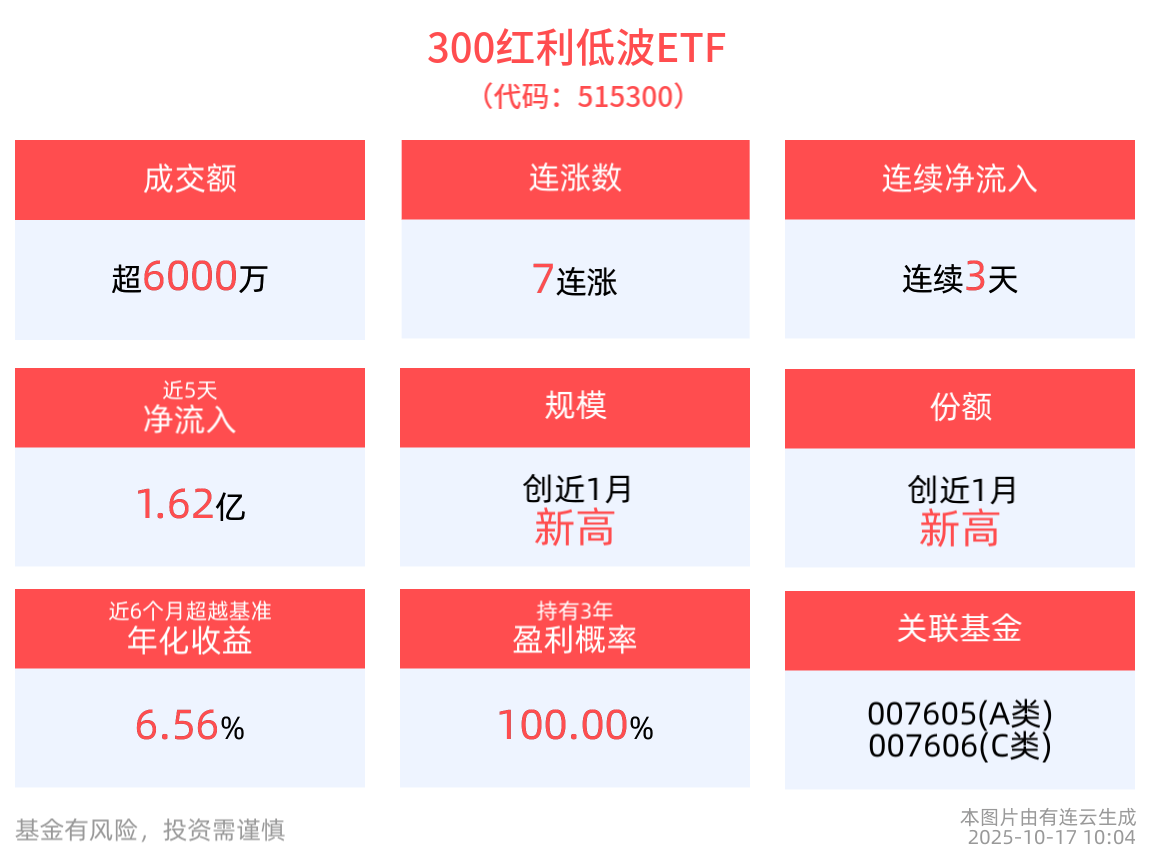
红利资产投资价值持续凸显,300红利低波ETF(515300)逆市冲击7连涨
Sou Hu Cai Jing· 2025-10-17 02:39
Core Insights - The Hu-Shen 300 Dividend Low Volatility Index has shown a slight increase of 0.08% as of October 17, 2025, with notable gains from Agricultural Bank (+2.27%), China Merchants Highway (+1.27%), and others [1] - The 300 Dividend Low Volatility ETF (515300) has achieved a 0.22% increase, marking its seventh consecutive rise [1] - Recent liquidity data indicates a turnover rate of 1.42% for the ETF, with a trading volume of 69.38 million yuan, and its latest scale reached 4.879 billion yuan, a one-month high [4] - The ETF has seen continuous net inflows over the past three days, totaling 205 million yuan, with a peak single-day inflow of 167 million yuan [4] - Over the past five years, the ETF's net value has increased by 57.94%, ranking it 82nd out of 1021 index equity funds, placing it in the top 8.03% [4] - The maximum monthly return since inception was 13.89%, with the longest consecutive monthly gain being five months and a maximum gain of 14.56% [4] - The ETF has outperformed its benchmark with an annualized excess return of 6.56% over the past six months [4] Sector Analysis - According to Zheshang Securities, there is a noticeable rise in the financial and cyclical sectors, while the technology sector has weakened, suggesting a potential shift in market focus towards financials, cyclical stocks, and dividends [4] - Changjiang Securities highlights that the dividend sector holds greater allocation value during low-interest periods, with excess returns inversely correlated with government bond yields, which are currently at their lowest since 2002, indicating an opening for price appreciation in dividend assets [5] - As of September 30, 2025, the top ten weighted stocks in the Hu-Shen 300 Dividend Low Volatility Index include China Shenhua, Shuanghui Development, Gree Electric, and others, collectively accounting for 35.84% of the index [5]

大金融思想沙龙第266期:现实世界中的货币流动性分析
Zhong Guo Fa Zhan Wang· 2025-10-16 03:25
Core Insights - The event focused on the analysis of monetary liquidity in the real world, highlighting the complexities of monetary operations involving central banks, banks, and various economic entities [1][2]. Group 1: Monetary Liquidity Analysis - Wang Jian shared insights from his book "Essentials of Chinese Monetary Fund Analysis," emphasizing a multi-layered analysis framework that includes base money, broad money, and data application [2]. - The analysis framework constructed by Wang aims to track the actual flow and derivation effects of funds, addressing issues such as the phenomenon of "money in the system but not flowing" [2]. Group 2: Financial Data and Economic Trends - Sheng Songcheng analyzed the relationship between financial data and the real economy, noting improvements in China's financial statistical system, particularly the adjustments made to M1 statistics to better reflect consumption and spending [3]. - The revised M1 statistics showed a year-on-year growth of 1.2% in December, indicating a recovery in corporate demand deposits and a gradual improvement in consumer spending [3]. Group 3: Efficiency of Monetary Policy - Zhao Xijun discussed the declining efficiency of M2 in mediating GDP growth, highlighting that the amount of M2 required to achieve GDP growth has significantly increased over the years [4]. - The current M2 statistics do not adequately reflect the structural changes in the monetary mediation function, necessitating improvements in the monetary statistical system [4]. Group 4: Monetary Policy and Economic Dynamics - Wu Ge emphasized that monetary policy should prioritize total volume over structural aspects, as current financing growth heavily relies on government bonds, indicating insufficient endogenous economic momentum [5]. - He advocated for a shift in monetary control from quantity-based to price-based approaches, integrating interest rate mechanisms and the velocity of money into liquidity analysis [5]. Group 5: Evolution of Monetary Concepts - Zeng Gang explored the need to refine the concept of money and the measurement of liquidity, suggesting that current liquidity analyses often rely on stock measures that may not accurately reflect real conditions [6][7]. - He proposed that monetary policy should shift focus from quantity to price to better understand economic dynamics and enhance policy effectiveness [7].
大盘或在当前位置进行“换挡”,低费率的自由现金流ETF(159201)布局价值凸显
Mei Ri Jing Ji Xin Wen· 2025-10-15 04:03
Core Insights - A-shares opened higher on October 15, with the Shanghai Composite Index up 0.06%, the Shenzhen Component Index up 0.19%, and the ChiNext Index up 0.29% [1] - The Guozheng Free Cash Flow Index experienced a slight increase of approximately 0.25%, with leading stocks including Qin'an Co., Shenhuo Co., and Jihong Co. [1] - The largest free cash flow ETF (159201) followed the index's upward trend, highlighting the value of strategic positioning [1] Industry Trends - According to a report from Zheshang Securities, there are clear signs of a resurgence in the financial and cyclical sectors, while the technology sector has weakened [1] - External news influences suggest that the market may be shifting focus towards large financials, cyclical stocks, and dividend-paying stocks [1] Investment Strategy - The free cash flow ETF (159201) focuses on industry leaders with abundant free cash flow, covering sectors such as non-ferrous metals, automotive, oil and petrochemicals, and power equipment, which are characterized by high barriers to entry [1] - The ETF's diversified industry coverage effectively mitigates risks associated with single industry volatility, making it a favorable choice for core portfolio allocation [1] - The fund management annual fee is 0.15%, and the custody annual fee is 0.05%, both of which are the lowest in the market [1]
A股开盘速递 | A股集体高开 培育钻石、有色金属、稀土永磁等板块涨幅居前
智通财经网· 2025-10-15 02:36
Core Viewpoint - The A-share market shows a collective rise in major indices, with the Shanghai Composite Index up by 0.06% and the ChiNext Index up by 0.29%, driven by sectors such as cultivated diamonds, non-ferrous metals, and rare earth permanent magnets [1] Institutional Outlook Zheshang Securities - External shocks do not alter the bullish strategy; market rotation may lead to style changes, focusing on large financials and dividend stocks [1] - After two weeks of market performance, large financials and cyclical sectors show significant rise, while technology style weakens [1] - The recommendation is to maintain a systematic "slow bull" mindset, taking advantage of any "buying opportunities" from external shocks, and to increase allocation during dips [1] - For industry allocation, absolute return funds should focus on large financials, real estate, state-owned infrastructure, and dividend stocks; relative return styles should monitor the upward trend of the innovation index and key moving averages for operational guidance [1] Dongfang Securities - Short-term index fluctuations are intensifying, but the main trend remains upward, with a core focus on large technology [1] - The current market adjustment is viewed as part of the consolidation since late August, with future upward movement expected [1] - From an allocation perspective, the core position of the large technology sector remains unchanged, with continued interest in self-controlled sectors and cyclical sectors with good prospects [1]


A股大幅低开
Di Yi Cai Jing Zi Xun· 2025-10-13 01:48
Market Overview - The A-share market opened significantly lower, with the Shanghai Composite Index down 2.49%, the Shenzhen Component down 3.88%, and the ChiNext Index down 4.44% [2][3] - The Hong Kong market also saw declines, with the Hang Seng Index down 2.5% and the Hang Seng Tech Index down 2.43% [5][6] Stock Performance - Weiqi New Materials (688585) resumed trading and hit the daily limit down, falling 20% [2][4] - Major tech stocks in Hong Kong, such as Bilibili and SenseTime, dropped over 5%, while financial stocks like China Pacific Insurance and Guotai Junan International fell by 6% [5][6] Commodity Market - Coking coal futures saw a significant drop, with the main contract down 3% to 1129 CNY per ton [8] - Copper futures also experienced a decline, with domestic copper down 2.07% to 85040 CNY per ton, and international copper down 2% to 75600 CNY per ton [9] Currency Exchange - The central parity rate of the RMB against the USD was reported at 7.1007, an increase of 41 basis points from the previous trading day [9]

蓄力新高13:贸易摩擦潜在情景及应对
CAITONG SECURITIES· 2025-10-12 10:08
Core Insights - The report emphasizes a strategic shift towards large financial sectors and consumer markets, indicating a rebound following the maximum negative impact of tariffs, with a notable performance in the AH market and a rise in the Shanghai Composite Index by over 10% to above 3800 points [2][9] - The fourth quarter strategy focuses on three main lines: traditional economic cycles, new economic technology, and service consumption [2][9] Group 1: Economic and Market Analysis - The report outlines a preference for "internal focus," highlighting sectors such as autonomous control (AI software, AI chips, semiconductor equipment and materials, aerospace), emotional consumption (Hong Kong internet, tea and dining, gold jewelry), and new quality industries (robots, nuclear fusion, solid-state batteries) [3][10] - Traditional economic sectors include anti-involution industries (silicon materials, coal, steel, copper smelting) and large financial sectors (insurance, brokerage, banking) [3][10] - Marginal easing signals are noted, with a shift towards external demand-related sectors in the third quarter, such as North American computing power and innovative pharmaceuticals [3][10] Group 2: Trade Tensions and Market Reactions - The report reviews the escalation of trade tensions, indicating a 6% decline in the A-share market during the rapid escalation phase, while anti-tariff and rare earth sectors saw increases of 18% and 7% respectively [4][11] - During the phase of easing tensions, the A-share market rose by 5%, with export-oriented and rare earth sectors increasing by 6% and 1% respectively [12] - Following the agreement phase, the A-share market surged by 12%, with export, anti-tariff, and rare earth sectors rising by 16%, 7%, and 64% respectively [12] Group 3: Third Quarter Earnings Forecast - As of October 11, 61 companies in the A-share market have disclosed third-quarter earnings forecasts, with the steel and light manufacturing industries showing strong growth [13][15] - The report highlights a high forecast rate for industries such as steel, light manufacturing, food and beverage, retail, non-bank financials, and public utilities [15] - The materials sector is expected to improve overall, with steel industry profits revised upwards, benefiting from anti-involution policies and expectations of Federal Reserve rate cuts [15][28]
A股市场运行周报第62期:上证突破但遇波折,战略看慢牛、战术盯金融-20251011
ZHESHANG SECURITIES· 2025-10-11 07:33
Core Insights - The report indicates that the Shanghai Composite Index broke through 3900 points but faced a pullback, leading to increased market volatility. The outlook remains optimistic for a systematic "slow bull" market, with potential adjustments viewed as opportunities for increased allocation [1][4][58] - The report suggests a strategic focus on large financials, real estate, and infrastructure sectors, while tactical operations should monitor the performance of the ChiNext Index and key moving averages [1][5][59] Market Overview - The major indices experienced fluctuations, with the Shanghai Composite Index showing a slight increase of 0.37% over the week, while the ChiNext Index and the STAR Market saw declines of 3.86% and 2.85% respectively [12][56] - The report highlights a significant rise in cyclical sectors, with non-ferrous metals up by 4.35%, and coal and electricity sectors also performing well. Conversely, technology sectors showed weakness, with declines in media, electronics, and communications [15][57] Market Sentiment and Capital Flow - The average daily trading volume in the Shanghai and Shenzhen markets increased to 2.59 trillion yuan, indicating heightened market activity. The margin trading balance also continued to rise, reaching 2.44 trillion yuan [24][29] - The report notes that the stock ETF saw a net inflow of 10.4 billion yuan, with the securities ETF leading in inflows, while the medical ETF experienced the largest outflow [31][39] Future Market Outlook - The report anticipates that if the ChiNext Index does not recover its upward trend in the short term, it may undergo a weekly level consolidation. The Shanghai Composite Index, having formed a five-wave structure, is expected to continue its upward trajectory unless external shocks disrupt this trend [4][58] - The report emphasizes the importance of monitoring the performance of key sectors, particularly large financials and cyclical stocks, as the market may shift focus away from technology [58][59]
大金融思想沙龙(总第 263 期) 顺利举行, 聚焦人工智能如何重塑金融业
Zhong Guo Fa Zhan Wang· 2025-09-29 12:59
Core Insights - The event focused on how artificial intelligence (AI) is reshaping the financial industry, highlighting its impact on decision-making, regulatory models, and investment strategies [1][2]. Group 1: AI Integration in Finance - AI is significantly changing the financial industry's decision-making mechanisms, regulatory approaches, and investment methods, particularly in handling complex, unstructured financial data [2]. - China has made substantial progress in AI applications within finance, developing competitive systems through independent research and algorithm innovation [2]. - Specific applications of AI include corporate sentiment monitoring, regulatory expectation management, market forecasting, and high-risk financial product investments, enhancing decision accuracy, market transparency, and risk control [2]. Group 2: Challenges and Risks - Despite the advantages, AI applications in finance face challenges such as algorithm compliance, signal recognition, and professional adaptation, which require technical adjustments, professional empowerment, and regulatory innovation [2]. - The rapid development of AI brings risks like data monopolization, model opacity, and algorithmic collusion, potentially exacerbating systemic risks and harming consumer interests [3]. - Regulatory frameworks need to evolve to address the dual challenges of lagging behind and over-regulation in response to AI advancements [3]. Group 3: Perspectives on AI's Future in Finance - AI is expected to deepen financial digitalization, enhancing individuals' computational abilities and making financial services more accessible and affordable for the general public [4]. - Financial service providers are already leveraging AI in various applications, including digital payments and risk management, which will continue to improve service efficiency and expand the range of financial services offered [4]. - The ongoing development of AI and improvements in computational power will further enhance the digitalization of financial services, leading to more flexible and efficient governance mechanisms [4]. Group 4: Academic and Theoretical Framework - The "Big Finance" salon aims to promote high-level academic exchanges and research on financial theories, policies, and strategies, rooted in both Chinese practices and international trends [5][6]. - The concept of "Big Finance" integrates macro and micro financial theories, emphasizing the inseparable relationship between finance and the real economy [5][6].
科技主线要换方向?“牛市旗手”中有个股涨停并创历史新高——涨停复盘
Mei Ri Jing Ji Xin Wen· 2025-09-29 08:24
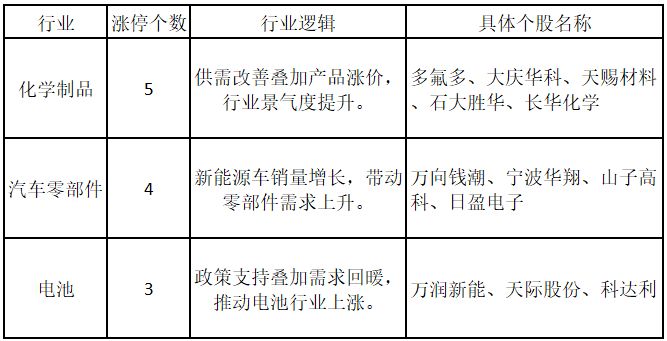
Market Overview - The Shanghai Composite Index rose by 0.90%, with the median stock price change being 0.58% [1] - A total of 53 stocks hit the daily limit up, an increase of 6 from the previous day, while 2 stocks hit the limit down, a decrease of 19 [2] Sector Characteristics - The most represented sectors among limit-up stocks were chemical products, automotive parts, and battery industries [3] - The chemical products sector saw 5 limit-up stocks, driven by supply-demand improvements and product price increases [3] - The automotive parts sector had 4 limit-up stocks, boosted by rising sales of new energy vehicles [3] - The battery sector had 3 limit-up stocks, supported by policy backing and recovering demand [3] Concept Characteristics - The most popular concepts among limit-up stocks included solid-state batteries, domestic chips, and robotics [4] - Solid-state battery stocks accounted for 8 limit-ups, driven by policy support and expected technological breakthroughs [4] - Domestic chip stocks had 6 limit-ups, accelerated by domestic substitution and increased policy support [4] - Robotics concept stocks saw 4 limit-ups, benefiting from policy support and industrial upgrades [4] Notable Limit-Up Stocks - Six stocks reached historical highs, including Guosheng Jinkong and Huajian Group, indicating strong market interest and clear upward trends [5] - A total of 17 stocks reached new highs in the past year, suggesting significant breakout trends [6] Main Capital Inflows - The top five stocks by net capital inflow included Lingyi Zhi Zao, Shanzi Gaoke, Tianqi Materials, Huatai Securities, and Guosheng Jinkong [7][8] - The stocks with the highest net inflow as a percentage of market value included Huijin Co., Initial Spirit, Jingxing Paper, Changhua Chemical, and Shanzi Gaoke [9] Limit-Up Stock Trends - The top five stocks by sealing capital included Shanzi Gaoke, Boqian New Materials, Tianji Co., Lingyi Zhi Zao, and Duofluo [10] - There were 45 first-time limit-up stocks today, with 4 stocks achieving 2 consecutive limit-ups and 4 stocks achieving 3 or more consecutive limit-ups [11]