
宽财政

Search documents
建信期货国债日报-20250930
Jian Xin Qi Huo· 2025-09-30 01:49
1. Report Information - Report Title: Treasury Bond Daily Report [1] - Date: September 30, 2025 [2] - Researchers: He Zhuoqiao, Huang Wenxin, Nie Jiayi [3] 2. Industry Investment Rating - Not provided in the report 3. Core Viewpoints - The domestic demand repair foundation remains weak, and the policy - driven infrastructure investment has slowed down, dragging down overall investment. The necessity for China's monetary policy to follow the Fed's easing in September is low, and policies may focus on expanding fiscal, credit, and real - estate support, which will bring disturbances to the bond market [11]. - The pressure on the bond market may ease as the fastest - growing phase of the stock market may have passed, but there is still no clear breakthrough. Patience is needed to wait for better allocation value. Currently, with economic data released, the market focus should shift to the capital market and the stock - bond seesaw. Short - term bond varieties have higher certainty as cross - month funds are stable [12] 4. Summary by Directory 4.1 Market Review and Operation Suggestions - **Market Performance**: In the afternoon, the strengthening of the A - share market suppressed the performance of long - term bond varieties, while stable cross - month funds supported short - term varieties [8]. - **Interest Rate Bonds**: Yields of major inter - bank interest rate bonds changed slightly, with most medium - and long - term yields rising by less than 1bp. By 16:30, the yield of the 10 - year treasury bond active bond 250011 was reported at 1.8075%, up 0.75bp [9]. - **Funding Market**: Cross - quarter funds were stable. There were 2405 billion yuan of reverse repurchases due, and the central bank injected 2886 billion yuan, achieving a net injection of 481 billion yuan. The inter - bank capital sentiment index was stable. Short - term capital rates rose slightly, with the overnight weighted rate of inter - bank deposits down 0.22bp to 1.3103%, the 7 - day rate up 3.17bp to 1.5873%, and medium - and long - term funds rising slightly. The 1 - year AAA certificate of deposit rate was 1.67% with little change [10] 4.2 Industry News - The Political Bureau of the CPC Central Committee held a meeting on September 29 to study major issues in formulating the 15th Five - Year Plan for National Economic and Social Development. The Fourth Plenary Session of the 20th Central Committee of the CPC will be held in Beijing from October 20 to 23 [13]. - On the morning of September 29, Premier Li Qiang met with North Korean Foreign Minister Choe Son - hee, expressing China's willingness to strengthen exchanges and cooperation with North Korea [13]. - The National Development and Reform Commission stated that the new policy - based financial instruments total 500 billion yuan, all for supplementing project capital, and efforts are being made to invest the funds in specific projects [13]. - The central bank conducted 288.6 billion yuan of 7 - day reverse repurchase operations on September 29, with an operating rate of 1.40%, resulting in a net injection of 48.1 billion yuan [14]. - From January to August, the total operating income of state - owned enterprises was 53.96201 trillion yuan, a year - on - year increase of 0.2%; the total profit was 2.79372 trillion yuan, a year - on - year decrease of 2.7%; the tax payable was 3.90125 trillion yuan, a year - on - year decrease of 0.3%; and the asset - liability ratio was 65.2%, a year - on - year increase of 0.3 percentage points [14] 4.3 Data Overview - **Treasury Bond Futures Market**: Transaction data for various treasury bond futures contracts on September 29 are provided, including opening price, closing price, settlement price, change, trading volume, open interest, etc. For example, the closing price of TL2512 was 113.720, down 0.540, with a decline of 0.47% [6]. - **Money Market**: Information on inter - bank capital sentiment index, short - term and medium - long - term capital rates, and the 1 - year AAA certificate of deposit rate is presented [10]. - **Derivatives Market**: Diagrams of Shibor3M and FR007 interest rate swap fixed - rate curves (mean) are mentioned [36]
建信期货国债日报-20250917
Jian Xin Qi Huo· 2025-09-17 01:37
1. Report Industry Investment Rating - No relevant content provided 2. Core Viewpoints of the Report - The domestic economic data for August showed marginal weakness rather than a sharp decline. It's not necessary for China's monetary policy to follow the Fed's easing in September. Policy may focus more on fiscal and credit expansion and real - estate support, which could bring disturbances to the bond market. However, as the fastest - strengthening phase of the stock market may have passed, the pressure on the bond market from the stock market may ease. Overall, the bond market's suppression may ease but still lacks a breakthrough, and investors need to be patient for better allocation opportunities. Currently, with the release of economic data, the short - end bonds may be more resilient than the long - end bonds under the support of loose funds [11][12] 3. Summary According to Relevant Catalogs 3.1 Market Review and Operation Suggestions - **Market Conditions**: Treasury bond futures recovered in the afternoon, with most contracts closing higher. The yields of major inter - bank spot interest - rate bonds declined across the board, with medium - and long - term yields falling by about 2 - 3bp. By 16:30, the yield of the 10 - year Treasury bond active bond 250011 was reported at 1.7800%, down 2bp [8][9] - **Funding Market**: Amid tax - period disturbances, the central bank resumed net injections in the open market, and the funding situation remained stable. There were 247 billion yuan of reverse repurchases due, and the central bank conducted 287 billion yuan of reverse repurchase operations, achieving a net injection of 40 billion yuan. The inter - bank funding sentiment index remained stable, short - term funding rates mostly rose slightly, while medium - and long - term funds changed little [10] 3.2 Industry News - From September 14th to 15th local time, Chinese and US economic and trade leaders held talks in Madrid, Spain, reaching a basic framework consensus on issues such as resolving TikTok - related problems, reducing investment barriers, and promoting economic and trade cooperation [13] - On September 15th, the National Bureau of Statistics released data showing that in August, the national economy maintained a stable and progressive development trend. From January to August 2025, the national fixed - asset investment (excluding rural households) was 3.26111 trillion yuan, a year - on - year increase of 0.5%. The real - estate development investment was 603.09 billion yuan, a year - on - year decrease of 12.9%. In August, the total retail sales of consumer goods was 396.68 billion yuan, a year - on - year increase of 3.4% [14] - As of the end of August, M2 increased by 8.8% year - on - year, M1 increased by 6% year - on - year, and the M1 - M2 gap narrowed to - 2.8%. In the first eight months, RMB loans increased by 13.46 trillion yuan, and the cumulative increase in social financing scale was 26.56 trillion yuan, 4.66 trillion yuan more than the same period last year [15] 3.3 Data Overview - **Treasury Bond Futures Market**: The report presents trading data for multiple Treasury bond futures contracts on September 16th, including settlement prices, opening prices, closing prices, price changes, trading volumes, open interests, and changes in open interests [6] - **Money Market**: The report includes figures related to the SHIBOR term structure change, SHIBOR trend, inter - bank pledged repurchase weighted interest rate change, and inter - bank deposit - based pledged repurchase interest rate change [31][35] - **Derivatives Market**: The report shows the Shibor3M interest - rate swap fixing curve (mean) and FR007 interest - rate swap fixing curve (mean) [37]
海外市场点评:没有货币,财政又变成问题?
Minsheng Securities· 2025-09-05 08:47
Group 1: Economic Impact and Fiscal Concerns - The recent ruling against the White House's tariff executive order has led to a downward adjustment in inflation expectations and an upward adjustment in Federal Reserve easing expectations, supporting the recession and easing trade narrative[4] - If the Supreme Court maintains the ruling, the potential loss of tariff revenue, estimated at approximately $72 billion from April to July, could impact the deficit rate by at least 0.7 percentage points[4] - Since Q3 2022, the U.S. economy has seen a decline in growth rate, with the annualized GDP growth rate dropping from 3.8% to 1.6% without fiscal support[5] Group 2: Fiscal Policy and Debt Management - The July tax cut legislation is perceived as a continuation of the previous expansionary fiscal policy, but its actual impact on the economy is uncertain due to indirect effects on corporate and consumer behavior[5] - The government’s ability to spend beyond its means is crucial, with the tax cut potentially allowing for $5 trillion in debt issuance, which requires careful timing to avoid future fiscal constraints[6] - Rising interest rates on debt refinancing are increasing the weighted average interest rate of U.S. Treasury bonds, which has risen to 3.352% as of July 2023[7] Group 3: Interest Payments and Budget Constraints - Federal interest payments are projected to exceed $1 trillion for the first time in 2024, significantly squeezing non-interest spending, which has dropped from over 95% of total spending in 2020 to around 85% currently[7] - The interest deficit rate is expected to rise from about 10% of total deficit in 2020 to nearly 50% by 2024, indicating a growing burden on fiscal policy[8] - If U.S. Treasury rates rise by 1%, the non-interest deficit rate could decrease by approximately 0.9 percentage points, leading to a potential GDP growth drag of about 0.6 percentage points[9] Group 4: Future Projections and Recommendations - To maintain fiscal stimulus effects, the U.S. may need to either issue more debt or rely on significant interest rate cuts from the Federal Reserve, which would require at least a 100 basis point reduction[10] - The current fiscal environment suggests limited support for economic growth over the next four quarters, with a potential for "stagflation" conditions[11] - Asset allocation strategies should consider precious metals as a safe haven, while also evaluating the risk of overseas assets amid rising credit concerns[11]
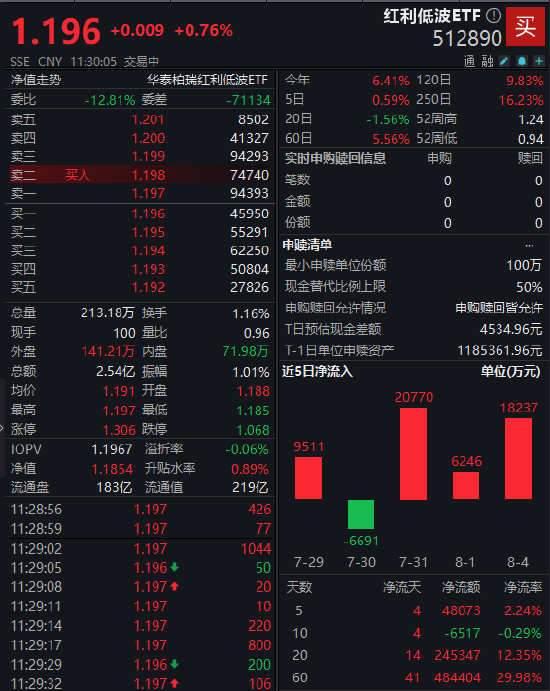
宽财政推动融资需求增长!红利低波ETF(512890)近5个交易日“吸金”4.8亿
Xin Lang Ji Jin· 2025-08-05 04:36
Core Viewpoint - The Hongli Low Volatility ETF (512890) has shown positive performance with a 0.76% increase in price, attracting significant net inflows over recent trading days, indicating strong investor interest and confidence in the fund's strategy [1][2]. Fund Performance - As of August 5, the ETF's price was 1.196 CNY, with a trading volume of 2.54 billion CNY and a turnover rate of 1.16% [1][2]. - The fund has experienced a net inflow of 4.8 billion CNY over the last 5 trading days and 24.53 billion CNY over the last 20 trading days [1][2]. - The total circulation scale of the ETF reached 217.31 billion CNY as of August 4, 2025 [1]. Holdings and Strategy - The Hongli Low Volatility ETF tracks the CSI Low Volatility Index and includes major holdings such as Chengdu Bank, Industrial Bank, and Sichuan Road and Bridge, among others [1][3]. - The top ten holdings account for a significant portion of the fund's net asset value, with a combined market value of approximately 5.15 billion CNY [3]. Market Outlook - The central bank's recent meeting indicates a supportive environment for credit growth, which is expected to stabilize bank performance and asset quality, particularly in the real estate and urban investment sectors [3]. - Analysts suggest focusing on high dividend and regional growth opportunities in bank stocks, particularly large state-owned banks and quality regional banks with dividend growth potential [3]. Investment Options - For investors seeking stable returns and low volatility, the Hongli Low Volatility ETF can be accessed through various fund classes, even without a stock account [4].

固收专题:中国出口依赖度高的表象与实质
KAIYUAN SECURITIES· 2025-07-15 02:45
Report Industry Investment Rating - Not provided in the content Core Viewpoints - The high contribution rate of net exports to China's GDP in Q1 2025 does not mean high dependence on exports; instead, it is mainly due to import substitution [2][4] - China's exports may remain at a relatively high level in the second half of 2025, and the economy may be better than expected, leading to an upward movement in bond yields and the stock market [6][8] Summary by Relevant Catalogs China's Export Dependence - China's export-to-nominal GDP ratio is relatively low compared to most countries and historical levels. In 2023, it was 19% (ranked 130th), lower than South Korea (44%, ranked 56th), Germany (43%, ranked 62nd), France (34%, ranked 86th), and Japan (22%, ranked 120th). From 1970 - 2006, it trended upward, reaching a maximum of 35%; from 2007 - 2019, it trended downward, with a minimum of 17%; from 2020 - 2024, it rebounded slightly, ranging from 17 - 19% [3] Import Substitution - In Q1 2025, the high contribution rate of net exports to GDP (nearly 40%) was mainly due to a low import growth rate (-7%) rather than a high export growth rate (+5.7%). The low import growth is related to import substitution, which may continue for a long time due to China's complete industrial chain and high - cost - performance products. In June 2025, China maintained a high - export and low - import situation [4][5] Export Outlook - Due to the "global trade dynamic balance" and the "wide fiscal" policies of major economies, China's exports may remain relatively stable. As long as the US continues its loose fiscal policy, its total demand and imports will not decline significantly, and China's total exports will remain stable. "Anything But Bond" may become the dominant global strategy [6] Economic Expectations and Market Trends - Some market views believe that China's economy may face pressure in the second half of the year. However, considering the stable export situation, the economy in the second half of 2025 may be better than expected, leading to a correction in market expectations and an upward movement in bond yields and the stock market [7][8]
五矿期货贵金属日报-20250711
Wu Kuang Qi Huo· 2025-07-11 01:31
Group 1: Market Performance - The Shanghai gold futures (Au) rose 0.07% to 771.70 yuan/gram, and Shanghai silver futures (Ag) rose 1.45% to 9014.00 yuan/kilogram. COMEX gold rose 0.27% to 3334.70 dollars/ounce, and COMEX silver rose 1.27% to 37.78 dollars/ounce. The US 10-year Treasury yield was reported at 4.35%, and the US dollar index was at 97.55 [2] - The Au(T+D) closed at 769.22 yuan/gram, up 0.83% from the previous trading day. The Ag(T+D) closed at 8899.00 yuan/kilogram, up 0.55%. London gold closed at 3312.60 dollars/ounce, up 0.38%, and London silver closed at 36.81 dollars/ounce, up 0.60%. The SPDR gold ETF holdings were at 948.80 tons, up 0.15%, and the SLV silver ETF holdings were at 14889.93 tons, down 0.51% [4] Group 2: Fed Officials' Statements and Policy Expectations - Multiple Fed officials expressed different views on the monetary policy path. St. Louis Fed President Mousalem's speech was hawkish, while San Francisco Fed President Daly thought there might be two rate cuts this year in the fall. Potential next Fed Chair candidate Waller was dovish, suggesting a rate cut in the July meeting. President Trump pressured the Fed to cut rates quickly [2][3] - Given the US fiscal expansion and high interest - payments, the Fed is likely to keep rates unchanged in the July meeting with a more dovish tone and cut rates by 25 basis points in the September meeting [3] Group 3: Investment Opportunities and Price Ranges - In the context of the expected loosening of the Fed's monetary policy, attention should be paid to the long - position opportunities in silver. Gold may perform relatively weakly due to the gradual realization of the US loose - fiscal expectation. The reference operating range for the main contract of Shanghai gold is 760 - 801 yuan/gram, and for Shanghai silver is 8805 - 9600 yuan/kilogram [3] Group 4: Gold and Silver Data Details - For gold on July 10, 2025, COMEX gold's closing price was 3333.00 dollars/ounce (up 0.32%), volume was 14.84 million lots (down 4.77%), open interest was 43.77 million lots (up 0.62%), and inventory was 1144 tons (down 0.26%). SHFE gold's closing price was 773.30 yuan/gram (up 0.85%), volume was 26.56 million lots (down 39.51%), and open interest was 39.56 million lots (down 0.23%) [6] - For silver on July 10, 2025, COMEX silver's closing price was 37.63 dollars/ounce (up 2.79%), open interest was 16.36 million lots (down 6.33%), and inventory was 15413 tons (down 0.35%). SHFE silver's closing price was 8919.00 yuan/kilogram (up 0.22%), volume was 69.73 million lots (down 24.31%), and open interest was 87.47 million lots (down 0.73%) [6] Group 5: Price and Spread Analysis - On July 10, 2025, the SHFE - COMEX gold spread was 31.1035 yuan/gram (1.34 dollars/ounce), and the SGE - LBMA gold spread was - 0.19 yuan/gram (- 0.80 dollars/ounce). The SHFE - COMEX silver spread was 228.70 yuan/kilogram (0.99 dollars/ounce), and the SGE - LBMA silver spread was 361.25 yuan/kilogram (1.57 dollars/ounce) [47]
永安期货有色早报-20250711
Yong An Qi Huo· 2025-07-11 00:59
Group 1: Report Industry Investment Rating - No information provided on the report industry investment rating Group 2: Core Views of the Report - Copper prices are expected to have some adjustment space in the third - quarter off - season due to fundamental inventory accumulation and a decline in scrap substitution, but there is strong support below, and a significant drop requires a macro black swan event with a low probability currently [1] - For aluminum, the short - term fundamentals are okay, and attention should be paid to demand. In a low - inventory situation, pay attention to far - month inter - month and internal - external reverse arbitrage [1] - The idea of short - allocating zinc remains unchanged, and short positions can be established on rebounds. The internal - external positive arbitrage can continue to be held [4] - For nickel, continue to pay attention to the opportunity of narrowing the nickel - stainless steel price ratio [6] - Stainless steel is expected to fluctuate weakly in the short term [9] - Lead is expected to oscillate in the range of 17,100 - 17,500 next week, and if affected by the macro environment and the price remains above 17,200, it may trigger a risk of a price - support cycle [11] - For tin, it is recommended to wait and see in the short term, and pay attention to high - short opportunities after the maintenance period in the medium - to - long term [13] - Industrial silicon is expected to oscillate if the leading enterprise continues to cut production and there is no obvious recovery in short - term production [17] - Carbonate lithium is expected to continue to be in a state of oversupply next week, with prices under upward pressure, but the "anti - involution" policy may boost sentiment [18] Group 3: Summary by Metal Copper - This week, copper prices showed a reverse V - shaped trend. The ADP and non - farm data were inconsistent, and the overall interest - rate cut expectation was unstable. The "Great Beauty" bill was implemented, and short - term broad fiscal policy may have a certain stimulating effect [1] - Domestically, inventory has increased, and the start - up rate has declined significantly. It is expected to continue to decline in the off - season from July to August, and copper consumption is restricted. The scrap - refined price difference has widened, and the scrap - refined substitution effect will weaken. A moderate inventory accumulation is expected from July to August [1] Aluminum - Supply has increased slightly, with aluminum ingot imports providing an increment from January to May. In July, demand is expected to weaken seasonally, with aluminum product exports remaining stable and photovoltaic demand declining, and supply and demand are expected to be balanced [1] - In the inventory aspect, supply and demand are expected to be balanced in July. The short - term fundamentals are okay, and attention should be paid to demand [1] Zinc - This week, zinc prices fluctuated widely. In July, the domestic TC has increased by 200 yuan/ton compared with June, and the imported TC has increased slightly. Some smelters are under maintenance, but new production capacities in the southwest and central China have been realized, and the zinc ingot output is expected to increase by more than 5,000 tons [4] - Domestically, demand has weakened seasonally, and the spot premium has basically leveled off. Overseas, European demand is weak, but some smelters face production resistance due to processing fees, and the spot premium has increased slightly [4] - Domestically, social inventory has increased, and overseas LME inventory has decreased after May, mainly because more overseas zinc ingots have flowed into China [4] Nickel - On the supply side, pure nickel production has remained at a high level, and nickel bean imports have increased in May. On the demand side, it is generally weak, and the LME premium has strengthened slightly [6] - Overseas nickel plate inventory has remained stable, and domestic inventory has decreased slightly. After the rumor that the Philippines' ban on raw ore exports has been repealed, concerns about ore - end disturbances have eased [6] Stainless Steel - Since late May, some steel mills have cut production passively. Demand is mainly for rigid needs. The prices of nickel iron and chrome iron have remained stable [9] - Inventory in Xijiao and Foshan has increased slightly, and some exchange warehouse receipts have expired and been removed. Fundamentals are generally weak, and spot pressure has increased after demand has weakened [9] Lead - This week, lead prices rose moderately. On the supply side, the scrap volume is weak year - on - year. The expansion of recycling plants has led to a shortage of waste batteries, and the low - profit situation has improved but the low - start - up rate remains [11] - On the demand side, battery inventory is high, the battery start - up rate has rebounded this week, and the market has expectations for the peak season. The scrap - refined price difference is - 50, and the willingness to sell recycled lead has increased but the receiving is poor [11] Tin - This week, tin prices fluctuated widely. On the supply side, the resumption of production in Myanmar's Wa State requires further negotiation. The processing fee at the ore end is low, and smelting profits are inverted. Some smelters in Jiangxi have cut production, and those in Yunnan are struggling to maintain [13] - On the demand side, the elasticity of solder is limited, and the growth rate of terminal electronics and photovoltaics is expected to decline. Domestic inventory has increased, and overseas consumption has continued to rush to install, but the inflection point of inventory accumulation is gradually emerging [13] Industrial Silicon - This week, Hesheng's Xinjiang production area continued to cut production, while production in Yunnan and Sichuan increased slightly. Overall, due to the large - scale production cut by the leading enterprise, the monthly output in July and subsequent months is expected to decline, and the supply - demand balance has shifted to inventory reduction [17] - The basis has strengthened rapidly, stimulating the downstream's speculative and inventory - replenishment sentiment. The market expectation has shifted from inventory accumulation to inventory reduction. If production does not recover significantly in the short term, the industrial silicon futures price is expected to oscillate [17] Carbonate Lithium - This week, carbonate lithium prices rose due to the "anti - involution" policy. Spot transactions are mainly based on the 09 - contract price, and the difference in prices between upstream and downstream has led to average transactions. Downstream enterprises settle at a later point, and there is inventory dumping at a reduced basis [18] - High prices have stimulated the resumption of production of some production lines in Sichuan, and salt lakes are continuing to increase production. Some factories have maintenance plans, and external - procurement projects have sufficient hedging profits and are in production [18] - Downstream enterprises are mainly in a wait - and - see state, only maintaining safety inventory. Overall, inventory has increased this week. The willingness to deliver to the warehouse has improved, and the number of registered warehouse receipts has increased [18]
永安期货有色早报-20250710
Yong An Qi Huo· 2025-07-10 05:39
Group 1: Report Industry Investment Rating - There is no information about industry investment rating in the report. Group 2: Core Viewpoints - The copper price is expected to have some adjustment space in the third - quarter off - season due to fundamental inventory accumulation and a decline in scrap - refined substitution, but there is strong support below the price [1]. - For aluminum, the short - term fundamentals are acceptable, and attention should be paid to demand. In the low - inventory pattern, pay attention to the far - month inter - month and internal - external reverse arbitrage [1]. - The zinc short - allocation idea remains unchanged, and short - selling on rallies is recommended. The internal - external positive arbitrage can continue to be held [4]. - For nickel, continue to pay attention to the opportunity of the nickel - stainless steel price ratio contraction [6]. - Stainless steel is expected to be weak and volatile in the short term [9]. - Lead is expected to oscillate in the range of 17100 - 17500 next week, and there may be a risk of a price - support cycle if the price remains above 17200 due to macro - influences [11]. - For tin, it is recommended to wait and see in the short term, and pay attention to high - short opportunities after the maintenance period in the medium - to - long term [13]. - Industrial silicon is expected to oscillate if the top enterprises continue to cut production and there is no obvious recovery in short - term production [17]. - Lithium carbonate is expected to be weak and volatile in the medium - to - long term. In the short term, supply is expected to be in surplus next week, and the "anti - involution" policy may drive up sentiment [17]. Group 3: Summary by Metal Copper - This week, the copper price showed a reverse - V trend. Macro - data was mixed, and the domestic market started to accumulate inventory in the off - season. The refined - scrap price difference widened, and a moderate inventory accumulation is expected from July to August [1]. Aluminum - Supply increased slightly, and demand is expected to weaken seasonally in July. Supply and demand are expected to be balanced, and the short - term fundamentals are acceptable [1]. Zinc - The zinc price fluctuated widely this week. Supply is expected to increase, demand is seasonally weak, and the inventory shows different trends at home and abroad. The short - allocation strategy remains unchanged [4]. Nickel - Supply is at a high level, demand is weak, and overseas nickel - plate inventory remains stable while domestic inventory decreases slightly. Pay attention to the price - ratio contraction opportunity [6]. Stainless Steel - Supply has been reduced, demand is mainly for rigid needs, costs are stable, and inventory is slightly increasing. It is expected to be weak and volatile [9]. Lead - The lead price rose this week. Supply - side issues include weak scrap production and tight waste batteries. Demand - side has high battery inventory. It is expected to oscillate in a certain range next week [11]. Tin - The tin price fluctuated widely. Supply is affected by mine issues, demand is weak, and inventory shows different trends at home and abroad. It is recommended to wait and see in the short term [13]. Industrial Silicon - Top enterprises are cutting production, and the supply - demand balance has shifted to inventory reduction. The price is expected to oscillate [17]. Lithium Carbonate - The price rose this week due to policy - driven sentiment. Supply is expected to be in surplus in the short term, and the price is expected to be weak and volatile in the medium - to - long term [17].
机构看金市:7月9日
Xin Hua Cai Jing· 2025-07-09 05:12
Group 1 - The expectation of a gradual implementation of US fiscal policies is leading to a relatively weak performance of gold [1] - The recent US non-farm payroll data exceeding expectations has caused the market to abandon bets on a July rate cut, shifting focus to upcoming US tariff policies [1][2] - The geopolitical risks and uncertainties surrounding tariff policies are providing strong support for precious metal prices, with gold expected to experience high-level fluctuations in the short term [2] Group 2 - Optimism surrounding trade negotiations is enhancing risk appetite, which is putting pressure on gold prices [2] - Despite short-term pressures, the long-term outlook for gold remains bullish due to ongoing geopolitical events and uncertainties related to the trade war [2]
永安期货有色早报-20250709
Yong An Qi Huo· 2025-07-09 01:47
Group 1: Report Industry Investment Rating - No relevant content provided Group 2: Core Views of the Report - Copper prices showed a reverse V - shaped trend this week. With the divergence between ADP and non - farm payroll data, the overall interest - rate cut expectation fluctuated. There may be a moderate inventory build - up from July to August, and copper prices are expected to have some adjustment space in the third - quarter off - season [1]. - Aluminum supply increased slightly, with imports from January to May contributing to the growth. Demand is expected to weaken seasonally in July, with flat supply and demand. Pay attention to demand and low - inventory trading opportunities [1]. - Zinc prices fluctuated widely this week. Supply is expected to increase, demand is seasonally weak, and the strategy is to maintain a short - position and hold long domestic - short overseas positions [4]. - Lead prices rose moderately this week. Supply - side issues persist, demand is still weak overall, and prices are expected to oscillate between 17100 - 17500 next week [9]. - Tin prices fluctuated widely. Supply is affected by the Myanmar situation and domestic production cuts, demand is weak, and it's recommended to wait and see in the short - term and look for short - selling opportunities in the long - term [11]. - Industrial silicon production is expected to decline in July due to major company cut - backs. If production doesn't recover soon, the market is expected to oscillate [15]. - Lithium carbonate prices rose due to policy sentiment. In the short - term, demand is weak, supply is expected to be in surplus, and prices are likely to oscillate weakly [16]. - Nickel supply is high, demand is weak, and it's advisable to continue to focus on the contraction opportunity of the nickel - stainless steel price ratio [18]. - Stainless steel supply has seen partial production cuts, demand is mainly for essential needs, and prices are expected to oscillate weakly in the short - term [19] Group 3: Summary by Metals Copper - This week, copper prices had a reverse V - shaped trend. Macro factors included the divergence between ADP and non - farm payroll data and the implementation of the "Big Beautiful" bill. Fundamentally, domestic inventory increased, and consumption was suppressed. There may be a moderate inventory build - up from July to August, and copper prices are expected to adjust in the third - quarter off - season [1] Aluminum - Supply increased slightly from January to May. Demand is expected to weaken seasonally in July, with flat supply and demand. Short - term fundamentals are okay, and attention should be paid to demand and low - inventory trading opportunities [1] Zinc - This week, zinc prices fluctuated widely. Supply is expected to increase as new capacity comes online and some smelters resume production after maintenance. Demand is seasonally weak both domestically and overseas. The strategy is to maintain a short - position and hold long domestic - short overseas positions [4] Lead - This week, lead prices rose moderately. Supply - side issues such as low scrap battery supply and high - cost raw materials persist. Demand is still weak overall, mainly for essential needs. Prices are expected to oscillate between 17100 - 17500 next week [9] Tin - This week, tin prices fluctuated widely. Supply is affected by the uncertain resumption of production in Myanmar's Wa State and domestic production cuts. Demand is weak, and it's recommended to wait and see in the short - term and look for short - selling opportunities in the long - term [11] Industrial Silicon - In July, production is expected to decline due to major company cut - backs. If production doesn't recover soon, the market is expected to oscillate. The market expectation has shifted from inventory build - up to inventory reduction [15] Lithium Carbonate - This week, prices rose due to policy sentiment. In the short - term, demand is weak, supply is expected to be in surplus, and prices are likely to oscillate weakly. Attention should be paid to the resumption of production of major projects [16] Nickel - Supply is high as pure nickel production remains at a high level and nickel bean imports increased in May. Demand is weak, and it's advisable to continue to focus on the contraction opportunity of the nickel - stainless steel price ratio [18] Stainless Steel - Supply has seen partial production cuts since late May. Demand is mainly for essential needs. Cost is stable, and inventory has slightly increased. Prices are expected to oscillate weakly in the short - term [19]