
工业需求

Search documents
NCE外汇:解读金属牛市 就业超预期但内需疲软
Xin Lang Cai Jing· 2025-12-17 10:28
Economic Overview - The current economic fundamentals are at a delicate turning point, with the latest non-farm payroll data showing an increase of 64,000, surpassing the market expectation of 51,000, but underlying signals indicate a cooling trend [1][3] - The unemployment rate unexpectedly rose to 4.6%, suggesting a loosening of the previously tight labor market, adding significant uncertainty to future monetary policy directions [1][3] Employment Structure Analysis - Recent revisions of employment data indicate that growth momentum has been overestimated, with August's figures revised down to -26,000 and September's to 108,000 [4] - The average hourly wage growth in November was only 0.1%, falling short of expectations, which may erode residents' real purchasing power amid inflation [4][5] Business Activity and PMI - The S&P Global Composite PMI index fell from 54.2 to 53, with the services PMI dropping to 52.9, reflecting a loss of momentum in business activity expansion [5] - Although all sectors remain above the 50 mark, the downward trajectory raises widespread concerns about the sustainability of growth [5] Commodity Market Insights - The commodity market is experiencing significant structural differentiation, with platinum emerging as a leading asset, surging 3.22% to $1,874.30, indicating its safe-haven asset characteristics and expectations of supply-demand gaps in industrial manufacturing [5] - Silver has slightly retreated to $63.795, but its substantial gains since August suggest that the current consolidation may represent a high-level bottoming process [5] Gold Market Dynamics - Gold prices are hovering around $4,331.20, reflecting a cautious investor sentiment as they digest conflicting information [6] - The rise in unemployment provides support for safe-haven assets, while the better-than-expected job growth suppresses bullish momentum [6] - The strong breakout of platinum and the high-level consolidation of gold create a market landscape driven by both safe-haven and industrial demand, with the metal sector's independent trends likely to be a focus in the near term [6]


广期所铂期货首次涨停!年内暴涨97%,缘何赶超黄金?
Sou Hu Cai Jing· 2025-12-15 13:13
Core Viewpoint - Platinum and palladium prices have surged significantly, with platinum futures hitting a limit up for the first time since their listing, driven by strong industrial demand and tightening supply conditions [1][3][4]. Group 1: Market Performance - On December 15, platinum futures (PT2606) closed up 7%, marking the first limit up since its listing, with a trading volume of 41,832 contracts, a 237% increase [3]. - Palladium futures (PD2606) also saw a substantial rise, closing up 4.73% at 407.6 yuan per gram, with a trading volume increase of 498% [3][4]. - Year-to-date, NYMEX platinum has risen by 97%, while NYMEX palladium has increased by over 73%, outperforming COMEX gold's 65% rise during the same period [1][3]. Group 2: Supply and Demand Dynamics - The surge in platinum prices is attributed to increasing industrial demand, particularly from the recovering fuel vehicle sector, and supply constraints from South Africa, which produces over 70% of the world's platinum [4][5]. - The global platinum market is expected to face a supply shortage for the third consecutive year in 2025, with an anticipated annual gap of 21.6 tons due to structural supply tensions and geopolitical trade uncertainties [5][6]. Group 3: Future Outlook - Analysts predict that platinum and palladium prices will continue to rise, supported by macroeconomic factors and ongoing supply-demand imbalances [5][6][7]. - The recent listing of platinum and palladium futures on the Guangzhou Futures Exchange is expected to enhance China's pricing power and risk management capabilities in the platinum group metals market [3][5]. - The long-term outlook remains bullish, with expectations of price fluctuations between $1,300 and $1,800 per ounce for platinum by 2026, driven by demand in the jewelry market and industrial applications [6][7].

白银年内大涨近120%,后市行情如何发展?
2 1 Shi Ji Jing Ji Bao Dao· 2025-12-11 23:37
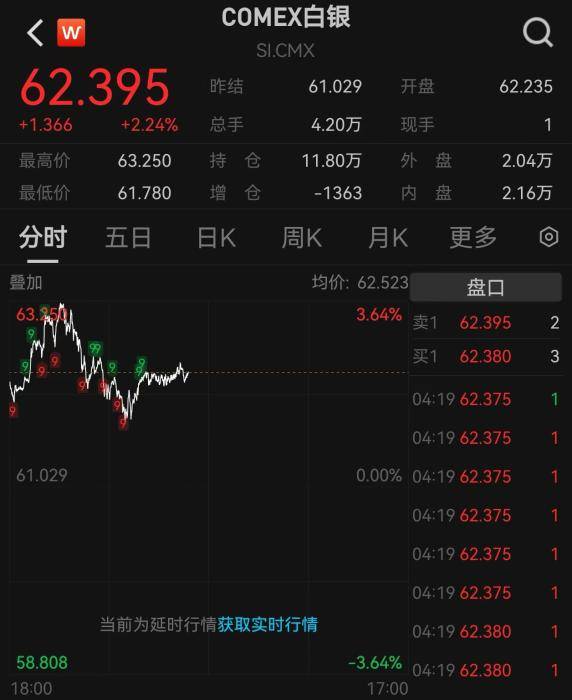
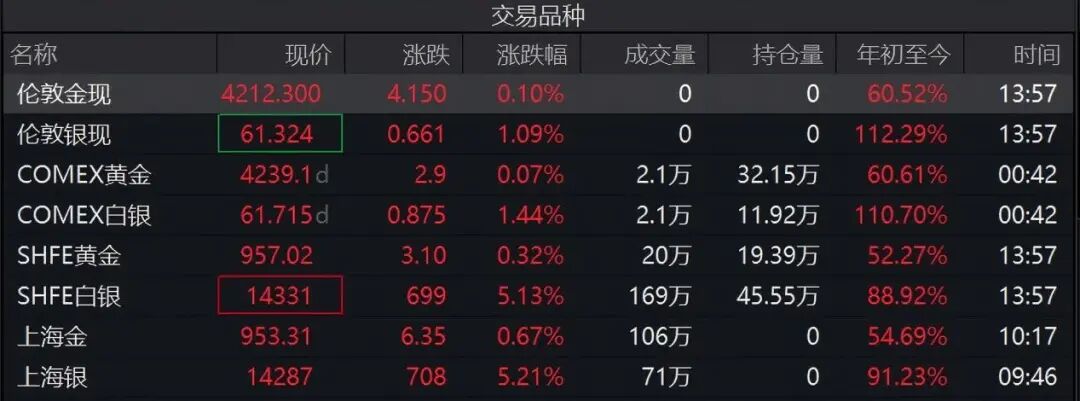
Core Viewpoint - Silver has emerged as a leading investment asset in 2023, with a year-to-date increase of nearly 120%, particularly accelerating in the second half of the year [1][2][3]. Price Movements - As of December 11, 2023, spot silver prices surpassed $62 per ounce, reaching a high of $62.884 per ounce, setting a new historical record [1]. - COMEX silver prices also broke through $63 per ounce, peaking at $63.25 per ounce, while the Shanghai Futures Exchange saw its main silver contract rise to a maximum of 14,655 yuan per kilogram, with an increase exceeding 5% [1][2]. - Silver's price has shown a significant upward trend, with a cumulative increase of nearly 120% for the year, particularly after breaking the $40 per ounce mark on September 1, 2023 [3]. Market Drivers - The Federal Reserve's decision to lower the benchmark interest rate by 25 basis points to a range of 3.50%—3.75% has been a key driver, marking the third consecutive rate cut of the year and a total reduction of 75 basis points [2]. - Silver's price is more sensitive to changes in the dollar due to its smaller market size compared to gold, attracting investors seeking lower-cost safe-haven assets [2][4]. - Strong industrial demand for silver, particularly in sectors like AI servers, photovoltaics, and electric vehicles, is expected to support prices [4][5]. Supply and Demand Outlook - The Silver Institute predicts a structural supply deficit of approximately 95 million ounces in the global silver market by 2025, marking the fifth consecutive year of supply shortages [5]. - Global silver supply is expected to remain stable at around 813 million ounces, with a slight increase in recycling supply, while demand from the photovoltaic industry is projected to significantly boost silver demand [5]. Future Market Expectations - Analysts suggest that while silver prices may experience short-term volatility, the long-term bullish outlook remains intact due to ongoing geopolitical tensions and economic uncertainties [6][7]. - The price of silver is expected to trade between $43 and $62 per ounce by 2026, primarily driven by investment demand [6].
美联储年内最后一次降息 如何影响明年金价?
Sou Hu Cai Jing· 2025-12-11 13:34
Group 1 - The Federal Reserve announced a 25 basis point cut in the federal funds rate, bringing it to a target range of 3.5% to 3.75%, marking the third rate cut of the year [1] - Following the rate cut, precious metal prices surged, with spot gold reaching a high of $4247.68 per ounce, a maximum increase of 0.58%, and COMEX gold hitting $4277.7 per ounce, a maximum increase of 1.25% [1] - Silver prices also hit historical highs, with spot silver reaching $62.884 per ounce, a maximum increase of 1.74%, and COMEX silver reaching $63.25 per ounce, a maximum increase of 3.64% [1] Group 2 - The Federal Open Market Committee showed significant internal dissent, with 9 members voting in favor of the rate cut and 3 against, indicating increased uncertainty in future monetary policy [3] - The cautious stance of the Federal Reserve regarding future rate cuts may suppress gold prices in the short term, as market consensus on easing is difficult to form [4] - Despite the uncertainty, long-term support factors for gold remain intact, including central bank demand, currency credit substitution, and geopolitical tensions [4] Group 3 - Silver prices have shown a significant upward trend, with a year-to-date increase of over 110%, outpacing gold's increase of over 60% [5] - The strong performance of silver is attributed to its dual role as a safe-haven asset and an important industrial metal, with growing demand in sectors like electronics and renewable energy [6] - Structural supply issues, including low global silver inventories and stagnant mine production, continue to drive silver prices higher [6]
贺利氏:贵金属价格或在2026年上半年呈现下行趋势
Zheng Quan Shi Bao Wang· 2025-12-11 11:00
Core Viewpoint - The report from Heraeus Precious Metals indicates that gold, silver, and platinum group metals prices may experience a downward trend in the first half of 2026, following previous highs driven by strong demand and macroeconomic factors [1][2] Group 1: Price Trends and Influencing Factors - Precious metal prices are expected to undergo consolidation after significant increases, with gold likely to have the strongest support due to robust central bank demand and favorable macroeconomic conditions [1] - Industrial demand weakness and recession risks pose significant downward pressure on platinum group metals, while silver's price may be more volatile due to industrial headwinds [1][2] - The report anticipates that the global market will face both economic and geopolitical challenges, with major economies like the US and Europe experiencing slower growth and persistent inflation affecting monetary policy [1] Group 2: China's Role and Future Demand - China remains a key factor in global demand trends, with economic stimulus measures potentially supporting industrial activity, although adjustments in photovoltaic policies may slow silver demand growth [2] - Initiatives related to green hydrogen and fuel cell technology in China's 14th Five-Year Plan may drive long-term demand for ruthenium and iridium [2] - The precious metals market may be influenced by slowing economic growth, geopolitical uncertainties, and ongoing transformations in the automotive industry, with low real interest rates and sustained inflation supporting investment demand [2]
白银:一场“逼空”行情酝酿中?
对冲研投· 2025-12-10 08:50
Market Trends - On December 10, the main silver futures contract on the domestic futures market surged by 5.44%, reaching a record high of 14,419.00 yuan/kg [1] - As of December 9, the world's largest gold ETF, SPDR Gold Trust, saw a decrease in holdings by 1.14 tons, with current holdings at 1,047.97 tons. Meanwhile, the largest silver ETF, iShares Silver Trust, maintained its holdings at 15,888.54 tons [1] Short Squeeze Dynamics - The current situation in the silver market resembles a potential "short squeeze," characterized by three key signals: 1. Price divergence from inventory, with silver prices rising significantly while global inventories are declining [4][6] 2. Strong demand for physical silver, particularly in industrial applications like photovoltaics, and a shift in markets like India towards silver due to high gold prices [7] 3. Accumulation of delivery pressure, as COMEX silver open interest remains high, with December being a delivery month, potentially forcing shorts to cover at higher prices [8] Risks Behind the Rally - The silver market has seen a 110% increase this year, leading to concerns about potential volatility due to high prices and market sentiment [9] - The sustainability of the short squeeze is uncertain; if exchanges increase delivery buffers or inventories are replenished, the short squeeze logic may weaken [10] - Leveraged products in the market can amplify both gains and losses, necessitating careful position management by investors [11] - Industrial demand may not be consistently realized, as technological substitutions and usage reductions could impact short-term demand growth [12] Future Outlook - Analysts suggest that the current price behavior of silver is more akin to gold's breakout in 2023-2024 rather than the bull markets of 1980 or 2011, indicating potential for further price increases in the future [13] - Expectations of interest rate cuts in December could bolster market sentiment, but the high price levels and overbought conditions may lead to increased sensitivity to macroeconomic news [14] - Structural supply-demand imbalances, particularly due to low capital expenditure in mining and increased demand from India, are contributing to the upward pressure on silver prices [15] - The overall market remains in a tight supply situation, with low inventories and strong ETF demand, creating a challenging environment for price declines [16][17]

黄金涨不动了,白银为啥还在涨?
3 6 Ke· 2025-12-10 07:59
Core Insights - Silver prices have surged significantly, surpassing $60 per ounce, marking a historical high, with a year-to-date increase of over 110%, compared to gold's 60% rise [1][2] Group 1: Price Movements - On October 9, silver prices reached $60.83 per ounce during trading, closing at $60.65, reflecting a daily increase of 4.4% [1] - Year-to-date, silver has outperformed gold, with silver's price increase being more than double that of gold [1][2] Group 2: Market Drivers - The recent surge in silver prices is attributed to three main factors: 1. Expectations of U.S. Federal Reserve policy changes, with a potential interest rate cut anticipated in early 2026, leading to a decline in real interest rates [2][3] 2. Increased industrial demand, particularly from the photovoltaic sector and AI-related industries, which has driven up orders for silver [2][3] 3. Supply constraints from key mining regions, raising concerns about future silver supply [3][4] Group 3: Investment Behavior - The rising silver prices have led to increased interest in silver investments, although many investors are cautious due to high prices [5] - The current high recovery price for silver, which is significantly higher than gold, has led to a higher loss rate for silver when reselling [5] Group 4: Market Dynamics - The divergence in performance between gold and silver is attributed to their differing market drivers, with silver benefiting from industrial demand and supply disruptions, while gold's price has stabilized due to already priced-in geopolitical risks [4][6] - The current market structure for silver, including high ETF holdings and speculative positions, may amplify price volatility [7]
白银价格突破57美元创历史新高,年内涨幅达90%
Sou Hu Cai Jing· 2025-12-04 00:44
Price Surge and Market Performance - Silver prices have surged past $57, reaching a historical peak, with a year-to-date increase of over 90%, significantly outpacing gold's 56% rise [1] - On November 28, 2025, COMEX silver futures rose by 6.06% to $57.085 per ounce, while London spot silver surpassed $56 per ounce, marking a historic record [1] Independent Market Dynamics - Silver has exhibited a unique "rapid rise and resistance to decline" characteristic, maintaining upward momentum even when gold experiences short-term pullbacks [2] Core Driving Factors - The expectation of a Federal Reserve interest rate cut has surged to 89%, weakening the dollar and enhancing the appeal of non-yielding assets [3] - Increased safe-haven demand due to Middle East conflicts, U.S. government shutdowns, and debt concerns (U.S. debt surpassing $37 trillion) has accelerated capital inflows [4] Industrial Demand Growth - The global photovoltaic installation capacity is expected to exceed 655 GW by 2025, with silver consumption in this sector alone exceeding 5,000 tons annually [5] - The silver usage in new energy vehicles is seven times that of traditional fuel vehicles, with industrial demand now accounting for 58% of total silver consumption [5] - A continuous supply deficit of over 4,000 tons for five consecutive years has led to a decline in London deliverable stocks to 233 tons, a five-year low [5] Market Structure Changes - A short squeeze is occurring as hedge funds reach peak net long positions, compounded by tight inventory conditions [6] - On November 28, the Chicago Mercantile Exchange (CME) experienced an 11-hour trading halt due to technical issues, coinciding with silver's historic high, exacerbating liquidity fears [6] Industry Chain Impact - Beneficiaries include investment silver bar manufacturers and recycling companies, with the latter seeing a 30% increase in recovery volume and prices rising from 7 to 9.4 yuan per gram [7] - Conversely, photovoltaic companies are under pressure as silver constitutes 15% of their component costs, leading some to halt purchases and explore copper alternatives [7] Optimistic Projections - Citigroup has a short-term bullish target of $55, while Bank of America has raised its 2026 target to $65 [8] - In extreme scenarios, silver could potentially reach $100 by 2028-2029 if the current momentum continues [8] Technological and Policy Considerations - The industrialization of copper paste in photovoltaics may reduce silver demand by 500-800 tons annually post-2026 [10] - The U.S. has classified silver as a "critical mineral," which may lead to potential tariffs impacting the supply chain [11]
黄金反常暴涨!美联储降息凉了不跌反涨,现在抄底还是再等等?
Sou Hu Cai Jing· 2025-11-18 10:48
Core Viewpoint - The recent fluctuations in gold prices are influenced by mixed signals from the Federal Reserve regarding interest rate policies and underlying market liquidity expectations [1][3][10]. Group 1: Federal Reserve's Influence - The initial drop in gold prices was due to the Federal Reserve's officials expressing skepticism about a potential interest rate cut in December, leading to a decline of over 2% [1][3]. - There is a division among Federal Reserve officials regarding interest rate cuts, with some opposing a December cut while others remain non-committal, which has created uncertainty in the market [7][8]. - Recent comments from the Federal Reserve Vice Chairman indicated that more data is needed to support a rate cut, which has alleviated immediate market fears [7][8]. Group 2: Market Liquidity Expectations - Barclays Bank predicts that the Federal Reserve may begin purchasing government bonds as early as February next year to manage market reserves, which supports long-term liquidity expectations [10]. - The stability of the Bloomberg Dollar Spot Index has not negatively impacted gold prices, suggesting that the dollar's performance is not currently a significant factor for gold [13]. Group 3: Economic Indicators and Consumer Sentiment - The University of Michigan's consumer sentiment index for November was reported at 60.2, below the expected 62.0, indicating a decline in consumer confidence which may drive investment into gold as a safe haven [15]. - Industrial demand for gold is also increasing due to its applications in electronic components and renewable energy equipment, providing a steady support for gold prices [15]. Group 4: Investment Strategy for Ordinary Investors - Investors should closely monitor the Federal Reserve's December monetary policy meeting, focusing on officials' statements and key economic data, particularly inflation and employment figures [19]. - Geopolitical tensions, such as those in the Middle East, can act as catalysts for gold price increases due to heightened uncertainty [19]. - Long-term investment logic should not be overlooked, as global economic easing and rising industrial demand for gold could provide significant upward potential for gold prices [19][22].
WORLD BANK:当不确定性上升时,黄金价格上涨
Sou Hu Cai Jing· 2025-11-16 09:10
Core Insights - The World Bank predicts that precious metal prices will reach historical highs by 2026, following a 41% increase this year [1] - Gold prices surpassed $4,300 per ounce in October, while silver reached $54 per ounce, before experiencing a slight decline [1] - The demand for gold is expected to remain strong due to ongoing central bank purchases and safe-haven demand, while silver prices are anticipated to rise further due to industrial demand from renewable energy technologies [1][3] Gold Market - Gold demand is projected to grow by 10% year-on-year in the first three quarters of 2025, driven by strong investment inflows, including from gold ETFs and central bank purchases [2] - Central banks' gold purchases have reached record levels, with the amount since 2022 being more than double the average from 2015-2019 [2] - Gold prices are expected to increase by approximately 42% in 2025, marking the largest annual increase since the late 1970s [2] Silver Market - Silver prices surged to around $54 per ounce in mid-October, supported by safe-haven demand and strong industrial needs [3] - Industrial applications account for over half of silver demand, with expectations for continued growth driven by renewable energy and semiconductor production [3] - Silver prices are forecasted to rise by about 34% in 2025 and an additional 8% in 2026, despite slow supply growth [3] Platinum Market - Platinum prices have increased significantly due to production falling to multi-year lows, with automotive demand expected to grow moderately [3] - The supply of platinum is anticipated to recover slightly, mainly due to increased mining output in South Africa, but will still remain below demand [3] - Platinum prices are expected to rise by 29% in 2025 and approximately 4% in 2026 [3] Overall Market Outlook - The outlook for precious metals is skewed towards the upside, with potential upward pressure from escalating geopolitical tensions and trade frictions [4] - Downside risks include a hawkish stance from U.S. monetary policy and a potential easing of geopolitical tensions, which could suppress investment demand [4]
