
智能化

Search documents
吉利汽车(00175.HK)2025年报点评:出海高端共筑盈利长坡
Ge Long Hui· 2026-03-24 23:24
Core Viewpoint - Geely Auto reported a revenue of 345.2 billion yuan for 2025, a year-on-year increase of 25%, with a net profit attributable to shareholders of 16.85 billion yuan, up 0.2% year-on-year. The core net profit, excluding foreign exchange gains and losses, reached 14.41 billion yuan, a year-on-year increase of 36% [1] Group 1: Financial Performance - In Q4 2025, Geely's revenue was 105.8 billion yuan, a year-on-year increase of 22% and a quarter-on-quarter increase of 19%, with a sales volume of 854,000 vehicles, up 24% year-on-year and 12% quarter-on-quarter [1] - The gross profit margin for Q4 2025 was 16.9%, a decrease of 0.5 percentage points year-on-year but an increase of 0.3 percentage points quarter-on-quarter [1] - Investment income for Q4 2025 was 930 million yuan, an increase of 430 million yuan year-on-year and 570 million yuan quarter-on-quarter [1] Group 2: Product Strategy and Sales Goals - Geely plans to launch over 10 new models in 2026, continuing a strong new product cycle, with a sales target of 3.45 million vehicles, representing a 14% year-on-year increase [2] - The high-end product strategy is progressing well, with the launch of flagship models such as the Galaxy M9, Lynk & Co 900, and Zeekr 9X in 2025 [2] - The Zeekr 8X, a flagship SUV, was launched with a pre-sale price range of 376,800 to 516,800 yuan, achieving over 10,000 orders in just 38 minutes [2] Group 3: Profit Growth and Market Outlook - Geely's high-end and export strategies are expected to drive profit growth, with a target of 640,000 vehicles for export in 2026, a year-on-year increase of 52% [3] - The automotive industry is showing signs of recovery, with improved expectations for electric vehicle exports following recent oil and gas price increases [3] - The company is projected to achieve a price-to-earnings ratio (PE) of 8 times in 2026, with potential for valuation recovery as industry expectations improve [3] Group 4: Strategic Integration and Technological Advancements - Geely is advancing strategic integration under the "Taizhou Declaration," aiming to optimize sales, management, and R&D expense ratios through technology sharing and joint procurement [4] - The year 2025 marks a critical turning point for Geely's "Smart Geely 2025" strategy, transitioning from investment to realization of smart technology [4] - Collaborations with partners like Samsung and Changxin are expected to yield new technologies and cost advantages in core components, enhancing competitive strength in the second half of the smart competition [4] Group 5: Earnings Forecast and Valuation - The forecast for Geely's net profit for 2026-2027 has been adjusted to 25 billion and 27.8 billion yuan, respectively, with a projected PE of 8.0 times, 6.9 times, and 6.3 times for 2028 [5] - Based on historical valuation levels and recent industry performance, the target PE for 2026 has been raised to 10-12 times, corresponding to a target price of 26.17-31.40 HKD, indicating a potential upside of 25-50% [5]

双林股份(300100) - 300100双林股份投资者关系管理信息20260324
2026-03-24 14:18
Group 1: Company Overview and Market Position - In 2025, the global automotive industry accelerated transformation driven by electrification and intelligence, with fierce market competition [3] - The company maintains a leading position in core automotive components while strategically positioning itself for future industries [3] - The company has established a manufacturing base in Thailand, achieving local production for wheel bearings and electric drive products [3] Group 2: Financial Performance - In 2025, the company achieved revenue of CNY 5.48 billion, a year-on-year increase of 11.67% from CNY 4.139 billion in 2023 [6] - Net profit attributable to shareholders exceeded CNY 503 million, with a basic earnings per share of CNY 0.89 [6] - The company's gross profit margin improved by 2-3 percentage points in various segments, despite a slight decline in the bearing business [8] Group 3: Research and Development - R&D expenses reached CNY 220 million, accounting for 4.02% of revenue, reflecting a 30.71% year-on-year increase [9] - The company has developed a reverse planetary roller screw for humanoid robots and acquired advanced grinding technology, establishing a complete industrial chain [3][9] Group 4: Production Capacity and Product Development - The company has established a production line capable of producing 100,000 units annually for roller screws, with plans for further expansion based on customer demand [13] - The joint development of distributed electric drive corner module technology with Tsinghua University has entered the industrialization phase, with the first commercial project expected to launch in mid-2026 [17] Group 5: Strategic Goals and Future Outlook - The company aims to focus on high-value automotive products, enhance operational efficiency, and expand into emerging fields such as humanoid robots and low-altitude economy [4] - Key strategies include deepening the automotive core business, promoting humanoid robot production, accelerating new technology commercialization, and pursuing cost reduction and digital transformation [4] Group 6: Risk Management - The company is closely monitoring changes in overseas tariff policies and has taken measures such as establishing overseas factories to mitigate risks [4] - Continuous optimization of customer structure is being implemented to reduce dependency on single clients [4] Group 7: IPO Progress - The company has received a filing notice from the China Securities Regulatory Commission for its Hong Kong IPO, with a new prospectus expected to be completed soon [21]

吉利汽车(00175.HK)2025年报点评:出海高端共筑盈利长坡
Huachuang Securities· 2026-03-24 13:25
Investment Rating - The report maintains a "Strong Buy" rating for Geely Automobile, expecting it to outperform the benchmark index by over 20% in the next six months [2][17]. Core Insights - Geely Automobile reported a revenue of 345.2 billion yuan for 2025, a year-on-year increase of 25%. The net profit attributable to shareholders was 16.85 billion yuan, up 0.2% year-on-year, while the core net profit, excluding foreign exchange gains and losses, reached 14.41 billion yuan, marking a 36% increase year-on-year [2][8]. - The company is in a strong new product cycle, planning to launch over 10 new models in 2026, with a target sales volume of 3.45 million units, representing a 14% year-on-year increase [2][8]. - Geely's high-end product strategy and export growth are expected to significantly enhance profitability, with a projected net profit of over 45 billion yuan in Q1 2026 [2][8]. Financial Performance Summary - For 2025, Geely's total revenue is projected at 351.4 billion yuan, with a year-on-year growth rate of 45.7%. The net profit attributable to shareholders is expected to be 16.85 billion yuan, reflecting a growth rate of 1.3% [8][9]. - The company anticipates a continued increase in revenue and net profit through 2028, with projected revenues of 547.9 billion yuan and net profits of 31.5 billion yuan by that year [8][9]. - The report highlights a projected PE ratio of 10-12 times for 2026, with a target price range of 26.17-31.40 HKD, indicating a potential upside of 25-50% from the current price of 20.90 HKD [2][8].
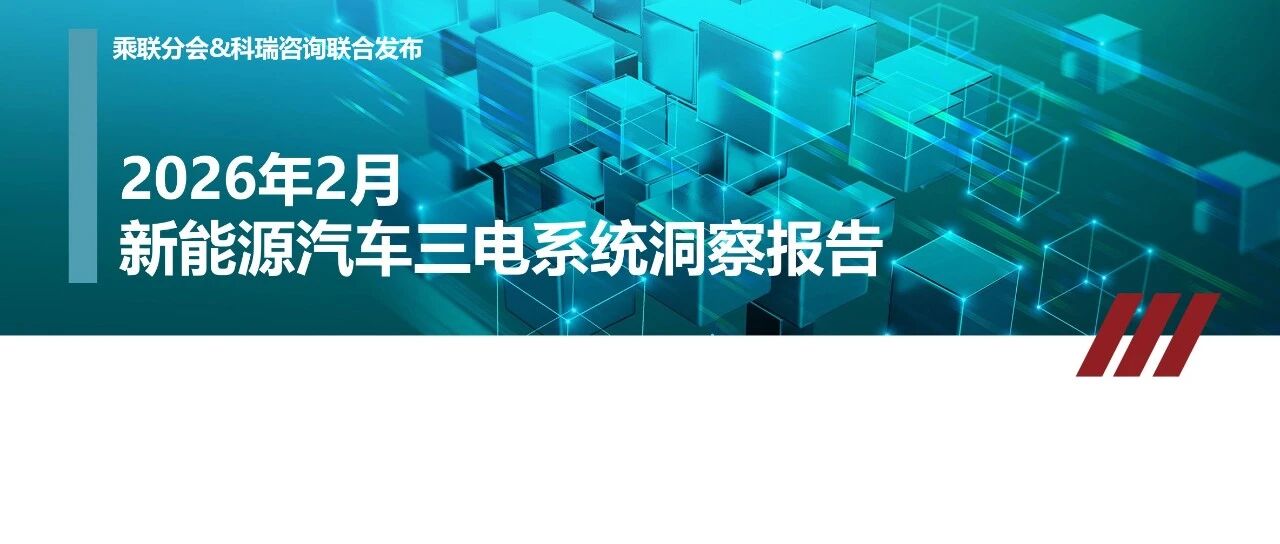
【联合发布】2026年2月新能源汽车三电系统洞察报告
乘联分会· 2026-03-24 08:42
Key Insights - The article discusses the current state and trends in the Chinese electric vehicle (EV) market, highlighting a decline in production and sales due to policy and consumer sentiment impacts, while emphasizing the need for product innovation and policy support to stimulate demand [5][7]. Group 1: Market Performance - In January-February 2026, China's EV production reached 1.604 million units, a year-on-year decrease of 13.7%, with a cumulative penetration rate of 39.9% [5]. - The market is undergoing structural adjustments, with a notable shift towards high-end and intelligent vehicles, but overall sales are declining [7]. - In February 2026, the market shares for different vehicle types were: Cars at 34.0% (down 17.2 percentage points), SUVs at 54.9%, MPVs at 4.7%, trucks at 4.0%, and buses at 2.4% [11]. Group 2: Battery Market Dynamics - In February 2026, the installed capacity of EV batteries was 27.3 GWh, a year-on-year decrease of 19.2%, while the cumulative growth rate for the first two months was 37.4% [17]. - The average battery capacity per vehicle was 62.0 kWh, reflecting a year-on-year increase of 29.2%, with major contributors being Xiaomi, BYD, and Tesla [17]. - In terms of battery cell types, square cells accounted for 97.8%, cylindrical cells for 1.9%, and pouch cells for 0.2% [18]. Group 3: Leading Battery Manufacturers - In February 2026, the top three battery manufacturers held a market share of 76.5%, with the top ten accounting for 95.8%. CATL led with a 52.7% share, followed by BYD and LG [20]. - LG experienced a significant year-on-year growth of 293.7%, driven by increased Tesla sales [20]. Group 4: Drive Motor Supply Chain - In February 2026, the top ten drive motor suppliers accounted for 62.4% of the market, with a decline in supply volume observed across all major players [23]. - The leading supplier, Fudi Power, saw a 55.5% decrease in supply volume, while Tesla's supply remained stable [24]. Group 5: Solid-State Battery Development - Solid-state battery technology is categorized by electrolyte types, including sulfide, oxide, polymer, and composite electrolytes, each with distinct advantages and industrial progress [33][34]. - The core advantages of solid-state batteries include enhanced safety, performance breakthroughs, and adaptability across various applications [35]. - The development of solid-state batteries is expected to progress through three stages: semi-solid state leading from 2024-2026, full solid state breakthroughs from 2027-2030, and cost parity post-2030 [39][40].




上汽红岩拿下重磅合作 聚焦海外智能重卡市场!
第一商用车网· 2026-03-24 06:50
Core Viewpoint - The strategic partnership between SAIC Hongyan and Xidi Zhijia focuses on the development of intelligent heavy trucks for overseas markets, marking a significant step in their collaboration in the commercial vehicle sector [2][3]. Group 1: Strategic Cooperation - The signing event on March 20, 2026, solidifies the strategic cooperation agreement initially signed on February 6, 2026, in Chongqing, emphasizing a comprehensive collaboration in the intelligent heavy truck field [1][2]. - The partnership aims to integrate the strengths of both companies, with SAIC Hongyan's expertise in commercial vehicle manufacturing and Xidi Zhijia's capabilities in intelligent networking technology [2]. Group 2: Market Focus and Development - The collaboration will focus on joint research and development of intelligent heavy trucks, integration of intelligent functions, and promotion in overseas markets [2][3]. - The partnership is expected to enhance the product development cycle and facilitate the delivery of overseas orders, thereby supporting the international expansion of Chinese intelligent commercial vehicles [3].

——汽车行业周报:宇树科技披露招股书,小米发布新一代SU7-20260323
Guohai Securities· 2026-03-23 09:06
Investment Rating - The report maintains a "Recommended" rating for the automotive industry [1] Core Insights - The automotive industry is experiencing a structural transformation with opportunities in high-end domestic brands and accelerated penetration of smart technologies. Despite challenges such as the reduction of new energy vehicle purchase tax incentives, the overall sentiment for 2026 remains optimistic [4][13] - The report highlights significant growth in companies like Yushu Technology, which reported a revenue of 1.71 billion yuan in 2025, a year-on-year increase of 335.4%, and a net profit of 600 million yuan, up 674.3% [11] - Xiaomi's new generation SU7 was launched with advanced safety and intelligent driving features, indicating a trend towards enhanced vehicle technology [12] Summary by Sections Recent Trends - The automotive sector's performance from March 16 to March 20 shows a decline of 4.4%, with passenger vehicles increasing by 0.8% while commercial vehicles decreased by 4.0% [14] - The report notes that the A-share automotive sector outperformed the Shanghai Composite Index during this period [14] Key Companies and Earnings Forecast - The report provides a detailed earnings forecast for key companies, recommending stocks such as BYD, Geely, and Great Wall Motors, with various ratings from "Buy" to "Increase" based on their projected earnings per share (EPS) and price-to-earnings (PE) ratios [6][54] - For instance, BYD is projected to have an EPS of 5.33 in 2026 with a "Buy" rating, while Great Wall Motors is expected to have an EPS of 1.70 with an "Increase" rating [54] Industry Indicators - In February 2026, the automotive production and sales figures were reported at 1.672 million and 1.805 million units respectively, showing a year-on-year decline of 20.5% and 15.2% [34] - New energy vehicles accounted for approximately 42.4% of total new vehicle sales, indicating a significant market share despite the overall decline [34]



蔚小理纷纷盈利之后,战事升级
凤凰网财经· 2026-03-22 14:39
Core Viewpoint - The article discusses the significant milestone achieved by China's leading new energy vehicle manufacturers, namely NIO, Li Auto, and Xpeng, as they all reported profitability for the first time in 2025, marking a turning point in the industry [4][5][6]. Group 1: Profitability of New Energy Vehicle Manufacturers - Xpeng Motors reported a net profit of 380 million yuan in Q4 2025, indicating a major shift in its financial performance [4][13]. - The three leading companies, NIO, Li Auto, and Xpeng, have different paths to profitability, with Li Auto delivering 406,343 vehicles, Xpeng 429,445 vehicles, and NIO 326,028 vehicles in 2025 [9][10]. - Xpeng's revenue reached 76.72 billion yuan, with a year-on-year growth of 87.7%, while NIO and Li Auto reported revenues of 87.49 billion yuan and 112.3 billion yuan, respectively [9]. Group 2: Strategies and Market Positioning - Li Auto is characterized as the "efficiency faction," focusing on cost control and high product margins, which allowed it to achieve self-sustainability first [10]. - NIO represents the "steadfast faction," investing heavily in the high-end electric market and battery swapping systems, ultimately reaching breakeven in 2025 [10]. - Xpeng is identified as the "technology faction," emphasizing smart driving technology and achieving significant growth in deliveries and gross margin [10][11]. Group 3: Future Challenges and Market Dynamics - The article emphasizes that achieving profitability is just the beginning, as the market competition is expected to intensify in 2026 with traditional automakers and new entrants like Huawei and Xiaomi [12]. - Maintaining growth post-profitability is crucial, as the industry faces ongoing price wars and the need for continuous innovation [12][28]. - Xpeng's cash reserves of 47.66 billion yuan as of December 31, 2025, provide a strong foundation for navigating future challenges and sustaining operations without external financing [22][25].


汽车及汽车零部件:油价上涨利好中国新能源车,理想发布下一代自动驾驶基础模型
SINOLINK SECURITIES· 2026-03-22 12:36
Investment Rating - The report suggests a positive outlook for the industry, particularly in the context of rising oil prices benefiting China's new energy vehicles and advancements in autonomous driving technology [1][2][4]. Core Insights - The international oil price has significantly increased, which is expected to boost the demand for new energy vehicles in China as consumers face higher fuel costs for traditional vehicles [1]. - The report highlights the launch of the next-generation autonomous driving model by Li Auto, which aims to enhance the company's position in the global intelligent vehicle market [2]. - The sales of passenger vehicles are gradually recovering, with a notable increase in new energy vehicle sales, indicating a shift in consumer preferences [3][4]. Summary by Sections Weekly Insights - Domestic fuel prices have been raised, with 92 and 95 octane gasoline increasing by 0.55 and 0.58 CNY per liter respectively, leading to a projected monthly fuel cost increase of over 350 CNY for typical private car usage [1]. - The report anticipates a recovery in new energy vehicle orders and sales due to rising fuel costs and consumer sentiment shifting towards electric vehicles [1]. Industry Data Tracking - The wholesale sales of passenger vehicles in February 2026 were 1.514 million units, a year-on-year decrease of 14.4%, while new energy vehicle wholesale sales were 709,000 units, also down 14.3% year-on-year [6]. - The retail sales of passenger vehicles in February 2026 were 1.116 million units, down 12.8% year-on-year, with new energy vehicle retail sales at 430,000 units, reflecting a significant year-on-year decline of 34.5% [6][29]. Industry Dynamics - The report notes that the export of passenger vehicles has maintained a growth rate of over 20% year-on-year for six consecutive months, indicating a strong international demand for Chinese vehicles [4]. - The report emphasizes the importance of intelligent vehicle technology and the potential for significant growth in the robotics industry, driven by advancements in autonomous driving and smart vehicle architectures [4][17]. Investment Recommendations - The report recommends focusing on companies such as BYD, Geely, and Li Auto for their strong positions in the electric vehicle market and advancements in intelligent driving technology [4][17].
——周一刻钟,大事快评(W147):小鹏、蔚来、理想、贝斯特更新
Shenwan Hongyuan Securities· 2026-03-22 11:32
Investment Rating - The report maintains an "Overweight" rating for the automotive industry, indicating an expectation for the industry to outperform the overall market [8]. Core Insights - The report highlights significant investment opportunities in the automotive sector, particularly focusing on companies like Xiaopeng, NIO, Li Auto, and Best, driven by advancements in AI and smart driving technologies [3]. - Xiaopeng Motors is emphasized for its potential in AI applications and the VLA 2.0 smart driving system, with a recommendation to buy based on expected market recognition adjustments [3]. - NIO is noted for its stable gross margin and strong Q1 2026 delivery performance, with new product launches expected to maintain margins in the 18%-20% range [3]. - Li Auto's market performance is under scrutiny, with cautious guidance for Q1 2026, but the report suggests that negative expectations are already priced in, leading to potential future optimism [3]. - Best is projected to see growth in its main business, supported by new growth curves in turbocharger components and advancements in its new energy and robotics sectors [3]. Summary by Relevant Sections Xiaopeng Motors - Focus on AI application investment opportunities and the VLA 2.0 smart driving system [3]. - Current valuation restructuring presents trading opportunities [3]. NIO - Strong Q1 2026 delivery performance, particularly with the ES 8 model [3]. - Expected stable gross margin between 18%-20% due to new product launches [3]. Li Auto - Cautious Q1 2026 performance guidance, with new L9 model launch as a key variable [3]. - Market has already reflected pessimistic expectations, suggesting potential for renewed optimism [3]. Best - Anticipated growth in main business driven by new product lines and partnerships [3]. - New energy and robotics sectors expected to contribute positively to future profitability [3]. Investment Analysis - The report suggests focusing on companies that leverage AI and high-end technology, including new entrants like Xiaopeng, NIO, and Li Auto, as well as established players with overseas business support like BYD and Geely [3]. - Emphasis on companies with strong performance potential in the supply chain, particularly in robotics and data center cooling technologies [3].

吉利汽车(00175):系列点评三十九:2025完美收官,2026出海+高端化
Guolian Minsheng Securities· 2026-03-22 11:05
Investment Rating - The report maintains a "Buy" rating for Geely Automobile [8][13]. Core Views - Geely Automobile achieved total sales of 3.025 million vehicles in 2025, representing a year-on-year increase of 39%. The sales revenue reached 345.23 billion RMB, up 25.1% year-on-year. The net profit attributable to shareholders was 16.85 billion RMB, a slight increase of 0.2% year-on-year, while the core net profit attributable to shareholders rose by 36% to 14.41 billion RMB [3][4]. Revenue and Delivery Performance - In Q4 2025, revenue was 105.76 billion RMB, showing a year-on-year increase of 22.4% and a quarter-on-quarter increase of 18.6%. The total sales volume for Q4 was 854,000 vehicles, up 24.4% year-on-year and 12.3% quarter-on-quarter. New energy vehicle sales reached 520,000 units, a year-on-year increase of 51.9% [4][5]. - The average selling price (ASP) for vehicles in Q4 2025 was 124,000 RMB, reflecting a quarter-on-quarter increase of 7,000 RMB, driven by the higher proportion of premium products [4]. Profitability and Cost Structure - The gross margin in Q4 2025 was 16.9%, a year-on-year decrease of 0.5 percentage points but an increase of 0.3 percentage points quarter-on-quarter. The improvement in product mix and the introduction of high-end products contributed to this trend [5][6]. - R&D expenses in Q4 2025 reached 5.91 billion RMB, a quarter-on-quarter increase of 1.5 billion RMB, with a full-year R&D expense of 17.62 billion RMB, up 29% year-on-year [6]. International Market Expansion - In Q4 2025, Geely's export sales reached 124,000 vehicles, a year-on-year increase of 29.9% and a quarter-on-quarter increase of 10.7%. The total export volume for the year was 420,000 vehicles, up 1.3% year-on-year [7]. Future Outlook - For 2026, Geely aims to achieve export sales of 640,000 vehicles, a year-on-year growth of 52%. The company plans to focus on three major markets: Europe, Eastern Europe, and ASEAN, and aims to expand its overseas channel count to over 2,200 [11]. - Geely is committed to enhancing its high-end and intelligent product offerings, with expectations of selling 300,000 units of its premium brand Zeekr, a 34% increase year-on-year, and 400,000 units of Lynk & Co, a 14% increase year-on-year [12].