智能消费

Search documents
业内人士称智能眼镜或成市场增长最快黑马
Xin Lang Cai Jing· 2026-01-05 13:00
Core Insights - Smart consumption is becoming a new engine for driving domestic demand in China, propelled by both policy initiatives and market demand [1] Group 1: Market Trends - AI smartphones and AI computers are emerging as the main drivers for trade-in programs, indicating a shift in consumer preferences towards intelligent devices [1] - Smart glasses are identified as a potential "dark horse" in the market, likely to experience rapid growth [1] Group 2: Future Opportunities - The next 3-5 years will see clear potential in two major sectors: intelligent connected vehicles, which represent a trillion-level industry, and household service robots, showcasing cutting-edge "embodied intelligence" technology [1]
家电数码补贴15% 点燃跨年焕新热
Sou Hu Cai Jing· 2026-01-03 07:16
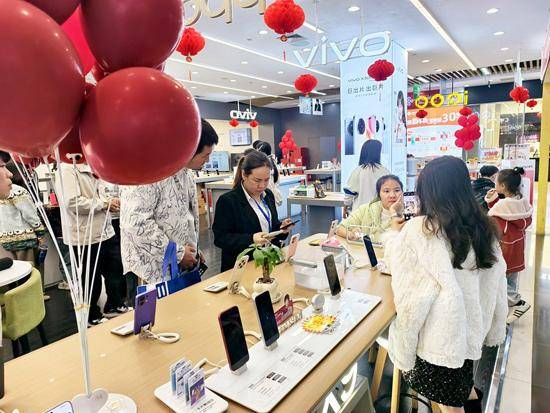
Core Viewpoint - The government subsidy program launched in Nanning for home appliances and digital products during the New Year holiday has significantly boosted consumer spending, with discounts reaching up to 60% and a 15% government subsidy on eligible products [6][11]. Group 1: Government Subsidy Program - The "National Subsidy" program offers a 15% subsidy on home appliances and digital products, with a maximum subsidy of 1500 yuan for appliances and 500 yuan for digital items [11]. - The program includes six categories of home appliances (refrigerators, washing machines, TVs, air conditioners, computers, and water heaters) and four categories of digital products (mobile phones, tablets, smartwatches, and smart glasses) [11]. - The subsidy program is set to last until December 31, with monthly funding limits that may pause the program if exhausted [11]. Group 2: Consumer Response and Sales Impact - The promotional activities during the New Year saw a doubling of customer traffic in participating stores, with sales of energy-efficient appliances increasing by 100% on January 2 alone [7][11]. - Consumers are taking advantage of the combined government subsidies and store promotions, leading to significant savings, with some reporting nearly 50% off their purchases [6][7]. - The program has particularly resonated with younger consumers, who are drawn to the high cost-performance ratio of subsidized digital products [10]. Group 3: Retailer Strategies and Services - Retailers are enhancing customer service by offering lifetime free maintenance for large appliances and free health checks for returning customers [8][12]. - Stores have optimized delivery processes, promising delivery within three days for large appliances and prioritizing service for loyal customers [12]. - Retailers are well-stocked with subsidized products to meet the increased demand during this peak shopping season [11].

2026国补:无需抽签摇号,单人最高省11000元
Guan Cha Zhe Wang· 2025-12-31 05:54
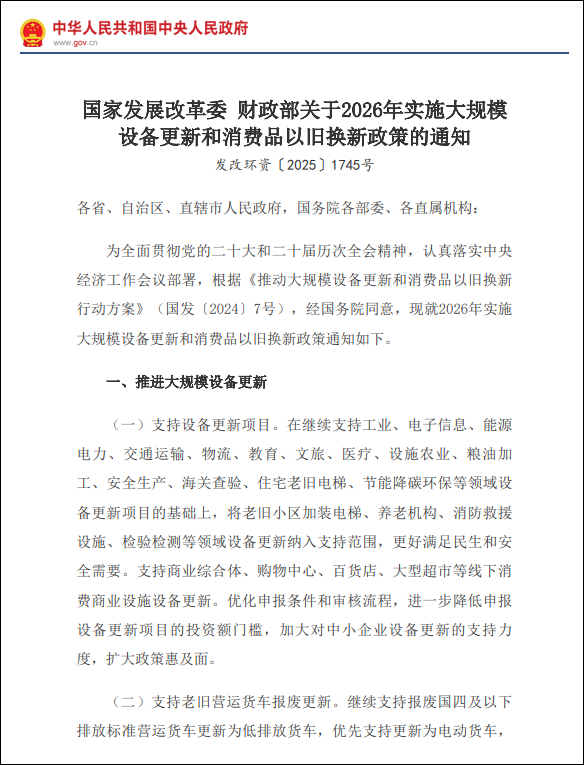
Core Viewpoint - The new policy for 2026 aims to enhance consumer spending through a large-scale equipment update and trade-in program, incorporating new technologies like AI glasses and standardizing subsidy calculations across the nation [1][4][5]. Group 1: Subsidy Expansion and Product Categories - The 2026 national subsidy policy expands its support to include both digital and smart products, with AI glasses being newly eligible alongside smartphones, tablets, and smartwatches, all capped at a price of 6000 yuan for subsidies [4]. - The policy also addresses essential living standards by including updates for old residential elevators and equipment in elderly care facilities, as well as safety equipment for fire rescue and inspection [4]. - Traditional household appliances remain a focus, with subsidies for refrigerators, washing machines, televisions, air conditioners, computers, and water heaters, limited to those meeting energy efficiency standards [4]. Group 2: Unified Subsidy Standards and Green Initiatives - The new policy establishes a nationwide uniform subsidy standard, promoting green and energy-efficient products, with household appliances receiving a subsidy of 15% of the sales price, capped at 1500 yuan per item [5]. - Digital and smart products will also receive a 15% subsidy, with a maximum of 500 yuan per item, ensuring that consumers can benefit from mainstream consumer products [5]. - The automotive sector will see subsidies calculated as a percentage of the vehicle price, with specific caps for both new energy and fuel vehicles, encouraging a shift towards greener transportation [5]. Group 3: Simplified Application Process - The new policy eliminates the lottery and waiting periods for subsidy applications, allowing all eligible consumers to apply directly without the need for a lottery system [6]. - The application process has been streamlined, enabling consumers to access subsidies through platforms like JD.com, with automatic deductions at the point of sale [6]. - A funding guarantee mechanism has been established, with 625 billion yuan allocated to ensure timely subsidy disbursement, alleviating financial pressure on businesses [6]. Group 4: Enhanced Regulation and Service - The policy includes strict measures to prevent fraudulent claims and ensures that subsidies are used appropriately through comprehensive digital management [7]. - Consumers can combine national subsidies with other promotional offers, enhancing the overall value of the subsidies available [7]. - The focus on rural areas and physical retail development aims to ensure that consumers in less accessible regions can also benefit from the subsidies [7].

2026国补新政落地,无需抽签摇号,单人累计最高省11000元
Guan Cha Zhe Wang· 2025-12-31 05:35
Core Viewpoint - The new policy for 2026 aims to enhance consumer spending through a large-scale equipment update and trade-in program, incorporating subsidies for emerging smart devices like AI glasses, and streamlining the application process for consumers [1][4][6]. Group 1: Policy Adjustments - The 2026 national subsidy policy expands its scope to include both digital and smart products, with AI glasses being newly eligible for subsidies alongside smartphones, tablets, and smartwatches [4]. - The policy introduces a unified national subsidy standard, optimizing the calculation method and ensuring that all eligible consumers can apply without restrictive measures like lotteries [5][6]. - The subsidy for household appliances is focused on six core categories: refrigerators, washing machines, televisions, air conditioners, computers, and water heaters, with a cap of 1500 yuan per item [4][5]. Group 2: Subsidy Standards and Implementation - The subsidy for digital and smart products is set at 15% of the sales price, with a maximum of 500 yuan per item, applicable to mainstream consumer products [5]. - For automobiles, the subsidy structure includes 12% for scrapping old vehicles when purchasing new energy cars (up to 20,000 yuan) and 10% for fuel vehicles (up to 15,000 yuan) [5]. - The application process has been simplified to allow for immediate subsidy access, with online platforms like JD.com facilitating direct claims without additional paperwork [6]. Group 3: Consumer and Market Impact - The policy aims to stimulate rural consumption by providing substantial subsidies and support for logistics and service networks, ensuring that rural consumers can benefit from the national subsidy [1][7]. - The government has allocated 625 billion yuan in special long-term bonds to ensure the availability of subsidy funds, preventing issues related to funding shortages [6]. - The overall adjustments in the subsidy policy are expected to enhance consumer experience, promote green consumption, and drive economic growth through increased spending and industry upgrades [7].

智能消费改变了什么
Xin Lang Cai Jing· 2025-12-22 18:17
Group 1 - The rise of smart consumption is transforming production methods, industrial structures, and social relationships, extending beyond mere lifestyle changes [1] - Many manufacturing companies are adopting a "customization" approach instead of focusing solely on mass production, reducing resource waste and enabling precise manufacturing [1] - Nike's customized shoes exemplify the consumer-to-manufacturer (C2M) model, allowing consumers to personalize their products while ensuring quick order fulfillment through smart factories [1] Group 2 - Smart consumption is creating new economic opportunities and diverse new business models, leading to the emergence of professions such as smart home operation technicians and AI lifestyle consultants [2] - The transformation of Shenzhen's Huaqiangbei into a hub for smart hardware innovation showcases a complete industrial chain from research and development to sales, enhancing consumer experiences with technologies like self-checkout systems and smart ordering robots [2] - These new business models are expanding economic growth boundaries and creating job opportunities, positioning them as vital support for the new economy [2] Group 3 - Smart consumption presents challenges for certain demographics, particularly the elderly, who may struggle with technology due to operational barriers and cognitive differences [3] - Addressing these challenges requires "age-friendly" technology design, such as simplified interfaces and additional support in public spaces to ensure inclusivity [3] - The rise of smart consumption is prompting market regulation upgrades, with Shenzhen leading the way in establishing guidelines to protect consumer privacy and data security [3] - Innovative applications of smart consumption are emerging in various sectors, enhancing visitor experiences in cultural and recreational settings [3]

【时代风口】 智能消费改变了什么
Zheng Quan Shi Bao· 2025-12-22 18:03
Group 1 - The core idea of the articles is that smart consumption is transforming various aspects of life, industry, and social relationships, moving beyond mere convenience to drive significant changes in production methods and industry structures [1][2][3] - Smart consumption has led to the rise of customized products, with companies like Nike allowing consumers to design their own shoes, thus shifting from mass production to precision manufacturing [1] - The emergence of new professions such as smart home operation technicians and AI lifestyle consultants highlights the economic opportunities created by smart consumption [2] Group 2 - There is a need for "age-friendly" technology design to ensure that older adults can also benefit from smart consumption, which currently poses challenges for them due to operational barriers [3] - Market regulation is evolving in response to smart consumption, with cities like Shenzhen implementing guidelines to protect consumer data and privacy [3] - Smart consumption is not only a technological advancement but also a necessary outcome of economic development, promising to enhance efficiency and vitality in society [3]
陇原烟火气升腾 新消费活力涌动
Xin Lang Cai Jing· 2025-12-22 00:51
Core Viewpoint - The consumption market in Gansu is experiencing a significant recovery, driven by policy benefits and market vitality, with a notable increase in retail sales of consumer goods. Group 1: Consumption Market Performance - From January to October, Gansu's total retail sales of consumer goods reached 354.52 billion yuan, showing a year-on-year growth of 2.5% [1] - The restaurant industry has seen a resurgence, with long queues at local specialty dining establishments and night markets [1] - The demand for new energy vehicles, home appliances, and furniture has surged, with retail sales growth exceeding 20% for these categories in the first half of the year [1] Group 2: Emerging Consumption Trends - The rise of green, smart, and experiential consumption is becoming a new trend in Gansu's market, with significant increases in orders for AI energy-saving air conditioners and smart refrigerators [2] - The demand for mid-to-high-end home appliances is being driven by the "old-for-new" policy, with consumers benefiting from subsidies [2] - New energy vehicle consumption has seen a remarkable growth rate of 38.1% in the first three quarters of 2025 [2] Group 3: Tourism and Cultural Consumption - Gansu welcomed 400 million tourists from January to September, generating tourism spending of 315.6 billion yuan, marking a substantial year-on-year increase [2] - The integration of cultural and tourism experiences is expanding the market, with activities ranging from cultural studies at Dunhuang Mogao Caves to eco-experiences in Gannan [2] Group 4: Promotional Activities and Infrastructure - Gansu has implemented various promotional activities such as "old-for-new policy benefits + special promotions," "New Year goods festival," and "automobile exhibition," which have stimulated diverse consumer demand [3] - The combination of promotional events and infrastructure upgrades is continuously igniting market enthusiasm [3] - The ongoing trend of consumption upgrading and the release of policy effects are expected to create new opportunities for high-quality economic development in the province [3]
国民消费大会体验区“上新” 地方特产科技好物助力品质新生活
Ren Min Wang· 2025-12-02 07:42
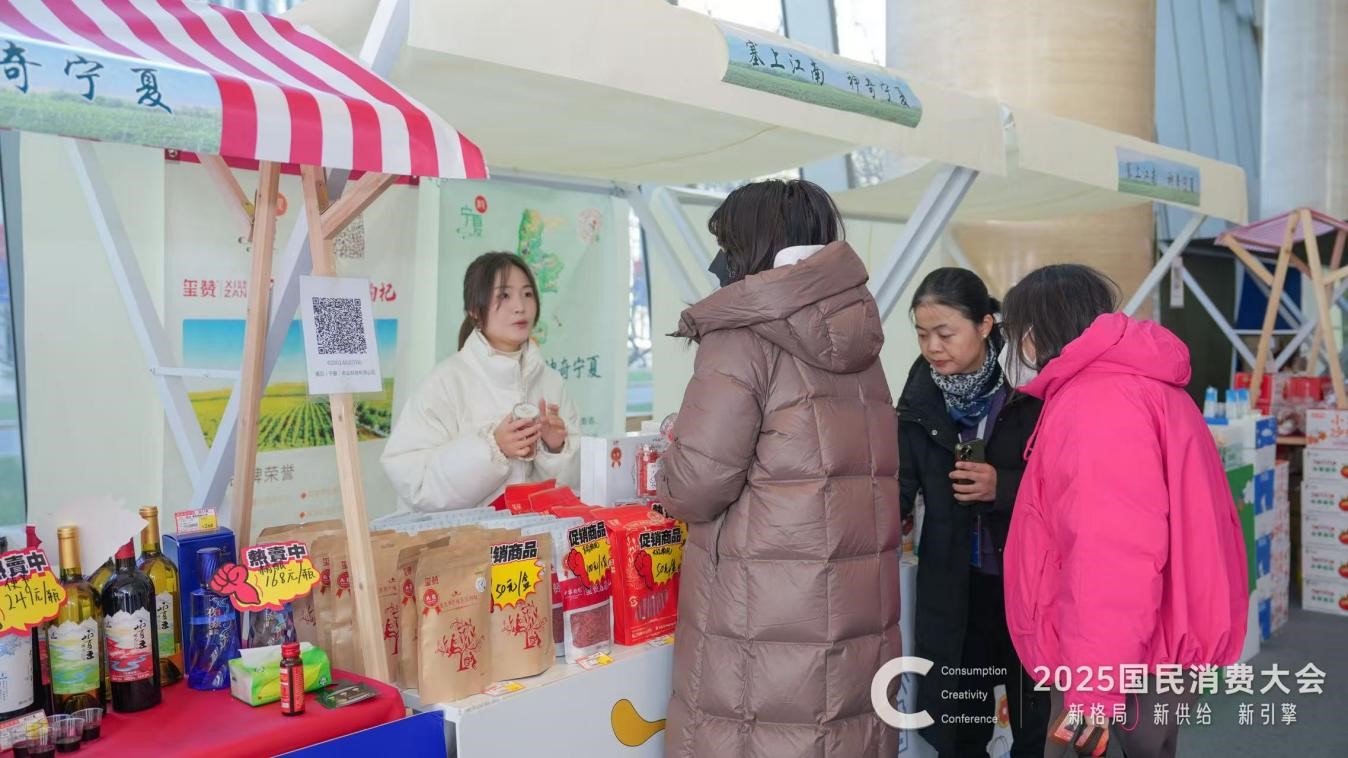
Core Insights - The 2025 National Consumption Conference launched the "Quality Consumption Month" and "Employee Care Season," showcasing local specialties, smart technology, health foods, and time-honored brands to highlight new consumption trends and enhance quality of life [1][10] Group 1: Local Specialties - Various local products were showcased, including Guangxi snail noodles, Heilongjiang blueberries, Jilin ginseng, Inner Mongolia yogurt, and Ningxia goji berries, attracting many visitors who appreciated the authentic taste of their hometowns [1] - The Ningxia representative office emphasized its role as a bridge to promote local products in Beijing, aiming to enhance the quality of life through authentic flavors [1] Group 2: Technology Integration - The technology experience area featured innovative lifestyle products, with a focus on smart drinking devices that garnered significant interest from health-conscious attendees [1][4] - Companies provided explanations of the entire production-to-consumption process, enhancing consumer understanding of modern service systems [1] Group 3: Health Consumption - The health consumption area displayed a variety of products, including children's food, premium fruits, and dairy products, with attendees actively engaging in product inquiries and tastings [3][6] - Interactive demonstrations in the dairy section allowed consumers to learn about healthier options available in the market [3] Group 4: Time-Honored Brands - Several time-honored brands participated, offering classic products alongside new low-sugar and light food options, appealing to younger audiences with trendy packaging [5][8] - A visitor noted the blend of traditional techniques and modern tastes in the offerings from a time-honored pastry brand [5] Group 5: Interactive Experience - The event featured multiple interactive segments, including a lottery in the People's Preferred Quality Life Experience Area, which created a lively atmosphere and provided useful lifestyle service information [8][10] - The conference aimed to enhance the sense of gain and happiness among employees by focusing on their daily lives and holiday purchasing needs [10]
从“买商品”到“享服务” 我国消费市场向“质”升级
Xiao Fei Ri Bao Wang· 2025-11-23 23:57
Group 1: Core Insights - The recent "Double 11" shopping festival highlights a clear path for the upgrade of China's consumer market towards quality, driven by the popularity of smart technology products and service consumption [1][2][4] Group 2: Smart Technology Consumption - Smart technology products have significantly influenced consumer behavior, with over 50% of shopping carts containing such items during the festival [3] - Policies aimed at boosting consumption have led to an 18.2% year-on-year increase in sales of digital electronic products in the first three quarters of the year [3] - The average consumer purchased 4.9 categories of goods, with a notable rise in demand for quality products like digital devices and smart home appliances [4] Group 3: Service Consumption Growth - Service consumption emerged as a new highlight during "Double 11," with hotel orders increasing nearly 8 times and flight bookings up 6.3 times year-on-year [5] - The shift towards a balanced consumption structure between goods and services is evident, with service retail sales growing by 5.2% in the first nine months of the year, outpacing goods retail sales [6][7] Group 4: Emotional and Cultural Consumption - Emotional connection and cultural identity are becoming key drivers of new consumption scenarios, expanding the domestic demand space [8] - The popularity of emotional consumption is reflected in the significant growth of products related to emotional engagement, such as blind boxes and game peripherals, with some categories seeing over 100% week-on-week growth [9] - The integration of traditional aesthetics with modern design is enhancing product competitiveness, as seen in brands that incorporate traditional craftsmanship into contemporary offerings [10]
5家消费品公司拿到新钱;李佳琦回应一夜之间赔了20亿;红果内测短剧带货|创投大视野
36氪未来消费· 2025-10-25 08:12
Group 1 - Blue Noxxi completed a 8 million RMB angel round financing to support the development and market expansion of its teeth whitening and oral care project in collaboration with Shanghai Aimeiya Medical Technology Research Center [2] - Tongyou Network completed a 100 million RMB Series A financing, focusing on building a digital consumption ecosystem driven by technology and data, while empowering rural revitalization and promoting green consumption [3][4] - Punk Coding completed a new round of financing worth several tens of millions, focusing on the development of popular culture toys and IP innovation [5] - Qiye Bakery completed a Pre-A round financing of 30 million RMB, aimed at improving smart equipment channels and production lines [6] - Bangzhu Intelligent completed a 70 million RMB angel round financing to accelerate the nationwide layout of its "smart unmanned AI bar" product [7] Group 2 - Li Jiaqi responded to rumors of losing 2 billion RMB during Double Eleven, stating that the claims were false and part of a smear campaign against him [8] - Wa Xiaozhi's chairman made his first live appearance, announcing a promotional policy where purchasing 300,000 RMB worth of goods would reward buyers with an SUV [9] - Qian Dao clarified misunderstandings regarding a recent refund incident, emphasizing that the issue arose from personal transactions and not from platform policies [10] - Fengchao's IPO process is stalled due to disputes with investors, particularly regarding buyback issues [11] - Roma Technology's shares have been frozen, and the company has recalled over 160,000 power banks [12] Group 3 - Hongguo has initiated a small-scale internal test for short drama e-commerce, aiming to drive traffic to Douyin e-commerce [13] - Bawang Tea Ji opened a new store at Shanghai Oriental Pearl Tower, enhancing brand visibility at a major tourist site [14] - Guming announced a collaboration with the classic anime "Crayon Shin-chan," offering themed packages with various merchandise [15] - Guming launched a promotional campaign offering coffee at a limited-time price of 2.9 RMB during breakfast hours [16] Group 4 - Domestic tourism in China saw 4.998 billion trips in the first three quarters of 2025, a year-on-year increase of 18% [18] - Investment in silver bars is in high demand, with prices rising nearly 70% this year, leading to shortages in stores [19] - The smart glasses market experienced a shipment increase of over 64% in the first half of 2025, with expectations for continued growth [20][21] - Coffee prices in the U.S. have risen nearly 21% year-on-year due to tariffs imposed on coffee imports [22] - Korean literature saw a 130% increase in overseas sales last year, reaching a record high of 1.2 million copies [23] - In the first nine months, China's postal industry completed 158.26 billion deliveries, a 15% year-on-year growth [24]