
流动性风险

Search documents
“翻倍基”乍现背后 基金经理依然相信港股繁荣刚刚开始
Zheng Quan Shi Bao· 2026-01-11 17:00
Core Viewpoint - The Hong Kong stock market is experiencing a prolonged consolidation phase, with significant challenges in liquidity and performance, particularly in sectors like innovative pharmaceuticals and technology, which previously showed strong growth [1][2][3] Group 1: Market Performance - In early 2026, the A-share market is performing well, while the Hong Kong stock market continues to struggle, particularly in sectors that previously led the market [1] - By the end of 2025, the performance of Hong Kong-themed funds, especially in innovative pharmaceuticals, has declined significantly, with only one fund showing over 112% growth [2] - The Hang Seng Index and Hang Seng Technology Index remain in a consolidation phase, contributing to the underperformance of related thematic funds [2] Group 2: Liquidity Issues - Liquidity is identified as a critical factor restraining the Hong Kong market, with a significant drop in net inflows from southbound funds, which were only 23 billion HKD in December 2025 [3] - The IPO market in Hong Kong is expected to remain active, with total fundraising projected to exceed 300 billion HKD in 2026, posing challenges for liquidity [3] - There is a structural liquidity issue in the Hong Kong market, characterized by concentrated trading in large-cap stocks while small-cap stocks experience very low trading volumes [3] Group 3: Investment Strategies - Investment in Hong Kong stocks should prioritize "winning rate over odds," emphasizing value investing and risk diversification to mitigate liquidity risks [6] - Investors are advised to maintain a cautious approach, focusing on high-quality companies with strong fundamentals and historical integrity, as these are likely to enjoy valuation premiums [6] - The current appreciation of the RMB is seen as a potential driver for increased capital inflows into the Hong Kong market, enhancing its attractiveness [4] Group 4: Sector Focus - Fund managers express optimism about technology and consumer sectors, highlighting the relative undervaluation of Hong Kong stocks compared to global markets [7] - There is a growing interest in high-end manufacturing and innovative consumer sectors, with a focus on companies that leverage supply chain advantages and product innovation [8] - The tea beverage industry is noted for its improving competitive landscape, with leading companies expected to achieve stable long-term growth due to their cost advantages [8]
日度策略参考-20260109
Guo Mao Qi Huo· 2026-01-09 05:51
Report Industry Investment Rating No relevant content provided. Core View of the Report - The market sentiment cooled slightly yesterday, with the commodity market weakening significantly and the stock index showing a volatile trend. The trading volume also contracted. After a rapid rise, the stock index has entered a stage of shock consolidation. There are no obvious macro-level negatives at present, and the short-term outlook for the stock index remains bullish. The bond futures are favored by the asset shortage and weak economy, but the central bank has recently warned of interest rate risks. Attention should be paid to the Bank of Japan's interest rate decision. [1] - The prices of various commodities are affected by different factors, such as supply and demand, policy changes, and macro sentiment. The report provides trend judgments and trading suggestions for each commodity, including metals, energy, chemicals, and agricultural products. [1] Summary by Related Catalogs Macro Finance - Stock Index: After a rapid rise, the stock index has entered a stage of shock consolidation. There are no obvious macro-level negatives at present, and the short-term outlook for the stock index remains bullish. Attention should be paid to capital flows and market sentiment changes. [1] - Treasury Bonds: The bond futures are favored by the asset shortage and weak economy, but the central bank has recently warned of interest rate risks. Attention should be paid to the Bank of Japan's interest rate decision. [1] Non-Ferrous Metals - Copper: The copper price has fallen from its recent high, but there are still disruptions in the mining end. The downside space for the copper price is expected to be limited. [1] - Aluminum: There has been an accumulation of domestic electrolytic aluminum stocks recently, and the industrial driving force is limited. The macro anti-involution sentiment has ebbed, and the aluminum price has fallen from its high. [1] - Alumina: The supply side of alumina still has a large release space, and the industrial side exerts downward pressure on the price. However, the current price is basically near the cost line, and the price is expected to fluctuate. [1] - Zinc: The fundamentals of zinc have improved, and the cost center has shifted upward. The recent macro sentiment has been good, and the zinc price has risen. However, considering the still existing pressure on the fundamentals, caution is advised regarding the upside space. [1] - Nickel: The market's concerns about nickel supply have significantly cooled, and the LME nickel inventory has increased significantly recently. The nickel price has corrected from its high. Since Indonesia has not disclosed the specific amount and said that it is still in the process of accounting, there is still uncertainty about the implementation of the subsequent policy. The short-term volatility risk of the nickel price has increased. Attention should be paid to the implementation of Indonesia's policy, changes in macro sentiment, and changes in futures positions, and risk control should be done well. [1] Precious Metals and New Energy - Gold and Silver: The annual weight adjustment of the BCOM index has officially started, and the exchange has introduced multiple risk control measures for silver to suppress speculative enthusiasm. The prices of precious metals have fallen across the board, with a significant decline in silver. In the short term, gold and silver are expected to continue to be weak and volatile. In the medium and long term, attention can be paid to the opportunity to buy on dips after this round of risk release. [1] - Platinum and Palladium: Platinum and palladium have followed the weakening of precious metals. In the short term, they are expected to be in a wide-range volatile pattern. In the medium and long term, with the still existing supply-demand gap for platinum and the tendency of palladium to have a loose supply, platinum can still be bought on dips or a [long platinum, short palladium] arbitrage strategy can be adopted. [1] Industrial Products - Industrial Silicon: There is an increase in production in the northwest and a decrease in production in the southwest. The production schedules for polysilicon and organic silicon in December have decreased. [1] - Polysilicon: It is the traditional peak season for new energy vehicles. The demand for energy storage is strong. The supply side has increased production resumption. There is a short-term rapid increase. [1] - Rebar and Hot Rolled Coil: In the short term, sentiment and capital have a greater influence than industrial contradictions. One can try to follow long positions with a stop-loss; for futures-spot trading, participate in positive spread positions. [1] - Iron Ore: There is sector rotation, but the upside pressure on iron ore is obvious. It is not recommended to chase long positions at this level. [1] - Non-Ferrous Metals: There is a combination of weak reality and strong expectations. The current supply and demand situation remains weak, but in terms of expectations, energy consumption double control and anti-involution may have an impact on supply. [1] - Soda Ash: Soda ash follows the trend of glass. In the medium term, the supply and demand situation will be more relaxed, and the price will be under pressure. [1] - Coking Coal and Coke: If the "capacity reduction" expectation continues to ferment and there is pre-holiday restocking of spot goods, coking coal may still have room to rise. However, since the current market's "capacity reduction" expectation mainly comes from online rumors, it is difficult to judge the actual upside space. After a significant increase, the volatility will intensify, and caution should be exercised. The logic for coke is the same as that for coking coal. [1] Agricultural Products - Palm Oil: The MPOB December data is expected to be bearish for palm oil, but palm oil will reverse under the themes of seasonal production reduction, the B50 policy, and US biodiesel in the future. Short-term rebounds due to macro sentiment should be watched out for. [1] - Soybean Oil: The fundamentals of soybean oil are relatively strong. It is recommended to allocate more in the oil sector and consider a long Y, short P spread. Wait for the January USDA report. [1] - Rapeseed Oil: The trade relationship between China and Canada may improve, and Australian rapeseed will be imported smoothly. After the rapeseed trade flow is opened up, the trading logic of rapeseed oil will gradually shift from the domestic tight supply situation to the global rapeseed production increase expectation. There is still room for the price to fall. Short-term rebounds due to macro sentiment should be watched out for. [1] - Cotton: There is a strong expectation of a good harvest for domestic new crops, and the purchase price of seed cotton supports the cost of lint cotton. The downstream operating rate remains low, but the inventory of yarn mills is not high, and there is a rigid demand for restocking. Considering the growth of spinning capacity, the demand for cotton in the new crop market year is relatively resilient. Currently, the cotton market is in a situation of "having support but no driving force." Future attention should be paid to the tone of the No. 1 Central Document in the first quarter of next year regarding the direct subsidy price and cotton planting area, the intention of cotton planting area next year, the weather during the planting period, and the demand during the "Golden Three and Silver Four" peak season. [1] - Sugar: Currently, there is a global surplus of sugar, and the supply of domestic new crops has increased. The short-selling consensus is relatively strong. If the futures price continues to fall, there will be strong cost support below. However, there is a lack of continuous driving force in the short-term fundamentals. Attention should be paid to changes in the capital side. [1] - Corn: The fundamentals of corn have not changed significantly. The spot price remains firm, and the progress of grain sales at the grassroots level is relatively fast. Most traders have not yet strategically built inventories, and feed enterprises maintain a safe inventory. There is a certain restocking demand before the holiday. The short-term outlook for CO3 is expected to be oscillating and slightly bullish. Attention should be paid to the dynamics of policy grain auctions. [1] - Soybean Meal: The domestic market may restart the auction of imported soybeans; the relationship between China and Canada is expected to ease, and China is expected to suspend the tax on Canadian rapeseed meal; the macro sentiment has cooled, and the domestic market has returned to the fundamentals and shown a significant decline. Recently, it has been greatly affected by policy news. The soybean meal futures price is expected to be mainly oscillating in the short term. Attention should be paid to the adjustment of the January USDA supply and demand report and the trend of the Brazilian premium. [1] - Pulp: Pulp has fallen today due to the decline in the commodity macro market. The overall price has not broken through the oscillating range. The short-term commodity sentiment fluctuates greatly, and it is recommended to observe cautiously. [1] - Logs: The spot price of logs has shown a certain sign of bottoming out and rebounding recently. The further downside space for the futures price is expected to be limited. However, the January overseas quotation has still slightly declined, and the log futures and spot markets lack upward driving factors. It is expected to oscillate in the range of 760 - 790 yuan/m³. [1] - Hogs: Recently, the spot price has gradually stabilized. Supported by demand and with the出栏体重 not yet fully cleared, the production capacity still needs to be further released. [1] Energy and Chemicals - Crude Oil: OPEC+ has suspended production increases until the end of 2026. There is uncertainty about the Russia-Ukraine peace agreement. The United States has imposed sanctions on Venezuela's crude oil exports. [1] - Fuel Oil: In the short term, the supply-demand contradiction is not prominent, and it follows the trend of crude oil. The probability of the 14th Five-Year Plan's rush demand being falsified is high, and the supply of Ma Rui crude oil is not short. The profit of asphalt is relatively high. [1] - BR Rubber: The futures position has declined, and the number of new warehouse receipts has increased. The increase in BR has slowed down temporarily. The spot price has led the rise to repair the basis, and BR continues to focus on the upward momentum above the 12,000 yuan line. The listed prices of BD/BR have been continuously raised, and the processing profit of butadiene rubber has narrowed. The overseas cracking device capacity has been cleared, which is beneficial to the long-term export expectation of domestic butadiene. The tax on naphtha also has a positive impact on the butadiene price. Fundamentally, butadiene rubber maintains high production and high inventory operation, and the trading center is generally average. Styrene-butadiene rubber is relatively better than butadiene rubber. [1] - PX and PTA: The PX market has experienced a rapid rise, but this round of rise is not due to a fundamental change. The fundamentals of PX do have support, and the market is expected to continue to tighten in 2026, driven by the new PTA production capacity in India and the organic growth of demand. Domestic PTA maintains high production. The gasoline spread is still at a high level, which supports aromatics. [1] - Ethylene Glycol: There is news that two sets of MEG plants in Taiwan, China, with a total annual capacity of 720,000 tons, plan to stop production next month due to efficiency reasons. Ethylene glycol has rebounded rapidly during the continuous decline, stimulated by supply-side news. The current operating rate of the polyester downstream remains above 90%, and the demand performance is slightly better than expected. [1] - Short Fiber: The PX market has experienced a rapid rise, but this round of rise is not due to a fundamental change. Domestic PTA maintains high production, and the domestic polyester load has declined. The short fiber price continues to closely follow the cost fluctuations. [1] - Styrene: The Asian styrene market is generally stable. Suppliers are reluctant to lower prices due to continuous losses, while buyers insist on pressing prices due to weak downstream polymer demand and compressed profits. Although the downstream demand is weak, the domestic market has a strong bullish sentiment due to export support. The market is in a weak balance state, and the short-term upward momentum needs to be driven by the overseas market. [1] - Urea: The export sentiment has slightly eased, and there is limited upside space due to insufficient domestic demand. There is support from anti-involution and the cost side below. [1] - PF: Geopolitical conflicts have intensified, and there is a risk of an increase in crude oil prices. There are fewer maintenance activities, the operating load is at a high level, and there are overseas arrivals, so the supply has increased. The downstream demand operating rate has weakened. In 2026, there will be more new production capacity, and the supply-demand surplus will further intensify, and the market expectation is weak. [1] - Propylene: There are fewer maintenance activities, the operating load is relatively high, and the supply pressure is relatively large. The improvement in the downstream is less than expected. The propylene monomer price is at a high level, the crude oil price has risen, and the cost support is strong. Geopolitical conflicts have intensified, and there is a risk of an increase in crude oil prices. [1] - PVC: In 2026, there will be less global new production capacity, and the future expectation is relatively optimistic. Currently, there are fewer maintenance activities, new production capacity is being released, and the supply pressure is increasing. The demand has weakened, and the orders are not good. The differential electricity price in the northwest region is expected to be implemented, which will force the clearance of PVC production capacity. [1] - LPG: The January CP has risen more than expected, and the cost support for imported gas is relatively strong. The geopolitical conflicts between the United States, Venezuela, and the Middle East have escalated, and the short-term risk premium has increased. The trend of inventory accumulation in the EIA weekly C3 inventory has slowed down, and it is expected to gradually turn to inventory reduction. The domestic port inventory has also decreased. Domestic PDH maintains high production and deep losses. There is a rigid demand for global civil combustion, and the demand for MTBE from overseas olefin blending for gasoline has declined temporarily. Since January 1, 2026, naphtha has been re-taxed, and the long-term demand expectation for light cracking raw materials such as LPG has increased, and the performance of downstream olefin products is relatively strong. [1] Shipping - Container Shipping - European Line: It is expected to peak in mid-January. Airlines are still relatively cautious in their trial reflights. The pre-holiday restocking demand still exists. [1]
国债与企业债的风险差异体现在哪?
Sou Hu Cai Jing· 2026-01-01 09:16
Group 1 - The core difference between government bonds and corporate bonds lies in their credit risk, with government bonds relying on the country's economic strength and fiscal stability, while corporate bonds depend on the issuing company's operational capability and financial health [1] - Government bonds have a high reliability in repayment due to stable sources of fiscal revenue, while corporate bonds face repayment risks if the issuing company experiences operational losses or cash flow issues [1] - Historically, government bonds have maintained a very low default record globally, with no defaults reported in China since their issuance, contrasting with corporate bonds that have varying default risks based on the issuer's credit rating [1] Group 2 - Government bonds enjoy high credit ratings and market acceptance, leading to high trading activity and liquidity in the secondary market, while corporate bonds' liquidity varies based on credit ratings and issuance scale [2] - Economic downturns significantly increase operational pressures on companies, raising the credit risk of corporate bonds, whereas government bonds are less affected by economic fluctuations and serve as a risk-averse investment choice [2]
白银跳水,有大银行爆仓了?
华尔街见闻· 2025-12-29 07:48
Core Viewpoint - The article discusses a significant market event involving a major bank's failure to meet margin requirements in the silver futures market, leading to forced liquidation and potential systemic risks in the banking sector [2][4][6]. Group 1: Market Reaction - On Monday, the spot silver price experienced extreme volatility, initially rising by 6% to nearly $84 per ounce before dropping 4% to $76.15 per ounce, with a low of around $75 during the day [2]. - A rumor circulated on social media regarding a "systemically important bank" facing a margin call in the silver futures market, which drew widespread attention [2][4]. Group 2: Bank's Margin Call - The bank in question reportedly failed to pay an additional $2.3 billion in margin by the required deadline, leading to forced liquidation by the futures exchange [4][7]. - The bank was described as one of the largest participants in the precious metals derivatives market, holding "hundreds of millions of ounces" in short positions [5][6]. Group 3: Market Speculation - There is speculation about the identity of the bank, with guesses focusing on a few large European banks, although the exact name was not disclosed [6][12]. - Analysts expressed differing opinions on the rumor's validity, with some believing that the bank's liquidity reserves could handle the shock, while others warned of a potential panic selling scenario [6][12]. Group 4: Financial Analysis - The bank was required to provide $2.3 billion in cash collateral due to insufficient liquidity, as silver prices surged past $70 per ounce [7][13]. - In extreme scenarios, if the bank's short positions were entirely self-held, it could face liquidity pressures of approximately $7.75 billion, which is manageable given its high-quality liquid assets of around $330 billion [13][14]. Group 5: Potential Risks - The bank is undergoing a complex integration process, with only about 70% of its systems migrated, raising concerns about potential risk spillover [16]. - Market behavior tends to follow a "sell first, ask questions later" pattern, which could exacerbate stock price volatility even if the rumors are unfounded [16]. - The bank's involvement in the London Bullion Market Association (LBMA) adds another layer of uncertainty regarding its liquidity risks, as LBMA's disclosure practices are less transparent than those of COMEX [16].


铅周报:流动性风险支撑,铅价震荡偏强-20251229
Tong Guan Jin Yuan Qi Huo· 2025-12-29 02:48
Report Industry Investment Rating - Not provided in the content Core Viewpoints of the Report - Last week, the lead price of the main SHFE contract rebounded. The US economic data showed strong resilience, and the employment data was moderate, leading to a slight increase in the expectation of the Fed's interest rate cut and a weak US dollar, which was beneficial to the lead price. The lead concentrate market had little trading, and the processing fee was weakly stable. The scrap battery recyclers' reluctance to sell increased, and the quotation was slightly raised. The primary lead smelters had both production cuts and restarts, and the supply improved marginally. The secondary lead supply was still tight due to environmental protection and raw material shortages. The terminal consumption acceptance declined after the end of the new national standard transition period and stricter supervision, and the spot trading was weak. Overall, the warm macro - sentiment and tight domestic spot supported the lead price rebound, but the open lead ingot import window and the expected transfer of overseas high - inventory pressure restricted the rebound height. In the short term, the lead price was expected to remain oscillating strongly, but the risk of a pullback after the New Year's Day holiday should be vigilant [3][6][7] Summary by Relevant Catalog Transaction Data - From December 19th to December 26th, the SHFE lead price rose from 16,880 yuan/ton to 17,555 yuan/ton, an increase of 675 yuan/ton; the LME lead price rose from 1,984.5 dollars/ton to 1,999.5 dollars/ton, an increase of 15 dollars/ton; the SHFE - LME ratio rose from 8.51 to 8.78, an increase of 0.27. The SHFE inventory decreased by 780 tons to 27,095 tons, the LME inventory decreased by 9,725 tons to 248,900 tons, and the social inventory decreased by 0.26 million tons to 1.79 million tons. The spot premium decreased by 5 yuan/ton to - 75 yuan/ton [4] Market Review - Last week, the main SHFE lead contract PB2602 rebounded strongly, closing at 17,555 yuan/ton with a weekly increase of 4%. The LME lead continued to rebound, closing at 1,999.5 dollars/ton with a weekly increase of 0.76%. In the spot market, as of December 26th, the Jiangxi lead in the Jiangsu and Zhejiang regions was reported at 17,300 - 17,330 yuan/ton, with a premium of 30 yuan/ton to the SHFE lead 2601 contract. The spot market had few circulating supplies, and the transaction was sluggish. As of December 26th, the LME weekly inventory was 248,900 tons, a weekly decrease of 9,725 tons. The SHFE inventory was 27,095 tons, a decrease of 780 tons from last week. As of December 25th, the SMM five - region social inventory was 1.79 million tons, a decrease of 0.23 million tons from Monday and 0.26 million tons from last Thursday [5] Industry News - In January 2026, the domestic and foreign lead concentrate processing fees were 300 yuan/metal ton and - 145 dollars/dry ton respectively, with the average remaining flat month - on - month. In November, the lead concentrate import volume was 109,800 tons, a month - on - month increase of 11.7% and a year - on - year increase of 15.78%. The silver concentrate import volume was 181,000 tons, a month - on - month increase of 21.13% and a year - on - year increase of 26.51%. The import volume of refined lead and lead products was 26,000 tons, a month - on - month increase of 42.04%. The export volume of refined lead and lead products was 3,675 tons, a month - on - month decrease of 7.7% and a year - on - year decrease of 4.3% [8] Related Charts - The content includes multiple charts showing the SHFE and LME lead prices, SHFE - LME ratio, SHFE and LME inventories, lead ingot premiums, price differences between primary and secondary lead, scrap battery prices, secondary lead enterprise profits, lead ore processing fees, electrolytic lead and secondary refined lead production, lead ingot social inventory, and refined lead import profit and loss [10][12][14]
央行年度重磅报告 披露三大领域压力测试结果
Sou Hu Cai Jing· 2025-12-28 16:26
Core Insights - The People's Bank of China released the "China Financial Stability Report (2025)", which includes stress test results for banks, public funds, and open bank wealth management products [1][2]. Banking Sector Stress Testing - A total of 3,235 banks were tested for their resilience against various extreme but plausible adverse shocks, revealing strong overall resistance to macroeconomic impacts [2][3]. - The stress tests included macro solvency, liquidity risk, and contagion risk assessments, with credit risk identified as the primary factor affecting capital adequacy [3][4]. Capital Adequacy and Loan Quality - Under different stress scenarios, the overall capital adequacy ratio for participating banks dropped significantly, with a 400% increase in non-performing loans leading to a capital adequacy ratio of 10.54% [7]. - The overall non-performing loan ratio for the 23 participating banks was 1.22% at the end of 2024, projected to rise to 6.55% by the end of 2027 under a severe stress scenario [4][5]. Liquidity Risk Assessment - The liquidity risk stress test indicated that 98.49% of banks passed under light stress conditions, while 96.29% passed under heavy stress, showing an improvement from 2023 [8]. - The liquidity management capability of public funds was assessed, with only 0.01% of funds failing under light stress and 0.34% under heavy stress [9][10]. Non-Banking Sector Insights - The report also analyzed the liquidity risk of public funds and open bank wealth management products, with a total of 3,690 products tested, amounting to 11.79 trillion yuan [2][9]. - The liquidity risk for the tested wealth management products was deemed manageable, with only 171 products failing the test, representing 4.6% of the total [10].
银价狂飙!实探深圳水贝市场:银条、银锭成“爆款”
证券时报· 2025-12-26 15:26
Group 1 - The core viewpoint of the article highlights the significant increase in silver prices, with current prices reaching 22 yuan per gram, up from less than 15 yuan in July and around 17 yuan earlier this month, marking a year-to-date increase of over 150% [1][3] - The demand for silver jewelry has increased, with sales rising nearly 10% month-on-month, and more stores are beginning to sell investment silver bars, indicating a shift in consumer interest from gold to silver [1][3] - The silver market is experiencing strong industrial and investment demand, tightening inventories, geopolitical tensions, and expectations of further interest rate cuts by the U.S., all contributing to the surge in silver prices [3][4] Group 2 - Small and medium investors are increasingly viewing silver bars and ingots as a more accessible investment option compared to gold, with a notable rise in the popularity of 500-gram silver ingots [3] - The price difference between buying and selling silver is larger compared to gold, but recent price increases have also led to a noticeable rise in recovery prices for silver [3] - Analysts predict that precious metals, including silver, will continue to perform strongly in 2026, particularly in the context of a potential crisis of confidence in U.S. debt and the dollar [4]
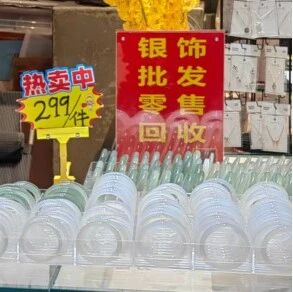
纸白银处上涨轨道 2026年贵金属或迎来转折
Jin Tou Wang· 2025-12-24 05:59
Group 1 - The core viewpoint is that the silver market is experiencing a supply shortage for five consecutive years, while industrial demand continues to grow, supporting price levels [2] - Analysts predict that the price of silver could reach $75, although profit-taking at the end of the year may lead to a price correction [2] - The Federal Reserve's monetary policy and potential leadership changes could impact liquidity and market dynamics, with a key turning point expected around mid-2026 [1] Group 2 - The current trading price of silver is around 16.269 yuan per gram, reflecting a 3.22% increase, with a daily high of 16.418 yuan and a low of 15.755 yuan [1] - The DMI indicator shows a potential risk of a pullback in silver prices, but the overall upward trend remains strong, with support levels at 15.0-15.50 and resistance levels at 16.40-16.80 [3] - The weakening dollar and declining yields are contributing factors to the silver market's performance, affecting its attractiveness to overseas buyers [2]
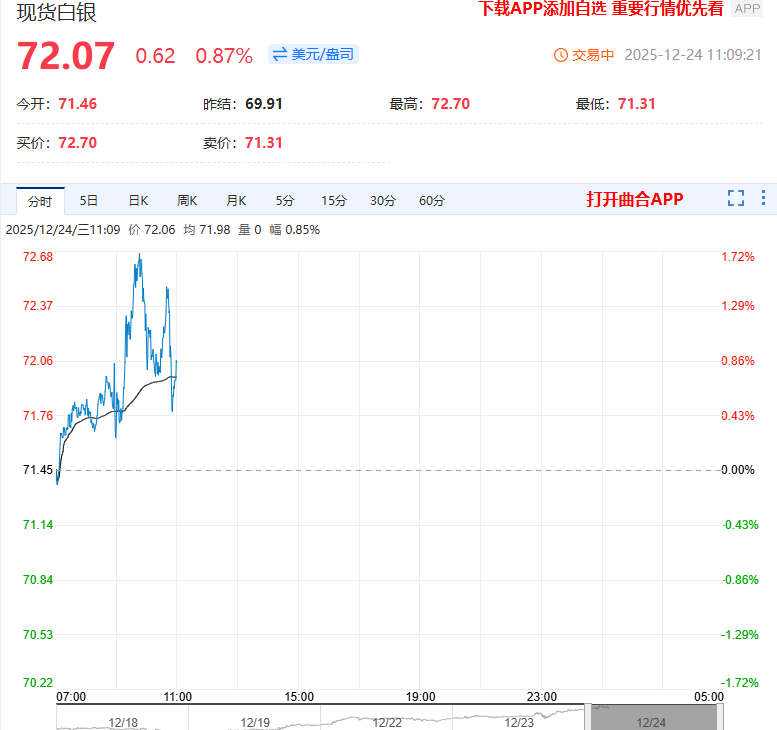
现货白银延续创纪录涨势 首次站上72美元/盎司关口
Jin Tou Wang· 2025-12-24 04:58
Core Viewpoint - Spot silver continues its record surge, surpassing $72 per ounce for the first time, with an intraday increase of 0.87% [1] Group 1: Market Performance - On December 22, the largest silver ETF, SLV (USA), saw an inflow of 533 tons in a single day, marking the fourth-largest single-day inflow in history, second only to the retail squeeze at the end of January 2021 [1] - Analysts from New Lake Futures anticipate that silver may still have some upward potential before the end of December delivery, but caution against the risks of chasing prices [1] Group 2: Supply and Demand Dynamics - Qi Sheng Futures analysts believe that the commodity attributes of precious metals may replace their financial and monetary attributes, becoming the primary driving force behind price movements [1] - The widening supply-demand gap for silver is expected to provide price support, and investors should pay close attention to liquidity risks in light of changes in the overseas macro environment [1]
贵金属的商品属性接棒驱动,转折点或出现在明年年中
Sou Hu Cai Jing· 2025-12-24 00:23
Core Viewpoint - The chief analyst of precious metals at Qisheng Futures, Liu Xufeng, believes that the commodity attributes of precious metals are likely to replace their financial and monetary attributes, becoming the main driving force behind price movements [1] Group 1: Market Trends - The widening supply-demand gap for silver may provide price support [1] - A key turning point in the precious metals market could occur around mid-2026 [1] Group 2: Macroeconomic Environment - The expected appointment of Kevin Hassett, who is perceived as dovish, to succeed Federal Reserve Chairman Jerome Powell in May 2026 may accelerate the pace of monetary policy easing [1] - The Federal Reserve has resumed balance sheet expansion in response to economic downturn pressures and the longest government shutdown in history, but there are potential risks of marginal tightening in liquidity [1]