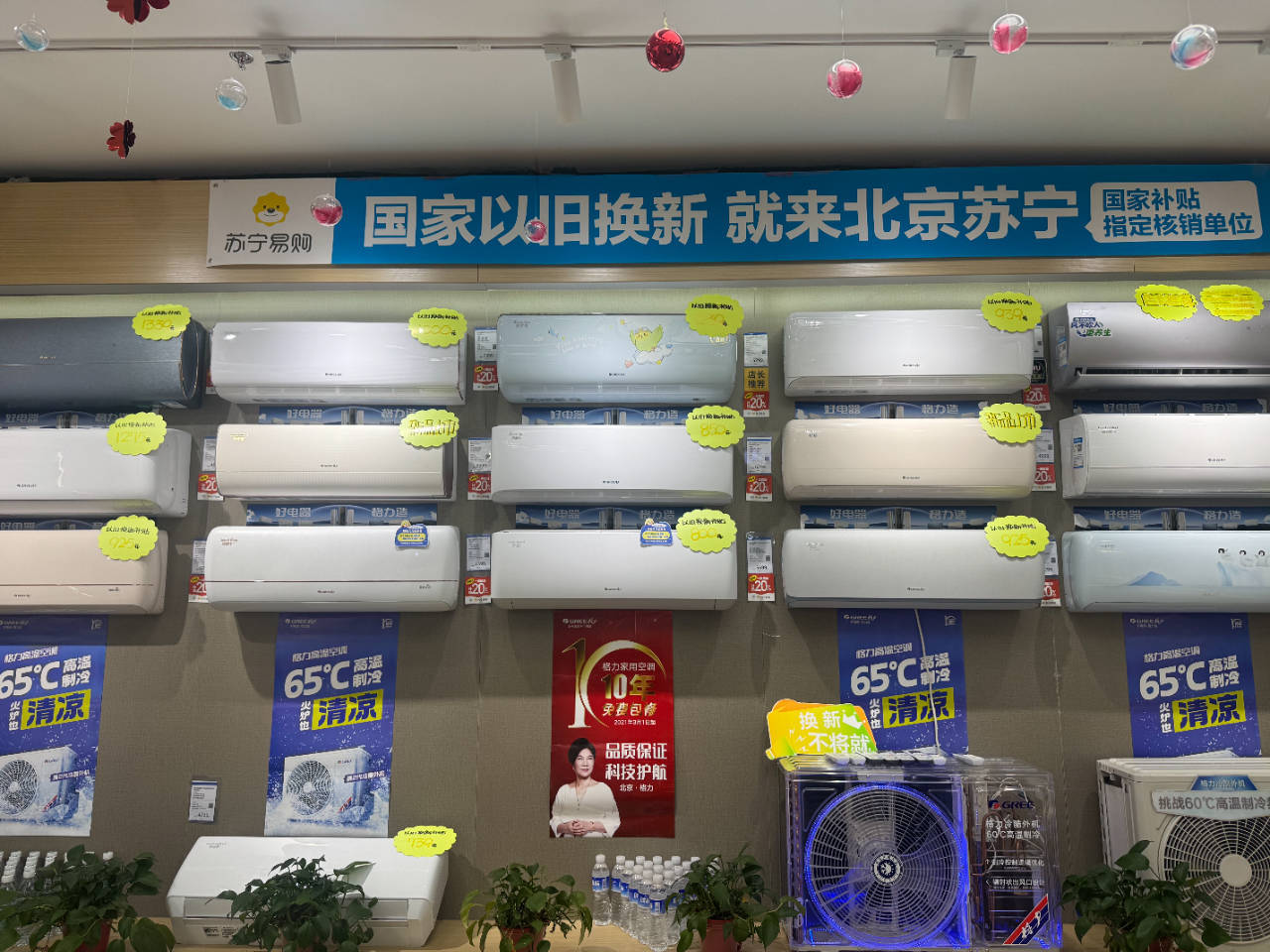
以旧换新

Search documents
湖北1—8月经济运行平稳 高技术制造业增速14.2%
Chang Jiang Shang Bao· 2025-09-18 00:03
Economic Overview - Hubei province's economy shows a stable and positive trend across various sectors including industry, investment, consumption, foreign trade, and finance [1][2] Industrial Performance - The industrial added value above designated size in Hubei increased by 7.8% year-on-year, surpassing the national average by 1.6 percentage points [2] - High-tech manufacturing led the growth with an increase of 14.2%, contributing 27.2% to the overall industrial growth [2] - Specific sectors such as computer, communication, and electronic equipment manufacturing grew by 15.6%, while electrical machinery and equipment manufacturing rose by 16.7% [2] Investment Trends - Fixed asset investment in Hubei grew by 6.7% year-on-year, outpacing the national growth rate of 6.2% [3] - Manufacturing investment saw a significant increase of 13.3%, while infrastructure investment rose by 3.5% [3] - Private investment remained active, growing by 6.0%, and 11.9% when excluding real estate development [3] Consumption Insights - The total retail sales of consumer goods reached 17,241.19 billion yuan, with a year-on-year growth of 5.7%, higher than the national average [4] - The "old-for-new" policy significantly boosted sales in home appliances and furniture, with retail sales increasing by 25.2% and 61.3% respectively [4] - Online retail sales also experienced rapid growth, increasing by 19.2% [4] Foreign Trade Developments - Hubei's total import and export value reached 5,463.9 billion yuan, marking a year-on-year increase of 27.3% [4] - Exports amounted to 3,898.3 billion yuan, growing by 35.0%, while imports increased by 11.5% to 1,565.6 billion yuan [4] Fiscal and Financial Performance - Local general public budget revenue for Hubei reached 2880.53 billion yuan, reflecting a year-on-year growth of 7.9% [5] - Financial institutions in Hubei reported a total deposit balance of 99,997.0 billion yuan, growing by 9.2% since the beginning of the year [5]
8月经济数据点评:经济稳中趋缓,地产仍是拖累
Mai Gao Zheng Quan· 2025-09-17 12:22
Production - In August 2025, the industrial added value of enterprises above designated size grew by 5.2% year-on-year, a decrease of 0.5 percentage points from the previous month[11] - The manufacturing sector remains the main driver of industrial growth, with a year-on-year increase of 5.7%, down from 6.2%[11] - High-tech manufacturing added value increased by 9.3% year-on-year, contributing 28.5% to the overall industrial growth[11] Consumption - The total retail sales of consumer goods in August 2025 increased by 3.4% year-on-year, a decline of 0.3 percentage points from July[2] - Rural consumption grew by 4.6%, outpacing urban consumption growth of 3.2%, indicating significant potential in the rural market[14] - Over 80% of product categories saw retail sales growth, with more than 30% achieving double-digit growth[15] Investment - From January to August 2025, fixed asset investment (excluding rural households) increased by 0.5%, continuing a downward trend[24] - Excluding real estate development investment, fixed asset investment grew by 4.2%, indicating resilience in manufacturing and some infrastructure sectors[24] - Real estate development investment fell by 12.9% year-on-year, with new construction, completion, and construction area all showing declines[25]
乘联分会:9月1-14日全国乘用车市场零售73.2万辆 同比下降4%
智通财经网· 2025-09-17 09:01
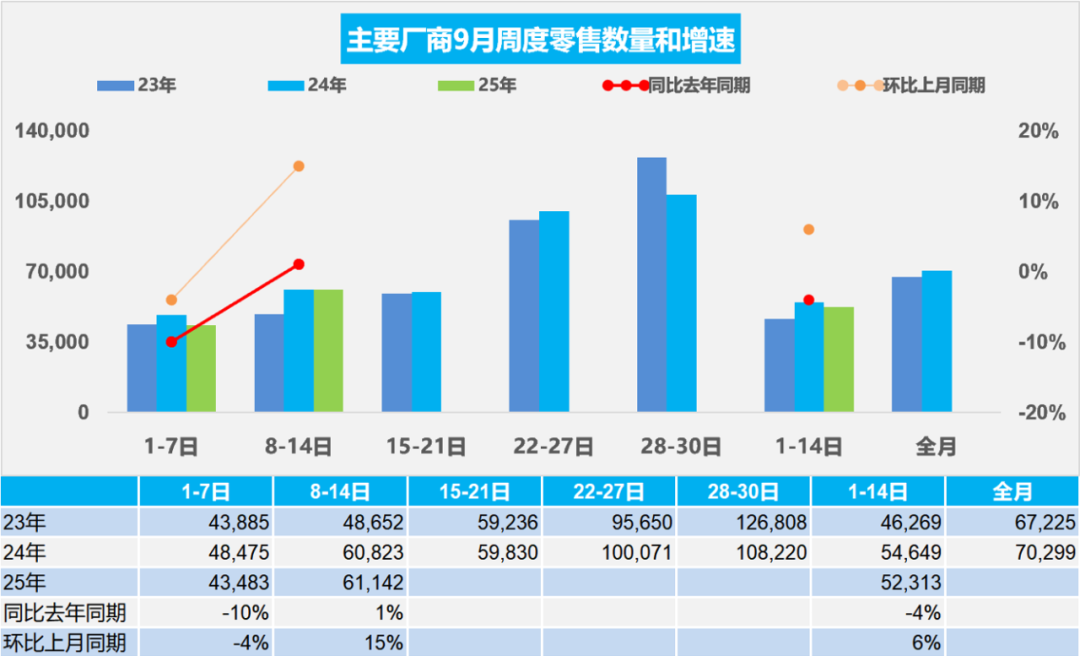
Group 1: Market Performance - From September 1 to 14, the national passenger car market retail reached 732,000 units, a year-on-year decrease of 4%, but a month-on-month increase of 6%. Cumulative retail for the year reached 15.497 million units, a year-on-year increase of 9% [1][5] - During the same period, wholesale of national passenger car manufacturers was 774,000 units, a year-on-year decrease of 3%, but a month-on-month increase of 18%. Cumulative wholesale for the year reached 18.816 million units, a year-on-year increase of 12% [1][9] Group 2: New Energy Vehicles - In the new energy sector, retail sales from September 1 to 14 reached 438,000 units, a year-on-year increase of 6% and a month-on-month increase of 10%. The penetration rate for new energy vehicles in the passenger car market was 59.8%, with cumulative retail for the year at 8.008 million units, a year-on-year increase of 25% [1][5] - Wholesale of new energy vehicles from manufacturers during the same period was 447,000 units, a year-on-year increase of 10% and a month-on-month increase of 21%. The cumulative wholesale for the year reached 9.39 million units, a year-on-year increase of 32% [1][9] Group 3: Market Trends and Challenges - The market is experiencing a mixed performance, with the "Golden September and Silver October" traditional peak season approaching, alongside the implementation of national and local purchase subsidies. However, the focus on high-priced models in local subsidy policies may hinder the growth of the mainstream market [5] - The introduction of new models at the Chengdu Auto Show has generated significant interest, but the lack of popular entry-level models has limited their contribution to overall sales [5][9]



以旧换新动能足 超大规模市场体量更大
Jing Ji Wang· 2025-09-17 03:40
Group 1: Policy Impact on Consumer Market - The "old-for-new" policy has significantly boosted consumer spending, with over 2.9 trillion yuan in sales generated and approximately 400 million people benefiting from subsidies as of mid-year [1][3] - The policy is part of a broader strategy to enhance domestic demand and promote green and intelligent consumption, leading to industry innovation and efficiency improvements [2][3] Group 2: Growth in Appliance Sales - Suning's report indicates a remarkable 81% year-on-year increase in "old-for-new" orders for home appliances, with high-end appliances priced over 8,000 yuan seeing a 96% sales increase [3] - The share of first and second-tier energy-efficient appliances in sales has exceeded 90%, with first-tier products accounting for 73.8% [3] Group 3: Service Consumption Trends - Service consumption in China has been growing rapidly, with per capita spending on services increasing by an average of 9.6% annually from 2020 to 2024 [4] - By 2024, service consumption is expected to account for 46.1% of total per capita consumption expenditure, contributing 63% to the growth of overall consumer spending [4] Group 4: Market Size and Economic Contribution - China's retail market is projected to exceed 50 trillion yuan this year, solidifying its position as the second-largest consumer market globally [6][7] - The final consumption's contribution to economic growth averaged 56.2% over the past four years, indicating a significant increase compared to the previous five-year period [6][7]
iPhone新品调研:换新周期进入“两年时代” 以旧换新需求崛起 京东获八成以旧换新用户青睐​
Sou Hu Wang· 2025-09-16 09:41
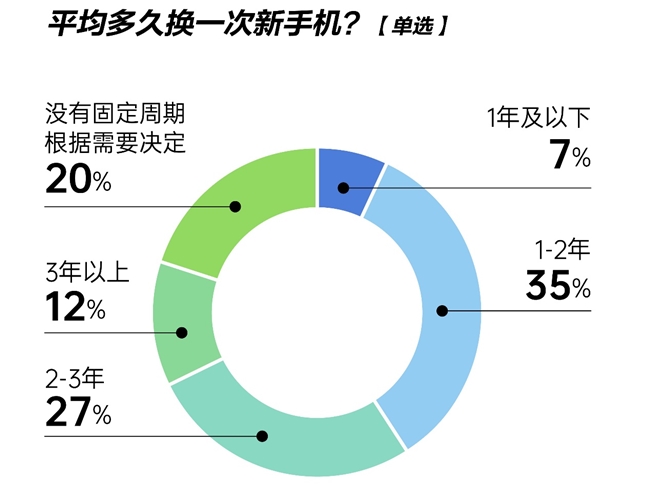
Group 1 - The iPhone 17 series is set to launch, with 68.9% of consumers preferring to purchase directly and 31.3% opting for trade-in options to reduce costs [1] - The demand for upgrading phones is stable, with 35% of respondents changing their phones every 1-2 years, and only 12% waiting over three years [2] - The main drivers for upgrading to the iPhone 17 include the pursuit of the latest technology (46%) and attractive trade-in subsidies (33%) [5] Group 2 - When choosing trade-in channels, 54.2% prioritize the final price, while 49.4% value transparent old device valuations [5] - JD.com stands out as the preferred platform for trade-ins, with 70.6% of users voting it as offering the highest valuations and subsidies [7] - JD.com offers a maximum trade-in subsidy of 2100 yuan for the iPhone 17, along with various discounts on related services, making it an attractive option for consumers [7]


iPhone 17首发 近半数人希望当月入手新机 超六成人认为京东货量最多、最能抢到
Sou Hu Wang· 2025-09-16 08:04
Core Insights - Apple is expected to have a significant inventory of nearly 100 million units for the iPhone 17 series in 2025, marking an increase of approximately 20 million units compared to the iPhone 16 series, which is the highest in three years [1] - A survey indicates that nearly 50% of consumers plan to upgrade their phones, with the standard version of the iPhone 17 being the most preferred model [1][10] - JD.com is the preferred purchasing channel for over 80% of consumers, highlighting its strong brand reputation and reliability in the electronics market [5][25] Consumer Preferences - The primary purchasing considerations for consumers include product authenticity (69.3%), after-sales service (43.7%), and price promotions (42.2%) [2] - The iPhone 17's features, such as extended battery life (6 hours), improved display (120Hz), and faster charging (40W for Pro models), are major attractions for consumers [8][10] - 54.1% of consumers are most interested in better battery life, while 38.4% are drawn to the improved display [9] Purchasing Behavior - 45% of respondents plan to purchase the iPhone 17, with 30% specifically choosing the standard version [10] - 66% of consumers are inclined to buy models with 512GB storage or higher, indicating a trend towards higher-end specifications [10] - 69% of users prefer direct purchases, while 31% are considering trade-in options to reduce costs [18] Channel Analysis - JD.com has established a strong position in the 3C electronics sector, with over 1 million units of the iPhone 17 being shipped directly from Apple to JD.com [4] - The survey shows that 64% of respondents believe JD.com has the most inventory available for the iPhone 17, making it the top choice for consumers [16][17] - Instant retail platforms are not a mainstream choice for purchasing high-priced items like the iPhone, with only 3% of consumers considering this option [23][24] Promotions and Offers - JD.com offers significant trade-in subsidies of up to 2,100 yuan and various financing options to lower the barrier for consumers [23] - The platform's reputation for high trade-in values and smooth user experience is recognized by 70.6% of respondents [20]

iPhone新品调研:换新周期进入“两年时代”以旧换新需求崛起 京东获八成以旧换新用户青睐
Jiang Nan Shi Bao· 2025-09-16 07:18
Core Insights - The iPhone 17 series is set to launch, with consumer purchasing methods and channels being a focal point of interest. A recent survey indicates that 68.9% of users prefer to buy the new iPhone directly, while 31.3% opt for trade-in options, highlighting the significance of trade-ins in reducing purchase costs [1]. Group 1: Consumer Behavior - The demand for upgrading phones is stable, with 35% of respondents replacing their phones every 1-2 years, and 7% doing so within a year. Only 12% wait over three years to upgrade, indicating a trend of timely replacements while older models still maintain good performance [2]. - In the motivations for upgrading to the iPhone 17, 46% of respondents seek the latest technology and features, while 33% are attracted by trade-in subsidies. Other motivations include loyalty to the Apple ecosystem (32%) and dissatisfaction with current phone performance (30%) [5]. Group 2: Trade-in Preferences - When choosing trade-in channels, 54.2% of respondents prioritize a lower final price, seeking high subsidies and valuations. Additionally, 49.4% value transparent old device valuations, while 43.6% consider the trustworthiness of the platform, and 39.78% focus on thorough data privacy measures [5]. - JD.com stands out as the preferred platform for trade-ins, with 70.6% of users voting it as offering the highest valuations and most generous subsidies. Furthermore, 75.4% find JD.com to provide the smoothest user experience [7]. Group 3: Promotions and Offers - For the iPhone 17 launch, JD.com offers a maximum trade-in subsidy of 2100 yuan and supports up to 24 months of interest-free installment payments. Additional discounts on iCloud and AppleCare purchases further lower the barriers for users looking to upgrade [8].
8月经济观察:“反内卷”影响显现,政策加码窗口临近
Xin Lang Cai Jing· 2025-09-16 07:13
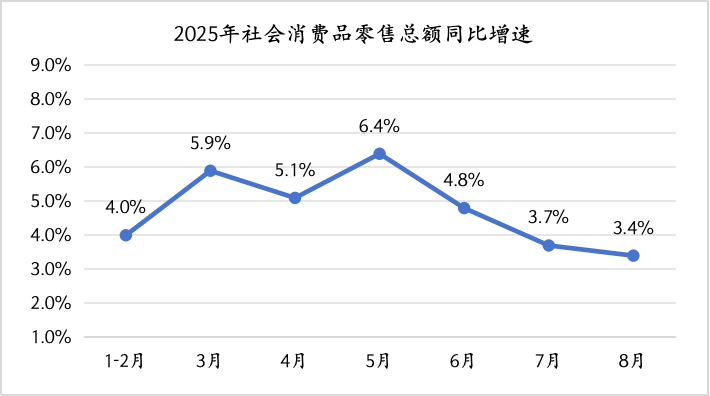
Economic Growth Overview - In August, China's economic growth momentum slowed down, with both supply and demand sides experiencing a decline in growth rates. Analysts suggest that due to high base effects and tariff uncertainties, along with the waning effects of the "trade-in" policy, downward pressure on the domestic economy is expected to increase in the fourth quarter, necessitating new policies to stabilize investment and promote consumption to achieve the annual growth target of around 5% [1][11]. Production Sector Analysis - In August, the industrial added value for large-scale enterprises grew by 5.2% year-on-year, a decrease of 0.5 percentage points from the previous month. The service production index growth rate was 5.6%, down 0.2 percentage points from the previous month [1]. - The "anti-involution" policy is identified as a primary reason for the cooling of industrial production. The industrial production intensity has declined for two consecutive months, influenced by extreme weather and the effects of the "anti-involution" policy [2]. - The added value of upstream production sectors showed strong performance, with non-ferrous metal smelting and rolling industries growing by 9.1% year-on-year, while coal mining and washing industries grew by 5.1% [2]. Demand Side Insights - In August, the total retail sales of consumer goods and exports in USD grew by 3.4% and 4.4% year-on-year, respectively, both showing declines from the previous month [3]. - The retail sales growth rate has been declining for three consecutive months, primarily due to the diminishing effects of the "trade-in" policy. The largest month-on-month declines were seen in home appliances and communication equipment, with decreases of 14.4% and 7.6% respectively [3][5]. Investment Trends - Investment growth has slowed for five consecutive months, with real estate, infrastructure, and manufacturing investments all experiencing varying degrees of decline [6]. - Infrastructure investment growth fell to 2.0% year-on-year for the first eight months, a decrease of 1.2 percentage points from the previous month. Manufacturing investment growth dropped to 5.1%, the lowest level since early 2021 [9]. - Analysts indicate that the decline in manufacturing investment is influenced by extreme weather and rising global trade uncertainties, which suppress the willingness of downstream enterprises to expand production [7]. Policy Recommendations - Analysts suggest that maintaining stable economic growth is becoming increasingly challenging, and timely policy adjustments are necessary. The potential for new incremental policies is anticipated, possibly by the end of September, including new policy financial tools and early allocation of local government debt quotas to improve infrastructure investment [12].
硅料景气度有所下行 | 投研报告
Zhong Guo Neng Yuan Wang· 2025-09-16 06:47
Market Overview - The mechanical equipment, electric equipment, and automotive industry indices experienced weekly changes of +3.52%, +0.53%, and +1.74% respectively, ranking 7th, 22nd, and 15th among 31 Shenwan first-level industries; during the same period, the CSI 300 index changed by +1.38% [2] Industry Insights Photovoltaics - The silicon material market showed a decline in sentiment, with the main contract for polysilicon dropping by 4.09% to a closing price of 4.40; the market had anticipated the implementation of storage-related funds and review matters in September, but these expectations have not materialized, negatively impacting market sentiment [3] - The expected output for September is 125,000 tons (equivalent to 65-66 GW), which is a slight decrease compared to August; the decline in silicon material prices is attributed to limited production cuts and weak downstream component demand [3] Industrial Gases - Overall industrial gas prices saw a weekly decline; as of September 11, 2025, the average price of liquid oxygen in China was 478 RMB/ton (down 3.2% from the previous week), liquid nitrogen was 451 RMB/ton (down 2.5%), and liquid argon was 609 RMB/ton (up 1.16%); rare gases showed stable prices [4] - The short-term decline in gas prices is mainly due to improved operational efficiency of air separation equipment and insufficient short-term demand from the steel and coal chemical industries; the industrial gas sector is currently at a cyclical low, with potential for a reversal due to supply optimization [4] Automotive - In the first week of September, the retail market for passenger vehicles saw a year-on-year decline of 10%, while the retail of new energy vehicles decreased by 3%, aligning with the typical transition between the end and beginning of the month; retail sales for passenger vehicles reached 304,000 units, a 10% decrease year-on-year [5] - The decline in the new energy vehicle market was less severe than the overall market, with retail sales of 181,000 units, down 3% year-on-year; the automotive market is expected to maintain rapid growth due to promotional activities and the upcoming sales peak in September and October [5]
“热搜”上的非凡“十四五”|以旧换新动能足 超大规模市场体量更大
Sou Hu Cai Jing· 2025-09-16 05:35
Group 1: Policy Impact on Consumer Market - The "old-for-new" policy has significantly boosted consumer spending, with approximately 4 billion people benefiting from subsidies, leading to a sales increase of 2.9 trillion yuan [1][6][9] - The retail sales of social consumer goods are projected to grow from 39.1 trillion yuan in 2020 to 48.3 trillion yuan in 2024, reflecting an annual growth rate of 5.5% [1][9][10] - The policy has enhanced the green and intelligent levels of the overall consumer market while promoting self-innovation and efficiency improvements in industries [2][5] Group 2: Industry Performance - Sichuan Changhong has upgraded its production line for high-efficiency televisions, achieving a production capacity of over 2,000 units per day, with 70% of its shipments being first-level energy efficiency products [2][5] - Suning.com reported an 81% year-on-year increase in "old-for-new" orders for home appliances, with high-end appliances priced above 8,000 yuan seeing a 96% increase in sales [5][6] - The penetration rate of new energy vehicles reached 50.2% in the first half of the year, with a projected growth of 5.4 times in ownership by 2024 compared to 2020 [6][9] Group 3: Market Dynamics and Future Outlook - The domestic market is characterized by a large scale and significant growth potential, with consumer spending contributing an average of 56.2% to economic growth over the past four years [10][11] - The service consumption sector is also expanding, with service consumption per capita expected to reach 46.1% of total consumption by 2024, contributing 63% to the growth of consumer spending [7][8] - The overall economic growth is projected to reach around 140 trillion yuan this year, with a contribution rate of approximately 30% to global economic growth [10][11]