金融强国

Search documents
管涛:低利率时代更加呼唤资本市场高质量发展 |国庆大咖谈
Di Yi Cai Jing· 2025-10-01 02:21
Group 1 - The current monetary policy in China is supportive and relatively loose, with major interest rates at historical lows, and low interest rates are expected to persist for some time [1] - The imbalance in China's financing structure, characterized by high debt and low equity, is a significant issue, and increasing the proportion of direct financing, especially equity financing, has been a key goal of financial reform [2][4] - Recent policies, such as the "New National Nine Articles" and the "1+N" policy framework, aim to enhance the quality of listed companies, encourage dividend returns to investors, and promote the development of public funds [4][6] Group 2 - The capital market plays a crucial role in fostering a virtuous cycle among industry, technology, and capital, supporting both the growth of emerging industries and the transformation of traditional industries [3] - The need to enhance domestic demand, particularly final consumption, is emphasized as a pathway to economic growth, with property income being a significant source of household income [4] - The current challenges in China's financial system include a lack of effective financing demand from the real economy and low lending enthusiasm from banks, which necessitates the development of a diversified financing structure [6][7] Group 3 - The construction of a financial powerhouse is essential for the overall economic strength of the nation, with a strong currency being a key component of this vision [6][7] - The internationalization of the Renminbi is highlighted as a critical aspect of achieving a strong currency, which requires high-level financial openness and the reform of capital market systems [6][7] - The emphasis on institutional openness in the capital market includes aligning domestic regulations with international standards to better support and attract foreign investment [7]
信托业积极履行社会责任 服务国计民生显行业担当
Zheng Quan Ri Bao· 2025-09-30 03:08
Core Viewpoint - The 2024-2025 China Trust Industry Social Responsibility Report highlights the trust industry's commitment to social responsibility and its transformation towards high-quality development, emphasizing its role in supporting the real economy and enhancing people's lives [1][3]. Group 1: Industry Transformation and Development - Since its restoration in 1979, the trust industry has evolved from "scale expansion" to "compliance development," and now to "high-quality development," becoming a significant financial force in serving the real economy [3]. - The trust industry is set to deepen its new classification regulations in 2024 and enter a new phase of high-quality development by 2025 [3]. Group 2: Social Responsibility Achievements - The report outlines achievements in social responsibility across eight areas: party building, livelihood, economic, legal, environmental, public welfare, human-centered, and responsibility management [3]. - By the end of 2024, the trust industry managed a total trust asset scale of 29.56 trillion yuan, a year-on-year increase of 23.58% [4]. Group 3: Financial Support for the Real Economy - Of the 22.25 trillion yuan in funds managed by the trust industry, 28.81% was directly invested in the real economy, while 46.17% supported it indirectly through capital markets, totaling 16.68 trillion yuan [4]. - In 2024, the trust industry allocated 1.6 trillion yuan to inclusive finance, established 1,148 pension service trust projects with an investment of 14.493 billion yuan, and funded 289 rural revitalization projects with 4.304 billion yuan [5]. Group 4: Charity and Green Development - The charity trust sector saw a total of 2,244 registered cases with a cumulative scale of 8.507 billion yuan by the end of 2024, with new registrations increasing by 18.72% year-on-year [5]. - The green trust sector experienced rapid growth, with 390 new projects and a new scale of 177.944 billion yuan, bringing the total to 325.388 billion yuan [5]. Group 5: Talent Development - The trust industry emphasizes talent as a core driver of high-quality development, with a total workforce of 17,884 employees by the end of 2024, over 60% of whom are under 40 years old [6]. - The proportion of employees with master's degrees or higher is steadily increasing, reflecting the enhancement of talent quality within the industry [6]. Group 6: Future Outlook - The trust industry aims to continue enhancing its ability to serve national strategies and improve people's lives while maintaining a focus on compliance and innovation [6].

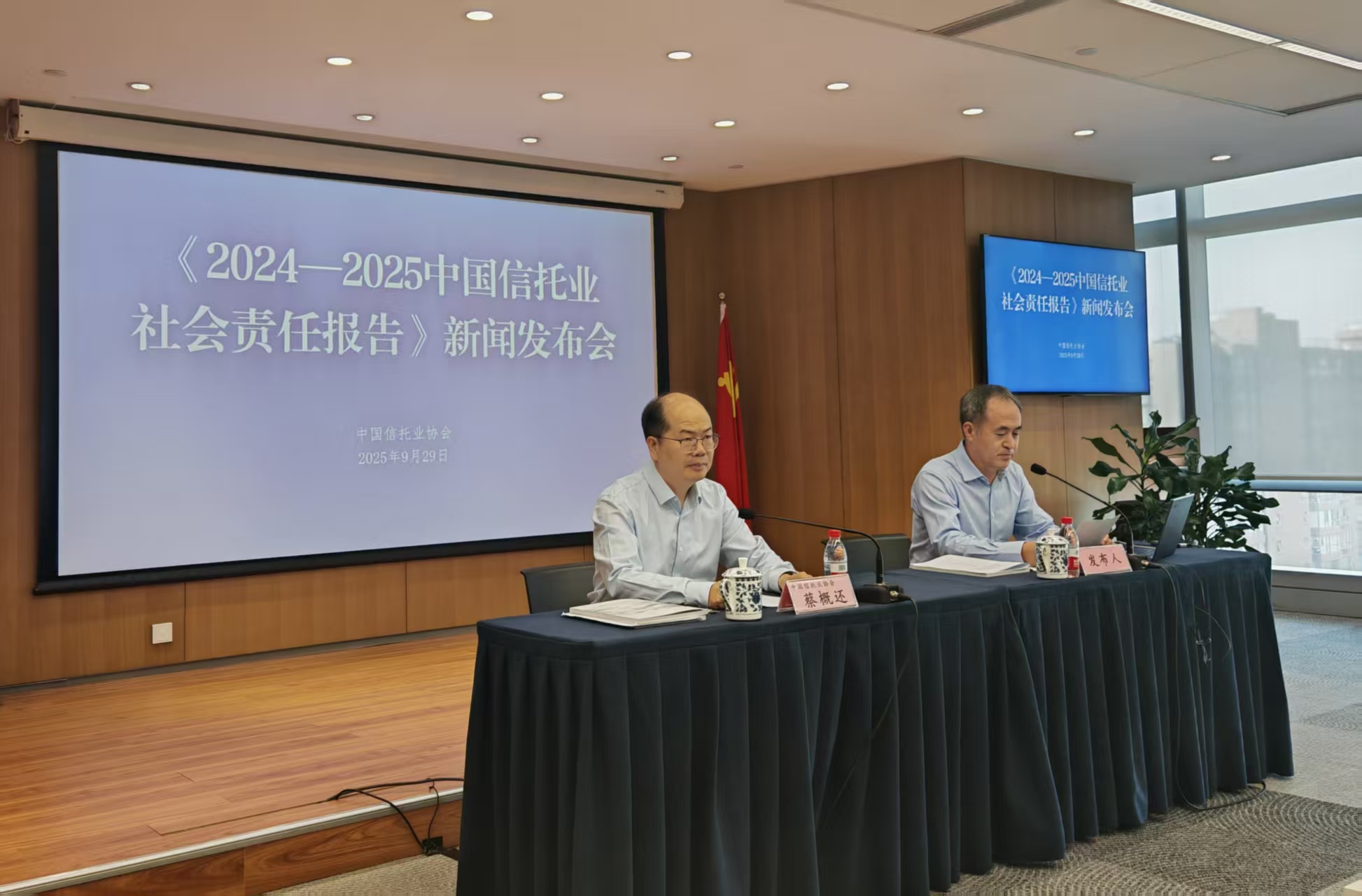
信托业交年度社会责任答卷 去年16.68万亿资金流向实体经济
2 1 Shi Ji Jing Ji Bao Dao· 2025-09-30 03:01
Core Insights - The trust industry in China has directed 16.68 trillion yuan towards the real economy as part of its social responsibility efforts, with a total of 22.25 trillion yuan in trust assets under management by the end of 2024 [1][2] Group 1: Financial Support to the Real Economy - 28.81% of the trust funds are directly invested in the real economy, while 46.17% are indirectly supporting it through capital markets, totaling 16.68 trillion yuan [2] - The trust industry has provided significant funding for national strategic projects, including 1.12 trillion yuan for the Belt and Road Initiative and 2.67 trillion yuan for the Yangtze River Economic Belt [2] Group 2: Social Welfare and Livelihood Support - In 2024, the trust industry allocated 1.6 trillion yuan to inclusive finance, established 1,148 pension service trust projects with an investment of 14.493 billion yuan, and funded 289 rural revitalization projects with 430.4 million yuan [3] Group 3: Green Trust Initiatives - The scale of green trust projects reached 325.3 billion yuan, with 390 new projects added in 2024, marking a 21.5% increase year-on-year [4] - Trust companies have implemented over 20 "dual carbon" target guidelines and conducted 46 training sessions on green trust, with 4,520 participants [5] Group 4: Charitable Trust Developments - By the end of 2024, the cumulative number of charitable trusts reached 2,244, with a total scale of 8.507 billion yuan, reflecting a year-on-year growth of 30.07% in new registrations [5]
从“美元潮汐”到“人民币暖流”:中国金融强国建设的“五把钥匙”
Guo Ji Jin Rong Bao· 2025-09-29 10:45
Core Viewpoint - The article highlights the shift in global financial governance from dominance by sovereign currencies to the provision of safer, lower-cost, and inclusive cross-border payment solutions, exemplified by the contrasting experiences of digital RMB and traditional currency exchanges [1]. Group 1: Trade Scenarios - The strategy focuses on creating a "RMB circle" by facilitating direct currency exchanges with countries related to the Belt and Road Initiative, aiming for 100% mutual currency settlement accounts with ASEAN countries by the end of 2025 [2]. - The implementation of simplified tools for small and medium enterprises (SMEs) has significantly reduced transaction times from 3 days to 2 minutes, enhancing efficiency and reducing costs [2]. Group 2: Fiscal Incentives - A fiscal incentive program offering a 0.3% reward on RMB settlements for SMEs is projected to cost 12 billion yuan annually but could stimulate 2 trillion yuan in trade, effectively lowering costs for businesses [3]. Group 3: Bond Market Development - The expansion of foreign market makers in the bond market from 46 to 100 by the end of 2025 aims to enhance liquidity and reduce transaction costs, with the first foreign market maker already demonstrating improved pricing [4]. - The introduction of long-term interest rate hedging products, such as 10-year government bond options and green CDS, is expected to attract foreign investment and mitigate credit risk [5]. Group 4: Offshore Financial Regulation - The establishment of integrated offshore accounts in Shanghai aims to streamline cross-border transactions while maintaining regulatory oversight, with significant reductions in transaction fees [6]. - The collaboration between Shanghai and Hong Kong to create a unified bond yield curve is set to enhance the pricing benchmark for RMB bonds in Asia [7]. Group 5: Capital Flow Management - The implementation of a macro-prudential adjustment fee for excessive capital inflows and outflows is designed to stabilize the market and reduce volatility [8]. - The use of AI for early warning systems in capital flows has proven effective in preventing potential financial risks [9]. Group 6: Rule-Making and International Cooperation - The establishment of a CBDC international alliance aims to facilitate cross-border digital currency transactions, with significant cost reductions compared to traditional methods [10]. - The proposal for IMF reform to increase the SDR weight of the RMB is gaining support among emerging economies, indicating a shift towards a more multipolar financial system [11]. Group 7: Overall Financial Strategy - The article concludes that the future of global finance will not be dominated by the RMB replacing the USD, but rather a coexistence of multiple currencies, with the RMB emerging as a regional leader in Asia and Africa [12][13].
刘世锦:中国资本市场增量资金来源,或已发生转折性变化
Zheng Quan Shi Bao Wang· 2025-09-27 08:07
Group 1 - The core viewpoint is that the source of incremental funds for China's capital market has undergone a transformative change, driven by the accumulation of significant social net wealth and low bank savings rates, leading to a shift towards capital market investments [1][8] - Liu Shijun emphasizes that the current economic challenges are primarily due to insufficient consumption rather than investment, highlighting a structural deviation in consumption patterns compared to international averages [2][3] - The need for structural reforms in three key areas is identified to effectively expand consumption, focusing on housing for new citizens, pension system reforms, and facilitating the flow of production factors between urban and rural areas [6][5] Group 2 - The capital market is expected to enter a new development phase, with a focus on nurturing large, globally competitive technology firms and a multitude of innovative small and medium enterprises [8] - Liu Shijun suggests that the capital market can enhance resource utilization efficiency, increase investors' income, and support pension expenditures in an aging society, thereby promoting consumption through wealth effects [8] - The recommendation includes implementing a balanced import-export strategy to enhance the international status of the RMB, shifting from a reliance on dollar reserves to increasing the use of RMB in global trade [8]
专家认为:金融与科技深度融合趋势已不可逆转
Zhong Guo Zheng Quan Bao· 2025-09-27 01:28
Group 1 - The importance of equity investment funds in the development of new productive forces is increasingly recognized, especially in the early stages of technological innovation [1] - Traditional financial services are inadequate to meet the current demands of technology-driven industrial development, necessitating a more integrated financial service system [1] - The trend of deep integration between finance and technology is irreversible, and embracing innovation is essential for modernizing finance and building a strong financial nation [1] Group 2 - Financial institutions, particularly state-owned banks, need to better integrate commercial, policy, and directional requirements to enhance innovation capabilities and service levels [2] - Expanding openness in the financial sector is crucial for improving resource allocation efficiency and international competitiveness [2] - Aligning with international high-standard economic and trade agreements will help streamline restrictive measures and enhance cross-border investment and financing [2]
金融与科技深度融合趋势已不可逆转
Zhong Guo Zheng Quan Bao· 2025-09-26 20:48
Group 1 - The importance of equity investment funds in the development of new productive forces is increasingly recognized, especially in the early stages of technological innovation [1] - Traditional financial services are inadequate to meet the current demands of technology-driven industrial development, necessitating a more integrated financial service system [1] - The trend of deep integration between finance and technology is irreversible, and embracing innovation is essential for modernizing finance and building a strong financial nation [1] Group 2 - Financial institutions, particularly state-owned banks, need to better integrate commercial, policy, and directional requirements to enhance innovation capabilities and service levels [2] - Expanding openness in the financial sector is crucial for improving resource allocation efficiency and international competitiveness, aligning with high-standard international trade agreements [2]
尹艳林:跨境支付中人民币占比有望进一步上升
Sou Hu Cai Jing· 2025-09-26 08:01
Core Insights - China's financial internationalization has made significant progress, with record offshore RMB bond issuance and breakthroughs in cross-border financial services [1] - The integration of finance and technology is an irreversible trend, essential for building a strong financial nation [1] Group 1: Financial Developments - Offshore RMB bond issuance has reached a new high, indicating increased international acceptance of the currency [1] - The Guangdong-Hong Kong-Macao Greater Bay Area's cross-border wealth management scheme has achieved significant scale [1] - New policies such as cross-border insurance and southbound trading under the Bond Connect have been successfully implemented [1] - The establishment of the digital RMB international operation center is expected to increase the proportion of RMB in cross-border payments [1] Group 2: Recommendations for Financial Innovation - Encourage innovation by promoting market-oriented and legal frameworks for financial development, emphasizing collaboration between financial institutions and technology companies [2] - Reform is necessary to achieve innovation, including improving the positioning of state-owned banks and enhancing regulatory frameworks [2] - Expand openness to improve financial resource allocation efficiency and enhance international competitiveness [3] Group 3: Integration and Safety - Promote the integration of various financial sectors and the fusion of finance with technology, e-commerce, and logistics to better serve the real economy [3] - Emphasize the importance of risk prevention and data security in the face of new financial business models, advocating for a robust regulatory framework [3]
刘世锦:中国资本市场资金的增量来源或已发生转折性变化
Zheng Quan Shi Bao· 2025-09-26 05:12
Core Viewpoint - China has accumulated a significant amount of social net wealth, and low bank savings rates suggest that net wealth can only grow through capital markets, indicating a transformative change in the sources of capital market funding compared to the past [1][10]. Economic Growth and Challenges - China's economic recovery post-COVID-19 has shown a generally positive trend, achieving growth targets of 5.2% and 5% in the past two years, placing it among the leading global economies [3]. - The macroeconomic environment faces increasing pressure from declining demand, with the GDP deflator index experiencing negative growth for nine consecutive quarters [3]. - The primary challenge during the "14th Five-Year Plan" period is not insufficient investment but rather insufficient consumption, which is significantly deviated from both international averages and typical economies at similar development stages [3][4]. Structural Consumption Issues - The structural bias in consumption is largely attributed to insufficient service consumption, particularly in education, healthcare, affordable housing, social security, and elderly care [4]. - The disparity in consumption is exacerbated by various factors, including low levels of public services, urbanization lag, income inequality, and a long-standing policy focus on investment over consumption [4]. Proposed Structural Reforms - To effectively expand consumption, three key areas for structural reform are identified: 1. Addressing housing shortages for new urban residents, particularly migrant workers, through government initiatives to convert unsold housing into affordable options [7]. 2. Reforming the rural pension system to significantly increase pension income for rural residents, thereby unlocking consumption potential for a large segment of the population [7]. 3. Promoting a new wave of urbanization by facilitating the smooth flow of production factors between urban and rural areas, enhancing rural residents' income [7]. Financial Market Development - A strong financial market is essential for supporting both consumption and manufacturing sectors, with a focus on establishing robust monetary and capital markets [9][10]. - The capital market is expected to enter a new development phase, with a shift in funding sources and an emphasis on nurturing globally competitive large tech firms and innovative SMEs [10]. - The strategy includes balancing imports and exports, promoting the use of the RMB in international trade, and enhancing the international status of the RMB as a reserve currency [10].
15载相伴成长:做服务实体经济与百姓民生的“舒心伙伴” 访苏州银行党委书记、董事长崔庆军
Jin Rong Shi Bao· 2025-09-26 02:07
Core Viewpoint - The article highlights the significant achievements of Suzhou Bank over its 15-year journey, emphasizing its alignment with national economic strategies and its role in supporting regional economic development, particularly in the Yangtze River Delta region [1][9]. Group 1: Strategic Development - Suzhou Bank has focused on local economic needs and has adapted to the changing market environment, achieving an asset scale of 754.974 billion yuan, which is 15 times its initial size [2]. - The bank's deposits and loans have also seen substantial growth, with deposits reaching 462.752 billion yuan and loans at 363.497 billion yuan, marking increases of 14.04 times and 15.38 times respectively since its inception [2]. - The bank maintains a low non-performing loan ratio of 0.83%, positioning it among the top tier of listed banks in terms of asset quality [2]. Group 2: Value Creation and Ecosystem - Suzhou Bank aims to be an "ecological enabler" for regional economic growth, enhancing its service capabilities and focusing on high-end manufacturing and specialized sectors [2]. - The bank has developed a comprehensive service network through institutional layout and rural bank reforms, which has facilitated its growth and service delivery [2]. Group 3: Innovation and Policy Alignment - The bank integrates financial services into key industrial upgrades, aligning with local industrial development strategies and national consumption enhancement initiatives [3]. - Suzhou Bank has introduced specialized service plans to support local employment and economic development, demonstrating its commitment to policy resonance [3]. Group 4: Cultural and Organizational Strength - The bank's core values emphasize trust and reliability, which are essential for its relationship with clients and the community [3][7]. - Suzhou Bank has established a culture of long-termism and innovation, focusing on customer needs and maintaining a commitment to serving the real economy [4][7]. Group 5: Party and Governance Integration - The bank integrates party leadership into its governance structure, ensuring that political advantages translate into effective service delivery [6]. - It has launched various initiatives to enhance party-building efforts, which support its operational goals and community engagement [6]. Group 6: Future Outlook - As Suzhou Bank celebrates its 15th anniversary, it aims to continue its journey towards higher quality development while fulfilling its mission to support the real economy and regional growth [9].