
智能化

Search documents
千万用户达成,一汽奥迪借智能化新品开启市场新阶段
Zhong Guo Qing Nian Bao· 2026-01-19 08:04
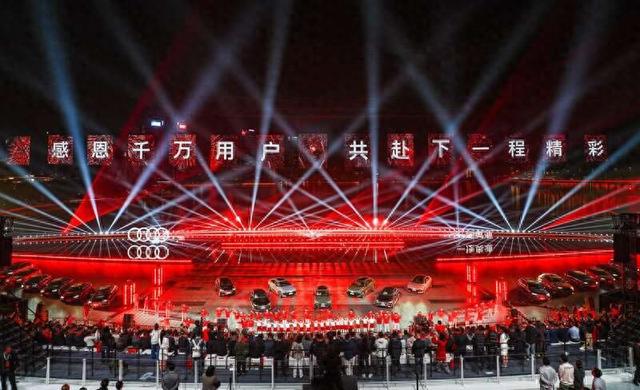
Core Insights - FAW Audi has achieved a significant milestone by reaching a cumulative user base of over 10 million in the Chinese market, making it the first joint venture luxury car brand to do so [2][3] - The company launched the new Audi Q5L, which features smart upgrades and is the first luxury fuel SUV equipped with Huawei's advanced intelligent driving system, marking a significant entry of high-level smart driving technology into traditional fuel luxury vehicles [2] - Audi's future product architecture will focus on the PPC luxury fuel intelligent platform and the PPE luxury pure electric platform, aiming for synchronized advancements in both fuel and electric vehicle models by 2026 [2] Company Developments - The new Audi Q5L is priced between 309,800 to 384,800 yuan and incorporates hybrid technology to reduce energy consumption, while also offering a long-wheelbase version and several market-specific color options [2] - FAW Audi's customer experience strategy, named "Zhen·Heart Path," aims to enhance its service system in response to the evolving competitive landscape of the luxury car market [3] - The company is leveraging its extensive existing user base and sales service system to accelerate its transformation towards smart technology, amidst increasing competition from local new energy brands and traditional luxury brands transitioning to electric vehicles [3]

双线对标特斯拉与丰田 尹同跃详解2026奇瑞AI“不客气”战略打法
Zhong Guo Jing Ying Bao· 2026-01-19 04:40
Core Viewpoint - The automotive industry is undergoing a significant transformation driven by AI, which is seen as a fundamental breakthrough comparable to historical milestones in human civilization. Chery Automobile aims to transition from a traditional automotive company to a global AI technology company, emphasizing the necessity of AI integration across all industries, including automotive [1][2]. Group 1: AI Strategy and Development - Chery has established a comprehensive AI strategy, marking its transition into the AI 2.0 era, which includes the introduction of various AI technologies and products such as the AI assistant "Xiao Qi," intelligent driving systems, and robotics [1][3]. - The company has a long history of AI exploration, starting from 2003 with the "talking QQ" and evolving through various technological advancements, culminating in a full-chain intelligent system that integrates R&D, manufacturing, supply chain, sales, and service [3][4]. - Chery's AI strategy is not limited to automotive applications but extends to other industries, including robotics and smart agriculture, aiming to empower various sectors with AI technology [3][4]. Group 2: Challenges and Solutions - Chery acknowledges three major challenges in AI integration: safety concerns related to AI decision-making, legal and ethical issues surrounding data privacy and algorithm fairness, and quality management in AI development [4][5]. - The company is actively working on solutions to these challenges, including obtaining quantum security certification and achieving high-level data security maturity certifications [4][5]. Group 3: Competitive Positioning - Chery aims to benchmark against industry leaders like Toyota and Tesla, focusing on quality manufacturing and disruptive innovation through its "Double T" strategy [5][6]. - The company is committed to a user-centric approach, ensuring that AI technology enhances user experience and emotional connection with vehicles [6][7]. Group 4: Product Innovations - At the AI Night event, Chery showcased its latest AI-driven products, including the Falcon Intelligent Driving system and the Lingxi Intelligent Cockpit, which feature significant upgrades in user interaction and privacy protection [7][8]. - The company introduced a new AI vehicle matrix, including models like the Fengyun T9L and iCAR V27, which leverage AI for enhanced performance and user customization [8][9]. Group 5: Future Vision - Chery envisions a future where AI is deeply integrated into its business model, transforming from traditional automotive sales to a software-driven ecosystem [9]. - The company emphasizes the importance of sustainable energy and advanced computing capabilities to support its AI initiatives, establishing research institutes focused on chip development and green energy technologies [5][6].
绿智双驱,链动未来!临清纺织绘就高质量发展新画卷
Zhong Guo Jing Ji Wang· 2026-01-19 03:22
Group 1 - The article highlights the advancements in the textile industry in Linqing City, Shandong, with companies like Sanhe Textile Group and Dehui Textile Company leading the way in smart and green production technologies [1][2] - Sanhe Textile Group has invested 120 million yuan in smart round screen printing technology, increasing its annual dyeing capacity by 120 million meters and reducing energy consumption per product by 8% [1] - The company has maintained a 30% market share in Africa, leveraging over 20 years of experience and continuous technological upgrades to enhance its competitive edge [1] Group 2 - Dehui Textile Company has implemented a comprehensive dust removal system, reducing dust concentration below national standards by 30% and cutting particulate emissions by over 50 tons annually [2] - The company focuses on producing high-end combed yarn, helping downstream clients save 20% on dyeing and finishing water consumption [2] - Both companies are part of a collaborative effort to transform the local textile industry, with Sanhe serving as a "chain master" to drive the upgrade of small and medium enterprises in the region [2] Group 3 - Linqing City encourages textile companies to adopt photovoltaic technology for cost reduction and efficiency improvement, with a total installed capacity of 10.4 megawatts providing 10.9 million kilowatt-hours of green electricity annually [2]
转型升级中迈向行业引领
Zhong Guo Jing Ji Wang· 2026-01-19 03:01
Core Insights - The Chinese injection molding machine industry is experiencing significant transformation driven by "China Intelligent Manufacturing" and global green transition, with a steady increase in market size and optimization of internal structure [1] Group 1: Market Overview - In 2024, the domestic injection molding machine market reached 25.21 billion RMB, a year-on-year increase of 8.2%, with vertical machines holding approximately 38% market share [2] - The market size is expected to stabilize between 27 billion to 30 billion RMB in 2025, with vertical injection molding machine market size projected to reach 9.67 billion RMB [2] - The growth is supported by continuous demand from various sectors, including automotive, home appliances, packaging, consumer electronics, and healthcare, particularly driven by the rapid development of the new energy vehicle industry [2] Group 2: Data Focus - The vertical injection molding machine market is showing strong growth, with total production expected to reach 187,200 units in 2025, a year-on-year increase of 10.71% [4] - Sales are projected at 184,500 units, with a year-on-year growth of 11.03%, indicating a healthy supply-demand balance [4] - China’s production of vertical injection molding machines accounted for 65% of global output in 2024, with an expected increase in this leading position in 2025 [4] Group 3: Technological Upgrades - The market growth is accompanied by significant technological advancements, with the penetration rate of servo energy-saving and all-electric vertical injection molding machines exceeding 42% in 2024 [5] - The market share of IoT-enabled high-speed precision models increased from 12% in 2023 to 24% in 2025, contributing to a 35% increase in overall industry profit margins [5] Group 4: Competitive Landscape - The industry is characterized by a competitive landscape where specialized companies are emerging, with Guangdong Baizan Intelligent Equipment Co., Ltd. being a notable example [6] - Baizan focuses on the vertical injection molding machine sector, investing in R&D to develop all-electric intelligent machines with high precision, achieving a tolerance of 0.01mm [6][7] - In 2025, Baizan is expected to hold approximately 16% market share in the IoT-enabled high-speed precision segment, ranking among the top three in the national market [7] Group 5: Future Outlook - The future of the Chinese injection molding machine industry will revolve around three core trends: deep integration of intelligence, accelerated globalization, and continuous emphasis on green manufacturing [8] - By 2025, the export value of Chinese vertical injection molding machines is projected to reach 1.28 billion USD, a year-on-year increase of 19.6% [8] - The "dual carbon" goals necessitate that manufacturing equipment be highly energy-efficient and capable of processing new eco-friendly materials, making green manufacturing capabilities a core competitive advantage [8]
全球首次,2025年我国全社会用电量超10万亿千瓦时——这个“10万亿”,意味着什么(经济新方位)
Ren Min Ri Bao· 2026-01-19 01:33
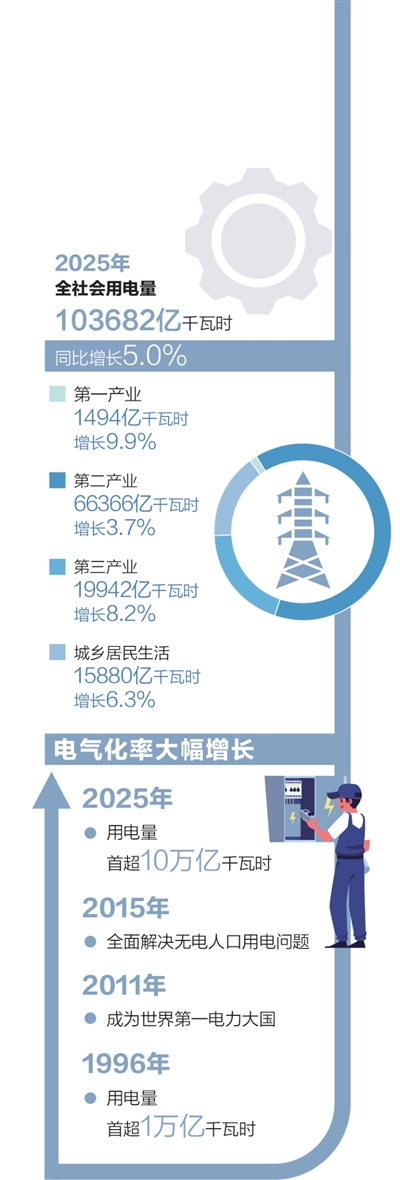
Core Insights - In 2025, China's total electricity consumption is projected to exceed 10 trillion kilowatt-hours for the first time, marking a significant milestone in global energy consumption [3][4] - The growth in electricity consumption reflects China's status as a manufacturing powerhouse and indicates a substantial improvement in energy security [3][4] Group 1: Electricity Consumption Growth - Total electricity consumption in 2025 is expected to reach 10,368.2 billion kilowatt-hours, a year-on-year increase of 5.0% [3] - The first industry will consume 149.4 billion kilowatt-hours, growing by 9.9% [3] - The second industry will account for 66,366 billion kilowatt-hours, with a growth rate of 3.7% [3] - The third industry will consume 19,942 billion kilowatt-hours, reflecting an 8.2% increase [3] - Urban and rural residents' electricity consumption will reach 15,880 billion kilowatt-hours, growing by 6.3% [3] Group 2: Industrial and Sectoral Changes - The second industry remains the primary electricity consumer, accounting for approximately 64% of total consumption [4] - High-value-added and technology-intensive industries are driving new electricity consumption growth, with semiconductor manufacturing seeing a significant increase [4][5] - The third industry is becoming a crucial driver of electricity consumption, with sectors like data centers and electric vehicle charging services experiencing rapid growth [5][7] Group 3: Electrification and Energy Efficiency - The electrification rate of end-use energy is around 30%, surpassing that of major developed economies [7] - Investments in smart irrigation systems and rural electrification projects are enhancing energy efficiency and supporting agricultural electricity needs [7][8] - The development of electric heating and high-temperature heat pumps in industrial sectors is contributing to energy transition [8] Group 4: Power Supply and Infrastructure - China has the world's largest power supply system, with renewable energy sources like wind and solar surpassing traditional coal power [9][10] - The construction of ultra-high voltage transmission lines is facilitating the transfer of clean energy from resource-rich regions to consumption centers [10] - The national electricity market is evolving, with significant increases in electricity trading volumes, reflecting a more dynamic and integrated energy market [11]
从新鲜入局“驶向”信任扎根
Xin Lang Cai Jing· 2026-01-18 21:30
Core Insights - The Chinese automotive industry is projected to achieve a production and sales volume exceeding 34 million vehicles by 2025, maintaining its position as the world's largest market for 17 consecutive years, with new energy vehicles (NEVs) expected to surpass 16 million units, leading globally for 11 years [1][2] - NEVs are anticipated to account for 50.8% of new car sales in China by 2025, marking a significant shift towards electric vehicles as the dominant force in the market [1] - China's automotive exports are expected to exceed 7 million units, with international markets becoming a new growth driver [1] Industry Development - The success of China's NEVs is attributed to a comprehensive and efficient supply chain, allowing rapid component development and enhancing consumer trust in product delivery and after-sales service [2] - China has established a complete industrial system covering basic materials, components, complete vehicles, and manufacturing equipment, supplying 70% of battery materials and 60% of power batteries globally, creating a competitive advantage [2] - Policy support, including long-term special bonds and targeted loans for technological innovation, has played a crucial role in driving the automotive industry's transformation towards green, intelligent, and high-end development [2] Brand Evolution - Chinese automotive brands have shifted from a low-price competition model to a focus on technological innovation and value enhancement, improving brand perception and quality [3] - The transition from being perceived as "new entrants" to gaining consumer trust reflects the evolution of Chinese manufacturing towards intelligent manufacturing, emphasizing innovation and quality [3] - The industry's advancement signifies a broader economic shift in China, driven by innovation and quality-first principles, positioning it for future growth in intelligent and connected vehicle markets [3]
古越新章 智风和畅——绍兴传统产业以创新突破发展瓶颈
Shang Hai Zheng Quan Bao· 2026-01-18 18:15
Core Viewpoint - Shaoxing is experiencing a transformation in its traditional industries through green and intelligent upgrades, maintaining its historical essence while adapting to modern trends [1] Industry Summary - The textile, pharmaceutical, and chemical industries, which have historically formed the foundation of Shaoxing's economy, are revitalizing through innovation and technology integration [1] - The manufacturing sector in Shaoxing is showing significant growth, with the industrial added value of above-scale enterprises increasing by 9.8% year-on-year from January to November 2025 [1] Company Summary - Xilinmen, starting from small workshops, focuses on health sleep solutions by integrating innovative technology into smart mattresses [1] - Wanfeng Co., known for its substantial R&D investments, is leading the green upgrade in high-end printing and dyeing, beginning with a high-temperature dye [1] - The computer communication and electronic equipment manufacturing industry, representing new growth momentum, achieved a growth rate of 20.1%, while the chemical raw materials and chemical products manufacturing industry also saw a 20% increase [1]
我省三大产业优化升级实施方案落地
Xin Lang Cai Jing· 2026-01-18 17:25
Group 1: Core Insights - The Anhui provincial government has approved three implementation plans focusing on the optimization and upgrading of the non-ferrous metals, building materials, and textile industries, aiming for high-quality development in manufacturing [1][2] - The non-ferrous metals industry is a key pillar for Anhui, with a target to exceed 500 billion yuan in revenue by 2027, cultivating two trillion-level industries (copper and aluminum) and two hundred billion-level industries (magnesium and lead) [1] - The building materials industry is competitive, with cement and glass as trillion-level segments, aiming for 270 billion yuan in revenue by 2027 and the establishment of 20 advanced intelligent factories and 50 provincial-level green factories [2] - The textile industry is crucial for Anhui's economy, with a goal of achieving approximately 120 billion yuan in revenue by 2027, fostering 2-3 nationally recognized consumer brands, and improving energy efficiency and recycling of textile waste [2] Group 2: Industry-Specific Goals - The non-ferrous metals sector aims for significant breakthroughs in key technologies and enhanced resource security, with a focus on creating innovative enterprises and industrial clusters [1] - The building materials sector emphasizes innovation with products like flexible foldable glass and high-generation display glass substrates, maintaining a leading market share domestically [2] - The textile industry is positioned as a vital part of the manufacturing strategy, enhancing competitiveness and creating new economic growth points through optimization and upgrading [2]
王均金郭广昌南存辉现身浙商年会:今年经济怎么样?民企未来靠什么
第一财经· 2026-01-18 15:51
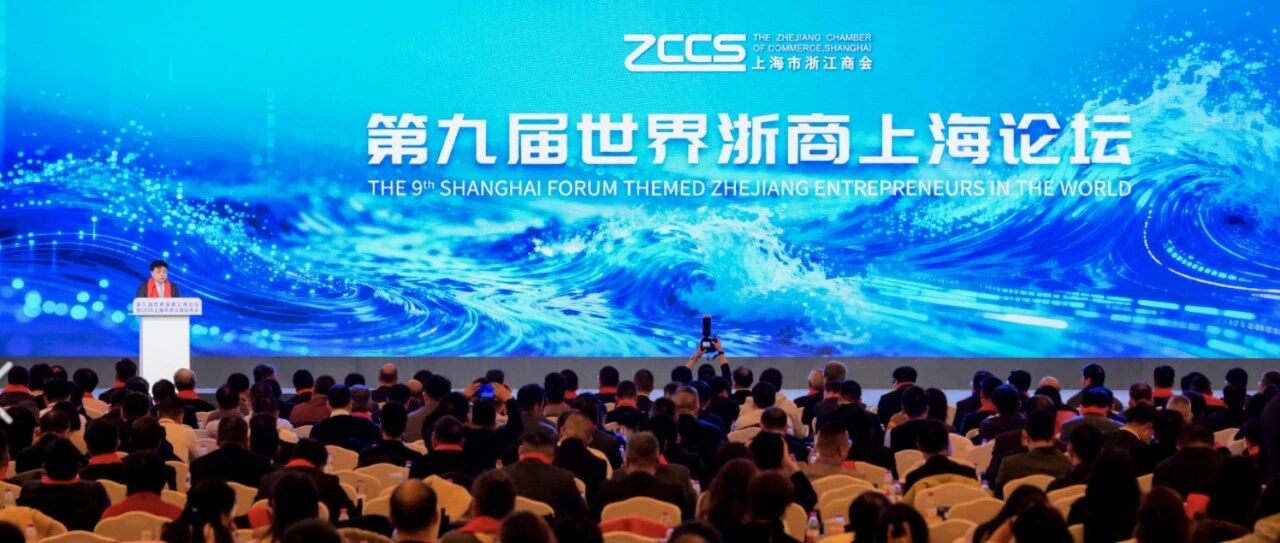
Core Viewpoint - The article emphasizes the resilience of the Chinese economy amidst challenges, highlighting the importance of innovation and global opportunities for private enterprises in China [3]. Group 1: Economic Resilience and Challenges - The current economic environment is warmer compared to the previous year, with negative factors being gradually digested, showcasing the resilience of the Chinese economy [3]. - The past few decades of rapid economic growth have led to challenges that require reflection on whether companies overestimated their capabilities and competitiveness [5]. Group 2: Innovation and Product Development - The era of relying on a single successful strategy is over; companies must focus on innovation and enhancing product quality to improve competitiveness [6]. - The hospitality sector, exemplified by the Atlantis Hotel in Sanya, has seen improved occupancy rates and pricing, indicating strong consumer demand for high-quality products despite a backdrop of consumption downgrade [6]. Group 3: Importance of Technology and ESG - Emphasis on technological innovation as a new engine for private enterprise development, with a call for investment in foundational research and key technologies [6]. - The significance of ESG (Environmental, Social, and Governance) initiatives and green technology development is highlighted as a global consensus and a substantial market opportunity [6]. Group 4: Globalization and International Opportunities - Despite domestic market challenges, globalization remains a key focus, with companies encouraged to build global capabilities and perspectives [8]. - The example of Fosun's global operations, with overseas revenue reaching 46.67 billion yuan in the first half of 2025, illustrates the potential of Chinese enterprises in the global market [8]. Group 5: Competitive Landscape and Future Directions - Chinese private enterprises, particularly in emerging sectors like AI and biotechnology, are becoming globally competitive, with significant price differentials in international markets [9]. - The new era of globalization involves not just product exports but also the allocation of innovative resources globally and participation in setting international standards [9].
汽车行业周报:中欧电动汽车反补贴案取得阶段性进展,机器人量产进程提速-20260118
SINOLINK SECURITIES· 2026-01-18 12:11
Investment Rating - The report suggests a focus on the automotive industry, particularly on companies like BYD and Geely for vehicle manufacturing, and companies like Li Auto, Xpeng Motors, and others in the smart technology and robotics sectors [3][20]. Core Insights - The EU's implementation of a price commitment mechanism is expected to significantly alleviate the tariff pressure faced by Chinese electric vehicle manufacturers exporting to Europe, improving their profitability per vehicle [1][13]. - Boston Dynamics' Atlas humanoid robot is set to begin mass production in 2026, marking a shift from technology validation to commercial deployment, with significant partnerships in manufacturing and logistics [2][14]. - The first week of 2026 saw a decline in retail sales of passenger vehicles, but there is optimism for recovery in Q1 2026 due to upcoming policy support and seasonal demand [19][3]. - The report highlights the ongoing trend of increasing exports of passenger vehicles, particularly in the context of recovering demand in markets like Russia and the growing penetration of new energy vehicles [3][19]. Industry Data Tracking - The Shanghai Composite Index decreased by 0.57%, while the automotive index increased by 0.49%, ranking 10th among 31 sectors [21]. - In the first week of January 2026, wholesale passenger vehicle sales were 381,000 units, down 40% year-on-year, with new energy vehicle sales at 167,000 units, also down 30% [5][27]. - In December 2025, the total wholesale passenger vehicle sales were 2.787 million units, a year-on-year decrease of 9.3%, while new energy vehicle sales increased by 3.4% [6][34]. - Exports of passenger vehicles in December 2025 reached 588,000 units, a year-on-year increase of 45.5%, with new energy vehicle exports at 270,000 units, up 122.9% [6][50][54]. Industry Dynamics - The report notes significant developments in the automotive sector, including the establishment of a new company by Jetta to focus on new energy vehicles, and plans by XPeng to build an independent overseas supply chain team [62][64]. - The Hong Kong government is advancing autonomous driving tests, which could provide valuable insights for the application of such technologies in urban environments [61].


