
美国通胀

Search documents
美国5月CPI数据点评:美国通胀数据平淡、关税立场或难改变
Bank of China Securities· 2025-06-13 02:42
Report Industry Investment Rating - No information provided regarding the industry investment rating Core Viewpoints - The flat inflation data in the US may be seen by the Trump administration as a favorable condition to maintain the tariff policy, but due to the clear role of tariffs in the fiscal plan, the Trump administration is unlikely to significantly increase tariffs easily [2][13] - The flat consumption data is related to the flat employment growth, the decline in consumer confidence, and the Fed's stance on combating inflation [2][7] - If tariffs cannot be passed on to prices, it will eventually undermine importer confidence, making the problem of commodity shortages more obvious and increasing price pressure [2] Summary by Related Content Inflation Data Analysis - The overall CPI data in the US in May was flat, with stable year - on - year changes in core, energy, and food CPI. Prices remained stable despite new tariffs in April and May, and the ability of importers to pass on tariffs to consumers is uncertain [2][4] - The housing price index was the main driver of the CPI increase in May, while the energy price index decreased month - on - month [3] Consumption and Employment Situation - Consumption data is affected by employment growth, consumer confidence, and the Fed's anti - inflation stance. The year - on - year growth rate of non - farm employment in the US has been steadily declining since this year, and GDP and consumer spending growth may return to the non - farm employment growth rate [2][7] - The consumer confidence index in April and May was at the fourth - lowest point on record. Although consumer confidence decline is related to expected inflation, inflation expectations may lead to a decrease in consumer spending [9] Tariff Policy and Its Impact - The Trump administration is unlikely to revoke or reduce tariffs easily, nor will it significantly increase tariffs easily, as tariffs are expected to cut the deficit by $2.8 trillion in the next 10 years [2][13] - If tariffs cannot be passed on to prices, it will affect importer confidence, and if energy prices rebound, price pressure in the US may increase [2][12]
黄金多头力量强劲5月PPI小幅上升
Jin Tou Wang· 2025-06-13 02:41
Group 1 - The core viewpoint indicates that gold prices have significantly increased, reaching $3430.29 per ounce with a rise of 1.33% [1][3] - The opening price for gold today was $3384.94 per ounce, with a high of $3432.70 and a low of $3379.33 [1][3] Group 2 - The U.S. inflation appears to be moving towards the Federal Reserve's 2% target, while labor data suggests a potential rise in unemployment [2] - The Producer Price Index (PPI) for May increased slightly by 0.1%, and initial jobless claims remain high at 248,000 [2] - These factors have heightened expectations for a possible interest rate cut by the Federal Reserve in early fall, with a 61% probability for a rate cut in September [2] - The two-year U.S. Treasury yield, sensitive to Federal Reserve movements, has decreased to 3.891% due to the recent data [2] - Economists predict a modest increase in the core Personal Consumption Expenditures (PCE) index for May, aligning with the Federal Reserve's inflation target [2]
张尧浠:地缘局势升温降息押注回暖、金价走强保持看涨
Sou Hu Cai Jing· 2025-06-13 00:05
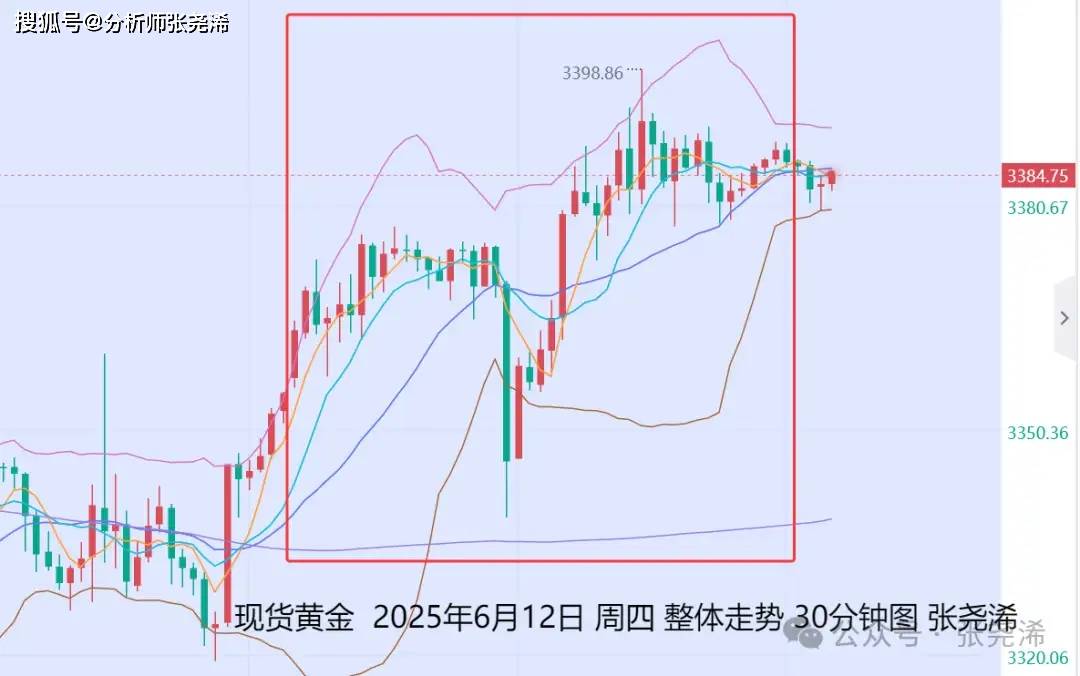
Core Viewpoint - The international gold price is expected to maintain a bullish trend, with targets set at $3435 and $3500, driven by geopolitical tensions and expectations of interest rate cuts by the Federal Reserve [1][3][8]. Market Performance - On June 12, gold opened at $3356.10 per ounce, reached a high of $3398.86, and closed at $3386.58, marking a daily increase of $30.48 or 0.91% [1]. - The daily trading range was $60.28, indicating significant volatility [1]. Economic Indicators - The U.S. dollar index fell, supporting gold prices, as both employment and inflation data showed signs of cooling, reinforcing expectations for two interest rate cuts by the Federal Reserve this year [3][7]. - The market anticipates a nearly 60% probability of a rate cut in September, despite strong non-farm payroll data that reduced immediate cut expectations [5][7]. Geopolitical Factors - Ongoing geopolitical tensions, including the situation in Ukraine and the Middle East, are fueling market risk aversion, which benefits gold prices [8]. - Recent comments from former President Trump advocating for a 200 basis point rate cut have further strengthened the outlook for gold [3][7]. Technical Analysis - The monthly chart indicates that gold remains in a bullish trend, supported by the 5-month moving average, despite recent volatility [10]. - The weekly chart shows that gold has rebounded from key support levels, with expectations to reach the upper Bollinger Band at $3500 [11]. - The daily chart reflects a bullish outlook, with gold stabilizing above the 5-10 day moving averages and aiming for targets of $3435 and $3500 [13]. Investment Strategy - The market is advised to look for buying opportunities at support levels around $3371 or $3360, while resistance levels are noted at $3400 or $3435 [13].

如何看待美国通胀不及预期?
2025-06-12 15:07
Summary of Conference Call Notes Industry Overview - The notes primarily discuss the **U.S. economy** and its inflation dynamics, particularly focusing on the **Consumer Price Index (CPI)** and the impact of tariffs and trade relations with China. Key Points and Arguments 1. **CPI Trends**: In May, the core goods CPI experienced a month-on-month decline of -0.04%, indicating reduced upward pressure on prices, potentially due to prior inventory replenishment and recent easing of tariffs [1][4] 2. **Price Performance**: Prices for clothing and communication goods were notably weak, while wholesale prices continued to rise sharply, suggesting that wholesalers absorbed some tariff costs [4][5] 3. **Inflation in China-Dependent Products**: Prices for entertainment products, sports goods, and toys, which are heavily reliant on China, continued to rise, with toys showing a month-on-month inflation rate of 1.35% [6] 4. **Core Services and Rent**: Rent growth has slowed, but forward-looking indicators suggest limited downward space for future rent increases, indicating resilience in core service inflation [7] 5. **Trade War Implications**: The escalation of the trade war could lead to increased goods prices, potentially harming consumer purchasing power in services and discretionary spending [7] 6. **Market Reactions**: Current CPI data is stable, with no further escalation in the U.S.-China trade war, leading to a slight increase in interest rate cut expectations and a decline in U.S. Treasury yields [8] 7. **Future Inflation Risks**: Energy prices have been a significant drag on inflation, with global manufacturing PMI showing weakness and OPEC+ discussions on production cuts affecting oil prices [3] 8. **Consumer Spending Concerns**: There are risks of weakened demand in consumer services related to travel and leisure, as prices in these sectors have been soft over the past two months [7] Additional Important Insights - **Tariff Impact on Prices**: The transmission of tariff costs to consumers is expected to take about 2 to 4 months, indicating a lag in the impact of tariffs on retail prices [5] - **Economic Resilience**: Despite the potential for rate cuts, the U.S. economy shows resilience, and the uncertainty surrounding tariffs and tax cuts continues to pose risks for interest rate volatility [2][8] - **Long-term Outlook**: The long-term outlook for U.S. Treasury yields will become clearer once the effects of tariffs and tax cuts are fully absorbed by the economy [2][8]
国泰海通|宏观:美国通胀暂低,降息预期再起
国泰海通证券研究· 2025-06-12 14:26
文章来源 报告导读: 5 月美国 CPI 环比回落,增速不及预期,核心商品中仅个别分项存在价格上 涨,整体尚未体现出关税影响。我们认为,在库存缓冲、关税政策与消费需求不确定性影 响下,企业提价或存在一定时滞, 6 月通胀数据仍存在反弹压力。在就业尚稳,通胀不确 定性仍存的情况下,美联储短期仍难以降息。 2025 年 5 月美国通胀环比回落,增速不及预期。 5 月美国 CPI 同比 2.4% (前值 2.3% ,市场预期 2.4% ),核心 CPI 同比维持在 2.8% (市场预期 2.9% )。环比来看, 5 月 CPI 环比 0.1% ,前值 0.2% ,略低于市场预期( 0.2% );核心 CPI 环比 0.1% ,前值 0.2% ,市场预期 0.3% 。 具体来看, 5 月除食品通胀环比有所回升外,能源、核心商品与核心服务通胀环比均较 4 月有所回落。 其中,能源是拖累 CPI 环比的核心分项。 核心商品方面, 5 月尚未体现出明显的通胀回升压力,仅在个 别分项通胀涨幅相对明显,例如家具(窗帘地毯)、汽车零件、玩具、电脑、药品等。而服装、新车、酒 精饮料等通胀环比增速均有回落; 核心服务方面 , 租金、 ...

【光大研究每日速递】20250613
光大证券研究· 2025-06-12 13:50
Group 1 - The article discusses the recent decline in the U.S. inflation rate, with May's CPI data showing a decrease that was below market expectations. This decline is attributed to low energy prices influenced by trade disputes and OPEC+ production increases, as well as companies stabilizing product prices by absorbing tariff costs [4] - It highlights that only certain sectors are experiencing price increases, while significant categories like clothing and automotive prices continue to fall. Additionally, consumer confidence has been impacted by tariffs, leading to a decrease in demand for travel-related services [4] Group 2 - The article reports on a fire at Jiangxi Yangfan's workshop, which may affect the supply of light initiator intermediates. The demand for light initiators is driven by the PCB industry, with Jiurich and Yangfan being major suppliers. The domestic production and sales of light initiators are on the rise, and product prices are expected to rebound from their lows [5] - It also notes the recent frequency of accidents in chemical enterprises, which has impacted the supply of chemicals like caprolactam. The article suggests focusing on the nylon and specialty nylon supply chain, as caprolactam is used to produce nylon 6, with a current production capacity of 7.1 million tons per year in China [6]


【宏观】美国通胀压力何时显现?——2025年5月美国CPI数据点评(高瑞东/刘星辰)
光大证券研究· 2025-06-12 13:50
Core Viewpoints - In May, US inflation data showed a lower-than-expected month-on-month increase, with CPI rising by 0.1% compared to market expectations of 0.2% [3][4] - The core CPI also increased by 0.1% month-on-month, below the expected 0.3%, indicating a cooling in energy, core goods, and core services prices [3][4] - The impact of tariff policies is contributing to the current inflation dynamics, with businesses absorbing tariff costs and consumer demand showing signs of weakening [3][4][5] Inflation Data Summary - In May, the CPI year-on-year increased to 2.4% from 2.3%, while the core CPI remained stable at 2.8% for three consecutive months [2][4] - Food prices saw a month-on-month increase of 0.3%, while energy prices dropped by 1.0% due to OPEC+ production increases and trade concerns [5][6] - Core services prices decreased, with notable declines in accommodation, airfare, and entertainment services, reflecting reduced consumer discretionary spending [5][6] Sector-Specific Insights - Certain categories, such as appliances and healthcare products, have seen mild price increases, indicating a gradual response to tariff impacts [6] - The overall inflationary pressure is expected to manifest more significantly in the second half of the year as tariff effects become more pronounced [6][7] - The resilience of non-farm data suggests that the Federal Reserve may maintain a patient approach, with the first rate cut anticipated in September [7] Federal Reserve Outlook - The Federal Reserve is likely to remain observant in the short term, with the potential for rate cuts later in the year as inflationary pressures are deemed manageable [7] - Current market expectations indicate two rate cuts by the end of the year, with the first expected in September [7]

就业和通胀数据提高美联储9月降息几率
news flash· 2025-06-12 13:38
Group 1 - The core viewpoint of the article indicates that U.S. inflation is moving towards the Federal Reserve's 2% target, while labor data suggests a potential rise in unemployment rates [1] - The Producer Price Index (PPI) increased slightly by 0.1% in May, and the number of unemployment claims remains high at 248,000 [1] - These factors have heightened expectations for a possible interest rate cut by the Federal Reserve in early fall, with a 61% probability for a rate cut in September, up from 58% the previous day [1] Group 2 - It is anticipated that the Federal Reserve will maintain interest rates unchanged in the upcoming meetings in the next week and July [1] - The likelihood of two or more rate cuts by December has risen to 78%, compared to 70% the day before [1] - The two-year U.S. Treasury yield, sensitive to Federal Reserve movements, has decreased to 3.891% due to the impact of this data [1]
美国关键通胀数据意外未“爆表”,关税风暴“虽迟必到”?|21全球观察
Sou Hu Cai Jing· 2025-06-12 12:30
21世纪经济报道记者吴斌 上海报道 5月通胀数据意外未"爆表" 关税后第一份CPI报告没有爆表,这虽然在意料之外,但却在情理之中。 在中航证券首席经济学家董忠云看来,美国5月CPI低于市场预期,主要源于多重因素暂时抑制了关税 向通胀的传导效应。其一,今年一季度美国进口增速较高,在关税不确定性下,"抢进口"效应较为显 著,导致美国零售企业库存较高。这使得在关税提高后,进口价格上行对美国通胀的影响受到缓冲。其 二,4月全面实施"对等关税"后,美国迅速对多数贸易伙伴设置了90天宽限期。因此,报复性关税对美 国进口价格的影响仍主要体现为10%的基础关税,对美国通胀的推升作用相对有限。其三,PMI、非农 就业等数据显示美国经济本身存在放缓趋势,这也在一定程度上抑制了美国通胀的上行。 当地时间6月11日,美国劳工部公布的数据显示,美国5月CPI同比增长2.4%,低于市场预期的2.5%;5 月CPI环比增长0.1%,低于预期的0.2%。剔除食品和能源成本后,5月核心CPI同比上涨2.8%,保持在 2021年3月以来的最低水平,低于预期的2.9%;核心CPI环比增长0.1%,也低于预期的0.3%。 东吴证券首席经济学家芦哲对 ...
美国通胀低于预期
Zhao Yin Guo Ji· 2025-06-12 12:07
Economic Overview - The US CPI inflation in May was lower than expected, with a month-on-month increase of only 0.08%, down from 0.22% in April, and below the market expectation of 0.2%[4] - Year-on-year CPI growth continued to rebound from 2.3% to 2.4%[4] - Core CPI month-on-month growth decreased from 0.24% to 0.13%, significantly below the expected 0.3%[4] Inflation Drivers - Energy prices saw a month-on-month decline of 1%, with gasoline prices dropping from -0.1% to -2.6%[4] - Core goods prices fell, with new and used car prices decreasing to -0.5%[4] - The impact of tariffs on inflation is expected to be lower than anticipated, with the actual tariff rate rising to around 16% from 2.3% in Q1, potentially pushing inflation up by about 1.5% annually[4] Consumer Behavior - Core services inflation decreased, indicating weakened discretionary spending, with travel service prices continuing to decline[4] - Rent inflation, which accounts for nearly 35% of CPI, fell from 0.4% to 0.3%[4] - The super core service price growth (excluding rent) dropped from 0.18% to 0.04%[4] Federal Reserve Outlook - The Federal Reserve is expected to maintain a wait-and-see approach in the short term, with potential rate cuts of two times between September and December[4] - The combination of falling demand and lower inflation pressures may lead to a more accommodative monetary policy[4]