
PMI

Search documents
国际金融市场早知道:6月24日
Xin Hua Cai Jing· 2025-06-24 00:00
Market Insights - The Hong Kong Monetary Authority (HKMA) has noted the emergence of carry trade in the market, with the Hong Kong-US interest rate spread widening to 3% to 4%, pushing the Hong Kong dollar close to the weak end of its peg at 7.85 [1] - HKMA's Chief Executive emphasized the importance of stablecoins in payment applications over asset appreciation, indicating that expectations for high investment returns from stablecoins are unrealistic [1] - The Federal Reserve's Vice Chair Bowman suggested support for a potential interest rate cut as early as July if inflation continues to decline or if the labor market weakens [1] Economic Indicators - The U.S. June S&P Global Manufacturing PMI preliminary reading held steady at 52, the highest since February, exceeding market expectations [2] - The Eurozone's June composite PMI preliminary reading remained at 50.2, slightly below the expected 50.5, with the services PMI returning to the 50 mark while manufacturing PMI stayed at 49.4, marking 36 months without growth [2] - Germany's June composite PMI preliminary reading increased from 48.5 to 50.4, while France's composite PMI decreased from 49.3 to 48.5 [3] Global Market Dynamics - The Dow Jones Industrial Average rose by 0.89% to 42,581.78 points, the S&P 500 increased by 0.96% to 6,025.17 points, and the Nasdaq Composite climbed by 0.94% to 19,630.97 points [4] - U.S. crude oil futures fell by 8.95% to $67.23 per barrel, while Brent crude oil futures dropped by 8.37% to $69.16 per barrel [5] - The COMEX gold futures decreased by 0.04% to $3,384.40 per ounce, while silver futures rose by 0.09% to $36.05 per ounce [6] Regulatory Developments - The Thai Stock Exchange temporarily halved the daily price fluctuation limit for listed companies, effective until June 27 [7] - Central banks in India and Malaysia have reduced their derivative positions aimed at weakening their currencies, while South Korea's National Pension Fund has ended its five-month support for the Korean won [7]
美国6月Markit制造业和制造业保持扩张 价格指数创四年来最大涨幅
Hua Er Jie Jian Wen· 2025-06-23 16:06
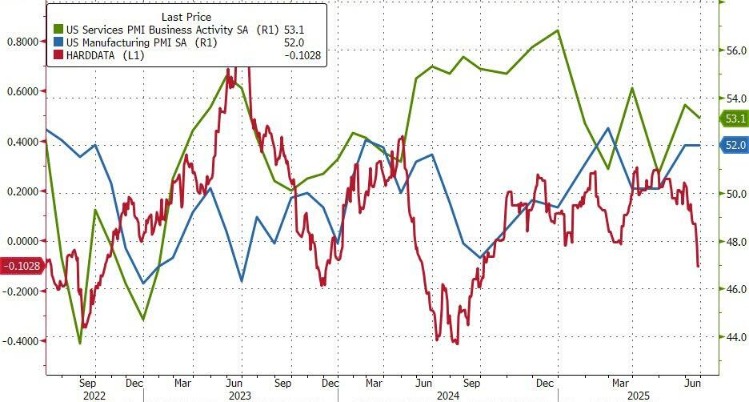
美国制造业6月继续保持稳定扩张步伐,但价格压力显著上升,两项关键通胀指标攀升至2022年7月以来最高水 平,反映出企业正将包括进口关税在内的更高成本转嫁给消费者。 周一,美国最新公布的PMI数据显示(调查数据收集的时间是6月12日至20日): 美国6月Markit制造业PMI初值52,与5月持平,高于预期的51,为2月以来最高水平。该指数高于50表明制造业活 动扩张。 美国6月Markit服务业PMI初值53.1,低于前值53.7,高于预期的52.9,创两个月新低。 美国6月Markit综合PMI初值52.8,低于前值53,高于预期52.1,创两个月新低。 通胀压力加剧,尤其是在制造业 通胀方面,制造业和服务业都面临显著的价格上涨,其中制造业尤为明显。 "虽然6月的商业活动和新订单继续增长,但在商品和服务出口下降的背景下,增长已显得疲弱。" 由于关税因素,材料采购价格指数大幅上升5.4点至70。销售价格指数上升至64.5,均达到2022年7月以来的最高 水平,显示制造商正在将成本上涨压力传导至下游。 约三分之二的制造商将原材料成本上涨归因于关税,而超过一半的制造商则将销售价格上涨归因于关税。 然而,服务业价格 ...

PMI显示美国经济在二季度末继续增长,但前景仍不明朗
news flash· 2025-06-23 13:51
金十数据6月23日讯,标普全球市场情报首席商业经济学家Chris Williamson表示,6月份的PMI初值显 示,美国经济在第二季度末继续增长,但前景仍然不确定,而过去两个月通胀压力急剧上升。尽管6月 份商业活动和新订单继续增长,但由于商品和服务出口双双下降,增长有所减弱。此外,尽管国内需求 (尤其是制造业)已经增强,以鼓励更高的就业,但这在一定程度上是由库存积累所驱动,而库存增加 往往与对价格上涨和关税导致的供应问题的担忧有关。这种提振可能会在未来几个月消退。与此同时, 商品价格再次大幅上涨,随着企业将更高的关税相关成本转嫁给消费者,上涨速度加速至三年来的最高 水平。服务提供商绝不可能不受这种关税的影响,同样报告了价格的另一次上涨,通常与食品等投入物 的关税有关。因此,这些数据证实了人们的猜测,即美联储将在一段时间内保持按兵不动,以评估经济 的弹性,以及当前这轮通胀将持续多久。 PMI显示美国经济在二季度末继续增长,但前景仍不明朗 ...
海外周报第95期:未来一周关注美欧日6月制造业PMI-20250623
Huachuang Securities· 2025-06-23 09:45
Economic Data Overview - Upcoming key economic data includes the June PMI for the US, Eurozone, and Japan, with specific dates for release noted[2][12][13] - Recent US retail sales fell by 0.9% in May, below the expected 0.6%, with previous values revised down[3][10] - Eurozone's May CPI final value matched expectations at 1.9%, with core CPI at 2.3%[3][10] Employment and Consumer Confidence - Initial jobless claims in the US were 245,000, aligning with expectations, while continuing claims slightly decreased to 1.945 million[5][25] - Consumer confidence indicators are set to be released next week, which may impact market sentiment[2][12] Price Trends - Global commodity prices increased by 0.8% week-on-week, while US gasoline prices rose to $3.02 per gallon, up 1.1%[6][27] - The US import price index showed a 0% change in May, exceeding the expected decline of 0.2%[3][10] Financial Conditions - US financial conditions index remained stable at 0.292, while the Eurozone index slightly declined to 0.905, indicating tighter conditions[6][31] - Long-term bond spreads narrowed between the US and Japan, as well as between the US and Germany, reflecting changing market dynamics[6][37]
不确定性阴云压顶!欧元区6月PMI略高于荣枯线,德国意外恢复增长
智通财经网· 2025-06-23 09:06
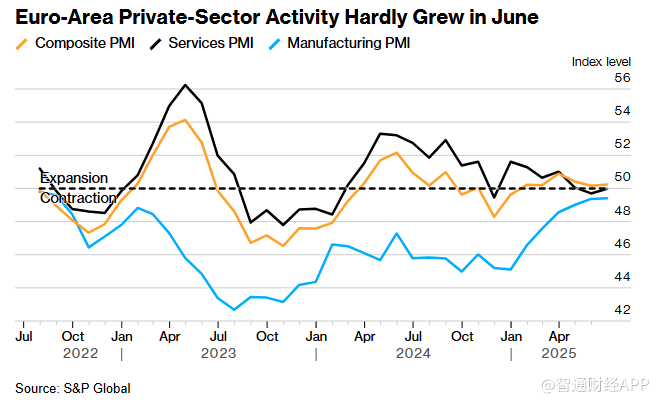
智通财经APP获悉,由于美国贸易政策反复无常以及地缘政治冲突导致企业对未来前景感到迷茫,6月 份欧元区私营部门活动几乎没有增长。相比之下,德国私营部门活动在经历了一个月的萎缩后意外恢复 增长,而法国继续萎缩。 欧元区私营部门活动接近停滞 周一公布的数据显示,欧元区6月SPGI综合PMI初值保持在50.2,略高于50的荣枯分界线。经济学家此 前预计该指数将加速至50.5。服务业PMI回到了至关重要的50,而制造业PMI则停留在49.4,连续36个 月未见增长。 6月份欧元区私营部门活动几乎没有增长 汉堡商业银行经济学家Cyrus de la Rubia表示:"欧元区经济正艰难地复苏。六个月来,经济增长一直微 乎其微。" 各国PMI数据喜忧参半 欧洲最大经济体德国的6月SPGI综合PMI初值从上月的48.5攀升至50.4,分析师此前预计该指数将维持在 荣枯线以下。 随着制造业PMI升至49,达到2022年8月以来的最高水平,德国制造业接近结束近三年的衰退。服务业 PMI也在5月份下滑后企稳,这增强了人们对德国经济正在摆脱停滞的预期,尽管美国关税和中东冲突 的不确定性扔挥之不去。 6月份德国私营部门活动意外增长 R ...
欢迎进入链接网页右侧下载本周财经数据与事件精美周历壁纸:多国制造业和服务业PMI公布,美国对多种钢制家电加征关税
news flash· 2025-06-22 23:55
Group 1 - The article highlights the release of manufacturing and services PMI data from multiple countries, indicating potential economic trends [1] - It mentions the United States imposing tariffs on various steel appliances, which could impact the manufacturing sector and related industries [1]
市场或有反复,但预计大盘仍保持震荡调整态势
Hua Lian Qi Huo· 2025-06-22 12:08
Report Industry Investment Rating No information provided. Core View of the Report The market may fluctuate, but the broader market is expected to maintain a volatile adjustment trend. With the realization of positive factors and the reality of weak fundamentals, and facing pressure above 3400 points, there is insufficient momentum for further upward movement. It is recommended for short - term trading. Hold short positions in IM2507 and long positions in MO2509 - P - 5600 [11]. Summary by Related Catalogs 1. Fundamental View - **Market Performance**: Last week, the broader market first rose and then fell, with a slight adjustment. The four major indices fluctuated and adjusted, and small and medium - cap stock indices declined more. All style indices fell, with the growth - style index having the largest decline. Most Shenwan industries fell, with textile and apparel, medicine, non - ferrous metals, and tourism sectors leading the decline. Only the banking, communication, and electronics industries rose [6][8][14]. - **Economic Data**: In May 2025, the manufacturing PMI was 49.5%, up 0.5 percentage points from the previous month; the non - manufacturing PMI was 50.3%, down 0.1 percentage points from the previous month. After Sino - US negotiations, tariffs will be reduced within 90 days, and the PMI rebounded. In terms of sub - items, production and demand recovered in May, with production up 0.9%, new orders up 0.6%, and new export orders up 2.8%. Most other indices also increased, while the inventory of finished products decreased continuously by 0.8%. In terms of prices, the ex - factory price and the purchase price of major raw materials continued to decline [8]. - **Policy**: The Politburo set the tone for the real estate market to stop falling and stabilize, boosting the capital market. The central bank created two new monetary policy tools, cut the reserve requirement ratio, and lowered interest rates to reduce the stock mortgage rate. The CSRC proposed mergers, acquisitions, and market value management to enhance market activity. The implementation plan for promoting the entry of long - term funds into the market was officially released, which is expected to add 800 billion yuan of long - term funds to the A - share market annually [8]. - **Earnings**: In terms of revenue, the revenue growth rates of the ChiNext, ChiNext, and CSI 500 indices increased, while those of the CSI 1000, SSE Composite Index, SSE 50, and CSI 300 indices declined. In terms of net profit attributable to the parent, except for the SSE Composite Index, the net profit growth rates of the ChiNext, Shenzhen Component Index, CSI 1000, SSE 50, CSI 500, and CSI 300 indices all increased significantly. Although the performance of the entire A - share market shows signs of stabilization, the 30% increase in tariffs imposed by the US since the second quarter may affect the fundamentals of the A - share market, and the A - share performance may bottom out again [8]. - **Valuation**: The valuation of the SSE Composite Index is 14.6431, at the 68.72 percentile since 2010. The valuation of the ChiNext is relatively low [9][65]. - **Funding**: From April 7 to June 20, 2025, the ETF scale increased by 138.3 billion yuan, with an increase of 12.9 billion yuan last week, which was the first increase after continuous reductions since May. In terms of margin trading, there was a net inflow of 274.8 billion yuan in 2024; as of June 12, 2025, there was a net outflow of 44.9 billion yuan in 2025, and a net inflow of 2 billion yuan in the first five trading days. At the end of 2024, the assets of the national team and insurance funds showed a net increase, while the assets of the Shanghai - Hong Kong and Shenzhen - Hong Kong Stock Connect showed a net decrease. Specifically, the assets of Central Huijin and insurance funds increased [9]. 2. Strategy View and Outlook - **Market Outlook**: The broader market showed a weak and volatile trend last Friday, with a brief rebound in the morning. The performance of the four major indices was divergent, with large - cap stock indices rising and small and medium - cap stock indices falling. The ratio of rising to falling stocks in individual sectors rebounded from a low level by 0.43. After two consecutive days of adjustment, the Hong Kong stock market rebounded, and market sentiment may have improved. Sino - US negotiations achieved important progress, and the positive factors in mid - May were realized. With the implementation of reserve requirement ratio cuts and interest rate cuts, subsequent policies may enter a wait - and - see period, and the focus of the market may shift to the domestic fundamentals. From the recent CPI and PPI data, CPI and PPI continued to decline more than expected, and the problem of domestic over - capacity is still significant. In addition, the negative impact of the additional tariffs imposed this year on the fundamentals may gradually emerge. Technically, after continuous volatile climbs, the short - term technical indicators are under pressure. The broader market, CSI 500, and CSI 1000 indices showed divergence structures in the minute - level sequences, and the broader market faced pressure when continuously attacking 3400 points. Technically, it may face adjustment. In summary, with the realization of positive factors and the weak reality, and facing pressure above 3400 points, there is insufficient momentum for further upward movement. It is expected that the broader market will continue to maintain a volatile adjustment, and the market may fluctuate. It is recommended for short - term trading [11]. - **Operation Suggestion**: Hold short positions in IM2507 and long positions in MO2509 - P - 5600 [11]. 3. Index and Industry Trend Review - **Index Performance**: Last week, the broader market first rose and then fell, with a slight adjustment. The four major indices fluctuated and adjusted, and small and medium - cap stock indices declined more [6][14]. - **Style and Industry Index**: All style indices fell last week, with the growth - style index having the largest decline. Most Shenwan industries fell, with textile and apparel, medicine, non - ferrous metals, and tourism sectors leading the decline. Only the banking, communication, and electronics industries rose [8][16]. 4. Main Contract and Basis Trend - **Index Adjustment**: The four major indices fluctuated and adjusted, with small and medium - cap stock indices having more adjustments. On Friday, due to delivery, the basis narrowed and there was a premium [19]. - **Arbitrage Relationship**: In terms of arbitrage among main contracts, IC/IF and IC/IH may decline again after a downward rebound, IH/IF stabilizes after a volatile adjustment, and IM/IF and IM/IH continue to decline after a downward rebound [24]. 5. Policy and Economy - **PMI Data**: In May 2025, the manufacturing PMI was 49.5%, up 0.5 percentage points from the previous month; the non - manufacturing PMI was 50.3%, down 0.1 percentage points from the previous month. After Sino - US negotiations, tariffs will be reduced within 90 days, and the PMI rebounded. In terms of sub - items, production and demand recovered in May, with production up 0.9%, new orders up 0.6%, and new export orders up 2.8%. Most other indices also increased, while the inventory of finished products decreased continuously by 0.8%. In terms of prices, the ex - factory price and the purchase price of major raw materials continued to decline [8][28]. - **PPI and Inventory Cycle**: Generally, PPI leads the inventory cycle (ranging from 1 month to 1 year, with an average of about half a year). PPI bottomed out and rebounded in June 2023, weakened after two months, and has seen a continuous narrowing of the decline since March 2024, with the decline widening again since July and narrowing again until March 2025, and then widening for three consecutive months. In April, the revenue of industrial enterprises fell back to 3.2%, and the inventory fell by 3.9% in March. In the past two years, inventory and revenue have shown a steady recovery, in the stage of active inventory replenishment. With the decline of PPI again, it is expected to enter the stage of passive inventory replenishment [30]. - **Social Financing and Credit**: In May 2025, the year - on - year increase in social financing continued to be 224.6 billion yuan, with government bonds increasing by 236.7 billion yuan, and the increase significantly narrowed. The year - on - year increase in credit was 330 billion yuan less, mainly due to a 210 - billion - yuan decrease in corporate loans, including a 23 - billion - yuan increase in short - term loans and a 17 - billion - yuan decrease in medium - and long - term loans [32]. - **Medium - and Long - Term Credit Growth**: The medium - and long - term credit growth rate has been falling for 24 consecutive months to 6.78% as of May 2025, hitting a new low since 2011 [7][35]. - **Policy on Long - Term Funds**: The implementation plan for promoting the entry of long - term funds into the market aims to increase the investment scale and proportion of long - term funds in A - shares. For public funds, it is clear that the market value of A - shares held by public funds should increase by at least 10% annually in the next three years. For commercial insurance funds, large - scale state - owned insurance companies are expected to invest 30% of their newly added premiums in A - shares annually starting from 2025, which means adding at least several hundred billion yuan of long - term funds to A - shares annually. The second - batch pilot program for long - term stock investment of insurance funds will be implemented in the first half of 2025, with a scale of no less than 100 billion yuan, and will be gradually expanded later. The implementation plan also extends the assessment cycle, aiming to improve the stability of long - term fund investment behavior [37]. - **Other Policies**: The Politburo set the tone for the real estate market to stop falling and stabilize, boost the capital market, and promote the entry of long - term funds. The central bank created new monetary policy tools, including a securities, funds, and insurance companies swap facility with an initial scale of 500 billion yuan, and a stock repurchase and increase loan with an initial scale of 300 billion yuan. There were also reserve requirement ratio cuts, interest rate cuts, and measures to support the real estate market and the real economy, such as increasing the quota of re - loans for scientific and technological innovation and technical transformation, setting up a "service consumption and elderly care re - loan", and creating a risk - sharing tool for scientific and technological innovation bonds [38][39][41]. 6. Revenue and Net Profit of Each Index - **Annual Report**: Except for the CSI 500, the year - on - year growth rates of the operating revenues of each index in the 2024 annual report declined. In terms of net profit attributable to the parent, the year - on - year growth of the SSE 50 index continued, the CSI 300 index had a slight increase, and the CSI 500, ChiNext, and Shenzhen Component Indexes declined to varying degrees [50]. - **First - Quarter Report**: In terms of revenue, the revenue growth rates of the Shenzhen Component Index, ChiNext, and CSI 500 indices increased, while those of the CSI 1000, SSE Composite Index, SSE 50, and CSI 300 indices declined. In terms of net profit attributable to the parent, the net profit growth rates of the ChiNext, Shenzhen Component Index, CSI 1000, SSE 50, CSI 500, CSI 300, and SSE Composite Indexes all increased significantly [56]. - **Performance Outlook**: Although the performance of the entire A - share market shows signs of stabilization, the 30% increase in tariffs imposed by the US since the second quarter may affect the fundamentals of the A - share market, and the A - share performance may bottom out again [60]. 7. Valuation - **SSE Composite Index Valuation**: The valuation of the SSE Composite Index is 14.6431, at the 68.72 percentile since 2010 [9][65]. - **Valuation of Each Index**: The report provides the PE percentiles of each index from 2010 to June 2025, showing that the ChiNext has a relatively low valuation [66]. 8. Funding - **ETF Scale**: From April 7 to June 20, 2025, the ETF scale increased by 138.3 billion yuan, with an increase of 12.9 billion yuan last week, which was the first increase after continuous reductions since May [69]. - **Margin Trading**: There was a net inflow of 274.8 billion yuan in margin trading in 2024; as of June 12, 2025, there was a net outflow of 44.9 billion yuan in 2025, and a net inflow of 2 billion yuan in the first five trading days [76]. - **Primary Market Financing**: As of last weekend, the IPO financing in 2023 was 356.5 billion yuan, 67.3 billion yuan in 2024, and 37.1 billion yuan in 2025 [79]. - **ETF Share and Scale**: In the week from June 13 to June 20, 2025, the ETF share increased by 29.252 billion shares (+0.83%), reaching 3556.49 billion shares; the total scale decreased by 37.137 billion yuan (-0.77%), to 4812.054 billion yuan [82]. - **Secondary Market Shareholder Transactions**: Last week, major shareholders in the secondary market continued to have a net reduction of 3.58 billion yuan [85]. - **Restricted - Share Unlocking**: The unlocking volume from March to June is not large [88].
美国消费行业5月跟踪报告:多扰动因素仍在,不确定性难消
Haitong Securities International· 2025-06-20 11:17
Investment Rating - The report maintains a cautious investment stance on the consumer sector, particularly for low-priced consumer goods and imported durable goods due to ongoing uncertainties and potential economic risks [5]. Core Insights - The consumer confidence index rebounded significantly in June, reaching 60.5, up 15.9% from May's 52.2, indicating a recovery from previous declines [8][9]. - Retail sales in May 2025 were $715.42 billion, a 0.9% month-over-month decline, marking the largest single-month drop since March 2023 [9]. - Inflation data showed a mild increase in May, with the CPI rising 2.4% year-over-year, below market expectations, but long-term inflation risks remain [11][13]. - Employment data showed a mixed picture, with non-farm payrolls adding 139,000 jobs in May, exceeding expectations, but revisions indicated a slowdown in job growth [15][19]. Summary by Sections Macro Overview - The consumer confidence index rebounded in June, reflecting a recovery from previous declines, with inflation expectations decreasing from 6.6% to 5.1% [8]. - Retail sales data for May showed a significant decline, particularly in durable goods, as the demand normalized following a previous surge [9]. - Inflation data indicated a mild increase, with CPI rising 2.4% year-over-year, but long-term inflation concerns persist due to potential tariff impacts [11][13]. - Employment data showed a stable job market, but with signs of sectoral divergence, particularly in manufacturing and services [15][17]. Essential Consumption - Beverage and tobacco sectors outperformed the market, with beverage sales showing resilience, while alcoholic beverages and dairy products continued to underperform [2][34]. - Alcoholic beverage retail sales in April were $5.63 billion, with a year-over-year increase of 1.6%, but overall sales volume continued to decline [2][29]. - Dairy product shipments totaled $13.61 billion in April, with a year-over-year increase of 2.5%, indicating a stable but lackluster performance [34]. - Beverage shipments reached $11.97 billion in April, with a year-over-year increase of 4.7%, showcasing strong demand in essential categories [34]. Optional Consumption - The restaurant sector showed resilience with retail sales of $97.36 billion in May, a year-over-year increase of 5.3%, but a month-over-month decline of 0.9% [39]. - Department store sales in May were $76.76 billion, reflecting a year-over-year increase of 2.2%, but a continued weakening trend [42]. - Apparel retail sales reached $26.18 billion in May, with a year-over-year increase of 3.7%, but a decline in momentum due to the end of pre-tariff purchasing [44]. Market Performance - The consumer sector saw a broad rally in May, with significant gains in essential and discretionary categories, although valuations remain at historical highs [4]. - The consumer discretionary ETF saw a net inflow of $553 million, while the essential consumer ETF had a net inflow of $522 million, indicating investor interest [4]. Investment Recommendations - The report advises maintaining a cautious approach towards the consumer sector, particularly in light of ongoing uncertainties related to tariffs and economic growth [5].