资产荒

Search documents
日度策略参考-20250606
Guo Mao Qi Huo· 2025-06-06 07:59
Report Industry Investment Ratings - No specific industry investment ratings are provided in the report. Core Views of the Report - The positive signals from the Sino - US economic and trade talks are expected to drive short - term strength in stock indices [1]. - The situation of asset shortage and weak economy is favorable for bond futures, but the central bank's short - term interest rate risk warning suppresses the upward movement [1]. - Different commodities have different trends: some are expected to rise, some to fall, and some to fluctuate, which are affected by factors such as supply - demand relationships, macro - economic conditions, and policy uncertainties [1]. Summary According to Relevant Catalogs Macro - finance - Stock indices are expected to be strong in the short term due to positive signals from Sino - US economic and trade talks [1]. - Bond futures are favored by asset shortage and weak economy, but short - term interest rate risk warnings limit upward movement [1]. Precious Metals - Gold is expected to fluctuate in the short term and has a solid long - term upward logic [1]. - Silver is expected to remain strong but there is a risk of a sharp pullback [1]. Non - ferrous Metals - Copper is expected to remain strong due to the boost of the Sino - US leaders' phone call [1]. - Aluminum may fluctuate weakly due to repeated macro - sentiment and weakening downstream demand despite low inventory support [1]. - Alumina may rebound in the short term due to rising spot prices, significant futures discounts, and mine - end disturbances [1]. - Nickel is expected to fluctuate in the medium - to - long term due to uncertainties in tariff policies and potential oversupply of primary nickel [1]. Black Metals - Iron ore may fluctuate as the iron - making volume is expected to peak and there is an expected increase in supply in June [1]. - Manganese silicon and silicon iron have different supply - demand situations, with manganese silicon having heavy warehouse receipt pressure and silicon iron having a tight supply - demand balance due to production cuts [1]. - Steel products such as hot - rolled coils and stainless steel have different trends based on factors like cost, supply, and demand [1]. Agricultural Products - Corn is expected to be strong in the medium term due to tightening supply - demand, but its upward potential is limited by domestic substitute grain prices [1]. - Soybean meal is expected to face pressure on the spot basis and near - month contracts due to expected inventory accumulation in June [1]. - Sugar production in Brazil is expected to change in the 2025/26 season, and the future production may be affected by the crude oil price [1]. Energy and Chemicals - Crude oil and fuel oil are expected to fluctuate, affected by OPEC+ production decisions, geopolitical situations, and seasonal consumption [1]. - PTA, ethylene glycol, and other chemical products have different trends based on factors such as cost, supply, and demand [1]. - Urea may rebound, while methanol is expected to fluctuate weakly in the short term [1]. Others - Shipping container freight on the European route has a "strong expectation, weak reality" situation, and certain trading strategies are recommended [1]. - LPG is expected to fluctuate weakly in the short term due to weak demand and lack of news guidance [1].
信用债ETF(511190)6月6日起可开展通用质押式回购交易,最新规模超90亿元创历史新高
2 1 Shi Ji Jing Ji Bao Dao· 2025-06-05 02:01
Group 1 - Haitong Fund Management Co., Ltd. announced that its credit bond ETF (511190) will be eligible for pledge-style repurchase transactions starting from June 6, 2025, making it one of the first credit bond ETFs in the market to serve as general collateral for such transactions [1] - The introduction of general pledge-style repurchase business is expected to provide multiple benefits for credit bond ETF products and investors, enhancing liquidity and attractiveness, and facilitating participation from various investors [1][2] - The credit bond ETF (511190) has seen a continuous net inflow of funds for 11 consecutive trading days, with a total net inflow exceeding 3.58 billion yuan, indicating strong market interest [1] Group 2 - The credit bond ETF (511190) closely tracks the Shanghai Stock Exchange's benchmark market-making corporate bond index, primarily composed of high-quality AAA-rated bonds issued by central and state-owned enterprises, ensuring liquidity and low credit risk [2] - Under the new regulatory framework and "benchmark market-making" mechanism, credit bond ETFs are transitioning from a single allocation tool to a composite product with trading and financing functions, which is expected to enhance market recognition and investment enthusiasm [2] - The ongoing demand for high-rated credit bonds amid the current "asset shortage" environment, combined with the pledge mechanism and T+0 trading convenience, is likely to improve liquidity in the credit bond market and optimize the bond market ecosystem [2]
低利率及资产荒背景下,银行股重构股市投资逻辑
Di Yi Cai Jing· 2025-06-03 14:33
Core Viewpoint - The banking sector has shown strong performance post the Dragon Boat Festival, with significant gains in both A-shares and H-shares, driven by the inclusion of certain banks in core market indices and a favorable low-interest-rate environment [1][2][3]. Group 1: Market Performance - On June 3, the banking sector saw a collective rise, with the A-share market capitalization of banks exceeding 10 trillion yuan, marking a 630 billion yuan increase from the beginning of the year [6][8]. - The banking index rose by 2.5% on June 3, closing with a 1.98% increase, ranking fourth among 31 Shenwan primary industries [2][3]. - Individual stocks such as Shanghai Rural Commercial Bank and Chongqing Rural Commercial Bank reached new highs, with the former hitting the daily limit up [2][3]. Group 2: Index Inclusion Impact - The strong performance of the banking sector is attributed to the inclusion of Shanghai Rural Commercial Bank and Chongqing Rural Commercial Bank in major indices like the CSI 300 and SSE 180 [3][4]. - The adjustment of index samples is expected to attract significant passive fund inflows, as these indices are closely linked to large-scale ETF products [4][6]. Group 3: Investment Trends - The banking sector has become a favored choice for risk-averse investors, with discussions around the attractiveness of bank stocks compared to traditional savings and investment products intensifying [1][9]. - The sector has seen a nearly 10% increase year-to-date, contrasting with a decline in the broader market [6][9]. - Analysts suggest that the current investment trend is supported by a combination of high dividend yields and a shift in institutional investment strategies towards banking stocks [8][11]. Group 4: Future Outlook - The low-interest-rate environment and ongoing asset scarcity are expected to sustain the appeal of bank stocks, with analysts predicting a potential recovery in price-to-book ratios for quality banks [10][11]. - The anticipated reforms in public funds are likely to further enhance the allocation towards banking stocks, contributing to continued price increases [8][9].
债市日报:6月3日
Xin Hua Cai Jing· 2025-06-03 07:56
Core Viewpoint - The bond market is experiencing a weak consolidation phase, with significant differences in conditions compared to the first quarter, leading to expectations of a more favorable monetary policy environment in the second and third quarters of the year [1][6]. Market Performance - On June 3, the majority of government bond futures closed lower, with the 30-year main contract up 0.03% at 119.45, while the 10-year main contract fell 0.03% to 108.69 [2]. - The interbank yield on major rate bonds mostly rose slightly, with the 10-year government bond yield at 1.6750% remaining flat, while the 30-year government bond yield increased by 1.25 basis points to 1.931% [2]. Overseas Bond Market - In North America, U.S. Treasury yields rose across the board, with the 10-year yield increasing by 3.76 basis points to 4.440% [3]. - In Asia, Japanese bond yields showed mixed results, with the 5-year and 10-year yields declining, while the 20-year yield rose by 0.8 basis points to 2.41% [3]. - In the Eurozone, 10-year bond yields for France, Germany, Italy, and Spain all increased, indicating a general upward trend in yields [3]. Primary Market - The results of the second local bond issuance in Hebei Province showed a bidding multiple exceeding 20 times, with the 10-year bond yielding 1.75% and a total bid multiple of 20.31 [4]. Funding Conditions - The central bank conducted a 7-day reverse repurchase operation of 454.5 billion yuan at an interest rate of 1.40%, resulting in a net withdrawal of 375.5 billion yuan for the day [5]. - Short-term Shibor rates mostly declined, with the overnight rate down by 6.1 basis points to 1.41% [5]. Institutional Perspectives - Institutions believe that the current market fluctuations may present more opportunities than risks, with expectations of a new downward trend in interest rates after mid-June [6][7]. - There is a potential for a "liquidity crunch" post-quarter-end, which could improve market supply-demand dynamics [6]. - Credit bonds are currently outperforming government bonds, as non-bank institutions are reallocating deposits towards credit bonds and repos, leading to higher yields in the bond market [7].
手续费降至“冰点价” !多家银行理财出手了
21世纪经济报道· 2025-05-30 07:23
Core Viewpoint - The recent wave of fee reductions by bank wealth management subsidiaries is a response to the decline in deposit rates, aiming to attract more investments into wealth management products while facing pressure from lower returns on these products [2][8]. Group 1: Fee Reductions by Wealth Management Subsidiaries - Multiple bank wealth management subsidiaries, including Bank of China Wealth Management and CCB Wealth Management, have significantly reduced their product fees, with some fees dropping to as low as 0.01% [2][4]. - Bank of China Wealth Management announced a reduction in fixed management fees from 0.15% to 0.01% for specific products, indicating a substantial decrease in costs for investors [4]. - Other banks, such as CCB and Hunan Bank, have also announced similar fee reductions, with management fees adjusted from 0.20% to 0.05% and from 0.60% to 0.50%, respectively [5][6]. Group 2: Market Dynamics and Trends - The total scale of bank wealth management products has exceeded 31 trillion yuan, reflecting a recovery in the market [7]. - Analysts suggest that the current fee reductions are driven by two main factors: the migration of deposits to wealth management products due to lower deposit rates and the need to retain existing investors amid declining product performance benchmarks [8]. - The low interest rate environment is expected to deepen, leading to a structural "asset shortage" and pressuring wealth management firms to diversify their asset allocation strategies [8]. Group 3: Performance Benchmarks and Product Issuance - The performance benchmarks for bank wealth management products have declined, with 1-3 month products showing a benchmark of 2.28%, down 9 basis points from the previous month [10]. - In April, the issuance scale of bank wealth management products was 556 billion yuan, a decrease of 158.8 billion yuan from the previous month, indicating a slight contraction in new product offerings [9].


手续费降至“冰点价” 银行理财低利率时代“降费大酬宾”
2 1 Shi Ji Jing Ji Bao Dao· 2025-05-30 05:11
Core Viewpoint - A new round of banks lowering deposit rates has led to a wave of fee reductions by wealth management subsidiaries, with some fees dropping to as low as 0.01% [1][2][5] Group 1: Fee Reductions by Wealth Management Subsidiaries - Multiple wealth management subsidiaries, including Bank of China Wealth Management and China Merchants Bank Wealth Management, have announced significant fee reductions for their products, with management fees as low as 0.01% [2][4] - Bank of China Wealth Management has issued 27 announcements regarding fee reductions since May, with specific products seeing management fees drop from 0.15% to 0.01% [2] - Other banks, such as Hunan Bank and Everbright Wealth Management, have also adjusted their fee structures, with some fees being eliminated entirely [3][4] Group 2: Market Dynamics and Trends - The reduction in fees is attributed to two main factors: the decrease in deposit rates leading to a shift of funds into wealth management products, and the need to retain existing investors amid declining product performance benchmarks [5][6] - The total scale of bank wealth management products has exceeded 31 trillion yuan, indicating a recovery in the market [6] - The wealth management market is undergoing strategic adjustments in response to a low-interest-rate environment, characterized by increased competition and a shift towards multi-asset allocation [6][7] Group 3: Performance Benchmarks and Product Issuance - The performance benchmarks for bank wealth management products have declined, with various product categories experiencing drops in their annualized returns [7] - In April 2025, the issuance scale of bank wealth management products was 556 billion yuan, reflecting a decrease from the previous month [6]
银行又又又拉起来了!持续上涨逻辑是什么?
Sou Hu Cai Jing· 2025-05-30 02:40
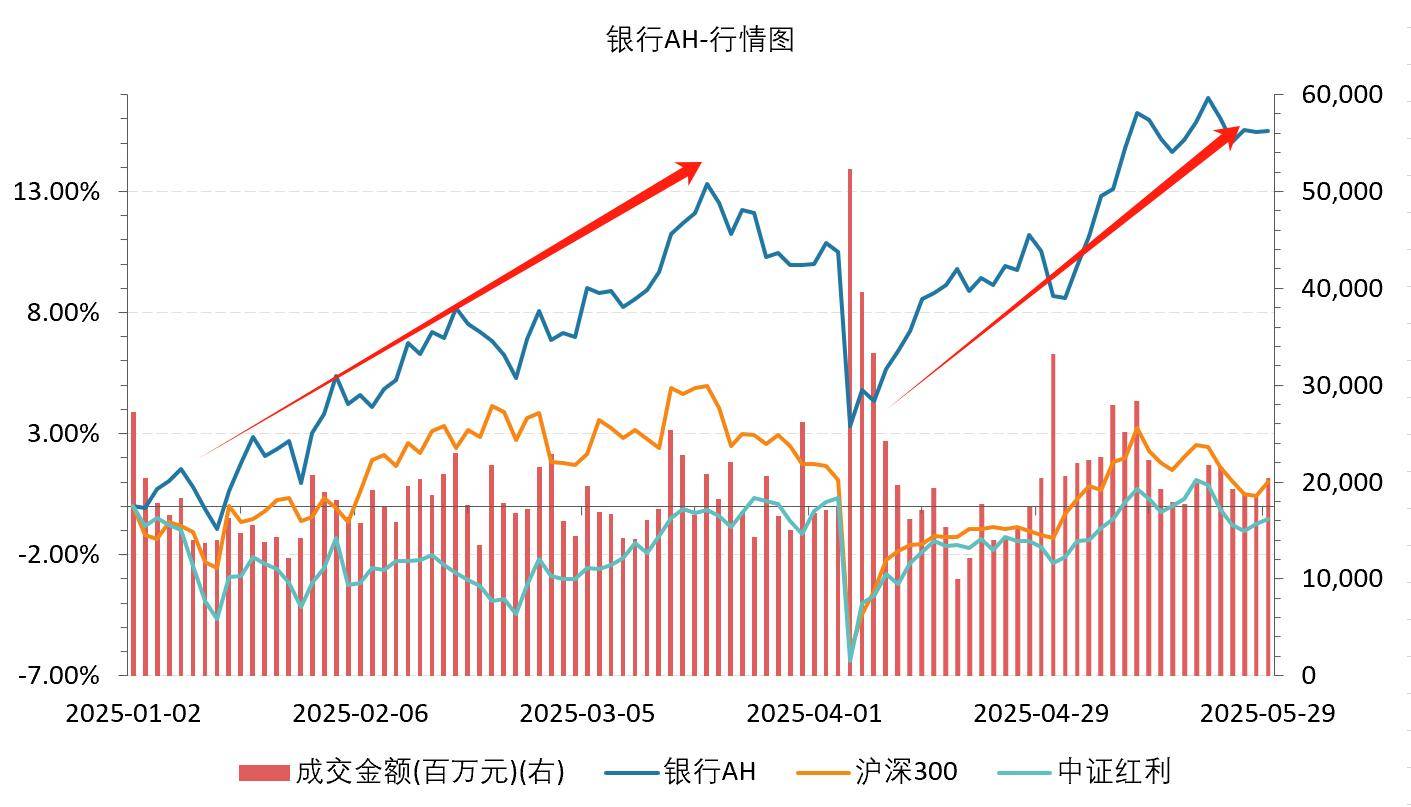
Core Viewpoint - The banking sector is experiencing a significant rally, driven by high dividend yields and a favorable interest rate environment, making it an attractive investment option [1][4][6] Group 1: Market Performance - The banking sector saw a trading volume of 222.5 billion yuan, indicating strong investor interest [1] - The A+H bank ETF has increased by 13.3% year-to-date and has set seven historical highs, with fund shares growing by 78 million [1][4] - The bank AH index has outperformed the CSI 300 and the CSI Dividend Index, suggesting continued upward potential [4] Group 2: Financial Metrics - The one-year fixed deposit rate is 0.95%, while the five-year rate is 1.3%, and the ten-year government bond yield is only 1.73%, highlighting the attractiveness of bank stocks with 4-6% dividends [1] - The banking sector's average net profit growth over the past ten years is 4.5%, with a variation coefficient of 78.6%, indicating stable earnings compared to other industries [5] - The projected return on equity (ROE) for the banking sector in 2024 is 9.3%, with a price-to-book (PB) ratio of 0.61x, suggesting undervaluation relative to other sectors [6] Group 3: Investment Trends - Insurance companies are increasingly investing in high-dividend stocks, particularly in the banking sector, as part of their asset allocation strategy [1] - The introduction of public fund quality development plans is seen as a positive factor for the stable and low-volatility banking sector [5]
国债期货下跌意味着什么?散户的钱袋子正在被谁掏空?
Sou Hu Cai Jing· 2025-05-29 14:06
Core Viewpoint - The recent decline in the government bond futures market reflects a silent struggle regarding the direction of the Chinese economy, driven by both funding and policy pressures [2][5]. Group 1: Policy Dynamics - The central bank's recent reverse repurchase operations, with a net injection of 58.5 billion yuan in a single day, signal a tightening stance despite appearing to be accommodative [2][5]. - The Ministry of Finance initiated bond market support operations, injecting 280 million and 260 million yuan of 2-year and 3-year bonds, respectively, indicating a subtle shift in market supply and demand dynamics [2][5]. Group 2: Interest Rate Environment - The current low interest rate environment has seen the interest rate on demand deposits from major state-owned banks drop to 0.05%, with 1-year fixed deposits falling below 1% [2][5]. - Despite this, the 30-year government bond ETF has shown a remarkable annualized return of 15.28% over the past year, highlighting a paradox where funds flee low-yield deposits but hesitate to enter riskier markets [2][5]. Group 3: International Market Influence - The cold reception of the U.S. 5-year Treasury auction, with indirect bidders receiving a record 78.4% allocation, indicates a global capital flight towards safe assets, contrasting with domestic capital fleeing the bond futures market [3][5]. - The significant increase in SOFR futures open interest by 173,000 contracts within three days suggests that the market may be anticipating larger upheavals [3][5]. Group 4: Market Behavior - The net short position in 5-year government bond futures among the top 20 positions reached 6,254 contracts, indicating a strong institutional presence in the short-selling camp [3][5]. - A "mini redemption wave" in the wealth management market has led to short-term products experiencing a withdrawal magnitude similar to last September, showcasing a stark contrast between retail panic selling and institutional arbitrage strategies [3][5]. Group 5: Economic Transition - The anticipated increase in government bond issuance in May and June may exceed expectations, with local government bond issuance aiming for 700 billion yuan in a single month [4][5]. - The decline in bank deposit rates has paradoxically strengthened residents' savings tendencies, with the proportion of demand deposits falling below 20% in April, indicating a growing conservative mindset among the populace [4][5].
日度策略参考-20250529
Guo Mao Qi Huo· 2025-05-29 05:34
1. Report Industry Investment Ratings - **Bearish**: Stainless steel, silicon metal, lithium carbonate, coke [1] - **Bullish**: Corn (mid - term), urea [1] - **Sideways**: Index futures, gold, silver, electrolytic aluminum, alumina, nickel, ferronickel, stainless steel (short - term), rebar, hot - rolled coil, iron ore, ferroalloys, ferrosilicon, glass, soda ash, palm oil, soybean oil, rapeseed oil, cotton, sugar, soybeans, pulp, live pigs, crude oil, fuel oil, asphalt, natural rubber, BR rubber, PTA, ethylene glycol, short - fiber, styrene, PE, BPP, PVC, caustic soda, LPG, container shipping [1] 2. Core Views - The current market is affected by multiple factors such as weak economy, asset shortage, global trade frictions, and policy changes. Different varieties show different trends due to their specific supply - demand relationships, cost factors, and market sentiment [1]. - For most commodities, short - term trends are often influenced by immediate news and short - term supply - demand imbalances, while long - term trends are determined by fundamental supply - demand structures and macro - economic conditions [1]. 3. Summary by Industry Macro - finance - **Index futures**: Lack of driving factors, likely to continue weak sideways movement [1] - **Bond futures**: Asset shortage and weak economy are favorable, but short - term interest rate risks from the central bank suppress upward movement [1] - **Gold**: Short - term sideways, long - term upward logic remains solid [1] - **Silver**: Short - term high - level sideways, limited upward space in the medium term [1] Non - ferrous metals - **Copper**: Supply disturbances in Congo (Kinshasa) increase concerns about supply shortages [1] - **Aluminum**: Low inventory supports prices in the short term, but upward space is limited as prices rise [1] - **Alumina**: Spot prices are rising, and the downward momentum of futures prices is weakening [1] - **Nickel**: Short - term weak sideways after price decline, long - term surplus pressure exists. Pay attention to inventory changes [1] - **Stainless steel**: Short - term weak sideways, long - term supply pressure remains. Pay attention to steel mill production schedules [1] - **Tin**: Supply recovery expectations are strengthening, and prices have significantly corrected in the short term [1] Ferrous metals - **Rebar**: In the window period from peak to off - peak season, cost is loose, and supply - demand is loose, with no upward driving force [1] - **Hot - rolled coil**: Potential risk of weakening exports, cost is loose, and supply - demand is loose, with unclear price rebound drivers [1] - **Iron ore**: Expectation of peak iron - making output, but no new stories on the supply side. Pay attention to steel pressure [1] - **Ferroalloys**: Short - term supply - demand balance, high warehouse receipt pressure [1] - **Ferrosilicon**: Cost is affected by thermal coal, but production cuts in the production area make supply - demand tight [1] - **Glass**: Supply - demand is weak, and prices may weaken due to the rainy season [1] - **Soda ash**: Short - term demand is okay, but medium - term supply is excessive, and prices are under pressure [1] - **Coking coal and coke**: Supply - demand is relatively excessive. Coking coal provides positive arbitrage and selling hedging opportunities when the futures price is at a premium. Coke is bearish [1] Agricultural products - **Palm oil**: Limited upward driving force, expected to maintain range - bound movement [1] - **Soybean oil**: Argentine weather impact is limited, and there is arrival pressure. It is recommended to wait and see [1] - **Rapeseed oil**: Concerns about supply shortage, and it is possible to consider long - volatility strategies [1] - **Cotton**: Short - term affected by trade negotiations and weather, long - term affected by macro uncertainties. Domestic cotton prices are expected to be weak sideways [1] - **Sugar**: Brazilian sugar production is expected to reach a record high, and the production volume may exceed expectations if crude oil is weak [1] - **Corn**: Medium - term supply - demand is expected to be tight, but short - term upward space is limited. It is recommended to buy on dips [1] - **Soybeans**: Short - term no obvious bullish drivers, expected to maintain range - bound movement. Long opportunities for M11 and M01 can be considered [1] - **Pulp**: Port inventory is rising, and demand is weak. It is expected to move sideways [1] - **Logs**: Supply is loose, demand is weak. It is recommended to hold short positions or short on rebounds [1] - **Live pigs**: Inventory is recovering, and the futures price is at a discount. The futures price is expected to be stable [1] Energy and Chemicals - **Crude oil and fuel oil**: Affected by the progress of the US - Iran nuclear agreement negotiation, OPEC+ production increase, and summer consumption season [1] - **Asphalt**: Cost drag, inventory accumulation, and slow demand recovery [1] - **Natural rubber**: Futures - spot price difference has returned, affected by exchange policies, and inventory has decreased [1] - **BR rubber**: Short - term sideways, long - term downward pressure due to weak demand [1] - **PTA**: Supply - demand tension has been relieved, and short - fiber cost is closely related [1] - **Ethylene glycol**: Continuing to reduce inventory, and the impact of polyester production cuts is ongoing [1] - **Short - fiber**: Cost is closely related to PTA, and the tight situation has been alleviated [1] - **Styrene**: Speculative demand is weakening, inventory is rising, and the spot - futures price gap persists [1] - **Urea**: High daily production, increased short - term export demand expectations, and a possible rebound [1] - **Methanol**: High domestic production, increasing arrivals, and entering the inventory accumulation phase. The market is expected to be weak sideways [1] - **PE**: Seasonal demand is weakening, and prices are weak sideways [1] - **BPP**: Maintenance support is limited, and prices are weak sideways [1] - **PVC**: Fundamentals are weak, but there is short - term rebound due to macro - level positives [1] - **Caustic soda**: Low inventory, sufficient orders, and subsequent trends depend on the alumina market [1] - **LPG**: Prices are weak, with narrow - range fluctuations, and are expected to be weak sideways [1] - **Container shipping**: Strong expectations but weak reality. It is recommended to be cautious when short - selling during the price - support period. Light - position long positions can be considered for peak - season contracts, and arbitrage opportunities exist [1]
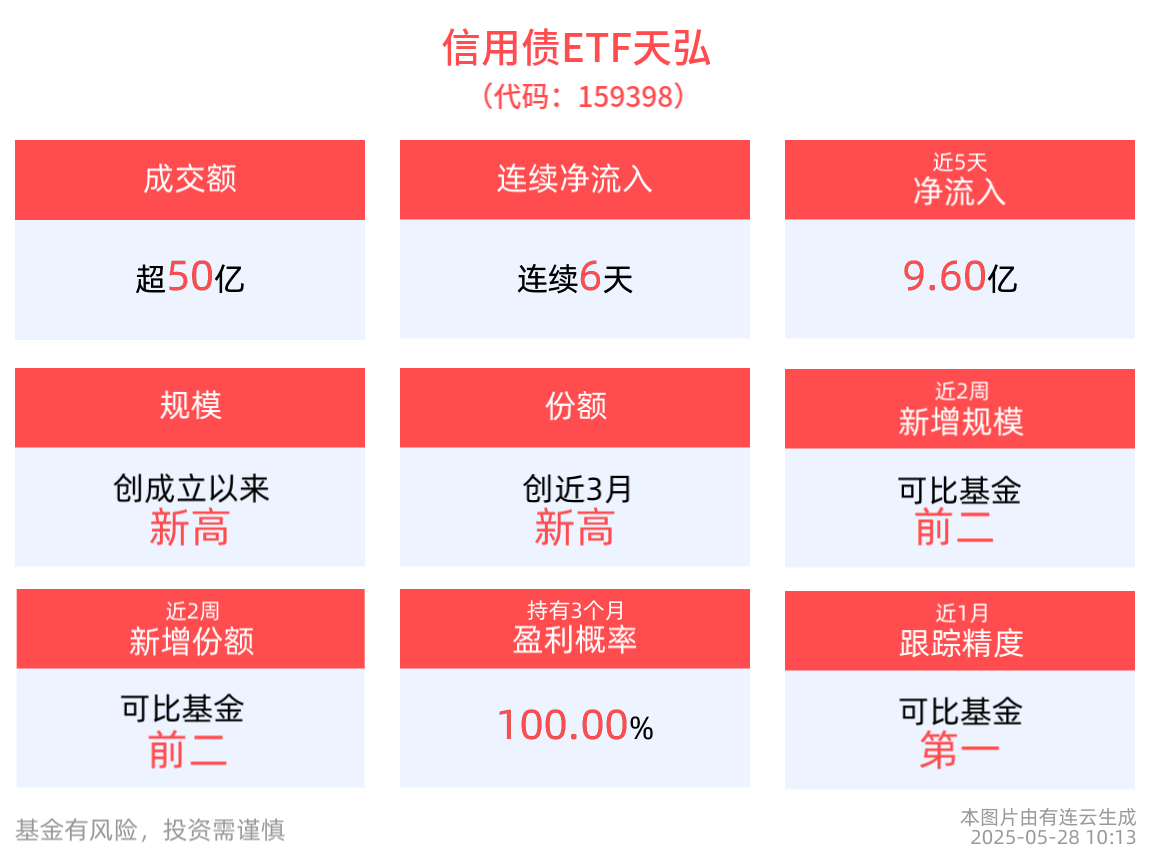
盘中实时成交额已突破50亿,信用债ETF天弘(159398)即将纳入质押库,已经实现连续6日净流入
Sou Hu Cai Jing· 2025-05-28 02:36
Group 1 - The pilot program for credit bond ETFs to conduct general pledge-style repurchase transactions is set to be officially implemented soon, marking a new phase in liquidity management tools in China's bond market [2] - The inclusion of credit bond ETFs in the general repurchase pledge library reflects support for green bonds, sci-tech innovation bonds, and corporate bonds from private enterprises, signaling a commitment to market construction for credit bond ETFs [2] - The current environment of "asset scarcity" is slowing down, with credit bonds expected to outperform interest rate bonds in a defensive strategy, emphasizing the importance of duration selection in different stages [2] Group 2 - As of May 28, 2025, the Tianhong credit bond ETF (159398) showed active trading with a turnover rate of 91.29% and a transaction volume of 5.1 billion yuan, indicating strong market activity [3] - The Tianhong credit bond ETF reached a new high in scale at 5.673 billion yuan and a new high in shares at 56.3323 million, reflecting growing investor interest [3] - The fund has seen continuous net inflows over the past six days, totaling 1.325 billion yuan, with an average daily net inflow of 221 million yuan [3] Group 3 - The management fee for the Tianhong credit bond ETF is 0.15%, and the custody fee is 0.05%, which are the lowest among comparable funds [4] - The tracking error for the Tianhong credit bond ETF over the past month is 0.006%, indicating the highest tracking precision among comparable funds [4] - The top ten weighted stocks in the Shenzhen benchmark market-making credit bond index account for 8.59% of the index, reflecting the concentration of holdings [4]