
反内卷

Search documents
中国工业利润三年跌势扭转,今年稳增长行动思路明确
第一财经· 2026-01-28 06:01
Core Viewpoint - In 2025, China's industrial profits showed a positive growth of 0.6%, reversing a three-year decline, with significant contributions from equipment manufacturing and high-tech industries, indicating an improvement in the industrial economic structure and quality [3][5][10]. Industrial Profit Improvement - The total profit of industrial enterprises above designated size reached 73,982 billion yuan in 2025, marking a 0.6% increase year-on-year, with a notable recovery in December where profits grew by 5.3% compared to November's decline of 13.1% [3][5]. - The profit growth trend was characterized by a "low first, high later" pattern, with significant policy effects from growth stabilization measures and "anti-involution" policies contributing to improved inventory and capacity utilization [5][10]. Cost and Expense Analysis - In 2025, the cost per 100 yuan of revenue for industrial enterprises was 85.31 yuan, an increase of 0.16 yuan year-on-year, while expenses decreased to 8.62 yuan, down 0.02 yuan [6]. - The average accounts receivable collection period decreased to 67.9 days by the end of December 2025, reflecting improved cash flow due to government actions to clear debts [6][10]. Profit Structure Improvement - In 2025, profits from small and medium-sized enterprises, as well as foreign-invested enterprises, turned positive, growing by 1.4% and 4.2% respectively, while state-owned and joint-stock enterprises also saw significant profit improvements [8]. - The manufacturing sector's profits increased by 5.0%, with equipment manufacturing and high-tech manufacturing being the main drivers, contributing 2.8 percentage points to overall profit growth [8][9]. High-Tech Manufacturing Growth - High-tech manufacturing profits rose by 13.3%, significantly outpacing the overall industrial profit growth, with smart electronic products and semiconductor-related industries showing remarkable profit increases [9]. - Specific sectors such as smart unmanned aerial vehicles and semiconductor manufacturing saw profits grow by 102.0% and 172.6% respectively, highlighting the rapid development in these areas [9]. Outlook for 2026 - Industrial profits are expected to continue their recovery in 2026, supported by stable domestic consumption, gradual investment recovery, and improved export quality [10]. - The "anti-involution" policies are anticipated to alleviate cost pressures and enhance profit margins, while ongoing industrial modernization efforts will further improve the operating environment for industrial enterprises [10][12].

5天14亿,10天21亿!“化工牛”盘中再涨2.8%冲击新高,资金抢筹大提速
Ge Long Hui· 2026-01-28 04:22
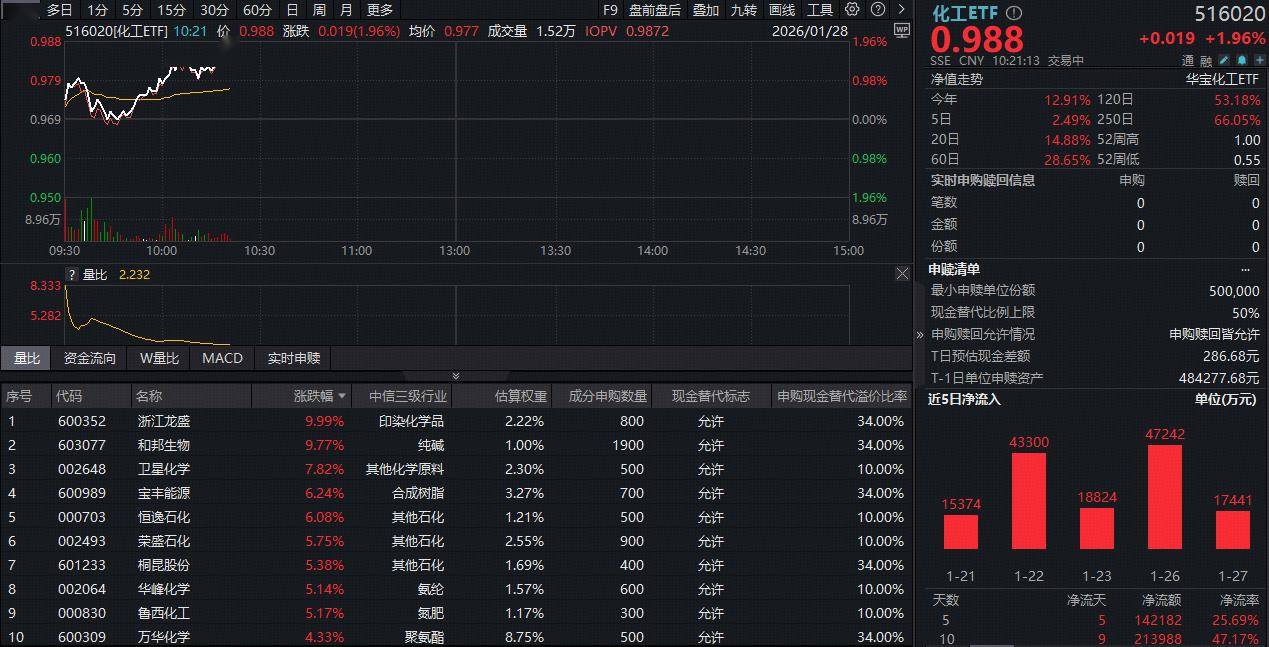
Group 1 - The chemical sector is experiencing a resurgence, with the Chemical ETF (516020) showing a price increase of over 2.8% and potentially reaching a new three-year closing high [1] - The Chemical ETF has attracted significant capital inflow, with a net subscription of 1.422 billion yuan in the last five days and 2.14 billion yuan in the last ten days, indicating strong buying momentum [1] - According to Guangfa Securities, the chemical industry typically follows a five-year cycle, and the current phase is characterized by a recovery in profitability and improved demand expectations [1] Group 2 - The Chemical ETF (516020) and its linked fund (012537) track the CSI segmented chemical industry theme index, with nearly 50% of its holdings concentrated in large-cap leading stocks such as Wanhua Chemical and Salt Lake Industry [2] - The remaining 50% of the portfolio includes leading stocks in sub-sectors like phosphate fertilizers, fluorochemicals, and nitrogen fertilizers, allowing for comprehensive investment opportunities in the chemical sector [2] Group 3 - Looking ahead, Zhongyin Securities projects that the chemical industry's prosperity will be at a low point in 2025, with potential recovery in profitability expected by 2026 due to measures like "anti-involution" and rapid development in new materials [1]
日度策略参考-20260128
Guo Mao Qi Huo· 2026-01-28 03:28
Report Summary 1. Report Industry Investment Ratings The report does not provide a unified industry investment rating. Instead, it gives trend judgments and investment suggestions for different varieties, including "看多" (Bullish), "震荡" (Sideways), and "震荡偏强" (Sideways with an upward bias). 2. Core Views of the Report - **Stock Index**: In the short term, the adjustment space of the stock index is limited, and it is expected to show a sideways - upward trend before the holiday, as the domestic macro - level may be relatively calm and market performance will be highly correlated with regulatory trends [1]. - **Treasury Bonds**: Asset shortage and weak economy are beneficial to bond futures, but the central bank has recently reminded of interest - rate risks, and the Japanese central bank's interest - rate decision should be noted [1]. - **Non - ferrous Metals**: - **Copper**: The copper price maintains a high - level sideways movement as the dollar index has declined, but the enthusiasm for buying copper has eased [1]. - **Aluminum**: The aluminum price is expected to move sideways as the industrial driving force is limited recently, but the decline of the dollar index supports the price [1]. - **Alumina**: The supply of domestic alumina is strong while demand is weak, and the price is under pressure. However, as the current price is near the cost line, it is expected to move sideways [1]. - **Zinc**: The cost center of zinc fundamentals is stable. The recent cold wave in North America has increased energy prices, which is not conducive to the resumption of overseas smelters. Zinc has a certain room for a supplementary rise [1]. - **Nickel**: In the short term, the nickel price is at a high level, affected by the resonance of the non - ferrous metal sector. Supply concerns may continuously disrupt the market. In the long - term, high global nickel inventories may still have a suppressing effect. It is recommended to go long on dips in the short term [1]. - **Stainless Steel**: The stainless - steel futures are in a high - level sideways movement. Supply - side disruptions are frequent, and spot trading is weak. It is recommended to focus on short - term operations [1]. - **Tin**: Although the approval of explosives in Myanmar is negative news, the increase in tin ore in Myanmar in the first quarter is still limited. In the pattern of fragile supply and rigid demand, there is still upward potential for tin. Attention should be paid to supply disruptions [1]. - **Precious Metals and New Energy**: - **Silver**: International uncertainties and the weakening dollar index support the price of precious metals. Due to factors such as spot shortages and falling inventories, there is a significant short - squeeze sentiment in the domestic market. The import window has opened significantly. It is recommended to control positions in single - side trading and pay attention to the inter - market arbitrage opportunities for the far - month contracts [1]. - **Platinum and Palladium**: The macro - driving force has weakened slightly, but international uncertainties are still high, which may support the prices of platinum and palladium, and the price fluctuations may be large. In the long - term, the supply - demand prospects of platinum and palladium are different. It is recommended to allocate platinum on dips or continue to pay attention to the [long - platinum short - palladium] arbitrage strategy [1]. - **Industrial Silicon**: The production of polysilicon and silicone decreased in December. The northwest region increased production while the southwest region decreased production [1]. - **Black Metals**: - **Rebar and Iron Ore**: High production, high inventory, etc., suppress the price increase space. The transmission of futures price increases to the spot market is not smooth. It is recommended to exit long single - side positions and participate in cash - and - carry arbitrage. The upward pressure on iron ore is obvious, and it is not recommended to chase long positions [1]. - **Coke and Coking Coal**: The market is pessimistic about the end - point price of the coking coal 05 contract. After the first round of coke price increase was shelved, short - sellers increased their positions. The coking coal 05 contract broke through important support levels. In the future, the price may be gradually priced according to the Mongolian coal long - term contract cost. The logic for coke is the same as that for coking coal [1]. - **Agricultural Products**: - **Palm Oil**: The purchasing rhythm of major consuming countries has started, and the production area is expected to reduce production and inventory. Coupled with the possible fermentation of the biodiesel theme, it is expected to show a sideways - upward trend [1]. - **Soybean Oil**: The domestic soybean - oil fundamentals are strong. Coupled with the rebound of US soybeans and positive news about US biodiesel, it is bullish [1]. - **Rapeseed Oil**: The Sino - Canadian trade relationship has not improved, and the import of Canadian rapeseed is blocked, creating a positive expectation gap. Positive news about US biodiesel is beneficial to the oil market [1]. - **Cotton**: The domestic cotton market is currently in a situation of "having support but no driving force". Future attention should be paid to factors such as the central government's No. 1 document in the first quarter of next year, the intention of cotton - planting area, weather during the planting period, and peak - season demand [1]. - **Sugar**: Globally, there is a sugar surplus, and the domestic new - crop supply has increased. There is a strong consensus among short - sellers. If the futures price continues to fall, there is strong cost support below, but there is no continuous driving force in the short - term fundamental aspect. Attention should be paid to changes in the capital side [1]. - **Corn**: The corn sales progress has passed half, and the inventories at ports and downstream are still low. With the replenishment of downstream enterprises and the profit - taking of long - positions before the holiday, there is a certain risk of price correction [1]. - **Soybeans**: The dry weather in Argentina may cause short - term weather speculation. The precipitation in February is expected to return to normal. With the progress of the Brazilian harvest, the overall rebound of M05 is expected to be limited [1]. - **Pulp**: The pulp price has fallen due to the decline of the commodity macro - environment. It has not broken through the sideways area. Short - term commodity sentiment fluctuates greatly. It is recommended to wait and see cautiously. The spot price of logs has shown a certain sign of bottom - rebound, and the further decline space of the futures price is limited. However, the January overseas offer has still declined slightly, and there is a lack of upward - driving factors in the log futures and spot markets. It is expected to move sideways in the range of 760 - 790 yuan/m³ [1]. - **Hogs**: Recently, the spot price has gradually stabilized. Supported by demand, the production capacity still needs to be further released as the average slaughter weight has not decreased significantly [1]. - **Energy and Chemicals**: - **Crude Oil and Related Products**: OPEC + has suspended production increases until the end of 2026, the geopolitical situation in the Middle East has intensified, and the cold wave in the United States has increased energy demand, which is beneficial to the price increase of crude oil and fuel oil [1]. - **Asphalt**: In the short - term, the supply - demand contradiction is not prominent, and it follows the trend of crude oil. The "14th Five - Year Plan" construction rush demand is likely to be falsified, and the supply of Ma瑞 crude oil is sufficient. The asphalt profit is relatively high [1]. - **Natural Rubber**: The raw - material cost has strong support, the synthetic rubber has risen significantly, and the overall atmosphere of the commodity market is bullish, driving the upward movement of the natural - rubber market [1]. - **BR Rubber**: The cost of butadiene has strong support at the bottom. Recently, the profit of private butadiene - styrene rubber plants has been seriously lost, and the expectation of maintenance and production reduction has increased. In the short - term, the futures price is expected to have a wide - range sideways correction, and there is an upward expectation in the long - term [1]. - **PTA and Short - fiber**: The strong PX market has led to the rise of chemical products, and a large amount of capital has flowed into the chemical sector. The polyester sector has led the rise of the entire chemical industry. The domestic PTA production has continued to increase, and the production reduction of polyester factories has a limited negative feedback on PTA. The short - fiber price continues to closely follow the cost fluctuations [1]. - **Ethylene Glycol**: After a long - term slump, the overseas ethylene - glycol price has rebounded. The reduction of ethylene - glycol exports from the Middle East has boosted market confidence. The speculative demand in the market has increased significantly [1]. - **Styrene**: The news of the shutdown of Middle Eastern styrene plants has led to a rapid rebound of the styrene futures price. The Asian styrene market has stabilized, the styrene - benzene price difference has widened, and the inventory has decreased [1]. - **Methanol**: Affected by the Iranian situation, the future import of methanol is expected to decrease, but the downstream negative feedback is obvious. The downstream MTO leading plants have stopped production, and some enterprises have reduced production, but the Fude plant will restart on January 25th. The Iranian situation has eased, but risks cannot be completely ruled out. The freight in the inland area has increased due to the cold air, and the northwest enterprises have great pressure to reduce inventory and sell at a reduced price [1]. - **Polyethylene**: The geopolitical conflict has intensified, and there is a risk of crude - oil price increase. The full - density plant of Zhong'an United has stopped production, and the linear - production ratio has decreased [1]. - **PVC**: In 2026, the global PVC production capacity will be put into operation less, and the future expectation is optimistic. However, the current fundamentals are poor. The export tax - rebate policy has been cancelled, and there may be a phenomenon of rushing to export in the future. The differential electricity price in the northwest region is expected to be implemented, forcing the elimination of PVC production capacity [1]. - **Liquefied Petroleum Gas (LPG)**: The March CP is expected to decline compared with February, and the market sentiment will switch between fundamentals and emotions. The geopolitical conflict in the Middle East has cooled down, and the short - term risk premium has declined. The driving logic of the overseas cold wave has gradually slowed down, and the futures price is expected to weaken. The domestic PDH operating rate has declined, and the profit is expected to recover seasonally. The short - term demand for LPG is bearish, suppressing the upward movement of the futures price [1]. - **Shipping**: The freight rate has peaked and declined before the holiday. Airlines are still cautious about trial resumption of flights. Airlines are expected to have a strong willingness to stop the price decline and increase prices after the off - season in March [1].
中银国际化工行业2026年度策略:行业周期拐点已近 新材料蓄势腾飞
智通财经网· 2026-01-28 03:15
Core Viewpoint - The chemical industry is expected to remain at a low level of prosperity in 2025, with potential recovery in profitability driven by "anti-involution" measures and rapid growth in new materials due to downstream demand in 2026. Current industry valuations are low, maintaining a strong market rating with three investment themes recommended [1]. Group 1: Industry Performance - Chemical product prices are at historical lows, with the basic chemical profitability cycle hitting a bottom. As of November 2025, the national industrial product PPI, production materials PPI, and chemical industry PPI have shown negative year-on-year growth for 38 consecutive months, marking the second-longest period of negative growth in history [1]. - As of the first three quarters of 2025, the sales gross margin and net profit margin for the SW basic chemical industry were 16.82% and 6.41%, respectively. The SW oil and petrochemical industry saw a net profit of 276.09 billion yuan, a year-on-year decrease of 11.07%, with sales gross margin and net profit margin at 19.03% and 5.26% [1]. Group 2: Supply Dynamics - The fixed assets in the basic chemical industry reached 1,462.86 billion yuan by the end of Q3 2025, a year-on-year increase of 15.56%. However, the growth rate of ongoing projects turned negative for the first time in nearly four years, with ongoing projects decreasing to 358.41 billion yuan, a year-on-year decline of 15.11% [2]. Group 3: Policy and Structural Changes - The "anti-involution" trend is expected to optimize the supply-demand structure. The "14th Five-Year Plan" emphasizes high-quality development and resource efficiency, which will accelerate the elimination of outdated production capacity under stricter energy consumption and environmental standards [3]. Group 4: Demand Trends - Domestic real estate demand is under pressure, but demand for automobiles and chemical fibers continues to grow. From January to October 2025, the demand for products related to the real estate chain declined, while demand for home appliance-related products remained stable, and automotive and chemical fiber production maintained low double-digit to high single-digit growth [4]. - The demand for chemical products is expected to continue growing due to the implementation of domestic demand expansion policies and the rapid development of downstream industries such as new energy, AI, semiconductors, and humanoid robots during the "14th Five-Year Plan" [4]. Group 5: Cost Factors - The global oil market in 2026 may still experience an oversupply situation, with international oil prices potentially having room to decline. However, major consuming countries like China, the U.S., and India may increase oil reserves, which could alleviate some supply pressure. The expected range for Brent crude oil prices in 2026 is between $50 and $70 per barrel [5].
ETF盘中资讯|暴力拉升!化工ETF(516020)盘中涨超2%,资金持续加码!机构:化工有望开启新一轮高成长
Sou Hu Cai Jing· 2026-01-28 02:58
Group 1 - The chemical sector has regained momentum, with the chemical ETF (516020) experiencing a rise of 1.96% after a brief fluctuation at the opening [1][2] - Key stocks in the sector include Zhejiang Longsheng, which hit the daily limit, and other notable gainers such as Hebang Biotechnology, Satellite Chemical, Baofeng Energy, and Hengyi Petrochemical, all showing significant increases [1][2] - The chemical ETF (516020) has attracted substantial investment, with net subscriptions of 1.422 billion yuan over the past five days and 2.14 billion yuan over the past ten days [1][2] Group 2 - Recent advancements in the basic chemical industry include breakthroughs in green refrigeration technology and key technologies for the industrialization of high-performance liquid crystal polyarylate fibers [3] - Looking ahead, the chemical industry is expected to experience low prosperity in 2025, with potential recovery in profitability driven by measures against "involution" and rapid growth in new materials due to downstream demand [3] - Investment opportunities in the large chemical sector are viewed positively, particularly in leading companies and sub-industries facing supply changes or significant pressure [3]


暴力拉升!化工ETF(516020)盘中涨超2%,资金持续加码!机构:化工有望开启新一轮高成长
Xin Lang Ji Jin· 2026-01-28 02:39
Group 1 - The chemical sector has regained momentum, with the chemical ETF (516020) experiencing a rise of 1.96% as of the latest report, reflecting a strong overall performance in the sector [1][3] - Key stocks in the sector include Zhejiang Longsheng, which hit the daily limit, and other companies like Hebang Bio and Satellite Chemical, which saw increases of over 9% and 7% respectively [1][3] - The chemical ETF has attracted significant investment, with net subscriptions of 14.22 billion yuan over the past five days and 21.4 billion yuan over the past ten days [1][3] Group 2 - Recent advancements in the basic chemical industry include breakthroughs in green refrigeration technology and key technologies for the industrialization of high-performance liquid crystal polyarylate fibers [3] - Looking ahead, the chemical industry is expected to face low demand in 2025, but measures to counteract "involution" may catalyze a recovery in profitability, particularly in new materials benefiting from rapid downstream demand [3] - Analysts from Zhongyin Securities and Guojin Securities express optimism about investment opportunities in the large chemical sector, particularly favoring leading companies and those with supply-side changes [3][4] Group 3 - The chemical ETF (516020) tracks the CSI segmented chemical industry theme index, covering popular themes such as AI computing power, counter-involution, robotics, and new energy [3] - Investors can also access the chemical ETF through linked funds, enhancing the efficiency of their investments in the chemical sector [3]
未知机构:国联民生交运周报260126即时零售再起势重视顺丰同城布局机会航空量价-20260128
未知机构· 2026-01-28 02:25
Summary of Key Points from Conference Call Records Industry Overview - **Industry Focus**: Instant retail and logistics sectors, particularly involving companies like Alibaba, Douyin, Pinduoduo, and SF Express - **Market Growth**: The instant retail market in China is projected to exceed 2 trillion yuan by 2030, indicating rapid expansion and increasing competition in the sector [1][2] Core Insights - **Alibaba's Commitment**: Alibaba is significantly investing in the instant retail space, with a peak daily order volume of 120 million during the 25H2 Taobao flash sale and an average of 80 million daily orders in August. Instant retail revenue is expected to grow by 60% year-on-year by Q3 2025 [1][1] - **Douyin and Pinduoduo's Entry**: Douyin is integrating its instant retail operations, merging Douyin Supermarket with its hourly delivery service, indicating a competitive response to Alibaba's dominance [1][1] - **SF Express's Position**: SF Express is highlighted as a leading independent third-party instant delivery service, benefiting from the rapid growth of the instant delivery industry and high growth in express delivery volumes [2][2] Financial Metrics - **SF Express's Financial Health**: - Cash on hand is substantial, with a cash-to-market cap ratio of 16.2% for 2024, providing a strong safety margin [2][2] - Projected shareholder return rates for 2025 and 2026 are estimated at 3.8%, with dividend yields of 2.57% and 2.88% respectively [2][2] - Current valuation is at a decade-low level, suggesting a potential for valuation recovery [2][2] Aviation Sector Insights - **Air Travel Trends**: The aviation industry is recovering from a seasonal downturn, with pre-sale prices for the 2026 Spring Festival showing an average ticket price of 677 yuan, up 8.4% year-on-year [2][2] - **Cargo Transport**: Air cargo rates are stabilizing, and demand is expected to rise due to pre-holiday stocking, which may enhance volume and pricing performance [3][4] Logistics and Express Delivery - **Express Delivery Pricing**: The express delivery sector is stabilizing, with a slight increase in market share for major players like SF Express, YTO, and Shentong [4][4] - **Current Pricing Trends**: In December 2025, the average express delivery revenue per ticket was 7.63 yuan, reflecting a 0.1% increase month-on-month [4][4] Recommendations - **Investment Recommendations**: - Favorable outlook on SF Express and SF City due to their positioning in the undervalued segment of the market [4][4] - Positive sentiment towards the aviation sector, particularly major airlines like Air China, China Southern Airlines, and China Eastern Airlines, as well as low-cost carriers [5][5] - Suggested investments in independent third-party delivery leaders like SF City [5][5] Risk Factors - **Potential Risks**: - Economic recovery may not meet expectations, leading to intensified competition within the industry - Rising oil prices and labor costs could impact profitability - Uncertainties in international trade and slower recovery in business travel demand pose additional risks [5][5]

化工行业2026年度策略:行业周期拐点已近,新材料蓄势腾飞
Bank of China Securities· 2026-01-28 02:06
Core Insights - The chemical industry is approaching a cyclical turning point, with the current low valuation presenting potential investment opportunities. The industry is expected to recover from its profitability bottom due to measures like "anti-involution" and the rapid growth of new materials driven by downstream demand [2][3][8]. Industry Overview - The chemical industry experienced a low point in 2025, with the PPI for industrial products, production materials, and chemical industries showing negative year-on-year growth for 38 consecutive months, marking the second-longest period of negative growth in history [16]. - As of the end of 2025, 30 out of 111 tracked chemical products had prices in the bottom 10% of their historical range, indicating significant pricing pressure [18]. Supply Dynamics - The construction of new projects in the chemical sector has seen a negative year-on-year growth rate, signaling that the current round of capacity expansion is nearing its end. By Q3 2025, the total fixed assets in the basic chemical industry reached 14,628.58 billion RMB, a 15.56% increase year-on-year, but the growth rate of ongoing projects turned negative for the first time in nearly four years [16][18]. Demand Trends - Domestic demand in the real estate sector is under pressure, but sectors like automotive and chemical fibers are showing positive growth. The demand for related products is expected to continue improving, supported by policies aimed at boosting domestic demand and the rapid development of downstream industries such as new energy and AI [16][18]. Cost Factors - The global oil market is expected to remain oversupplied in 2026, with international oil prices projected to stabilize within a range of 50-70 USD per barrel. This could lead to a gradual recovery in oil prices, although geopolitical events may introduce volatility [16][18]. Valuation Metrics - As of January 23, 2026, the SW basic chemical index had a TTM P/E ratio of 29.45, placing it at the 41.85% percentile since 2002, indicating a low valuation environment. The oil and petrochemical index had a TTM P/E ratio of 14.08, at the 12.49% percentile [16][18]. Investment Recommendations - The report suggests focusing on traditional chemical leaders that are expanding into new materials, as they are expected to see both performance and valuation improvements. Recommended companies include WanHua Chemical, Hualu Hengsheng, and others [2][3][8]. - Attention is also drawn to sub-industries benefiting from "anti-involution" measures, such as refining, polyester, and organic silicon, where price levels are low and supply dynamics are improving [2][3][8].


未知机构:东财宏观反内卷系列微专题近期反内卷升温下的投资机会1本轮-20260128
未知机构· 2026-01-28 02:05
【东财宏观-反内卷系列微专题】近期"反内卷"升温下的投资机会 [太阳]1.本轮"反内卷"较此前的三大不同 ➽#范围更广。上轮"去产能"聚焦于上游资源品(煤炭、钢铁为主);本轮"反内卷"治理领域扩大至中、下游,既 包括传统上游产业,也涵盖汽车等中下游产业以及互联网平台、光伏、新能源等新兴产业领域,涉及企业面更 广。 ➽#更注重价。具体举措方面,上轮"去产能"更多采用对产量与产能的直接约束与治理,关于量的举措多于价格层 面的举措;本轮"反内卷 【东财宏观-反内卷系列微专题】近期"反内卷"升温下的投资机会 [太阳]1.本轮"反内卷"较此前的三大不同 ➽#加强价格监测与价格执法。各部委关于"反内卷"的工作部署中,多次提及强化价格监测与价格执法。比如,1 月22日,财政部发布《 查找图书 》,明确要求在政府采购评审中的多种情形应启动异常低价投标审查程序。 ➽#通过标准引导落后产能出清。除了出台行业标准与加强价格监测执法,本轮"反内卷"仍然保留了必要的产能出 清的措施,但更多通过提高行业标准引导而非强制性进行。 [太阳]3.本轮"反内卷"有哪些投资机会? ➽#近期"反内卷"政策在部委协同、制度支持、落地节奏方面已经出现加 ...
未知机构:东财宏观反内卷系列微专题近期反内卷升温下的投资机会1本轮反-20260128
未知机构· 2026-01-28 02:05
➽#范围更广。 上轮"去产能"聚焦于上游资源品(煤炭、钢铁为主);本轮"反内卷"治理领域扩大至中、下游,既包括传统上游产 业,也涵盖汽车等中下游产业以及互联网平台、光伏、新能源等新兴产业领域,涉及企业面更广。 ➽#更注重价。 具体举措方面,上轮"去产能" 【东财宏观-反内卷系列微专题】近期"反内卷"升温下的投资机会 1.本轮"反内卷"较此前的三大不同 ➽#范围更广。 【东财宏观-反内卷系列微专题】近期"反内卷"升温下的投资机会 1.本轮"反内卷"较此前的三大不同 目前来看,无论是煤炭等传统的能源和资源领域,还是在新能源汽车、光伏等新兴行业,部委层面对于"反内 卷"的工作推进更多是通过出台优化相应的行业规范与能效标准,引导产业提质增效。 ➽#加强价格监测与价格执法。 上轮"去产能"聚焦于上游资源品(煤炭、钢铁为主);本轮"反内卷"治理领域扩大至中、下游,既包括传统上游产 业,也涵盖汽车等中下游产业以及互联网平台、光伏、新能源等新兴产业领域,涉及企业面更广。 ➽#更注重价。 具体举措方面,上轮"去产能"更多采用对产量与产能的直接约束与治理,关于量的举措多于价格层面的举措;本 轮"反内卷"更多通过对定价层面的指导与 ...