财政政策

Search documents
财政部:向中度及以上失能老年人发放养老服务消费补贴 逐步推行免费学前教育
Ge Long Hui· 2025-11-07 09:57
Core Viewpoint - The Ministry of Finance has released a report on the implementation of China's fiscal policy for the first half of 2025, emphasizing the commitment to enhance and improve people's livelihoods through various measures [1] Group 1: Social Welfare Initiatives - The Ministry plans to strengthen services for the elderly and children, including providing consumption subsidies for elderly individuals with moderate to severe disabilities [1] - There will be a gradual implementation of free preschool education and the establishment of a childcare subsidy system [1] - The report highlights the importance of inter-departmental coordination in major livelihood policies to ensure effective support in education, health, and other key areas [1] Group 2: Social Security and Support - The Ministry aims to expand the coverage of social security and enhance support for low-income groups to ensure a more equitable and inclusive social welfare system [1] - The focus is on promoting fair, balanced, and accessible development in livelihood construction [1]
财政部:在稳步推进隐性债务置换的同时,对新增隐性债务行为露头就打、严肃问责
Sou Hu Cai Jing· 2025-11-07 09:51
Core Viewpoint - The Ministry of Finance emphasizes the need to continuously prevent and resolve risks in key areas while implementing a comprehensive debt management policy [1] Group 1: Risk Management - The report highlights the importance of addressing new hidden debt behaviors promptly and holding accountable those responsible [1] - There will be a focus on strengthening financial operation analysis and dynamic monitoring to ensure stability [1] Group 2: Policy Implementation - The government plans to utilize relevant policy tools to assist in the reform and transformation of financing platforms and small financial institutions [1] - Efforts will be made to manage land acquisition and the purchase of existing residential properties for the purpose of providing affordable housing [1]
建信期货焦炭焦煤日评-20251106
Jian Xin Qi Huo· 2025-11-06 11:15
1. Report Industry Investment Rating - No information provided in the report. 2. Core View of the Report - Coke and coking coal futures have declined due to the accelerated steel production cuts, but the spot market still has strong support. The market may be volatile and bullish after a period of correction and consolidation. Attention should be paid to the resilience of the spot market, the lag effect of the transfer from steel profits to raw material costs, and whether subsequent steel production data confirms the expectation of accelerated production cuts [9]. 3. Summary by Relevant Catalogs 3.1 Market Review - On November 5th, the main contracts 2601 of coke and coking coal futures turned to volatile recovery after 4 consecutive trading days of volatile decline. The closing prices of J2601 and JM2601 were 1753 yuan/ton and 1268.5 yuan/ton respectively, with daily declines of 0.03% and 0.47%. The trading volumes were 19,107 lots and 807,948 lots respectively, and the positions decreased by 391 lots and 737 lots respectively. The capital inflows were 0.05 billion yuan and 1.09 billion yuan respectively [5]. - In the black - series futures on November 5th, the long - short deviation degrees of RB2601, HC2601, SS2512, J2601, JM2601, and I2601 were - 2.68%, 0.37%, - 1.65%, 1.90%, 3.17%, and - 2.06% respectively [6]. - On November 5th, the flat - price index of quasi - first - grade metallurgical coke at Rizhao Port, Qingdao Port, and Tianjin Port was 1750 yuan/ton, with no change. The summary price of low - sulfur main coking coal in Tangshan was 1615 yuan/ton, with no change; in Linfen, it was 1600 yuan/ton, with no change; in Handan, it was 1580 yuan/ton, up 40 yuan/ton [7]. - On November 5th, the daily KDJ indicator of the coke 2601 contract continued to decline. The daily MACD red column of the coke 2601 contract narrowed for 5 consecutive trading days and was close to a dead cross; the daily MACD red column of the coking coal 2601 contract narrowed for 4 consecutive trading days [7]. 3.2 Market Outlook - Recently, the coke production of independent coking enterprises has significantly declined, and the coke inventories of ports and independent coking enterprises are generally low, leading to the successful third - round price increase of coke spot. The coal prices have generally risen due to the low - temperature weather in most parts of the north and the stricter coal mine safety production inspections. The coking coal port inventory is at a low level. Although coking coal imports have recovered, the year - on - year decline from January to September is still more than 6%, and the coking coal spot price has significantly increased [9]. 3.3 Industry News - As of now, Shanxi Province has fully completed the shutdown and elimination of 4.3 - meter coke ovens, with a cumulative shutdown and elimination of over 90 million tons of 4.3 - meter coke oven capacity and a cumulative reduction of 44.24 million tons of excess coking capacity [10]. - In the first 10 months of this year, the total issuance of local government bonds nationwide was approximately 9.1062 trillion yuan, a year - on - year increase of about 23%. The issuance of local government bonds accelerated significantly this year, mainly concentrated in the first half. Since July, the monthly issuance scale has declined month by month, and the issuance in October was about 560 billion yuan [10]. - On November 5, 2025, the People's Bank of China carried out a 700 - billion - yuan outright reverse repurchase operation with a term of 3 months (91 days) [10]. - Since November 10, 2025, the additional tariffs on some imported goods originating from the United States have been suspended. The additional 15% tariff on imported coking coal from the United States has been suspended, but the 3% import tariff and 10% additional tariff remain, bringing the current tariff on imported coking coal from the United States to 13%. As of September, China imported 2.9088 million tons of coking coal from the United States [10]. - Hengyuan Coal & Electricity plans to acquire 100% of the equity of Hongneng Coal Industry and Changsheng Energy held by Shaanxi Black Cat with its own funds of 439.86 million yuan and assume the creditor's rights of 1.137 billion yuan to the target companies. The acquisition may increase the company's resource reserves [10][11]. - Kailuan Co., Ltd. stated that its main business includes coal mining, raw coal washing and processing, coal product sales, coking, and the production and sales of coal - chemical products. In the reporting period, the operating cost rate increased by 15.27% compared with the second quarter. The profit in the third quarter decreased compared with the second quarter due to factors such as changes in coal mine geological conditions and the squeeze on profit margins in the coal - chemical business [11]. - In September, Indonesia's coke exports continued to recover, with both year - on - year and month - on - month growth rates exceeding 10%. In September, Indonesia's coke exports were 657,400 tons, a year - on - year increase of 10.62% and a month - on - month increase of 17.53% [11]. - Many Wall Street analysts believe that due to the high financing costs, the current liquidity shortage in the US money market may last until November, which may force the Federal Reserve to take emergency measures to enhance liquidity before officially stopping the balance - sheet reduction on December 1 [11]. 3.4 Data Overview - The report provides figures on the spot price index of metallurgical coke in major markets, the summary price of main coking coal in major markets, the production and capacity utilization rate of coking plants, the production and capacity utilization rate of steel mill coke, the national daily average hot - metal output, the coke inventory of ports/steel mills/coking plants, the profit per ton of independent coking plants, the production and operation rate of sample mines, the inventory of clean coal and raw coal in sample mines, the coking coal inventory of ports/coking plants/steel mills, the basis of Rizhao Port's quasi - first - grade coke and the January contract, and the basis of Linfen's low - sulfur main coking coal and the January contract, with data sources from Mysteel and the research and development department of Jianxin Futures [13][17][18][24][26][27].
信心指数持平50.3 全年5%增速有望实现
Sou Hu Cai Jing· 2025-11-05 17:13
Economic Outlook - The necessity for domestic demand to take over from external demand is increasing as external demand's contribution to economic growth may weaken [1] - The central economic work conference at the end of the year is expected to continue advocating for a "more proactive fiscal policy" and "moderately loose monetary policy" [1] - Economists predict that China's economy will achieve a growth target of around 5% for the year, despite a complex external environment [2][3] Confidence Index - The "Chief Economist Confidence Index" for November 2025 is reported at 50.3, remaining stable from the previous month [2] - The index indicates a balanced outlook among economists regarding economic performance in the coming months [2] Inflation Predictions - The average forecast for October's Consumer Price Index (CPI) is -0.1%, while the Producer Price Index (PPI) is expected to be -2.2% [4] - CPI is anticipated to show a seasonal increase in the fourth quarter, while PPI's recovery will depend on policy support or improvements in overseas demand [5] Retail and Industrial Growth - The predicted growth rate for social retail sales in October is 2.7%, lower than the previous month's 3% [6] - Industrial value-added growth for October is forecasted at 5.7%, indicating a slight decline but still maintaining a strong performance [7] Investment Trends - Fixed asset investment growth is expected to be -0.8% for September, reflecting a slight decrease from the previous month [8] - Real estate development investment is projected to decline by 14% in October, indicating a worsening trend in the sector [9] Trade and Foreign Exchange - The trade surplus for October is predicted to be $94.26 billion, slightly higher than the previous month's figure [10] - The average forecast for the RMB to USD exchange rate by the end of November is 7.1, indicating stability in the currency [16] Monetary Policy and Financing - New loans for October are expected to decrease to 454.91 billion yuan, down from 1.29 trillion yuan in the previous month [11] - The total social financing volume for October is projected to be 1.3 trillion yuan, lower than the previous month's figure [13] Policy Focus - Macro policies are expected to strengthen coordination between fiscal and monetary measures, with an emphasis on infrastructure and social welfare investments [18] - The focus on "investment in people" aims to enhance human capital and stimulate domestic consumption, which is crucial for sustainable economic growth [19][20]
快问快答丨央行恢复操作,净投放200亿元!体现什么监管意图?
Sou Hu Cai Jing· 2025-11-05 14:27
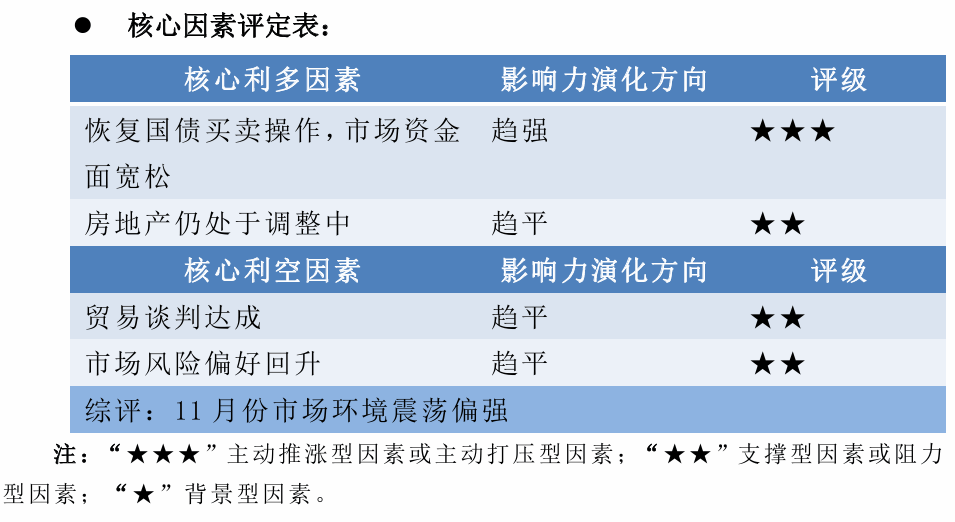
Core Viewpoint - The People's Bank of China has resumed the trading of government bonds in October 2023, with a net injection of 20 billion yuan, marking the end of a suspension that began in January 2023 [1][2]. Group 1: Reasons for Resumption - The resumption of government bond trading is attributed to improved market conditions, with the 10-year government bond yield rising to approximately 1.8% and a widening yield spread [2]. - The current state of the bond market is considered stable, providing a conducive environment for the resumption of operations [2]. Group 2: Benefits of Resuming Operations - Resuming government bond trading supports the real economy, enhances the coordination between monetary and fiscal policies, and helps to release liquidity while stabilizing market expectations [3]. - This action enriches the monetary policy toolkit, enhances the financial functions of government bonds, and strengthens the pricing benchmark role of the yield curve [4]. Group 3: October's Net Injection Considerations - The net buying operation reflects the central bank's goal to nurture liquidity in the market and stabilize expectations in the bond market [5]. - The relatively low net buying scale of 20 billion yuan indicates the central bank's intention to avoid rapid declines in interest rates and excessive influence on market expectations [6].


国债期货日报:央行买卖国债落地,国债期货涨跌分化-20251105
Hua Tai Qi Huo· 2025-11-05 02:16
Report Industry Investment Rating No relevant content provided. Core View of the Report Affected by the central bank's restart of treasury bond trading and the continuation of the Fed's interest rate cut expectations, treasury bond futures showed a mixed performance yesterday. Overall, the increasing global trade uncertainty adds to the uncertainty of foreign capital inflows. The bond market fluctuates between the expectations of stable growth and monetary easing. Short - term attention should be paid to the policy signals at the end of the month [3]. Summary by Directory I. Interest Rate Pricing Tracking Indicators - China's CPI (monthly) had a 0.10% month - on - month change and a - 0.30% year - on - year change; China's PPI (monthly) had a 0.00% month - on - month change and a - 2.30% year - on - year change [9]. - Social financing scale was 437.08 trillion yuan, with a month - on - month increase of 3.42 trillion yuan and a growth rate of 0.79%; M2 year - on - year was 8.40%, with a decrease of 0.40% and a decline rate of 4.55%; Manufacturing PMI was 49.00%, with a decrease of 0.80% and a decline rate of 1.61% [10]. - The US dollar index was 100.21, with a month - on - month increase of 0.33 and a growth rate of 0.33%; The US dollar against the offshore RMB was 7.1308, with an increase of 0.014 and a growth rate of 0.19%; SHIBOR 7 - day was 1.42, with an increase of 0.00 and a growth rate of 0.21%; DR007 was 1.43, with an increase of 0.01 and a growth rate of 0.53%; R007 was 1.53, with an increase of 0.02 and a growth rate of 1.49%; The 3 - month inter - bank certificate of deposit (AAA) was 1.57, with an increase of 0.01 and a growth rate of 0.45%; The AA - AAA credit spread (1Y) was 0.09, with an increase of 0.00 and a growth rate of 0.45% [11]. II. Overview of Treasury Bonds and Treasury Bond Futures Market No specific content provided other than referring to multiple figures related to the market, such as the closing price trend, price change rate, capital flow, and position ratio of treasury bond futures [12][14][16]. III. Overview of the Money Market Funding Situation The central bank conducted 117.5 billion yuan of 7 - day reverse repurchase operations at a fixed interest rate of 1.4% on November 4, 2025. The main term repurchase rates of 1D, 7D, 14D, and 1M were 1.315%, 1.415%, 1.478%, and 1.546% respectively, and the repurchase rates have declined recently [2]. IV. Spread Overview No specific content provided other than referring to figures related to various spreads, such as the inter - period spread of treasury bond futures and the spread between spot bond term spreads and futures cross - variety spreads [37]. V. Two - Year Treasury Bond Futures No specific content provided other than referring to figures related to the implied interest rate, IRR, and basis of the two - year treasury bond futures main contract [39]. VI. Five - Year Treasury Bond Futures No specific content provided other than referring to figures related to the implied interest rate, IRR, and basis of the five - year treasury bond futures main contract [52]. VII. Ten - Year Treasury Bond Futures No specific content provided other than referring to figures related to the implied yield, IRR, and basis of the ten - year treasury bond futures main contract [59]. VIII. Thirty - Year Treasury Bond Futures No specific content provided other than referring to figures related to the implied yield, IRR, and basis of the thirty - year treasury bond futures main contract [66]. Strategy - Unilateral: With the decline of repurchase rates and the fluctuating prices of treasury bond futures, the 2512 contract is neutral [4]. - Arbitrage: Pay attention to the decline of the 2512 basis [4]. - Hedging: There is medium - term adjustment pressure, and short - side investors can use far - month contracts for appropriate hedging [4].
央行等量续作3个月期买断式逆回购,流动性稳定充裕状态有望延续
Xin Jing Bao· 2025-11-05 01:38
Group 1 - The central bank conducted a 700 billion yuan reverse repurchase operation with a fixed amount and interest rate, maturing in 3 months, indicating a strategy to maintain liquidity in the market [1] - There is an expectation for another 6-month reverse repurchase operation in November, with a possibility of increasing the amount, reflecting the central bank's proactive approach to manage liquidity [2] - The central bank's resumption of government bond trading is aimed at injecting liquidity into the bond market, which is expected to bolster market confidence and support the issuance of government bonds in the upcoming year [3][4] Group 2 - The central bank's actions are seen as a means to stabilize the funding environment, especially with the anticipated increase in local government bond issuance and the maturity of interbank certificates of deposit [2] - The resumption of government bond trading is expected to alleviate pressure on commercial banks' bond holdings and provide a quasi-reduction in reserve requirements, ensuring smooth market operations in the fourth quarter [3][4] - The current low inflation levels provide ample room for the central bank to implement various monetary policy tools to support economic stability [4][5]
存款搬家停下来了!这是什么信号?
大胡子说房· 2025-11-04 11:21
Group 1 - The core viewpoint of the article emphasizes the current economic situation, particularly focusing on CPI and PPI data, indicating a lack of inflation and a need for continued monetary and fiscal policy support [5][6][10] - In September, the CPI decreased by 0.3% year-on-year and increased by 0.1% month-on-month, while the PPI fell by 2.3% year-on-year, suggesting weak consumer demand and manufacturing prices [1][3] - The article highlights the importance of M1 and M2 monetary supply data, with M2 growing by 8.4% year-on-year and M1 by 7.2%, indicating a narrowing gap between the two, which reflects a shift in liquidity dynamics [6][8][9] Group 2 - The increase in M1 is attributed to a decline in government bond prices, leading individuals to withdraw funds from fixed-term investments and place them into demand deposits [9][10] - In September, household deposits rose by 2.96 trillion yuan, while non-bank financial institution deposits fell by 1.06 trillion yuan, indicating a trend of funds returning to banks rather than remaining in investment accounts [10][11] - The article suggests that the current market volatility and lack of clear upward trends in the stock market have led to a decrease in the "money-moving" phenomenon, with investors opting to keep funds in banks [12][13] Group 3 - The article anticipates that as the stock market stabilizes and begins to rise, there will be a renewed influx of deposits into the market, driven by improved investor sentiment [14][15] - It discusses the government's intention to stimulate the capital market to help escape the current economic stagnation and achieve asset price recovery [16][18] - The upcoming key events, including trade negotiations and monetary policy decisions, are expected to influence market movements, necessitating strategic asset allocation in anticipation of these developments [20][21]

海外宏观周报:美联储如期降息,欧洲、日本央行维持利率不变-20251104
Dong Fang Jin Cheng· 2025-11-04 04:25
Monetary Policy - The Federal Reserve lowered the federal funds rate target range by 25 basis points to 3.75% to 4.00%, aligning with market expectations[9] - The European Central Bank (ECB) maintained its benchmark interest rate at 2%, citing stronger-than-expected economic resilience in the Eurozone, with Q3 GDP growth of 0.2%[11] - The Bank of Japan (BOJ) kept its interest rate unchanged, with two members voting against this decision, indicating potential future rate hikes[12] Economic Data - Eurozone's Q3 GDP growth of 0.2% exceeded the expected 0.1%, with France showing a 0.5% increase, the highest in three years, while Germany's growth stagnated[26] - In the U.S., September fiscal revenue was $543.7 billion, a 3.2% year-on-year increase, while expenditures were $345.7 billion, down 22.6% year-on-year, resulting in a fiscal surplus of $198 billion[17] - Japan's industrial and commercial sales showed improvement, with consumer confidence rising for three consecutive months[28] Market Trends - The S&P 500 index rose by 0.71% last week, with a year-to-date increase of 16.30%[5] - The 10-year U.S. Treasury yield increased by 9 basis points to 4.11%, reflecting market adjustments following the Fed's rate cut[5] - The WTI crude oil price decreased by 1.01% to $61, with a year-to-date decline of 14.78%[5]
薛鹤翔:政策助力期债价格回升
Sou Hu Cai Jing· 2025-11-04 03:03
Core Viewpoint - Since October, the prices of government bond futures have shown a strong upward trend, reversing the weak performance of the third quarter, primarily due to the central bank's increased open market operations and the resumption of government bond trading, leading to a more relaxed market liquidity environment [1][29]. Group 1: Market Analysis - The average daily trading volume of government bond futures in October was 318,100 contracts, a decrease of 13.76% month-on-month, mainly due to the National Day holiday [4]. - The average open interest increased by 10.49% month-on-month to 678,000 contracts, indicating strong hedging demand in the market [4]. - The central bank's open market operations have resulted in a slight net injection of liquidity, maintaining a relatively stable overall funding rate [4][22]. Group 2: Economic Indicators - The U.S. ADP employment figures for September showed a decrease of 32,000 jobs, which was below expectations and previous values, leading to increased risk aversion [8]. - The U.S. Consumer Price Index (CPI) for September rose by 0.3% month-on-month and 3.0% year-on-year, slightly above the previous value but below market expectations, indicating moderate inflation [8]. - The central bank's decision to cut interest rates by 25 basis points on October 29 was influenced by the soft employment data and the government shutdown, which affected the release of several economic indicators [8]. Group 3: Policy and Future Outlook - The central bank has resumed government bond trading operations to stabilize market expectations and enhance liquidity, which is expected to support government bond prices [26][27]. - The central bank is likely to continue implementing a supportive monetary policy stance, providing both short-term and long-term liquidity arrangements to maintain relatively loose financing conditions [27]. - Despite achieving consensus in U.S.-China trade negotiations, external uncertainties remain, and the domestic economy is facing challenges, particularly in the real estate sector, which continues to show weakness [29].