
关税冲击

Search documents
IMF和世界银行年会聚焦全球经济风险
Huan Qiu Shi Bao· 2025-10-13 22:49
Core Insights - The upcoming meetings of global policymakers and finance ministers will focus on the escalating tensions in world trade, exacerbated by the U.S. government's threats of imposing significant tariffs, alongside political uncertainties in countries like Japan and France, raising concerns about potential shocks to the global economy [1] - The three major risks facing the global economy are identified as tariffs, government debt, and the potential bubble in technology stocks [2] - The International Monetary Fund (IMF) is expected to update its global GDP growth forecast during the annual meetings, with a previous prediction of a 3% growth rate for this year, indicating a slowdown in growth for 2024 [4] Group 1: Trade and Tariffs - The global economy has so far withstood the largest tariff shocks initiated by the U.S. since the 1930s, but experts warn that this resilience is unsustainable and a slowdown is anticipated [2] - The World Trade Organization (WTO) has projected that the growth rate of global merchandise trade will plummet to 0.5% by 2026, significantly lower than the expected 2.4% growth for this year [2] Group 2: Technology Sector - Concerns are rising regarding a potential reversal in the boom of artificial intelligence, with the S&P 500 index having risen 32% since its low in April, despite recent tariff threats impacting the market [3] - The IMF president has cautioned that U.S. stock valuations are nearing levels seen during the internet bubble 25 years ago, suggesting that a significant market correction could tighten financial conditions and hinder global economic growth [3] Group 3: Government Debt - The issue of rising public debt is a focal point of the meetings, with global debt increasing by over $21 trillion in the first half of this year, reaching a record high of nearly $338 trillion [3] - Analysts indicate that struggling governments are cutting back on healthcare and education spending, prompting calls from leading economists for debt relief measures [3]
周度债市讨论会
2026-03-03 02:52
Summary of Key Points from Conference Call Industry Overview - The conference call primarily discusses the bond market and its current dynamics, including investor sentiment, monetary policy, and fiscal measures in response to trade tensions and economic pressures [1][2][3][4]. Core Insights and Arguments - **Investor Sentiment**: Investors generally hold a bullish outlook on the bond market but are hesitant to make significant investments due to uncertainties surrounding tariff negotiations, economic downturn pressures, and the potential for monetary policy easing [1][2]. - **Policy Expectations**: There is low expectation for significant policy changes from the upcoming Politburo meeting at the end of April, with most investors anticipating a focus on maintaining economic stability and flexibility in policy implementation [1][3][5]. - **Tariff Impact**: Approximately 46% of investors believe that tariff impacts will ease in the third quarter, but overall sentiment regarding the annual outlook for tariff relief remains pessimistic [6][7]. - **Monetary Policy Outlook**: A majority of investors expect a reserve requirement ratio (RRR) cut in the next three months, with a smaller percentage anticipating interest rate cuts. The rationale for RRR cuts includes addressing liquidity gaps and supporting government bond issuance [9][10]. - **Bond Market Predictions**: Investors predict that the 10-year government bond yield will fluctuate between 1.5% and 1.8%, indicating a slight downward adjustment in market expectations [11]. Additional Important Content - **Trade Policy Response**: The policy response to trade tensions includes stabilizing the market, maintaining exchange rate stability, and expanding domestic demand, with a focus on service consumption as a key driver [12][13]. - **Service Consumption Policies**: Recent policies in the service consumption sector include direct subsidies for hospitality, dining, and transportation, with expectations for further financial support to stimulate consumption [14]. - **Real Estate Sector Focus**: Key points of interest in the real estate sector include government attitudes towards market stabilization and the potential for policy shifts regarding property development and financing [15][16]. - **Credit Bond Market Regulation**: Recent regulatory changes in the credit bond market have tightened oversight on local state-owned enterprises, impacting their financing capabilities [24]. - **Local Government Financing**: Local governments, particularly in Guangdong, are actively issuing special bonds to support land reserve projects, with a focus on expediting the issuance process compared to previous years [25][37]. This summary encapsulates the essential insights and data points discussed during the conference call, providing a comprehensive overview of the current state of the bond market and related economic policies.
关税冲击如何影响国内市场?
Sou Hu Cai Jing· 2025-10-13 14:26
Core Viewpoint - The U.S. plans to impose an additional 100% tariff on all goods imported from China starting November 1, 2025, and implement export controls on "all critical software," leading to a decline in global risk assets and increased market volatility [1][2]. Market Reactions - Following the announcement, the Shanghai Composite Index fell below 3900 points, and the bond market saw a general decline in interest rates, with 30-year and 10-year government bonds dropping by 5.01 and 2.54 basis points, respectively [1]. - On October 10, the Nasdaq and S&P 500 indices dropped by 3.56% and 2.71%, while international spot gold rose by 1.05%, surpassing $4000 per ounce [1]. Analyst Perspectives - Analysts believe that the recent escalation in U.S.-China trade tensions is primarily due to unreasonable sanctions on China's shipbuilding industry, with the market expected to adopt a cautious approach [1][2]. - Compared to the previous "reciprocal tariff" policy in April, the current market reaction is more measured, as investors have gained experience and are more prepared for potential outcomes [2][3]. A-Share Market Outlook - Despite short-term volatility, several brokerages maintain a positive long-term outlook for the A-share market, citing factors such as the resilience of Chinese enterprises, improving company quality, increasing dividends and buybacks, and sustained capital inflows [4]. - The A-share market is expected to remain focused on domestic factors, with analysts noting that the current market environment is stronger than in April [3][4]. Bond Market Impact - The impact of the current tariff escalation on the bond market is expected to be less severe than in April, with analysts predicting that the 10-year government bond yield will fluctuate between 1.7% and 1.75% [5][6]. - The market's learning effect from previous tariff announcements has led to a more rational response, with current sentiment favoring equities over bonds, limiting the extent of yield declines [6][7].
逆势涨超5%!银行股久违大涨,这次轮到谁了?
Di Yi Cai Jing· 2025-10-13 11:53
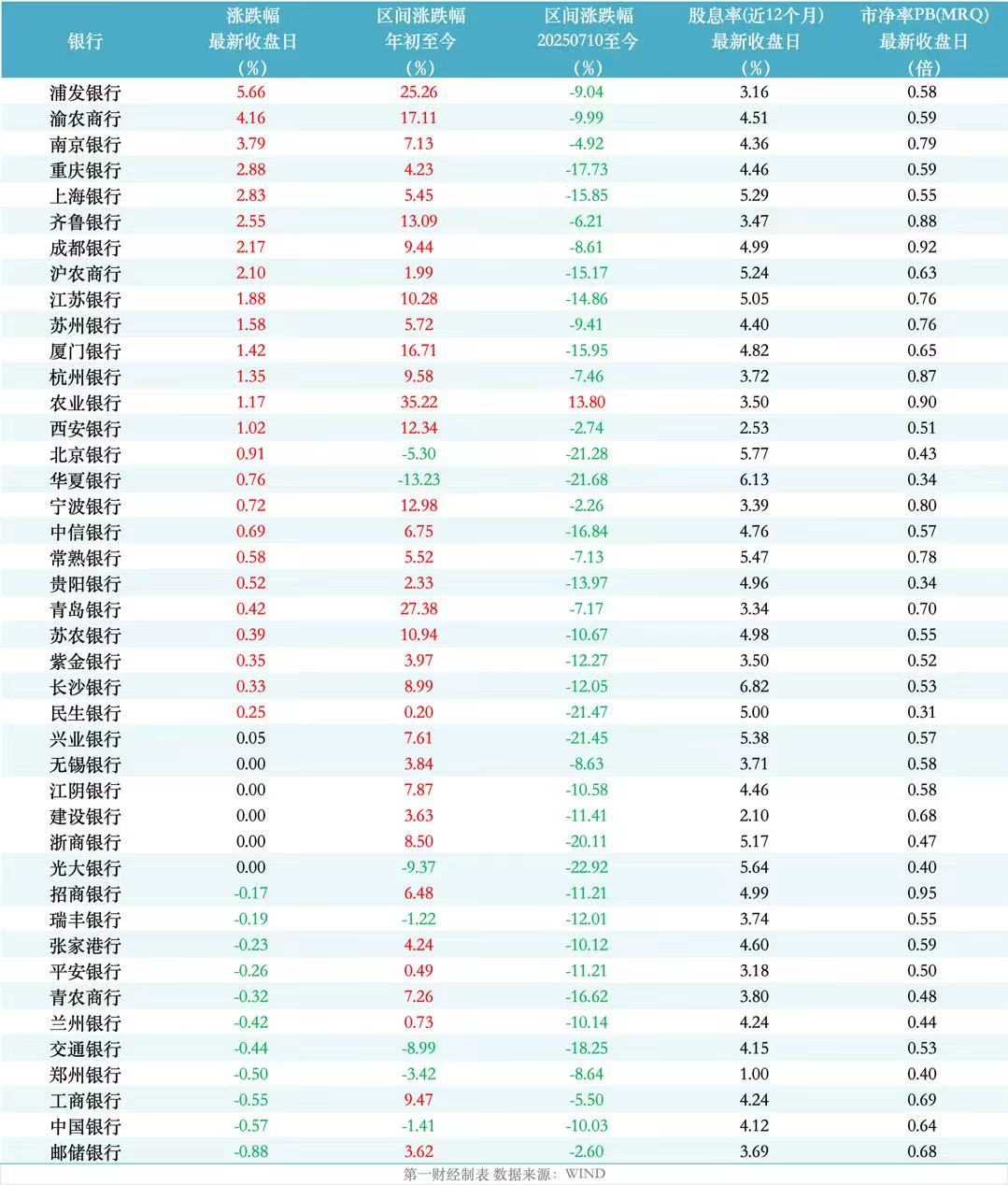
Core Viewpoint - The banking sector has experienced a notable rebound, with regional banks gaining favor, particularly led by Shanghai Pudong Development Bank, which rose by 5.66% on October 13, amidst a broader market correction [1][2]. Summary by Sections Market Performance - The China Securities Banking Index increased by 0.75% on October 13, with Shanghai Pudong Development Bank leading the gains [1][2]. - Other banks such as Chongqing Rural Commercial Bank and Nanjing Bank also saw significant increases of over 4% and 3%, respectively [1][2]. - In contrast, many state-owned banks experienced declines, with Postal Savings Bank down by 0.88% and Industrial and Commercial Bank down by 0.55% [2]. Investment Trends - The recent rally in bank stocks is attributed to a shift in market sentiment, with funds seeking temporary safe havens, leading to a preference for regional banks over larger state-owned banks [1][5]. - The banking sector has seen a cumulative decline of 14% since July, while the Shanghai Composite Index and CSI 300 Index have risen over 11% and 15%, respectively [3]. Economic Impact - The announcement of additional tariffs on Chinese goods by the U.S. is expected to have a controllable impact on banks, particularly affecting regional banks with higher exposure to foreign trade [6]. - The report from Galaxy Securities suggests that while the overall impact on banks is manageable, regional banks reliant on export-oriented businesses may face increased risks [6]. Future Outlook - Analysts predict that the upcoming dividend distribution period and stable bank performance may present opportunities for a rebound in bank stocks if market sentiment stabilizes [7]. - The banking sector's price-to-book (PB) ratio has fallen to 0.67, indicating potential value for investors, especially given the average dividend yield of state-owned banks at 4.11% [7][8].







博时市场点评10月13日:沪深两市震荡,有色涨幅领先
Xin Lang Ji Jin· 2025-10-13 07:58
Market Overview - The three major indices in the A-share market adjusted, with the ChiNext index falling over 1% and total trading volume decreasing to 2.37 trillion yuan [1][2] - The non-ferrous metals sector led the gains among the Shenwan first-level industries [1] Trade Data - In September, China's total goods trade value reached 4.04 trillion yuan, a year-on-year increase of 8%, marking the highest monthly growth rate of the year [2][3] - Exports amounted to 2.34 trillion yuan, up 8.4% year-on-year, while imports were 1.70 trillion yuan, increasing by 7.5% [2] Economic Indicators - The rebound in both export and import growth indicates a synchronized improvement in domestic and external demand [3] - The resilience in exports is attributed to China's ongoing market diversification strategy and product structure optimization, enhancing overall competitiveness and value-added exports [3] Market Sentiment - The market is currently observing a high-risk preference, with attention on the changes in incremental capital, especially high-risk preference funds [1][2] - The Federal Reserve's continued interest rate cuts and manageable tariff risks contribute to maintaining a high market risk appetite [1][2] Sector Performance - On October 13, the A-share market saw declines in major indices, with the Shanghai Composite Index down 0.19% and the Shenzhen Component Index down 0.93% [4] - The non-ferrous metals, environmental protection, and steel sectors showed notable gains, while the automotive, home appliances, and beauty care sectors experienced significant declines [4]
每日市场观察-20251013
Caida Securities· 2025-10-13 05:48
Market Performance - On October 13, the market experienced a significant decline with a trading volume of 2.53 trillion, down approximately 140 billion from the previous trading day[1] - The semiconductor and new energy sectors showed weakness, while non-tech sectors like building materials and coal performed better[1] - The Shanghai Composite Index fell by 0.94%, closing below 3900 points, with the Shenzhen Component down 2.70% and the ChiNext Index down 4.55% on October 10[3] Sector Analysis - The adjustment in the tech sector is expected to create a capital spillover effect, leading to potential gains in non-tech sectors such as non-bank financials and chemicals[1] - Major outflows were noted in the semiconductor, battery, and software development sectors, while inflows were seen in grid equipment, infrastructure, and securities[4] Economic Indicators - The Ministry of Civil Affairs announced a first batch of elderly care service subsidies amounting to 1.16 billion yuan, aimed at supporting elderly individuals with moderate to severe disabilities[5] - The World Trade Organization revised its global trade growth forecast for 2025 from -0.2% to 2.4%, but lowered the 2026 forecast from 2.5% to 0.5% due to anticipated tariff impacts[7] Investment Trends - Public funds have shown increased enthusiasm for participating in private placements, with total subscriptions exceeding 30 billion yuan this year, surpassing last year's total[13] - Private equity firms remain optimistic about market continuity but advise caution regarding valuation pressures on certain tech stocks[14]
本次冲击或将小于“4·7行情”!把握黄金坑机会
Zheng Quan Shi Bao Wang· 2025-10-13 03:39
Group 1 - The traditional manufacturing sector in China is poised to benefit from the current geopolitical climate, as it can leverage its advantages to gain pricing power and move away from intense competition [2] - Recent export controls and licensing systems are aimed at protecting national interests and may help leading companies secure stable overseas market shares and better profitability [2] - The capital expenditure in traditional industries is showing signs of stabilization and recovery, providing a favorable environment for companies to improve their profit margins [2] Group 2 - External shocks leading to asset declines present a buying opportunity in the Chinese market, as the current trade risks are clearer compared to previous disruptions [3] - The demand for quality assets in China is surging, driven by the ongoing transformation of the economy and capital market reforms [3] - The focus remains on sectors that align with industrial development and stability, particularly in emerging technologies and cyclical finance [3] Group 3 - The market is expected to experience a short-term adjustment, but the overall resilience remains strong, with potential for new highs post-adjustment [5] - The current market conditions are more favorable than previous shocks, with investor sentiment and institutional support strengthening [5] - Key sectors to watch include military, semiconductors, and new consumption, which are positioned for marginal improvements [5] Group 4 - The core drivers of the current market rally remain unchanged, with a focus on medium to long-term policy expectations and liquidity trends [6] - Attention should be directed towards sectors with strong performance certainty, such as new productivity themes and large consumption [6] - Investment opportunities are identified in metals, agriculture, and energy sectors [6] Group 5 - The recent volatility in the technology sector is not expected to lead to significant long-term declines, as the market has learned from past experiences [7] - The focus should be on sectors that can benefit from domestic policies and self-sufficiency, including non-ferrous metals, banking, and agriculture [7] - Opportunities may arise from market corrections, particularly in sectors with strong growth potential [7] Group 6 - The mid-term outlook for A-shares remains optimistic despite external uncertainties, with a focus on traditional value sectors such as real estate and consumption [8] - The market is showing signs of a shift towards value-oriented investments, indicating a potential rebalancing of investment styles [8] - The gold market is expected to maintain a positive outlook, with no immediate signs of a peak [8] Group 7 - The current market environment is characterized by a lack of panic, suggesting that adjustments in global risk assets will be manageable [9] - The focus should be on domestic policies and the recovery of internal demand, which are expected to gain more attention in the market [9] - The recovery of manufacturing activities and investment acceleration are seen as key themes for future growth [9] Group 8 - The upcoming APEC summit is anticipated to be a significant event for potential shifts in the geopolitical landscape, impacting market sentiment [12] - The market is expected to respond positively to the stabilization of industry chains and economic resilience amid ongoing trade tensions [12] - Investment strategies should focus on sectors that align with anti-tariff measures and self-sufficiency, such as agriculture and military [12]
港股三大指数集体低开,机构称外部因素短期波动的边际影响有限
Sou Hu Cai Jing· 2025-10-13 02:09
Group 1 - The Hong Kong stock market opened lower on October 13, with the Hang Seng Index down 2.5% and the Hang Seng Tech Index down 2.43% [1] - The largest ETF tracking the Hang Seng Tech Index (513180) followed the index's decline, with most constituent stocks falling, while only a few like Kingsoft, Hua Hong Semiconductor, and SMIC saw gains [1] - In contrast, U.S. stock futures rebounded, with the Nasdaq futures rising over 1.6%, and notable tech stocks like TSMC and Nvidia experiencing significant gains [1] Group 2 - As of October 10, the latest valuation (PETTM) of the Hang Seng Tech Index ETF (513180) was 23.82 times, which is approximately in the 34.04% valuation percentile since the index's inception, indicating it remains in a historically undervalued range [2] - The ETF's characteristics of high elasticity and growth potential suggest it has greater upward momentum, making it an attractive option for investors without a Hong Kong Stock Connect account to access core Chinese AI assets [2]
IMF世行年会直面“三重风暴”:贸易战火重燃、债务海啸与AI泡沫隐忧
智通财经网· 2025-10-12 23:53
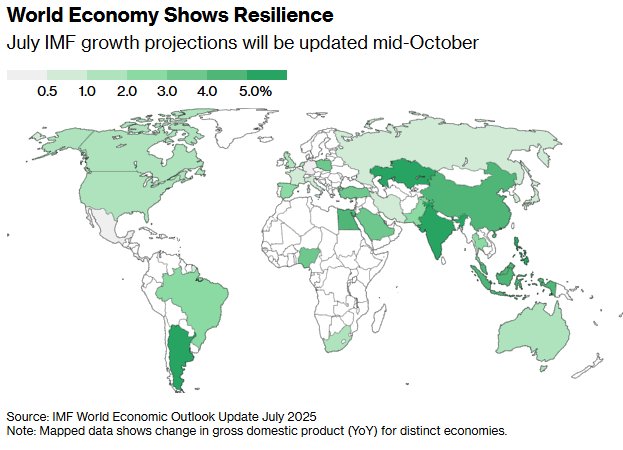
Core Viewpoint - The global economy is facing multiple risks, including potential new tariffs proposed by the U.S. government, rising government debt, and concerns over a technology stock bubble, despite recent optimism driven by consumer spending and AI advancements [1][4][5]. Economic Performance - The U.S. economy has shown resilience, with the second quarter GDP growth reaching a two-year high, and the S&P 500 index rising 32% since April [4]. - However, there are signs of slowing growth, with predictions of a decline in global economic growth rates to 3.2% in 2025 and 2.9% in 2026 [5]. Debt Concerns - Global debt has surged, with an increase of over $21 trillion in the first half of the year, bringing the total to nearly $338 trillion, a record high [5]. - The rising debt levels in both developed and emerging economies are expected to be a central topic at the upcoming meetings in Washington [5]. Trade and Tariff Impacts - The World Trade Organization (WTO) forecasts a significant slowdown in global goods trade growth, predicting only a 0.5% increase by 2026, down from 2.4% this year, largely due to the impact of U.S. tariffs [6]. - The potential for new tariffs on Chinese goods, announced by President Trump, raises concerns about further economic repercussions [4][9]. Consumer Spending and Inflation - There are concerns that rising prices may eventually dampen U.S. consumer spending, which could have a cascading effect on the global economy [9]. - The impact of tariffs is expected to manifest gradually, with predictions of a 2% increase in import prices over several quarters, rather than an immediate shock [10]. Technology Sector Vulnerability - The valuation of tech stocks is nearing levels seen during the dot-com bubble, raising alarms about a potential downturn that could adversely affect global economic growth [11]. - The sustainability of the current AI investment boom is uncertain, with doubts about its ability to translate into long-term productivity gains [12].
海外市场点评:外部变数下的市场悬念
Minsheng Securities· 2025-10-12 05:42
海外市场点评 外部变数下的市场悬念 2025 年 10 月 12 日 分析师:陶川 分析师:邵翔 研究助理:武朔 执业证号:S0100524060005 执业证号:S0100524080007 执业证号:S0100125070003 邮箱:taochuan@glms.com.cn 邮箱:shaoxiang@glms.com.cn 邮箱:wushuo@glms.com.cn ➢ 随着特朗普关税突临变数,本周末海外风险资产再起波澜,时隔 6 个月,这 一次是更像 4 月,还是更像 5 月?投资者应如何研判潜在关税冲击下的地缘动 向,对国内政策以及资本市场的叙事又将产生怎样的影响? ➢ 4 月的剧本是关税不停地加码,最终在市场不堪重负下,美国选择让步;5 月则是首次谈判后,出口管制政策的"针尖对麦芒",最终以元首会晤为破局。这 一次形式上更像 4 月,但其实更像是 5 月的"增强版本"。 ➢ 本次关税的升级,之前已有苗头。9 月元首通话、就 Tiktok 达成初步协议之 后,美国依旧"小动作不断"。尤其是 9 月 29 日美国商务部出台史上最严股权 50%穿透管制规则,进一步强化技术封锁。随后中国全面升级了稀土及关 ...