
科技自主

Search documents
外媒评价称:人工智能生态系统将是中国未来数年科技投资新引擎
Huan Qiu Wang· 2025-10-13 01:08
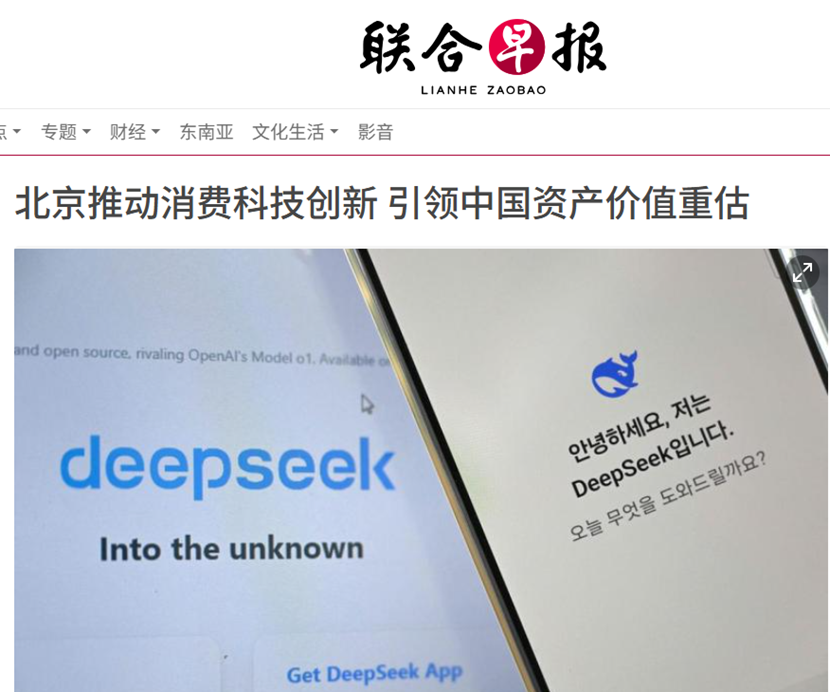
Core Insights - The Ministry of Industry and Information Technology (MIIT) and six other departments have issued an implementation plan to promote service-oriented manufacturing innovation, emphasizing the need for enhanced new-type information infrastructure and the integration of "5G + industrial internet" [1] - The MIIT Minister highlighted the importance of implementing national major science and technology projects and key R&D plans, aiming to attract innovation resources to enterprises [1] - A recent article by HSBC's Chief Investment Officer for Asia suggests that innovations like DeepSeek are reshaping international investors' perceptions of China's tech capabilities and asset values, potentially accelerating the application and commercialization of AI across various industries in China [1] Group 1: Policy and Infrastructure - The implementation plan includes tasks to strengthen new-type information infrastructure and promote the integration of AI technology with service-oriented manufacturing [1] - The focus is on building computing power infrastructure based on demand and enhancing the overall efficiency of the manufacturing innovation system [1] Group 2: Industry Outlook - The AI sector is expected to benefit from favorable industrial policies, with a positive outlook for AI promoters and adopters in industries such as internet, e-commerce, software, smartphones, semiconductors, autonomous driving, and humanoid robots [4] - Increased capital expenditure related to AI applications and commercialization is anticipated to benefit these sectors [4]

黑五大洗盘与4月有何异同?短中长期的3个重要转机推演!
格隆汇APP· 2025-10-11 11:55
Core Viewpoint - The article discusses the recent escalation of trade tensions between the U.S. and China, particularly focusing on the implications of Trump's announcement to impose a 100% tariff on all Chinese imports starting November 1, which has triggered significant market reactions and a shift in investor sentiment compared to previous trade conflicts [3][14]. Group 1: Market Reactions and Changes - On October 10, the S&P 500 index dropped by 3.5%, resulting in a loss of $2.5 trillion in market value within six hours, while the cryptocurrency sector saw over $19.1 billion in liquidations, marking a record in the industry [3][14]. - The current market panic is notably less severe than in April, with the VIX fear index rising to only 22 compared to 60 in April, indicating a fundamental shift in investor perception regarding the U.S.-China trade dynamics [3][14]. Group 2: Strategic Shifts in U.S. and China - China has transitioned from a "passive defense" strategy to "active countermeasures," focusing on accelerating technological independence and implementing strict export controls on rare earth materials [5][9]. - The U.S. has intensified its technology restrictions, adding 23 Chinese semiconductor companies to its entity list and requiring licenses for exports of semiconductor manufacturing equipment, aiming to disrupt China's technological advancements [6][9]. Group 3: Key Observational Nodes - Four critical observation points are identified: the APEC summit on October 31-November 1, the implementation of U.S. tariffs on November 1, the full enforcement of China's rare earth controls in December, and U.S. soybean inventory data in mid-November [20][21]. - These nodes are expected to influence market sentiment and provide insights into potential negotiation outcomes between the two countries [20][21]. Group 4: Market Opportunities - Short-term opportunities focus on sectors like rare earths, semiconductors, and agricultural safety, with an emphasis on companies that can benefit from China's countermeasures [23]. - Mid-term strategies should consider companies aligned with the "14th Five-Year Plan" and those showing strong Q3 performance, particularly in AI and advanced technologies [24]. - Long-term investments should target AI infrastructure, robotics, and semiconductor equipment, as the ongoing trade tensions will continue to shape the technological landscape [25].

帮主郑重:沪指逼近3900,半导体掀涨停潮!这波午盘行情要盯准主线
Sou Hu Cai Jing· 2025-09-30 04:18
Market Overview - The Shanghai Composite Index is approaching the 3900-point mark, with a notable increase in trading activity, indicating a potential shift in market sentiment [1][3] - The three major indices are all in the green, with the Shanghai Composite up by 0.3%, the Shenzhen Component by 0.31%, and the ChiNext Index slightly up by 0.06% [3] Sector Performance - Semiconductor and storage chip sectors are particularly strong, with companies like Huahong Semiconductor rising over 15% and ZhiChun Technology hitting the daily limit [3] - The storage chip sector is also performing well, with Jiangbolong increasing by over 17%, and other companies like Baiwei Storage and Xiangnong Chip Innovation nearing 10% gains [3] - The energy metals sector is benefiting from the recovery of the new energy industry chain, with companies like Boqian New Materials hitting the daily limit and others like Yongxing Materials and Huayou Cobalt rising nearly 7% [3] Market Dynamics - There is a rotation of funds from large financial sectors, which are experiencing declines, to more growth-oriented sectors like technology and new energy, indicating a normal market rotation rather than a downturn [4] - The increase in trading volume, reaching 136.98 billion, suggests that market sentiment is gradually warming, with over 2900 stocks rising, reflecting broad market participation [3][4] - The focus on technology (semiconductors and storage) and new energy industry chains aligns with long-term investment logic, emphasizing the importance of following industry trends rather than chasing short-term speculative opportunities [4]
上周南向资金净买入近440亿港元,港股科技30ETF(513160)涨超1%,近10日累计“吸金”超9亿元
2 1 Shi Ji Jing Ji Bao Dao· 2025-09-30 02:05
Group 1 - The Hong Kong stock market opened slightly higher on September 30, with the Hong Kong Technology 30 ETF (513160) rising by 1.35% and trading volume exceeding 800 million yuan, indicating strong investor interest [1] - The ETF has seen consistent capital inflow, with net inflows for 9 out of the last 10 trading days, accumulating over 900 million yuan [1] - As of September 29, the Hong Kong Technology 30 ETF reached a record high in both circulation shares at 3.469 billion shares and circulation scale at 4.852 billion yuan [1] Group 2 - The ETF closely tracks the Hang Seng Hong Kong Stock Connect China Technology Index, which includes mainland companies listed in Hong Kong engaged in technology [1] - Major holdings in the ETF include leading technology stocks such as SMIC, Kuaishou-W, Tencent Holdings, Alibaba-W, and Xiaomi Group-W [1] - Southbound capital has significantly increased, with a net purchase of 43.959 billion HKD in the last week and a total of 1,153.689 billion HKD year-to-date, surpassing last year's total [1] Group 3 - Haitong Securities noted that the impact of major overseas events during the National Day holiday on the Hong Kong stock market is expected to be limited, suggesting a strategy of holding stocks through the holiday [2] - Guotai Junan highlighted the attractiveness of Hong Kong technology assets amid the AI-driven tech cycle, which continues to draw incremental capital inflows [2] - Western Securities remains optimistic about domestic AI computing and overseas chain sustainability, focusing on investment opportunities in AI hardware and the revaluation of Hong Kong tech companies [2]


阿里、小米等芯片开发进程加速,重仓的港股通科技ETF(159262)盘中最高涨超2%,连续12日“吸金”规模突破50亿元
Xin Lang Cai Jing· 2025-09-25 06:09
Group 1 - The Nasdaq Golden Dragon China Index saw significant gains, with notable increases in companies such as GDS Holdings up 16.6%, Daqo New Energy up 12.6%, and Alibaba maintaining around a 10% increase [1] - The Hang Seng Tech Index rose over 2%, led by Hua Hong Semiconductor and followed by SMIC and Alibaba [1] - Xiaomi officially announced the global launch of its 17 series featuring the fifth-generation Snapdragon 8 processor, which boasts a peak frequency of 4.6GHz and significant power efficiency improvements [1] Group 2 - Zhongtai Securities indicated that the Hong Kong stock market is expected to continue its structural rise, supported by the US-China summit and improved sentiment in the A-share market, with a focus on the technology sector driven by AI demand [2] - The Hong Kong Stock Connect Technology ETF (159262) rose 1.65%, with component stocks like Hua Hong Semiconductor and Xiaomi Group showing strong performance [2] - The Hang Seng Stock Connect Technology Index excludes sectors like pharmaceuticals and automobiles, focusing on TMT industries, with major weights in AI leaders such as Alibaba, Tencent, and Xiaomi [2] Group 3 - As of September 24, 2025, the Hong Kong Stock Connect Technology ETF reached a record size of 5.034 billion yuan, marking the highest since its inception [3] - The ETF has seen continuous net inflows over the past 12 days, with a peak single-day inflow of 325 million yuan, totaling 785 million yuan in net inflows [3] Group 4 - The Hong Kong Stock Connect Technology ETF represents a shift from "Internet" to "AI+" within the hard technology sector [4]


阿里巴巴宣布牵手英伟达,港股科技30ETF(513160)涨近1%,最新规模创历史新高
2 1 Shi Ji Jing Ji Bao Dao· 2025-09-25 02:10
Group 1 - The Hong Kong stock market showed volatility on September 25, with the Hang Seng Tech Index rising by 0.17% [1] - The Hong Kong Tech 30 ETF (513160) increased by 0.99%, with a trading volume exceeding 1 billion yuan and a premium rate of 0.24% [1] - Key components of the ETF, such as Kingsoft Cloud, Ubiquiti, and China Software International, saw gains of over 4%, while Huahong Semiconductor and ZTE also rose [1] - The ETF has experienced significant capital inflow, with net inflows on 9 out of the last 10 trading days, totaling over 720 million yuan [1] - The ETF's circulating scale reached a record high of 4.588 billion yuan [1] Group 2 - Alibaba Cloud announced a partnership with NVIDIA in the field of Physical AI during the 2025 Hangzhou Cloud Summit [2] - The integration of NVIDIA's Physical AI software stack into Alibaba Cloud's AI platform PAI will enhance services for enterprises, including data preprocessing and model training [2] - By 2032, Alibaba Cloud's global data center energy consumption is expected to increase tenfold compared to 2022, indicating a significant rise in computing power investment [2] - Analysts from Western Securities and Guotai Junan Securities expressed optimism about the domestic AI computing chain and the ongoing capital expenditure expansion cycle in emerging industries [2]


月日国新会点评:政策定调明朗,股指震荡上行可期:发布会核心要点:从成就总结到改革深化的政策信号
Chang Jiang Qi Huo· 2025-09-23 03:00
Report Industry Investment Rating No relevant content provided. Core View of the Report The report suggests that the stock index (centered on the Shanghai Composite Index) will consolidate in the short term and show a clear upward trend in the long term. Attention should be paid to the traction of structural forces on the index weights [17]. Summary by Related Catalogs 1. Press Conference Core Points: Policy Signals from "Achievement Summary" to "Reform Deepening" (1) Five - year Report Card of "Stable Quantity and Improved Quality" in the Capital Market - **Mature institutional system**: With the new Securities Law as the core, relevant regulations have been implemented, and the legal foundation for the capital market has been solidified [2]. - **Deepened multi - level market**: Reforms in the Sci - tech Innovation Board, ChiNext, and the high - quality expansion of the Beijing Stock Exchange have improved the multi - level market system, with 964 futures and options varieties covering major industries [2]. - **Coordinated investment and financing functions**: In the past five years, equity and bond financing totaled 57.5 trillion yuan, and the direct financing ratio increased to 31.6%. Over 90% of newly listed companies are technology - related, and the market value of the technology sector in A - shares exceeds 1/4 [2]. - **Enhanced market resilience**: The annualized volatility of the Shanghai Composite Index dropped to 15.9%, and the total market value of A - shares increased by 10 trillion yuan in the past year [4]. - **Effective supervision**: Fines for illegal activities increased by 30% compared to the "13th Five - Year Plan", and regulatory measures such as delisting and mergers have maintained market order [4]. (2) Expansion of the "Circle of Friends" in Reform and Opening - up: Full - chain Breakthroughs from the Financing End to the Investment End - **Investment end**: By the end of the month, long - term funds held 21.4 trillion yuan of A - share floating market value, a 32% increase from the end of the "13th Five - Year Plan" [5]. - **Financing end**: The registration system has been fully implemented, and reforms on the Sci - tech Innovation Board have improved resource allocation efficiency [5]. - **Quality of listed companies**: Dual - wheel drive of information disclosure and governance, and active mergers and acquisitions have improved the overall quality of listed companies [5]. - **Open end**: Foreign ownership restrictions have been lifted, and the internationalization of the capital market has increased, with foreign investors holding 3.4 trillion yuan of A - share market value [5]. (3) Current Policy Tone The regulatory authorities focus on "long - term healthy and stable" development, emphasizing zero - tolerance for violations and leaving room for subsequent policies, which helps stabilize market expectations [7]. 2. Market Reaction and Short - term Logic - **Policy expectation shift**: The market is expected to enter a consolidation phase as there is no strong stimulus, and the index is at a relatively high level [9]. - **Technology and high - end manufacturing as the main lines**: The market has responded to policies supporting technology, making the technology sector a core area for long - term capital allocation [10]. - **Limited short - term incremental funds**: Long - term funds prefer to "buy on dips", and short - term incremental funds mainly come from portfolio rebalancing [11]. 3. Long - term Outlook - **Resilient economic fundamentals**: New economic drivers such as high - tech manufacturing will improve corporate profitability and support the stock index [13]. - **Adequate policy tools**: The regulatory authorities have a mechanism to stabilize the market, and global liquidity improvement will enhance the attractiveness of RMB assets [14]. - **Deepened capital market reform**: The capital market's "market - oriented, legal, and international" level has been improved, and foreign investors' willingness to allocate A - shares will increase [15]. 4. Overall Judgment - **Short - term**: The Shanghai Composite Index is expected to consolidate around 3800 points, with a fluctuation range of 3700 - 3900 points [17]. - **Long - term**: Driven by economic fundamentals, policies, and reforms, the stock index has an upward trend [18].
市场抢跑,新一轮上涨行情启动?
Sou Hu Cai Jing· 2025-09-17 10:21
Core Viewpoint - The A-share and Hong Kong stock markets experienced a strong rally, driven by the technology growth sector, with significant gains in the ChiNext Index and the Hang Seng Technology Index, indicating a positive market sentiment ahead of anticipated Federal Reserve interest rate cuts [1][2]. Market Performance - A-share market continued its upward trend, with the ChiNext Index breaking through 3100 points, closing up 1.95% at 3147.35 points. The Shanghai Composite Index rose 0.37% to 3876.34 points, while the Shenzhen Component increased by 1.16% to 13215.46 points. The total market turnover reached 2.4 trillion yuan, an increase of 359 billion yuan from the previous trading day [2]. - In the Hong Kong market, the Hang Seng Index rose 1.78% to 26908.39 points, and the Hang Seng Technology Index surged 4.22% to 6334.24 points, with significant inflows from southbound funds totaling 9.441 billion HKD [2]. Industry Highlights and Driving Logic - The A-share market saw a dual drive from high-end manufacturing and technology sectors, with the new energy industry chain experiencing a broad rally. The power equipment sector led with a 2.55% increase, while the automotive sector rose 2.05%, supported by better-than-expected new energy vehicle export data [3]. - In the Hong Kong market, technology and education sectors saw significant gains, with the Sapphire Index soaring 7.45% and the online education index rising 6.66%, driven by improved policy expectations [3]. Underperforming Sectors and Driving Logic - In the A-share market, consumer and cyclical sectors showed weak performance, with the agriculture, forestry, animal husbandry, and fishery sector declining by 1.02% due to falling pork prices. The retail and social services sectors also faced declines of 0.98% and 0.86%, respectively, due to weak consumption data [4]. - In the Hong Kong market, the precious metals and healthcare sectors faced significant declines, with the precious metals index dropping 2.20% amid concerns over overbought conditions in gold [4]. Investment Strategy Recommendations - The market exhibited a structural characteristic of "growth dominance, value consolidation," with a focus on technology and high-end manufacturing in the medium to long term. The A-share market is advised to focus on "new energy + hard technology" dual lines, particularly in the lithium battery and semiconductor sectors [5][6]. - For the Hong Kong market, a strategy focusing on "technology leaders + policy beneficiaries" is recommended, particularly in AI chips and cloud computing sectors, which still have upward potential [5][6].
中泰国际每日动态-20250917
ZHONGTAI INTERNATIONAL SECURITIES· 2025-09-17 01:43
Market Overview - The Hang Seng Index slightly declined by 8 points or 0.03%, closing at 438 points on September 16, 2025[1] - The Hang Seng Tech Index rose by 0.6%, closing at 6,077 points[1] - Market turnover was recorded at HKD 294.1 billion, with a net outflow of HKD 3.18 billion from the Hong Kong Stock Connect[1] Economic Indicators - Investor sentiment is cautious, awaiting the outcome of the upcoming FOMC meeting[1] - The U.S. Federal Reserve's potential rate cut is anticipated to have limited impact on Hong Kong stocks due to already high valuations[2] - Sectors sensitive to interest rates, such as AI, robotics, semiconductors, and real estate, may benefit more directly from monetary policy changes[2] Sector Performance - The automotive parts sector saw a significant rise, with Sanhua Intelligent Controls (2050 HK) increasing by 12.8%[3] - The pharmaceutical sector experienced minor declines, with a focus on innovative drugs and leading CXO companies[3] - The renewable energy sector showed mixed performance, with solar stocks generally rising, such as Xinyi Solar (968 HK) up by 2.1%[4] Company Insights - Chaoyun Group (6601 HK) reported a 7.2% increase in revenue to RMB 1.34 billion, with pet category revenue doubling to RMB 96 million, a growth of 101.4%[5][6] - The overall gross margin improved by 2.9 percentage points to 49.3%[5] - The company plans to expand its offline pet store count to 200 by 2027 and is expected to maintain a high dividend payout ratio of 80%[8] Investment Strategy - The report suggests focusing on technology leaders and sectors benefiting from industrial upgrades, such as semiconductors and AI, amidst market volatility[9] - The anticipated rate cut by the Fed is expected to attract foreign capital back to Hong Kong stocks, with a focus on sectors showing strong earnings certainty[9]
窄幅震荡,耐心等待靴子落地
Sou Hu Cai Jing· 2025-09-16 05:27
Market Overview - A-share market showed a fluctuating and differentiated trend, with major indices mostly declining while the Sci-Tech 50 Index rose against the trend, indicating resilience in the technology growth sector [1][2] - The Hong Kong stock market continued its upward trend, with the Hang Seng Technology Index slightly rising, driven by active performances in sectors like brain-computer interfaces and biotechnology [1][2] Index Performance - A-share indices experienced notable fluctuations, with the Shanghai Composite Index closing at 3856.45 points, down 0.1%, and the Shenzhen Component Index down 0.26% at 12971.8 points; the ChiNext Index fell 0.32% to 3056.3 points, influenced by the new energy industry chain [2] - The Sci-Tech 50 Index surged 1.52% to 1360.78 points, driven by hard technology sectors such as AI chips and computing infrastructure [2] - In the Hong Kong market, the Hang Seng Index rose 0.07% to 26465.87 points, while the Hang Seng Technology Index increased by 0.39% to 6067.05 points, marking three consecutive days of gains [2] Sector Highlights and Driving Logic - The A-share market exhibited a structural characteristic of "technology leading and consumption recovering," with policy-sensitive sectors and industrial transformation aligning [3] - The retail sector led gains, with the Wande Retail Index rising 1.36%, boosted by positive developments in U.S.-China trade talks regarding TikTok [3] - The electronics and computer sectors saw significant gains, with the GPU concept maintaining strength and the logic of domestic substitution for AI chips being reinforced [3] - In the Hong Kong market, technology growth and medical innovation drove performance, with brain-computer interface concepts experiencing a surge following product certifications [3] Underperforming Sectors and Driving Logic - A-share resource cyclical stocks and previously popular sectors collectively retreated, negatively impacting market sentiment; the non-ferrous metals sector fell 2.28% [4] - The lithium battery industry chain weakened for two consecutive days due to intensified competition and rising raw material costs [4] - In the Hong Kong market, cyclical and consumer sectors showed mixed performance, with the materials index dropping 2.96% due to industrial metal price corrections [4] Investment Strategy Recommendations - The current market is at a convergence of an "event vacuum period" and a "policy observation period," with cautious sentiment prevailing ahead of the Federal Reserve's meeting [5] - For A-shares, a focus on "technology independence and consumption recovery" is recommended, particularly in AI computing infrastructure and semiconductor equipment [6] - In the Hong Kong market, structural opportunities in "technology growth and medical innovation" should be seized, with attention on AI applications and core technology barriers [6]