美国经济衰退

Search documents
美国经济衰退风险加剧,美元“失宠”,全球投资者“囤金”
Zhong Guo Jin Rong Xin Xi Wang· 2025-09-10 14:35
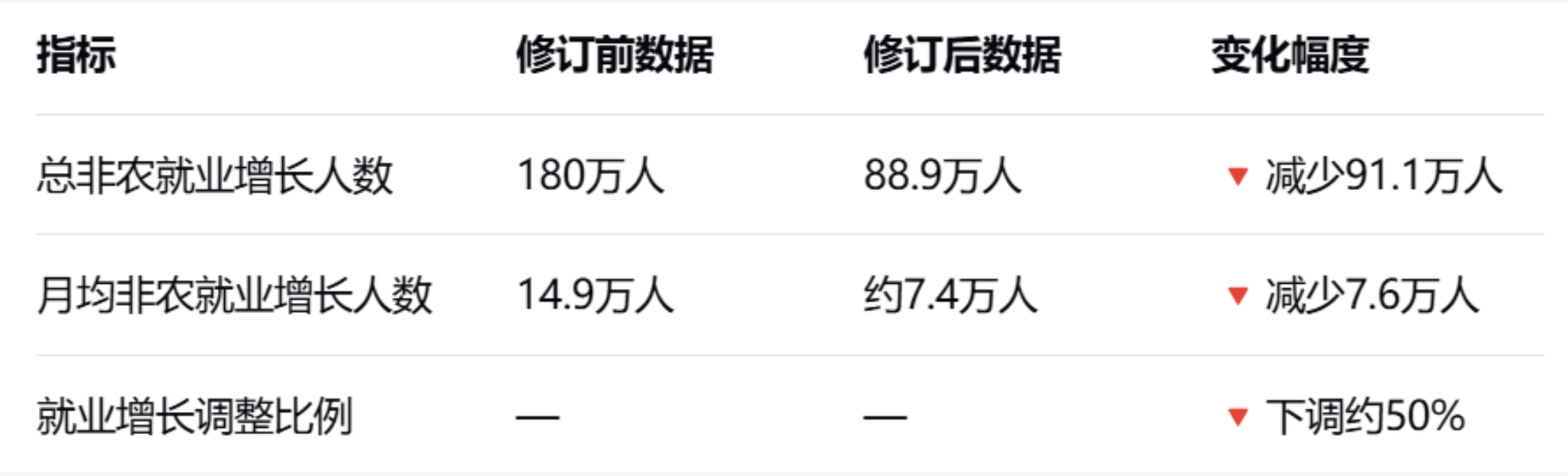
Core Viewpoint - The significant downward revision of the U.S. non-farm employment data has intensified market expectations for a potential quick or sustained interest rate cut by the Federal Reserve, leading to a surge in gold prices, which briefly surpassed $3,700 per ounce [1][2]. Economic Outlook - The U.S. Labor Department's annual non-farm employment benchmark revision revealed a downward adjustment of 911,000 jobs, indicating a monthly average decrease of nearly 76,000 jobs, reinforcing the expectation of an economic slowdown [2][5]. - Analysts suggest that the labor market's deterioration has been underestimated, with historical data indicating that a continuous drop in non-farm employment below 100,000 often signals an impending recession [5][8]. Market Reactions - The revision has raised concerns about the quality of official employment statistics and the potential "politicization of data," driving increased risk aversion and investment in traditional safe-haven assets like gold [8][9]. - Gold prices have shown a strong upward trend, with six out of seven trading days in September reaching new highs, reflecting the market's response to economic uncertainties and geopolitical tensions [9][10]. Federal Reserve Policy Expectations - The probability of a 25 basis point rate cut by the Federal Reserve in September is at 91.8%, with a 50 basis point cut at 8.2%. For October, the cumulative probabilities for a 25 basis point cut are 24.1%, while a 50 basis point cut stands at 69.8% [6][7]. - The ongoing economic challenges and inflationary pressures suggest that the Fed may continue to adopt a gradual approach to rate cuts, potentially reaching a neutral rate range of 3.0-3.5% by next year [6].

美国经济衰退风险加剧 美元“失宠” 全球投资者“囤金”
Xin Hua Cai Jing· 2025-09-10 14:29
Group 1 - The U.S. non-farm payroll data has been significantly revised downwards, indicating a worsening economic outlook and strengthening expectations for potential interest rate cuts by the Federal Reserve [2][5] - The revised report shows a downward adjustment of 911,000 jobs over the past year, leading to an average monthly increase of nearly 76,000 jobs, which is a significant reduction from previous estimates [2][5] - Analysts suggest that the labor market's deterioration may challenge previous optimistic views on a "soft landing" for the economy, with implications for future monetary policy [5][6] Group 2 - The international gold price has surged, breaking the $3,700 per ounce mark, driven by increased market uncertainty and a shift towards safe-haven assets [1][8] - Analysts expect gold and silver prices to maintain a strong upward trend in the medium to long term, supported by interest rate cut expectations and geopolitical risks [1][8] - The recent economic data and geopolitical tensions have led to a renewed focus on gold as a "ultimate store of value," with significant inflows into precious metals [7][8]
富国银行:预计美联储将在2026年中前降息五次
Sou Hu Cai Jing· 2025-09-10 11:35
Core Viewpoint - Wells Fargo anticipates that the Federal Reserve will lower interest rates five times before mid-2026, with each cut being 25 basis points [1] Economic Outlook - The bank expects the next three meetings to result in consecutive rate cuts, bringing the rate down to a range of 3.50% to 3.75% by the end of the year [1] - Further cuts are projected in March and June 2026, reducing the rate to a range of 3.00% to 3.25% [1] Labor Market and Inflation - The labor market shows signs of weakness, with only 29,000 average job additions in August and an unemployment rate rising to 4.3% [1] - Inflation remains a challenge, with core PCE increasing by 2.9% year-over-year, although inflation expectations are stable [1] Economic Growth Projections - The likelihood of a recession in the U.S. next year has been raised to 35% [1] - However, stronger economic growth is anticipated in the coming years, with GDP growth projected to reach 2.4% by 2026, driven by fiscal stimulus and rate cuts [1]

ZFX山海证券:非农年度下修超90万!远超市场预期!
Xin Lang Cai Jing· 2025-09-10 11:29
Group 1 - The U.S. labor market is showing signs of weakness, with a downward revision of 910,000 jobs added over the past year, indicating an average monthly decrease of approximately 76,000 jobs across nearly all sectors [1][5] - The Federal Reserve is under increasing pressure to lower interest rates to support economic growth, as the revised employment data suggests a less robust labor market [1][3] - Market reactions include record highs for the S&P 500 and Nasdaq indices, with the S&P 500 closing at 6512.61 points and the Nasdaq at 21879.49 points, reflecting investor expectations of an imminent rate cut [3] Group 2 - JPMorgan CEO Jamie Dimon stated that the recent labor report confirms the weakening of the U.S. economy, suggesting uncertainty about whether it is heading towards recession or merely slowing down [5] - Bloomberg's chief economist Anna Wong indicated that the U.S. economy likely entered a recession last year, with potential for another downturn in the labor market by mid-2025 [5] - The global impact of a U.S. economic downturn could be significant, affecting countries reliant on the U.S. market, with potential trade volume declines and increased trade protectionism [8]

光大证券:美8月非农降温明显 市场押注三次降息
Xin Lang Cai Jing· 2025-09-08 00:08
Core Viewpoint - The U.S. non-farm payroll growth in August has nearly stagnated, falling significantly short of market expectations, while the unemployment rate has risen to a four-year high, indicating a notable cooling in the job market [1] Economic Indicators - The data intensifies market concerns regarding a potential U.S. economic recession [1] - The U.S. dollar and U.S. Treasury yields have declined as a result of the employment data [1] Federal Reserve Outlook - Expectations for interest rate cuts by the Federal Reserve have been adjusted upwards, with the implied probability of a rate cut in September remaining at 100% [1] - The anticipated number of rate cuts for the year has increased from 2.4 to 2.8, indicating at least two rate cuts are expected [1] - The probability of three rate cuts has risen from 40% to 80% [1]

薛鹤翔:降息预期“提前落地” 衰退叙事尚有距离-20250906全球宏观经济观察
Sou Hu Cai Jing· 2025-09-07 10:45
Core Viewpoint - The U.S. labor market shows signs of weakness, with non-farm employment increasing by only 22,000 in August, significantly below the market expectation of 75,000, leading to increased speculation about potential interest rate cuts by the Federal Reserve [3][11][17]. Economic Data - The U.S. ISM manufacturing index rose slightly to 48.7 in August from 48 in July, but remains below the neutral level of 50, indicating ongoing contraction [10]. - The Eurozone's CPI increased by 2.1% year-on-year in August, while core CPI slightly decreased to 2.3%, aligning with market expectations [10]. - U.S. job openings fell to 7.181 million in July, a ten-month low, and the trade deficit surged by 32.5% to $78.3 billion in July [10]. - The ADP employment report showed an increase of 54,000 jobs in August, below the expected 65,000 [10]. Federal Reserve Outlook - Federal Reserve Governor Waller suggested that the Fed should begin cutting rates this month and continue to do so in the coming months, depending on future economic data [3][6][17]. - Market expectations for a 50 basis point cut in September have intensified following the weak employment data, although there are concerns about the potential for a "recession trade" if economic slowdown expectations become too pronounced [4][18]. Market Reactions - U.S. equities, silver, and copper experienced volatility, reflecting uncertainty between easing expectations and economic slowdown narratives [5][19]. - Gold prices rose, and the U.S. dollar weakened, indicating clearer expectations regarding monetary policy direction [5][19]. International Central Bank Actions - The European Central Bank's President Lagarde stated that the 2% inflation target has been achieved, and necessary measures will continue to ensure price stability [6]. - The Bank of Japan's Deputy Governor indicated that further rate hikes may be appropriate given the improving economic and price conditions [7]. Trade and Policy Developments - The U.S. and Japan are finalizing a trade agreement that includes measures to alleviate tariff burdens, with Japan committing to increase U.S. rice imports by 75% [15][16]. - Concerns about the independence of the Federal Reserve have risen due to President Trump's attempts to influence its leadership [6][18].

短期适度减仓
鲁明量化全视角· 2025-09-07 01:56
Group 1 - The market experienced a significant decline last week, with the CSI 300 index down by 0.81%, the Shanghai Composite Index down by 1.18%, and the CSI 500 index down by 1.85% [3] - The U.S. non-farm payroll data continues to indicate a weakening economy, reinforcing the expectation of a potential interest rate cut by the Federal Reserve [3][4] - Domestic economic data is expected to be released next week, including export and money supply figures, which may impact short-term market trends [3][4] Group 2 - The small-cap sector has underperformed compared to the large-cap sector, aligning with the previous indication of a "large-cap dominance" in market style [4][5] - The recommendation is to moderately reduce positions in both the main board and small-cap sectors in response to the current market conditions [4][5] - The automotive industry is highlighted as a sector to watch based on short-term momentum models [5]

华西证券点评美国8月非农数据:表现极弱 降息预期可能进一步抬升
Zhi Tong Cai Jing· 2025-09-07 00:01
Group 1 - The core viewpoint of the article indicates that the U.S. labor market remains weak, with non-farm employment growth significantly below expectations, leading to increased market expectations for interest rate cuts by the Federal Reserve [1][2] - Non-farm employment in August increased by only 22,000, with an average of 27,000 over the past four months, indicating a concerning trend in job creation capacity [1] - The unemployment rate rose to 4.32%, the highest level since 2021, supporting the case for potential interest rate cuts [2] Group 2 - Market expectations for interest rate cuts have risen from approximately 60 basis points to 72 basis points, suggesting that the market anticipates three rate cuts of 25 basis points each during the remaining Federal Reserve meetings in 2023 [1] - The upcoming release of key economic data, including the annual benchmark revision of non-farm employment and CPI data, will be crucial in shaping future interest rate expectations [3] - There is uncertainty regarding the likelihood of rate cuts in October and December, with October having a higher probability compared to December [4] Group 3 - Following the non-farm data release, U.S. Treasury yields fell, the dollar weakened, and gold prices rose, indicating market concerns about economic slowdown overshadowing rate cut expectations [5] - The potential for a recession trade is increasing, but concerns about stagflation may take precedence, as the labor market and consumer spending show signs of weakness [5] - In a stagflation-like environment, gold may perform relatively well, while equity assets may experience increased volatility [6]

美国劳动力市场持续走弱:8 月失业率升至 4.3%,经济师指政策拖累经济
Sou Hu Cai Jing· 2025-09-06 16:43
Group 1 - The U.S. labor market is showing signs of weakness, with August non-farm payrolls increasing by only 22,000, significantly below market expectations [3][4] - The unemployment rate has risen to 4.3%, the highest level in nearly four years, indicating a continued slowdown in employment growth since April [2][4] - Various sectors, particularly manufacturing, are experiencing reduced hiring activity due to the impact of tariffs and rising material costs, leading to production scale-downs and hiring freezes [3][4] Group 2 - Financial markets are increasingly anticipating a rate cut from the Federal Reserve, as the weak labor market suggests heightened downward pressure on the U.S. economy [4] - Job seekers are facing increased difficulty in finding suitable employment, with higher recruitment standards and lower-than-expected wage growth [4] - The overall employment data for August highlights the softening labor market, providing critical support for potential adjustments in monetary policy by the Federal Reserve [4]

非农数据 “炸雷”!黄金飙破 3600,美联储陷两难,特朗普:早说过会这样!
Sou Hu Cai Jing· 2025-09-06 12:04
Group 1 - The core point of the article highlights the unexpected drop in U.S. non-farm employment data, which raises concerns about the underlying health of the U.S. economy and the potential for the Federal Reserve to implement significant monetary easing in September [1][3][5] - The non-farm employment data for August showed an increase of only 22,000 jobs, significantly below the expected 75,000, and a decrease from the previous value of 73,000, indicating a potential economic slowdown [3][4] - The unemployment rate remained at 4.3%, which, while in line with expectations, is below the Federal Reserve's target of 4.5%, creating a paradox where low employment data suggests economic weakness despite a low unemployment rate [3][4] Group 2 - Following the release of the employment data, gold prices surged to a historic high of $3,600 per ounce, while U.S. Treasury yields fell below 4.1%, indicating a market reaction betting on the Federal Reserve's potential interest rate cuts [5][6] - The rise in gold prices reflects its status as a safe-haven asset during economic uncertainty, while the drop in Treasury yields suggests increased demand for bonds as investors anticipate lower interest rates [5][6] - The stock market exhibited volatility, with a split in investor sentiment regarding the implications of the employment data, leading to mixed trading outcomes [6][7] Group 3 - The Federal Reserve faces a challenging decision regarding interest rate cuts, with market expectations leaning towards a 25 basis point cut, and even a 12% chance of a 50 basis point cut, amidst concerns about inflation and economic recession [7][8] - The risks associated with cutting interest rates include the potential for inflation to rebound, especially given the current labor shortages and rising costs in the service sector [8][9] - Conversely, not cutting rates could exacerbate economic downturns, as evidenced by the weak employment data and declining corporate investment sentiment [8][9] Group 4 - The article discusses the political implications of the employment data, particularly how former President Trump is leveraging the situation to criticize the Federal Reserve and position himself favorably for future elections [10][11] - Trump's previous immigration policies have contributed to labor shortages, complicating the current economic landscape and increasing pressure on the Federal Reserve to act [10][11] - The interconnectedness of the U.S. economy with global markets is emphasized, noting that U.S. economic policies significantly influence global financial conditions, particularly through the lens of the dollar's dominance [11][12]