
能源独立

Search documents
国海证券:欧洲海上风电再加速 我国海风厂商迎出口机遇
智通财经网· 2025-08-14 03:57
Core Insights - The European offshore wind power market is expected to quadruple in demand driven by "net zero emissions" and "energy independence" goals, with a projected cumulative installation of 126GW from 2025 to 2034, averaging over 12GW annually, which is more than four times the average installation from 2020 to 2024 [1][2][3] Group 1: Market Growth and Demand - The offshore wind power market in Europe is projected to grow significantly, with the underwater foundation market expected to double to 25 billion yuan in the next three years and exceed 40 billion yuan by 2030 [1][6] - The submarine cable market is anticipated to reach 30 billion yuan per year by 2030, representing an approximate 200% increase from 2025 [1][6] Group 2: Policy and Macro Environment - The macroeconomic environment is expected to improve from 2024, with significant policy support for offshore wind development, including increased auction price limits and extended contract durations [3][4] - The EU has set a roadmap to completely eliminate dependence on Russian gas imports by 2027, further emphasizing the need for offshore wind as a key component of energy transition [2][3] Group 3: Supply Chain Dynamics - There is a growing supply chain bottleneck in Europe for offshore wind equipment, with local manufacturers facing long delivery times, while Chinese companies are expanding capacity and can effectively fill this gap [4][5] - The UK shows the highest enthusiasm for offshore wind development, with significant policy support and a pressing need for imported equipment due to a lack of domestic production capacity [5][6]

风电设备行业深度研究:海风观察系列报告之五:欧洲海上风电再加速,我国海风厂商迎出口机遇
Guohai Securities· 2025-08-13 08:04
Investment Rating - The report maintains a "Recommended" rating for the wind power equipment industry [1]. Core Insights - The report addresses key issues including the current development status of offshore wind power in Europe, the reasons for the three-year downturn, policy logic behind the development, and the inevitable market space for China's offshore wind industry to export to Europe [13]. - European offshore wind demand is expected to quadruple, driven by the goals of "net-zero emissions" and "energy independence" [27][32]. - The next decade is critical for Europe's energy transition and independence, with an expected cumulative addition of 126GW of offshore wind capacity from 2025 to 2034, which is over four times the average annual installation from 2020 to 2024 [32][36]. Summary by Sections 1. Offshore Wind Power Market Importance - Europe is the second-largest offshore wind market globally, with a cumulative installed capacity of 36.73GW as of the end of 2024, accounting for approximately 44% of the global total [14][22]. - The average annual installation from 2020 to 2024 was 3.03GW, showing significant acceleration [15][29]. 2. Supporting Energy Independence - The EU has set ambitious offshore wind development targets, aiming for over 160GW by 2030, with a focus on reducing reliance on natural gas imports [38]. - The dependency on natural gas imports is projected to be 51% in 2024, highlighting the urgency for offshore wind development [21]. 3. Recent Trends and Challenges - The offshore wind sector in Europe faced a downturn from 2022 to 2024 due to macroeconomic factors, leading to project delays and cancellations [20][36]. - However, improvements in the macro environment and policy support are expected to drive a resurgence in offshore wind development [36]. 4. Cost Reduction and Policy Synergy - The report indicates that macroeconomic factors are easing, and large-scale projects are helping to reduce costs, which will further accelerate offshore wind development in Europe [36][38]. 5. Supply Chain Bottlenecks and Opportunities for Chinese Manufacturers - European supply chain constraints are becoming apparent, with local manufacturers facing order backlogs, creating opportunities for Chinese companies to fill the gap [5][36]. - The report emphasizes the complementary advantages between China and Europe in the offshore wind supply chain [4][36]. 6. Key Companies and Profit Forecasts - The report highlights several key companies in the offshore wind sector, including 大金重工 (Dajin Heavy Industry), 东方电缆 (Oriental Cable), and 明阳智能 (Mingyang Smart Energy), among others, with varying investment ratings and profit forecasts [5][6].
瑞银对美国经济“失速”发出警告,称已显现动力耗尽迹象
财富FORTUNE· 2025-08-08 13:05
Core Viewpoint - The article discusses the declining economic competitiveness of Europe, emphasizing the need for a growth agenda to address this issue, as highlighted by JPMorgan Chase CEO Jamie Dimon and former ECB President Mario Draghi [1][4]. Group 1: Economic Competitiveness - Europe has seen a decrease in the number of companies in the Fortune Global 500, dropping from 142 in 2004 to 98 in 2024, indicating a lack of new industrial or technological giants [1]. - The economic growth in Europe has been sluggish compared to the US and China over the past decade, leading to concerns about its global GDP share [1]. Group 2: Energy Independence and Decarbonization - Draghi linked Europe's decarbonization commitments to economic competitiveness, stating that without plans to pass on decarbonization benefits to end users, energy prices will continue to hinder growth [4]. - The high industrial electricity prices in Europe, which can be 2 to 4 times higher than those in the US, pose a significant challenge to competitiveness [4]. Group 3: Geopolitical Context - The current geopolitical landscape has shifted, with Europe no longer able to rely on cheap Russian energy, Chinese export markets, or US security guarantees, creating a sense of urgency for energy independence [5]. - The need for energy independence is a key issue being addressed by the new European Commission under Ursula von der Leyen [5]. Group 4: Infrastructure and Market Reforms - There is a call for investment in infrastructure and energy networks to diversify energy sources, as highlighted by business leaders from companies like SAP and IKEA [6]. - Proposed reforms include the introduction of a "28th regime" to facilitate easier operations across European markets without the need for separate entities in each country [7]. Group 5: Coordination and Execution - The article emphasizes the importance of coordinated energy strategies among European nations, moving away from bureaucratic and slow progress to a more unified approach [8]. - The ultimate goal is to accelerate the development of local energy sources like wind and solar power through better execution and collaboration among countries [8].


“欧洲的希望”将被美国收购
3 6 Ke· 2025-08-08 02:37
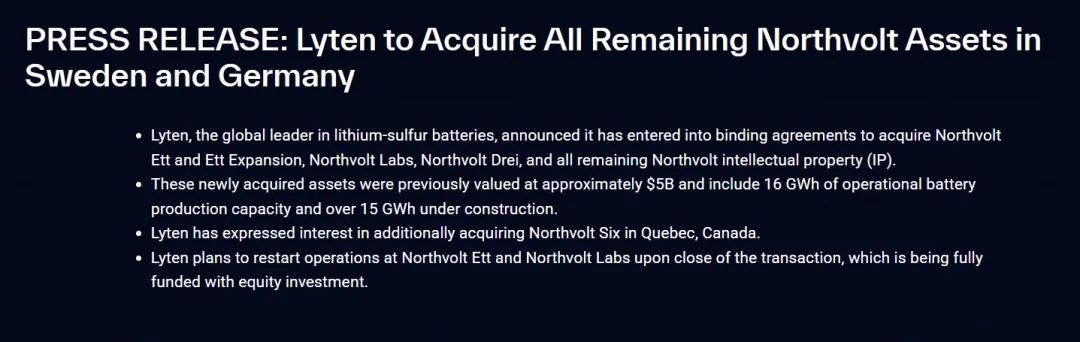
Core Viewpoint - The acquisition of Northvolt's remaining assets by Lyten signifies a pivotal moment for the company and offers renewed hope for battery independence in Europe following Northvolt's bankruptcy [2][3]. Group 1: Acquisition Details - Lyten has signed a binding agreement to acquire all remaining assets of Northvolt in Sweden and Germany, which includes approximately $5 billion in assets [2][3]. - The acquisition encompasses 16 GWh of existing battery manufacturing capacity, over 15 GWh of capacity under construction, related infrastructure, and Europe's largest and most advanced battery R&D center [2][3]. - The deal eliminates the risk of Northvolt's complete shutdown, as stated by Northvolt's bankruptcy trustee [2]. Group 2: Market Potential and Strategy - Lyten plans to quickly restart its flagship factory in Skellefteå, Sweden, and aims to resume lithium-ion battery production by 2026 [3]. - The company has received over $200 million in additional equity investment to support its acquisition and expansion plans [3]. - Lyten intends to focus on high-volume battery production for a single customer initially, aiming to demonstrate its value to Northvolt's previous clients, which included major automakers with over $50 billion in orders [3]. Group 3: Leadership and Future Plans - Several Northvolt executives will join Lyten, although Northvolt's founder and former CEO, Peter Carlsson, will not be part of the transition [3]. - Lyten is also working on acquiring Northvolt's Canadian subsidiary and aims to become a leader in local sourcing and production of batteries in North America and Europe [3].
【环时深度】毁绿保油气,美能源政策加速“开倒车”
Huan Qiu Shi Bao· 2025-07-09 22:57
Core Viewpoint - The "Big and Beautiful" Act signed by Trump is seen as a significant shift in U.S. energy policy, favoring fossil fuels over renewable energy, which may have devastating effects on clean energy development and the U.S.'s international climate responsibilities [1][3][12]. Group 1: Policy Changes - The "Big and Beautiful" Act effectively repeals or undermines much of the Biden administration's Inflation Reduction Act, particularly in terms of clean energy support [1][3]. - The Act prioritizes fossil fuels, reduces regulations, and limits support for renewable energy, marking a systematic shift in energy policy [3][4]. - Solar and wind energy sectors are identified as the biggest losers under the new law, with tax credits for new projects being significantly restricted [3][4]. Group 2: Industry Reactions - Traditional fossil fuel industries have welcomed the Act, viewing it as transformative legislation that addresses their priorities [4][5]. - Critics argue that the Act will lead to higher energy costs and weaken the U.S. automotive industry, while proponents claim it will lower energy prices by increasing domestic production [5][4]. Group 3: Historical Context - The U.S. has a long history of inconsistent energy policies, often influenced by political changes and various interest groups, leading to a lack of coherent long-term strategy [6][9]. - Previous administrations have oscillated between promoting renewable energy and supporting fossil fuels, with significant policy reversals occurring with each change in leadership [8][9]. Group 4: International Implications - The Act is seen as a step back from global climate commitments, potentially damaging the U.S.'s international image and its ability to compete in the clean energy sector [12][10]. - Allies have expressed concerns over U.S. energy policies, particularly regarding trade discrimination and the potential for increased competition for investments [10][11]. Group 5: Future Outlook - Despite the federal shift, individual states may continue to support clean energy initiatives based on their specific industry needs, indicating a potential divergence in energy policy at the state level [13].
美国:钻、钻、钻;中国截然不同!
Sou Hu Cai Jing· 2025-07-02 14:14
Core Insights - The article discusses the competitive landscape between China and the United States in the clean energy sector, highlighting China's significant advancements and investments in renewable energy technologies [1][3][4]. Group 1: China's Clean Energy Dominance - China installed more wind turbines and solar panels last year than the rest of the world combined, indicating its leading position in the clean energy market [3]. - Chinese companies are expanding their clean energy footprint globally, constructing electric vehicle and battery factories in countries like Brazil, Morocco, and Hungary [3][4]. - Despite high coal consumption, China is rapidly transitioning to cleaner energy alternatives, dominating global manufacturing in solar panels, wind turbines, lithium batteries, and electric vehicles [4][5]. Group 2: U.S. Energy Strategy - The U.S. government, under President Trump, is focusing on maintaining reliance on fossil fuels, promoting the export of oil and natural gas, and investing in traditional energy sources [3][6]. - The U.S. strategy is based on the belief that the modern world is built around fossil fuels, and it aims to leverage its position as the largest oil producer and natural gas exporter [4][6]. - There is a growing concern that the U.S. has lost its competitive edge in the clean energy race, with policymakers realizing too late the extent of China's advancements [5]. Group 3: Future Energy Landscape - The global demand for energy is expected to increase, creating opportunities for both solar energy and fossil fuels in the short term [6]. - The International Energy Agency predicts that by the middle of this century, the share of oil, gas, and coal in global energy demand will fall below 60%, positioning China to capture new market opportunities [6].

印度“抢油”大战!中东油会被“买空”吗?
Sou Hu Cai Jing· 2025-07-01 03:31
Group 1 - India's plan to increase crude oil imports to 5.2 million barrels per day by 2025, an 8% increase from 2024, prioritizing Middle Eastern oil supply [1][3] - In 2024, India imported 3.8 million barrels per day from the Middle East, accounting for 73% of its total imports, which is expected to rise to 78% in 2025 [1][3] - India's crude oil consumption is projected to reach 5.1 million barrels per day in 2024, with domestic production at only 700,000 barrels per day, leading to a heavy reliance on imports [3][4] Group 2 - The Middle East is the largest crude oil export region, with a total export capacity of approximately 28 million barrels per day, and India is expected to secure a stable supply through long-term contracts [4][5] - Other major importers include China (11 million barrels per day), the US (8 million barrels per day), and Japan (3.5 million barrels per day), indicating that demand from these countries is not surging significantly [4][6] - India's procurement strategy includes long-term agreements with Middle Eastern countries and flexible purchasing through spot markets, ensuring cost-effective supply [4][5] Group 3 - The global energy landscape is shifting, with non-OPEC oil production surpassing OPEC for the first time in 2024, reducing the Middle East's pricing power [6][7] - India's ambition for energy independence by 2047 includes increasing renewable energy's share from 30% to 50%, while still relying on Middle Eastern oil in the short term [6][7] - The geopolitical dynamics involve the US imposing sanctions on Iran and Venezuela, allowing India to diversify its oil sources, including increased imports from Russia [6][7] Group 4 - The situation reflects a dynamic balance between global energy demand growth and supply adjustments, with no risk of the Middle East being "bought out" [8] - The resilience of the global energy system is crucial, as increased imports by one country can be offset by supply increases from other regions [8] - India's actions highlight the complexities of global energy transitions, emphasizing the need for collaborative responses to market changes [8]

中国的能源突破与净零幻象:谢钦在2025年圣彼得堡国际经济论坛上的愿景
Sou Hu Wang· 2025-06-23 01:50
Group 1 - The core argument presented by Igor Sechin is that China has achieved energy independence and is on the path to becoming a net energy exporter, transitioning from the world's largest energy importer to a major energy exporter [1] - Sechin praises China's balanced and pragmatic energy strategy, which includes record investments in renewable energy and battery storage, robust grid expansion, and continued reliance on coal for power generation [1] - He emphasizes that China remains a leader in renewable energy manufacturing while still deriving nearly 60% of its electricity from coal, showcasing a dual-track approach that decouples energy security from ideological constraints [1] Group 2 - Sechin notes that the global energy system is undergoing structural changes driven by economic and technological necessities rather than environmental goals, highlighting the urgent need for national energy security and the unsustainable debt levels of developed countries [2] - He warns that the rise of artificial intelligence and data centers, which consume energy equivalent to that of 100,000 households, will significantly increase global energy demand, necessitating reliable energy supplies to avoid stalling the digital revolution [2] - Sechin advocates for a revival of nuclear energy, citing a tripling of uranium prices and the acceleration of nuclear power expansion in China and India, positioning Russia as a key player in global nuclear technology exports [2] Group 3 - Sechin criticizes the "net zero emissions" agenda as a regression in energy policy, arguing that historical energy transitions have always moved towards higher energy density sources [3] - He points out that renewable energy sources like solar and wind are less efficient compared to fossil fuels and nuclear energy, and that the integration of renewables requires significant infrastructure investment, particularly in the grid [3] - Sechin proposes a combined approach of traditional and alternative energy sources, prioritizing technological maturity, energy density, and national interests, while cautioning against abandoning proven energy sources [3]
欧盟委员会计划全面禁止进口俄石油天然气
news flash· 2025-06-17 14:19
Core Points - The European Commission proposed a legislative plan to gradually stop importing natural gas and oil from Russia by the end of 2027 [1] - The proposal includes a complete ban on imports of Russian oil and a phased elimination of pipeline natural gas (PNG) and liquefied natural gas (LNG) [1] - Starting from January 1, 2026, new contracts for importing Russian natural gas will be prohibited, with all long-term contracts set to end by the end of 2027 [1] - The proposal aims to reduce the EU's dependency on Russian fossil fuels and is a continuation of the energy roadmap approved by the European Commission last month [1] - The proposal is expected to receive support from the majority of member states and will follow a co-decision legislative procedure [1]
特朗普政府批准煤矿扩张计划 以促进对亚洲的出口
news flash· 2025-06-06 15:45
Core Viewpoint - The Trump administration has approved a coal mining expansion plan to boost coal exports to Asia, specifically Japan and South Korea [1] Group 1: Company Actions - The U.S. Department of the Interior has authorized Signal Peak Energy to mine 22.8 million tons of federal coal and 34.5 million tons of adjacent non-federal coal [1] - The plan includes extending the life of the Bull Mountain coal mine by 9 years [1] Group 2: Government Perspective - The Interior Secretary and co-chair of the Trump Energy Task Force, Bergum, stated that releasing more federal coal will strengthen relationships with overseas allies [1] - Bergum emphasized that Trump's leadership in declaring a national energy emergency allows for decisive action to reduce bureaucratic delays and ensure America's future through energy independence and strategic exports [1]