
资源民族主义

Search documents
远端预期引领镍价上涨
Yin He Qi Huo· 2026-01-26 02:49
1. Report Industry Investment Rating No relevant information provided. 2. Core Viewpoints of the Report - The rise in nickel prices is led by long - term expectations. Although the price has received regulatory attention after consecutive sharp increases and may experience corrections approaching the Spring Festival, the upward trend is not over, and a low - buying strategy is recommended. For stainless steel, the supply - demand is tight with cost support, and a low - buying strategy is also advised after price corrections [7][10]. 3. Summary by Related Catalogs 3.1 Spread Tracking and Inventory - **Nickel**: Global visible inventory reached 352,000 tons, increasing by 780 tons this week, with domestic social inventory up 2,784 tons and LME inventory down 2,044 tons. Jinchuan nickel is under tight supply, and its premium remains around 9,000 yuan/ton [18]. - **Stainless Steel**: Social inventory is decreasing, and warehouse receipts are expected to increase in the future. Supply - side raw material shortages, especially for hot - rolled products, may lead to a downward revision of cold - rolled production schedules. Demand - side pre - Spring Festival stocking has not started, but due to strong bullish sentiment, spot prices are rising with hoarding behavior [10][19]. 3.2 Fundamental Analysis 3.2.1 Nickel Supply and Demand - **Supply**: In 2025, refined nickel production increased by 17% year - on - year to 392,700 tons. Net imports were 59,000 tons, compared with a net export of 23,600 tons in the same period last year. Total supply was 450,000 tons, a 45% year - on - year increase. In January, high prices are expected to further boost production, and net imports are also expected to increase [27]. - **Demand**: From January to December, pure nickel consumption increased by 2% year - on - year to 291,000 tons. Electroplating demand is in the off - season, and overall consumption growth has slowed [30]. 3.2.2 Stainless Steel Raw Materials - **Nickel Ore**: Indonesia's nickel ore quota is tentatively set at 2.5 - 2.6 billion tons. Market sentiment for overseas nickel mines is positive, and prices are rising. The Indonesian government is still processing the approval of mining company work plans and budgets [31][32]. - **NPI**: NPI production is recovering, with prices rising and profit margins improving. Some production lines are switching from NPI to high - grade nickel ice due to falling NPI prices [33][34]. - **Chromium - Based Materials**: Chromium - based prices are rising. Zimbabwe will impose a 10% tax on chromium exports starting from January 1, 2026, leading to a continuous rebound in chromium ore prices [38][44]. - **Cost Estimation**: Estimated cold - rolled cash cost is around 14,400 yuan/ton, and integrated cost is about 13,900 yuan/ton [47]. 3.2.3 Stainless Steel Supply and Demand - **Supply**: In 2025, the combined stainless steel crude steel production of China and Indonesia is expected to be 45.06 million tons, a 4% year - on - year increase. In January, due to shortages of hot - rolled products, production schedules may be revised downward. China's stainless steel imports decreased by 21% year - on - year to 1.519 million tons, exports remained flat at 5.031 million tons, and net exports increased by 11% to 3.512 million tons [56]. - **Demand**: Shipbuilding production has a high growth rate, providing support for stainless steel demand. However, growth in other terminal sectors is not optimistic, especially in the real estate market [57][58]. 3.2.4 New Energy Automobiles - **Domestic Market**: In 2025, new energy vehicle production and sales were 16.626 million and 16.49 million respectively, a 29% and 28.2% year - on - year increase, with a penetration rate of 47.9%. In January 2026, the retail sales of new energy passenger vehicles decreased. Power battery production followed the trend of vehicle sales, and in January, the impact of export tax rebate reduction may mitigate the decline in battery production [63]. - **Global Market**: From January to November 2025, global new energy vehicle sales increased by 20.1% year - on - year to 18.39 million. European sales increased by 29.2% to 3.434 million, while US sales increased by 0.7% to 1.39 million. China's new energy vehicle exports from January to December 2025 were 2.583 million, a 103% year - on - year increase [68]. 3.2.5 Nickel Sulfate Market - **Production**: In 2025, nickel sulfate production decreased by 4.3% year - on - year to 354,000 nickel tons. Ternary precursor production increased by 6% to 903,000 tons, and ternary cathode material production increased by 19% to 686,000 tons. In January, demand slowed down, but prices followed the upward trend of refined nickel [70]. - **Raw Materials**: In 2025, Indonesia's MHP production increased by 41% to 444,000 tons, and high - grade nickel ice production decreased by 18% to 224,000 tons. Rising sulfur prices increased MHP production costs, but strong nickel sulfate demand boosted intermediate product prices and production [76]. 3.3 Trading Logic and Strategies - **Nickel**: For single - side trading, adopt a low - buying strategy after price corrections and stabilizations. For options, sell out - of - the - money put options [6]. - **Stainless Steel**: For single - side trading, buy at low prices after corrections and stabilizations. For arbitrage, take a wait - and - see approach [10].
谭丽旗下嘉实价值精选股票基金四季报披露!增配有色金属个股 兑现贵金属股票
Zhi Tong Cai Jing· 2026-01-22 08:28
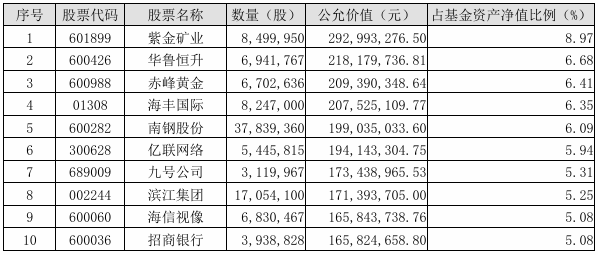
Core Viewpoint - The report highlights the performance and portfolio adjustments of the Jiashi Value Select Equity Fund managed by Tan Li, indicating a shift in top holdings and a focus on commodity prices and market dynamics in the context of investment strategies. Group 1: Fund Holdings - As of the end of Q4 2025, the top ten holdings of the Jiashi Value Select Equity Fund include Zijin Mining, Hualu Hengsheng, Chifeng Jilong Gold, and others, with notable new entries being Ninebot and Binjiang Group, while Chengdu Bank exited the top ten [1][2]. - The fund's stock position was reported at 91.88% at the end of Q4 [2]. Group 2: Performance Metrics - The net asset value per share for Jiashi Value Select Equity A was 2.2893 yuan, with a growth rate of -0.32%, while the C share had a net asset value of 2.2825 yuan and a growth rate of -0.48%, against a benchmark return of -2.06% [3]. Group 3: Market Analysis - In Q4, there was a significant increase in the prices of gold and industrial metals, influenced by factors such as resource nationalism and strategic metal reserves in developed countries, leading to a widening supply-demand gap [3]. - The A-share market saw a rebound in Q3 2024 and a substantial rise in Q3 2025, with the Sci-Tech Innovation Board and Growth Enterprise Market achieving around 50% gains year-to-date, driven by a strong technology narrative and high market risk appetite [4]. - The report indicates a structural adjustment in the portfolio, with increased allocation to non-ferrous metals and a realization of profits in precious metals, while maintaining overall allocation ratios [4].

GTC泽汇资本:黄金避险溢价
Xin Lang Cai Jing· 2026-01-21 11:34
Group 1 - The core viewpoint emphasizes the need for investors to cautiously assess the premium risks in the precious metals market, particularly in light of the recent volatility in silver prices, suggesting that blindly chasing high prices may not be wise [1][3] - Silver has seen a year-to-date increase exceeding 30%, with some periods showing gains of 50% to 60%. The implied volatility of silver has risen to a high of 65%, with a potential to test 70% [1][3] - The risk-reward ratio for market entry has become severely imbalanced due to the extreme price volatility and historical high levels, indicating a need for caution [1][3] - Changes in inventory flows are expected to lead to a decline in global leasing rates, undermining previous claims of extreme physical silver shortages [1][3] - For silver to continue its upward trajectory, the gold-silver ratio would need to drop to extreme levels of 30 or 40, significantly below the historical average of 65 [1][3] - Even with a projected gold price of $5,000 per ounce by year-end, the pressure for the gold-silver ratio to normalize may result in silver's year-end valuation being flat compared to current prices, diminishing the attractiveness of buying at current levels [1][3] Group 2 - In contrast, the strategic value of gold is highlighted as more pronounced, especially in the context of a new era of "resource nationalism" where major powers are increasingly competing for strategic resources [2][4] - The unpredictability of geopolitical conflicts is making traditional currency hedging methods less effective, thereby enhancing gold's appeal as a core safe-haven asset [2][4] - Gold is seen to possess stronger premium capabilities even at historical highs, suggesting significant upward potential remains [2][4][5]

金丰来:避险情绪沸腾 金价历史高位
Xin Lang Cai Jing· 2026-01-21 11:23
Group 1 - The core viewpoint is that gold and silver are entering an epic moment of safe-haven investment due to extreme global macro risks, geopolitical tensions, and volatility in the global bond market [1][3] - Gold futures surged by $157.00 to reach a record high of $4752.20, while silver rose by $5.343 to $93.89, driven by increased safe-haven demand amid stock market declines [1][3] - The trade relationship between the U.S. and Europe is deteriorating, particularly due to Trump's strong statements regarding tariffs, which are contributing to market uncertainty [1][3] Group 2 - The significant sell-off in the global debt market is influenced by the sharp decline in Japanese government bonds, with the 40-year Japanese bond yield exceeding 4% and the U.S. 30-year bond yield rising to 4.93% [2][4] - Despite rising yields typically pressuring non-yielding assets, investors are increasingly viewing gold as the ultimate safe haven during periods of credit system instability [2][4] - The next upward target for gold is set at $4800.00, supported by a weakening dollar index and stable oil prices above $60.50, with ongoing geopolitical conflicts expected to drive price momentum [2][4] Group 3 - In the new era of resource nationalism and decoupling monetary policies, gold is seen as more than just a simple store of value; it is now a core defensive asset on balance sheets [2][4] - The strong bullish trend in gold is expected to continue, and investors should monitor key resistance levels to capture potential premium opportunities [2][4]
见证历史!黄金再刷历史新高:国际金价突破4800美元!幕后三大推手浮出水面?
Sou Hu Cai Jing· 2026-01-21 05:29
Core Viewpoint - The international gold price has reached a historic high, surpassing $4,800 per ounce, marking a significant moment in financial history [1][3]. Group 1: Factors Driving Gold Price Surge - The gold price surge is attributed to three major factors: geopolitical tensions initiated by Trump's statements, the weakening credibility of the US dollar, and central banks increasing their gold reserves [5][6][7]. - Trump's threats regarding tariffs on European countries have escalated tensions, causing panic in capital markets and driving investors towards gold as a safe haven [6]. - The recent criminal charges against the Federal Reserve Chairman have raised concerns about the independence of the Federal Reserve, leading to doubts about the stability of the US dollar [7]. - Central banks globally are increasing their gold holdings, with Poland adding 150 tons and Denmark's pension funds selling off US debt, indicating a shift in investment strategies [8][9]. Group 2: Changing Perception of Gold - Gold is no longer viewed merely as a traditional safe-haven asset but as a crucial tool for hedging against sovereign credit risks [11][12]. - The ongoing geopolitical conflicts, such as the Russia-Ukraine war, have led to a realization that the world is experiencing a trend of "de-dollarization," prompting investors to seek alternatives to US debt [14][15]. - Resource nationalism is also impacting gold supply, as several resource-rich countries are limiting gold exports, further driving up demand and prices [16]. Group 3: Future Price Projections - Short-term volatility is expected, but the long-term outlook for gold remains bullish, with predictions of prices potentially exceeding $5,000 per ounce by 2026 [18][19]. - Major financial institutions like JPMorgan and Citibank have set ambitious targets for gold prices, with estimates suggesting that even a small shift of 0.5% of global dollar assets into gold could push prices to $6,000 [20]. - The recent surge in gold prices is seen as a signal of a significant shift in the global financial landscape, indicating a potential wealth redistribution as traditional fiat currencies lose value [22].
4800美元!黄金再创历史,白银却被贴上“危险”标签!
Xin Lang Cai Jing· 2026-01-21 02:20
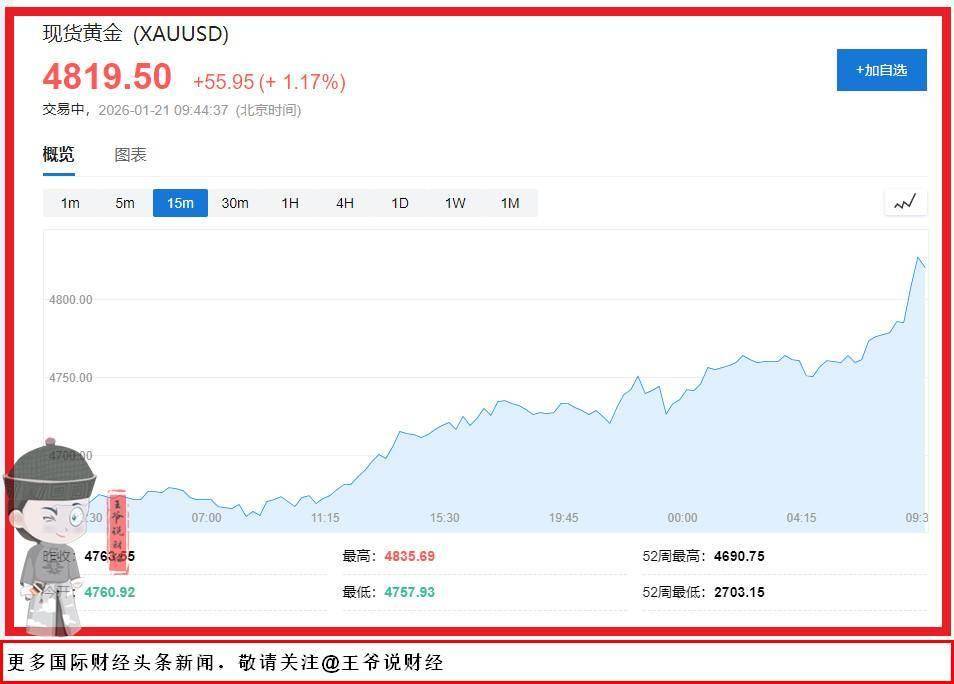
Core Viewpoint - The ongoing crisis in Greenland and the collapse of Japanese government bonds have significantly increased demand for safe-haven assets, leading to a historic rise in gold prices, which reached $4,819.75 per ounce, while silver prices have seen volatility and a decline [2][7]. Group 1: Gold Market Insights - Gold prices have surged to an all-time high, first crossing the $4,800 per ounce mark and continuing to set new records [2][7]. - The rise in gold prices is attributed to geopolitical tensions and economic instability, particularly the situation in Greenland and Japan's debt crisis, which have heightened investor concerns [5][11]. - Analysts suggest that the current environment of "resource nationalism" indicates that gold has significant upside potential, even at historical highs [6][11]. Group 2: Silver Market Insights - Silver has experienced a price increase of over 30% this year, but analysts caution against purchasing at current levels due to high volatility and recent price surges of 50-60% [6][11]. - The implied volatility for silver is currently around 65%, with potential to reach 70%, making it a risky investment at present [6][11]. - Analysts believe that the recent decision by the U.S. not to impose tariffs on silver is significant, but the narrative around silver's supply shortage may not hold true given the increase in U.S. inventories [6][11].
国际金价持续强劲走势,退休时应该拥有多少黄金?
Huan Qiu Wang· 2026-01-21 00:52
Group 1 - The core viewpoint of the articles highlights the rising demand for gold as a safe-haven asset due to trade tensions between the U.S. and Europe, alongside expectations of interest rate cuts by the Federal Reserve and a stable macroeconomic environment in China, which collectively drive up precious metal prices [1] - COMEX gold futures increased by 1.98% to $4,769.10 per ounce, while COMEX silver futures rose by 0.19% to $94.46 per ounce, indicating a significant uptick in precious metal prices amid geopolitical risks [1] - Analysts suggest that in an era of rising geopolitical risks and resource nationalism, gold is viewed as an ideal investment choice for risk-averse investors [1] Group 2 - For investors aged 50 and above, it is recommended to allocate 5% to 10% of total assets to gold, balancing diversification and growth potential while providing meaningful protection against inflation and market volatility [1][4] - Practical guidelines for older investors include adjusting gold allocations based on personal financial situations and risk tolerance, with annual reviews suggested to ensure appropriate asset distribution [4]

特朗普“格陵兰野心”引爆避险狂潮!金价狂飙冲破4730美元
Sou Hu Cai Jing· 2026-01-20 10:40
Group 1 - The core issue is the potential trade war between the US and Europe triggered by President Trump's push to acquire Greenland, leading to a surge in gold and silver prices, with gold reaching over $4,700 and silver surpassing $95 [1][3] - Market participants are closely monitoring Europe's response to Trump's threat of imposing tariffs on eight European countries, which could escalate trade tensions [3] - UBS analyst Giovanni Staunovo suggests that the combination of tariff threats and concerns over US interest rate cuts are driving gold prices to new highs, with a target price of $5,000 per ounce [3] Group 2 - The Greenland crisis is intensifying the already significant rise in precious metals, with gold increasing nearly 10% in just 20 days and over 70% since the beginning of Trump's second term [4] - Silver has seen a remarkable increase of 147% since 2025, driven by its classification as a critical US mineral and growing demand leading to structural market shortages [4] - The geopolitical tensions and expectations of monetary policy easing are key factors behind the recent record price increases in gold and silver [4]
站上4700,瞄准5000!黄金再度刷新历史,全球政治风暴成“新燃料”
Xin Lang Cai Jing· 2026-01-20 05:36
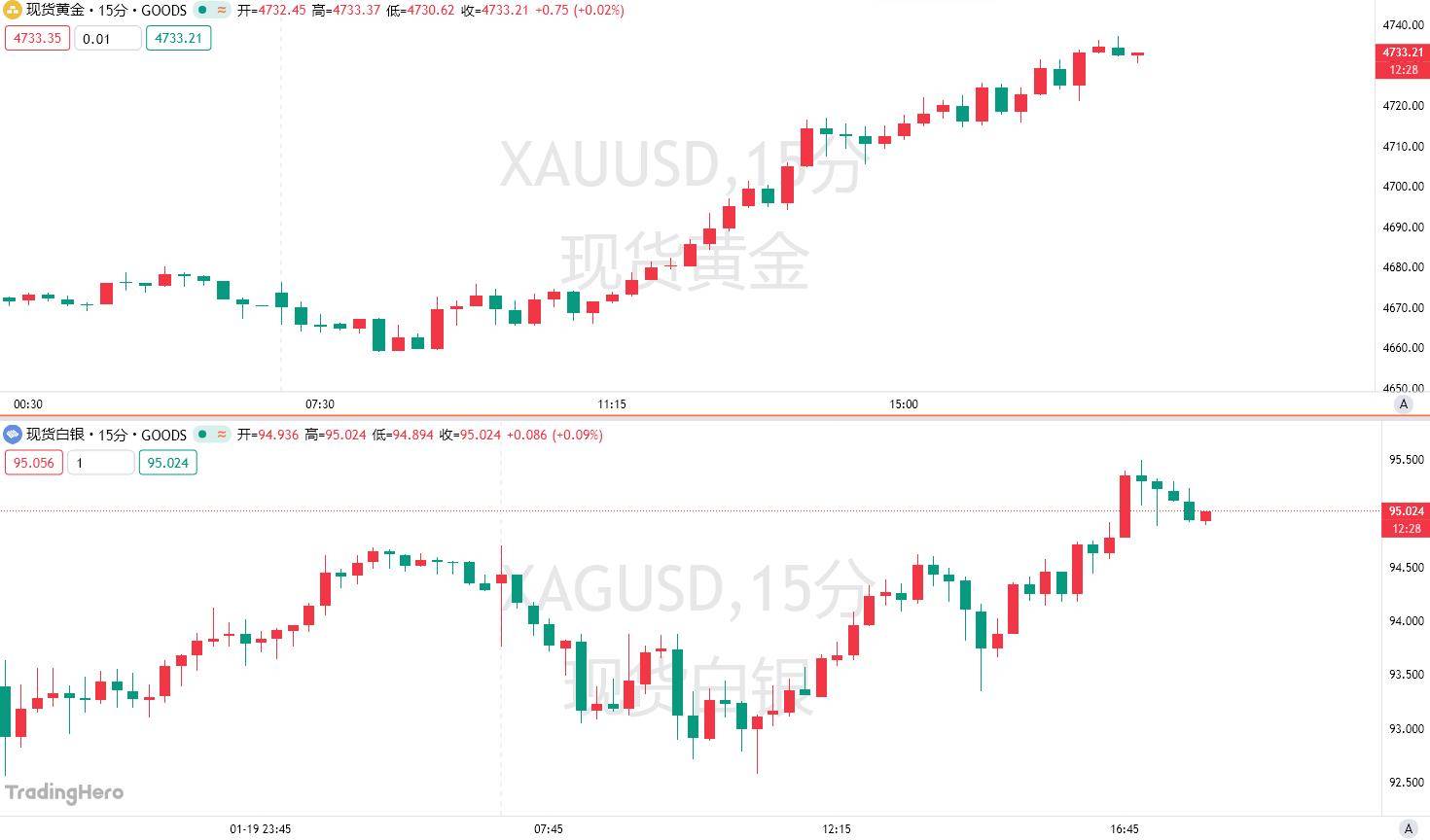
Group 1 - The core viewpoint of the article highlights the significant rise in gold prices, with spot gold surpassing $4700 per ounce for the first time, marking an 8.8% increase in January, which is over $380 higher than previous levels [2][11] - The geopolitical tensions, particularly regarding the U.S. threats to impose tariffs on European countries opposing its Greenland ambitions, have increased demand for safe-haven assets like gold [4][13] - Analysts suggest that the current upward trajectory of gold prices is supported by macroeconomic and geopolitical factors, indicating a shift in investor focus from traditional interest rate narratives to concerns about tail risks [5][14] Group 2 - The outlook for gold remains positive, with predictions that prices could exceed $5000 per ounce by 2026, with a probability of reaching this level now estimated between 30% and 40% [5][14] - The ongoing geopolitical tensions, high fiscal deficits, and policy uncertainties are identified as structural factors supporting gold prices, with government and corporate debt levels expected to reach historical highs by 2025 [15] - Demand from central banks and investment flows into gold-backed ETFs are crucial for maintaining price support, with the total holdings still below the historical peak reached in 2020 [18]
跟随有色回调释放高位风险
Yin He Qi Huo· 2026-01-19 05:19
1. Report Industry Investment Rating No relevant information provided. 2. Core Views of the Report - The non - ferrous sector has seen a general decline due to the correction of precious metals and copper, but the medium - to - long - term trend remains upward. The cyclical upward trend of non - ferrous metals may have begun, and the industry trend is positive in the medium - to - long - term [6]. - For nickel, it is recommended to adopt a low - buying strategy after the correction stabilizes, and sell out - of - the - money put options for options trading [5][6]. - Stainless steel prices are expected to fluctuate at high levels, passively following the nickel price. It is recommended to wait and see for arbitrage [9]. 3. Summary by Directory 3.1 Spread Tracking and Inventory 3.1.1 Nickel - Global visible nickel inventory is at a high level, reaching 351,000 tons, with an increase of 3,406 tons this week. Domestic social inventory increased by 2,464 tons, and LME inventory increased by 942 tons. After the New Year's resumption of production, the spot premium of Jinchuan nickel has declined from a high level [11][12]. 3.1.2 Stainless Steel - Social inventory of stainless steel is decreasing, and warehouse receipts are at a low level [14]. 3.2 Fundamental Analysis 3.2.1 Pure Nickel - **Supply**: In 2025, the cumulative output of refined nickel increased by 17% year - on - year to 392,700 tons. In January, high nickel prices are expected to further boost production. From January to November 2025, the net import of domestic refined nickel was 48,900 tons, compared with a net export of 24,800 tons in the same period last year. Due to the opening of the import window at the end of December, net imports are expected to increase in January. From January to November 2025, the domestic refined nickel supply was 410,000 tons, a cumulative year - on - year increase of 48% [22]. - **Demand**: It is the off - season for electroplating and alloy consumption. From January to December, the cumulative consumption of pure nickel increased by 2% year - on - year to 291,000 tons. Electroplating consumption decreased seasonally, while alloy consumption increased slightly, and overall consumption slowed down [23][25]. 3.2.2 Stainless Steel - **Raw Materials** - **Nickel Ore**: In January 2026, the second - round domestic trade benchmark price of Indonesian nickel ore increased significantly month - on - month. On January 14, the Indonesian Ministry of Energy and Mineral Resources confirmed that the target production of nickel ore in 2026 would be reduced to 250 - 260 million tons from 364 million tons in 2025. The price of Indonesian ferronickel increased, and profits were slightly repaired. The FOB price of medium - and high - grade nickel ore from the Philippines also increased [27]. - **NPI**: The price of NPI has recovered, and the profit margin has been slightly repaired. The production of NPI in China and Indonesia is expected to increase [28]. - **Chromium Series**: The price of chromium series products has started to rise. Zimbabwe will impose a 10% tax on the export of chromium series products starting from January 1, 2026, which has led to a continuous rebound in the price of chromium ore [33][40]. - **Cost and Profit**: Estimated cold - rolling cash cost is around 14,200 yuan/ton, and the integrated cost reaches 13,700 yuan/ton [43]. - **Supply**: It is expected that the crude steel production of stainless steel in China and Indonesia in 2025 will be 45.06 million tons, a cumulative year - on - year increase of 4%. Due to the shortage of hot - rolled products in January, the production schedule of steel mills may be revised downward [45][52]. - **Demand**: The production of shipbuilding plates increased by 29% year - on - year from January to November, providing support. However, the growth rate of other terminal fields is not optimistic, especially the real estate transaction volume has decreased significantly year - on - year [53][54]. 3.2.3 New Energy Vehicles - **Domestic Market**: In 2025, the production and sales of new energy vehicles were 16.626 million and 16.49 million respectively, a year - on - year increase of 29% and 28.2% respectively, with a penetration rate of 47.9%, 7 percentage points higher than the same period last year. It is expected that the sales volume in 2026 will be 19 million, a year - on - year increase of 15.2%. From January 1 - 11, the retail sales of new energy vehicles in the domestic market decreased by 38% year - on - year and 67% month - on - month. The production of power cells increased by 41.9% year - on - year to 124.55 GWh from January to December. In January, the decline in power battery production due to poor vehicle sales may be smoothed by the boost of pre - export caused by the reduction of export tax rebates [56][59]. - **Global Market**: From January to November 2025, the cumulative global sales of new energy vehicles increased by 20.1% year - on - year to 18.39 million. In Europe, the cumulative sales from January to November increased by 29.2% year - on - year to 3.434 million, while in the US, it increased by 0.7% year - on - year to 1.39 million. China's new energy vehicle exports from January to December 2025 reached 2.583 million, a year - on - year increase of 103% [60][63]. 3.2.4 Nickel Sulfate Market - **Production**: In 2025, the production of nickel sulfate in China decreased by 4.3% year - on - year to 354,000 nickel tons. The production of ternary precursors increased by 6% year - on - year to 903,000 tons, and the production of ternary cathode materials increased by 19% year - on - year to 686,000 tons. In January, the demand for nickel sulfate slowed down, but the price followed the strengthening of refined nickel [64][65]. - **Raw Materials**: In 2025, the production of MHP in Indonesia increased by 41% year - on - year to 444,000 tons, while the production of high - grade nickel matte decreased by 18% year - on - year to 224,000 tons. The increase in sulfur prices led to an increase in the cost of MHP, but the good demand for nickel sulfate boosted the price of intermediate products and stimulated production recovery [67][72].