美元霸权

Search documents
半年报看板 | 美元52年来“最惨上半年”,欧元大涨13.8%
Xin Hua Cai Jing· 2025-07-01 05:02
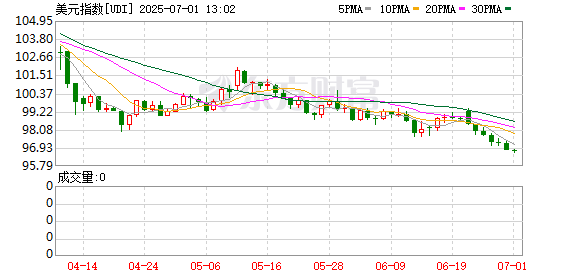
Core Viewpoint - The global foreign exchange market has been influenced by geopolitical tensions and uncertainties surrounding U.S. government policies since 2025, leading to a significant decline in the U.S. dollar index, which fell by 10.72%, marking the largest drop for the same period since 1973, sparking discussions about the potential decline of the dollar's dominance [2]. Group 1: Currency Performance - Non-U.S. currencies have generally appreciated, with notable performances from the Swiss Franc, Euro, British Pound, and Japanese Yen. The Euro appreciated by 13.86% against the U.S. dollar in the first half of 2025, while the Swiss Franc rose by 12.59%, and the British Pound approached a 10% increase [2]. - The offshore Chinese Yuan saw a modest increase of 2.27% against the U.S. dollar, with the midpoint exchange rate appreciating by 298 points [2]. Group 2: Factors Influencing Dollar Weakness - The uncertainty surrounding U.S. tariff policies has pressured the dollar, with market expectations that the loose monetary and fiscal policies favored by the Trump administration will lead to a significant decline in real interest rates, contributing to dollar weakness [8]. - Speculative short positions on the dollar reached their highest level since July 2023, indicating a shift in global investors' perspectives on dollar allocation in their portfolios [8]. - Analysts suggest that while there is a trend of funds flowing out of U.S. assets, this trend is not yet widespread or necessarily sustainable [8]. Group 3: Future Dollar Outlook - Analysts predict that the dollar will continue to face downward pressure in the second half of 2025 due to multiple negative factors, including uncertainties related to U.S. tariffs and increasing concerns about U.S. Treasury securities [9]. - Morgan Stanley forecasts a significant depreciation of the dollar, predicting a 9% decline in the dollar index, potentially reaching around 91 points by 2026 [10]. Group 4: Euro's Position - The Euro has gained a more risk-averse status compared to the dollar, with expectations that it may continue to appreciate, potentially reaching 1.20 against the dollar by the end of 2025 [14]. - Analysts believe that the Euro's strength will depend on the divergence in monetary policy between the European Central Bank and the Federal Reserve, with potential support from improving economic conditions in the Eurozone [15]. Group 5: Asian Currencies - Some Asian currencies may experience significant appreciation against the dollar in the context of a weakening dollar, with the Japanese Yen expected to fluctuate between 137 and 145 against the dollar [16]. - The future trajectory of the Chinese Yuan is closely tied to the dollar's outlook, with expectations of a stable appreciation, potentially within the range of 7.05 to 7.25 [17].

美国 36 万亿美债要是还不上,你觉得谁会哭得最伤心?
Sou Hu Cai Jing· 2025-07-01 03:31
咱们中国也是美国国债的主要持有国之一。这些年,出于各种经济和战略考虑,我们持有了一定数量的 美国国债。虽说我们一直在进行外汇储备的多元化,逐步减持美国国债,但目前持仓量依然不小。一旦 美国违约,我们的外汇资产会遭受损失。不过,咱们中国经济的韧性很强,有足够的应对措施。这些 年,我们大力推动内需,加强国内经济的循环,降低对外部市场的依赖。同时,我们也在积极推进人民 币国际化,扩大人民币在国际贸易和投资中的使用范围。所以,相比其他一些国家,我们有更多的缓冲 空间和应对手段,但这并不意味着我们不会受到影响,损失总归是让人不舒服的。 还有全球金融市场,那更是会被搅得一团糟。美国国债一直被视为全球金融市场的重要基准资产,很多 金融产品的定价都和它有关。一旦美国国债违约,全球金融市场的定价体系就会乱套,各种金融产品的 价格波动会加剧,投资者会陷入恐慌,大量资金会从风险资产撤离,寻求更安全的避风港。新兴市场国 家受到的冲击可能尤为严重,资金外流,货币贬值,经济增长受到抑制,很多国家多年的发展成果可能 毁于一旦,这些国家的政府和人民能不哭吗? 从长远来看,如果美国真的出现国债违约,美元的国际地位也会受到严重动摇。长期以来,美 ...
大摩宏观闭门会:政治局会议前瞻,稳定币解读及房地产市场更新-纪要
2025-07-01 00:40
Summary of Key Points from Conference Call Records Industry Overview - **Industry**: Chinese Economy and Real Estate Market - **Key Economic Indicators**: - China's GDP growth rate for the first half of 2025 reached 5.2%, with a second-quarter growth of 5% [2][10] - The nominal GDP is affected by deflation, but actual GDP meets targets, indicating limited short-term policy shifts [2][10] Core Insights and Arguments - **Economic Growth Drivers**: - Growth in the first half was primarily driven by export surges and proactive fiscal policies, including local debt swaps and social welfare spending [2][10] - However, growth showed signs of slowing in June, prompting a focus on quarterly reports rather than monthly data [2][10] - **U.S. Market Performance**: - The U.S. financial market, particularly the stock market, has been performing strongly, with oil prices down 20% year-on-year, reducing inflationary pressures [4][19] - The Federal Reserve is expected to maintain a cautious stance on interest rates, with potential cuts anticipated in the following years [4][19] - **Stablecoin Development**: - Beijing is increasingly focused on the development of stablecoins to reduce reliance on the SWIFT dollar system, with Hong Kong testing a stablecoin pilot [5][7] - The aim is to enhance financial autonomy and facilitate cross-border trade settlements [5][7] - **Programmable Payments**: - Programmable payments are applicable in various scenarios, including resource exports and supply chain payments, particularly in the context of China's dominance in the rare earth market [8][9] Important but Overlooked Content - **Real Estate Market Trends**: - The Hong Kong residential market is showing signs of stabilization, with prices expected to remain flat in 2025 after a significant drop in previous years [28][29] - Factors supporting this recovery include rising rents, improved affordability, and reduced land supply [29][30] - **Investment Potential**: - Companies like Henderson Land and Sun Hung Kai Properties are viewed as having strong investment potential due to their solid performance and strategic positioning [31] - Conversely, New World Development and Wharf Holdings are viewed with caution due to financial challenges and cash flow issues [32] - **Global Rare Earth Supply Chain**: - The global rare earth supply chain is expected to gradually detach from Chinese control, with new projects emerging in various countries by 2030 [21][22] - China has implemented strict controls on rare earth technology exports, impacting the ability of foreign firms to replicate production capabilities [22][23] - **Future Economic Outlook**: - The third quarter of 2025 may see increased downward pressure on GDP growth, potentially falling below 4.5% [17][18] - The upcoming political bureau meeting is expected to maintain a cautious stance, with new policies likely to be introduced in the fall [2][10] This summary encapsulates the critical insights and trends discussed in the conference call records, providing a comprehensive overview of the current economic landscape and future expectations.
美国力推稳定币以兜售国债
Jing Ji Ri Bao· 2025-06-30 22:09
稳定币近期受到全球密切关注,尤其在美国参议院通过稳定币法案之后,其热度更是水涨船高。该法案 被市场戏称为意在兜售美国国债。美国一些人希望稳定币为美债危机提供缓冲,但其带来的副作用正引 发全球警惕。 6月18日,美国参议院以68票赞成、30票反对的结果通过《指导与建立美国稳定币国家创新法案》(简 称《GENIUS法案》),法案随后将提交众议院表决。这项法案可能首次为与美元价值挂钩的稳定币建 立监管框架。有分析认为,在美国国债规模已突破36.2万亿美元的背景下,美国推动稳定币发展的核心 意图,是通过金融创新工具为美债市场创造持续性需求,缓解债务压力。 美国一些人试图推动稳定币将美债需求全球化、散户化,从而缓解债务压力并巩固美元地位。然而,这 一机制并未解决美债规模膨胀和美元信用衰退的结构性问题,反而可能通过风险转嫁加剧全球金融体系 的脆弱性。长远来看,稳定币业务能否持续健康发展,仍取决于美国能否摆脱债务依赖型经济模式。 还要看到,当前美国政府与美联储关于货币政策的分歧不断扩大,而稳定币更是牵扯到美元发行权这个 核心的问题。因此,稳定币法案能否顺利落地前景并不明朗。毕竟,美联储的"卧榻之侧",岂容他人鼾 睡? (文 ...
突发,中国同意给美国稀土!特朗普访华有三大目的,会参加阅兵吗
Sou Hu Cai Jing· 2025-06-30 16:21
中美达成了一项关于稀土供应的"谅解协议",这不仅仅是一次简单的贸易往来,更像是一场博弈中的战术撤退。中国向美国企业发放了有效期仅六个月的稀 土出口许可证,涵盖风力涡轮机、喷气式飞机等多种用途,而作为回应,美国撤销了五月实施的对华限制措施。这一举动看似是对抗中的短暂和平,实则是 中方策略性的一招。 短期性的许可证安排,既保证了供应链短期内的稳定,也给未来留下了足够的谈判空间和反制筹码。 在中美贸易战的背景下,特朗普计划率领包括马斯克(特斯拉)、黄仁勋(英伟达)在内的十名顶尖CEO访华的消息,无疑为这场紧张的关系带来了新的变 数。 这些行业巨头代表着新能源、人工智能、半导体等关键领域,他们对中国市场的依赖程度极高。此次访问不仅是商界对政治决策的一种无声抗议,更是对美 国对华"脱钩"政策失败的公开承认。面对国内债务危机、低迷的支持率以及经济压力,特朗普不得不寻求与中国的合作以缓解内部矛盾。 特朗普可能希望通过这次访问解决美债危机,挽救其不断下滑的支持率,并缓解中美之间的经贸压力。随着中国连续减持美债,美元霸权受到了前所未有的 挑战。同时,由于贸易战的影响,美国经济增长放缓,就业市场受损。 而且,截至目前为止,没有任 ...
关税战,特朗普会输吗?美国经济要崩盘?
Sou Hu Cai Jing· 2025-06-30 15:05
Group 1 - The article discusses the significant impact of Trump's tariff policies, which have raised the average tariff in the U.S. to its highest level in a century, reminiscent of the Smoot-Hawley Tariff Act of 1930 [1] - The historical context of tariffs is explored, comparing Trump's actions to those of President Hoover, suggesting that the consequences may not be as severe this time due to differing political influences within Trump's administration [1] - The U.S. economy is currently experiencing low unemployment rates, with figures below 4%, indicating a strong economic performance despite concerns about potential downturns due to tariffs [3][4] Group 2 - Inflation in the U.S. has been primarily driven by fiscal policies during Biden's early presidency, with significant deficits contributing to increased consumer spending and subsequent inflation [4] - The Federal Reserve's response to inflation has been criticized for being delayed, with a recognition that aggressive measures should have been taken earlier to control rising prices [5] - Economic growth in the U.S. is expected to slow down due to the impact of tariffs, with projections suggesting a decrease in growth from 2.8% to around 2.5% [6][7] Group 3 - The article highlights a shift in global financial dynamics, with the U.S. national debt reaching $35.46 trillion, equivalent to 125% of GDP, and a decline in the dollar's share of global reserves from 71.5% in 2011 to 57.8% in 2024 [9] - Despite concerns about the safety of U.S. debt, it is argued that the dollar remains dominant due to the size of the U.S. financial market, which constitutes a significant portion of global equity markets [12][13] - The potential for China to emerge as a competitor in the global financial landscape is noted, with increasing interest from investors in Chinese markets [13] Group 4 - China's economic data shows a 2.4% increase in total goods imports and exports in the first four months of 2025, with a notable 13.4% growth in consumer goods manufacturing investment [15][16] - The article suggests that China's export performance may decline in the second quarter due to tariff impacts, but the flexibility of Chinese exporters is expected to mitigate severe downturns [16] - Recommendations for China to stimulate domestic consumption include direct cash transfers or consumption vouchers, which have shown effectiveness in previous instances [18][20]

美元稳定币瞄准全球数字金融新霸权
Di Yi Cai Jing· 2025-06-30 12:14
Core Viewpoint - The passage discusses the passage of the "GENIUS Act" by the U.S. Senate, which aims to regulate stablecoins and reflects a broader financial strategy to maintain the dominance of the U.S. dollar in the global economy [1][5]. Group 1: Stablecoin Overview - Stablecoins are digital currencies pegged to specific assets, primarily fiat currencies like the U.S. dollar, providing stability in value [2][3]. - Unlike traditional cryptocurrencies, stablecoins adjust their supply based on market demand and are not fully decentralized, as their issuance and reserve processes are managed by private entities [3][4]. - The majority of stablecoins are dollar-pegged, with over 95% of them based on the U.S. dollar, as the "GENIUS Act" does not recognize gold, silver, or digital assets as collateral [4]. Group 2: U.S. Dollar Dominance - The U.S. dollar's global dominance is under threat, prompting the U.S. to explore digital currencies as a means to sustain its hegemony [5][6]. - The U.S. currently holds a significant share of the global stablecoin market, with 95% of domestic stablecoins and 83% of global fiat stablecoins being dollar-based [6]. - The "GENIUS Act" mandates that stablecoins must be backed by a 1:1 ratio of U.S. dollar cash reserves, which is expected to further increase the volume of dollar stablecoins [6]. Group 3: U.S. Debt and Stablecoins - The U.S. national debt has reached $36.22 trillion, with concerns about the sustainability of this debt level [7]. - Stablecoins are becoming major buyers of U.S. Treasury bonds, with USDT and USDC holding approximately $170 billion in U.S. debt, surpassing several countries [8]. - Predictions suggest that by 2028, the issuance of stablecoins could reach $2 trillion, creating an additional $1.6 trillion demand for U.S. Treasury bonds, which could help absorb new debt issued during Trump's term [8][9]. Group 4: Global Demand for Stablecoins - There is a growing demand for dollar stablecoins in regions with volatile local currencies, as they provide easier access to U.S. dollars [9]. - The "GENIUS Act" stipulates that stablecoin reserves must primarily consist of short-term U.S. Treasury bonds, ensuring safety and liquidity [9].
中国香港及美国稳定币法案后的虚拟资产行业趋势
2025-06-30 01:02
Summary of Key Points from Conference Call Records Industry Overview - The conference call discusses trends in the virtual asset industry following the introduction of stablecoin legislation in the United States and Hong Kong, highlighting the impact of geopolitical risks on decentralized finance adoption [1][2]. Core Insights and Arguments - **Geopolitical Influence**: The expulsion of Russia from the SWIFT system has accelerated the adoption of decentralized finance, with developing countries increasingly using crypto finance for value storage and transaction payments [2]. - **Correlation with Monetary Supply**: Bitcoin prices are highly correlated with global M2 money supply, suggesting that a loose monetary policy in the U.S. could drive up Bitcoin and other risk assets [1][3]. - **Stablecoin Legislation**: The U.S. aims to extend dollar hegemony into blockchain, while Hong Kong seeks to create a digital financial experimental zone to facilitate the internationalization of the Renminbi [1][5]. - **Market Growth Projections**: The stablecoin market is expected to grow rapidly, with Citigroup predicting it could reach $1.6 trillion by 2030, and U.S. Treasury Secretary suggesting it could hit $2 trillion within three years [1][8]. Additional Important Content - **Impact on Traditional Financial Institutions**: Stablecoin trading volumes have surpassed the combined market capitalization of Visa and Mastercard, indicating potential disruption to traditional financial revenue streams [3][9]. - **Stablecoin Market Dynamics**: The market is characterized by a concentration of major players, with Tether (USDT) holding over 60% market share and Circle (USDC) around 25%. Key competitive factors include customer acquisition, security, and liquidity [12]. - **Regulatory Landscape**: Both U.S. and Hong Kong stablecoin regulations emphasize compliance and risk prevention, with the U.S. prohibiting interest payments to users [7]. - **Real World Assets (RWA)**: RWA refers to the tokenization of physical assets on the blockchain, enhancing liquidity and efficiency in financial transactions. Examples include Blackrock's tokenized U.S. Treasury bonds [16][17]. Future Trends and Risks - **Institutional Participation**: Major financial institutions like Bank of America and JPMorgan Chase are beginning to apply for stablecoin licenses, indicating a shift towards institutional involvement in the stablecoin market [11]. - **Challenges for Circle**: Circle faces risks related to its revenue dependence on interest income from U.S. Treasury rates and its reliance on B2B channels without direct consumer engagement [15]. - **Market Competition**: The stablecoin market is expected to see increased competition as compliance and institutionalization progress, potentially squeezing out non-compliant players [8][12]. Conclusion - The virtual asset industry is undergoing significant transformation driven by regulatory changes, geopolitical factors, and evolving market dynamics. The growth of stablecoins and RWAs presents both opportunities and challenges for traditional financial institutions and new entrants alike.
别了美国兵,别了美利坚,别了美元霸权,让我们送美国人回家啦
Sou Hu Cai Jing· 2025-06-29 08:45
Group 1: U.S. Global Military Presence - The U.S. has approximately 750 military facilities in over 80 countries, with a permanent troop presence of around 170,000, making it the most extensive military network globally [4] - The establishment of military bases has been a strategy to consolidate U.S. global hegemony, particularly in regions of strategic interest such as Europe and the Middle East [6][9] - Recent strategic adjustments include the withdrawal of troops from non-core interest areas, such as Niger and Chad, reflecting the challenges and costs associated with maintaining a vast military presence [9][10] Group 2: Economic and Financial Dynamics - The U.S. dollar has been a crucial pillar of American hegemony, serving as the world's primary reserve currency, allowing the U.S. to exert significant economic influence [10][12] - The U.S. federal debt reached $33 trillion by the end of 2023 and is projected to rise to $35 trillion in 2024, exceeding 122% of GDP, indicating a severe fiscal challenge [12][14] - Many countries are actively seeking to reduce their reliance on the U.S. dollar, exploring alternative currencies for trade and investment, which could undermine the dollar's dominance [14] Group 3: Domestic Challenges - The U.S. faces significant internal issues, including political polarization and social unrest, which have been exacerbated by economic disparities and a lack of trust in government [17][18][20] - The widening wealth gap is evident, with the top 1% controlling 38.6% of the nation's wealth, while the bottom 50% holds only 2.4% [20] - The manufacturing sector is experiencing a decline, with its GDP share dropping from approximately 12% in 2008 to below 10% in 2024, indicating a trend of industrial hollowing out [20]
央行称人民币是第三大支付货币,SWIFT却显示排第六,怎么回事?
Sou Hu Cai Jing· 2025-06-28 23:36
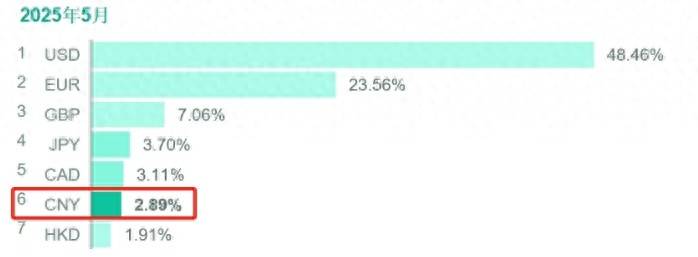
Core Viewpoint - The recent SWIFT data indicates that the payment share of the Chinese yuan (RMB) has dropped to 2.89% in May, marking a significant decline and placing it sixth among global currencies, behind the US dollar, euro, British pound, Japanese yen, and Canadian dollar [1][3]. Group 1: Payment Share Statistics - SWIFT's ranking shows RMB as the sixth largest payment currency, while the People's Bank of China (PBOC) claims it is the third largest when considering all payment methods [1][7]. - The discrepancy between SWIFT and PBOC data arises from different statistical scopes; SWIFT only accounts for transactions processed through its network, while PBOC includes all RMB transactions [1][3]. Group 2: Factors Affecting RMB Payment Statistics - The first factor is that domestic RMB payments are processed through local channels, not SWIFT, leading to underreporting in SWIFT statistics [3][5]. - The second factor is that small-value payments, typically under $10,000, are less likely to use SWIFT, resulting in many small RMB transactions being excluded from SWIFT's data [5]. - The third factor is that payments between branches of the same bank in different countries may not utilize SWIFT, further contributing to the discrepancy [5]. - The fourth factor is the increasing role of the Cross-Border Interbank Payment System (CIPS), which has expanded significantly since its launch in 2015 and now covers over 180 countries, allowing more RMB transactions to bypass SWIFT [7]. Group 3: Future Prospects for RMB Internationalization - Short-term challenges exist for the RMB to surpass the euro or dollar in global payment share, as most trade is still settled in these currencies [9]. - However, with the gradual decline of dollar dominance and ongoing efforts to internationalize the RMB, achieving a higher status is seen as a potential future outcome [10]. - Strategies suggested for enhancing RMB's global standing include integrating CIPS with global payment systems, deepening currency cooperation with emerging markets, and cautiously advancing capital account openness [10].