人民币升值

Search documents
贸易担忧情绪缓解:申万期货早间评论-20251013
申银万国期货研究· 2025-10-13 00:33
Core Viewpoint - The article discusses the easing of trade concerns, with positive movements in stock futures and commodities, while highlighting the impact of U.S.-China trade tensions on various markets [1][4]. Group 1: Stock Indices - U.S. stock futures opened higher, with the S&P 500 futures up 1.1% and Nasdaq futures up 1.4% [1]. - The market experienced a significant pullback due to escalating U.S.-China trade tensions, with a trading volume of 2.53 trillion yuan [2]. - The financing balance increased by 50.8 billion yuan to 2.429195 trillion yuan, indicating a potential shift towards a bullish trend despite short-term volatility [2][12]. Group 2: Precious Metals - Gold prices reached a new high, surpassing $4,060 per ounce, driven by renewed trade tensions and a lack of pressure from traditional bearish factors [3][20]. - Central banks continue to increase their gold holdings, reflecting a growing recognition of gold as a safe-haven asset amid rising global tensions [3][20]. Group 3: Oil Market - Oil prices fell approximately 4% following the announcement of a 100% tariff on Chinese goods, indicating the significant impact of trade tensions on global supply chains [4][14]. - The trade war is expected to disrupt supply chain efficiency, leading to reduced demand for oil and petrochemical products [4][15]. - Market sentiment has shifted towards safe-haven assets like gold and the U.S. dollar, resulting in a potential downward trend for oil prices [4][15]. Group 4: Economic Indicators - The Chinese Ministry of Commerce announced export controls on rare earths, emphasizing the need for dialogue with the U.S. to resolve trade issues [1][8]. - The Small and Medium Enterprises Development Index (SMEDI) in China showed a slight decline to 89.0 in September, indicating challenges amid a complex external environment [9].


美元走弱,黄金是涨是跌?人民币能否升值?
Sou Hu Cai Jing· 2025-10-04 05:37
Core Viewpoint - The recent weakening of the US dollar is primarily driven by the Federal Reserve's interest rate cuts in 2024, leading to increased interest in gold and the potential for the renminbi to appreciate [1][3]. Group 1: Reasons for Dollar Weakness - The Federal Reserve's decision to cut interest rates by 50 basis points in September and 25 basis points in November has reduced the dollar's attractiveness, causing funds to flow away from dollar assets [3]. - The Fed's shift from a high-interest rate environment aimed at curbing inflation to a more accommodative stance is a key factor in the dollar's decline [3]. - Potential adjustments to the overnight reverse repurchase rate may further diminish the dollar's appeal, indicating a sustained trend of dollar weakness [3]. Group 2: Gold Price Dynamics - Gold prices are rising as the dollar weakens, with the price of gold in New York reaching $3912.1 per ounce, a 1.14% increase, and domestic gold prices in China rising to 874.4 yuan per gram, up 1.48% [4]. - Since the Fed's first rate cut in September 2024, domestic gold prices have increased nearly 10% [4]. - Central banks, including China's, are increasing their gold reserves, with China's reserves reaching 2302.28 tons by August 2025, supporting gold prices [4]. Group 3: Renminbi Outlook - The renminbi's potential for appreciation is influenced by domestic economic fundamentals and policy direction, rather than solely by the dollar's performance [5]. - The People's Bank of China maintains a managed exchange rate system, allowing the renminbi to fluctuate within a reasonable range, with a slight depreciation of 1.1% against the dollar in 2024 [5]. - The narrowing interest rate differential between the US and China due to the Fed's rate cuts reduces outflow pressure on the renminbi, providing a supportive environment for its appreciation [5]. Group 4: Summary of Implications - The weakening dollar benefits both gold and the renminbi, but their underlying mechanisms differ: gold typically rises as the dollar falls, while the renminbi's strength is contingent on economic stability and policy [6]. - Investors are advised to approach gold purchases cautiously and monitor the renminbi's movements without rushing into currency exchanges, as both assets carry inherent risks [6].
人民币狂飙2.46%!美元却“崩了”,全球资本正悄悄转向中国
Sou Hu Cai Jing· 2025-10-03 06:25
Core Viewpoint - The offshore RMB has surpassed the 7.0 mark against the USD, marking a 16-month high and a year-to-date appreciation of 2.46%, while the USD index has seen a decline of over 10% this year, the largest annual drop since 1973. This shift reflects a deep reassessment of international capital towards Chinese assets amid a new phase of US-China competition and a quiet "capital migration revolution" [2]. Exchange Rate Fluctuations: RMB vs. USD - RMB appreciation driven by three engines: - Collapse of USD credibility with US debt exceeding $36 trillion and a fiscal deficit rate of 6.8%, leading to a downgrade of US debt ratings and a sell-off [3]. - Resilience of the Chinese economy with a GDP growth rate of 5.3% in the first half of 2025, significant increases in exports of new energy vehicles and photovoltaic equipment, and a trade surplus of $420 billion [3]. - Precise policy adjustments by the central bank, including dynamic adjustments to foreign exchange reserve requirements and a 120% year-on-year increase in offshore central bank bill issuance [3]. - Four major factors contributing to the USD decline: - Uncontrolled interest rate cuts by the Federal Reserve, with a cumulative reduction of 150 basis points in 2025, leading to a federal funds rate of 3.75% and a decline in the attractiveness of USD assets [3]. - Geopolitical backlash from US tariffs deemed illegal by the WTO, undermining the foundation of USD hegemony [4]. - Impact of digital currencies, with the digital RMB's cross-border payment pilot expanding to 47 countries, resulting in a decrease in the USD's settlement share [5]. - Concerns over "fiscal deficit monetization" as US Treasury bond issuance exceeds $1.2 trillion per month, raising fears of severe inflation [6]. Capital Shift: Global Funds Moving East - Equity markets favoring China: - Northbound capital inflow exceeding 280 billion RMB, with significant investments in AI, robotics, and innovative pharmaceuticals [7]. - The Hang Seng Tech Index rising by 28% this year, with substantial daily net purchases from southbound funds [7]. - Bond market stability: - Continuous six-month increase in foreign holdings of RMB bonds, surpassing 4.8 trillion RMB, with policy financial bond yields reaching 3.2%, widening the yield spread over US bonds to 180 basis points [8]. - Cross-border investment restructuring: - Foreign companies establishing R&D centers in China, with foreign R&D investment share rising to 27% [9]. - Ant Group collaborating with Southeast Asian digital banks to launch a "RMB stablecoin," with daily transaction volumes exceeding 10 billion RMB [9]. Underlying Logic: Paradigm Shift in Global Monetary Order - Shift in credit anchors from "gold-USD" to "industrial chain-RMB," with China's manufacturing value added accounting for 31% of the global total [10]. - Intensifying competition in digital currencies, with the digital RMB cross-border payment system covering 107 countries and processing over 1.2 trillion RMB daily [10]. Future Outlook: From "Currency Wars" to "Civilizational Competition" - Scenarios for 2026-2030: - RMB becoming the third-largest currency in the SDR with a cross-border payment share exceeding 15% [11]. - Potential for a "digital currency swap agreement" between China and the US, enhancing global payment efficiency by 40% [11]. - Risk of a "digital currency cold war," leading to increased trade friction costs by 30% [11].
美联储降息引爆A股!北上资金单日狂买177亿,外资抄底人民币资产
Sou Hu Cai Jing· 2025-09-28 08:40
Group 1 - The core focus of the article is the impact of the Federal Reserve's interest rate cut on the A-share market, highlighting the optimism of international investment banks towards core RMB assets and the continuous inflow of northbound capital [1][2]. - Following the Federal Reserve's announcement on September 17, 2023, there is a strong expectation that further rate cuts may occur in October and December 2025, indicating a prolonged trend of global liquidity easing [2][4]. - The offshore RMB to USD exchange rate reached a new high since 2025 on the day of the rate cut, with 1 USD exchanging for 7.1 RMB, marking the largest appreciation of the RMB against the USD this year [3]. Group 2 - If the Federal Reserve proceeds with another rate cut in Q4 2025, the appreciation trend of the RMB against the USD is likely to continue, which could lead to a shift in global capital preferences from USD assets to RMB assets [4][5]. - The combination of these factors is expected to support the A-share market, with international investment banks like Goldman Sachs and Morgan Stanley expressing positive outlooks on RMB core assets in A-shares based on the analysis of the Federal Reserve's policies and capital flows [5][11]. - Data from September 24 indicates significant net inflows from foreign capital into A-shares, with the MSCI China Index seeing a net inflow of 17.7 billion RMB, and the FTSE Russell China Index and S&P China Index also showing substantial inflows [8][9]. Group 3 - The continuous inflow of northbound capital serves as a market-level confirmation of the positive trends driven by the Federal Reserve's rate cuts, RMB appreciation, and the favorable outlook from international investment banks [11]. - Monitoring macro policy changes and capital flows can help investors better understand current market dynamics and seize investment opportunities [11].

洪灏:美元是今年表现最差的主要货币,还要贬值
Feng Huang Wang Cai Jing· 2025-09-28 04:04
Group 1 - The forum "Phoenix Bay Area Financial Forum 2025" was held in Guangzhou, focusing on the theme "New Pattern, New Path" and gathering global political, business, and academic elites to explore development opportunities [1] - Hong Hao, managing partner of Lianhua Asset Management, expressed the view that a bull market is genuinely on the horizon, stating that "every decade China experiences an epic bull market" [1] - Hong Hao highlighted that the US dollar is the worst-performing major currency this year, indicating a long-term depreciation trend despite a slight rebound [1] Group 2 - The slight appreciation of the Chinese yuan this year is seen as a positive surprise, contrasting with previous years of depreciation that led to capital flowing into the US market [1] - The decline of the US dollar and the appreciation of the yuan have resulted in a better performance of the Chinese stock market, which is now leading globally [1] - There is an ongoing trend of capital returning to the Chinese market, and the upward trend in Chinese asset prices is expected to continue [1]

机构:年末人民币升值将趋于7.0
Sou Hu Cai Jing· 2025-09-26 19:55
Group 1 - The core viewpoint is that despite the People's Bank of China implementing interest rate cuts in Q4, the RMB is expected to appreciate, with the USD/RMB exchange rate projected to approach 7.0 by year-end under baseline conditions and 6.7 in optimistic scenarios [1] - The appreciation of the RMB is associated with improved market risk appetite, benefiting both A-shares and Hong Kong stocks, with the latter being more sensitive to foreign capital and global liquidity [1] - The macro report from China Galaxy Securities indicates signs of economic weakness in Q3, leading to a new policy waiting period, but there is no consensus on the expectation of interest rate cuts in Q4 [1] Group 2 - The current RMB appreciation is not driven by economic fundamentals but rather by a self-reinforcing cycle of exchange rate expectations and supply-demand dynamics in the foreign exchange market [2] - The Chinese government's low debt cost relative to economic growth and high efficiency in debt usage supports the exchange rate, with significant policy financial tools and special refinancing bonds expected to be implemented in Q4 [2] - An estimated $700 billion to $1 trillion in settlement demand may be released during the upcoming appreciation cycle, providing further support for the RMB exchange rate [2] Group 3 - Weak economic fundamentals typically correspond to lower valuations in the Chinese stock market, making it more attractive compared to other markets [3] - Significant interest rate cuts are expected to boost economic recovery expectations and enhance corporate profit forecasts, which are crucial for the performance of the Chinese stock market [3] Group 4 - In the US stock market, signals indicate that stock prices are relatively high, with the Shiller P/E ratio of the S&P 500 surpassing 40 for the first time since 2000, raising concerns about potential market corrections [6] - Federal Reserve Chairman Jerome Powell has warned that stock prices are relatively elevated, suggesting caution in the market [6]
人民币升值基调,速度放缓?
日经中文网· 2025-09-26 03:18
Core Viewpoint - The Chinese yuan has appreciated against the US dollar, reaching levels not seen in about 10 months, primarily due to reduced concerns over US-China trade tensions and a stable economic growth rate in China above 5% [2][4]. Exchange Rate Trends - The yuan's exchange rate recently peaked at 1 USD = 7.1019 CNY, marking the highest level since November 2024, with fluctuations around 1 USD = 7.110 to 7.114 CNY [4]. - Earlier in April, the yuan had depreciated to 1 USD = 7.3518 CNY, the lowest level in 18 years, driven by significant tariffs imposed by the Trump administration and market fears regarding China's economic outlook [4]. Trade Agreements and Economic Factors - In May, the US and China reached an agreement to reduce additional tariffs by 115%, with a 90-day suspension of certain tariffs, which has contributed to the yuan's appreciation [6]. - The interest rate differential between the US and China has narrowed, with Chinese long-term rates rising and US rates expected to decline, further supporting the yuan's relative value [6]. Central Bank Policies - The People's Bank of China (PBOC) has adjusted the daily floating range of the yuan against the dollar to ±2% around the central rate, indicating a controlled approach to allow for some appreciation while preventing excessive depreciation [7]. - The PBOC has shown a willingness to let the yuan appreciate moderately, as evidenced by its setting of the central rate above the previous day's actual rate during periods of high selling pressure [7]. Economic Growth Projections - China's GDP growth rate is projected to exceed 5% in the first half of 2025, allowing for a toleration of yuan appreciation [7]. - The economic outlook for 2024 suggests higher growth driven by consumer incentives, but challenges may arise in achieving targets in the latter half of 2025 [7].
美联储降息,对中国外贸出口企业影响几何?
Sou Hu Cai Jing· 2025-09-25 09:24
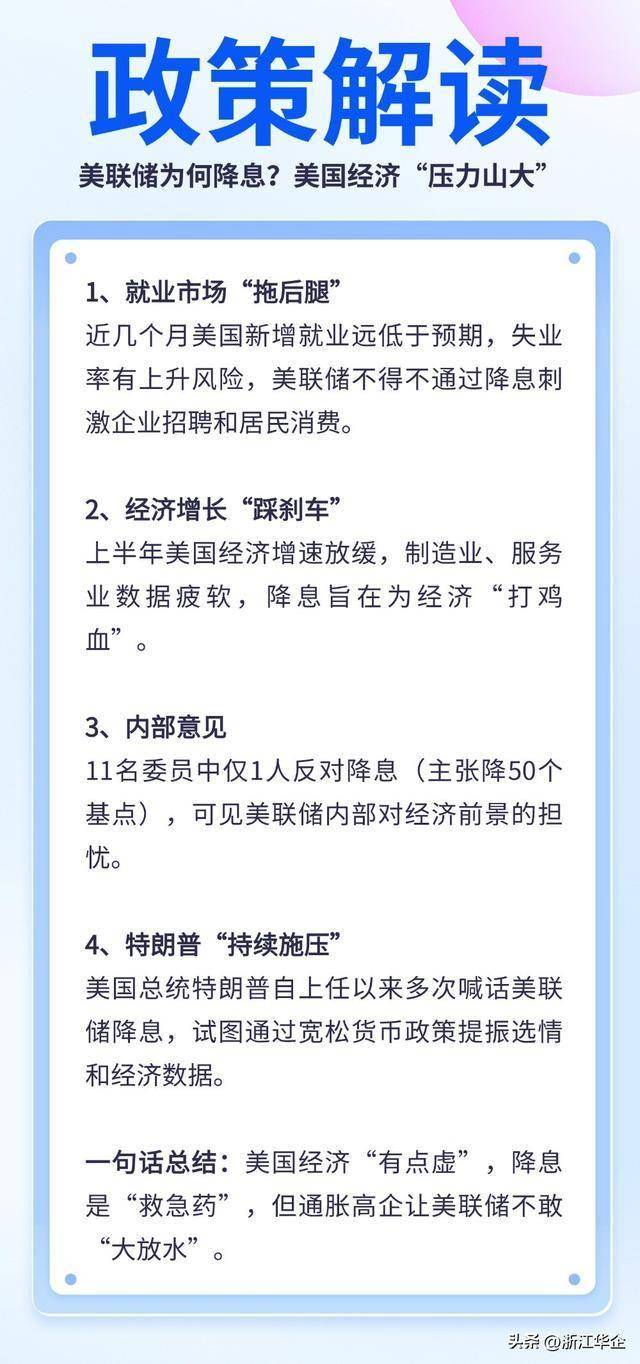
Core Viewpoint - The Federal Reserve's decision to lower the federal funds rate by 25 basis points to a target range of 4.00%-4.25% reflects a response to economic slowdown and political pressure, presenting both challenges and opportunities for Chinese export enterprises and cross-border e-commerce [1]. Direct Impact: Exchange Rate Fluctuations and Cost Restructuring - The depreciation of the US dollar typically leads to the appreciation of the RMB, impacting the competitiveness of export prices. For instance, the USD/RMB exchange rate fell from 7.3 to around 7.1, potentially causing a profit decline of 0.5%-1% for the textile industry with every 1% appreciation of the RMB [7][8]. - The appreciation of the RMB reduces import costs for raw materials and consumer goods, allowing cross-border e-commerce companies to optimize procurement strategies, particularly in categories like 3C electronics and beauty products [8]. - Increased exchange rate volatility raises the risk of foreign exchange losses for enterprises, with some exporters experiencing losses exceeding 5% of net profit in a single quarter due to unhedged positions [9]. Indirect Impact: Capital Flows and Market Segmentation - The Fed's rate cut encourages capital flow to emerging markets, reducing financing costs for Chinese export enterprises. For example, the dollar loan interest rate decreased from 5% to 4%, alleviating financial pressure [10]. - While US consumer spending may be stimulated by lower rates, high inflation could weaken actual purchasing power, leading to mixed demand for Chinese exports, with some categories like home appliances and clothing seeing moderate growth [12]. Long-term Trends: Industrial Upgrading and Restructuring - Traditional export sectors face pressure to upgrade due to RMB appreciation and rising labor costs, prompting a shift of low-end production to Southeast Asia. Companies are encouraged to innovate and build brands to enhance value [15]. - High-tech products and flexible supply chains are becoming central to cross-border e-commerce, with high-tech exports projected to account for 35% of total exports by 2024 [16]. - Diversification into regional markets through agreements like RCEP is essential for reducing reliance on the US market, with exports to ASEAN expected to rise to 16% by 2024 [17]. Corporate Response Strategies: From Passive Adaptation to Active Transformation - Traditional export enterprises should implement dynamic hedging strategies, diversify settlement currencies, and enhance product and market upgrades through increased R&D and brand development [18][20]. - Cross-border e-commerce companies are advised to optimize supply chains through localized procurement and flexible production, while also adjusting operational strategies to reduce dependency on third-party platforms [22][24]. Conclusion - The Fed's rate cut may intensify short-term risks for Chinese export enterprises and cross-border e-commerce, but it also compels a shift towards high-tech and high-value-added operations, necessitating a robust competitive framework for sustainable growth [29].
从宏观上如何理解本轮权益资产重估:一个框架系列
郭磊宏观茶座· 2025-09-25 00:06
Group 1 - The article discusses the macro perspective on the recent revaluation of equity assets, summarizing insights from eleven reports that form a methodological series [1] - It identifies five asset classes that have performed notably well since early 2025, including precious metals, non-ferrous metals, emerging market stocks, major market tech stocks, and alternative assets [6] - The article outlines three main themes behind these asset performances: the weakening of dollar credit and "soft decoupling" of assets, the reshaping of global supply chains and "backup" supply, and a new wave of technological revolution and industrial layout [1][6] Group 2 - The article analyzes the acceleration of technological innovation in China, using the pharmaceutical industry as an example to observe the release of the "engineer dividend" in the economy [2][9] - It discusses the relationship between the appreciation of the RMB and asset appreciation, noting that the exchange rate is influenced by purchasing power parity, interest rate differentials, and risk premiums [2][11] Group 3 - The article identifies five key drivers behind the recent pricing recovery of equity assets, including total recovery, broad-based growth improvement, increased asset activity among residents, medium to long-term capital entering the market, and rising credit risk premiums on dollar assets [2][13] - It explains the phase of divergence between equity market performance and economic indicators, using the "Changjiang Business School BCI" to represent economic fundamentals and "Wind All A" for the equity market [2][13] Group 4 - The article explores the relationship between liquidity and asset pricing, indicating that liquidity affects financial market asset pricing through opportunity costs and the availability of financing [3][13] - It summarizes five characteristics of high-growth narratives in the equity market, observed during specific periods, including macro risk clearance, low traditional asset profitability, ample liquidity, sticky expected returns, and the presence of industry narratives [3][14] Group 5 - The article presents a "5+1" timing framework for high-growth narratives, which has yielded a cumulative return of 1147.47% since 2006, with an annualized return of 13.96% and an annualized excess return of 2.98% [4][15] - It builds an analytical framework for understanding the recent rise in gold prices, incorporating its financial, monetary, commodity, and safe-haven attributes, along with a quantitative monitoring system for gold price indicators [4][16]

人民币升值动能增强,市场预期基本稳定——8月外汇市场分析报告
Sou Hu Cai Jing· 2025-09-24 00:44
Core Insights - In August, the expectation of a Federal Reserve interest rate cut strengthened, leading to a depreciation of the US dollar and an increase in the appreciation momentum of the Chinese yuan, while market expectations remained stable [3][4]. Currency Market Analysis - The US dollar index fell from above 100 to 97.8, a decrease of 2.2%, due to weaker-than-expected employment data and concerns over the independence of the Federal Reserve [3]. - The Chinese yuan's central parity rate appreciated for the fourth consecutive month, with an average daily appreciation of 8 basis points from August 1 to 20, and accelerated to an average daily appreciation of 51 basis points in late August [4]. - By the end of August, the central parity, onshore, and offshore exchange rates of the yuan reached 7.1030, 7.1330, and 7.1221 respectively, appreciating by 0.7%, 0.8%, and 1.2% compared to the end of the previous month [4]. Cross-Border Capital Flows - In August, cross-border capital turned into a net inflow, with banks' foreign currency payments shifting from a deficit of $7.7 billion to a surplus of $3.2 billion [13]. - Foreign currency payments contributed significantly to this surplus, with a month-on-month increase of $17.6 billion to $53.2 billion, marking a new high since October 2024 [13]. - Foreign investment interest in Chinese stocks increased, with a net inflow of $10.8 billion in August, the highest since February of the same year [14]. Foreign Exchange Supply and Demand - The bank's foreign exchange settlement and sales surplus narrowed to $16.8 billion, the lowest in four months, indicating a decrease in the willingness to settle foreign exchange [20]. - The ratio of foreign currency receipts to payments fell to 52.6%, the lowest in five months, while the ratio of payments to purchases rose to 62.0%, the highest in nearly seven months [21]. Trade and Investment - The goods trade surplus decreased by $16.5 billion to $72.9 billion, reflecting a slowdown in export revenue collection [18]. - Direct investment foreign exchange payments showed a deficit increase of $4.5 billion to $7.5 billion, with foreign income dropping to $50.2 billion, the lowest for the same period in five years [15].