半导体

Search documents
立中集团(300428.SZ):2025年净利润同比预增17.38%-23.04%
Ge Long Hui A P P· 2026-01-05 10:28
Core Viewpoint - The company, Lichung Group, forecasts a net profit of 830 million to 870 million yuan for the year 2025, representing a year-on-year growth of 17.38% to 23.04% [1] Group 1: Financial Performance - The net profit attributable to shareholders, excluding non-recurring gains and losses, is expected to be between 750 million to 790 million yuan, with a year-on-year increase of 23.42% to 30.00% [1] - The company anticipates total sales revenue of approximately 32 billion yuan for the year, with steady growth in production and sales across various business segments [2] Group 2: Business Growth Drivers - The aluminum alloy wheel segment is projected to sell 23.4 million units, while the recycled casting aluminum alloy segment is expected to reach 1.26 million tons, and the functional intermediate alloy segment is estimated at 120,000 tons [2] - The overseas production capacity in Thailand and Mexico is being effectively utilized, enhancing global supply capabilities and supporting sales growth from high-end customers [2] - The lithium hexafluorophosphate business has turned profitable since November, benefiting from market price recovery and increased capacity utilization [2] - The company is actively optimizing its product structure and customer matrix, focusing on new materials and products in emerging markets such as new energy vehicles, humanoid robots, aerospace, and semiconductors [2]

立中集团:2025年净利润同比预增17.38%-23.04%
Ge Long Hui· 2026-01-05 10:23
Core Viewpoint - Lichung Group (300428.SZ) forecasts a net profit of 830 million to 870 million yuan for the year 2025, representing a year-on-year growth of 17.38% to 23.04% [1] Group 1: Financial Performance - The net profit attributable to shareholders, excluding non-recurring gains and losses, is expected to be between 750 million and 790 million yuan, with a year-on-year increase of 23.42% to 30.00% [1] - The company anticipates total sales revenue of approximately 32 billion yuan for the year, driven by steady growth in production and sales across various business segments [2] Group 2: Business Growth Drivers - The aluminum alloy wheel segment is projected to sell 23.4 million units, while the recycled casting aluminum alloy segment is expected to reach 1.26 million tons, and the functional intermediate alloy segment is estimated at 120,000 tons [2] - The overseas production capacity in the aluminum alloy wheel segment is being effectively utilized, with operations in Thailand and Mexico enhancing global supply capabilities [2] - The lithium hexafluorophosphate business has turned profitable since November, benefiting from market price recovery and increased capacity utilization [2] Group 3: Strategic Focus - The company is focusing on its core business and enhancing its global industrial chain layout, particularly in new materials and products for emerging markets [1] - Continuous optimization of product structure and customer matrix is being pursued, with applications in new energy vehicles, humanoid robots, aerospace, and semiconductors [2]
焦点复盘沪指刷新33年来连阳纪录,两市成交额激增超5000亿,脑机接口概念掀批量涨停
Sou Hu Cai Jing· 2026-01-05 09:55
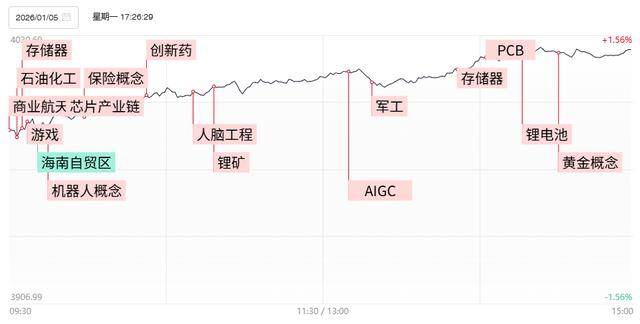
Market Overview - The market experienced a strong opening with 108 stocks hitting the daily limit, and the sealing rate reached 81%, indicating robust investor sentiment [1] - The ChiNext index led the gains, while the Shanghai Composite Index returned above 4000 points, marking a 12-day consecutive rise [1] - Total trading volume in the Shanghai and Shenzhen markets reached 2.55 trillion, an increase of 501.1 billion from the previous trading day [1] Stock Performance - Notable stocks included Fenglong Co., which achieved a 7-day limit, and Leike Defense with a 4-day limit [1] - The market saw over 4100 stocks rising, with sectors like brain-computer interfaces, innovative pharmaceuticals, insurance, and storage chips leading the gains [1] - Conversely, sectors such as Hainan Free Trade Zone, tourism hotels, pork, and banking faced declines [1] Hot Topics and Trends - The brain-computer interface sector surged following Elon Musk's announcement that Neuralink would begin large-scale production in 2026, leading to significant stock price increases in related companies [6] - The commercial aerospace sector remains popular, with companies like Leike Defense and China Satellite Communications achieving consecutive limit-ups [5] - The semiconductor industry is also performing well, with TSMC increasing prices for advanced processes due to high demand, and several companies in the sector reporting significant gains [7] Investment Opportunities - The insurance sector showed strong performance, with major companies like China Life and Ping An reporting new single premium growth rates between 40-60% [8] - The overall market sentiment remains positive, with a high number of stocks hitting daily limits, although concerns about the sustainability of this momentum exist [9] - The potential for further gains in sectors like brain-computer interfaces and commercial aerospace is supported by recent policy developments and market interest [6][5]

机构扎堆推荐中际旭创
21世纪经济报道· 2026-01-05 09:23
记者丨 唐铮玮 2026年首个交易日,A股市场高开高走迎来开门红,截至收盘,沪指涨1.38%重回4000点上 方,录得十二连阳,深成指涨2.24%,创业板指涨2.85%。沪深两市成交额高达2.55万亿,较 上一个交易日放量5011亿,全市场超4100只个股上涨。板块上,保险板块集体爆发,新华保 险、中国太保大涨续创历史新高。商业航天概念反复活跃,半导体产业链走强,AI应用概念表 现活跃。下跌方面,海南自贸概念集体大跌。 回顾2025年全年,A股持续走强,沪深两市全年总成交额超400万亿元创下年度历史新高,A 股总市值跃升至近109万亿元,年内新增近23万亿元。各大主要指数全线上涨,其中,创业板 指领涨市场全年涨幅高达49.57%,沪指全年上涨18.41%再度逼近4000点,深证成指全年上涨 29.87%,科创50指数全年上涨35.92%,北证50指数全年上证38.80%。板块方面,CPO(光模 块)、存储芯片、商业航天、有色金属等方向领涨,胜宏科技、新易盛、中际旭创等多只科技 龙头全年涨幅超过3倍。 据不完全统计,目前已有30余家券商发布了2026年1月投资组合和最新市场观点。 纵观这些报告,多家机构看好市场 ...


开门红!沪指重返4000点,科技+医疗双线暴走,春季行情稳了
Sou Hu Cai Jing· 2026-01-05 09:18
Market Overview - The A-share market experienced a strong opening on the first trading day of 2026, with the Shanghai Composite Index rising over 1% to close at 4023.42 points, while the Shenzhen Component Index and the ChiNext Index increased by 2.24% and 2.85%, respectively [1] - The STAR 50 Index led the market with a remarkable gain of 4.41%, indicating a significant bullish sentiment [1] - Market trading activity surged, with total turnover reaching 2.57 trillion yuan, an increase of approximately 500 billion yuan from the previous trading day, reflecting the inflow of new capital [1] Sector Performance - The technology and healthcare sectors were the main drivers of the market rally, with the media, pharmaceutical, and electronics sectors all rising over 3.5% [1] - Non-bank financials, particularly insurance, and the computer sector also showed considerable gains, highlighting the two core investment themes: hard technology growth (AI, semiconductors, brain-computer interfaces) and innovative pharmaceuticals [1] Key Drivers of Growth - The surge in the pharmaceutical sector was primarily triggered by the announcement from Elon Musk's Neuralink regarding the large-scale production of brain-computer interface devices starting in 2026, which ignited investor interest in human-computer interaction technologies [2] - The innovative drug sector reached a milestone with 76 new drugs approved in 2025, generating over 130 billion yuan in licensing deals, showcasing the international recognition of domestic pharmaceutical companies [3] - The technology sector's growth was fueled by the ongoing AI wave and the anticipated demand for hardware, particularly in the semiconductor industry, with projections of a 50% increase in DRAM contract prices in Q1 2026 [3] Financial Sector Insights - The non-bank financial sector, particularly insurance stocks, saw significant gains, with companies like China Pacific Insurance and New China Life reaching historical highs, supported by favorable regulatory policies aimed at enhancing the health insurance market [4] - The combination of a declining interest rate environment and improved product attractiveness has led to renewed investor interest in insurance products, which possess both defensive and growth characteristics [4] Market Outlook - The strong market performance sets a positive foundation for the spring market of 2026, with expectations of sustained high-risk appetite driven by favorable policies, clear industry trends, and ample liquidity [4] - The dual themes of "technology + healthcare" are expected to continue leading the market, with specific focus on brain-computer interfaces, innovative drugs, AI computing power, and storage chips [4]
把握行业轮动,精选弹性个券
Xiangcai Securities· 2026-01-05 08:51
Report Industry Investment Rating No relevant information provided. Core Viewpoints - In December 2025, the equity market continued to recover and outperformed the CSI Convertible Bond Index significantly. The high - price convertible bonds were more elastic in the bull market, while the low - price convertible bonds were more resistant to decline during the market adjustment. The double - low strategy underperformed the high - price and low - premium strategy in the bull market [3][5]. - In 2026, the convertible bond valuation is expected to remain at a high level, and the pressure of individual bond call will increase. When selecting bonds, it is necessary to pay attention to industry rotation and individual bond selection, control risks and pursue elasticity [6][9]. Summary by Directory 1. Convertible Bond Monthly Market Tracking - **Overall Market Performance**: In December, the CSI Convertible Bond Index rose 2.13%, while the CSI All - Share Index rose 3.25%. Throughout 2025, the CSI Convertible Bond Index and the CSI All - Share Index rose 18.66% and 24.6% respectively. The CSI Convertible Bond Index underperformed the CSI 300 Index by 0.15 pct and the CSI 500 Index by 4 pct in December [3][15]. - **Performance by Price Classification**: In December, the Wind high - price convertible bond index rose 5.14%, while the medium - price and low - price convertible bond indexes rose 1.92% and 0.34% respectively. In 2025, the cumulative increases of the high - price, medium - price, and low - price convertible bond indexes were 28%, 16%, and 17% respectively [3][16]. - **Performance by Stock Size Classification**: In December, the Wind medium - cap and small - cap convertible bond indexes rose strongly by 2.52% and 3.23% respectively, while the large - cap convertible bond index fell 0.36%. In 2025, the small - cap convertible bond index rose 27%, leading the large - cap (+11%) and medium - cap (+19%) convertible bonds [19]. - **Performance by Credit Rating**: In December, high - rated convertible bonds continued to be weak. The AAA and AA+ convertible bond indexes rose - 0.01% and +1.87% respectively. In 2025, the AA - and below convertible bond index rose 28%, and the AA convertible bond index rose 25% [22]. - **Performance by Industry**: In December, only the energy (-2.05%) and financial (-0.39%) convertible bond indexes fell, while the corresponding underlying stock indexes rose 1.6% and 2.37% respectively. The largest increases in December were the materials (+3.66%) and optional consumption (+3.51%) convertible bond indexes. In 2025, the top three industries with the largest increases in the convertible bond indexes were materials (+26%), information technology (+25%), and industry (+24%), while the smallest were finance (+5%) and public utilities (+8%) [4][25]. - **Strategy Performance**: In 2025, the double - low strategy underperformed the high - price and low - premium strategy in the equity market bull market. The Wind double - low index rose 0.42% in December, while the high - price and low - premium index rose 5.78%. In 2025, they rose 30% and 12% respectively [5][32]. 2. Convertible Bond Monthly Investment Recommendations 2.1 Double - Low Strategy Recommendations: Grasp Industry Rotation and Focus on Individual Bond Selection - **December Double - Low Portfolio Performance**: In December, the self - constructed double - low portfolio had a return of - 4.72%, while the CSI Convertible Bond Index rose 2.13%. From June to the end of 2025, the cumulative return of the portfolio was 15.25%, underperforming the CSI Convertible Bond Index by 0.06 pct, with a maximum drawdown of - 12.78% [6][35]. - **January 2026 Double - Low Portfolio Recommendation**: Optimistic about the "anti - involution", consumption, robot, and brokerage sectors in January. The number of portfolio targets is reduced to 5, with 3 new targets (Huairui Convertible Bond, Guotou Convertible Bond, Jiayue Convertible Bond) and 2 original targets retained (China Southern Airlines Convertible Bond, Sanfang Convertible Bond). The average convertible bond price, conversion value, conversion premium rate, and double - low value of this portfolio are 122 yuan, 101 yuan, 23%, and 145 respectively [7][38]. 2.2 Industry Allocation Recommendations: Pay Attention to Call Risks, and Technology Remains the Main Line - In 2026, the equity market is still optimistic, which will keep convertible bond prices at a high level and increase the number of individual bonds facing call. It is recommended to choose high - growth technology sectors such as AI, semiconductors, and robots, and also pay attention to the "anti - involution" (chemical, photovoltaic) and consumption sectors with low valuations and expected demand recovery [9][42].
2026年首批券商金股出炉,中际旭创最受追捧,市场春季行情可期
2 1 Shi Ji Jing Ji Bao Dao· 2026-01-05 08:45
炒股就看金麒麟分析师研报,权威,专业,及时,全面,助您挖掘潜力主题机会! 2026年首个交易日,A股市场高开高走迎来开门红,截至收盘,沪指涨1.38%重回4000点上方,录得十二连阳,深成指涨2.24%,创业板指涨2.85%。沪深两 市成交额高达2.55万亿,较上一个交易日放量5011亿,全市场超4100只个股上涨。板块上,保险板块集体爆发,新华保险、中国太保大涨续创历史新高。商 业航天概念反复活跃,半导体产业链走强,AI应用概念表现活跃。下跌方面,海南自贸概念集体大跌。 回顾2025年全年,A股持续走强,沪深两市全年总成交额超400万亿元创下年度历史新高,A股总市值跃升至近109万亿元,年内新增近23万亿元。各大主要 指数全线上涨,其中,创业板指领涨市场全年涨幅高达49.57%,沪指全年上涨18.41%再度逼近4000点,深证成指全年上涨29.87%,科创50指数全年上涨 35.92%,北证50指数全年上证38.80%。板块方面,CPO(光模块)、存储芯片、商业航天、有色金属等方向领涨,胜宏科技、新易盛、中际旭创等多只科 技龙头全年涨幅超过3倍。 复盘2025年12月,A股"先抑后扬",沪指月末收获11连阳 ...


港股收评:香港恒生指数收涨0.03% 恒生科技指数涨0.09% 脑机接口概念股领涨
Jin Rong Jie· 2026-01-05 08:45
Group 1 - The Hang Seng Index closed at 26,347.24 points, up 0.03%, while the Hang Seng Tech Index rose 0.09% to 5,741.63 points. The National Enterprises Index fell 0.22% to 9,148.47 points, and the Red Chip Index increased by 0.07% to 4,086.74 points [1] - Brain-computer interface concept stocks led the market, with Nanjing Panda Electronics rising nearly 40% and Brain动极光 up over 15%. Meanwhile, domestic property stocks also saw gains, with融信中国 up over 6% and世茂集团 up over 5% [1] - New energy vehicle stocks continued to decline, with Great Wall Motors down over 6%, NIO down nearly 6%, and XPeng Motors down over 4% [1] Group 2 - GF Securities indicated that the recent rise in Hong Kong stocks is supported by fundamentals, with signs of structural recovery in profitability starting from the second half of 2024, driven by stable internal and external demand and macro policy support [1] - The report highlighted that most core companies in strategic technology sectors between China and the U.S. are listed in Hong Kong, with growth in high-end manufacturing and technology transitioning from "single-point breakthroughs" to "multi-point explosions" [1] - The weighting of new economy-related stocks in the Hang Seng Index has increased from 17% to nearly 50%, indicating a shift from traditional economic cycles to hard technology sectors such as AI applications, new energy, and semiconductors [1] Group 3 - Huajin Securities noted a correlation coefficient of approximately 0.5 between the performance of the Hang Seng Index during the New Year holiday and the performance of the Shanghai Composite Index in the following 10 trading days, suggesting that a strong performance in Hong Kong could positively influence A-shares [2] - The Hang Seng Index, Hang Seng Tech Index, and Hang Seng China Enterprises Index rose by 2.8%, 4%, and 2.9% respectively on January 2, indicating a potentially strong short-term outlook for A-shares following the holiday [2]
宏观经济周报2026年第二周-20260105
工银国际· 2026-01-05 08:23
宏观经济周报 2026 年第二周 一、中国宏观 高频:本周 ICHI 综合景气指数连续第五周扩张,扩张幅度较上周进一步抬升, 显示经济运行稳健向好,内生动能在年末维持韧性。从分项结构看,消费景气 指数回升至荣枯线以上,结束前期短暂回落,表明在促消费政策持续发力、居 民预期边际改善以及年末季节性消费的带动下,消费端复苏趋势延续。投资景 气指数同步回升并重新站上荣枯线,显示企业投资活动在阶段性波动后企稳, 收缩压力进一步缓释。出口景气指数仍处于收缩区间,延续低位运行,反映年 末外需节奏放缓及订单与结算安排的阶段性影响,短期内对总需求形成一定拖 累。生产景气指数保持在扩张区间,虽较前期高点有所回落,但仍对综合景气 形成主要支撑。综合来看,当前景气格局呈现出生产端相对稳健、内需边际修 复、外需偏弱制约的结构特征。年末阶段的波动更多体现为节奏性调整而非趋 势性转弱,随着稳增长政策持续落地及预期逐步改善,经济运行有望在扩张区 间内进一步夯实基础,为 2026 年开局奠定相对稳固的景气起点。 按点如欲查询更多产品资料,请联络工银国际证券有限公司,电话(852) 2683 3888 请参阅最后一页的重要声明 证券研究 宏观经 ...
发红包了
中国基金报· 2026-01-05 07:56
Market Overview - A-shares experienced a significant rise on January 5, with the Shanghai Composite Index surpassing 4000 points, closing up 1.38%, the Shenzhen Component up 2.24%, and the ChiNext Index up 2.85% [2] - A total of 4185 stocks rose, with 127 hitting the daily limit up, while 1168 stocks declined [2][3] Sector Performance - The brain-computer interface sector saw a surge, with over 20 stocks including Sanbo Brain Science and Innovation Medical hitting the daily limit up, following Elon Musk's announcement regarding Neuralink's plans for large-scale production of brain-computer interface devices by 2026 [3] - The semiconductor sector strengthened, particularly in memory chips, with stocks like Hengsuo and Zhaoyi Innovation also hitting the daily limit up [4] - The insurance sector showed robust performance, with Xinhua Insurance and China Pacific Insurance both rising over 7%, reaching historical highs [5] International Market Trends - The Japanese market opened strong in the first trading week of 2026, with the Nikkei 225 index rising nearly 3% and the TOPIX index up 2.12%, reaching a historical high [5] - The South Korean KOSPI index continued its upward trend, increasing by 3.15% to a new historical high of 4448.52 points, driven by a significant rise in Samsung Electronics' stock, which increased over 7% [7] Geopolitical Impact - The recent military actions by the U.S. against Venezuela led to a spike in gold and silver prices, reflecting market reactions to geopolitical tensions [9] - Analysts noted that geopolitical noise tends to dissipate quickly, and the escalation in Venezuela has not significantly impacted global risk assets, indicating a tendency for markets to quickly digest such shocks [10][12]