
通胀预期

Search documents
贵金属早报-20250911
Da Yue Qi Huo· 2025-09-11 01:27
Report Overview - Report Date: September 11, 2025 [1] - Report Author: Xiang Weiyi from Dayue Futures Investment Consulting Department [1] Industry Investment Rating - Not provided in the report Core Viewpoints - Gold: After the adjustment of non - farm payroll data, the gold price dropped slightly during the previous day, but due to the continued slowdown of PPI and high expectations of interest rate cuts, the gold price fluctuated and closed higher. With the approaching of the September Fed meeting and high expectations of interest rate cuts, paying attention to today's CPI data, the gold price remains strong [4]. - Silver: With the continued slowdown of PPI and high expectations of interest rate cuts, risk appetite recovered, and the silver price fluctuated and closed higher. As the September meeting approaches and interest rate cut expectations are high, paying attention to the US CPI data today, the silver price follows the gold price and remains strong [6]. Summary by Directory 1. Previous Day Review - **Gold**: The US PPI in August declined more than expected, and the gold price fluctuated and closed higher. The three major US stock indexes rose and fell differently, and the main European stock indexes also showed mixed results at the close. The US Treasury yields fell collectively, with the 10 - year Treasury yield dropping 4.21 basis points to 4.047%. The US dollar index rose 0.08% to 97.85, and the offshore RMB appreciated slightly against the US dollar to 7.1226. COMEX gold futures closed down 0.05% at $3680.4 per ounce [4]. - **Silver**: The US PPI in August declined more than expected, and the silver price fluctuated at a high level. The three major US stock indexes rose and fell differently, and the main European stock indexes also showed mixed results at the close. The US Treasury yields fell collectively, with the 10 - year Treasury yield dropping 4.21 basis points to 4.047%. The US dollar index rose 0.08% to 97.85, and the offshore RMB appreciated slightly against the US dollar to 7.1226. COMEX silver futures closed up 0.75% at $41.65 per ounce [6]. 2. Daily Tips - **Gold**: The basis is - 3.92, with the spot at a discount to the futures; the inventory of gold futures warrants increased by 1536 kilograms to 45951 kilograms; the 20 - day moving average is upward, and the K - line is above the 20 - day moving average; the main net position is long, and the main long position increased [5]. - **Silver**: The basis is - 25, with the spot at a discount to the futures; the inventory of Shanghai silver futures warrants increased by 1831 kilograms to 1252170 kilograms; the 20 - day moving average is upward, and the K - line is above the 20 - day moving average; the main net position is long, and the main long position decreased [6]. 3. Today's Focus - Time TBD: South Korean President Lee Jae - myung holds a press conference on his 100th day in office; the 7th China Financial Technology Forum is held; the 2025 China International Fair for Trade in Services is held at Shougang Park; the 2025 E - commerce Conference is held; the 17th meeting of the 14th National People's Congress Standing Committee is held in Beijing from September 8 - 12; Reserve Bank of New Zealand Governor Adrian Orr gives a speech [15]. - 20:15: The European Central Bank releases its interest rate decision [15]. - 20:30: US CPI for August and the number of initial jobless claims for the week of September 6 are released [15]. - 20:45: ECB President Christine Lagarde holds a monetary policy press conference [15]. - 23:10: Bank of England Executive Director Sasha Mills speaks at the European Settlement System Conference [15]. - Next Day 00:00: US household net worth in the second quarter is released [15]. - Next Day 02:00: US government budget for August is released [15]. 4. Fundamental Data - **Gold Logic**: After Trump took office, the world entered a period of extreme turmoil and change. The inflation expectation has shifted to an economic recession expectation, and the gold price is difficult to fall. The verification between the expected and actual policies of the new US government will continue, and the sentiment for the gold price is high, still prone to rise and difficult to fall [10]. - **Silver Logic**: After Trump took office, the world entered a period of extreme turmoil and change. The inflation expectation has shifted to an economic recession expectation, and the silver price still mainly follows the gold price. The concern about tariffs has a stronger impact on the silver price itself, and there is a risk of an enlarged increase in the silver price [13]. 5. Position Data - **Gold**: On September 10, 2025, the long position volume was 251,787, a decrease of 1,379 or 0.54% compared with September 9; the short position volume was 82,397, an increase of 1,398 or 1.73%; the net position was 169,390, a decrease of 2,777 or 1.61% [31]. - **Silver**: On September 10, 2025, the long position volume was 366,328, an increase of 2,030 or 0.56% compared with September 9; the short position volume was 247,265, a decrease of 448 or 0.18%; the net position was 119,063, an increase of 2,478 or 2.13% [32].
货币政策对通胀预期的影响机制研究
Sou Hu Cai Jing· 2025-09-11 00:23
Core Viewpoint - The article discusses the mechanisms through which monetary policy influences inflation expectations among economic agents, emphasizing the importance of managing these expectations for achieving price stability [1][2][14]. Group 1: Monetary Policy Channels - The central bank influences inflation expectations through two main channels: "listening to words" (communication and transparency) and "observing actions" (quantitative and price-based monetary policies) [2]. - Trust in the central bank is crucial for economic agents to accept its information, which relies on the effective use of monetary policy tools [2]. Group 2: Immediate and Dynamic Effects of Monetary Policy - Differentiating the immediate and dynamic effects of monetary policy on inflation expectations helps the central bank manage these expectations more precisely [3]. - The study finds that residents' inflation expectations are influenced by both current and lagged monetary policy variables, indicating a need to consider both immediate and dynamic impacts [3][10]. Group 3: Formation Mechanisms of Inflation Expectations - The article explores the formation mechanisms of inflation expectations using adaptive learning theory and sticky information theory, establishing models for both residents and experts [4]. - The analysis includes a four-variable VAR model to study the dynamic effects of monetary policy on inflation expectations, incorporating real output growth, actual inflation rates, and monetary policy indicators [4][11]. Group 4: Data and Methodology - The empirical analysis covers macroeconomic variables such as GDP growth, CPI growth, and effective exchange rates from Q4 2000 to Q1 2023, alongside monetary policy variables [5][6]. - The study utilizes GMM estimation to address endogeneity issues in the analysis of inflation expectations [7]. Group 5: Immediate Impact of Monetary Policy - The results indicate that CHIBOR, SHIBOR, and the growth rate of base money have significant immediate negative impacts on residents' inflation expectations [8]. - For experts, the growth rate of base money shows a significant negative immediate impact, while M1 and M2 growth rates have significant positive immediate effects [8][10]. Group 6: Dynamic Impact of Monetary Policy - The VAR model analysis reveals that SHIBOR, base money growth, and M1 and M2 growth rates have significant dynamic impacts on residents' inflation expectations [12]. - After Q1 2011, only SHIBOR and DR007 significantly influence inflation expectations, indicating a shift towards price-based monetary policy [13][17]. Group 7: Conclusion and Implications - The findings suggest that the effectiveness of monetary policy is closely linked to its ability to influence inflation expectations, highlighting the need for improved understanding of these mechanisms [14][17]. - The transition from quantity-based to price-based monetary policy has altered the dynamics of how inflation expectations are formed, with price-based tools becoming increasingly central [17].
国泰海通:确定的降息,不确定的节奏
Ge Long Hui· 2025-09-08 02:31
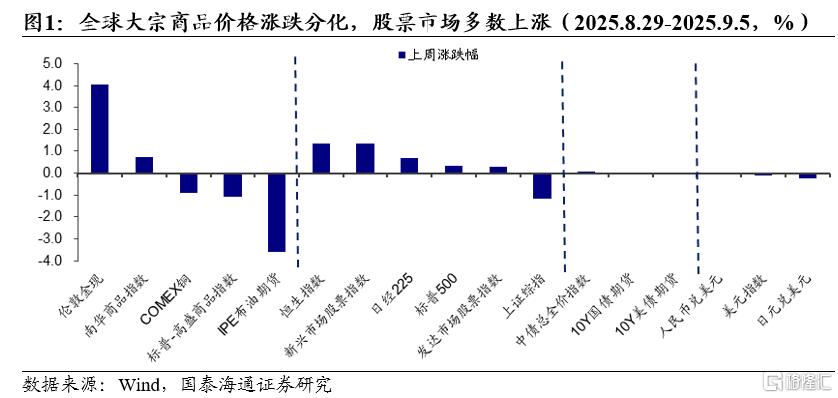
Group 1: Economic Overview - The U.S. economy is experiencing a marginal slowdown, with July durable goods orders showing a significant year-on-year decline and a negative month-on-month change [3][7][19] - The Markit Manufacturing PMI for August increased to 53.0, while the Philadelphia Fed Manufacturing Index declined to -0.30, indicating mixed economic signals [7][14] - The unemployment rate rose to 4.3% in August, with initial jobless claims increasing to 237,000, reflecting a weak labor market [11][19] Group 2: Global Asset Performance - Global asset prices showed mixed performance, with commodities experiencing varied price changes and most stock markets rising, including a 1.36% increase in the Hang Seng Index [2][5] - The 10-year U.S. Treasury yield decreased by 13 basis points to 4.10%, while the domestic 10Y government bond futures remained stable [2][5] Group 3: Policy Implications - The weak non-farm payroll data reinforces expectations for a rate cut by the Federal Reserve, with potential challenges to its independence due to political pressures [3][19][28] - The European Central Bank is likely to pause rate cuts in the short term, with the euro potentially appreciating despite political uncertainties [28] - The Bank of Japan maintains a stance for further rate hikes but warns of significant uncertainties due to U.S. tariff policies [29]


黄金VS A股:美联储降息周期下,谁能率先冲破关键点位?
Sou Hu Cai Jing· 2025-09-08 02:16
Group 1 - The international gold market has seen a surge, with gold prices surpassing $3,650 per ounce, marking a historical high and a year-to-date increase of nearly 38% [1][3] - The recent spike in gold prices is primarily driven by disappointing U.S. non-farm payroll data, which reported only 22,000 new jobs in August, significantly below the expected 75,000, raising concerns about the U.S. economic outlook and leading to a decline in the U.S. dollar index [3] - The weak non-farm data has heightened expectations for a rate cut by the Federal Reserve in September, increasing inflation expectations globally and boosting demand for gold as a hedge against inflation [3] Group 2 - The long-term trend for gold prices remains positive, with a steady increase since 2016, characterized by a slow bull market, and a notable acceleration in the past two years, with a 27.39% increase in 2024 and a 37.82% increase in 2025 to date [3] - Goldman Sachs predicts that if the credibility of the Federal Reserve is compromised, gold prices could potentially exceed $5,000 per ounce [3] Group 3 - In contrast to the booming gold market, the A-share market is still in a critical breakthrough phase, with the Shanghai Composite Index struggling to overcome resistance levels from historical highs in 2007 and 2015 [4] - The A-share market is currently valued at historical median levels, presenting a significant value proposition compared to the average valuation of over 30 times in the U.S. stock market [4] - With the impending rate cut cycle from the Federal Reserve, both gold and A-shares face upward breakout opportunities, with the A-share index needing only a 5% increase to reach 4,000 points, compared to a 10% increase for gold [4]

利率策略周报(2025-09-07):长债重定价结束了么-20250907
CMS· 2025-09-07 13:35
Group 1 - The report indicates that the 10-year government bond yield slightly declined to 1.83% as of September 5, down about 1 basis point from August 29, influenced by market concerns regarding the "anti-involution" policy and banks adjusting their balance sheets at the end of the quarter [1][2] - The bond market is currently in a weak oscillating environment, with a notable "see-saw" effect between stocks and bonds driven by rising inflation expectations. If the stock market continues to strengthen, the 10-year government bond yield is likely to undergo further repricing [2][3] - The investment strategy in the bond market should focus on defensive tactics, employing a barbell strategy. Investors are advised to consider short-term credit bonds with moderate duration due to the volatility in long-term rates [3] Group 2 - The report highlights that the domestic bond market is showing stronger credit performance compared to interest rates, with longer maturities outperforming shorter ones. Specifically, 5Y and 30Y government bonds have shown relatively strong performance [8] - The report notes that the high-frequency economic activity index in China is currently at 1.04, indicating a seasonal decline, while the operating rates of various industries such as steel and automotive are showing mixed trends [18][36] - The report provides insights into the monetary and liquidity conditions, indicating that the central bank implemented a net withdrawal of 1,204.7 billion yuan through open market operations from September 1 to September 5, reflecting a stable overall funding environment [61]
华尔街“最后的鹰派”投降! 高喊“全年不降息”美银押注美联储9月与12月降息
Zhi Tong Cai Jing· 2025-09-06 05:21
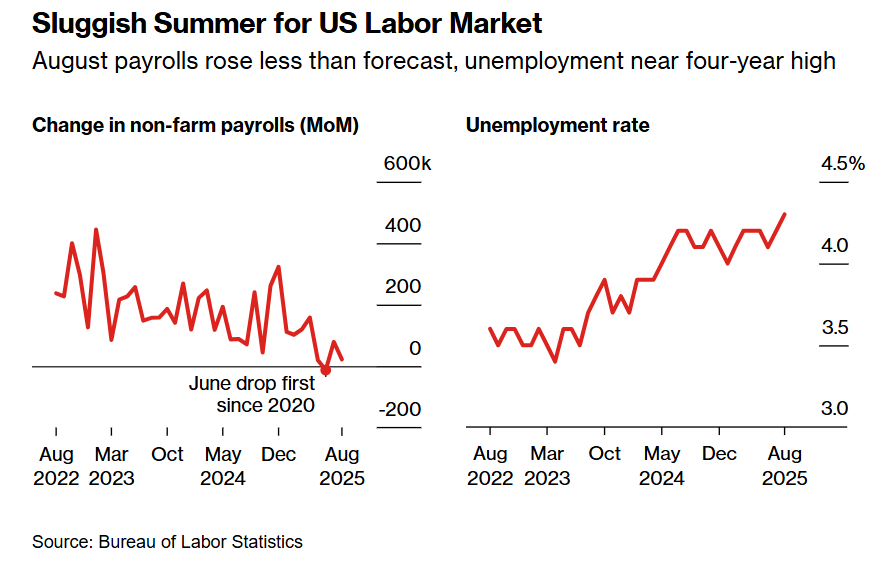
Core Viewpoint - Bank of America economists predict two interest rate cuts by the Federal Reserve this year, in September and December, abandoning their previous hawkish stance due to weak labor market data and signs of a potential economic slowdown [1][2][5] Economic Data - August non-farm payrolls increased by only 22,000, significantly below the median economist estimate of 75,000, while the unemployment rate rose to 4.3%, the highest since 2021 [2] - The downward revision of June and July non-farm payrolls by a total of 21,000, with June's data showing negative growth for the first time since 2020, indicates a concerning trend in employment [2][5] Monetary Policy Predictions - Bank of America now expects the Federal Reserve to lower the policy interest rate target range from 4.25%-4.5% to 3%-3.25% starting in June 2026, with three cuts of 25 basis points each [1] - The market has fully priced in a 100% chance of a rate cut in September following the disappointing employment report [2] Inflation Expectations - Economists at Bank of America anticipate that the core Personal Consumption Expenditures (PCE) inflation may reach 3% in August due to tariff effects, with expectations of further increases by year-end [1] Market Sentiment - The sentiment among large investment institutions has shifted, with Bank of America being one of the last to predict a September rate cut, contrasting with its earlier stance of no cuts for the year [5] - The recent employment reports have provided significant evidence for a slowdown in the U.S. economy, influencing market expectations for more aggressive monetary easing [2][6]

?华尔街“最后的鹰派”投降! 高喊“全年不降息”的美银押注美联储9月与12月降息
Zhi Tong Cai Jing· 2025-09-06 04:18
Core Viewpoint - Bank of America has shifted its stance from a hawkish monetary policy outlook to predicting two interest rate cuts by the Federal Reserve in September and December, driven by weak labor market data and signs of a potential economic slowdown [1][2] Economic Predictions - Bank of America economists expect the U.S. inflation, measured by the core Personal Consumption Expenditures (PCE) index, to reach 3% in August due to tariff effects, with further increases anticipated by year-end [2] - The new monetary policy forecast aligns with market expectations, indicating a 100% pricing for a September rate cut following disappointing employment data [2][3] Employment Data Insights - The August non-farm payrolls report showed only a 22,000 increase in jobs, significantly below the median economist estimate of 75,000, with the unemployment rate rising to 4.3%, the highest since 2021 [2][3] - The downward revision of previous months' employment data, including a negative growth in June, has led to increased speculation about more aggressive rate cuts [2][3] Federal Reserve's Stance - The shift in Bank of America's predictions marks a departure from its previous stance of not expecting rate cuts until next year, highlighting a significant change in the economic outlook [1][3] - Some Federal Reserve officials have expressed support for rate cuts, while others remain cautious due to persistent inflation concerns [4]
华尔街“最后的鹰派”投降! 高喊“全年不降息”的美银押注美联储9月与12月降息
智通财经网· 2025-09-06 03:27
Core Viewpoint - Bank of America economists have revised their monetary policy outlook, now expecting two interest rate cuts from the Federal Reserve in 2023, specifically in September and December, due to weak labor market data and signs of a potential economic slowdown [1][2] Group 1: Economic Indicators - The August non-farm payrolls report showed an increase of only 22,000 jobs, significantly below the median forecast of 75,000, with the unemployment rate rising to 4.3%, the highest since 2021 [2] - The previously weak employment figures for June and July were revised down by a total of 21,000 jobs, with June's data indicating a contraction for the first time since 2020 [2][5] Group 2: Monetary Policy Predictions - Bank of America now anticipates that the Federal Reserve will lower the policy interest rate target range from 4.25%-4.5% to 3%-3.25% by mid-2026, with three cuts of 25 basis points each [1] - The economists also predict that inflation, measured by the core Personal Consumption Expenditures (PCE) index, may rise to 3% in August due to tariff effects, potentially leading the Fed to pause rate cuts in October [1] Group 3: Market Reactions - Following the disappointing employment data, swap contracts have fully priced in a 100% chance of a rate cut in September, with increased expectations for further cuts in the remaining meetings of the year [2] - The sentiment among market participants has shifted towards anticipating more aggressive easing measures by the Fed, with some traders considering the possibility of a larger half-percentage point cut [2]
欧洲股市为何下跌?美国就业疲软成主因,降息押注也难挽颓势
Sou Hu Cai Jing· 2025-09-05 22:36
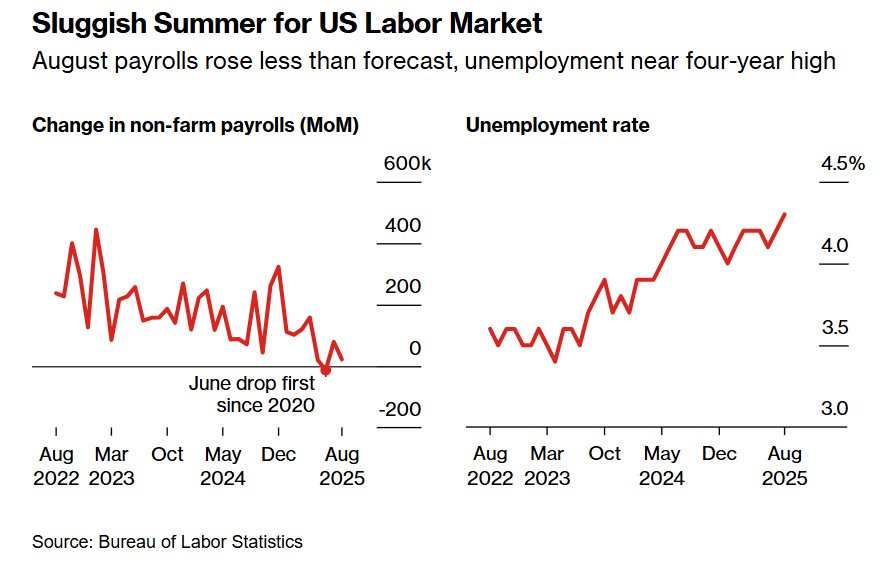
Group 1 - European major stock indices fell on Friday due to weak U.S. employment data, with the Stoxx Europe 600 index closing down 0.2% after fluctuating throughout the day [1] - The U.S. Labor Department reported that non-farm payroll growth in August was significantly below expectations, and the unemployment rate rose to its highest level in nearly two years, raising concerns about economic slowdown [3] - Despite some investors interpreting the weak employment report as a signal for a rate cut by the Federal Reserve, the shadow of a potential recession continues to suppress risk appetite [3] Group 2 - The swap market has fully priced in a 25 basis point rate cut by the Federal Reserve this month, but expectations for a larger 50 basis point cut have not significantly increased [3] - Berenberg Bank economist Atakan Bekircan stated that the employment report was weak across various dimensions, but the slight increase in the unemployment rate suggests that the likelihood of a drastic rate cut remains low [3] - The market sentiment was cautious, with cyclical sectors like energy and finance under pressure, reflecting investor concerns about the economic outlook [3] Group 3 - Earlier in the week, European stocks had rebounded on rate cut expectations, but the Stoxx 600 index still posted a slight weekly decline of 0.2% [3] - RBC Wealth Management's strategy head, Frederic Carriere, warned that if the bond market experiences volatility due to rising inflation expectations, the stock market could face downward pressure [3] - The excitement in the market regarding rate cuts may be offset by inflation concerns, which is a current risk point that needs close monitoring [3]

法巴银行:美国8月通胀预期将加速
Sou Hu Cai Jing· 2025-09-05 13:52
Core Insights - The U.S. employment indicators suggest that the Federal Reserve may lower interest rates in the coming weeks, shifting Wall Street's focus towards inflation [1] - The Consumer Price Index (CPI) for August is set to be released next Thursday, representing the last significant data set before the FOMC meeting [1] Economic Forecasts - Economists at Societe Generale predict that the September CPI will rise from 0.2% in July to 0.4%, leading to a year-on-year CPI growth from 2.7% to 2.9% [1] - The core CPI annual rate is expected to remain steady at 3.1% [1] Market Implications - Companies have largely depleted their pre-tariff inventories, making them more susceptible to tariff impacts and increasing the likelihood of passing price increases onto consumers [1]