
外需

Search documents
华泰证券:财政政策持续有效发力是稳内需、稳信心的关键
Zheng Quan Shi Bao Wang· 2025-08-16 01:36
Core Viewpoint - The report from Huatai Securities indicates that while external demand uncertainty is decreasing due to the reduction of U.S. tariff policy disruptions, the impact of a potential slowdown in global trade activities after the "export grabbing" trend subsides still needs to be observed [1] Group 1: Economic Indicators - From January to June, the broad fiscal expenditure, including general public budgets and government funds, increased by 8.9% year-on-year, a significant improvement compared to a decline of 2.8% in the same period last year, contributing positively to economic growth in the first half of the year [1] - The implementation of "reciprocal tariffs" in early August may significantly raise the U.S. weighted average import tariff level, introducing uncertainty to external demand trends [1] Group 2: Policy Implications - Continuous effective fiscal policy is crucial for stabilizing domestic demand and confidence [1] - The need for timely reinforcement of domestic fiscal measures after initial efforts, as well as the effectiveness of new policy financial tools in boosting investment, are areas of concern [1]

制造业用工续创新低【陈兴团队·财通宏观】
陈兴宏观研究· 2025-08-15 16:03
Core Insights - Monthly commodity price forecast indicates oil prices in a fluctuating range, while copper and gold prices are expected to trend upwards [2] Domestic Demand - New housing and passenger vehicle sales growth rates have declined, while second-hand housing sales have rebounded; consumer electronics sales prices in August have shown a year-on-year decline [2] - In August, new housing sales saw a year-on-year decline, while second-hand housing sales increased but prices fell; the high base and hot weather contributed to a decrease in passenger vehicle sales growth, with retail sales declining and wholesale sales recovering [2] - Movie box office revenue and attendance have decreased but remain at historically high levels; tourism consumption continues to rise, with hotel occupancy rates increasing and revenue per available room up compared to last year [2] External Demand - The extension of the US-China tariff exemption for three months has been announced, while shipping volumes from China to the US continue to decline [3] - Overall exports are weakening, with a drop in CCFI shipping rates and a significant decrease in container throughput; however, the number of departing ships has increased [3] Production - The effects of capacity reduction are yet to be seen, with manufacturing employment reaching a new low [4] - Recent steel production has decreased due to maintenance and iron water transfer, while the profitability of sample steel mills has slightly declined but remains acceptable [4] - The average daily coal consumption of six major power generation groups has significantly increased, driving up coal prices [5] - The manufacturing employment index has increased month-on-month but shows a year-on-year decline, reaching a historical low [6] Prices - Tariff exemptions have suppressed gold prices; domestic rebar prices have increased, while cement and thermal coal prices continue to rise, and glass prices have decreased [6]


对外贸易图谱2025年第31期:制造业用工续创新低
CAITONG SECURITIES· 2025-08-15 13:09
Domestic Demand - New housing and passenger car sales growth has declined, while second-hand housing sales have rebounded[2] - In August, new housing sales saw a year-on-year decline of 8%, while second-hand housing sales volume increased, but prices fell[2] - Retail sales of home appliances in August showed a downward trend in year-on-year growth[2] External Demand - The extension of tariff exemptions between China and the U.S. for three months has led to a continued decline in shipping volumes from China to the U.S.[2] - Overall exports are weakening, with the China Containerized Freight Index (CCFI) showing a decrease in shipping rates and a significant drop in container throughput[2] Production - Manufacturing employment index has reached a historical low, with a year-on-year decline continuing[2] - Steel production has decreased due to maintenance and operational adjustments, while rebar prices have started to rise[2] Prices - Tariff exemptions have suppressed gold prices, while domestic rebar prices have increased, and cement and coal prices continue to rise[2] - The geopolitical situation and rising U.S. commercial crude oil inventories have put downward pressure on oil prices[2] Risks - Potential policy changes and economic recovery not meeting expectations pose risks to the forecasts[2]
日本二季度实际GDP环比微增0.3%
Xin Hua Wang· 2025-08-15 06:13
Group 1 - Japan's real GDP grew by 0.3% quarter-on-quarter in Q2, translating to an annualized growth rate of 1.0% [1] - Personal consumption, which accounts for over half of Japan's economy, increased by 0.2% quarter-on-quarter, while business equipment investment rose by 1.3% and residential investment grew by 0.8% [1] - Public demand, including government consumption and public investment, decreased by 0.3%, contributing negatively to domestic demand growth [1] Group 2 - The Cabinet Office revised its GDP growth forecast for the current fiscal year (April 2025 to March 2026) down from 1.2% to 0.7% [2] - The reduction in GDP growth expectations is attributed to the impact of U.S. tariff policies, which are expected to directly decrease Japan's exports to the U.S. and indirectly affect exports to other countries [2]
【环球财经】日本二季度实际GDP环比微增0.3%
Xin Hua Cai Jing· 2025-08-15 05:53
Group 1 - Japan's real GDP grew by 0.3% quarter-on-quarter in Q2, translating to an annualized growth rate of 1.0% [1] - Personal consumption, which accounts for over half of Japan's economy, increased by 0.2% quarter-on-quarter, while business investment in equipment rose by 1.3% and residential investment grew by 0.8% [1] - Public demand, including government consumption and public investment, decreased by 0.3%, contributing negatively to domestic demand growth [1] Group 2 - The Japanese Cabinet Office revised its economic growth forecast for the fiscal year 2025 from 1.2% to 0.7%, citing the impact of U.S. tariff policies on Japan's exports [2] - The decline in exports to the U.S. is expected to have a direct effect, while reduced exports from other countries to the U.S. will indirectly affect Japan's exports of intermediate goods [2]
7月货币加速、贷款减速的背后
Sou Hu Cai Jing· 2025-08-14 00:55
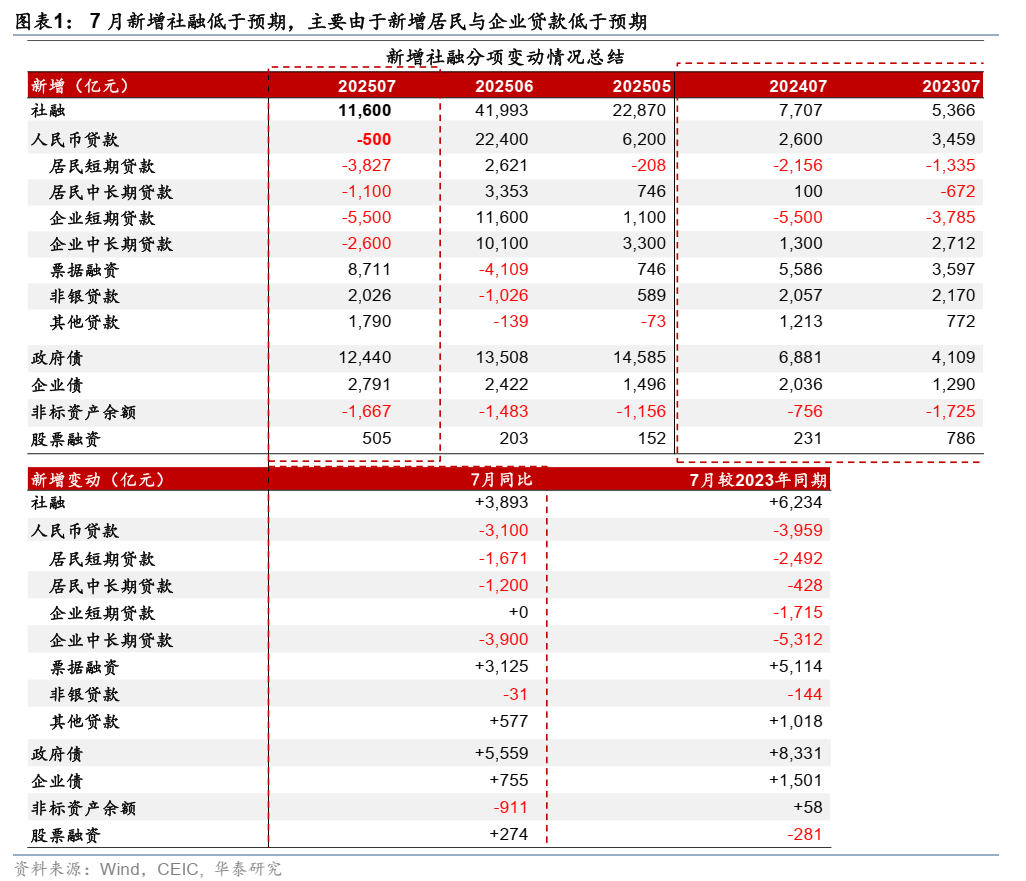
Core Viewpoint - July's social financing data indicates that while M1 and M2 growth exceeded market expectations, new loans and social financing fell short, reflecting changes in financing structure, seasonal factors, and shifts in household investment behavior [1][2][3] Monetary Supply - In July, M2 expanded by 8.8% year-on-year, while M1 grew by 5.6%, both surpassing Bloomberg's consensus expectations of 8.3% and 5.2% respectively [1][7] - The year-on-year growth rate of M1 increased from 4.6% in June to 5.6% in July, partly due to low interest rates and the reactivation of deposits by residents and enterprises [7] - M2's year-on-year growth rate rose from 8.3% in May to 8.8% in July, significantly higher than the expected 8.3% [8] Social Financing - July's new social financing amounted to 1.16 trillion yuan, lower than the expected 1.63 trillion yuan, but showed a year-on-year increase of 389.3 billion yuan [6][10] - Government bond net issuance in July was 1.24 trillion yuan, contributing approximately 4.1 percentage points to the year-on-year growth of social financing [2][6] - The net issuance of government bonds in the first seven months of the year reached 8.9 trillion yuan, an increase of 4.9 trillion yuan year-on-year, indicating a proactive fiscal policy [3][4] Loan Dynamics - New RMB loans in July decreased by 500 billion yuan, contrasting with the expected increase of 300 billion yuan, reflecting weak demand from the private sector, particularly in the real estate market [2][4][5] - The total amount of short-term and medium-to-long-term loans for residents fell by 287.1 billion yuan year-on-year, primarily due to weakened demand in the real estate sector [2][4] - Corporate short-term and medium-to-long-term loans decreased by 5.5 billion and 2.6 billion yuan respectively, indicating a decline in financing demand amid rising uncertainties [5][6] Fiscal Policy Impact - The acceleration of social financing growth in July was supported by the front-loaded issuance of government bonds, which is expected to continue influencing the broad credit cycle positively [3][4] - The overall fiscal expenditure growth in the first half of the year was 8.9%, significantly higher than the -2.8% recorded in the same period last year [4] - The sustainability of fiscal stimulus in the latter half of the year may face uncertainties, particularly in light of potential reductions in government bond issuance compared to the previous year [4]
外贸数据超预期的四点观察——7月进出口数据点评
一瑜中的· 2025-08-08 09:45
Core Viewpoints - In July, China's export growth rate exceeded Bloomberg's consensus expectations, with a year-on-year increase of 7.2%, slightly below the company's forecast of 7.5% but higher than the previous value of 5.9% [2][4] - The resilience of exports is supported by low base effects and driven by three key regions: ASEAN, EU, and Africa, which may continue to provide unexpected strength against US tariff pressures [4][6] - Import growth in July significantly surpassed expectations, primarily driven by raw materials and intermediate goods, including crude oil and integrated circuits, indicating potential future pressures on import demand [4][11] Group 1: Trade Data Observations - July's export data aligns closely with the company's expectations, with a year-on-year increase supported by a low base from the previous year, while the month-on-month figure fell below the historical average [6][12] - The resilience of exports is notable given the backdrop of significant US tariff increases, with cumulative export growth remaining robust despite potential "export rush" factors [6][16] - The overall external demand may face downward pressure in the second half of the year, compounded by the potential for a decline in import demand [9][10] Group 2: Regional Export Performance - Exports to the EU, ASEAN, and Africa have shown strong growth, contributing significantly to the overall export performance in July [7][17] - The recovery in EU exports aligns with the manufacturing cycle in the Eurozone, while ASEAN exports may be influenced by transshipment trade dynamics [20][23] - African exports have been particularly strong, driven by vehicle and parts exports, indicating a divergence from trends seen in other regions [26][29] Group 3: Export Outlook - Short-term export resilience is expected to face adjustments due to external demand slowing and high base effects in the fourth quarter [9][34] - Leading indicators suggest that export growth may range between 3%-4% for the year, with potential declines in the second half [10][34] Group 4: Import Performance - July's import growth rate of 4.1% significantly exceeded expectations, driven by various categories including crude oil and integrated circuits [38][60] - The contribution to import growth primarily came from unlisted other goods, indicating a potential reliance on specific categories for sustained growth [11][39] - Future import growth may face challenges due to declining commodity prices and ongoing pressures in the manufacturing sector [39][63]

X @外汇交易员
外汇交易员· 2025-08-05 01:52
Economic Indicators - China's July Caixin/S&P Global Services PMI reached 52.6, exceeding expectations of 50.4 [1] - The Composite PMI registered 50.8 [1] - China's July S&P Global Manufacturing PMI came in at 49.5, below the anticipated 50.4 [2] Service Sector Performance - Service sector new business volume experienced a notable increase, marking a one-year high [1] - The improvement was attributed to enhanced basic demand and successful business expansion [1] - Foreign demand rebounded for the first time in three months, driven by increased tourism and stable trade conditions, leading to the highest export order growth since February [1] Manufacturing Sector Performance - China's manufacturing output experienced its second decline since October 2023 [3] - Surveyed companies attributed the production decrease to a slowdown in new order growth [3] - Manufacturers reported weak foreign demand, with new export orders contracting for the fourth consecutive month and at an accelerated pace compared to June [3] Cost Pressure - Average input costs continued to rise in July due to increased raw material, fuel, and payroll expenses [1]
中国宏观周报(2025年7月第5周)-20250804
Ping An Securities· 2025-08-04 07:14
Group 1: Industrial Production - Industrial production in China shows divergence, with raw material production demonstrating relative resilience[1] - Daily pig iron output is higher than the same period last year, while steel and construction material production and apparent demand have marginally declined[1] - The operating rates for petroleum asphalt and some chemical products have recovered, while cement clinker capacity utilization remains stable compared to last week[1] Group 2: Real Estate - New home sales in 30 major cities decreased by 18.4% year-on-year as of August 1, 2025, with a 19.3% decline in July compared to the previous month[1] - The second-hand housing listing price index decreased by 0.48% month-on-month as of July 21, 2025[1] Group 3: Domestic Demand - National retail sales of passenger cars from July 1-27, 2025, reached 1.445 million units, a 9% increase year-on-year, while the total market for July is estimated at around 1.85 million units, up 7.6% year-on-year[1] - Major home appliance retail sales increased by 18.5% year-on-year as of July 25, 2025[1] - Daily movie box office revenue averaged 230 million yuan, a 27.9% increase year-on-year, with a government subsidy program in Beijing to encourage attendance[1] Group 4: External Demand - Port cargo throughput increased by 10.9% year-on-year as of July 27, 2025, with container throughput up by 5.6%[1] - South Korea's export value grew by 5.9% year-on-year in July, an increase of 1.6 percentage points from June[1] Group 5: Price Trends - The South China industrial product index fell by 3.8%, with the black raw materials index down by 5.6%[1] - Rebar futures prices dropped by 4.6%, while spot prices decreased by 2.3%; coking coal futures fell by 13.2%, but spot prices rose by 1.2%[1]
通胀数据表现偏弱
Bao Cheng Qi Huo· 2025-07-09 13:08
Report Summary 1. Report Industry Investment Rating No information about the report industry investment rating is provided in the given content. 2. Core View of the Report - Today, most treasury bond futures closed higher, with the 30 - year main contract up 0.19%, the 10 - year main contract up 0.05%, the 5 - year main contract up 0.03%, and the 2 - year main contract flat. The inflation data in June showed that CPI rose 0.1% year - on - year and PPI fell 3.6% year - on - year, which is weak and not conducive to the endogenous growth of domestic demand. Considering the current macroeconomic indicators and monetary policy, domestic inflation is weak, the endogenous growth momentum of domestic demand is insufficient, and external demand is vulnerable to tariff factors. A moderately loose monetary environment is still needed in the second half of the year to support demand and stabilize expectations, so the medium - to - long - term upward trend of treasury bond futures remains. However, due to the recent increase in risk appetite in the stock market leading to capital diversion and the weak expectation of interest rate cuts in the short term, the upward and downward space of treasury bond futures is limited in the short term. Overall, treasury bond futures will continue to fluctuate and consolidate in the short term [2]. 3. Summary According to Relevant Catalogs Industry News and Related Charts - On July 9, the People's Bank of China conducted 75.5 billion yuan of reverse repurchase operations at a fixed interest rate of 1.4%. There were 98.5 billion yuan of reverse repurchase maturities in the open market today, resulting in a net withdrawal of 23 billion yuan. - In June 2025, the year - on - year increase in the consumer price index was 0.1%, and the year - on - year decrease in the producer price index for industrial products was 3.6% [4].