
精细化运营

Search documents
未来4年武汉甲级写字楼市场新增供应超百万方 精细化运营与差异化竞争成关键
Zhong Guo Jing Ying Bao· 2026-01-16 23:58
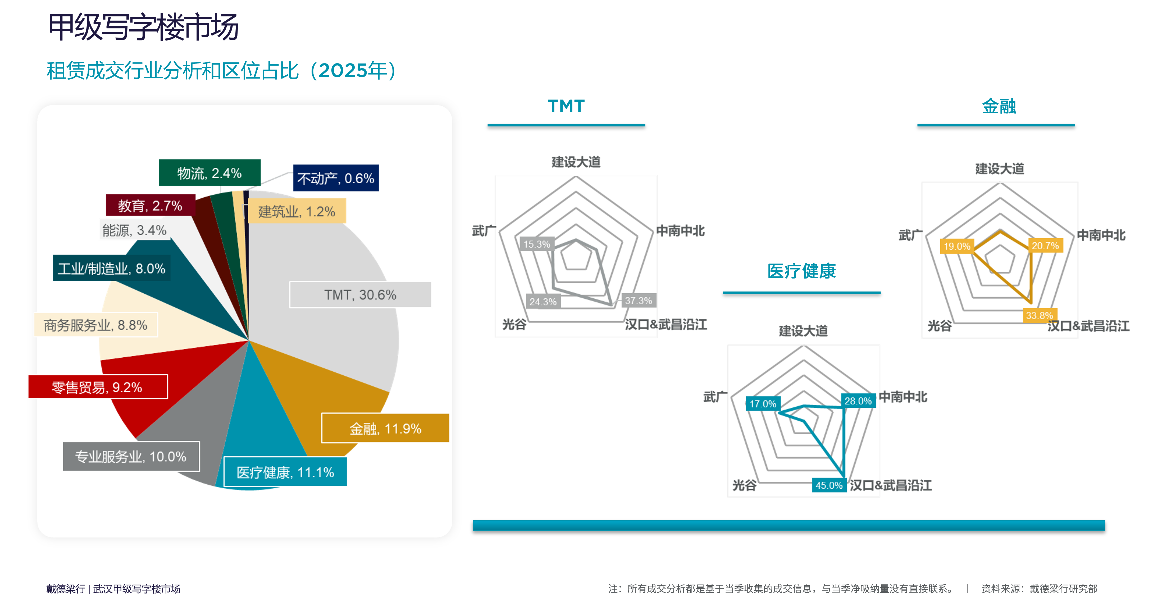
Core Insights - The Wuhan Grade A office market is expected to experience a significant increase in supply, with approximately 1.12 million square meters set to be added over the next four years, primarily concentrated in the Hankou and Wuchang riverside areas [1][4]. Grade A Office Market Overview - In 2025, the Wuhan Grade A office market will see an addition of about 230,000 square meters, raising the total stock in the core business district to 3.433 million square meters [4]. - The TMT (Technology, Media, and Telecommunications) sector is projected to be the main driver of leasing activity, accounting for 35.9% of the new space leased in 2025 [4][6]. - Average rental rates for Grade A offices in Wuhan fell to 73.3 yuan per square meter per month, a decrease of 11.2% year-on-year, while the vacancy rate rose to 39.1%, an increase of 2.7 percentage points compared to the previous year [5]. Market Dynamics and Trends - The overall demand for Grade A office space in Wuhan is undergoing a phase of contraction due to cautious expansion attitudes among companies, with a net absorption of 59,000 square meters in 2025, reflecting a year-on-year decline of 33.4% [5][6]. - Operators are adopting diversified leasing strategies, including co-working spaces and customized services, to attract tenants amid rising competition and increased vacancy rates [5][6]. Sector-Specific Demand - The main sectors supporting the Grade A office leasing market in 2025 are TMT, finance, and healthcare, contributing 30.6%, 11.9%, and 11.1% respectively to the leasing activity [6]. - Cost control remains a core driver for relocations, accounting for 58.3% of demand, while new demand remains limited [6]. Future Outlook - The competition in the Grade A office market is expected to intensify, particularly along the Yangtze and Han rivers, challenging landlords to enhance operational efficiency and differentiate their offerings [6].

港股医药IPO热潮汹涌!资本追求变了!
Sou Hu Cai Jing· 2026-01-13 08:43
中国商报(记者 马嘉)2025年,港交所医疗健康企业IPO热潮涌动:年初脑动极光鸣锣开市,年末AI制 药独角兽登场。数据显示,2025年超20家医疗健康企业在港交所上市,数量接近2022-2024年三年总 和。 多位业内人士告诉中国商报记者,2025年医疗健康行业资本化呈现新特征:年初企业争相递表,年中明 星企业募资近百亿港元,年末多家新股首日破发。这一系列现象标志着行业进入新阶段。从过去追求管 线数量的"粗放扩张",转向如今深耕临床与商业价值的"精细化运营"。 2025年港股生物医药板块明显的估值修复与赚钱效应,吸引了更多企业寻求上市。图为某药企研发人员 在进行分析检测实验。(资料图,图片由CNSPHOTO提供) 资金向"头部"与"硬科技"集中 在2025年的港股医疗健康板块上,资本呈现"头部聚集"与"硬科技偏好"特征:头部企业与细分赛道龙头 受青睐,而部分企业则面临融资困境。 以年中上市的恒瑞医药为例,其募资额约为98.9亿港元,不仅是近5年港股医药板块的最大IPO,更吸引 了包括新加坡政府投资公司、高瓴资本在内的顶级基石投资者。弗若斯特沙利文大中华区生命科学事业 部咨询总监张辰阳直言,这充分证明了全球资 ...

JPM 2026 | 营收跳涨70%后,布鲁克CEO抛出全新战略目标
仪器信息网· 2026-01-13 03:56
Core Insights - The article highlights Brook's strategic shift towards refined operations, focusing on profit margins and EPS growth, alongside a significant annual cost reduction plan of $120 million [1][3][2]. Strategic Shift - Brook has transitioned from an aggressive acquisition strategy to a focus on operational efficiency, marking a pause in its expansion efforts after achieving a 12% compound annual growth rate over the past five years [3]. - The new strategy, dubbed Project Accelerate 3.0 (PA3), emphasizes maximizing operational efficiency rather than merely pursuing revenue growth [3]. Market Implications - This strategic pivot signals a more resilient pricing strategy in the high-end market, indicating a shift in global competition from mere parameter comparisons to comprehensive performance evaluations [5]. Technological Innovations - Brook is betting on the "post-genomics era," focusing on proteomics and spatial biology, with the launch of two significant products: CosMx WTX for spatial biology and the timsOmni mass spectrometry platform for top-down proteomics [7]. - CosMx WTX integrates NanoString technology to cover over 18,000 RNA targets, enhancing pathological research capabilities [7]. - The timsOmni platform represents a milestone in protein analysis, transitioning from piecemeal approaches to comprehensive profiling [7]. Additional Business Segments - Brook is also capitalizing on two lucrative segments: semiconductor technology and automated AI laboratories, which have contributed over $300 million in revenue with high profit margins [8]. - The semiconductor segment is driven by the demand for X-ray and atomic force microscopy (AFM) in chip manufacturing, while the automated AI laboratory initiative promotes a vision of "unmanned laboratories" to global pharmaceutical companies [8].

福建圣农发展股份有限公司2025年12月份销售情况简报
Shang Hai Zheng Quan Bao· 2026-01-12 18:12
Sales Performance - In December 2025, the company achieved a sales revenue of 1.861 billion yuan, representing an 11.03% increase year-on-year and a 2.84% increase month-on-month [2] - The poultry breeding and processing segment generated chicken sales revenue of 1.385 billion yuan, up 5.18% year-on-year and up 9.14% month-on-month [2] - The deep-processed meat products segment reported sales revenue of 948 million yuan, showing a significant year-on-year increase of 50.87%, but a month-on-month decrease of 2.97% [2] Sales Volume - The sales volume for chicken in the poultry breeding and processing segment reached 147,600 tons, marking a 14.28% increase year-on-year and a 7.54% increase month-on-month [2] - The sales volume for deep-processed meat products was 49,200 tons, reflecting a year-on-year increase of 51.01%, but a month-on-month decrease of 6.01% [2] Cost Management - The company effectively controlled overall costs through refined operations and dynamic cost management, achieving a reduction of over 5% in comprehensive meat production costs year-on-year for 2025 [3] - Continuous optimization of product structure has increased the proportion of high-value-added deep-processed products, enhancing profitability resilience [3]

圣农发展:2025年12月实现销售收入18.61亿元,同比增长11.03%
Ge Long Hui· 2026-01-12 09:43
Core Viewpoint - The company reported a sales revenue of 1.861 billion yuan for December 2025, marking an 11.03% increase year-on-year and a 2.84% increase month-on-month [1] Group 1: Sales Performance - The poultry farming and processing segment generated chicken sales revenue of 1.385 billion yuan, reflecting a 5.18% year-on-year increase and a 9.14% month-on-month increase [1] - The deep-processed meat products segment achieved sales revenue of 948 million yuan, showing a significant 50.87% increase year-on-year, although it experienced a month-on-month decline of 2.97% [1] Group 2: Sales Volume - In December, the poultry farming and processing segment sold 147,600 tons of chicken, which is a 14.28% increase compared to the same month last year and a 7.54% increase from the previous month [1] - The deep-processed meat products segment sold 49,200 tons, representing a 51.01% year-on-year increase, but a month-on-month decrease of 6.01% [1] Group 3: Cost Management and Product Strategy - The company effectively controlled overall costs despite rising expenses due to seasonal factors, achieving a more than 5% year-on-year reduction in comprehensive meat production costs for the entire year of 2025 [1] - The company continues to optimize its product structure by increasing the proportion of high-value-added deep-processed products, thereby enhancing its profitability resilience [1]
2025年中国上海零售行业政策、发展历程、销售规模、竞争格局、业态结构及发展趋势研判:行业整体仍保持在较高水平,节假日期间消费活力显著提升[图]
Chan Ye Xin Xi Wang· 2026-01-12 01:26
Core Insights - Shanghai has established itself as one of the top three "Best Business Cities in Mainland China" since 2014, showcasing strong performance in the retail sector [6][7] - In 2024, Shanghai's total retail sales of consumer goods reached 17,940.19 billion yuan, with a slight decline of 3.1% year-on-year [7] - The retail sales structure is dominated by brand specialty stores, online retail, and specialty shops, indicating a shift in consumer preferences [7][8] Retail Industry Overview - The retail industry is defined as the sale of goods directly to consumers for personal or public consumption, encompassing various formats such as supermarkets, convenience stores, and online shops [2] - Shanghai's retail sector is characterized by a diverse and multi-layered structure, catering to different consumer needs [4] Current Development Status - The retail industry plays a crucial role in the economy, influencing production, consumption, and employment [6] - In 2024, the retail sales figures for food, clothing, daily necessities, and fuel were 3,721.33 billion yuan, 4,341.81 billion yuan, 9,354.46 billion yuan, and 522.60 billion yuan respectively, with food sales showing a 1.6% increase year-on-year [7] Sales Trends and Consumer Behavior - Major retail formats such as brand specialty stores and online retail are experiencing growth, with online sales showing a significant increase during key holidays [8] - During the Spring Festival, total online and offline consumption reached 56.9 billion yuan, marking a notable year-on-year increase [8] Policy Environment - Shanghai has implemented various policies to optimize the retail environment, including the launch of a pilot program for retail innovation [9] - The city aims to enhance the retail sector's contribution to the economy through multi-dimensional reforms [9] Competitive Landscape - The retail market in Shanghai is highly competitive, with both international giants like Carrefour and local players like Bailian Group vying for market share [12] - The rise of e-commerce platforms such as Tmall and JD.com has intensified competition, impacting traditional retail businesses [12] Future Development Trends - The retail industry in Shanghai is expected to evolve towards "refined operations," "green sustainability," and "instant retail," driven by changing consumer demographics and preferences [12][16] - The increasing share of online retail sales indicates a significant shift in consumer shopping habits and a transformation in the retail landscape [16]


“网红第一大楼”为何冷清了? 杭州直播电商产业在重构中新生
Zheng Quan Shi Bao· 2026-01-07 22:28
Core Viewpoint - The decline in rental prices and the reduction of tenants in the Regin International Center in Hangzhou, a symbol of the live-streaming economy, does not indicate the retreat of the live-streaming e-commerce industry but rather a transition from rapid growth to refined operations [1][3]. Industry Transition - The live-streaming e-commerce industry is moving from a phase of "barbaric growth" to a stage of "mature differentiation," driven by increased competition, stricter regulations, and the need for professionalization [3][4]. - The industry is experiencing a shift from a focus on traffic acquisition to refined operations, emphasizing efficiency and sustainability [5][6]. Market Dynamics - The rental prices in the Regin International Center have decreased by 500 to 1000 yuan per month, reflecting normal market adjustments rather than a decline in the industry [2][3]. - The number of businesses related to live-streaming in the Regin International Center has decreased, with only 25% of the tenants being involved in live-streaming-related activities [2]. Growth Projections - The live-streaming e-commerce market in China is projected to reach a transaction scale of 5.33 trillion yuan in 2024, with a year-on-year growth of 8.31%, and is expected to increase to 5.6 trillion yuan in 2025 [4]. Technological Advancements - The integration of AI and new technologies is becoming crucial in various aspects of the live-streaming e-commerce industry, including product selection, efficiency optimization, and content creation [5][6]. - Companies are investing heavily in technology to enhance operational efficiency, with some institutions developing comprehensive live-streaming service platforms [6]. Competitive Landscape - Hangzhou remains a vital hub for live-streaming e-commerce, housing the largest number of MCN institutions and live-streaming practitioners in China, which contributes to its unmatched industry concentration [7][8]. - The city has a complete ecosystem for live-streaming e-commerce, including upstream supply chains, midstream live-streaming institutions, and downstream e-commerce platforms [9]. Talent and Resource Availability - The availability of abundant resources and skilled personnel in Hangzhou continues to attract live-streaming e-commerce professionals, reinforcing the city's position as a leading center for the industry [7][8].
长视频平台差异化之战,如何闯出新增量?|年终盘点
Sou Hu Cai Jing· 2026-01-07 20:19
Core Insights - The long video market in 2025 has shown resilience with a variety of high-quality content capturing audience attention throughout the year [1][3] - Despite challenges from short-form content, the intrinsic value of long video storytelling and emotional resonance remains irreplaceable, highlighting a strong demand from users and society [3] - Platforms are adapting quickly and innovating with differentiated content strategies to explore new market opportunities [3][4] Company Strategies - iQIYI has focused on integrating short and long content while expanding its international presence, achieving significant growth in overseas revenue and a 40% year-on-year increase in membership income [4] - Tencent Video continues to emphasize high-quality content, particularly in IP adaptations and comedy, with several successful series based on novels demonstrating its stable content quality [6] - Youku has excelled in long-form content, producing critically acclaimed series such as "The Human Trafficking Incident," which has achieved a Douban rating of 8.7, indicating a strong foothold in the suspense genre [9] - Mango TV maintains a strong position in the variety show sector, capturing 36.5% of the market share in the first half of 2025, with several shows dominating viewership [11] - Migu Video has leveraged its sports content to create a unique ecosystem, integrating high-profile sports events with diverse entertainment offerings, thus establishing a solid growth path [12][15] Market Trends - The differentiation strategies adopted by platforms have led to a healthy competitive environment, showcasing their production and operational capabilities through a series of high-quality content releases [12] - The integration of online and offline experiences is becoming crucial, with platforms exploring ways to enhance viewer engagement through immersive experiences linked to their content [16][18] - Breaking down barriers between different content genres has proven effective in attracting new audience segments, as seen with Migu Video's cross-promotional efforts between sports and drama [19][21] - The competition is evolving into a resource integration phase, where platforms are leveraging their ecosystem to enhance content production, marketing, and distribution [22][23]

古猫科技创始人汤诗伟:数字文博不缺载体与技术,需要的是精细化运营
Mei Ri Jing Ji Xin Wen· 2026-01-06 14:27
Core Viewpoint - The article discusses how a cultural and creative enterprise, Guma Technology, is transforming museums through digital technology and innovative storytelling, making them more accessible and engaging to the public [1] Group 1: Company Background - Guma Technology was founded by Tang Shiwei, who previously served as the director of the ancient architecture department at the Chengdu Archaeological Research Institute, emphasizing the need for quality content and sustainable operations in the digital cultural heritage sector [4][8] - The company aims to make museums not only popular but also lively, focusing on modern technology to enhance public interest in Chinese culture and artifacts [9] Group 2: Industry Challenges and Opportunities - The museum and ancient architecture sectors face challenges in reaching the public and creating lasting impact, as highlighted by Tang's experiences with the ancient Shu Kingdom's heritage application project [7] - The rise of digital technology and new communication methods presents an opportunity for the cultural heritage sector to engage with a broader audience [7][9] Group 3: Digital Innovation and Growth - Guma Technology has rapidly established itself in the digital cultural heritage field, collaborating with around 100 museums, including prominent ones like the Sanxingdui Museum and the Dunhuang Academy [12] - The company has successfully ventured into short video content, gaining over 500,000 followers on platforms like Douyin and Bilibili, showcasing the importance of content output and IP development in the cultural heritage sector [12][14] Group 4: Future Trends - The digital cultural heritage industry lacks quality content and sustainable operational capabilities, which are crucial for long-term success [14] - Tang emphasizes the importance of continuous output and establishing new identities in a content-driven era, indicating a shift towards more engaging and innovative approaches in the sector [14]

2026年公寓管理系统哪个好用?公寓管理系统软件推荐
Xin Lang Cai Jing· 2026-01-05 11:45
Core Insights - The apartment rental industry has fully entered a refined operational stage by 2026, with property management systems becoming essential for resource control, financial security, and compliance operations [1][9] - Selecting an appropriate system is crucial for adapting to the scale and type of operations, whether for small landlords or large apartment operators, to achieve cost reduction and efficiency [1][9] System Summaries - **Yumeng Manager**: Targets medium to large multi-type apartments, focusing on comprehensive compliance and customization. It has extensive functionality covering all processes from property management to financial oversight, with strong customization capabilities for complex needs [10][15] - **All Room Pass**: Aimed at small to medium-sized centralized apartments, emphasizing financial control and operational efficiency. It features a high level of financial module detail but has limited customization capabilities [11] - **Yuxiaoer**: Designed for small-scale apartments and sub-leasing, it offers basic management needs with a user-friendly interface. However, it lacks advanced features for larger operations [12][13] - **Landlord Tool**: Focuses on individual small landlords with free basic functionalities for entry-level management. It has weak data security and lacks compliance features, making it unsuitable for large-scale operations [12][13] - **Smart Small Nest**: Targets decentralized properties and small operators, combining smart hardware with a SaaS system. It offers basic financial compliance but lacks advanced features for complex management needs [14] Why Choose Yumeng Manager? - Yumeng Manager is more suitable for operators with large-scale needs, emphasizing financial security and compliance, and is adaptable for multi-type management [15] - Its banking direct connection and no fund pool model ensure that funds reach accounts directly, aligning with the industry's strict regulatory requirements for 2026 [15] - The system's comprehensive functionality covers all operational aspects, allowing for seamless management without switching between tools, and its strong customization capabilities cater to various operational scenarios [15][16] - With over a decade of industry experience, Yumeng Manager effectively addresses core pain points in apartment operations, meeting current compliance and efficiency demands while supporting future growth [15][16]