线上消费

Search documents
江苏商务半年报:消费领跑全国,外贸外资彰显韧性
Zhong Guo Fa Zhan Wang· 2025-08-04 12:24
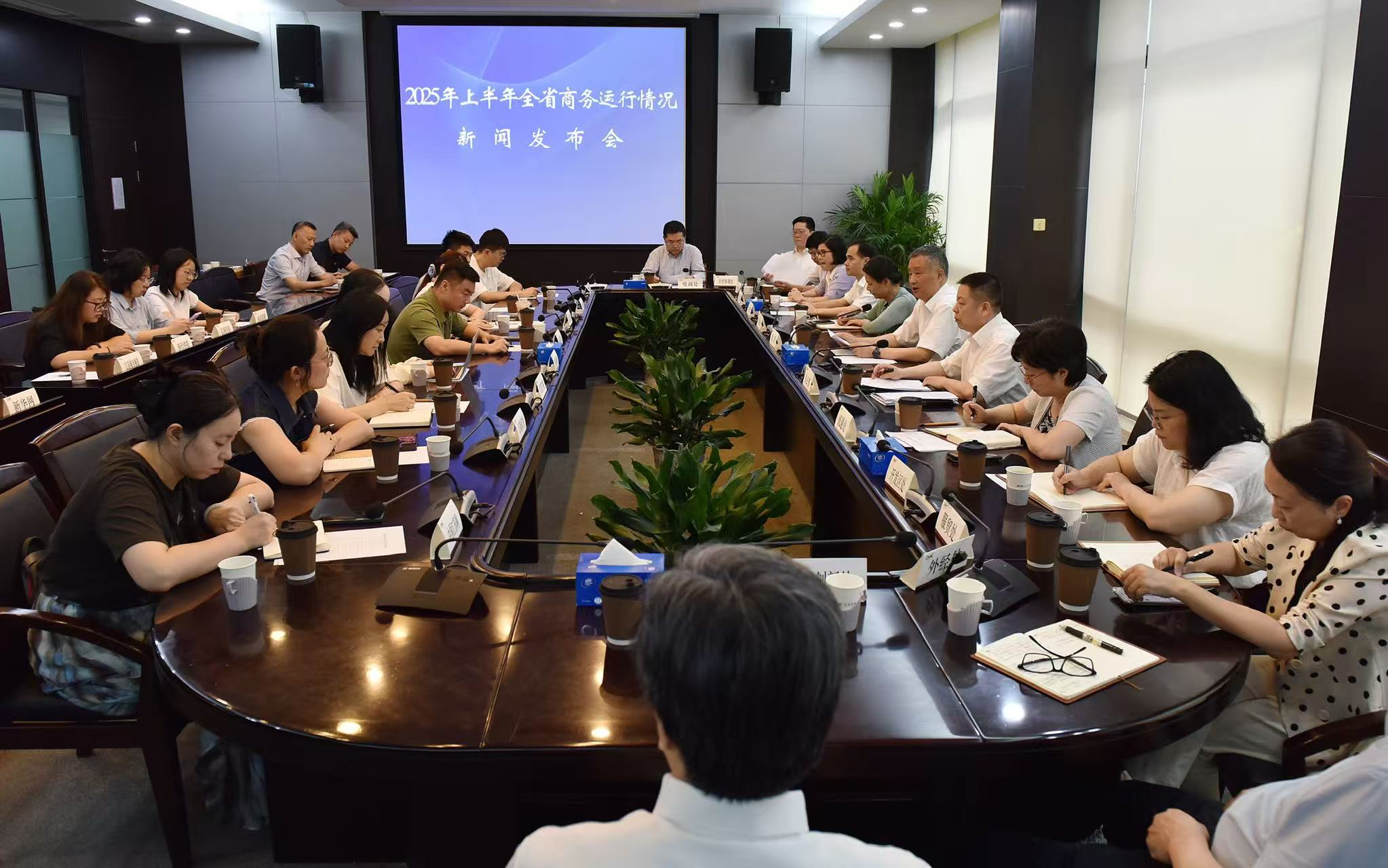
Group 1: Consumer Market Performance - Jiangsu's social retail sales reached 2.39 trillion yuan, a year-on-year increase of 5%, ranking first in the nation [3] - The "old for new" policy for major consumer goods contributed 3.7 percentage points to growth, with retail sales of covered goods reaching 384.7 billion yuan [3] - Online retail sales grew by 7.9% to 636.24 billion yuan, ranking third nationally [3] - The top 100 retail enterprises achieved sales of 294.85 billion yuan, with a growth rate of 14.8% [3] Group 2: Foreign Trade Resilience - Jiangsu's total import and export value reached 2.81 trillion yuan, a year-on-year increase of 5.2%, surpassing the national average [6] - Exports amounted to 1.88 trillion yuan, growing by 9.4% [6] - Trade with Belt and Road countries reached 1.39 trillion yuan, a growth of 9.5%, accounting for nearly half of the total [6] - ASEAN became the largest export market with a growth rate of 28.4% [6] Group 3: Foreign Investment Growth - Actual foreign investment in Jiangsu reached 11.54 billion USD, accounting for 19.5% of the national total, with a year-on-year increase of 0.8 percentage points [7] - The service sector's foreign investment share increased by 0.8 percentage points [7] - Significant growth in foreign investment from Germany (+107.4%), Luxembourg (+222.5%), and Japan (+165.4%) [7] Group 4: International Cooperation and Investment - Jiangsu's outbound investment projects increased by 806, with actual investment of 4.29 billion USD, a growth of 8.1% [8] - 62.3% of projects and 65.2% of investment were directed towards Belt and Road countries [8] - The establishment of the "China-Central Asia Trade Cooperation Platform" enhances regional trade [8] Group 5: Open Platforms and Economic Zones - Jiangsu has 124 provincial-level economic development zones, leading the nation [9] - The implementation of "50 measures for institutional opening" has resulted in over 450 innovative outcomes [9] - The construction of 18 international cooperation parks is accelerating, fostering significant industrial clusters [9] Group 6: Future Initiatives - Plans to organize over 180 overseas exhibitions to expand international markets [10] - Continued efforts to implement the "22 measures" to stabilize foreign investment [10] - Initiatives to enhance night economy through 50 night consumption zones [10]

31省份消费版图
2 1 Shi Ji Jing Ji Bao Dao· 2025-08-02 04:30
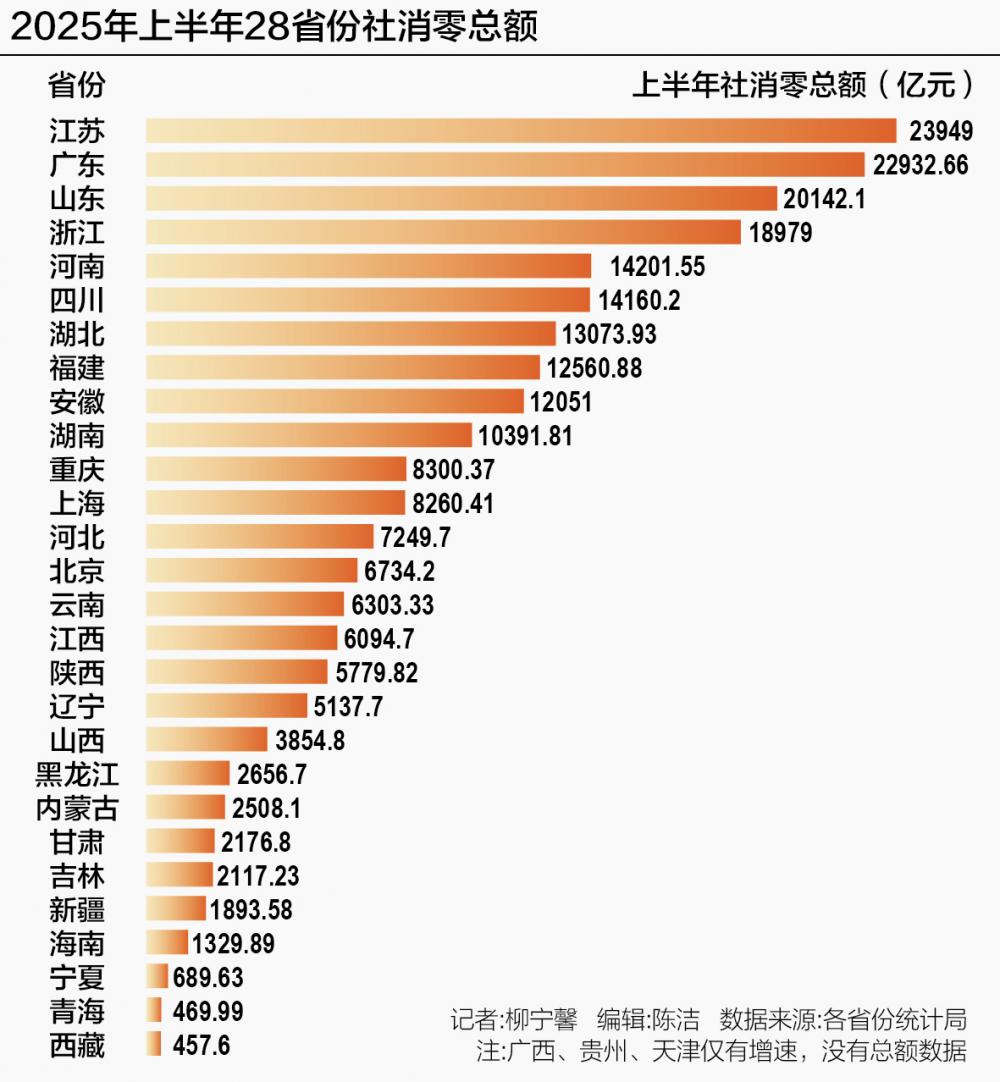
Core Insights - Domestic demand contributed 68.8% to China's GDP growth in the first half of the year, highlighting its role as the main driver of growth [1] - The consumption reports from 31 provinces indicate the initial effectiveness of strategies aimed at expanding domestic demand [1] Consumption Growth - The top ten provinces by total retail sales of consumer goods (社消零) in the first half of the year are Jiangsu, Guangdong, Shandong, Zhejiang, Henan, Sichuan, Hubei, Fujian, Anhui, and Hunan, with Jiangsu, Guangdong, and Shandong exceeding 2 trillion yuan [1][5] - 19 provinces outperformed the national retail sales growth rate of 5%, with 11 provinces achieving growth rates of at least 6%, led by Hainan at 11.2% [1][5] - Hainan's total retail sales reached 1329.89 billion yuan, growing 11.2% year-on-year, with significant growth in automobile sales, particularly in new energy vehicles [5][6] Regional Performance - Jiangsu, Guangdong, and Shandong are the top three provinces in retail sales, with Jiangsu leading at 23949 billion yuan, followed by Guangdong at 22932.66 billion yuan and Shandong at 20142.1 billion yuan [5][6] - The rankings of the top ten consumption provinces have shifted, with Fujian surpassing Anhui to become the eighth largest [6] Consumption Drivers - The main drivers of consumption growth include trade-in policies and the rise of online shopping, with structural factors such as effective domestic demand policies and rapid growth in e-commerce playing significant roles [9][10] - In Fujian, the implementation of trade-in policies and online consumption led to a total retail sales figure of 12560.88 billion yuan, with a growth rate of 6% [10] Future Outlook - The second half of the year is expected to focus on emerging consumption and service consumption, with many provinces planning to enhance trade-in policies and promote service consumption activities [2][11] - The government plans to increase fiscal support for trade-in subsidies to 300 billion yuan, potentially driving an additional 2 trillion yuan in consumption [11] Service Consumption Trends - New consumption hotspots are emerging, particularly in technology and high-quality exhibitions, which are expected to drive service consumption [12][13] - Various provinces are implementing specific actions to enhance service consumption, including cultural tourism and sports events [13][14]
31省份消费版图:海南上半年增速领先,苏粤鲁拿下总量前三
21世纪经济报道· 2025-08-01 13:35
Core Viewpoint - The article highlights the significant contribution of domestic consumption to China's GDP growth, with a focus on the performance of various provinces in the first half of the year and the strategies being implemented to further stimulate consumption [3][4]. Group 1: Consumption Growth and Provincial Performance - In the first half of the year, domestic consumption contributed 68.8% to China's GDP growth, making it the main driver of growth [3]. - The top ten provinces by total retail sales of consumer goods (社消零) are Jiangsu, Guangdong, Shandong, Zhejiang, Henan, Sichuan, Hubei, Fujian, Anhui, and Hunan, with Jiangsu, Guangdong, and Shandong exceeding 2 trillion yuan [3][6]. - Nineteen provinces outperformed the national retail sales growth rate of 5%, with eleven provinces achieving growth rates of at least 6%, led by Hainan at 11.2% [6][4]. Group 2: Consumption Policies and Future Outlook - The central government emphasizes the need to enhance the endogenous power of consumption and effectively release domestic demand potential as a key task for the second half of the year [4]. - New consumption and service consumption are expected to be focal points for expanding domestic demand, with various provinces planning to implement policies to stimulate consumption in sectors like dining and tourism [4][12]. - The "old for new" policy and online consumption are identified as major drivers of consumption growth, with significant increases in retail sales for home appliances and new energy vehicles in provinces like Fujian and Hainan [11][12]. Group 3: Income Levels and Consumption Patterns - In the first half of the year, eleven provinces had a per capita disposable income exceeding 20,000 yuan, with Shanghai and Beijing leading at over 45,000 yuan [8][9]. - The article notes a shift in consumption potential from first-tier cities to central and western provinces, where residents are more willing to spend under the current consumption stimulus policies [9][10]. Group 4: Emerging Consumption Trends - The article discusses the rise of new consumption hotspots, particularly in technology and service sectors, with events like the World Artificial Intelligence Conference showcasing innovative products that attract consumer interest [14][15]. - Provinces are focusing on enhancing service consumption through various initiatives, including cultural tourism and sports events, to stimulate economic activity [15][16].

超市集体低迷 社区团购倒逼行业变革
Bei Jing Shang Bao· 2025-07-28 03:04
Core Insights - The community group buying model has significantly impacted the supermarket industry, leading to a decline in performance for many supermarkets in the first quarter [1][2] - Despite the challenges posed by community group buying, there is a recognition that it can complement physical supermarkets if managed correctly [1][6] - The rapid expansion of community group buying, fueled by capital investment, has led to a price war that undermines its original purpose of serving consumers and suppliers [3][6] Supermarket Performance - In the first quarter, 12 out of 13 supermarkets reported a year-on-year decline in revenue, with four experiencing double-digit declines [2] - Some supermarkets have noted a stabilization in sales performance compared to previous periods, despite the overall downturn [2] - The decline in foot traffic has been observed, although the average transaction value has increased, indicating a shift in consumer behavior [2][4] Community Group Buying Impact - Community group buying has introduced competitive advantages such as lower inventory and higher turnover rates, but the price differences between community group buying and supermarkets can be exaggerated due to capital influence [2][6] - The model has evolved into a low-price competition arena, which has led to conflicts with traditional supermarkets [3][6] - Regulatory interventions have started to bring some stability back to the community group buying sector [6] Consumer Behavior Changes - The pandemic has accelerated the shift towards online shopping, with consumers developing new purchasing habits [4][5] - Certain products, particularly those requiring sensory evaluation, continue to drive consumers to physical stores, highlighting the need for supermarkets to enhance their offerings [4][6] - Supermarkets are increasingly recognizing the importance of online sales and are adapting their strategies accordingly [4][6] Industry Adaptation - Supermarkets are adjusting their operations in response to the challenges posed by community group buying and e-commerce [5][6] - There is a focus on improving product offerings and service quality to better meet consumer needs [6][7] - The future of physical retail lies in differentiation rather than direct competition with e-commerce on standardized products [7]


湖南智能绿色消费需求旺盛
Sou Hu Cai Jing· 2025-07-22 01:22
Group 1 - The core viewpoint of the article highlights the robust growth in consumer demand for smart and green products, driven by the implementation of the old-for-new consumption policy in Hunan Province, leading to a significant increase in retail sales [1][4]. - In the first half of the year, Hunan Province's total retail sales of consumer goods reached 1,039.181 billion yuan, with a year-on-year growth of 6.2%, surpassing the national average growth rate by 1.2 percentage points [1][2]. - The old-for-new policy has notably boosted retail sales in various categories, with telecommunications equipment, home appliances, and cultural office supplies seeing increases of 71.6%, 55.2%, and 35.1% respectively, contributing 1.3 percentage points to the overall retail sales growth [2][4]. Group 2 - Basic living goods experienced a rapid retail growth of 11.4% year-on-year, with beverages, grain and oil products, and daily necessities growing by 16.9%, 13.5%, and 10.1% respectively [3]. - The demand for high-efficiency home appliances surged by 77.6%, alongside significant growth in sports and entertainment products (26.5%) and wearable smart devices (22.5%), indicating a shift towards intelligent and green consumption [4]. - Online retail sales in Hunan Province grew by 13.0% year-on-year, with physical goods online retail sales increasing by 10.1%, reflecting a growing trend in e-commerce [5].
线上消费ETF基金: 平安中证沪港深线上消费主题交易型开放式指数证券投资基金2025年第2季度报告
Zheng Quan Zhi Xing· 2025-07-17 12:23
Group 1 - The report covers the performance of the Ping An CSI Hong Kong-Shanghai-Deep Online Consumption Theme ETF for the second quarter of 2025, highlighting its investment strategy and financial indicators [2][3][9] - The fund aims to closely track the performance of its benchmark index, the CSI Hong Kong-Shanghai-Deep Online Consumption Theme Index, using a full replication strategy [2][9] - As of the end of the reporting period, the fund's total shares amounted to 33,758,908, with a net asset value of 0.9295 RMB per share and a net value growth rate of 1.60% [3][9][13] Group 2 - The fund's investment strategy includes stock investments, stock index futures, government bond futures, and stock options, with a focus on minimizing tracking deviation and error [2][9] - The fund's major financial indicators show a realized income for the reporting period, which includes interest income and investment income, after deducting relevant expenses [3][9] - The fund's asset allocation at the end of the reporting period was primarily in stocks, with a significant portion (52.60%) invested in Hong Kong stocks through the Stock Connect mechanism [10][11] Group 3 - The fund's performance compared to its benchmark shows a positive return, with the benchmark yield at 0.79% during the same period [9][12] - The fund manager has adhered to legal regulations and internal policies, ensuring compliance and protecting the interests of fund shareholders [8][9] - The report indicates that there were no abnormal trading activities during the reporting period, and all transactions were conducted in accordance with fair trading practices [8][9]

美国EDA三巨头解禁,AI人工智能ETF(512930)回调整固,消费电子ETF(561600)交投活跃
Sou Hu Cai Jing· 2025-07-04 02:46
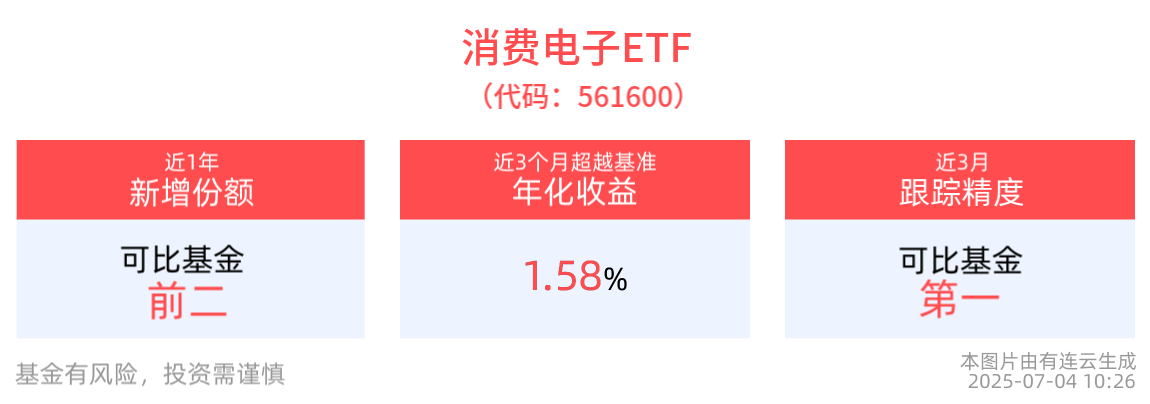
Group 1: AI Industry Insights - The AI theme index (930713) shows mixed performance among its constituent stocks, with Runze Technology (300442) leading with a 4.95% increase, while Fudan Microelectronics (688385) is the biggest loser [1] - The AI ETF (512930) has seen a slight decline of 0.37%, with a latest price of 1.35 yuan, and a trading volume of 35.6 million yuan during the session [1] - The U.S. Department of Commerce has lifted the requirement for semiconductor design software vendors to apply for government licenses to sell products to China, allowing companies like Siemens, Synopsys, and Cadence to resume services in China [1] Group 2: Consumer Electronics Sector - The Consumer Electronics Index (931494) has shown varied performance, with Jingwang Electronics (603228) leading with a 7.36% increase, while Lens Technology (300433) is the biggest loser [3] - The Consumer Electronics ETF (561600) has a latest price of 0.81 yuan, with a net value increase of 23.48% over the past year [3][4] - The trading volume for the Consumer Electronics ETF was 3.54 million yuan, with an average daily trading volume of 12.1 million yuan over the past week [4] Group 3: Online Consumption Trends - The Online Consumption Index (931481) has shown mixed results, with Giant Network (002558) leading with a 7.59% increase, while Alibaba Health (00241) is the biggest loser [6] - The Online Consumption ETF (159793) has a latest price of 0.9 yuan, with a net value increase of 42.80% over the past year [6][14] - The top ten weighted stocks in the Online Consumption Index account for 52.54% of the index, including Tencent Holdings (00700) and Alibaba Group (09988) [14] Group 4: Market Dynamics and Future Outlook - The "hard technology" sector is expected to perform well under the influence of AI, with domestic computing power chips and related infrastructure projected to see rapid growth in 2024 and maintain double-digit growth in Q1 2025 [2] - The valuation system in the technology sector is anticipated to be restructured, particularly in semiconductor manufacturing and design, which are areas of low domestic production [2] - The consumer electronics sector, particularly companies in the Apple supply chain, has seen valuation corrections, but leading companies in PCB and ODM are expected to benefit from AIoT and automotive electronics demand [2]
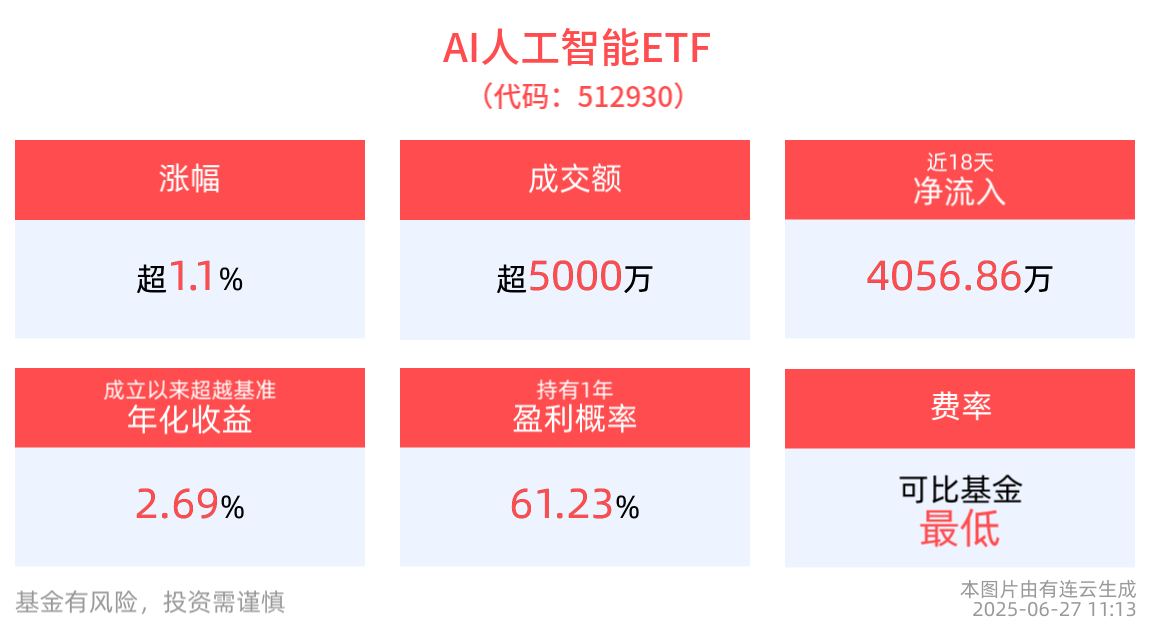
小米YU7赚足眼球,AI眼镜1999起!人工智能ETF(512930)上涨超1%,消费电子ETF(561600)红盘上扬
Xin Lang Cai Jing· 2025-06-27 03:58
Group 1: AI and Technology Sector - The CSI Artificial Intelligence Theme Index (930713) rose by 1.09%, with notable gains from component stocks such as Chipone Technology (688521) up 9.01% and Zhongji Xuchuang (300308) up 4.29% [1] - Xiaomi launched its first SUV, the Xiaomi Yu7, alongside AI glasses, which are positioned as a personal smart device with a starting price of 1999 yuan and a battery life of 8.6 hours, outperforming competitors [1] - The AI glasses are described as a combination of glasses, first-person camera, headphones, and a personal AI assistant, indicating a trend towards integrated smart devices [1] Group 2: Consumer Electronics Sector - The CSI Consumer Electronics Theme Index (931494) increased by 1.49%, with Chipone Technology (688521) also performing well in this sector, up 9.01% [5] - The index includes companies involved in component production and consumer electronics design, reflecting the overall performance of the sector [13] Group 3: Online Consumption Sector - The CSI Hong Kong and Shanghai Online Consumption Theme Index (931481) rose by 0.96%, with significant increases from stocks like Ping An Good Doctor (01833) up 13.29% and Alibaba Health (00241) up 10.72% [8] - This index tracks companies engaged in online shopping, digital entertainment, online education, and telemedicine, highlighting the growth in online consumption [16]
今年前5个月经济总体保持平稳运行态势
Su Zhou Ri Bao· 2025-06-26 00:41
Economic Performance Overview - The city's industrial output value from January to May reached 1,906.11 billion yuan, with a year-on-year growth of 4.7% [1] - The added value of the city's industrial sector grew by 8.1% year-on-year [1] - Among 35 industrial sectors, 24 reported year-on-year growth, resulting in a growth coverage of 68.6% [1] Industrial Sector Insights - The computer, communication, and other electronic equipment manufacturing sectors saw output growth of 7.6%, while electrical machinery and equipment manufacturing grew by 6.7% [1] - High-tech industries within the industrial sector achieved a year-on-year output growth of 7.1%, accounting for 56.2% of the total industrial output, an increase of 1.9 percentage points year-on-year [1] Service Sector Performance - The city's service sector generated operating income of 200.38 billion yuan from January to April, reflecting a year-on-year increase of 8.6% [1] - The leasing and business services sector experienced a 12.3% increase in operating income, while transportation, storage, and postal services grew by 12.0% [1] Investment Trends - Fixed asset investment in the city totaled 262.0 billion yuan from January to May, with a slight year-on-year increase of 0.1% [2] - Industrial investment reached 92.03 billion yuan, marking a significant year-on-year growth of 16.1% and accounting for 35.1% of total fixed asset investment, an increase of 4.8 percentage points [2] - Infrastructure investment grew by 10.1% year-on-year, and investment in high-tech industries rose by 10.8% [2] Consumer Market Dynamics - The total retail sales of consumer goods in the city amounted to 385.27 billion yuan from January to May, with a year-on-year growth of 4.2% [2] - Retail sales of household appliances and audio equipment surged by 22.8%, while computer and related products saw a remarkable increase of 240.2% [2] - Online retail sales through the wholesale and retail sector increased by 15.0% year-on-year, contributing 2.0 percentage points to the overall growth of retail sales [2] Trade Performance - The total import and export value reached 1,076.145 billion yuan from January to May, reflecting a year-on-year growth of 6.2% [2] - Exports totaled 679.543 billion yuan, growing by 8.6%, while imports reached 396.602 billion yuan, with a growth of 2.3% [2] - General trade exports increased by 15.4%, accounting for 46.6% of total exports, an increase of 3 percentage points year-on-year [2] - Exports to emerging markets, including ASEAN and Africa, grew by 46.2% and 36.1% respectively [2] Financial Sector Overview - By the end of May, the balance of deposits in financial institutions reached 56,845.4 billion yuan, with a year-on-year growth of 5.1% [3] - The balance of loans in financial institutions was 59,143.9 billion yuan, reflecting a year-on-year increase of 6.8% [3] Consumer Price Index - The overall consumer price level in the city decreased by 0.9% year-on-year from January to May, with a decline of 1.0% in May [3] - Among eight categories of goods and services, two categories saw price increases while six experienced price declines [3]
老综合体黄金二三层咋看不见几个人
Sou Hu Cai Jing· 2025-06-23 14:12
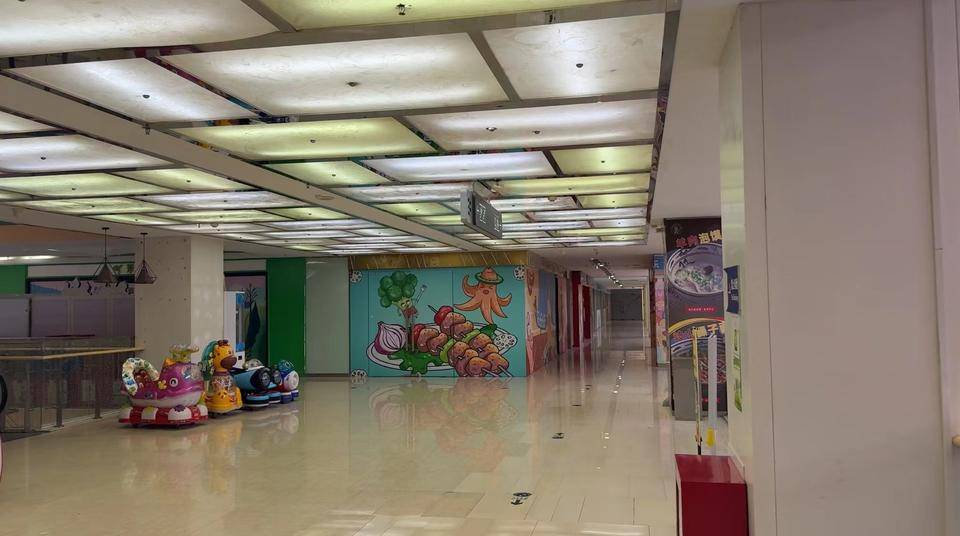
Group 1 - The decline in foot traffic at large commercial complexes, which were once popular, is attributed to the emergence of new shopping centers and changing consumer preferences towards online shopping [1][3] - Older commercial complexes are facing challenges such as outdated facilities, slow management updates, and low rates of new brand entries, making it difficult to compete with newly opened malls [3] - To attract popular brands and increase foot traffic, older malls should consider offering incentives to tenants, such as rent reductions, to enhance sales per square meter [3] Group 2 - Specific examples of declining foot traffic include the Dinghao Plaza in Jinan, where many shops, especially restaurants, have closed, leading to a stark contrast in customer presence on different floors [1] - The overall trend indicates that both new and old shopping malls are experiencing a decrease in overall revenue, with older malls being more significantly affected [3] - The need for improved environment, atmosphere, and service in commercial complexes is emphasized as a way to retain customers and boost revenue from dining and entertainment [3]