美国经济衰退

Search documents
美国最新非农就业数据远逊预期,美联储9月能降息50个基点吗?需关注哪些关键节点|国际
清华金融评论· 2025-09-06 10:00
Core Viewpoint - The August 2025 non-farm payroll data in the U.S. significantly underperformed expectations, reinforcing the anticipation of a Federal Reserve interest rate cut in September, with some institutions predicting a potential cut of 50 basis points [2][3]. Summary by Sections Non-Farm Employment Data - The U.S. Labor Department reported that non-farm employment increased by only 22,000 in August, a substantial decline from the revised 79,000 in July and far below the market expectation of 75,000 [3]. - The unemployment rate rose by 0.1 percentage points to 4.3%, marking a four-year high [3]. Market Reactions - Following the release of the employment data, the U.S. dollar index dropped nearly 0.8%, while spot gold prices surged over 1%, reaching a new historical high of $3,594.76 per ounce [3]. - The weak employment data is attributed to several factors, including job losses in manufacturing due to tariffs, federal government layoffs, and a crisis of trust in data following the dismissal of the former Labor Statistics Bureau chief [3]. Federal Reserve's Policy Implications - The disappointing non-farm data has led to a strong signal for the Federal Reserve to consider rate cuts, with market expectations for a September cut rising to 99% and some predicting a 50 basis point reduction if subsequent inflation data supports it [3]. - The Fed's dual mandate is shifting focus towards employment, as current wage growth is slowing (with hourly wages increasing by 3.7% year-on-year) and labor participation rates are recovering, but demand remains weak, reducing the necessity for rate hikes [3]. Asset Market Impact - The weakening dollar is expected to see the dollar index fall below the critical support level of 98, potentially testing the 96.5-97 range [4]. - U.S. Treasury yields are declining, with the 2-year yield dropping by 11 basis points in a single day, leading to a flight to safe-haven assets [4]. - The stock market is experiencing divergence, with technology stocks benefiting from rate cut expectations, while manufacturing and energy sectors are under pressure [4]. - Emerging markets may find opportunities, with the Chinese yuan appreciating (breaking the 7.15 level) and Hong Kong stocks (Hang Seng Index) potentially benefiting from foreign capital inflows [4]. Economic Concerns - The weak non-farm employment data not only indicates cyclical slowdown but also points to structural risks, with manufacturing and construction sectors continuing to shrink under high interest rates and tariffs [4]. - Government layoffs and a decrease in immigrant labor are further impacting supply, particularly in the construction industry [4]. Upcoming Key Events - On September 9, the annual benchmark revision of non-farm payrolls is expected to be downwardly adjusted by 600,000 to 900,000 jobs, which may further strengthen the case for rate cuts [6]. - The August CPI data will be released on September 11; a decline in inflation would solidify the rationale for rate cuts, while a rebound could lead to market volatility [6]. - The Federal Reserve's meeting on September 16-17 will determine whether the rate cut will be 25 or 50 basis points, depending on the aforementioned data [6]. Conclusion - The recent non-farm data serves as a critical catalyst for the Federal Reserve's policy shift, with a September rate cut now almost certain. However, attention must be paid to the potential discrepancies between policy pace and market expectations, particularly regarding interest-sensitive assets and currency fluctuations [8].


分析师:非农数据大失所望,下周黄金趋势分析
Sou Hu Cai Jing· 2025-09-06 07:49
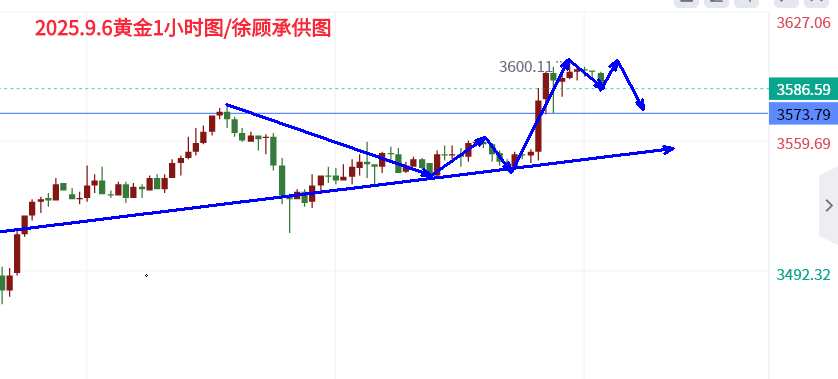
Group 1 - The core viewpoint is that the recent non-farm payroll data significantly underperformed expectations, which has strengthened the case for a potential interest rate cut by the Federal Reserve in September, leading to a surge in gold prices [1][3] - Following the release of the non-farm data, gold prices jumped and reached a historic high of $3600, indicating a strong upward trend with no signs of decline unless risk aversion diminishes [1] - The market's reaction to the non-farm data also caused fluctuations in U.S. stock markets, while gold and silver maintained their gains, reflecting rising expectations for interest rate cuts and concerns about a potential U.S. economic recession [3] Group 2 - Technical analysis shows that the gold price has a support level around $3500 and a resistance level near $3645 for the upcoming week, suggesting a trading strategy of shorting at high points and going long at low points [3] - On a daily basis, the support level is identified at approximately $3576, which serves as a critical point for determining market direction, with resistance around $3594 [3] - The analysis suggests a cautious trading approach, recommending to monitor the price levels of $3576-$3593 for potential trading opportunities [3]
美国非农就业大幅低于预期,9月降息50个基点概率大
Hua Xia Shi Bao· 2025-09-06 06:55
Group 1 - The U.S. added only 22,000 non-farm jobs in August, significantly below the expected 75,000, with an unemployment rate of 4.3%, the highest in nearly four years [2] - The average monthly job growth over the past three months is only 29,000, marking the weakest period since the pandemic, with non-farm employment below 100,000 for four consecutive months [2][3] - The job growth in August was primarily driven by the healthcare sector, which added 31,000 jobs, while manufacturing jobs decreased by 12,000 [3] Group 2 - Former President Trump has been pressuring the Federal Reserve to lower interest rates, claiming that high borrowing costs are unnecessarily suppressing the economy [4] - Fed Chair Powell indicated a shift towards easing monetary policy, acknowledging a "peculiar balance" in the labor market due to significant slowdowns in both labor supply and demand [4] - The upcoming Federal Reserve meeting in September is expected to consider a rate cut of either 25 or 50 basis points, with market expectations leaning towards a larger cut [4][5]

疲软非农点燃50基点降息预期 与2024年如出一辙的美联储降息剧本即将上演?
智通财经网· 2025-09-06 01:28
Core Viewpoint - The unexpectedly weak U.S. non-farm payroll report suggests a significant economic slowdown, prompting Wall Street institutions to advocate for accelerated monetary easing by the Federal Reserve, including a potential 50 basis point rate cut this month [1][2][3]. Group 1: Economic Indicators - The August non-farm payroll report showed an increase of only approximately 22,000 jobs, far below the market expectation of 75,000, and the June employment data was revised down to negative growth, marking the first monthly decline since 2020 [3][4]. - The unemployment rate rose to 4.3%, the highest level since 2021, reinforcing market expectations for a 25 basis point rate cut in September [3][4]. Group 2: Market Reactions - Following the release of the non-farm payroll data, U.S. stock indices fell, the dollar weakened, and U.S. Treasury yields declined across the board, indicating market pricing for a more aggressive rate cut [3][4][6]. - The CME FedWatch Tool indicated a 90% probability of a 25 basis point cut in September, with a notable increase in the probability of a 50 basis point cut from 0% to 10% after the non-farm report [2][6]. Group 3: Future Rate Cut Expectations - Market participants are betting on consecutive 25 basis point cuts in the upcoming FOMC meetings on October 29 and December 10, anticipating a total of 100 basis points in cuts by the end of 2025 [2][6]. - Analysts suggest that the Fed may replicate the 2024 rate cut path, starting with a more aggressive 50 basis point cut, which could support stock market performance and increase risk appetite among investors [7][8]. Group 4: Inflation Concerns - Despite the push for rate cuts, inflation remains a significant concern, with current rates still above the Fed's 2% target, and potential tariff impacts on consumer prices being closely monitored [7][8]. - Some analysts caution against assuming a large rate cut will occur, noting that August is often a "noisy" month and subsequent data, including the upcoming CPI report, will provide further insights into inflation trends [8].
非农远不及预期,特朗普再施压:鲍威尔早就该降息了
Hua Er Jie Jian Wen· 2025-09-05 23:36
Group 1 - The August non-farm payroll report released in the U.S. was significantly worse than expected, leading to renewed criticism from President Trump towards Federal Reserve Chairman Powell for not lowering interest rates sooner [1] - Trump has been pressuring the Federal Reserve to cut rates, arguing that high borrowing costs are unnecessarily suppressing the economy, indicating a potential political influence on the traditionally independent Federal Reserve [1] - Weak employment data increases the likelihood of a rate cut at the upcoming September FOMC meeting, with Powell suggesting that such a move may occur [1] Group 2 - Despite Trump's claims of a "hot" U.S. economy attracting massive investments due to his tax and trade policies, employment data indicates signs of slowdown, raising concerns about a potential recession [1] - The recent employment data is critical for the upcoming 2026 midterm elections, serving as a warning signal for Trump's political prospects [1] - The August non-farm payroll report was released shortly after Trump dismissed the head of the Bureau of Labor Statistics due to weak employment data, which has drawn criticism for setting a dangerous precedent of political interference [2]
美国衰退可能高达93%川普迅速向五角大楼下任务,直言美国输不起
Sou Hu Cai Jing· 2025-09-05 20:17
Group 1 - The core argument revolves around the financial implications of Trump's military revitalization efforts, which are heavily dependent on tariff revenues that are now under legal threat [1][5][9] - The recent court ruling declaring most global tariffs illegal poses a significant financial challenge for the U.S., potentially leading to a loss of revenue in the trillions of dollars [1][3][4] - The U.S. is facing a critical juncture where rising debt levels, projected to exceed $37 trillion, are leading to soaring interest payments, surpassing defense spending for the first time [4][8] Group 2 - The Federal Reserve's interest rate cuts, while aimed at alleviating debt service pressures, could exacerbate inflation risks, complicating the economic landscape for the Trump administration [5][6] - The economic slowdown, indicated by a 93% recession risk according to UBS, is reflected in stagnant economic activities and rising consumer prices, further straining fiscal resources [3][4][8] - Trump's strategy of using tariffs as a fiscal tool to support military spending is now facing significant obstacles, as global investors show declining interest in U.S. debt, leading to concerns about the sustainability of U.S. financial dominance [8][9][11]

8月非农公布在即 华尔街投资人正在做哪些准备?
Sou Hu Cai Jing· 2025-09-05 07:25
Group 1 - The U.S. Labor Department is set to release the August non-farm payroll report, which is crucial for investors to assess the U.S. economy and the Federal Reserve's interest rate outlook [1] - Economists expect an increase of 75,000 jobs in August, while Goldman Sachs predicts a lower increase of 60,000 jobs, which is still above the average of 35,000 jobs over the past three months [1] - A significant miss in non-farm data could heighten concerns about a slowing job market and potential recession, while exceeding expectations may reduce the likelihood of a Fed rate cut [1] Group 2 - Capital Wealth Planning's strategist believes a rate cut in September is almost certain, which will impact refinancing and the real estate market, presenting opportunities in housing-related stocks like Home Depot [1] - Wealth Consulting Group's analyst also supports the view of a September rate cut and suggests investors diversify away from AI and past winners [2] - Analysts are focusing on dividend growth and dividend-paying stocks, such as FedEx and PNC Financial, while also identifying opportunities in cyclical consumer stocks and major retailers like American Express [2]
美联储褐皮书:美国经济出现多重隐忧_发现频道_中国青年网
Sou Hu Cai Jing· 2025-09-05 01:36
Economic Overview - The recent Beige Book indicates that the growth rate of the U.S. economy is below average, with little sign of acceleration [1] - Most Federal Reserve districts reported minimal economic activity, with only four regions noting moderate growth [1] Price and Cost Pressures - Tariff policies are causing rising costs across multiple industries, with ten districts reporting moderate price increases and two districts experiencing significant rises in input prices [1] - Many regions noted that tariffs have notably impacted input prices, leading to increased prices for consumers [2] Consumer Spending - Consumer spending has remained flat or declined due to rising prices outpacing wage growth, particularly in essential expenses like insurance and utilities [1] Industry Insights - The retail and hospitality sectors are offering promotions to attract price-sensitive consumers, but this has not offset the decline in international tourist demand [2] - The automotive industry has seen stable to slight increases in sales, with a growing demand for services related to maintaining older vehicles [2] - Manufacturing companies are shifting towards local supply chains and automation to manage costs amid tariff impacts [2] Labor Market Conditions - Employment levels have shown little change across 11 districts, with one district reporting a slight decline [2] - Uncertainty and weak demand have led to hesitance in hiring, with reports of increased layoffs in two districts and a noted decrease in immigrant labor affecting recruitment [2] Economic Outlook - Concerns about a potential economic recession are rising, with UBS estimating a 93% probability of economic weakness based on actual data [3] - Moody's chief economist has also warned that the U.S. is on the brink of recession, echoing similar concerns [3]
美联储褐皮书:美国经济出现多重隐忧
Huan Qiu Shi Bao· 2025-09-04 22:45
Economic Overview - The recent Beige Book indicates that the growth rate of the U.S. economy is below average, with little sign of acceleration [1] - Most Federal Reserve districts reported minimal economic activity growth, with only four districts noting moderate growth [1] Price and Cost Pressures - Tariff policies are causing rising costs across multiple industries, with ten districts reporting moderate price increases and two districts noting significant increases in input prices [1] - The impact of tariffs is particularly pronounced on business input prices, leading many companies to raise prices to offset increased costs [2] Consumer Spending - Consumer spending has remained flat or declined due to rising prices outpacing wage growth, with specific pressure noted from increases in insurance, utilities, and other daily expenses [1][2] Industry Insights - The retail and hospitality sectors are offering promotions to attract price-sensitive consumers, but this has not compensated for the decline in international tourist demand [2] - The automotive industry has seen stable to slight increases in sales, with a growing demand for services related to maintaining older vehicles [2] - Manufacturing companies are shifting towards local supply chains and automation to manage costs amid tariff impacts [2] Labor Market Conditions - Employment levels have shown little change across 11 districts, with one district reporting a slight decline; uncertainty and weak demand have led to hesitance in hiring [2] - A reduction in immigrant labor is contributing to recruitment challenges, with half of the districts noting a decrease in this labor source [2] Economic Outlook - Concerns about a potential economic recession are rising, with UBS estimating a 93% probability of economic weakness based on actual data [3] - Moody's chief economist has also warned that the U.S. is on the brink of recession, echoing similar concerns raised by UBS [3]
专访美国耶鲁大学高级研究员斯蒂芬·罗奇:AI投资潜藏泡沫风险 美股或出现修正
Sou Hu Cai Jing· 2025-09-03 23:33
来源:21世纪经济报道 8月最后一个交易周,美股市场未能延续上涨态势,标普500指数在尾盘遭遇抛售,结束了连续三周的升势。进入9月,市场焦点迅速转向即将 公布的美国8月非农就业数据。该报告不仅被视为评估经济健康状况和影响美联储利率决策的重要依据,也被认为是美股能否再度冲击新高的 关键。 美联储会否在9月如期降息?美国经济是否正在滑向衰退?在AI概念推高科技巨头估值之际,美股是否正在形成新一轮泡沫?围绕这些问题, 美国耶鲁大学高级研究员、前摩根士丹利亚洲区主席斯蒂芬·罗奇接受了南方财经记者的专访。 谈及降息预期,罗奇指出,美联储不会迫于政治压力而急于调整政策。但另一方面,劳动力市场的脆弱性,加之关税因素的扰动,可能促使美 联储转向更为宽松的立场。虽然当前通胀与就业风险平衡已出现变化,但幅度尚不剧烈,其后续发展仍将依赖于未来经济数据的表现。 罗奇还表示,美国经济已显示出放缓迹象,消费增速仅为过去几年平均水平的一半。此外,AI领域的投资热潮隐藏泡沫风险,美股"七巨头"的 市值集中度甚至已超过2000年互联网泡沫时期的水平。"因此我认为,美股在未来六个月内很可能出现一定程度的市场修正。"他说。 斯蒂芬·罗奇。资料图 ...