
财政主导

Search documents
美联储货币政策框架演进分析暨美国经济系列专题二:锚的再“拧紧”:从超调容忍回归对称平衡
NORTHEAST SECURITIES· 2025-10-27 08:16
Report Industry Investment Rating No relevant content provided. Core Views of the Report - The political power within the Federal Reserve Board is in a fragile balance. Trump's personnel arrangements have tilted the policy scale towards the dovish side, threatening the Fed's independence. If Trump gains a majority on the board, the implementation of monetary policy independence will face greater resistance [6][28][43]. - The Fed may be facing the trend of "fiscal dominance" again. High - level government debt, expanding fiscal deficits, and political pressure are forcing monetary policy to compromise with fiscal needs rather than firmly control inflation. However, the Fed needs to maintain a certain degree of independence on the surface to avoid inflation expectations getting out of control and U.S. debt risks spiraling [6][67][68]. - There is an obvious maturity mismatch problem in the Fed's balance sheet, with a high proportion of long - term assets. After the end of the balance - sheet reduction, the Fed may increase short - term Treasury bond holdings to optimize the maturity matching [6][119]. - The ON RRP balance has significantly declined and is approaching exhaustion, and the TGA scale is still below the average in recent years. If the Fed continues to shrink its balance sheet, the ON RRP may not effectively hedge liquidity fluctuations, and bank reserves may face downward pressure. The Fed may restart "reserve - management bond purchases", which is beneficial to short - duration assets [6]. Summary by Directory 1. Fed Decoded: History, Organization, and Decision - Making Framework 1.1 Fed Historical Context - The evolution of the Federal Reserve reflects continuous innovation and change in monetary policy in response to different economic crises. In 2025, it returned to the "Flexible Inflation Target" (FIT) framework, aiming to more strictly anchor the 2% inflation target while retaining flexibility in responding to the employment market [14]. 1.2 Fed Organizational Structure - The Fed consists of the Board of Governors, 12 Federal Reserve Banks and their branches, and the Federal Open Market Committee (FOMC). The Board of Governors is the highest decision - making body, and the Federal Reserve Banks play an important role in operations. The FOMC is the core decision - making body for monetary policy [18][19]. - Currently, Trump is trying to influence the Fed's leadership composition through personnel arrangements. Although the Fed is trying to show unity, if Trump gets a majority on the board, his control over monetary policy will be further strengthened [28][29]. 1.3 Federal Open Market Committee (FOMC) - The FOMC holds eight regular meetings a year to discuss economic and financial conditions and formulate monetary policies. The post - meeting statement is the core document for understanding monetary policy trends [37]. - The voting records in the statement are important sources of information on the Fed's policy stance. There are different levels of influence within the Fed, with the chair having the strongest voice, the seven governors having permanent voting rights, and other members having different voting rights [39][40]. - The political power within the Fed's board is in a fragile balance. Trump's actions have tilted the policy towards the dovish side, and if he gets a stable majority, the implementation of monetary policy independence will face greater resistance [41][43]. 2. What Does the Return Mean? - The Return of "Fiscal Dominance" Pressure to FIT 2.1 The Origin of the "Dual Mandate" - After World War II, the Fed's monetary policy was restricted by the Treasury. In 1951, the "Treasury - Fed Agreement" marked the beginning of the Fed's independent formulation of monetary policy. In 1977, the Fed was given the "dual mandate" through legislation [47][52]. 2.2 The Birth of the Flexible Inflation Targeting - Since the 1990s, central banks around the world have increased policy transparency. In 2012, the Fed's "Flexible Inflation Targeting" (FIT) framework was formally established, with a long - term inflation target of 2% [56][57]. 2.3 Addressing the Challenge of Long - Term Low Inflation: The Formation and New Consensus of the FAIT Framework - In 2020, the Fed introduced the FAIT framework to deal with the long - term low - inflation and zero - lower - bound dilemma. Its core idea is to allow inflation to moderately exceed 2% for a period to compensate for previous periods of low inflation [58][59]. 2.4 Framework Adjustment: Return from FAIT to FIT - In 2025, the Fed returned to the FIT framework. The FAIT framework failed to control inflation during the pandemic, and the return to FIT aims to strengthen the Fed's credibility in inflation targeting and ease market inflation expectations [62][66]. - The Fed may be facing the trend of "fiscal dominance" again, but it needs to maintain a certain degree of independence on the surface [67][68]. 3. Is the End of Balance - Sheet Reduction Near as ON RRP Approaches Exhaustion? 3.1 Understanding the Fed's Price - Based Tools - The Fed's price - based tools form an "interest rate corridor" system to keep the market interest rate within the target range. The main tools include the Federal Funds Rate (FFR), Interest Rate on Reserve Balances (IORB), Overnight Reverse Repurchase Agreement (ON RRP), Discount Rate, and Standing Repo Facility (SRF) [81][86][100]. - The IORB and ON RRP form a "double - floor" system to absorb excess liquidity. The ON RRP is the "hard floor" of the interest rate corridor, and the IORB is the "soft ceiling" of the Effective Federal Funds Rate (EFFR) [91][92][99]. 3.2 Understanding the Fed's Balance Sheet - The Fed's balance sheet has expanded significantly due to quantitative easing policies during the global financial crisis and the COVID - 19 pandemic. There is a maturity mismatch problem, with a high proportion of long - term assets [108][119]. - The Fed's liabilities mainly include currency, the Treasury General Account (TGA), reserves, and reverse repurchase agreements. The Fed may adjust its securities holdings by increasing short - term Treasury bonds to optimize the maturity matching [115][119]. 3.3 Will Balance - Sheet Reduction Be Suspended as ON RRP Is Exhausted? - Since June 2022, the Fed has been reducing its balance sheet. The decline in the ON RRP balance is the main manifestation of the liability reduction, and bank reserves have remained relatively stable. Currently, the reserve market is still in an abundant state, and the Fed may restart "reserve - management bond purchases" [120]. 4. What to Expect After Balance - Sheet Reduction? - "Reserve - Management Bond Purchases" May Restart - The Fed may restart "reserve - management bond purchases" by increasing short - term Treasury bond holdings to maintain sufficient reserves, which can also optimize the balance - sheet structure and support the demand for short - term Treasury bonds, benefiting short - duration assets [6].
四国央行原行长谈货币政策难题与选择,中国可以从中借鉴什么?
Di Yi Cai Jing Zi Xun· 2025-10-26 02:00
Core Insights - The discussion at the 2025 Bund Summit focused on the challenges facing central banks, including geopolitical tensions, tariff barriers, high public debt, and the impact of artificial intelligence on monetary policy choices [1] Group 1: Tariffs and Inflation - Tariffs are becoming a significant uncertainty for central banks, particularly regarding their impact on U.S. inflation and the Federal Reserve's policy direction [3] - Jacob Frenkel noted that despite previous market concerns not materializing, it is premature to celebrate the current situation, drawing parallels to the "weaponization" of tariffs in the 1930s [3] - Raghuram Rajan indicated that while tariff-induced inflation effects have not fully manifested, there are signs of price increases due to tariffs, with a potential inflation rise of about one percentage point if two-thirds of tariffs are passed on [3][4] Group 2: Labor Market and Economic Growth - Rajan expressed concerns about the slowing net job growth in the U.S. labor market, although the extent to which this will exert downward pressure on wages remains uncertain [4] - The resilience of U.S. consumption and strong investment, particularly in AI, has surprised many, suggesting that the anticipated impacts of trade uncertainties have not yet been fully realized [5] Group 3: Monetary Policy Framework - The traditional monetary policy framework's effectiveness is under scrutiny, especially following the Federal Reserve's recent adjustments to its policy framework [6] - Frenkel emphasized that while the framework should remain stable, it must adapt to significant external changes, indicating that the Fed's previous framework is no longer suitable in the current high-inflation environment [6][7] - The debate continues on whether to maintain a strict 2% inflation target or to adopt a more flexible range to avoid damaging credibility and causing unnecessary policy adjustments [7][8] Group 4: Lessons from Japan - Former Bank of Japan Governor Masaaki Shirakawa highlighted that Japan's prolonged economic stagnation is more related to demographic decline and adaptation to external changes than merely deflation [10] - Shirakawa advised against relying solely on aggressive monetary easing, suggesting that China should focus on supply-side issues rather than adopting Japan's past strategies [10] Group 5: Public Debt and Central Bank Credibility - Patrick Honohan discussed the challenges posed by high public debt, emphasizing the need for central banks to maintain their credibility while addressing inflation [11] - Shirakawa noted that the lack of political will for fiscal reform in Japan is partly due to the perception that low interest rates mitigate concerns over fiscal deficits [12]


黄金一直涨?历史上三次都以暴跌收场
阿尔法工场研究院· 2025-10-15 00:07
Core Viewpoint - The article discusses the surge in gold prices driven by fears of financial collapse, with global investors, both professional and retail, rushing to purchase gold, pushing its price to historical highs, potentially entering a bubble phase [2][4][8]. Group 1: Market Dynamics - Gold prices have increased over 50% this year, reaching a record of $4,000 per ounce, with expectations for 2023 to be the best year since 1979 [4][20]. - The recent gold buying frenzy in Japan has seen retail investors actively purchasing gold bars and coins, leading to a significant increase in demand [6][29]. - Central banks, particularly in developing countries, have been major buyers of gold, diversifying their foreign exchange reserves and reducing reliance on the US dollar [6][7]. Group 2: Investor Behavior - A record $26 billion flowed into gold ETFs in the third quarter, indicating a shift in investor sentiment towards gold as a safe haven asset [7][20]. - The phenomenon of "gold-plated FOMO" (fear of missing out) has emerged, with investors rushing to buy gold to avoid missing price momentum, potentially leading to increased market volatility [7][20]. - Traditional methods of valuing gold, such as its relationship with real interest rates, have become less reliable, complicating investment decisions [21][30]. Group 3: Economic Context - The article highlights concerns over rising debt levels and inflation, with investors viewing gold as a hedge against these risks, particularly in the context of US economic policies [10][18]. - The ongoing tensions in US-China trade relations have further fueled gold's appeal as a safe asset [20][30]. - The article notes that gold's supply is relatively inelastic, with production expected to remain stable over the next three years, which could support higher prices [23][24]. Group 4: Historical Comparisons - Historical patterns indicate that rapid increases in gold prices can lead to significant corrections, as seen in the late 1970s and 2011 [14][17]. - The current market sentiment reflects a shift towards gold as a protective asset amid fears of economic instability, reminiscent of past financial crises [8][10].

星展银行:美债规模已超过GDP的120%,引发对“财政主导”的担忧
Sou Hu Cai Jing· 2025-10-13 12:14
Core Insights - The current U.S. government debt has exceeded 120% of GDP, prompting concerns about the need to lower interest rates to alleviate debt repayment pressure [1] - There are growing worries about "fiscal dominance," where fiscal demands begin to influence central bank policies [1] - The S&P 500 index shows signs of excessive concentration risk, valuations nearing historical extremes, and a slowdown in corporate earnings, indicating a fragile foundation for the current market rally [1] - The company suggests capitalizing on upward market opportunities while diversifying investment portfolios to mitigate downside risks [1]
星展银行:美债规模已超过GDP的120% 引发对“财政主导”的担忧
2 1 Shi Ji Jing Ji Bao Dao· 2025-10-13 12:01
Core Insights - The current scale of U.S. government debt has exceeded 120% of GDP, necessitating a reduction in interest rates to alleviate debt repayment pressure, raising concerns about "fiscal dominance" where fiscal needs begin to influence central bank policies [1] - Signs such as the excessive concentration risk in the S&P 500 index, valuations nearing historical extremes, and slowing corporate earnings indicate that the current upward market trend is built on fragile foundations [1] - The company suggests that investors should seize upward opportunities while diversifying their portfolios to mitigate downside risks [1]
疯狂的黄金,是对所有货币信用的“不信任投票”
Jin Shi Shu Ju· 2025-10-13 01:20
Core Insights - The recent surge in gold prices, surpassing $4,000 per ounce, is linked to Japan's new prime minister, Sanae Takaichi, who advocates for a dovish monetary policy and increased economic stimulus [1] - The rise in gold prices reflects a broader trend of declining trust in fiat currencies globally, with various countries facing high debt-to-GDP ratios [3][4] Group 1: Gold Price Dynamics - Gold's price increase can be segmented into three phases: the first phase began with the Russia-Ukraine conflict in 2022, leading to a significant accumulation of gold by central banks seeking non-freezable assets [2] - The second phase was triggered by the U.S.-China trade war initiated by Trump in April, which diminished confidence in the U.S. dollar's stability [2] - The third phase commenced in August when the Federal Reserve signaled potential interest rate cuts despite high inflation, further fueling gold's appeal as a safe-haven asset [2] Group 2: Economic and Monetary Policy Implications - The current economic landscape shows that debt levels in developed economies are nearing or exceeding 100% of GDP, raising concerns about debt sustainability [3][4] - Morgan Stanley's report indicates that rising debt costs and slowing nominal growth threaten the sustainability of debt in developed markets, predicting that by 2030, debt repayment costs will align with economic growth rates [4] - The potential shift in U.S. monetary policy under Trump, focusing on fiscal dominance, could lead to a depreciation of the dollar and increased inflation expectations, thereby elevating gold prices [5][6] Group 3: Japan's Economic Strategy - Japan's new prime minister supports a strategy that combines structural reforms with fiscal and monetary stimulus, which may lead to higher inflation if the Bank of Japan yields to government pressure [6] - The market signals indicate a long-term expectation of debt dilution through inflation, particularly in Japan, where long-term bond yields are rising [6]
黄金缘何彻底爆发?答案就在六个字
Feng Huang Wang· 2025-10-09 07:53
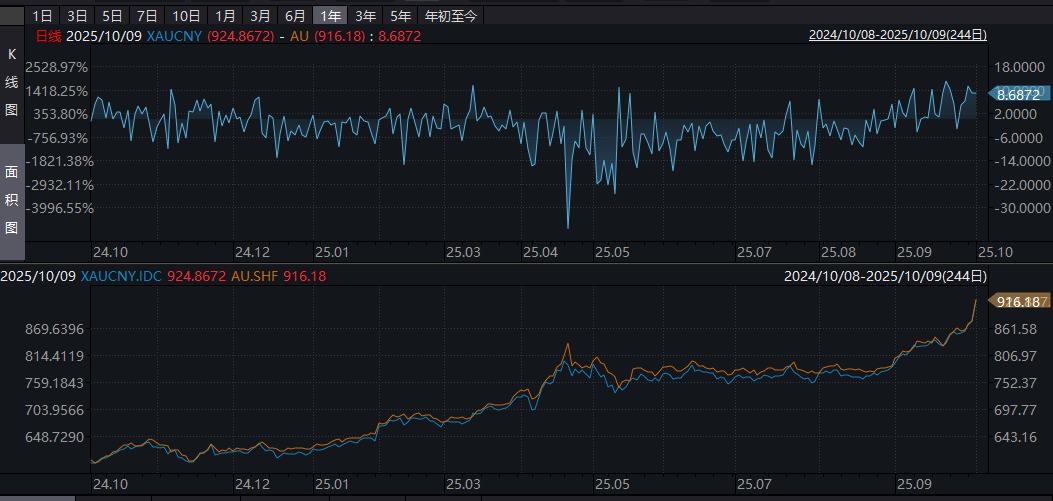
Core Viewpoint - The recent surge in international gold prices, which broke the $4000 mark, is primarily driven by Western investors, particularly during a period when Chinese investors were absent due to the National Day holiday [1][3]. Group 1: Market Dynamics - The price of spot gold rose nearly $200 from around $3860 to over $4000 during the Chinese holiday, indicating a significant market movement [1]. - The premium for domestic gold in China has shifted from positive to negative, suggesting a decrease in local investor interest compared to Western markets [3]. - The trend of Western investors leading the gold price increase reflects a broader shift in global investment dynamics, with a notable decline in interest from non-US regions [3]. Group 2: Investment Sentiment - The concept of "debasement trade" has gained traction among investors, indicating a strategy to hedge against the depreciation of all fiat currencies, not just the US dollar [3][5]. - The stability of the US dollar since August has not deterred gold's rise, suggesting a loss of confidence in fiat currencies overall [5]. - Political events, such as the election of Japan's new prime minister advocating for economic stimulus, have contributed to currency fluctuations, further driving gold prices [6]. Group 3: Historical Context - The current gold price surge can be divided into three phases, starting from the onset of the Russia-Ukraine conflict, followed by the US-China trade war, and culminating in recent signals from the Federal Reserve regarding interest rate cuts [9][10][12]. - The rise in gold prices is increasingly seen as a speculative trend rather than solely based on fundamental factors, with its traditional role as a safe-haven asset being emphasized [12][13]. Group 4: Debt and Economic Factors - High levels of debt in developed economies, nearing or exceeding 100% of GDP, are creating a backdrop for increased gold investment as a hedge against economic instability [15]. - The sustainability of debt is under scrutiny, with rising interest rates and inflation posing challenges to fiscal health, which could further drive investors towards gold [15][16]. - The political landscape, particularly in the US and Europe, is complicating fiscal measures needed to manage debt, leading to a potential increase in gold's appeal as a safe asset [16][17].


华泰证券今日早参-20250923
HTSC· 2025-09-23 01:56
Group 1: Market Overview - The A-share market is currently experiencing a period of volatility, with liquidity and market sentiment being key factors influencing its performance [2][4] - Recent data indicates that financing activity is approaching historical highs, with private equity fund registrations returning to mid-July levels and new public fund issuance maintaining around 20 billion [2][4] - The market's ability to break through its current plateau will depend on the continued inflow of public and foreign investment funds [2][4] Group 2: Fixed Income Insights - Since 2024, the structure of credit floating rate bonds has adjusted, with a notable increase in corporate issuances and a contraction in asset-backed securities (ABS) [3] - Floating rate bonds are characterized by their interest rates that follow benchmark rates, providing a defensive advantage, especially during periods of rising rates [3] - The performance of floating rate bonds has lagged behind fixed rate bonds in recent years, suggesting that better investment opportunities may arise when the funding environment tightens [3] Group 3: Real Estate and Construction - In the third week of September, both new and second-hand housing markets showed signs of recovery, particularly in first-tier cities following policy relaxations [4][16] - The construction sector is witnessing an increase in industrial activity, with freight volumes remaining high and coal consumption showing a downward trend [4] - The demand for cement remains stable, while supply is at low levels, indicating a potential for price recovery in the construction materials market [4] Group 4: Energy and New Energy Equipment - In August 2025, China's inverter exports reached 6.29 billion, with a notable demand driven by energy transitions in India and subsidy plans in Australia [7] - The long-term demand for inverters is expected to be supported by rising electricity prices and increased installations of renewable energy sources [7] - The report recommends leading companies in the sector, such as Sungrow Power Supply and DeYe Shares, as having strong performance support [7] Group 5: Transportation and Logistics - Despite August being a traditional off-peak season for e-commerce and express delivery, the industry is experiencing a rebound in demand due to competitive pressures [8] - The report highlights a marginal slowdown in package volumes, but anticipates a price increase as the peak season approaches, which could enhance profitability [8] - Recommended companies in the logistics sector include Shentong Express and YTO Express, with a focus on those benefiting from price increases and strong overseas growth [8] Group 6: Consumer Goods and Retail - The snack retail sector is evolving from rapid expansion to consolidation, with new retail formats emerging in response to changing consumer preferences [13] - The report discusses the competitive landscape of various retail formats, including discount stores and community shops, and their impact on traditional retail channels [13] - Companies like Youyou Foods are highlighted for their strategic positioning in the market, aiming for significant revenue growth through innovative product offerings [13] Group 7: Construction Materials - The report discusses the outlook for specialty electronic fabrics, driven by trends in AI and high-end PCB materials [14] - The demand for low thermal expansion and high-performance materials is expected to grow, with recommendations for companies like China Jushi and China National Materials [14] - The report emphasizes the importance of product upgrades in meeting the evolving needs of the electronics industry [14] Group 8: Company Ratings and Recommendations - New Hongji Real Estate has been rated "Buy" with a target price of 111.51 HKD, supported by its significant land reserves and upcoming project deliveries [17] - Youyou Foods has also received a "Buy" rating with a target price of 15.60 CNY, reflecting its strong market position in the snack sector [19] - The report indicates a positive outlook for companies with robust growth strategies and market adaptability [19]



基本面观察9月第3期:全球财政主导与共振下的经济与市场
HTSC· 2025-09-22 03:27
Group 1: Global Fiscal Dominance - The global economy is entering a new era of fiscal dominance, driven by structural imbalances and the need for fiscal policy to address various societal demands[1] - Countries like France, the UK, and Japan are facing political challenges to fiscal tightening, leading to a necessary shift towards fiscal expansion[1] - In China, fiscal measures are crucial to address internal supply-demand issues, especially given the diminishing effectiveness of monetary policy[1] Group 2: Strategic Significance of Fiscal Expansion - Fiscal expansion is increasingly seen as strategically important in the context of global order reconstruction, including areas like AI, trade restructuring, and national defense[2] - A potential "fiscal dominance + monetary cooperation" model may emerge, where government fiscal deficits significantly increase, compelling central banks to adapt their policies accordingly[2] Group 3: Regional Fiscal Trends - In the US, the "Big and Beautiful" Act is projected to increase federal deficits by $4.1 trillion, with a deficit rate expected to be around 7% next year[3] - European countries are expected to see marginal fiscal loosening, particularly in defense spending, with Germany leading the way with a projected increase in defense spending of approximately €5.5 billion[5] - China's fiscal policy is expected to remain proactive, with a broad deficit rate likely to stay at high levels, supported by various policy measures aimed at boosting demand[8] Group 4: Implications for Global Economy and Markets - The combination of fiscal dominance and monetary cooperation is expected to support global economic growth, with a potential recovery in the global manufacturing cycle[12] - Increased fiscal spending is likely to focus on defense, infrastructure, and supply chain security, which may create cyclical opportunities in physical assets and commodities[12] - The fiscal expansion and monetary cooperation are anticipated to positively influence liquidity and profitability in global markets, particularly benefiting sectors sensitive to interest rates[13]

Markets can support a higher multiple as productivity increases, says Morgan Stanley's Jim Caron
Youtube· 2025-09-17 18:46
分组1 - The Federal Reserve's decision-making process is influenced by a wide dispersion of views among its members, indicating confusion about the current state of the US economy [2][4][3] - The consensus within the Federal Reserve remains strong, with only one dissenting vote, suggesting a unified approach despite individual ambitions for leadership positions [5][6] - The Phillips curve framework is being utilized by the Fed, indicating that rising unemployment may lead to lower wage inflation and consumer inflation, allowing for potential rate cuts [7][8] 分组2 - Productivity is expected to rise, which could support higher profit margins and a bullish outlook for equity markets, as higher productivity correlates with growth [9][10] - Small-cap stocks are showing significant movement, with the SML small cap 600 index up 2%, indicating that domestic companies may benefit later in the rate cut cycle [12] - The bond market remains relatively stable, with the 10-year yield at 4%, suggesting limited immediate relief for mortgage rates despite expectations of easing from the Federal Reserve [13][14]