
关税

Search documents
Ulta美容(ULTA.US)业绩喜忧参半:Q2盈喜推动上调全年指引 但预警销售增长放缓
智通财经网· 2025-08-29 00:07
Core Viewpoint - Ulta Beauty reported better-than-expected Q2 earnings and raised its full-year guidance, despite warnings of potential consumer spending reductions [1][2]. Financial Performance - Q2 net profit increased from $252.6 million ($5.30 per share) to $260.9 million ($5.78 per share) [1]. - Revenue grew by 7.7% year-over-year to $2.8 billion, exceeding analyst expectations [1]. - Same-store sales are projected to grow by 2.5% to 3.5% for the year, up from a previous forecast of no more than 1.5% [1]. - The company expects FY2025 sales between $12 billion and $12.1 billion, and earnings per share between $23.85 and $24.30, both higher than previous estimates [1]. Consumer Behavior and Market Trends - Despite economic uncertainties, consumers continue to spend on beauty products, with Ulta experiencing significant growth in this category [2]. - Ulta's average transaction value increased by 2.9%, and the number of transactions grew by 3.7% compared to the previous year [3]. - The company faces intensified competition from brands like Sephora, Walmart, and Kohl's, which are expanding their beauty offerings [2]. Strategic Initiatives - Ulta is exploring new growth channels, including the introduction of health-related products in approximately 370 stores [5]. - The company has acquired UK beauty retailer Space NK, allowing entry into a new international market [6]. - A third-party marketplace platform is set to launch in Q3, aimed at expanding product offerings without increasing inventory [7]. Leadership and Management - The company is currently searching for a permanent CFO after the departure of the previous CFO, with Chris Lialios serving as the interim CFO [7]. - Ulta's management emphasizes a cautious approach due to consumer spending uncertainties [2].

“加班加点”取消对美所有工业品关税,欧盟承认:这有利于美国,但不得不干
Sou Hu Cai Jing· 2025-08-28 18:09
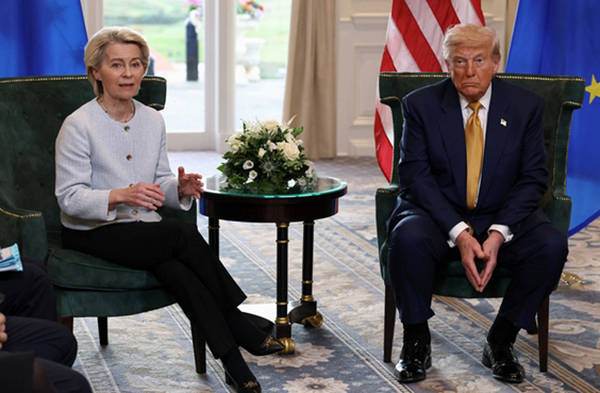
Group 1 - The EU is rapidly legislating to eliminate all tariffs on US industrial goods in exchange for the US reducing tariffs on EU automobiles [1][3] - The EU Commission acknowledges that the trade agreement favors the US but provides necessary stability and predictability for businesses [1][3] - EU Commission President von der Leyen defends the agreement as a thoughtful choice to avoid escalation and confrontation with the US [1][3] Group 2 - The EU is under pressure to complete legislation by the end of the month to meet US demands, which could significantly impact the EU automotive industry [3][4] - A survey by the German Chamber of Commerce indicates that 55% of industrial companies believe the trade agreement imposes a heavy burden on the European economy [4] - The German Mechanical Engineering Industry Association warns that 30% of machinery exported to the US faces 50% tariffs, urging the EU to negotiate for tariff exemptions [4] Group 3 - President Trump threatens high tariffs on countries that impose digital taxes targeting US tech companies, indicating potential trade tensions with the EU [5][6] - French President Macron suggests the EU should consider retaliatory measures against the US tech industry due to significant trade imbalances [5][6] - Despite calls for a stronger stance, EU member states show reluctance to engage in a full-scale trade war, limiting the EU's response options [6]

Bath & Body Works季度利润不及预期,盘前跌6%
Xin Lang Cai Jing· 2025-08-28 12:12
Core Viewpoint - Bath & Body Works reported second-quarter profits that fell short of Wall Street expectations, facing challenges from uncertain consumer discretionary spending and rising costs [1] Group 1: Financial Performance - The company's adjusted earnings per share for the quarter were 37 cents, below the analyst average expectation of 38 cents [3] - Quarterly net sales amounted to $1.55 billion, in line with market expectations [3] - General management and store operating expenses reached $483 million, a 9% increase compared to the same period last year [3] Group 2: Market Challenges - The company is experiencing significant operational pressure due to inflation and the negative impact of trade policies from the Trump administration, leading consumers to cut back on spending [2] - Although consumer spending increased in June and July, growth in the third quarter is expected to be constrained by a weak labor market and rising commodity prices [2] Group 3: Strategic Initiatives - To position its products as "affordable luxuries" and "ideal gifts," Bath & Body Works has intensified marketing and promotional efforts, including launching a Disney villain-themed product line aimed at Halloween sales [2] - The company has narrowed its full-year adjusted earnings per share guidance to a range of $3.35 to $3.60, previously $3.25 to $3.60, considering current tariff levels [3] Group 4: Supply Chain Insights - Unlike many peers, Bath & Body Works primarily utilizes local sourcing for most of its products, which helps mitigate tariff impacts [3] - However, approximately 10% of the company's supply chain still relies on China, with Canada and Mexico accounting for about 7% combined, with nearly equal shares [3]

贵金属日报-20250828
Guo Tou Qi Huo· 2025-08-28 10:37
Report Investment Ratings - Gold: ★★★, indicating a clearer long trend with a relatively appropriate investment opportunity currently [1] - Silver: ★★★, indicating a clearer long trend with a relatively appropriate investment opportunity currently [1] Core View - Overnight, the US dollar fluctuated sharply, and precious metals oscillated at high levels. Trump's dismissal of Fed officials this week intensified concerns about the Fed's independence and impacted the US dollar's credit. International gold and silver are in an oscillating trend, continuing to test the upper key resistance. The medium - term strategy maintains a long - buying approach on pullbacks. Attention should be paid to the revised value of the US Q2 GDP and weekly initial jobless claims data today [1] Other Summaries Fed - related - Biesent called for an internal review of the Fed and said it would surely know in the fall who Trump would choose as the Fed chair. Williams said the policy remains moderately tight, inflation is gradually falling, and every meeting is absolutely "real - time" [1] Tariff - related - The White House trade advisor said that if India stops buying Russian oil, it can get a 25% tariff discount. India hopes that the US will reconsider the decision to impose a 25% tariff on it. Biesent said many things India does are "performative." The EU plans to accelerate the legislative process before this weekend to fully cancel tariffs on US industrial products to meet Trump's requirements. Japanese Economic Revitalization Minister Akazawa Ryosei visited the US again, urging the US to implement the auto tariff reduction agreement [2]
贸易规则|千年关税:历史会终结吗
Sou Hu Cai Jing· 2025-08-28 10:08
Group 1: Historical Context of Tariffs - Tariffs have a long history, dating back to ancient civilizations, where they were used to generate revenue and regulate trade [2][3] - During the mercantilist period (16th to 18th centuries), high tariffs were implemented to maximize exports and minimize imports, with average tariffs in England reaching 45-55% [4][5] - The classical economists, such as Adam Smith and David Ricardo, argued for lower tariffs and free trade, suggesting that it would benefit all nations involved [5][6] Group 2: Tariff Policies in the 18th and 19th Centuries - In the 18th and 19th centuries, tariff policies varied significantly across countries, with the U.S. initially using tariffs as a revenue source, later increasing them to protect emerging industries [7][9] - The U.K. maintained high tariffs until the repeal of the Corn Laws in 1846, marking a shift towards free trade [8][9] - The U.S. and Germany adopted high tariffs to protect their industries, leading to faster industrial growth compared to the U.K. [10][9] Group 3: Impact of Tariffs on Global Trade - The imposition of tariffs in the early 20th century, particularly during the Great Depression, led to a significant decline in international trade, exemplified by the Smoot-Hawley Tariff Act [12] - Post-World War II, the establishment of GATT aimed to reduce tariffs and promote free trade, resulting in a decrease in average tariffs from 22% in 1947 to below 5% by 1994 [13][14] Group 4: Modern Tariff Trends and Conflicts - In the 21st century, tariffs have resurfaced as a tool for economic policy, with the U.S. under Trump increasing tariffs on imports, particularly from China, leading to retaliatory measures [16][15] - The ongoing trade disputes highlight the tension between protecting domestic industries and the benefits of free trade, with economists warning that high tariffs can lead to increased prices and economic inefficiencies [16][17]
白宫顾问纳瓦罗再爆惊人言论:俄乌冲突是“莫迪的战争”!
Jin Shi Shu Ju· 2025-08-28 09:27
Group 1 - The White House trade advisor Navarro increased pressure on India to stop purchasing Russian oil, accusing New Delhi of funding the Kremlin's military actions in Ukraine and labeling the conflict as "Modi's war" [2][3] - Navarro stated that India's discounted purchases of Russian oil are harming the U.S. and that American consumers, businesses, and workers are suffering due to India's high tariffs, which he claims lead to job losses and reduced wages [2][3] - The proposed 50% tariff on Indian goods is the highest among Asian countries and would impact over 55% of goods exported to the U.S., with labor-intensive industries like textiles and jewelry being particularly affected [2][3] Group 2 - The decision to raise tariffs on India followed months of negotiations between New Delhi and Washington, with U.S. officials expressing disappointment over India's high tariffs and protectionist policies in key sectors like agriculture [3] - Despite India's historical reliance on Middle Eastern oil, it has seized the opportunity to control domestic energy costs by increasing imports of Russian oil, defending its relationship with Russia against U.S. criticism [3] - The U.S. has previously encouraged countries to purchase Russian oil to maintain market supply while controlling revenue flow back to the Kremlin, especially after the G7 imposed a price cap on Russian oil [3]
8月28日汇市晚评:日本央行中川顺子重申加息立场 美元/日元呈现震荡偏弱格局
Jin Tou Wang· 2025-08-28 09:18
Market Overview - The GBP/USD is showing a fluctuating pattern, while the USD/JPY is exhibiting a weak trend. The EUR/USD has potential for upward movement, and the AUD/USD is under significant downward pressure from a trendline. The dollar index is supported by the middle band in the short term [1] Key Economic Insights - Federal Reserve's Williams stated that the policy remains moderately tight and inflation is gradually decreasing. Each meeting is considered "real-time" [2] - Brazil's Finance Minister emphasized that the dollar will continue to be a reserve of value for many years unless the U.S. makes significant mistakes [2] - Japan's Chief Cabinet Secretary announced the cancellation of a planned visit to the U.S. by the trade negotiation representative, insisting on lower U.S. tariffs [2] - The Bank of Japan's committee member reiterated the stance on interest rate hikes, noting concerns over tariff impacts [2] - Japan's two-year government bond auction demand hit a new low since 2009 [2] - The Russian Finance Minister projected that Russia's economic growth will not be less than 1.5% by 2025 [3] - The Slovak central bank governor appealed to the Supreme Court regarding a bribery case [4] - The Bank of Korea maintained its benchmark interest rate at 2.5%, aligning with market expectations, and expressed caution regarding potential exchange rate volatility [5] - The Bank of Korea's governor defended foreign exchange interventions aimed at preventing the depreciation of the won, which subsequently strengthened [6] Technical Analysis - GBP/USD is in a delicate balance, likely to fluctuate between 1.3405 and 1.3585. A clear market driver could break this balance and set a new direction [7] - The USD/JPY has a 14-day RSI of 45.967, indicating a neutral to slightly weak state, suggesting a potential for continued fluctuation [7] - The EUR/USD's 14-day RSI has just entered 50, indicating a need to monitor for upward movement, with a bullish flag pattern suggesting a breakout target of 1.2120 if it closes above 1.1740 [7] - The dollar index has key resistance levels at 98.83 and 98.95, with support levels at 98.27 and 97.5877. A drop below 97.54-97.59 could redefine the market structure [8] Upcoming Economic Data - The European Central Bank will release the minutes from the July monetary policy meeting at 19:30 [10] - Canada’s Q2 current account data and U.S. initial jobless claims for the week ending August 23 will be released at 20:30 [10] - The U.S. will also revise its Q2 annualized GDP rate at 20:30 and report on the July pending home sales index at 22:00 [10] - The EIA natural gas inventory data will be available at 22:30, followed by a speech on monetary policy by Fed Governor Waller at 06:00 the next day [10]
非农大幅下修后,如何关注美国就业与通胀?
NORTHEAST SECURITIES· 2025-08-28 07:58
1. Report Industry Investment Rating No relevant content provided. 2. Core Views of the Report - This year, with Trump's return to the White House, U.S. policies have shifted significantly, increasing market attention to U.S. economic and financial trends. The report aims to build an analysis framework for tracking the U.S. economy, focusing on the core economic indicators of the U.S. household sector [2][11]. - In Q2, the contribution rate of net exports to U.S. GDP reached a record - high of 4.99%, mainly driven by a sharp decrease in imports. However, after excluding the contribution of net exports, the real GDP growth rate was - 2.0%, indicating a severe decline in domestic demand [28]. - The significant downward revision of non - farm data may be due to large - scale layoffs in government departments in the first half of the year, which affected data collection efficiency and increased the risk of statistical errors. There may also be other systematic factors [3][125]. - The current tariff level has an impact on the year - on - year growth rate of U.S. PCE. In the optimistic, benchmark, and pessimistic scenarios, it may increase by 0.37, 0.92, and 1.46 percentage points respectively. Once the tariff effect fully appears in prices, the year - on - year growth rate of U.S. PCE may rise above 3% [4]. - In the "stagflation - like" situation, the Fed is in a dilemma. Powell signaled a 25bp interest rate cut in September, but the evolution of non - farm employment and inflation data in August needs to be verified. The report maintains the benchmark assumption of two 25bp interest rate cuts in September and December [5]. 3. Summary by Relevant Catalogs 3.1 Five - Sector Perspective on the U.S. Economy Observation Starting Point - The report divides the U.S. economy into five core sectors: government, enterprise, household, finance, and overseas sectors. The household and enterprise sectors form the core "employment - consumption" cycle, and the government participates in resource reallocation [12]. 3.2 U.S. Q2 GDP: The "Apparent Prosperity" Driven by Net Exports - The U.S. GDP is calculated and released by the BEA. There are three estimates for each quarter, and annual overhauls are conducted in July. The GDP data is also seasonally adjusted [16]. - From 2020 - 2023, the U.S. GDP revision was large due to the impact of the pandemic. Since H2 2024, the revision has gradually converged, but the "reciprocal tariff" policy may cause the revision to increase again [17]. - Personal consumption expenditure is the most important component of U.S. GDP, with a long - term upward - trending share and a significant driving effect on economic growth. Net exports have a continuous negative contribution to GDP growth [24]. - In Q2, the contribution rate of net exports to GDP reached a record high, mainly due to a 15.1% month - on - month decrease in imports and a 1.7% increase in exports, narrowing the trade deficit by 50.8%. However, domestic demand declined seriously after excluding the contribution of net exports [28]. 3.3 Consumption Research Framework Based on Household Income and Expenditure - The U.S. consumption research can start from the income and expenditure of residents. Income is divided into five parts, with laborer compensation accounting for 57% and transfer payment income accounting for 18% in June 2025 [32]. - Personal disposable income is obtained by subtracting government social security contributions and personal current taxes from total income. From August 2023 to June 2025, the year - on - year growth rate of personal disposable income decreased significantly, weakening residents' consumption ability and confidence [33]. - U.S. personal consumption expenditure is divided into goods and services consumption. Since 2022, service consumption has made a greater contribution to GDP. In June 2025, the actual personal consumption expenditure increased by 2.1% year - on - year, with goods consumption increasing by 2.9% and service consumption increasing by 1.7% [38][40]. - Retail sales data shows that in June 2025, the year - on - year and month - on - month retail sales increased, with miscellaneous goods retailers being the main driving force [45]. - The U.S. personal savings rate has fallen to 4.5%, lower than the pre - pandemic average. In the future, the savings rate may continue to rise, suppressing short - term consumption growth [51]. - Third - party data such as the Michigan Consumer Sentiment Index (CSI) and the Redbook Retail Sales Index can be used to verify U.S. consumption conditions. The overall consumption growth in the U.S. is slowing down [53][61]. 3.4 How to Track U.S. Employment after the "Non - Farm" Data Distortion 3.4.1 Employment Research Framework Based on Supply and Demand Sides - There are many employment - related data in the U.S., including JOLTS, CES, ADP, CPS, and UI. These data have different sample scopes, core indicators, advantages, and frequencies [63]. - JOLTS provides supplementary information on the demand side of the labor market. The job vacancy rate reflects the shortage of labor. Since 2022, the gap between job vacancies and hiring has narrowed, and the resignation rate has continued to decline [67][73][76]. - CES (non - farm data) has a wide coverage. In July, the number of new non - farm jobs was lower than expected, and the data for May and June was significantly revised downward. The hourly wage of the private sector increased, increasing inflation pressure [78][86]. - ADP data is based on real payroll records of private - sector employees, covering more than 25 million employees. It is released two days earlier than CES and can be used to perceive private - sector employment trends [91]. - CPS is a household - based survey that provides information on labor force participation rate, unemployment rate, and other indicators. In July, the labor force participation rate declined for four consecutive months, and the unemployment rate rose to 4.2% [93][104]. - The Unemployment Insurance Weekly Claims Report provides high - frequency data on initial and continued claims for unemployment benefits, which can be used to predict economic inflection points [108]. 3.4.2 How Credible is the Non - Farm Data? - In May - June this year, the non - farm employment data was significantly revised downward, and the deviation of the revision reached a new high since 2010. The reasons given by the BLS are insufficient to fully explain the large - scale revision [116]. - It is more likely that large - scale layoffs in government departments in the first half of the year affected data collection efficiency, and there may be other systematic factors. The credibility of non - farm employment data has declined, and multiple independent data should be used for cross - verification [125]. 3.5 U.S. Inflation Monitoring and Tariff Impact Assessment 3.5.1 Inflation Status Monitoring and Expectation Analysis Framework - The report analyzes U.S. inflation from two aspects: status monitoring (focusing on CPI and PCE) and expectation analysis (introducing BEI and 5Y - 5Y BEI) [126]. - CPI and PCE are two core consumer inflation indicators. PCE is generally lower than CPI because of its chain - type update and wider coverage. The Fed prefers PCE [126][127]. - Core services are the main driver of U.S. inflation. In July 2025, the year - on - year growth rate of service CPI was 2.18%, and the month - on - month growth rate was 0.18% [130]. 3.5.2 Import Structure Split and Tariff Calculation: U.S. PCE May Face Phased Upward Pressure - The current tariff level has an impact on the year - on - year growth rate of U.S. PCE. In different scenarios, it may increase by 0.37, 0.92, and 1.46 percentage points respectively. Once the tariff effect fully appears in prices, the year - on - year growth rate of U.S. PCE may rise above 3% [4].