
数字乡村

Search documents
《2025年数字乡村发展工作要点》印发—— 数字红利将惠及更多乡村
Jing Ji Ri Bao· 2025-06-03 22:08
Group 1: Digital Rural Development Initiatives - The central government has issued the "2025 Digital Rural Development Work Points," outlining 26 key tasks across 9 areas, emphasizing the role of digital technology in ensuring national food security and preventing large-scale poverty by the end of 2025 [1] - By 2024, the rural internet penetration rate is projected to reach 65.6%, with a total of 313 million internet users, indicating that the internet has become a primary means of production and daily life for rural residents [2] - The work points aim to enhance the digital governance efficiency and information service levels in rural areas, continuing the previous years' focus on foundational building, application expansion, integration promotion, and benefiting people's livelihoods [1][2] Group 2: Agricultural Machinery and Digital Transformation - The work points highlight the importance of agricultural machinery in various farming processes and propose actions for high-quality development in this sector, addressing issues such as insufficient supply of high-end intelligent equipment and low operational efficiency [2][3] - Accelerating the digital transformation of the entire agricultural machinery supply chain, including production, processing, circulation, and services, is essential for improving the agricultural machinery industry [3] Group 3: Digital Governance and Data Utilization - The establishment of a big data platform for monitoring and preventing poverty is proposed, which will cover all rural populations and enhance the existing poverty prevention monitoring system [3] - Continuous efforts are needed to promote the digital transformation of government services, breaking down data barriers among departments, and enhancing the precision and responsiveness of rural digital governance [3] Group 4: Education and Healthcare Digitalization - The work points call for improving the digitalization of rural education through the promotion of national smart education public service platforms, aiming for balanced urban-rural education development and quality enhancement [4] - Digital technology is expected to provide low-cost access to quality urban resources in education, healthcare, and finance for rural areas, allowing farmers to gradually benefit from digital dividends [4]
以数字技术强农惠农富农
Jing Ji Ri Bao· 2025-05-31 22:02
Group 1 - The core objective of the digital rural development initiative is to enhance farmers' income and improve agricultural efficiency, with a focus on nine key tasks outlined in the "2025 Digital Rural Development Work Points" [1] - The initiative aims to leverage digital technology to transform rural life, enabling farmers to remotely control irrigation systems and access e-commerce services, thereby increasing their productivity and income [1] - The emergence of new business models and platforms, such as short video marketing for local products, is helping to promote rural specialties and cultural heritage, making them accessible to a wider audience [1] Group 2 - Since the introduction of the digital rural strategy in 2018, significant progress has been made, with 3.13 billion rural internet users by December 2024, representing 28.2% of the total internet user base [2] - Challenges remain in rural digitalization, including weak infrastructure, high application costs for smart agriculture, and a shortage of skilled personnel who understand both agriculture and information technology [2] - To address these challenges, there is a need for enhanced 5G and broadband coverage in remote areas, as well as a multi-faceted approach to training and skill development for farmers [2]
踔厉奋发新征程丨数字赋能乡村振兴
Zhong Yang Ji Wei Guo Jia Jian Wei Wang Zhan· 2025-05-25 23:41
Digital Rural Development - The digital rural development strategy is a key direction for rural revitalization, with a focus on enhancing digital governance and building smart beautiful villages by 2025 [4] - By the end of 2024, China aims to achieve county-wide gigabit connectivity, 5G access in towns, and broadband in villages, with rural internet users reaching 313 million [4] Agricultural Technology Integration - The integration of IoT and digital technologies in agriculture is transforming traditional farming practices, allowing for remote management and precision farming [5][6] - In Jiangsu Province, a rose garden utilizes a comprehensive IoT management platform, enabling real-time monitoring of soil conditions and automated irrigation, significantly improving efficiency [6] Smart Agriculture - The emergence of "smart agriculture" is characterized by the use of AI, big data, and autonomous machinery, enhancing productivity and efficiency in farming operations [7] - As of January 2023, the Ministry of Agriculture and Rural Affairs has supported the establishment of 34 national digital agriculture innovation centers and 116 smart agriculture application projects [7] E-commerce and Digital Economy - The digital economy is opening new revenue channels for farmers, with rural e-commerce sales reaching 2.56 trillion yuan in 2024, a 6.4% increase year-on-year [10] - The "live streaming + e-commerce" model is effectively promoting local agricultural products, with significant increases in sales and customer loyalty observed [9][10] Smart Living and Governance - The establishment of smart living centers in rural areas is enhancing healthcare access and community services, integrating various digital applications for improved quality of life [11][12] - Digital platforms are being utilized for efficient rural governance, monitoring infrastructure, and providing real-time alerts for safety and environmental management [14]


中国人民银行山东省分行:强化数字金融供给 助力高质量打造乡村振兴齐鲁样板
Qi Lu Wan Bao· 2025-05-21 23:29
Core Insights - The People's Bank of China Shandong Branch is focusing on the application of digital technology in rural finance to stimulate new development vitality in agriculture and rural areas through effective supply of digital finance [1] Group 1: Strategic Planning for Rural Digital Inclusive Finance - The initiative aims to enhance the supply of rural digital inclusive finance by utilizing digital technologies such as blockchain and artificial intelligence to optimize credit decision-making processes [2] - Financial resources are being directed towards key areas such as rural digital industries, governance, culture, and smart beautiful villages to improve the sustainability of rural digital finance [2] Group 2: Empowering Rural Financial Services with Digital Technology - The implementation of financial technology in rural revitalization is being promoted, with financial institutions encouraged to customize financing solutions based on agricultural production cycles and characteristics [3] - New financial products and service models, such as "Xingniu Cloud Loan" and "New Agricultural Data Loan," are emerging to support agricultural efficiency and farmers' income [3] Group 3: Enhancing Operational Efficiency and Service Quality - The construction of information service platforms is being strengthened to provide precise profiling of agricultural entities, with a focus on building a financing data service platform that covers nearly 20 million entities [4] - The "Rongyitong" platform in Linyi City is being developed as a model for rural credit system construction, integrating various services to enhance convenience for farmers [4] Group 4: Regional Practices for Innovative Rural Digital Inclusive Finance - A digital platform named "Nongnong e-chain" is being established in Zaozhuang City to address challenges in rural property rights, enabling standardized and digital representation of rural assets [5] - The "Rural Property Digital Asset Locking Certificate + Rural Land Operating Income Pledge" financial service model is being created to ensure priority repayment rights for financial institutions [5] - As of now, 894 households and village collectives have been confirmed in the chain, with loans totaling 5.55 million yuan issued through the "Nongquan e-loan" product [5]
2025乡村振兴创新案例征集启事
Ren Min Wang· 2025-05-19 03:02
Core Viewpoint - The People's Daily Finance Research Institute has launched the "2025 Rural Revitalization Innovation Case Collection" to promote the implementation of rural revitalization strategies as outlined in the 2025 Central Document No. 1 and government work reports, aiming to discover and promote exemplary experiences and achievements in rural revitalization [1]. Group 1: Collection Objectives - The collection is open to all sectors of society, allowing various organizations, including government agencies, social groups, and enterprises, to self-nominate or recommend cases [2]. Group 2: Scope of Collection - The specific categories for case collection include: - **Party Building**: Strengthening grassroots party organization construction and enhancing leadership capabilities [3]. - **Characteristic Industries**: Developing rural characteristic industries and expanding income channels for farmers [3]. - **Beautiful Countryside**: Improving rural living environments and promoting cultural services [3]. - **Rural Construction**: Enhancing public service levels and promoting rural consumption upgrades [4]. - **Digital Countryside**: Supporting the development of modern circulation networks for agricultural products and e-commerce [4]. - **Rural Services**: Establishing a comprehensive elderly care network and optimizing educational resource allocation [4]. - **Smart Agriculture**: Promoting technological innovation and the application of advanced technologies in agriculture [4]. Group 3: Case Requirements - Recommended cases must comply with relevant policies and regulations, demonstrating authenticity, innovation, effectiveness, and typicality. The case subjects should have a good reputation without any legal violations or negative public sentiment [5]. - Case submissions should include an introduction to the submitting unit, a summary of the case, background information, main practices, development outcomes, and lessons learned [6]. Group 4: Submission Process - Submissions should be made by downloading the "2025 Rural Revitalization Innovation Case Collection Form," completing it, and sending it to the specified email address. Additional materials such as images and media reports can be included as attachments [7]. - During the collection period, a dedicated webpage will be created to showcase selected cases across various platforms, and interviews and research will be conducted with experts and scholars [7].
东兴证券晨报-20250514
Dongxing Securities· 2025-05-14 10:06
Group 1: Airline Industry Overview - The airline industry has faced significant operational pressure since the second half of 2024, with major airlines reporting substantial losses, totaling approximately 10.8 billion yuan in Q4 2024, although this was an improvement from the 14.3 billion yuan loss in Q4 2023 [2] - In Q1 2025, the three major airlines reported a combined loss of 4.4 billion yuan, an increase from 2.1 billion yuan in Q1 2024, indicating ongoing challenges despite rising passenger load factors [2][3] - Domestic flight load factors have improved significantly, with Q1 2025 load factors surpassing those of 2019, suggesting a recovery trend in passenger demand [3] Group 2: Domestic Route Outlook - The Civil Aviation Administration of China (CAAC) is promoting a rebalancing of supply and demand in the domestic airline market, with measures to control capacity and enhance market regulation [3] - The overall capacity for domestic routes has decreased in Q1 2025 compared to the previous year, which has positively impacted load factors for major airlines [3][7] - If the industry can maintain high load factors while reducing supply, it is expected to significantly benefit the profitability of the airline sector [3] Group 3: International Route Outlook - The recovery of international routes is lagging, with some long-haul routes still not returning to normal demand levels, leading to structural oversupply in the short term [4] - The capacity fluctuations in international routes have become more pronounced, with airlines increasing capacity during peak travel seasons and retracting it quickly afterward [4] Group 4: Investment Recommendations - The current price-to-cash-flow (PCF) valuation of airline stocks is at a relatively low level, suggesting potential for upward price elasticity during the peak travel season [8] - The management of supply and pricing in domestic routes is expected to yield positive results, with higher load factors likely translating into increased ticket prices during peak demand periods [8] - The overall market sentiment is currently low, indicating that airline stocks may be undervalued and could see significant gains as demand increases [8]
红宝书20250513
2025-05-14 02:38
Summary of Key Points from Conference Call Records Industry Overview - **Shipping and Port Industry**: The industry is experiencing a surge in demand due to the easing of tariffs between the US and China, leading to increased inventory replenishment by American clients. [3][11] Core Insights and Arguments - **Inventory Replenishment**: As of May 12, 2025, booking and inquiry volumes have surged to 3-4 times recent levels, with expectations of releasing over 1 million TEUs in the short term. The inventory-to-sales ratio for US retailers is at a historical low of 1.26 compared to a ten-year average of 1.35, driving demand for shipping services. [3] - **Shipping Rates**: The shipping rates on the US West Coast have jumped by 18% in a week, with the main futures contract for European shipping indices rising over 10%. [3] - **Core Companies**: - **COSCO Shipping Holdings**: Third-largest container shipping company, with 28.33% of its business in the Americas and 20.99% in Europe. [3] - **China International Marine Containers (CIMC)**: Container manufacturing business accounts for 35.01% of its operations, with 20.27% in the Americas and 14.33% in Europe. [3] Additional Important Information - **Dry Bulk Shipping**: Companies such as Ningbo Shipping, Phoenix Shipping, and Haitong Development are also positioned to benefit from the current market dynamics. [4] - **Active Dyes Market**: The price of H-acid, a key intermediate for active dyes, is expected to continue rising due to a production shortfall, with a reported 10% increase in price in April 2025. [5] - **Digital Rural Development**: The Chinese government has set goals for digital rural development, aiming for over 90% 5G coverage in administrative villages by the end of 2025. [5][6] - **MXD6 Material**: A high-performance engineering plastic, MXD6, is gaining traction with a projected market size growth from $410 million in 2024 to $760 million by 2033. [7] - **Solar Industry**: Companies like JinkoSolar are collaborating with leading firms to enhance solar module solutions, amidst rising prices in the silicon material sector. [7] - **Gene Testing**: Berry Genomics is leading in gene testing, leveraging AI for enhanced diagnostic capabilities, with a significant focus on non-invasive prenatal testing. [14] Conclusion The shipping and port industry is poised for growth due to tariff reductions and increased demand for inventory replenishment. Companies in related sectors, such as active dyes and digital rural development, are also positioned to benefit from current market trends. The advancements in materials like MXD6 and the gene testing sector highlight the diverse opportunities across industries.
中国调整对美加征关税措施;特朗普再次呼吁鲍威尔降息;微软宣布将裁员3%|早报
Di Yi Cai Jing· 2025-05-14 00:43
第一财经每日早间精选热点新闻,点击「听新闻」,一键收听。 【今日推荐】 国务院关税税则委员会:调整对原产于美国的进口商品加征关税措施 5月13日,国务院关税税则委员会关于调整对原产于美国的进口商品加征关税措施的公告。自5月14日12 时01分起,调整对原产于美国的进口商品加征关税措施。一、调整《国务院关税税则委员会关于对原产 于美国的进口商品加征关税的公告》(税委会公告2025年第4号)规定的加征关税税率,由34%调整为 10%,在90天内暂停实施24%的对美加征关税税率。二、停止实施《国务院关税税则委员会关于调整对 原产于美国的进口商品加征关税措施的公告》(税委会公告2025年第5号)和《国务院关税税则委员会 关于调整对原产于美国的进口商品加征关税措施的公告》(税委会公告2025年第6号)规定的加征关税 措施。 特朗普再次呼吁鲍威尔降息 美国总统特朗普在"真实社交"发文称,没有通胀,汽油、能源、食品杂货以及几乎所有其他商品的价格 都在下跌!美联储必须像欧洲和中国那样降低利率。"太迟先生"鲍威尔,为什么还在犹豫?这对正准备 繁荣发展的美国来说不公平。让一切顺其自然吧,这将是一件美好的事情! 微软宣布将裁员3% ...
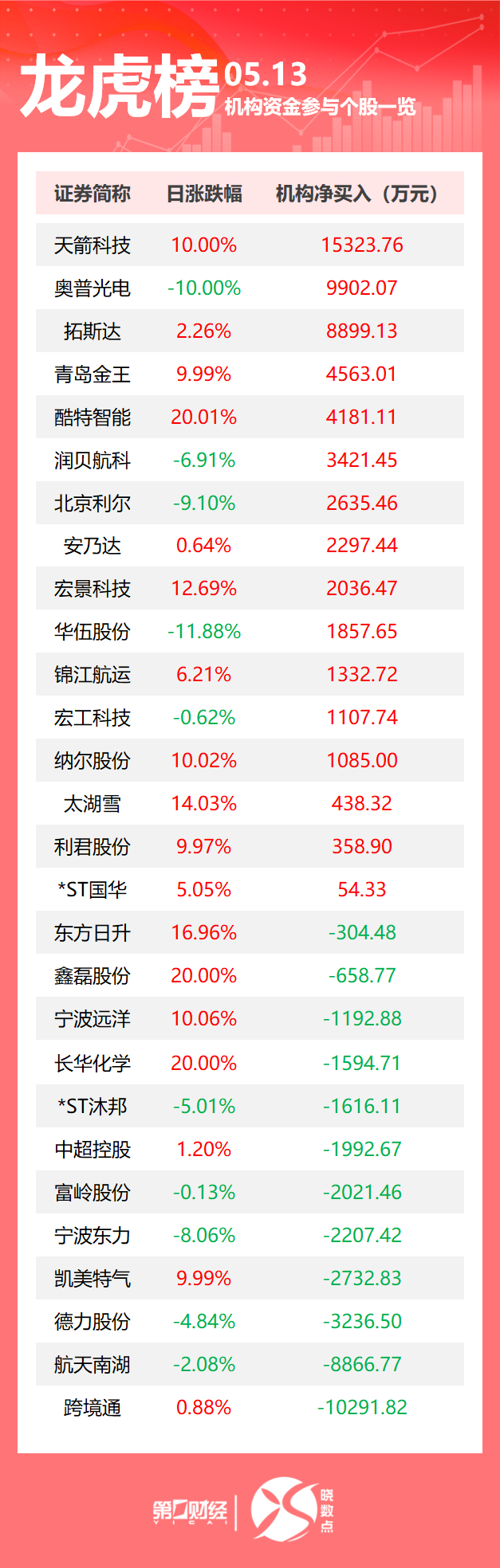
盘前情报丨官宣,中方调整对美关税;五部门约谈外卖平台企业
2 1 Shi Ji Jing Ji Bao Dao· 2025-05-14 00:42
Market Overview - On May 13, the A-share market opened high but closed lower, with the Shanghai Composite Index rising by 0.17% to 3374.87 points, while the Shenzhen Component Index fell by 0.13% to 10288.08 points, and the ChiNext Index decreased by 0.12% to 2062.26 points. The total trading volume in the Shanghai and Shenzhen markets was 1.29 trillion yuan, a decrease of 169 billion yuan from the previous trading day [2] - The U.S. stock market showed mixed results on May 13, with the Dow Jones Industrial Average dropping by 0.64% to 42140.43 points, the S&P 500 rising by 0.72% to 5886.55 points, and the Nasdaq Composite increasing by 1.61% to 19010.08 points [2][5] - European stock indices also exhibited mixed performance, with the UK FTSE 100 down by 0.02% to 8602.92 points, the French CAC40 up by 0.30% to 7873.83 points, and the German DAX up by 0.31% to 23638.56 points [3] Sector Performance - In the A-share market, sectors such as ports, photovoltaic equipment, propylene oxide, and banks saw significant gains, while sectors like military industry, commercial aerospace, rail transit equipment, and minor metals experienced declines [2] - The main sectors with net inflows of capital included photovoltaic equipment (+2.26%), shipping ports (+3.7%), and banks (+1.64%), while sectors with net outflows included aerospace (-3.01%) and automotive parts (-0.84%) [12] Corporate Actions - Over 300 listed companies have publicly disclosed stock repurchase and increase plans since April, with a total proposed amount exceeding 100 billion yuan. Notable companies include Sany Heavy Industry, Midea Group, and China Petroleum [7] - JD Group reported a net revenue of 301.08 billion yuan for the first quarter, reflecting a year-on-year growth of 16% [12] Regulatory Developments - The State Council Tariff Commission announced adjustments to tariffs on imports from the U.S., reducing the additional tariff rate from 34% to 10% effective from May 14, 2025, and suspending the implementation of a 24% additional tariff for 90 days [5][6] - The Ministry of Industry and Information Technology issued an action plan for improving the quality and safety of communication construction projects from 2025 to 2027, focusing on enhancing project management and safety standards [10] Economic Indicators - The U.S. Consumer Price Index (CPI) for April increased by 2.3% year-on-year, with a core CPI growth of 2.8%, indicating stable inflationary pressures [9]

标普500收复年内失地,英伟达涨超5%;四川省加速布局低空经济,万亿级市场加速爆发;中国信通院将发布智能体标准体系——《投资早参》
Mei Ri Jing Ji Xin Wen· 2025-05-14 00:40
Important Market News - In April, the US CPI rose by 2.3% year-on-year, slightly below the expected 2.4%, while the core CPI remained at 2.8% [1] - US stock indices showed mixed results, with the Nasdaq up 1.61% and the S&P 500 up 0.72%, while the Dow Jones fell by 0.64% [1] - Nvidia and Tesla stocks rose over 5%, reaching their highest closing prices since late February [1] - COMEX gold futures increased by 0.96% to $3259 per ounce, and WTI crude oil futures rose by 2.77% to $63.67 per barrel [1] Industry Insights - The 2025 Data Intelligence Conference will be held in Beijing on June 18-19, where standards for smart applications will be released [2] - AI Agents are expected to play a crucial role across various industries, including manufacturing, education, finance, and retail, with major internet companies leading the development [2] - Sichuan province announced plans for low-altitude economic development, including the establishment of over 40,000 square kilometers of airspace and the launch of eight low-altitude transport routes [3] - The low-altitude economy is projected to reach a market size of 1.5 trillion yuan by 2025 and 3.5 trillion yuan by 2035 [3] - The central government aims for over 90% of administrative villages to have 5G coverage by 2025, with the digital rural market expected to exceed 2.2 trillion yuan by 2025 [4] - The China Aerospace Science and Technology Corporation successfully tested a 140-ton reusable liquid oxygen-methane engine, marking a significant advancement in aerospace technology [5] - The 3D printing market in China is projected to exceed 630 billion yuan by 2024, with significant growth expected in various manufacturing sectors [5] Company Updates - Donghu High-tech announced the termination of a share acquisition agreement due to unmet preconditions [6] - Huafeng Chemical decided to terminate its restructuring plan after failing to secure the necessary shareholder approval [6] - Zhejiang Rongtai reported plans for major shareholders to reduce their stakes through public trading [7] - Baijie Shenzhou reported a 50.2% year-on-year increase in revenue for Q1 2025, reaching 8.048 billion yuan, but still incurred a net loss [7]

