
消费复苏

Search documents
复苏态势明朗,板块预期乐观
KAIYUAN SECURITIES· 2026-02-08 04:11
Investment Rating - The industry investment rating is "Positive" (maintained) [1] Core Viewpoints - The food and beverage sector is experiencing a strong upward trend, driven by multiple factors including policy support, trading dynamics, fundamental improvements, and external catalysts, indicating clear investment value [3][9] - The food and beverage index increased by 4.3% from February 2 to February 6, outperforming the CSI 300 by approximately 5.6 percentage points, with sub-sectors like liquor, soft drinks, and beer leading the performance [9][11] - The liquor industry is entering a new development cycle, with Guizhou Moutai's market-oriented reforms marking a significant phase, and the pricing system gradually returning to a supply-demand driven model [10] Summary by Sections Market Performance - The food and beverage index rose by 4.3%, ranking first among 28 sectors, with liquor (+5.3%), soft drinks (+4.7%), and beer (+4.5%) showing relative strength [11][12] - Individual stocks such as Huangtai Liquor, Hai Xin Food, and Ri Chen Co. saw significant gains, while *ST Yedao, *ST Chuntian, and Li Ziyuan experienced declines [11][14] Upstream Data - Some upstream raw material prices are declining, with the price of whole milk powder at $3,614 per ton, down 13.3% year-on-year, and fresh milk prices at 3.04 yuan per kilogram, down 2.9% year-on-year [15][31] - The price of pork is down 20.1% year-on-year, with live pig prices at 12.2 yuan per kilogram, reflecting a broader trend of price adjustments in the sector [21][24] Liquor Industry News - Some distributors of Moutai have sold out their first batch of flying Moutai quotas for March, indicating strong demand during the Spring Festival [36] - The Qingdao Beer production base has commenced operations, aiming to produce high-end products and achieve an annual output value of approximately 1 billion yuan [36] Investment Recommendations - Focus on leading liquor stocks such as Guizhou Moutai, Wuliangye, Luzhou Laojiao, and Shanxi Fenjiu, as well as elastic stocks like Shede Liquor and benefiting stocks like Jiu Gui Liquor [10] - In the consumer goods sector, three main lines are suggested: the snack sector, dairy products, and the restaurant supply chain, with specific companies highlighted for potential growth [10][43]






促消费政策加码落地,消费ETF嘉实(512600)布局A股消费复苏行情
Xin Lang Cai Jing· 2026-02-06 02:57
Group 1 - The A-share market opened lower on February 6, 2026, with the major consumption index down by 1.06% as of 10:08 AM, indicating mixed performance among constituent stocks [1] - The food and beverage industry is showing a recovery trend, particularly in the liquor sector, driven by macro policy optimization, low valuation levels, and improvements in leading companies' fundamentals [1] - Optimized real estate policies and intensive domestic demand support measures have boosted market expectations for a recovery in consumer scenarios [1] Group 2 - The top ten weighted stocks in the major consumption index as of January 30, 2026, include Kweichow Moutai, Wuliangye, Yili, Muyuan Foods, Luzhou Laojiao, Shanxi Fenjiu, Wens Foodstuff, Haitian Flavoring, Dongpeng Beverage, and Haida Group, collectively accounting for 67.37% of the index [1] - The consumption ETF managed by Harvest (512600) tracks the major consumption index, which encompasses leading consumer stocks across various sectors, with liquor being the largest sector, accounting for over 38% of the index [2] - Investors can also access the consumption recovery trend through the consumption ETF linked fund (009180) [3]




开源证券:白酒板块迎来较强上涨 大众品投资机会聚焦零售、原奶/乳制品及餐饮供应链
智通财经网· 2026-02-06 01:29
智通财经APP获悉,开源证券发布研报称,近期白酒板块在政策、估值、基本面共振下强势上涨,行业 处于周期底部,需求复苏与政策优化支撑可持续性预期。其底部修复逻辑同样适用于啤酒、调味品等处 于双底部的食品饮料子行业。2026年大众品投资可聚焦零食、原奶/乳制品及餐饮供应链三大方向。需 关注经济、政策及需求复苏不及预期等风险。 周期底部复苏逻辑明确,看好白酒板块可持续性上涨 该行认为本轮白酒板块上涨具备可持续性,当前行业已处于周期底部区域,基本面向上修复逻辑清晰。 首先,白酒需求端呈现缓慢复苏态势,高端白酒批价回落至合理区间后,有效激发了真实消费需求,叠 加春节旺季临近,家庭聚会、礼品馈赠等场景需求集中释放,价格下行带来的消费提振效应逐步显现; 其次,禁酒令进行纠偏后,政策负面影响边际递减,从近期消费场景恢复情况来看,政策对白酒核心消 费需求的扰动持续减弱,市场预期趋于稳定;再次,随着宏观经济逐步企稳、促消费政策持续出台,整 体消费市场活力有望修复,白酒行业有望实现企稳回升。 伴随后续需求回暖和政策加码,多个子行业有望复制底部修复行情 板块底部修复逻辑并非白酒板块独有,可延伸至整个食品饮料行业。当前啤酒、调味品、速 ...
春节消费旺季大幕拉开,各地促消费政策密集出台,为全年消费市场\"开门红\"注入强劲动力
Xin Lang Cai Jing· 2026-02-05 12:24
Group 1 - Yum China reported a strong financial performance for the year 2025, with operating profit reaching $1.3 billion, reflecting an 11% year-on-year growth [1][3] - The company opened 1,706 new stores in 2025, expanding its network to 18,101 locations across over 2,500 cities in China [1][3] - In Q4 2025, Yum China's operating profit saw a significant increase of 25% year-on-year, with same-store sales growing for the third consecutive quarter [1][3] Group 2 - The Ministry of Commerce and nine other agencies issued a notice regarding the "2026 Spring Festival Special Activity Plan," promoting various food-related events to enhance consumer engagement during the holiday [1][3] - The plan includes initiatives such as launching New Year's Eve dinner packages, organizing food festivals, and encouraging local food markets to attract more consumers [1][3] - Huachuang Securities highlighted that the upcoming Spring Festival consumption season is expected to see strong recovery, driven by government-led consumption policies and diverse promotional activities [2][4] - The Hong Kong Stock Connect Consumption ETF closely tracks the consumption theme index, which includes leading companies in traditional service sectors and high-growth assets, with a rolling P/E ratio of 17.9 and a dividend yield of 3.6% as of February 4 [2][4]

消费政策全线发力,港股通消费ETF华夏(513230)上涨2.39%,春节旺季有望迎来“开门红”
Sou Hu Cai Jing· 2026-02-05 07:45
Core Viewpoint - The Hong Kong stock market shows mixed performance with significant gains in consumer stocks, driven by recent consumption-promoting policies and a positive outlook for the upcoming Spring Festival shopping season [1][2]. Group 1: Market Performance - As of 15:00 on February 5, the Hong Kong stock market indices exhibited varied performance, with the Hong Kong Stock Connect Consumer Index rising by 2.59% [1]. - Notable individual stock performances include Yum China increasing by over 10%, Smoore International by over 9%, Miniso by over 6%, and Mao Geping by over 5% [1]. - The Hong Kong Stock Connect Consumer ETF, Huaxia (513230), rose by 2.39% with a trading volume of 88.13 million yuan and a turnover rate of 22.06% [1]. Group 2: Consumption Policies and Data - Recent consumption policies have been implemented, including a "zero tariff" policy for imported goods in Hainan Free Trade Port, benefiting local residents [1]. - The Ministry of Culture and Tourism has resumed travel for Shanghai residents to Kinmen and Matsu, further stimulating consumption [1]. - The Ministry of Commerce and nine other agencies announced the "2026 'Le Gou Xin Chun' Spring Festival Special Activity Plan," which will run from February 15 to 23, aiming to enhance consumption across various sectors [1][2]. Group 3: Consumer Market Outlook - Data from the Ministry of Commerce indicates that sales of six categories of home appliances and four categories of digital and smart products exceeded 15 million units, with sales nearing 59 billion yuan, reflecting a year-on-year growth of approximately 20% [2]. - The "New National Subsidy" program has benefited 16.13 million people in its first month, driving sales of related products to 92.56 billion yuan [2]. - Analysts from Guosen Securities and Huachuang Securities express optimism for the spring market, anticipating a strong recovery in the consumption market during the 2026 Spring Festival, potentially exceeding market expectations [2]. Group 4: ETF Details - The management fee for the Hong Kong Stock Connect Consumer ETF Huaxia (513230) is currently 0.5% per year, with a custody fee of 0.1% per year [3]. - The ETF tracks the CSI Hong Kong Stock Connect Consumer Theme Index, selecting 50 liquid and large-cap consumer-related securities from the Hong Kong Stock Connect universe [2]. - The top ten holdings include leading companies such as Pop Mart, Baisheng China, and Anta Sports, accounting for a combined weight of 60.29% [2].
消费股逆势走强,春节消费旺季大幕拉开,恒生消费ETF(159699)涨超2%,广发基金ETF“消费链”一键布局“吃喝玩乐”行情
Xin Lang Cai Jing· 2026-02-05 07:37
2025年2月5日港股市场多数板块调整,消费股逆势走强。有市场分析认为,当前港股消费板块值得关 注,一是因为9天超长春节假期有望带动黄金零售、酒旅、餐饮等服务消费行情,而港股服务消费资产 较为稀缺,有望在一季度受益;二是因为在前期持续回调后,估值已进入低位水平,相关龙头公司近期 的回购有望提振市场信息。 消息面方面,1月30日,泡泡玛特创始人、CEO王宁在举办的中英商务论坛上表示,泡泡玛特宣布将伦 敦定为欧洲总部所在地。此外,泡泡玛特已与美国商业地产集团Simon展开合作,计划在全美超过20家 Simon购物中心及The Mills购物中心新增标准零售形式的线下门店。 2026年以来,港股上市公司纷纷出手回购,向市场传递积极信号。根据Wind数据,截至2月3日,年内 已有超过120家港股公司实施回购,其中泡泡玛特于2026年1月19日和21日合计斥资3.48亿港元回购190 万股公司股票,名创优品今年已累计进行15次回购,累计回购金额达2463.25万元。 政策面方面,国务院印发《加快培育服务消费新增长点工作方案》后,多地迅速响应落地。文化和旅游 部于1月29日在泉州启动2026年全国春节文化和旅游消费月,活 ...
旅游及酒店行业持续走强,三峡旅游涨停领衔,多龙头跟涨,消费复苏行情拉满!
Jin Rong Jie· 2026-02-05 07:07
Group 1 - The A-share tourism and hotel sector is experiencing a significant rally, driven by a consumption recovery trend, with Sanxia Tourism hitting the daily limit and becoming a core engine of the sector [1] - Other companies such as Shaanxi Tourism and Juntin Hotel saw gains exceeding 8%, indicating strong performance, while Huangshan Tourism and Jinjiang Hotel also participated in the upward movement, showcasing a synchronized strengthening pattern [1] - The overall recovery of the industry is highlighted by increased market attention and investment in scenic tourism and chain hotel segments [1] Group 2 - The number of planned travelers for the 2026 Spring Festival is expected to surge by 300% year-on-year, leading to an explosion in tourism and hotel demand, which directly catalyzed the sector's rise [2] - The hotel industry's supply-demand dynamics are improving, with leading companies expected to see RevPAR growth and a recovery in profit expectations, as noted in a report by CITIC Securities [2] - The ongoing anti-monopoly investigations on OTA platforms are anticipated to enhance the chain rate in the hotel industry, benefiting leading chain hotels [2] Group 3 - The scenic tourism sector is a core beneficiary of the Spring Festival travel boom, with companies like Sanxia Tourism and Huangshan Tourism directly benefiting from increased demand [3] - The chain hotel sector is also benefiting from improved supply-demand conditions and rising chain rates, with companies like Juntin Hotel and Jinjiang Hotel experiencing simultaneous gains [3] - The tourism service sector, including companies like Shaanxi Tourism, is capitalizing on the recovery of the tourism market, with significant gains reflecting the growth in travel demand [3]




大行评级丨野村:百胜中国上季业绩稳健,目标价上调至459港元
Ge Long Hui· 2026-02-05 03:24
Core Viewpoint - Nomura's research report indicates that Yum China delivered robust performance in the last quarter, with both revenue and profit exceeding expectations, and quarterly revenue increased by 9% year-on-year [1] Group 1: Financial Performance - The company benefited from cost improvements and enhanced operational efficiency, leading to a significant expansion in restaurant profit margin and operating profit margin by 70 basis points and 80 basis points, respectively [1] - Quarterly operating profit reached $187 million [1] Group 2: Management Insights - Yum China's management reiterated early signs of consumer recovery ahead of the Lunar New Year holiday [1] Group 3: Future Projections - Nomura raised Yum China's revenue forecasts for the fiscal years 2026 and 2027 by 1% to 2% [1] - The target price was increased from HKD 432 to HKD 459, maintaining a "Buy" rating [1]
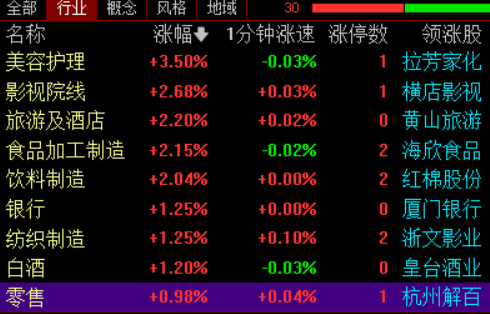
大消费板块走强 !美容护理、旅游、食品、零售、影视等方向纷纷拉升,开年之际促消费政策频发
Jin Rong Jie· 2026-02-05 02:37
早盘,A股大消费(核心股)板块走强,美容护理、旅游、食品、零售、影视(核心股)等方向纷纷拉 升。拉芳家化、安记食品、海欣食品、红棉股份、杭州解百、浙文影业、横店影视等多股涨停。 | 美部 行业 | 概念 风格 地域 | 30 | | | --- | --- | --- | --- | | 名称 | | 涨幅� 1分钟涨速 涨停数 | 领涨股 | | 美容护理 | +3.50% | -0.03% | - 拉芳家化 | | 影视院线 | +2.68% | +0.03% | - 横店影视 | | 旅游及酒店 | +2.20% | +0.02% | 0 黄山旅游 | | 食品加工制造 | +2.15% | -0.02% | 2 海欣食品 | | 饮料制造 | +2.04% | +0.00% | 2 红棉股份 | | 银行 | +1.25% | +0.00% | E 厦门银行 | | 纺织制造 | +1.25% | +0.10% | 2 浙文影业 | | 白酒 | +1.20% | -0.03% | 0 皇台酒业 | | 零售 | +0.98% | +0.04% | 1 杭州解百 | 消息面上,国务院新闻办公室将于20 ...

2026年开年之际促消费政策频发,消费ETF嘉实(512600)获资金关注
Xin Lang Cai Jing· 2026-02-05 02:20
Group 1 - The core viewpoint is that the consumer sector is expected to benefit from a series of consumption promotion policies in 2026, focusing on encouraging new business models rather than traditional stimulus methods [1] - The main consumption index increased by 0.86% as of 09:53 on February 5, 2026, with significant gains from companies like Beitaini (up 8.74%) and Huaxi Biological (up 6.62%) [1] - New economic models such as performance economy, cruise economy, and ice and snow economy are anticipated to receive policy support, creating structural investment opportunities in the consumer industry [1] Group 2 - The top ten weighted stocks in the main consumption index account for 67.37%, with leading companies including Kweichow Moutai and Wuliangye [1] - The consumption ETF managed by Harvest (512600) tracks the main consumption index, which includes major consumer leaders across various sectors, with over 38% weight in the liquor industry [2] - Investors can also access the consumption recovery trend through the consumption ETF linked fund (009180) [3]