
美国劳动力市场

Search documents
铜冠金源期货商品日报-20251112
Tong Guan Jin Yuan Qi Huo· 2025-11-12 07:04
1. Report Industry Investment Rating No relevant content provided. 2. Core Views of the Report - Overseas, the US private - sector employment data is cooling, with the ADP small - non - farm employment in October decreasing by 45,000, the largest decline since March 2023. The small - business confidence index dropped to a six - month low. There is uncertainty in economic assessment due to potential missing economic data. In the US, the stock market is divided, the 10Y Treasury yield fell to 4.06%, the US dollar index weakened to 99.5, gold prices rose, copper prices rose, and oil prices rose by over 1% [2]. - Domestically, the A - share market opened higher and closed lower, with the trading volume of the two markets falling to 2 trillion. The micro - cap and dividend styles are still dominant over the technology style. In the short term, there may be new highs, but there is a risk of subsequent adjustments. In the long - term, it is still cost - effective to buy on dips. The bond market is oscillating, waiting for the release of October financial and economic data. The central bank emphasizes strengthening counter - cyclical and cross - cyclical adjustments [3]. - For precious metals, the optimistic expectation of interest rate cuts boosted gold and silver prices. The US Senate's bill to end the government shutdown and the expected weak economic data may prompt the Fed to cut interest rates in December. The demand for gold is expected to be strong this year and next, and the price may reach $4,700 per ounce [4]. - For copper, the market is cautious. The weak US labor market requires continuous interest rate cuts. The global mine supply is tight, and domestic social inventories are decreasing marginally. Copper prices are expected to remain high and volatile in the short term [6][7]. - For aluminum, the macro - narrative is positive. The end of the US government shutdown, the resumption of economic data, and the dovish shift in the Fed's stance are positive. The supply and demand are relatively stable, and aluminum prices will continue to be strong and volatile [8]. - For alumina, the supply pressure persists, and the price remains weak. The production capacity is high, but the market expects potential production cuts in winter, so the price is oscillating at a low level [9][10]. - For zinc, the market is worried about the deterioration of the US labor market. The LME has low inventories and a strong structure, which supports zinc prices. However, weak domestic consumption limits the upside space, and zinc prices will oscillate [12]. - For lead, the LME is strong, driving up the price of Shanghai lead. The supply shortage in the domestic market has been alleviated, and Shanghai lead is expected to be strong in the short term but may face a pull - back risk [13][14]. - For tin, the weak US employment and the slow recovery of Indonesian tin exports support tin prices. However, the volatile macro - sentiment and high raw material prices may lead to a pull - back in tin prices [15]. - For industrial silicon, the supply is contracting marginally, and the demand is weakening. The price will oscillate in the short term [16][17]. - For lithium carbonate, the current fundamentals are strong, but there are risks of increased imports and weakening demand in the future. The price will fluctuate widely [18][19]. - For nickel, the weak US labor market boosts the expectation of interest rate cuts, which is positive for nickel prices. The high cost of nickel ore limits the downside space, but the high inventory weakens the fundamentals [20]. - For soda ash and glass, there are maintenance plans for soda ash production lines, and the glass production line's daily melting volume is weakening. Both lack demand - driven price increases and may oscillate at a low level [21][22]. - For steel products, the supply and demand are both weak, and steel prices are expected to oscillate and adjust [23][24]. - For iron ore, port inventories are increasing, and the price will oscillate weakly [25]. - For soybean and rapeseed meal, the South American production is expected to be good. The market is waiting for the USDA report, and the price will oscillate and adjust [26][27]. - For palm oil, the weak US employment data boosts the expectation of interest rate cuts. The supply of rapeseed oil is tightening, and the price of vegetable oil has rebounded, driving up the prices of other oils. Palm oil prices will oscillate in the short term [28][29]. 3. Summary by Related Catalogs 3.1 Metal Main Varieties Trading Data - The trading data of various metal contracts on November 11, including closing prices, price changes, price change rates, trading volumes, and open interests, are presented. For example, SHFE copper closed at 86,630 yuan/ton, up 150 yuan, with a trading volume of 156,444 lots and an open interest of 553,109 lots [30]. 3.2 Industrial Data Perspective - **Copper**: On November 11, SHFE copper's main contract price was 86,630 yuan/ton, up 150 yuan from the previous day. LME copper's price was 10,840 US dollars/ton, down 34.5 US dollars. SHFE copper's warehouse receipts remained unchanged at 42,964 lots, and LME copper's inventory decreased by 25 tons to 136,250 tons [32]. - **Nickel**: SHFE nickel's main contract price was 119,380 yuan/ton, down 300 yuan. LME nickel's price was 15,025 US dollars/ton, down 75 US dollars. SHFE nickel's warehouse receipts decreased by 241 lots to 32,292 lots, and LME nickel's inventory decreased by 96 tons to 253,308 tons [34]. - **Zinc**: SHFE zinc's main contract price was 22,675 yuan/ton, up 5 yuan. LME zinc's price was 3,069 US dollars/ton, down 16.5 US dollars. SHFE zinc's warehouse receipts increased by 649 lots to 70,518 lots, and LME zinc's inventory increased by 400 tons to 35,300 tons [34]. - **Lead**: SHFE lead's main contract price was 17,440 yuan/ton, down 65 yuan. LME lead's price was 2,067 US dollars/ton, up 10.5 US dollars. SHFE lead's warehouse receipts remained unchanged at 4,981 lots, and LME lead's inventory increased by 24,525 tons to 226,725 tons [34]. - **Aluminum**: SHFE aluminum's continuous third - month contract price was 21,670 yuan/ton, down 55 yuan. LME aluminum's price was 2,879.5 US dollars/ton, down 1 US dollar. SHFE aluminum's warehouse receipts remained unchanged at 64,142 lots, and LME aluminum's inventory decreased by 2,000 tons to 545,225 tons [34]. - **Alumina**: SHFE alumina's main contract price was 2,816 yuan/ton, down 13 yuan. The national average spot price of alumina was 2,869 yuan/ton, down 2 yuan [34]. - **Tin**: SHFE tin's main contract price was 288,180 yuan/ton, up 1,620 yuan. LME tin's price was 36,695 US dollars/ton, up 515 US dollars. SHFE tin's warehouse receipts decreased by 112 lots to 5,582 lots, and LME tin's inventory decreased by 20 tons to 3,015 tons [36]. - **Precious Metals**: SHFE gold remained unchanged at 948.88 yuan/gram, and COMEX gold remained unchanged at 4,116.30 US dollars/ounce. SHFE silver remained unchanged at 11,880 yuan/kg, and COMEX silver remained unchanged at 50.744 US dollars/ounce [36]. - **Steel and Iron Ore**: SHFE rebar's main contract price was 3,025 yuan/ton, down 19 yuan. The main contract price of iron ore futures was 763 yuan/ton, down 2 yuan. The inventory of imported iron ore at 47 ports in China increased by 380.41 million tons to 15,819.49 million tons [36][38]. - **Coke and Coking Coal**: The main contract price of coke futures was 1,685 yuan/ton, down 58.5 yuan. The main contract price of coking coal futures was 1,213 yuan/ton, down 52.5 yuan [38]. - **Lithium Carbonate**: The main contract price of lithium carbonate futures was 8.46 yuan/ton, up 0.01 yuan. The spot price of electric - grade lithium carbonate was 8.2 yuan/ton, up 0.10 yuan [38]. - **Industrial Silicon**: The main contract price of industrial silicon futures was 9,180 yuan/ton, down 110 yuan. The average price of East China's 553 oxygen - containing silicon remained unchanged at 9,500 yuan/ton [38]. - **Agricultural Products**: CBOT soybean's main contract price was 1,126.75 US cents/bushel, down 0.75 US cents. The main contract price of soybean meal futures was 3,054 yuan/ton, down 9 yuan. The main contract price of rapeseed meal futures was 2,500 yuan/ton, down 27 yuan [40].
贵金属日报2025-11-12:贵金属-20251112
Wu Kuang Qi Huo· 2025-11-12 01:44
1. Report Industry Investment Rating - No relevant content provided 2. Core View of the Report - The U.S. government shutdown has affected the release of non - farm payroll data, and the private sector's weekly job losses indicate pressure on the U.S. labor market. The passage of the temporary appropriation bill in the Senate is likely to resolve the government shutdown issue, and the release of funds from the Treasury cash account will support market liquidity, which in turn will support gold and silver prices. Given that the Fed's current easing cycle is in its early stage and the market prices in a 67.4% probability of a 25 - basis - point rate cut in the December FOMC meeting, it is recommended to buy silver on dips. The reference operating range for the main contract of SHFE gold is 927 - 968 yuan/gram, and for the main contract of SHFE silver is 11575 - 12366 yuan/kilogram [2][3] 3. Summary by Related Catalogs Market Quotes - SHFE gold dropped 0.01% to 944.18 yuan/gram, SHFE silver rose 0.74% to 11921.00 yuan/kilogram. COMEX gold was at 4133.20 dollars/ounce, and COMEX silver was at 51.08 dollars/ounce. The U.S. 10 - year Treasury yield was 4.13%, and the U.S. dollar index was 99.46 [2] - ADP's estimate showed that private - sector weekly job losses were 11,200 in the month ending on the 25th of last month, significantly lower than the estimated 42,000 job increases in October [2] Key Data of Gold and Silver - COMEX gold: The closing price of the active contract rose 0.24% to 4133.20 dollars/ounce, trading volume dropped 1.23% to 23.96 million lots, and the CFTC - reported open interest rose 2.43% to 52.88 million lots. The inventory decreased 0.41% to 1169 tons [5] - LBMA gold: The closing price rose 2.41% to 4090.25 dollars/ounce [5] - SHFE gold: The closing price of the active contract rose 1.38% to 948.88 yuan/gram, trading volume dropped 5.06% to 45.73 million lots, and open interest rose 1.71% to 35.57 million lots. The inventory remained unchanged at 89.62 tons, and the settled funds increased 3.11% to 53.996 billion yuan [5] - AuT + D: The closing price rose 1.44% to 946.50 yuan/gram, trading volume rose 23.13% to 63.05 tons, and open interest dropped 0.35% to 248.98 tons [5] - COMEX silver: The closing price of the active contract rose 1.33% to 51.08 dollars/ounce, and the CFTC - reported open interest rose 1.75% to 16.58 million lots. The inventory decreased 0.11% to 14885 tons [5] - LBMA silver: The closing price rose 2.76% to 50.04 dollars/ounce [5] - SHFE silver: The closing price of the active contract rose 1.37% to 11,880.00 yuan/kilogram, trading volume dropped 26.87% to 137.01 million lots, and open interest rose 1.76% to 72.53 million lots. The inventory decreased 2.97% to 591.88 tons, and the settled funds increased 3.15% to 23.265 billion yuan [5] - AgT + D: The closing price rose 1.19% to 11,865.00 yuan/kilogram, trading volume rose 1.74% to 725.11 tons, and open interest rose 0.15% to 4243.002 tons [5] Strategy and Outlook - The CME FedWatch Tool shows a 67.4% probability of a 25 - basis - point rate cut in the December FOMC meeting and a 32.6% probability of keeping the interest rate unchanged. It is recommended to buy silver on dips. The reference operating range for the main contract of SHFE gold is 927 - 968 yuan/gram, and for the main contract of SHFE silver is 11575 - 12366 yuan/kilogram [3] Price Difference Data - Gold: On November 11, 2025, the SHFE - COMEX price difference was 3.00 yuan/gram or 13.12 dollars/ounce. The SGE - LBMA price difference was 4.16 yuan/gram or 18.18 dollars/ounce [54][59] - Silver: On November 11, 2025, the SHFE - COMEX price difference was 224.16 yuan/kilogram or 0.98 dollars/ounce. The SGE - LBMA price difference for Ag(T + D) was 137.33 yuan/kilogram or 0.60 dollars/ounce [54]
美国政府即将重开,9月非农最早或在周五发布,10月非农可能“没了”,但高盛预期是“2020年12月以来最差”
Sou Hu Cai Jing· 2025-11-12 01:12
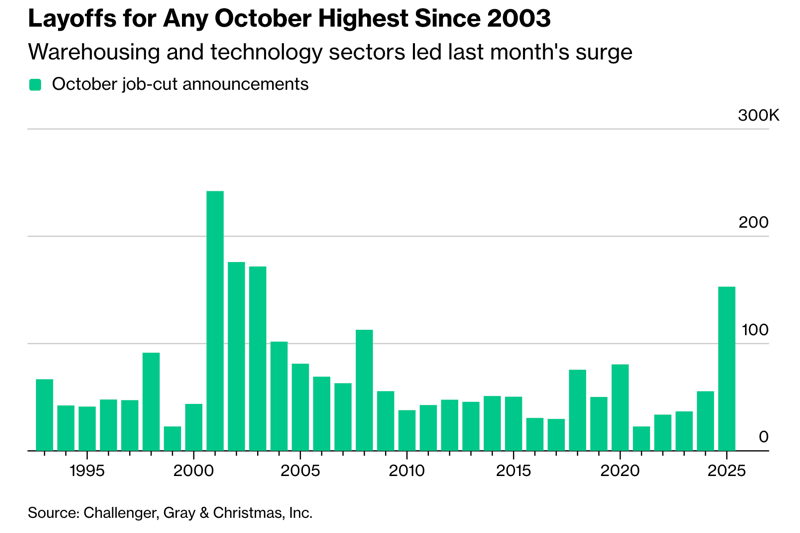
Core Insights - The U.S. government is expected to end its record shutdown, but investors face deteriorating labor data, with Goldman Sachs predicting a potential decline in non-farm payrolls for October, marking the first negative growth in nearly three years [1][2] Group 1: Government Shutdown and Data Collection - The Senate passed a bill to end the government shutdown, allowing key economic data to be released soon [1] - The Labor Department faces unprecedented challenges due to interrupted data collection during the shutdown, leading to potential permanent loss of some October data [2] Group 2: Labor Market Indicators - Private sector indicators show a sharp deterioration in the labor market, with announced layoffs in October reaching 153,000, nearly three times the number from the previous year and the highest for the month since 2003 [3][6] - Average weekly job losses in the private sector were 11,250 in the last four weeks of October, indicating struggles in job creation [7] - Goldman Sachs has adjusted its employment growth tracking indicator for October down to 50,000, a significant decrease from 85,000 in September [10] Group 3: Economic Outlook and Federal Reserve Implications - The interruption of data and the bleak labor market outlook place the Federal Reserve in a difficult position regarding interest rate decisions [15] - Goldman Sachs predicts a 20%-25% chance of a significant rise in the unemployment rate over the next six months, up from 10% six months ago [15][19] - The chaotic data release situation and negative private indicators complicate the risk assessment for investors, suggesting increased market volatility in the coming weeks [19]


股市早观点,哪些热点?哪些消息?11月8日
Sou Hu Cai Jing· 2025-11-08 12:22
Core Viewpoint - The U.S. labor market data is currently lacking due to the government shutdown, which has delayed the release of the October non-farm payroll report, impacting the Federal Reserve's decision-making for potential interest rate cuts in December [1] Group 1: Labor Market Insights - The October non-farm payroll report was not released as scheduled due to the government shutdown, marking the second consecutive absence of this report [1] - Economists had previously anticipated a reduction of 60,000 jobs in October, with the unemployment rate expected to rise to 4.5% [1] - A report from an employment consulting firm indicated that U.S. companies announced over 153,000 layoffs in October, the highest level for this period in over 20 years and the most layoffs in a single month for the fourth quarter since 2008 [1]
再度降息、停止缩表,鲍威尔却为何更鹰?:——美联储FOMC会议点评(25.10)
Huafu Securities· 2025-10-30 12:17
Monetary Policy Actions - The Federal Reserve has lowered the federal funds rate by 25 basis points to a target range of 3.75%-4.0%, totaling a 50 basis point reduction for the year[3] - The Fed will stop balance sheet reduction starting December 1, allowing MBS to mature and reinvesting in short-term Treasury securities[12] Economic Outlook - Powell indicated that inflation risks are skewed to the upside while employment risks are skewed to the downside, creating a challenging situation[3] - Current economic indicators suggest moderate expansion, but the government shutdown has delayed the release of various economic data[3] Inflation Analysis - Powell highlighted three factors affecting inflation: tariffs pushing up goods prices, declining housing services, and stable core non-housing services due to slightly restrictive monetary policy[4] - The impact of tariffs on inflation is expected to persist until spring 2026, with potential for a rebound in core inflation due to tariff transmission and base effects[4] Labor Market Insights - The weakening labor market is attributed to a significant decline in labor supply and a decrease in labor demand, influenced by tighter immigration policies and previous tariff impacts[4] - Recent tax cuts from the Inflation Reduction Act and recent rate cuts may help restore labor demand over time[4] Balance Sheet Management - The Fed's balance sheet reduction pace has slowed to $5 billion per month since March, with Powell stating further reductions are not meaningful[12] - The decision to stop balance sheet reduction aims to avoid upward pressure on long-term Treasury yields and alleviate government debt burdens[16] Risks and Uncertainties - There is uncertainty regarding the extent and speed of future rate cuts by the Fed, which may be less than market expectations[16] - The potential for inflationary pressures from tariffs may limit the Fed's ability to cut rates aggressively in the short term[16]
The Fed has a big decision to make without key data. Here's what it could do.
MarketWatch· 2025-10-20 10:00
Core Insights - Federal Reserve officials are divided on how concerned they should be about the U.S. labor market as they prepare for an upcoming meeting on interest rates [1] Group 1 - The division among Federal Reserve officials indicates differing perspectives on the strength and stability of the labor market [1] - The upcoming meeting in 10 days will focus on interest rate decisions, which are influenced by labor market conditions [1]
褐皮书释放微妙信号,美联储进一步宽松“箭在弦上”
2 1 Shi Ji Jing Ji Bao Dao· 2025-10-16 12:54
Economic Overview - The Federal Reserve's Beige Book indicates that overall economic activity in the U.S. has not changed significantly, with some regions reporting slight to moderate growth, while others show stagnation or slight declines [1] - The report highlights that inflation is being driven up by tariffs imposed by the government, leading to challenges for businesses in absorbing costs or passing them on to customers [2][3] - The labor market remains stable, but demand is generally weak across most Federal Reserve districts [1][2] Labor Market Insights - The labor market is showing signs of weakness, with stable employment levels but low demand for labor across various sectors [1][3] - Employers are resorting to layoffs and natural attrition to reduce workforce numbers due to weak demand and economic uncertainty [1][3] - Immigration policies are contributing to labor shortages in industries such as hospitality, agriculture, construction, and manufacturing [1] Inflation and Consumer Spending - Rising costs from imports, tariffs, and service expenses are accelerating input costs for businesses, with some passing these costs onto consumers [2][6] - Overall consumer spending has slightly declined, particularly in retail, with a growing divide in spending patterns among different income groups [2][7] - The impact of tariffs on inflation is becoming evident, with core goods inflation rising, particularly in categories like clothing and vehicles [6][7] Federal Reserve Policy Outlook - The Federal Reserve is expected to continue its trend of interest rate cuts, with a consensus for further reductions in October and December [8][9] - The current economic environment presents a complex scenario of employment risks and inflation pressures, influencing the Fed's monetary policy decisions [9][10] - The potential for a more dovish Federal Reserve leadership in the future could lead to increased rate cuts, especially in response to significant economic downturn signals [9][10]
美联储9月会议纪要曝光内部分歧,政府停摆令美联储陷入数据盲区
Bei Ke Cai Jing· 2025-10-09 05:41
Core Viewpoint - The Federal Reserve is leaning towards further interest rate cuts, with most participants in the September meeting believing that easing monetary policy may be appropriate for the remainder of the year, although there are still internal disagreements regarding the timing and pace of future cuts [1][2]. Group 1: Federal Reserve's Decision-Making - The Federal Reserve decided to lower the federal funds rate target range by 25 basis points to between 4% and 4.25% due to signs of weakness in the U.S. labor market [2]. - There is a classic dilemma facing the Federal Reserve: the potential weakness in the labor market versus persistently high inflation, leading to significant internal disagreements on the timing and pace of future rate cuts [2][3]. - Some officials expressed reservations about the September rate cut, suggesting that maintaining the rate could also be justified given that recent indicators did not show a sharp deterioration in the labor market [2]. Group 2: Economic Data and Government Shutdown - The U.S. federal government shutdown on October 1 has resulted in a lack of timely releases of key economic data such as non-farm payrolls and inflation, complicating the Federal Reserve's decision-making process for the upcoming meeting on October 28-29 [4]. - The shutdown may lead to a significant increase in the risk of misjudgment for the Federal Reserve, as it will have to rely on scattered private data and feedback from businesses [4]. - Market expectations currently fully price in a rate cut at the October meeting, with a 90% probability of another cut in December, influenced by potential job losses and economic output declines due to the government shutdown [4]. Group 3: Market Reactions and Predictions - Analysts from Tianfeng Securities believe that the government shutdown has increased expectations for two more rate cuts by the Federal Reserve this year, as it could negatively impact employment and GDP [5]. - The shutdown creates a "black box" for economic data, amplifying uncertainty and affecting market expectations regarding the economy [5]. - Concerns over rising debt and interest pressures are eroding the growth potential of the U.S. economy, with current debt rates around 3.4%, suggesting that a small rate cut may not address the fundamental issues [5].
Government shutdown leaves investors in a data void. Here's how they get around it.
MarketWatch· 2025-10-03 18:29
Core Insights - Investors are increasingly utilizing alternative data sources to understand the U.S. labor market and economy amid the government shutdown [1] Group 1 - The reliance on alternative data is growing as traditional economic indicators may be less reliable during the shutdown [1] - Investors are seeking innovative ways to analyze labor market trends without access to government data [1] - The shift towards alternative data reflects a broader trend in investment strategies, emphasizing the importance of real-time information [1]
This chart shows the U.S. labor market is running on fumes. Why that's a risk for the stock market.
MarketWatch· 2025-09-29 16:32
Group 1 - A weakening U.S. labor market poses risks for both the U.S. economy and markets [1] - The rate of new jobs created and the official unemployment rate are critical metrics but do not provide a complete picture of the labor market [1]