能源转型

Search documents
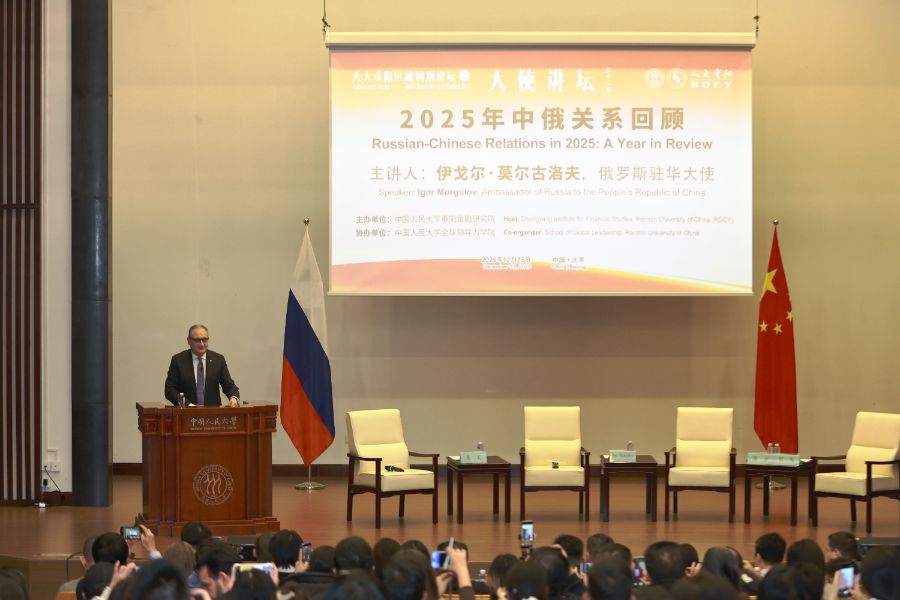
俄驻华大使:今年两国贸易或至2200亿美元,农业领域潜力巨大
2 1 Shi Ji Jing Ji Bao Dao· 2025-12-23 13:05
Core Viewpoint - The comprehensive strategic partnership between China and Russia is maintaining a high level of operation, showcasing strong resilience and vitality in practical cooperation [2] Economic Cooperation - China has been Russia's largest trading partner for 15 consecutive years, with bilateral trade growing by nearly $100 billion over the past three years, reaching a projected $245 billion in 2024 [3] - As of November this year, bilateral trade has surpassed $203 billion, with analysts predicting it could reach $220 billion by the end of the year [3] - The two countries are currently working on over 80 large joint projects across key industries such as automotive manufacturing, steel, non-ferrous metallurgy, chemicals, and wood processing [3] Energy Cooperation - Energy cooperation is the most significant area of practical collaboration, with Russia being China's largest supplier of oil and natural gas, meeting about 20% of China's coal import needs [4] - Ongoing discussions are taking place regarding a new gas pipeline through Mongolia, which will secure China's gas supply for decades [4] - Collaboration in decarbonization and renewable energy is expected to become a growth point in the energy sector [4] Agricultural Cooperation - The agricultural sector presents significant potential for cooperation, with Russian high-quality green agricultural products gaining popularity in the Chinese market [5] - In 2025, Russian grain exports to China are expected to grow by 10%, with total agricultural trade increasing by 14% [5] Technological Collaboration - Cooperation in science and high technology is steadily deepening, with joint research in fields such as medicine, biotechnology, ecology, and new materials [5] - Collaborative projects include the construction of a heavy ion superconducting synchrotron accelerator at the Dubna Joint Institute for Nuclear Research [5] Cultural Exchange - The two countries will host the "Russia-China Education Year" in 2026-2027, with approximately 56,000 Chinese students currently studying in Russian universities [5] - The number of Chinese citizens applying for study visas to Russia is expected to increase by 25% in 2025 [5]

Precious metals rally on supply deficits: Sprott's ETF director Schoffstall
Youtube· 2025-12-23 12:23
looking at gold. So, gold's on pace for its best year since the 70s. Uh the years that you gave us, 73, 79.Those are the years after we abandoned the gold standard. So, is there any correlation between those years and this year that we're seeing such a big gold rally. >> Yeah, you know, if you go back through the 70s till now, there's only been four times that gold's actually um returned over 50%.So, I think a lot of what we're seeing now is the debasement trade. So looking at largely central banks uh movin ...

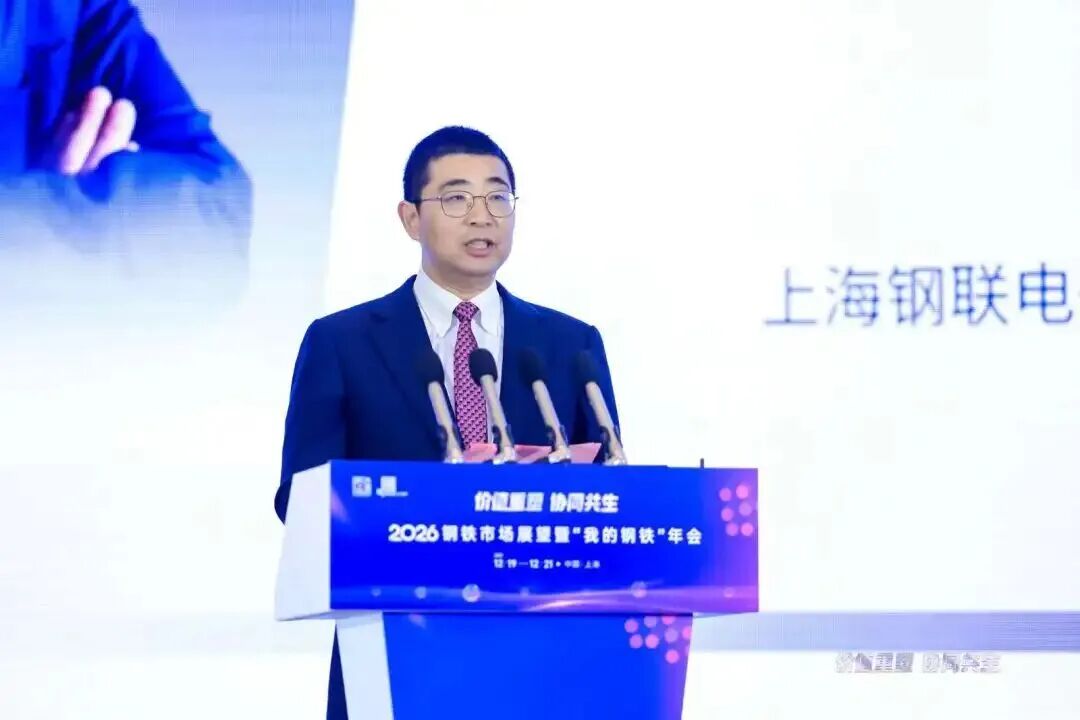
上海钢联朱军红董事长:未来工业生产的底层逻辑将发生根本性改变
Xin Lang Cai Jing· 2025-12-23 12:14
Core Viewpoint - The steel industry is undergoing a significant transformation driven by energy transition, with hydrogen playing a crucial role in changing production methods and creating new opportunities for sustainable development [3][4][7] Company Overview - Shanghai Steel Union celebrates its 25th anniversary, evolving from a steel information platform to a comprehensive data service provider across various sectors including black and non-ferrous metals, energy, construction materials, and new materials [3][6] - The company aims to create value for users by providing precise trading benchmarks and commercial decision-making support through in-depth industry research and data analysis [3][6] Industry Insights - China's heavy chemical industry has made remarkable achievements, and the country now holds a significant position in global commodity production [3][6] - The traditional development model characterized by high energy and material consumption is nearing its growth limit, necessitating a shift towards energy transition as a historic opportunity for the industry [3][6] - The National Energy Administration predicts that by 2035, China's total installed capacity for wind and solar power will reach 3.6 billion kilowatts, with an additional potential of 1.9 billion kilowatts in the next decade [3][6] Technological Transformation - The fundamental logic of industrial production is set to change, with hydrogen serving as a reducing agent and chemical raw material, facilitating production method transformations in various industries [4][7] - In the steel industry, hydrogen direct reduction technology is expected to replace traditional blast furnace processes, while green hydrogen can be used in the fertilizer industry for ammonia synthesis [4][7] - The integration of energy revolution, industrial revolution, and artificial intelligence will lead the industry into a new era of "resource creation, zero-carbon development, and intelligent innovation" [4][7] Future Opportunities - This profound transformation is anticipated to generate new capital investments, business models, and technological breakthroughs, fostering numerous development opportunities [4][7] - Shanghai Steel Union plans to leverage its data services and industry insights to collaborate with clients in exploring innovative breakthroughs and sustainable development paths [4][7]

1000亿补贴砸下!宁德、华为、海辰、晶科等储能巨头已抢占先机
Xin Lang Cai Jing· 2025-12-23 12:09
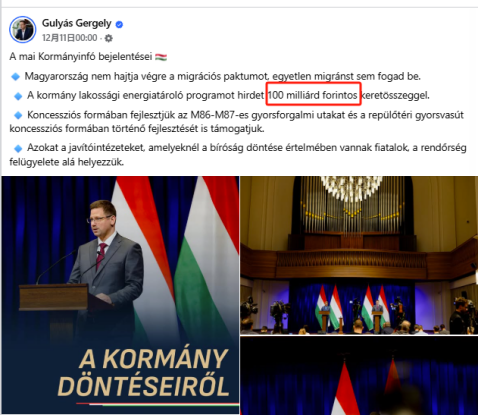
匈牙利总理Gergely Gulyás指出,该计划旨在帮助已安装或计划安装光伏板的家庭储存电力,从而提升 家庭能源自给能力。 (来源:储能产业网) 近日,匈牙利政府推出了一项总预算达1000亿匈牙利福林(约合3.02亿美元)的户用储能补贴计划,为 安装储能系统的家庭提供有力支持。根据方案,家庭配置10kW户储系统,可获高达250万匈牙利福林的 补贴。 体) (图源:Gergely Gulyás社交媒 能源部议会国务秘书Gábor Czepek在其Facebook中进一步透露,政府将在1月中旬公布更多招标细节, 并于2月初正式开放家庭申请窗口。他表示,每户250万匈牙利福林的补贴,可覆盖家庭电池和逆变器总 成本(约320万匈牙利福林)的80%以上。 1 "可选"走向"刚需",储能成为关键拼图 在欧洲能源结构转型与电价波动的双重驱动下,储能正从"可选"逐渐走向"刚需",成为欧洲能源体系中 不可或缺的一环。 过去五年,匈牙利光伏产业发展迅猛,太阳能发电占比从2019年的4%大幅攀升至2024年的近25%。截 至2025年7月,匈牙利光伏累计装机已超8GW,光伏发电渗透率已位居世界前列。然而光伏"发电高 峰"与"用电 ...
能源权力转移中的美元与油价
Sou Hu Cai Jing· 2025-12-23 10:32
身份转变。 美元和原油通常"反着走",但在今年经历了一系列的全球货币政策调整,能源结构转型等多重因素后, 两者之间的传统定价逻辑正在发生变化。若还是停留在二者"负相关"的层面上,整个2026年将是看不明 白的。 也就是说,美元的短期强势,更多是全球资本的无奈选择。 长期以来,美元作为全球储备货币和主要结算货币,其强弱被视为全球经济信心的晴雨表。但自从23年 美联储加息周期以来,美元的支撑逻辑就变了,从相对增长优势变为被动流动性紧缩。 到2025年,美联储开始降息,美元指数随之走弱。 需要清楚的是,美元的下行并非源于外部竞争力提升,而是美国内部财政不可持续性的外溢。25年,美 赤字占GDP突破7%,净利息支出首次超过国防预算。 为弥补赤字,财政部大幅增加中长期国债发行,10年期美债收益率虽因降息预期回落至3.8%左右,但 外国官方投资者(尤其是中国、日本、沙特)的购债意愿显著下降——这意味着"美元回流闭环"正在松 动。 2026年,若是按照正常的剧本走下去,美国财政继续恶化,全球货币多级体系加速,则美元长期贬值压 力难以逆转。但是,在危机或流动性紧张时刻,美元仍可能阶段性走强,形成"脉冲式升值"。 原油,能源权 ...
华顿在沪发布2025年世界500强企业排行榜
Guo Ji Jin Rong Bao· 2025-12-23 07:32
Core Insights - The "Wharton Version 2025 World 500 Companies Ranking" was released, focusing on profit as the ranking criterion, differing from the Fortune magazine's revenue-based ranking [1] - The total profit of the world's top 500 companies reached approximately $4.02 trillion, a 5% increase from the previous year [1] - The median profit increased from $4.47 billion to $4.58 billion, reflecting a growth of 2.4% [1] - The threshold for inclusion in the ranking rose from $2.17 billion to $2.31 billion, marking a 6.8% year-on-year increase [1] - The total revenue of all listed companies was about $33.41 trillion, with a year-on-year growth of approximately 4% [1] Company Rankings - Apple topped the profit ranking with $112.01 billion, followed by Saudi Aramco at $104.98 billion [2] - Other notable companies in the top ten include Microsoft ($101.83 billion), Alphabet ($100.12 billion), and Berkshire Hathaway ($88.99 billion) [2] - Among the top 20, seven companies are from China, including China Construction Bank and China Agricultural Bank [2] Industry Trends - The 2025 ranking reflects a core pattern of "U.S. dominance, followed by China, with Europe and Japan diversifying and emerging forces rising" [3] - The industry distribution is concentrated in technology, finance, and energy sectors, indicating pressures for traditional industries to transform [3] - The top 100 companies contributed 57% of total profits, with the top 10 accounting for 20%, highlighting a structural characteristic of "head concentration and tail pressure" [3] Regional Insights - The U.S. has 191 companies on the list, an increase of 9 from the previous year, generating a total profit of approximately $1.77 trillion, which is 44% of the total profits of the top 500 [3] - China (including Hong Kong, Macau, and Taiwan) has 114 companies, accounting for 22.8% of the total, with a total profit of $989.28 billion, representing 24.6% of the total [4] - The financial sector is significant in China, with 39 financial companies listed, 13 of which are in the top 100 [4]






碳酸锂期货日报-20251223
Jian Xin Qi Huo· 2025-12-23 07:22
Group 1: General Information - Report title: Carbonate Lithium Futures Daily Report [1] - Date: December 23, 2025 [2] - Researcher: Zhang Ping, Yu Feifei, Peng Jinglin [3][4] Group 2: Market Review and Operational Suggestions - Carbonate lithium futures reached a new high this year, with total positions increasing by 26,408 lots, and the 05 - 01 spread widening to 1,900. Spot electric carbon rose 1,350 to 99,000. The trade market's premium/discount to the main contract was reported at (-3,500, -1,500). Australian ore rose 50 to 1,385, lithium mica ore rose 85 to 2,920, ternary materials rose 500 - 1,000, iron - lithium rose 315 - 330, and electrolyte remained flat [9]. - The slowdown in demand at the end of the year was obvious. The weekly production of power lithium batteries, ternary, and iron - lithium all slowed down last week, and the weekly de - stocking volume slowed down for three consecutive weeks [9]. - Overall, there was an expected difference on the supply side of carbonate lithium, and demand slowed down slightly. It was expected that the de - stocking intensity of carbonate lithium would stop falling and rise, and carbonate lithium futures were prone to rise and difficult to fall [9]. Group 3: Industry News - Over 60% of global key mineral demand was met through international trade, making the global supply chain vulnerable to geopolitical tensions, export controls, and refining bottlenecks. The supply - side vulnerability was increasing as the demand for major energy - transition minerals was expected to rise sharply by 2040. Copper and nickel markets might face shortages in the mid - 2030s, and lithium supply was concentrated in a few countries, with the concentration of the refining segment increasing from about 82% in 2020 to 86% in 2024. Governments had accelerated their responses, with the number of key mineral policies issued since 2020 nearly doubling that of the previous two decades [12]. - Battery metals such as lithium, nickel, and cobalt had faced a third difficult year, struggling to digest the supply wave after the 2022 price surge. However, the electric vehicle revolution continued, and the demand for batteries and battery - forming metals was still growing rapidly. Chinese companies were leading a technological revolution to develop more powerful batteries at lower costs. Not all battery metals would succeed in the intense competition. In the first 11 months of 2025, global electric vehicle sales increased by 21% year - on - year to 18.5 million. The Chinese electric vehicle market was mainly dominated by lithium iron phosphate (LFP) batteries, which were safer, cheaper, and had a narrowing performance gap compared to NCM batteries. In 2024, LFP batteries accounted for 48% of global electric vehicle batteries, and Macquarie Bank expected this proportion to rise to 65% by 2029 [13].
日本拟提供2100亿日元补贴以支持清洁能源投资
Xin Lang Cai Jing· 2025-12-23 05:09
Core Insights - The Japanese government plans to provide 210 billion yen (approximately 1.34 billion USD) to support companies investing in clean energy, aiming to boost demand for renewable energy and stimulate regional economic growth [1][3] - The subsidies are intended to help Japan, the world's fifth-largest carbon dioxide emitter, achieve its clean energy goals and reduce reliance on imported fossil fuels after setbacks in wind and solar projects [1][3] - The initiative will begin in the fiscal year 2026 and will span five years, with eligible companies potentially receiving subsidies covering up to half of their capital expenditures [1][3] Renewable Energy Goals - Japan aims for renewable energy to account for up to 50% of its power structure by the fiscal year 2040, an increase from 22.9% in the fiscal year 2023, with nuclear power expected to rise to 20% from 8.5% in the same period [2][4] - This new support measure is part of Japan's "GX 2040" vision, a national strategy combining decarbonization and industrial policy, which was approved by the cabinet earlier this year [2][4] GX Strategic Regions - As part of the framework, the Japanese government will establish a "GX Strategic Region" system to create new industrial clusters in low-carbon energy areas [2][4] - Local governments and businesses will collaboratively develop plans, with the national government selecting regions and providing support through subsidies and regulatory reforms [2][4] - Applications from local governments are expected to open later in the current fiscal year [2][4]
“能源展望2060”系列报告: 中国以能源转型成绿色低碳引领者
Zhong Guo Hua Gong Bao· 2025-12-23 02:45
Group 1 - The core theme of the forum is "Integrated Innovation and Transformative Development," focusing on the release of the "Energy Outlook 2060" series report [1] - The oil and chemical industry in China is experiencing stable economic operations but faces pressures for transformation and upgrading [1] - Recommendations include promoting integrated development, strengthening innovation-driven growth, and enhancing the stability of industrial and supply chains [1] Group 2 - The global economic environment is complex, with varying energy transition paths among countries, but electrification is emerging as a common solution [2] - China's primary energy consumption is expected to peak around 2035 at approximately 7 billion tons of standard coal, with carbon emissions related to energy activities entering a plateau phase [2] - The role of fossil fuels is shifting, with coal and oil demand expected to peak in an orderly manner, while natural gas remains in a growth phase [2] Group 3 - During the 14th Five-Year Plan, China's primary energy consumption is projected to grow from 617 million tons of standard coal in 2025 to 686 million tons in 2030, with non-fossil energy accounting for 85% of the increase [3] - The chemical industry is expected to see a slowdown in product consumption, with planned capacities of approximately 26 million tons/year for ethylene and 10 million tons/year for PX [3] - Future industries such as low-altitude economy, humanoid robots, and intelligent driving are expected to significantly increase the demand for new materials, with new energy storage installations projected to double by 2030 [3]

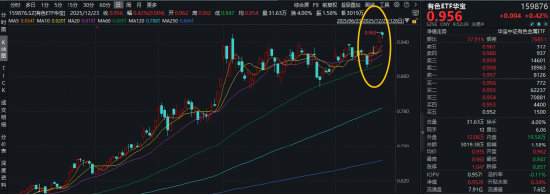
有色ETF华宝(159876)创上市新高!山东黄金领涨超4%!机构:有色金属正在经历爆发性的一年
Xin Lang Cai Jing· 2025-12-23 02:45
Core Viewpoint - The non-ferrous metal sector continues to surge, with the largest non-ferrous ETF, Huabao (159876), reaching a new high, up over 0.6% in intraday trading on December 23 [1][9]. Group 1: Market Performance - Leading gold stocks such as Shandong Gold rose over 4%, while Yunnan Zinc Industry and Zhongjin Gold increased by more than 1% [3][11]. - The international prices of gold and silver have reached historical highs, driven by geopolitical tensions that have increased demand for safe-haven assets [3][11]. - Year-to-date, gold prices have surged over 60% [3][11]. Group 2: Economic Factors - Recent strength in gold prices is attributed to the December interest rate cut, higher-than-expected unemployment rates, and lower-than-expected CPI, which have raised expectations for further rate cuts in January [4][12]. - The long-term outlook for gold prices is positive due to a low current gold reserve in China and a trend of central bank gold purchases [4][12]. Group 3: Future Trends in Non-Ferrous Metals - By 2025, metals such as copper, aluminum, cobalt, and lithium are expected to perform well, driven by three main factors: energy transition, AI revolution, and strategic reserves amid global competition [5][12]. - The duration of the super cycle for non-ferrous metals will depend on the recovery of the US dollar's credit, progress in strategic reserves, and the effectiveness of "anti-involution" policies [5][12]. - The upcoming "spring market" presents opportunities for investors, supported by a weak dollar cycle, policy backing, and industrial upgrades [5][12]. Group 4: Investment Strategy - A diversified investment approach through the Huabao non-ferrous ETF (159876) and its linked funds is recommended to capture the beta performance across the non-ferrous metal sector [6][12]. - This ETF covers a wide range of industries including copper, aluminum, gold, rare earths, and lithium, which helps in risk diversification compared to investing in single metal sectors [6][12].