
智能网联汽车

Search documents
乘联分会:6月新能源乘用车国内零售销量达111万辆,同比增长29.7%;深圳实现无人车全市域覆盖运营丨汽车交通日报
创业邦· 2025-07-08 09:12
Group 1 - The core viewpoint of the article highlights significant growth in the domestic retail sales of new energy passenger vehicles, with June sales reaching 1.11 million units, a year-on-year increase of 29.7% [1] - In June, the overall retail sales of passenger cars in China reached 2.084 million units, marking an 18.1% year-on-year growth and a 7.6% month-on-month increase [1] - Cumulatively, from January to June, retail sales of passenger cars totaled 10.901 million units, reflecting a 10.8% year-on-year increase [1] Group 2 - Shenzhen has achieved full city-wide operational coverage for autonomous vehicles, with over 300 autonomous vehicles now in operation, serving more than 100 community business circles and achieving a daily delivery volume exceeding 100,000 orders [1] - The operational network for autonomous vehicles in Shenzhen has expanded to cover various service scenarios, including 12 categories such as urban delivery and manufacturing supply chains [1] Group 3 - Faraday Future (FF) announced that its FX series has accumulated 4,100 paid pre-orders from B-end customers, covering four core areas including partners, rental companies, live e-commerce MCN agencies, and real estate agencies [1] - The FX Super One product is expected to roll out its first vehicle in the U.S. by the end of 2025 [1] Group 4 - PACCAR has recalled 56,575 vehicles in the U.S. due to potential issues with tail brake lights, high and low beam headlights, reverse lights, and turn signals not functioning properly [1]


“特斯拉中国员工4年反馈了3次,美国总部都没当回事”
Guan Cha Zhe Wang· 2025-07-08 08:00
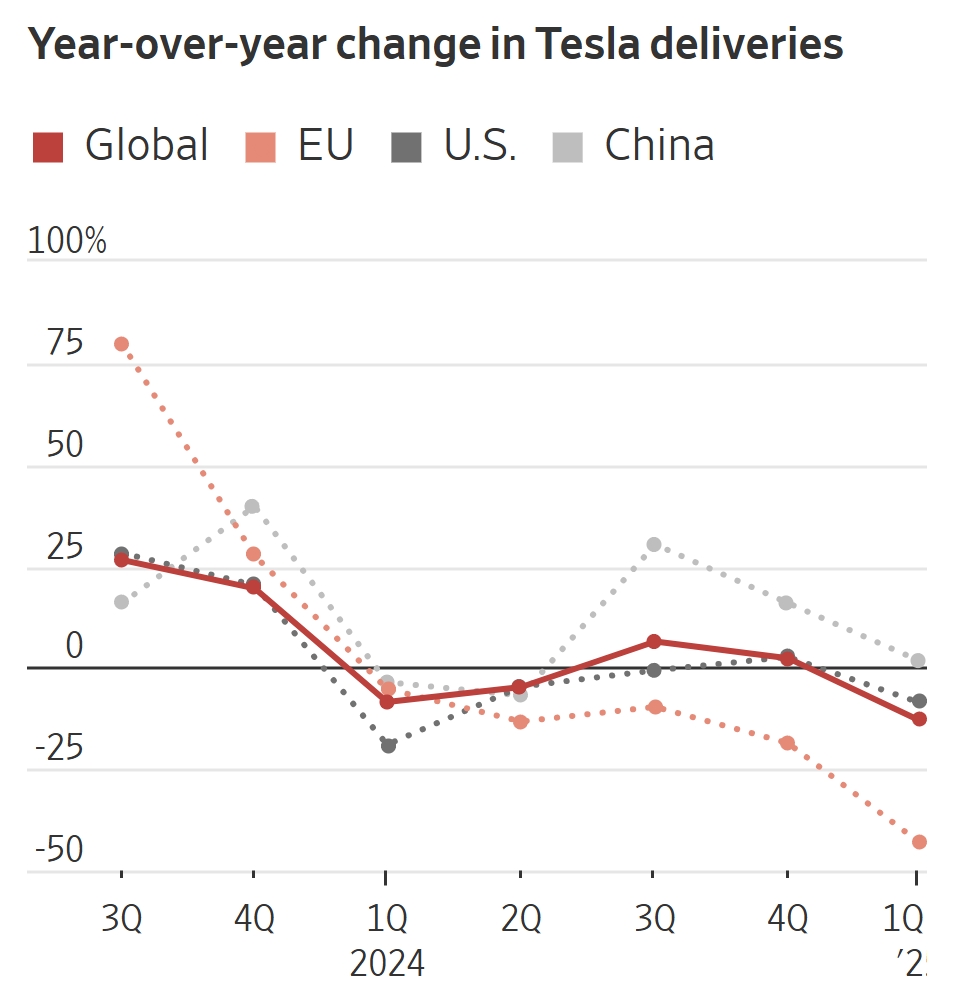
Core Viewpoint - Tesla is facing significant challenges in the Chinese market, with its market share declining as local electric vehicle brands gain popularity due to better alignment with consumer needs [1][5][6]. Group 1: Market Performance - Tesla's sales in China fell to just under 40,000 units in May, representing a 30% year-over-year decline, while the overall Chinese new energy vehicle market grew by 28% during the same period [5][6]. - Tesla's market share in the Chinese new energy vehicle sector has dropped from 11% in early 2021 to 4% as of May [6]. - Competitors like BYD have captured approximately 29% of the market, while even new entrants like Xiaomi have secured a 3% share [6]. Group 2: Product Strategy and Consumer Preferences - Tesla's products are increasingly seen as outdated compared to local competitors, which offer features such as multiple entertainment screens and advanced charging technologies [6][9]. - Tesla's Chinese team has repeatedly communicated the need for products that better integrate with smartphones and include more entertainment applications, but these suggestions have not been prioritized by the U.S. headquarters [9][10]. - The company's strategy has shifted towards cost-cutting measures, leading to simplified models that may struggle to compete unless significantly discounted [10]. Group 3: Regulatory and Operational Challenges - Tesla has faced difficulties in launching its Full Self-Driving (FSD) service in China due to safety compliance issues and restrictions on data transmission [13][15]. - The company attempted to push software updates that included FSD features but faced regulatory pushback, highlighting the challenges of operating in a tightly regulated environment [14][15]. - Despite these setbacks, Tesla continues to leverage its brand recognition and government support in China, which views the company as a model for foreign investment [16][17]. Group 4: Future Outlook - Tesla's ability to maintain its competitive edge in China is increasingly uncertain as local companies advance in technology and pricing [17][18]. - The company is exploring new avenues, such as expanding its operations in energy storage and robotics, while relying on Chinese suppliers for cost-effective components [17][18][19].

“闯将南沙”打造智能网联汽车新高地
Ke Ji Ri Bao· 2025-07-08 06:54
Core Viewpoint - The development of the autonomous driving industry in the Nansha Free Trade Zone is rapidly advancing, supported by favorable policies and a robust industrial ecosystem, positioning it as a national leader in autonomous driving innovation [1][2][3]. Group 1: Industry Development - Nansha Free Trade Zone has accumulated over 45 million kilometers of road testing mileage for autonomous vehicles, with a significant presence of autonomous driving cars available for public use [1]. - The zone has formed a comprehensive automotive industry cluster exceeding 100 billion yuan, providing ample resources for the development and testing of autonomous driving technologies [2][3]. - In 2024, key enterprises in the autonomous driving sector within Nansha are projected to achieve a total revenue of 4.421 billion yuan, with nearly 900 million kilometers of testing mileage [3]. Group 2: Policy and Strategic Collaborations - Nansha Free Trade Zone has established a supportive policy environment for autonomous driving, allowing for commercial operations without a safety driver in the main driving seat [4][5]. - Strategic partnerships have been formed with companies like Uber and the Dubai Roads and Transport Authority to enhance the deployment of autonomous vehicles [2]. - The recent issuance of licenses for autonomous driving equipment marks a transition from closed testing to real-world operations, facilitating rapid commercialization [7]. Group 3: Future Prospects - The introduction of national policies supporting the deepening of intelligent connected vehicle testing and demonstration applications is expected to further accelerate the development of the autonomous driving industry in Nansha [6]. - Nansha aims to create a global leading autonomous driving innovation ecosystem, attracting domestic and international companies to establish operational scenarios [7].
“新央企”将落户重庆 由朱华荣掌舵?长安称未收到正式通知
Nan Fang Du Shi Bao· 2025-07-08 06:40
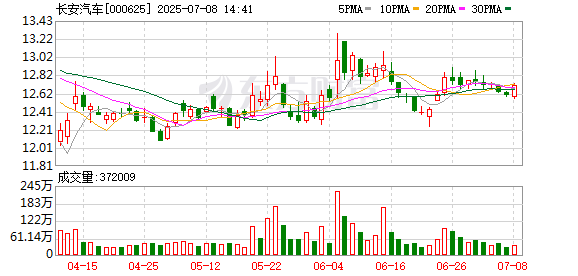
Group 1 - The establishment of a new state-owned enterprise closely related to Changan Automobile is confirmed, with its headquarters located in Chongqing and led by current chairman Zhu Huarong [2] - The new entity is expected to be a direct unit under the State-owned Assets Supervision and Administration Commission (SASAC), with its name to be finalized by the end of the month [2] - Changan Automobile recently changed its name to Chanzhi Automotive Technology Group Co., Ltd., which is seen as a move to free up the name for the new group [2] Group 2 - Changan Automobile reported a global cumulative sales of 1.355 million units in the first half of 2025, marking a year-on-year increase of 6.8%, the highest in nearly eight years [3] - Sales of new energy vehicles reached 448,000 units, a year-on-year increase of 48.8%, accounting for 33% of total sales [3] - The company has invested over 40 billion yuan in the new energy sector since 2015 and plans to launch solid-state battery prototypes by the end of this year [3]

【会讯】2025年7月乘用车市场分析发布会会议通知
乘联分会· 2025-07-07 08:36
点 击 蓝 字 关 注 我 们 本文全文共 685 字,阅读全文约需 2 分钟 为了便于大家进一步及时掌握全国乘用车市场产销动态,并了解行业政策、价格、二手车、新能源汽 车、商用车市场、上海汽车市场等情况,中国汽车流通协会乘用车市场信息联席分会秘书处现决定举行"2025 年7月乘用车市场分析发布会",本次会议以 网上发布 的形式举行。 会议相关信息如下: 主办方: 中国汽车流通协会乘用车市场信息联席分会 协办方: 搜狐·汽车事业部 上海市信息中心 益普索(中国)咨询有限公司 上海安路勤企业管理咨询有限公司 上海福蓝汽车技术有限公司 广州威尔森信息科技有限公司 科瑞卓信(北京)咨询有限公司 广州市佩升前研市场信息咨询股份有限公司 会议报告网上发布时间: 2025年7月8日(星期二)下午16:00 请大家关注微信订阅号:cpca2024和官网www.cpcaauto.com,届时报告将通过以上两种渠道发布。感谢各 位的支持! 会议报告内容: 1)2025年6月份上海汽车市场上牌情况 ——上海市信息中心; 2)2025年5月价格指数报告 ——福蓝汽车; 会议报告网上发布渠道: 微信订阅号(cpca2024) 官网( ...

中部首个两岸(武汉)智能网联汽车产业融合发展示范基地落户武汉经开区
Zhong Guo Jing Ji Wang· 2025-07-07 06:50
7月4日,第十九届湖北·武汉台湾周海峡两岸(武汉)新能源与智能网联汽车产业融合发展交流会在武 汉经开区举行。两岸(武汉)智能网联汽车产业融合发展示范基地(以下简称"基地")揭牌并落户武汉 经开区,汉台汽车产业融合创新、协同发展迈上新台阶。 这是中部地区首个、大陆地区第二个两岸智能网联汽车产业融合发展示范基地。基地将以武汉经开区智 能网联和电动汽车产业园为核心载体,打造海峡两岸智能网联汽车产业协同发展标杆。 《两岸(武汉)智能网联汽车产业融合发展示范基地三年行动计划实施方案(2025—2027年)》(以下 简称"《方案》")同时发布,为汉台汽车产业深入合作擘画新蓝图,明确新路径。 据悉,《方案》聚焦智能网联与新能源汽车产业,推动两岸汽车产业从"产业链条互补"升级为"创新链 条共生""生态体系共建",加快构建更具国际竞争力的汽车产业发展新格局。 当前,武汉经开区加快迈向"世界车谷",力争到2027年形成具有国际影响力的智能网联汽车产业集群, 跻身全国新能源与智能网联汽车产业第一方阵。 根据《方案》,武汉经开区将高水平建设两岸(武汉)智能网联汽车产业融合发展示范基地,打造台商 集聚核心区,深化台湾优势企业技术人才合 ...
一个朴素而热烈的“造车梦” 探访安徽新能源汽车产业
Jin Rong Shi Bao· 2025-07-04 01:51
Core Insights - The automotive industry in Anhui has transformed from manual production methods in the 1960s to advanced digital manufacturing, with Anhui now accounting for one in four cars exported from China [1] Group 1: Industry Transformation - Anhui's automotive industry has evolved significantly, with the introduction of intelligent manufacturing technologies such as robotic arms and digital twin technology [1] - The production of new energy vehicles (NEVs) in Anhui has reached historical highs, with 123.57 million vehicles produced in the first five months of the year, including 61.33 million NEVs, leading the nation [3] Group 2: Financial Support and Innovation - Financial institutions in Anhui are providing crucial support to the automotive sector, including liquidity loans and supply chain financing, to address cash flow challenges [3][4] - The collaboration between Jianghuai Automobile and Huawei has been pivotal in the establishment of a world-class smart factory, enhancing the digital and green transformation of the automotive industry [2] Group 3: Ecosystem Development - The establishment of a comprehensive ecosystem for NEVs in Anhui includes over 3,000 parts manufacturers and 1,700 after-market enterprises, creating a complete supply chain [8] - The government of Anhui is actively promoting policies to support the growth of the NEV sector, aiming to build a world-class NEV industry cluster by 2025 [8] Group 4: Technological Advancements - Companies like Huating Power are innovating in battery technology, providing customized battery systems for electric vehicles, which are critical for performance and safety [7] - NIO's manufacturing base in Anhui showcases advanced technologies such as AI self-check systems and innovative battery swapping solutions, enhancing operational efficiency [5][6]

拟自建工厂摆脱“大客户依赖” 四维智联冲刺港股IPO
Jing Ji Guan Cha Wang· 2025-07-03 15:10
Core Viewpoint - Four-dimensional Zhihui, a subsidiary of Four-dimensional Tuxin, has submitted its IPO application to the Hong Kong Stock Exchange, aiming to navigate the reshuffling in the intelligent connected vehicle industry while facing significant financial challenges [2]. Group 1: Company Overview - Four-dimensional Zhihui, established in 2018, focuses on providing comprehensive software and hardware solutions for intelligent cockpits, including AI assistants and navigation systems [3]. - The company ranks tenth among domestic primary intelligent cockpit solution providers, with a market share of only 0.1% [2]. Group 2: Financial Performance - From 2022 to 2024, Four-dimensional Zhihui is projected to incur cumulative losses of 847 million yuan, averaging annual losses of 280 million yuan, with an operating cash flow of only 89.88 million yuan in 2024 [2][4]. - Revenue figures for Four-dimensional Zhihui from 2022 to 2024 are 539 million yuan, 477 million yuan, and 479 million yuan, respectively, while losses increased from 203 million yuan to 378 million yuan during the same period [4]. Group 3: Customer Dependency - The company has a high customer concentration, with the top five clients contributing to 92.2% of revenue by 2024, including major shareholders like Four-dimensional Tuxin and Didi [4]. - Didi alone contributed approximately 1.726 billion yuan to Four-dimensional Zhihui's revenue in 2024, accounting for 37.2% of total revenue [4]. Group 4: Research and Development - Four-dimensional Zhihui's R&D expenditures from 2022 to 2024 were 113.1 million yuan, 103.4 million yuan, and 209.6 million yuan, with R&D spending as a percentage of revenue rising from 21% to 43.8% [5]. - The company is focusing on solutions based on computing power chips, indicating a commitment to maintaining high R&D investments amid increasing competition in the intelligent cockpit sector [5]. Group 5: Supply Chain and Production - Four-dimensional Zhihui relies heavily on external suppliers for hardware production, which affects its profitability and production quality [6]. - The company aims to establish its own assembly factory to enhance control over production processes and reduce dependency on external suppliers, thereby lowering production costs and supply chain risks [7].
汽车产业变革倒逼车险转型,新老玩家如何破局?
3 6 Ke· 2025-07-03 08:00
Core Insights - The rapid growth of the new energy vehicle (NEV) market in China is not matched by the development of the corresponding insurance market, leading to high premiums, high claim rates, and high loss ratios in NEV insurance [1][3][7] - The insurance industry is facing challenges due to the high repair costs associated with NEVs, which are exacerbated by the vehicles' design and technology [15][18] - The market for NEV insurance is projected to grow significantly, with estimates suggesting it could reach 500 billion yuan by 2030, accounting for nearly 50% of total auto insurance premiums [9][10] NEV Market Growth - In March 2025, NEV sales in China reached 1.237 million units, with a month-on-month growth of 38.7% and a year-on-year growth of 40.2%, achieving a penetration rate of 42.4% [1] - By the end of 2024, the total number of NEVs in China is expected to reach 31.4 million, representing 8.9% of the total vehicle population, with an annual growth rate exceeding 50% [1] Insurance Market Dynamics - In 2024, the insurance industry covered 27.95 million NEVs, generating 140.9 billion yuan in premiums but incurring a loss of 5.7 billion yuan [3][10] - The average premium for NEVs is approximately 30%-50% higher than that for traditional fuel vehicles, with NEV premiums ranging from 3,000 to 4,000 yuan compared to 2,000 to 3,000 yuan for fuel vehicles [6][10] Challenges in NEV Insurance - The high repair costs for NEVs are attributed to advanced designs, high-tech components, and a lack of scale in parts production, leading to increased insurance claims [15][18] - The operational use of NEVs, particularly in ride-hailing and delivery services, results in a higher claim rate compared to traditional vehicles, with 5.5% of NEVs used for commercial purposes versus only 0.4% for fuel vehicles [19] Regulatory and Industry Responses - Regulatory bodies are closely monitoring the NEV insurance market, with initiatives aimed at improving pricing mechanisms and developing new insurance products to address the unique risks associated with NEVs [14][19] - Major insurance companies are adopting strategies to maintain market share in the NEV segment despite ongoing losses, indicating a willingness to invest in the future potential of this market [9][10] Competitive Landscape - Traditional insurance companies maintain a significant market share in NEV insurance, with the top three companies holding approximately 74.7% of the market [21] - New entrants, including automotive manufacturers, are beginning to establish their own insurance operations, aiming to integrate insurance offerings with their vehicle sales to enhance customer loyalty [22][24] Future Outlook - The NEV insurance market is expected to evolve with increased competition and potential collaboration between traditional insurers and automotive manufacturers, as both sectors seek to adapt to the changing landscape of vehicle technology and consumer needs [27][28]

北京市集中发布96项地方标准
Bei Jing Qing Nian Bao· 2025-07-03 01:10
Group 1 - The city has released 96 local standards, including 69 new and 27 revised standards, aimed at enhancing digital economy and urban safety [1][2] - The newly established "Automated Driving Map Data Exchange and Service Interface Specification" fills a gap in domestic standards for automated driving map data sharing, facilitating efficient data sharing among map providers, car manufacturers, and users [1] - The revised "Electric Vehicle Charging Infrastructure Planning and Design Standards" mandates 100% construction of charging infrastructure in new residential projects, optimizing charging facility requirements for various public buildings [2] Group 2 - The "Information Security Technology Requirements for Protection and Assessment of Important Information Infrastructure" is the first local standard in the city focusing on the security of important information infrastructure, proposing enhanced security measures [1] - The revised "Residential Property Service Standards" introduces rigid and flexible indicators for service quality, allowing homeowners to select standards based on their needs, promoting personalized property management services [2] - New standards include the first health examination quality control specification in the Beijing-Tianjin-Hebei region and the first local standard for medical security at large events [3]