
供需错配

Search documents
【图解】权威解读:5方面举措破解供需错配 最大程度激发消费潜力
Zhong Guo Jing Ji Wang· 2025-12-01 13:11
Core Viewpoint - The article discusses the implementation of a new plan aimed at addressing structural mismatches in supply and demand within China's consumer goods market, emphasizing the need to enhance adaptability between supply and consumer preferences to maximize consumption potential and promote economic circulation [3][6]. Group 1: Implementation Plan Overview - The Ministry of Industry and Information Technology, along with five other departments, has issued an "Implementation Plan" to enhance the adaptability of consumer goods supply and demand [3]. - The plan aims to address existing structural mismatches in various sectors of consumer goods [3]. Group 2: Key Measures Proposed - Five key measures are proposed to tackle supply-demand mismatches: 1. **Expand Incremental Supply**: Accelerate the application of new technologies and innovative models [7]. 2. **Deepen Existing Supply**: Increase the supply of specialized and new products, focusing on areas like green, health, rural, and national trends [11][12]. 3. **Precise Matching of Diverse Needs**: Address the differentiated needs of various age groups, including children and the elderly, through targeted actions [13][15][16]. 4. **Scene Empowerment**: Cultivate new consumption scenarios and business formats, promoting platforms for product launches and exhibitions [17][18][19]. 5. **Optimize Environment**: Create favorable conditions for development by leveraging new policies, enhancing financial support, and maintaining market order [21][22]. Group 3: Focus Areas for Development - The plan emphasizes the importance of aligning production with consumer preferences from the design stage, ensuring dynamic matching in quality, structure, and utility [5][6]. - It highlights the need for a comprehensive approach that includes user participation in design and the integration of artificial intelligence across the entire production and sales chain [12].


多空分歧--到底谁在说假话
雪球· 2025-11-30 06:56
Group 1 - The article discusses the contrasting market signals regarding production data and forecasts, indicating a potential misalignment in expectations and reality [3] - November is expected to show significant month-on-month growth, with no anticipated decline into December, supported by various institutions' positive outlooks [3] - The main divergence in the market is centered around the performance of power batteries, with slight downward expectations for BYD's Q1 production, but overall, a 3-5% decline is considered within expectations [3][6] Group 2 - The article argues that despite the reduction or cancellation of subsidies, consumer demand for electric vehicles remains strong, driven by the anticipation of future price increases [6] - The expected increase in battery capacity per vehicle is projected to drive a 10-15% growth in the power battery sector [6][7] - Heavy-duty trucks are highlighted as a significant growth area, with projections indicating a production increase of 130-150 GWh for next year, contributing to an overall 8.65% growth in power batteries [11][12] Group 3 - The article emphasizes that the storage energy sector is on the verge of significant growth, with production expected to ramp up in Q4 or Q1-Q2 of the following year [13] - It notes that the global demand for storage is surging, driven by economic viability and policy support, particularly in the context of renewable energy [14][15] - The article posits that the transition from traditional energy sources to renewable energy solutions is not merely a price issue but a matter of energy security and efficiency [15] Group 4 - The article addresses the skepticism surrounding the demand forecasts, suggesting that the current market dynamics are driven by genuine demand rather than speculative behavior [16][18] - It highlights the need for a balanced approach to managing supply and demand, warning against the dangers of excessive speculation that could lead to market instability [20][21] - The article concludes that the current market conditions reflect a significant supply-demand mismatch, with downstream and midstream sectors expanding while upstream investment remains stagnant [26][27]

国投期货农产品日报-20251128
Guo Tou Qi Huo· 2025-11-28 11:13
Report Industry Investment Ratings - Soybeans: ☆☆☆, indicating a relatively clear long - term trend with a current appropriate investment opportunity [1] - Palm Oil: ★★★, representing a more distinct long - term trend and a current appropriate investment opportunity [1] - Soybean Meal: ☆☆☆, showing a relatively clear long - term trend and a current appropriate investment opportunity [1] - Rapeseed Oil: ★★★, meaning a more distinct long - term trend and a current appropriate investment opportunity [1] - Rapeseed Meal: ★★★, suggesting a more distinct long - term trend and a current appropriate investment opportunity [1] - Corn: ★★★, indicating a more distinct long - term trend and a current appropriate investment opportunity [1] - Live Pigs: ★★★, representing a more distinct long - term trend and a current appropriate investment opportunity [1] - Eggs: ☆★☆, meaning a clear upward - looking trend and the market is developing [1] Core Views - The overall agricultural product market is in a state of complex supply - demand and price fluctuations, with different products having different influencing factors and development trends. Short - term and medium - term factors such as export, weather, and policy need to be continuously monitored [2][3][4] Summary by Related Catalogs Soybeans - Domestic soybeans are de - stocking, with stable spot prices. The new - crop domestic soybeans follow the principle of good quality at a good price. The price difference between domestic and imported soybeans fluctuates horizontally. Imported soybeans are volatile, and short - term attention should be paid to US soybean exports, while medium - term attention should be on South American weather [2] Soybeans and Soybean Meal - US soybeans are on holiday. The main contract of Dalian soybean futures is shifting from 01 to 05, with prices fluctuating. Brazil's 2025/26 soybean production is expected to reach a record 178.1 million tons. Argentina's soybean planting progress is slow. The domestic soybean supply is sufficient, with increased crushing volume and rising soybean meal inventory. The M2605 contract has reached the upper edge of the shock platform, and its upward breakthrough depends on US soybean exports and South American weather [3] Soybean Oil and Palm Oil - The high - frequency data of Malaysia's palm oil export market is still poor, and Indonesia's inventory increased slightly in September. The overseas supply - demand of palm oil is weak, but the marginal negative factors have eased. The output of palm oil in November 1 - 20 is expected to increase by 3.24% month - on - month. Soybean oil has a de - stocking rebound. Short - term attention should be on US soybean exports, and medium - term on South American weather [4] Rapeseed Meal and Rapeseed Oil - The positions of near - month contracts of rapeseed futures are decreasing, and prices are slightly falling. Canada's rapeseed export is poor, and domestic attention is on Australian rapeseed customs clearance and crushing. The short - term driving force of rapeseed is not significant, and a wait - and - see strategy is recommended [6] Corn - Corn futures are in a wide - range shock at a high level. North port corn prices are firm, and Northeast farmers are reluctant to sell. The quality of North China corn is poor, and the market is worried about Northeast corn supply and transportation. The downstream inventory is low, and the replenishment willingness has increased. New grain is in the peak release period, and attention should be paid to the Sino - US trade agreement, Northeast grain sales progress, and expired wheat auctions. The 01 contract of Dalian corn futures is technically strong, and it is recommended to wait and see first [7] Live Pigs - Live pig futures are weakly volatile, and spot prices continue to decline slightly. The demand for curing and sausage - making in the South will gradually start, but there is also pressure on the supply side. Historically, the bottom of the pig cycle is mostly in a double - bottom "W" shape, and it is expected that pig prices will likely have a second bottom in the first half of next year [8] Eggs - Egg futures are rising sharply, and capital is pushing up the far - month contracts. The spot price in Hebei has increased slightly. In the long - term, the egg industry's inventory is expected to decline, but the current spread between near - and far - month contracts is too large, so chasing the rise is not recommended [9]
经济观察|破解“供需错配”,中国多部门合力促消费
Zhong Guo Xin Wen Wang· 2025-11-28 04:12
Core Viewpoint - The Chinese government is addressing the "supply-demand mismatch" in the consumer market through a new implementation plan aimed at enhancing the adaptability of consumer goods supply to meet diverse consumer needs [1][2]. Group 1: Market Overview - China's consumer market has become the second largest globally, with a total of 230 million types of consumer goods, leading in over 100 categories such as home appliances, furniture, and clothing [1]. - The rapid response of Chinese enterprises to technological upgrades and subtle changes in consumer demand is supported by strong manufacturing capabilities [1]. Group 2: Supply-Demand Mismatch - The "supply-demand mismatch" is identified as a key bottleneck for consumption upgrades, with issues such as overproduction of some products and insufficient high-quality supply in sectors like jewelry and cosmetics [2]. - Specific consumer needs, such as personalized products for the elderly and students, are not being adequately met, highlighting gaps in product functionality and safety [2]. Group 3: Implementation Plan Goals - The implementation plan sets two main targets: to establish three trillion-yuan-level consumption sectors and ten hundred-billion-yuan-level consumption hotspots by 2027, and to achieve a high-quality development pattern of positive interaction between supply and demand by 2030 [2]. Group 4: Key Measures - The plan includes five key measures: expanding new technology applications, increasing the supply of unique products, precisely matching different demographic needs, creating new consumption scenarios, and optimizing the development environment [2]. - The Ministry of Industry and Information Technology will promote the integration of new technologies like artificial intelligence into the consumer goods industry [3]. Group 5: Government Initiatives - The National Development and Reform Commission will focus on three areas: enhancing technological leadership, improving brand standards, and addressing public needs through infrastructure development [3]. - The Ministry of Commerce will implement policies to boost sales through trade-in programs and organize promotional activities to stimulate consumption [3]. - The Ministry of Culture and Tourism will support the introduction of quality cultural and tourism products and enhance consumer experiences through innovative activities [3]. Group 6: Market Regulation - The State Administration for Market Regulation emphasizes the importance of maintaining market order through enhanced supervision and enforcement actions, particularly in the safety of children's and student products [4].
(经济观察)破解“供需错配”,中国多部门合力促消费
Zhong Guo Xin Wen Wang· 2025-11-27 13:59
Core Viewpoint - The Chinese government is addressing the "supply-demand mismatch" in the consumer market through a new implementation plan aimed at enhancing the adaptability of consumer goods supply to meet diverse consumer needs [1][2]. Group 1: Market Overview - China's consumer market has become the second largest globally, with a total of 230 million types of consumer goods, leading in over 100 categories such as home appliances and furniture [1]. - The rapid response of Chinese enterprises to technological upgrades and consumer demand changes is supported by strong manufacturing capabilities, with flexible manufacturing enabling quick production cycles [1]. Group 2: Supply-Demand Mismatch - The "supply-demand mismatch" is identified as a key bottleneck for consumption upgrades, with issues such as oversupply of certain products and insufficient high-quality offerings in sectors like jewelry and cosmetics [2]. - Specific consumer needs, such as those for elderly products and personalized items, are not being adequately met, highlighting gaps in the market [2]. Group 3: Implementation Plan Goals - The implementation plan sets two main targets: to establish three trillion-yuan-level consumption sectors and ten hundred-billion-yuan-level consumption hotspots by 2027, and to achieve a high-quality development pattern of supply and consumption interaction by 2030 [2]. Group 4: Key Measures - The plan includes five key measures: expanding new technology applications, enhancing the supply of unique products, precisely matching market segments, creating new consumption scenarios, and optimizing the development environment [2]. - The Ministry of Industry and Information Technology will promote the integration of new technologies like artificial intelligence into the consumer goods industry [3]. Group 5: Government Initiatives - The National Development and Reform Commission will focus on three areas: strengthening technological leadership, enhancing brand standards, and improving public facilities to meet consumer needs [3]. - The Ministry of Commerce will implement policies to boost sales through trade-in programs and organize promotional activities to stimulate consumption [3]. - The Ministry of Culture and Tourism will support the development of quality cultural and tourism products and enhance consumer experiences [3]. Group 6: Market Regulation - The State Administration for Market Regulation emphasizes the importance of maintaining market order through enhanced supervision and enforcement actions, particularly in the safety of children's and student products [4].
龙虎榜复盘 | 锂电池板块大幅反弹,机构持续2日保持整体净卖出
Xuan Gu Bao· 2025-11-27 11:20
Group 1: Institutional Trading Insights - On the institutional trading leaderboard, 34 stocks were listed, with 12 experiencing net buying and 22 facing net selling [1] - The top three stocks with the highest net buying by institutions were: Saiwei Electronics (CNY 441 million), Haike New Source (CNY 133 million), and Leike Defense (CNY 100 million) [1][2] Group 2: Company-Specific Developments - Saiwei Electronics announced that its subsidiary, Sailex Beijing, has successfully passed customer verification for a MEMS-OCS product and has received a purchase order, initiating small-batch trial production of 8-inch wafers [2] - Haike New Source signed a three-year supply agreement with Kunlun New Materials to supply electrolyte solvents from 2026 to 2028 [4] Group 3: Industry Trends - The price of lithium carbonate has surged over 60% in the past six months, driven by supply-demand imbalances and inventory depletion, with the main contract recently surpassing CNY 100,000 per ton, reaching a new high since June 2024 [3] - A recent implementation plan from six departments aims to enhance the adaptability of supply and demand in consumer goods, targeting the formation of three trillion-level consumption sectors and ten hundred-billion-level consumption hotspots by 2027, including areas such as elderly products, smart connected vehicles, and consumer electronics [5]
“金价2026年最高触及5000美元,白银和铂族金属将跟随补涨”!德银大幅上调明年金价预测
Hua Er Jie Jian Wen· 2025-11-27 03:27
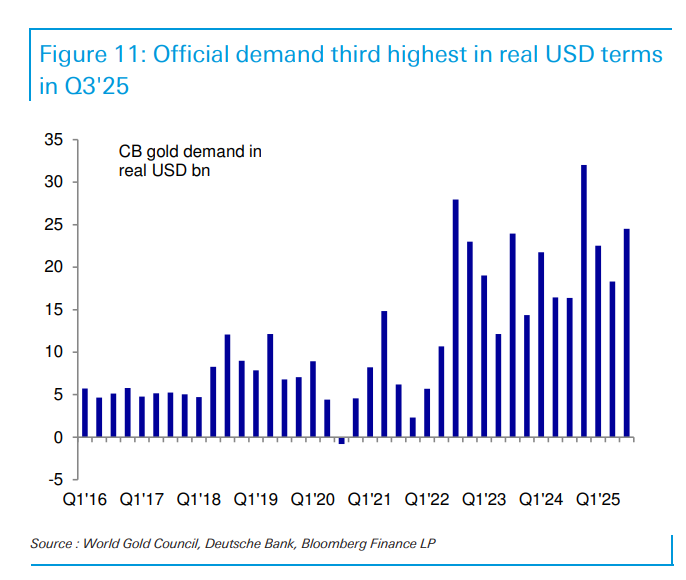
德银在最新报告中,向市场发出了强烈看多黄金的信号。 据追风交易台,德银在最新报告中大幅上调预期,将2026年平均价格目标从此前的4000美元/盎司上调 至4450美元/盎司,年度价格区间预计为3950-4950美元/盎司,最高可能触及4950美元/盎司意味着金价 或冲击5000美元大关。 德银指出,这种结构性牛市的驱动力已发生根本转变,刚性的官方购买正在取代价格敏感型的消费需 求。正如报告所强调的: 缺乏价格弹性的央行购买和ETF投资需求,正在取代对价格敏感的珠宝消费需求,成为黄金 市场的主导力量。同时,总体需求增长超过供应增长,这种供需错配为金价提供了坚实的底 部支撑。 德银表示: 相对于美元的表现与2024年创下的纪录相当,2025年黄金价格区间是自1980年以来最大的。 从历史数据看,自1971年以来,只有8次年度涨幅超过当年波动区间的情况,且全部为价格 上涨。即使在2026年黄金相对美元的表现不如2024-2025年那样出色,黄金价格仍能从近期 强势中继续延伸。这种结构性支撑来自于非弹性需求的增长主导了市场格局。 从需求方面来看,尽管金价处于高位,第三季度官方黄金需求从第二季度显著回升,达到220吨, ...
碳酸锂
数说新能源· 2025-11-27 02:03
Price Outlook - The short-term price trend is expected to be volatile, with no new highs anticipated within the year. Future trends are upward, but the degree of supply-demand mismatch will influence price levels, leading to cautious views on absolute price heights [1]. Demand and Supply Analysis - In the short term, demand is projected to see a slight month-on-month increase in production next month. However, due to the approaching Spring Festival holiday, subsequent production (demand) may experience a slight decline, making sustained net demand increases unlikely. On the supply side, high prices are leading to an influx of overseas mines, coupled with increased expectations for the resumption of production at a major mine in Jiangxi, resulting in a gradual increase in weekly supply. Monthly inventory reduction may continue to narrow or even halt [2]. Mid-term Industry Outlook - The lithium carbonate industry is currently in a dual growth phase for both supply and demand. The extent of price rebound will largely depend on the degree of supply-demand mismatch during peak seasons. However, the industry remains cautious about absolute price heights due to existing inventory held by overseas mining companies, which will gradually be released. Additionally, under high price conditions, previously suspended or underperforming overseas mining capacities are expected to come back online, leading to significant supply increases that may suppress the extent of price rebounds [3].

苯酐:低位徘徊态势难改
Zhong Guo Hua Gong Bao· 2025-11-25 03:06
Group 1 - The anhydride market is experiencing a significant downturn, with prices reaching a four-year low of 5700 yuan per ton, indicating a persistent low-level trend due to unresolved supply-demand contradictions [1][2] - The traditional peak season of "Golden September and Silver October" has failed to boost market performance, with prices dropping below 5900 yuan in October, marking a decline of over 1000 yuan compared to the same period in 2024 [2] - Increased supply is identified as the core factor behind the sluggish anhydride market, with new production capacities contributing to a total of 163,000 tons per year for neighboring anhydride and 172,000 tons per year for naphthalene anhydride, leading to weakened bargaining power for producers [2][3] Group 2 - A reversal in profitability has been observed between neighboring and naphthalene anhydride, with neighboring anhydride moving from a loss of 300-500 yuan to a break-even state due to increased supply of ortho-xylene [3] - Naphthalene anhydride, despite some recovery in profits, remains in a state of loss exceeding 900 yuan, with overall industry operating rates dropping to 40%-50% [3] - The anhydride industry is expected to enter a deep adjustment period, with low operating rates and the permanent exit of some outdated capacities potentially providing limited space for profit recovery [3] Group 3 - Demand for anhydride remains weak, with downstream industries such as plasticizers and unsaturated resins showing slow recovery and maintaining only minimal purchasing needs [4] - The main downstream product, DOP, faces challenges from increasing substitutes and declining demand, leading to low operational loads and continuously falling prices [4] - The unsaturated resin market is also under pressure, with operating rates around 36% and limited potential for price recovery, further contributing to the downward trend in the anhydride market [4]
纯苯、苯乙烯日报:纯苯累库加速,苯乙烯再现分化-20251121
Tong Hui Qi Huo· 2025-11-21 07:38
1. Report Industry Investment Rating No relevant information provided. 2. Core Viewpoints of the Report - The pure benzene market continues to be weak. Recently, the arrival rhythm of imports has been relatively dense, and port inventories have significantly increased, putting pressure on the spot market. The spot discount has widened, and the basis has further weakened, indicating a shift in market sentiment from stable to weak. Although low gasoline inventories provide some support for Asian aromatics, the overall external processing margin is weakening, and its support for the domestic market is limited. Overseas arbitrage spreads have been repaired, which may attract some South Korean supplies to flow outward, alleviating China's subsequent import pressure to some extent, but this effect is more medium - term. Domestically, supply is moderately increasing, while downstream demand is insufficient. The profitability of major benzene - consuming products like caprolactam and phenol - acetone is severely compressed, and their operating rates are mostly weak or only at a rigid level, unable to effectively consume pure benzene. In general, pure benzene is still in a weak - equilibrium state dominated by inventory in the short term, with the supply - demand mismatch intensifying spot pressure and prices showing weak fluctuations. Future focus should be on changes in import rhythm and signs of increased operating rates due to active resumption of downstream plants or improved profitability [2]. - Styrene shows more resilience than pure benzene, presenting a structural divergence. Although the price difference between the futures and spot markets has adjusted, the inventory in East China continues to decline, reflecting the combined effect of tight supply and improved short - term exports. Currently, styrene's operating rate is relatively low, and plant maintenance effectively restricts supply, keeping inventory in a downward trend. The market is also concerned about the resumption of plant operations at the end of the month. Once the resumptions are concentrated, the tight supply pattern may be alleviated, and the inventory trend may reverse, which requires continuous monitoring [3]. 3. Summary by Relevant Catalogs 3.1 Daily Market Summary 3.1.1 Fundamental Information - **Price**: On November 20, the main styrene futures contract closed up 0.55% at 6,595 yuan/ton, with a basis of 20 (+19 yuan/ton); the main pure benzene futures contract closed up 1.14% at 5,595 yuan/ton. The spot price of East China pure benzene was 5,420 yuan/ton (+25 yuan/ton), Brent crude oil closed at $59.4/barrel (-$1.3/barrel), and WTI crude oil closed at $63.5/barrel (-$1.4/barrel) [2]. - **Inventory**: Styrene port inventory was 14.8 tons (-2.7 tons), a 15.2% month - on - month decline, continuing the destocking trend but still higher than in previous years. Pure benzene port inventory was 14.7 tons (+3.4 tons), a 30.1% month - on - month increase [2]. - **Supply**: Styrene's operating rate and supply fluctuated slightly month - on - month. Currently, the weekly styrene output is 34.3 tons (-0.1 tons), and the plant capacity utilization rate is 69.0% (-0.3%) [2]. - **Demand**: The overall demand of downstream 3S products has recovered. The capacity utilization rate of EPS is 56.3% (+4.6%), ABS is 72.4% (+0.6%), and PS is 55.9% (+0.5%) [2]. 3.2 Industry Chain Data Monitoring 3.2.1 Styrene and Pure Benzene Prices | Product | 2025/11/19 | 2025/11/20 | Change Rate | | --- | --- | --- | --- | | Styrene (Futures Main Contract) | 6,559.0 yuan/ton | 6,595.0 yuan/ton | 0.55% | | Styrene (Spot) | 6,594.0 yuan/ton | 6,620.0 yuan/ton | 0.39% | | Styrene Basis | 1.0 yuan/ton | 20.0 yuan/ton | 190000% | | Pure Benzene (Futures Main Contract) | 5,533.0 yuan/ton | 5,596.0 yuan/ton | 1.14% | | Pure Benzene (East China) | 5,390.0 yuan/ton | 5,455.0 yuan/ton | 1.21% | | Pure Benzene (South Korea FOB) | $664.0/ton | $664.0/ton | 0.00% | | Pure Benzene (US FOB) | $829.9/ton | $829.9/ton | 0.00% | | Pure Benzene (China CFR) | $677.2/ton | $677.2/ton | 0.00% | | Pure Benzene Domestic - CFR Price Difference | -408.0 yuan/ton | -345.7 yuan/ton | 15.28% | | Pure Benzene East China - Shandong Price Difference | -160.0 yuan/ton | -45.0 yuan/ton | 71.88% | | Brent Crude Oil | $60.7/barrel | $59.4/barrel | -2.14% | | WTI Crude Oil | $64.9/barrel | $63.5/barrel | -2.13% | | Naphtha | 7,106.5 yuan/ton | 7,106.5 yuan/ton | 0.00% | [5] 3.2.2 Styrene and Pure Benzene Production and Inventory | Product | 2025/11/14 | 2025/11/21 | Change Rate | | --- | --- | --- | --- | | Styrene Production (China) | 34.4 tons | 34.3 tons | -0.43% | | Pure Benzene Production (China) | 45.4 tons | 44.7 tons | -1.67% | | Styrene Port Inventory (Jiangsu) | 17.5 tons | 14.8 tons | -15.16% | | Styrene Factory Inventory (Domestic) | 18.9 tons | 18.8 tons | -0.70% | | Pure Benzene Port Inventory (National) | 11.3 tons | 14.7 tons | 30.09% | [6] 3.2.3 Operating Rate | Product | 2025/11/14 Capacity Utilization | 2025/11/21 Capacity Utilization | Change | | --- | --- | --- | --- | | Styrene (Pure Benzene Downstream) | 69.3% | 69.0% | -0.30% | | Caprolactam (Pure Benzene Downstream) | 86.0% | 88.2% | 2.18% | | Phenol (Pure Benzene Downstream) | 67.3% | 78.7% | 11.46% | | Aniline (Pure Benzene Downstream) | 80.2% | 75.7% | -4.49% | | EPS (Styrene Downstream) | 51.6% | 56.3% | 4.64% | | ABS (Styrene Downstream) | 71.8% | 72.4% | 0.60% | | PS (Styrene Downstream) | 55.4% | 55.9% | 0.50% | [7] 3.3 Industry News - The EU imposed sanctions on several Russian individuals. - The number of non - farm payrolls in the US increased by 119,000 in September, higher than market expectations. - Iran's foreign minister announced the official termination of the Cairo Agreement signed with the International Atomic Energy Agency. - The US Department of Energy announced a restructuring, prioritizing oil and nuclear energy resources and replacing the previous department dedicated to renewable energy and energy efficiency [8]. 3.4 Industry Chain Data Charts The report provides multiple data charts, including those on pure benzene prices, styrene prices, styrene - pure benzene price differences, styrene and pure benzene import - domestic cost differences, styrene port and factory inventories, pure benzene port inventory, ABS inventory, and the weekly capacity utilization rates of caprolactam, phenol, and aniline. The data sources are iFinD and Steel Union Data [13][18][22][28][29].