
债市震荡

Search documents
月初资金宽松 债市震荡偏强
Qi Huo Ri Bao· 2025-06-09 02:43
Group 1 - The bond market is experiencing a volatile yet strong trend, with 2-year, 5-year, 10-year, and 30-year treasury futures showing weekly increases of 0.05%, 0.11%, 0.18%, and 0.31% respectively, indicating a balanced tug-of-war between bulls and bears [1] - The official manufacturing PMI for May is reported at 49.5%, a month-on-month increase of 0.5 percentage points, while the Caixin manufacturing PMI decreased to 48.3%, a drop of 2.1 percentage points, highlighting a divergence between large and small enterprises [1] - The recent easing of tariffs between China and the U.S. may continue to support manufacturing sentiment in the second quarter, although uncertainties regarding external demand persist in the medium to long term [1] Group 2 - In response to a slowing global economic recovery and increasing geopolitical uncertainties, multiple central banks are signaling monetary easing, with the People's Bank of China announcing a 1 trillion yuan reverse repo operation [2] - Recent U.S. economic data, including a significant drop in ADP employment numbers and a contraction in the ISM non-manufacturing PMI, has heightened expectations for potential interest rate cuts by the Federal Reserve [2] - The market's anticipation of Fed rate cuts has surged, with the probability of a rate cut in September reaching 77.1% according to the CME FedWatch tool [2] Group 3 - The funding environment remains loose, with slight declines in overnight and 7-day repo rates, although there is pressure from over 4 trillion yuan in maturing certificates of deposit in June, complicating banks' asset-liability management [3] - The combination of government debt supply pressure, significant credit issuance, and the peak of maturing certificates of deposit in June may lead to increased volatility in the funding environment [3] - Short-term attention should be on the movement of certificates of deposit and the demand for government bonds, particularly long-term bonds, as well as regulatory measures to stabilize banks' liabilities [3] Group 4 - The bond market is likely to maintain a volatile pattern, with the potential for interest rates to decline requiring further triggering factors, including changes in the economic fundamentals and central bank policies [4] - The likelihood of further monetary easing from the central bank in the short term is relatively low, but any unexpected resumption of government bond purchases could catalyze a decline in long-term interest rates [4] - Technically, mid to short-term interest rate bonds are considered a relatively safe choice in the current market environment [4]
A股指数集体高开,沪指高开0.06%,贵金属、虚拟电厂等板块涨幅居前
Feng Huang Wang Cai Jing· 2025-06-05 01:39
Group 1: Market Overview - The three major indices opened higher, with the Shanghai Composite Index up 0.06%, Shenzhen Component Index up 0.08%, and ChiNext Index up 0.08% [1] - The Shanghai Composite Index closed at 3,378.22 points with a slight increase of 0.06%, while the Shenzhen Component Index reached 10,152.55 points, up 0.08% [2] - The U.S. stock market showed mixed results, with the Dow Jones down 0.22% to 42,427.74 points, while the S&P 500 rose slightly by 0.01% to 5,970.81 points [3] Group 2: Industry Insights - Huatai Securities reported a 2.9% month-on-month increase in lithium battery production for June, with total battery production reaching 107.7 GWh, driven by demand from new energy vehicles and favorable export conditions [4] - China International Capital Corporation (CICC) anticipates a continued recovery in the small home appliance sector, supported by trade-in policies and low base effects, leading to improved profitability for companies in this space [5] - Tianfeng Securities indicated that the bond market is likely to maintain a volatile pattern, with potential trading opportunities arising from adjustments in monetary policy and market dynamics [6] Group 3: Strategic Positioning - Huaxi Securities noted that some funds may have begun to position themselves in the technology sector, driven by positive market sentiment regarding U.S.-China trade relations, despite potential risks from fluctuating tariff policies [7][8]


【债市观察】资金平稳跨月 关税不确定性主导债市弱势震荡
Xin Hua Cai Jing· 2025-06-03 03:02
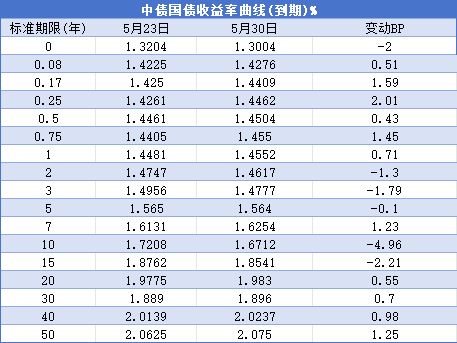
Group 1 - The central bank has been actively engaging in net liquidity injection operations to maintain a balanced and slightly loose funding environment in the market [1][13] - The 10-year government bond yield fluctuated, reaching a high of 1.73% before retreating to 1.70%, with an overall increase of approximately 1 basis point for the week [1][5] - The upcoming week will see over 1.6 trillion yuan in reverse repos maturing, with a significant decrease in net government bond payments expected [1][6] Group 2 - The yield curve for government bonds showed mixed movements, with the 10-year yield decreasing by 4.96 basis points, while the 30-year yield increased by 0.7 basis points [2][3] - The issuance of interest rate bonds last week totaled 61 issues amounting to 394.21 billion yuan, a significant decrease compared to previous weeks [6] - The upcoming week is set to see the issuance of 32 interest rate bonds totaling 434.89 billion yuan, including 2.76 billion yuan in government bonds [6] Group 3 - The U.S. Treasury market experienced a sell-off in May, with yields across various maturities rising by over 20 basis points, indicating a shift in investor sentiment [7][8] - The Federal Reserve's recent meeting minutes highlighted increased uncertainty regarding the economic outlook, with potential risks of rising unemployment and inflation [11][12] - Analysts suggest that the widening yield spread between 30-year and 10-year U.S. Treasuries reflects concerns over the safety of long-term bonds, with expectations of limited interest in purchasing them unless credible fiscal signals are provided [12]
银行大幅卖债止盈,债市继续跌,发生了什么?
Sou Hu Cai Jing· 2025-05-29 07:00
银行大幅卖债止盈,债市继续跌,发生了什么? 【下跌原因1:银行需要卖债兑现利润】 【后市研判:央行呵护债市,持续投放流动性】 自上周来,央行连续8个交易日均投放流动性,缓解资金压力。虽然债市近期有所调整,但债市仍然没 有脱离震荡区间,上行和下行的空间均不是很大。 此外,关税被叫停虽然对股市交易情绪有实质性利好。但需考虑到一个重要事实:裁决不影响10%芬太 尼、和25%针对汽车汽零、钢铁等征收的关税,未好于4.3日对等关税前的水平,且近期抢出口从数据 上已经有所回落,预计后续难有长期的积极效用释放。在贸易摩擦不确定性依然比较大,而且货币政策 的支持性立场依然会变的大背景之下,债市长期看多逻辑实际上还是没有发生根本性的转变。 以上内容与数据,与有连云立场无关,不构成投资建议。据此操作,风险自担。 具体来看逻辑链条是:银行降存款利率到1%以下→居民将银行存款搬家至理财或公募债基→导致银行 负债端(即存款)更缺失→为了平衡资产负债表的资产端和负债端,在负债端减少后被迫减少资产端,即 卖出资产端的债券→最终导致利率债价格下跌,但实际上述逻辑成立的前提是要等到存款陆续到期,然 后才可能逐渐搬家至理财,因此市场是在对上述逻 ...
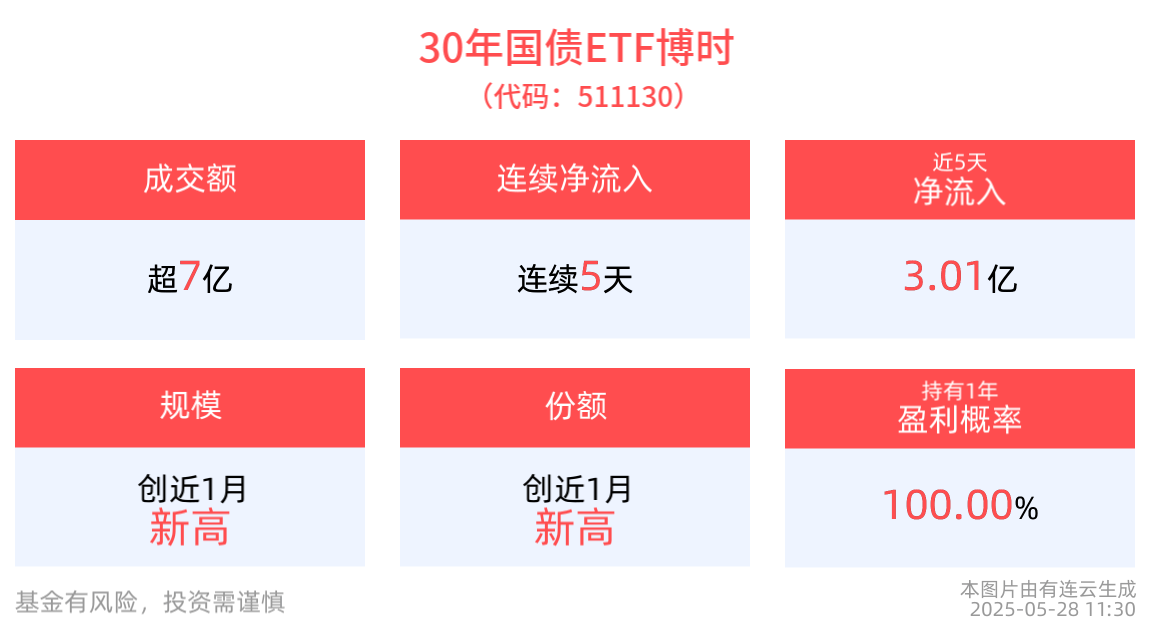
债市预计延续震荡走势,30年国债ETF博时(511130)早盘成交额超7亿元,连续5天净流入
Sou Hu Cai Jing· 2025-05-28 04:30
Group 1 - The core viewpoint of the news is that the 30-year government bond futures are experiencing a slight decline, with the market showing mixed signals amid various economic factors [3][4] - The 30-year government bond ETF from Bosera has seen active trading, with a recent price of 111.41 yuan and a turnover rate of 10.17%, indicating a vibrant market [3][4] - The overall bond market is in a state of fluctuation, influenced by factors such as tax periods, government debt supply, and the recent adjustments in deposit rates and LPR [4] Group 2 - The 30-year government bond ETF from Bosera has reached a new high in scale at 7 billion yuan, reflecting strong investor interest [4][5] - Over the past five days, the ETF has experienced continuous net inflows, totaling 301 million yuan, with a peak single-day inflow of 17.6 million yuan [5] - The ETF has shown a 14.68% increase in net value over the past year, ranking 3rd out of 378 index bond funds, indicating strong performance [5] Group 3 - The maximum drawdown for the 30-year government bond ETF since inception is 6.89%, with a tracking error of 0.071% over the past year, suggesting effective management [6] - The management fee for the ETF is set at 0.15%, while the custody fee is 0.05%, which are relatively low compared to industry standards [6]
债市震荡偏弱,上周纯债基金收益均值偏低,为何发行却火了?
Mei Ri Jing Ji Xin Wen· 2025-05-27 06:40
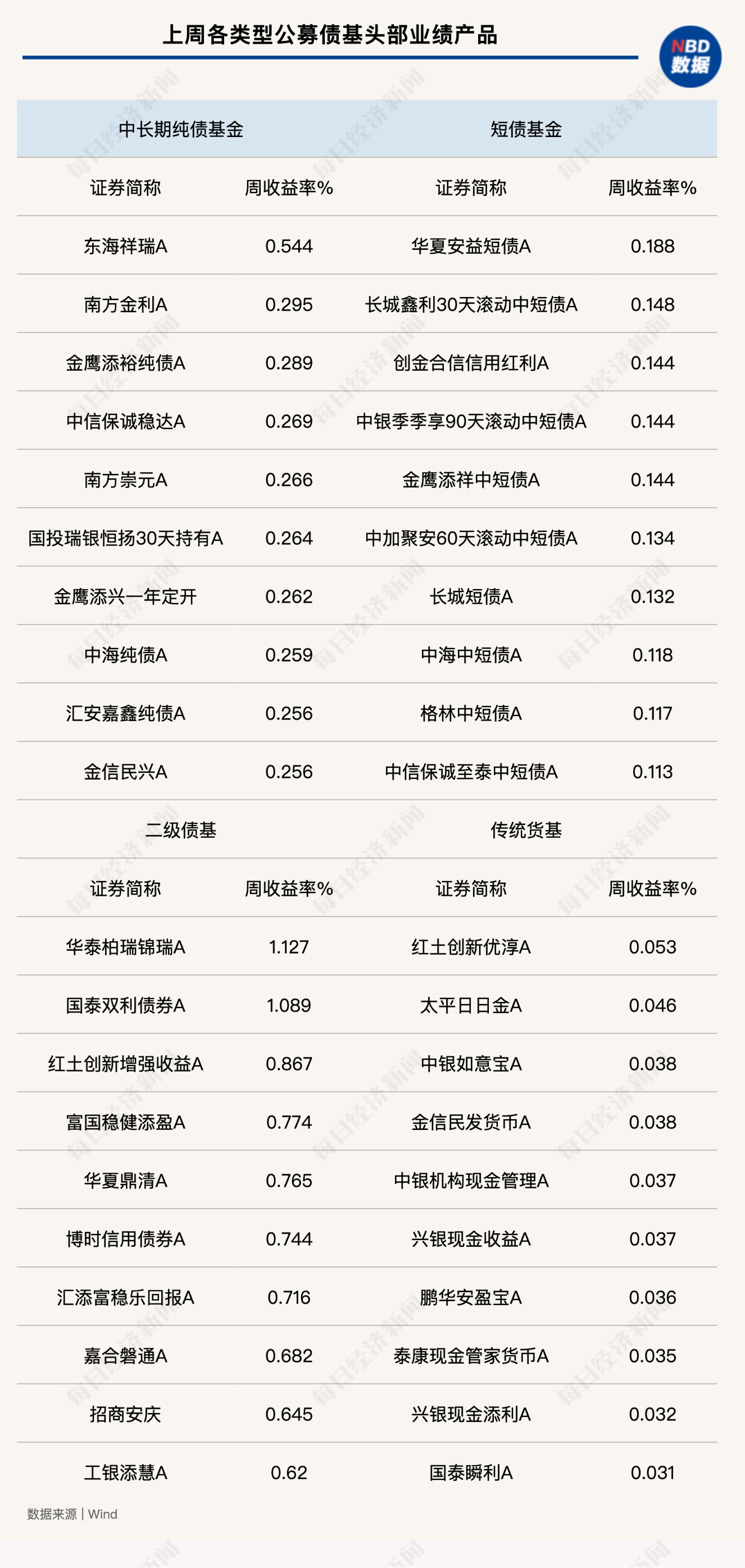
Core Viewpoint - The bond market is experiencing a weak and volatile trend, with expectations for liquidity driven by recent interest rate cuts and reserve requirement ratio reductions, but the sentiment remains limited [1][5]. Group 1: Market Performance - The bond market showed a fluctuating trend from May 19 to May 25, with adjustments in interest rate bonds and a slight compression in credit spreads [3]. - The average yield of medium to long-term pure bond funds was 0.08%, while short-term bond funds recorded an average yield of 0.05% [6]. - Major bond funds have seen significant fundraising activity, with 48 out of 85 newly established bond funds raising over 1 billion yuan, and 12 funds exceeding 5 billion yuan [7][8]. Group 2: Investment Strategy - Analysts suggest maintaining duration allocation while increasing the proportion of swing trading due to the current market conditions [5][6]. - The market is focused on upcoming economic data, supply pressures, and changes in liquidity, but lacks factors that could lead to a trend-driven market [5]. - Following the recent interest rate cuts, there is an expectation that the central bank will continue to support liquidity, reducing concerns about significant increases in funding costs [7][8].
中信建投:预计债市以震荡为主 DR001中枢仍在1.4%附近
news flash· 2025-05-27 00:45
Core Viewpoint - The bond market is experiencing a volatile upward trend in yields, with expectations of continued fluctuations in the near future [1] Group 1: Market Outlook - The short-term funding environment is stabilizing, with DR001 fluctuating around 1.5%, and attention is on the central bank's liquidity injection at the end of the month [1] - The overall cross-month liquidity has remained stable in recent months, indicating low risk in the near term [1] - The central tendency of DR001 is expected to remain around 1.4% [1] Group 2: Credit Market Insights - There is an opportunity to capitalize on the compression of credit spreads, as short-duration high-grade credit spreads have narrowed to low levels [1] - The market may shift towards longer-duration high-grade credit bonds, particularly those with maturities of over three years [1]

【财经分析】债市震荡不改较乐观预期 “每调买机”策略仍获关注
Xin Hua Cai Jing· 2025-05-26 13:31
Core Viewpoint - The bond market is currently experiencing a phase of cautious sentiment and narrow fluctuations, influenced by recent interest rate cuts and government bond supply dynamics [2][3][4]. Group 1: Market Dynamics - Despite recent deposit rate cuts, the bond market has not reacted positively, as these cuts are viewed as a continuation of earlier rate reduction actions [2][3]. - From May 19 to May 23, the bond market showed a mixed performance, with the 10-year government bond yield rising by 1 basis point to 1.69%, while the 3-year bond yield fell by 1 basis point to 1.49% [2]. - The issuance of long-term government bonds has been weak, with a notable decline in the bid-to-cover ratio for recent auctions, indicating reduced enthusiasm in the primary market [2][3]. Group 2: Supply and Demand Imbalance - There is a significant mismatch between the growth rates of government bonds and bank liabilities, with government bond growth increasing from 17.0% to 20.7%, while bank liabilities only rose from 6.3% to 7.4% [3]. - The pressure on banks to absorb new government bond supply is expected to increase, leading to a potential reduction in their demand for bonds in the secondary market [3][4]. Group 3: Future Outlook - The supply pressure in the bond market is likely to ease in June and July, with a projected increase in government bond maturities and a slowdown in new bond issuance [4]. - Analysts anticipate that the net issuance of government bonds will decrease significantly in the second half of the year, which could improve the supply-demand dynamics in the bond market [4]. - There is a possibility of a "bond bull" market re-emerging, driven by stable demand for fixed-income assets and a potential decline in interest rates [5].
债券周报:存款利率调降对债市影响的三个维度-20250525
Huachuang Securities· 2025-05-25 14:45
1. Report Industry Investment Rating No information provided in the content regarding the report industry investment rating. 2. Core Viewpoints of the Report - The transmission path from policy rates to deposit rate cuts is in line with expectations, but the adjustment amplitude of deposit rates exceeds expectations, which helps banks reduce liability costs [1][17]. - From three dimensions, the impact of deposit rate cuts on the bond market is complex. The decline in medium - and long - term bank liability costs may be beneficial for bond allocation, but there may be disturbances in the short - term due to deposit migration, and the impact on other fixed - income investors varies [2]. - The current deposit rate cuts may not bring significant positive effects to the bond market as the market has already priced in factors such as loose funds and declining bank liability costs. The bond market is in a narrow - range shock, with multiple long and short factors intertwined [3]. - The trading cost - effectiveness of 10 - year Treasury bonds above 1.7% is emerging, and attention should be paid to positive carry varieties for coupon payments, while more caution is needed for ultra - long - term bonds [4]. 3. Summary According to the Table of Contents I. Three Dimensions of the Impact of Deposit Rate Cuts on the Bond Market (1) The transmission path from policy rates to deposit rate cuts is in line with expectations - On May 20, major banks experienced the seventh round of deposit rate cuts. The policy transmission path of OMO policy rate - 1 - year LPR - deposit listing rate is clear [1]. - The adjustment amplitude of deposit rates exceeds expectations. The long - end deposit listing rate is still lowered by about 25bp, and the decline in the bank deposit self - regulatory ceiling is generally higher than that of the listing rate [1][17]. - The reason is that banks still face great pressure on net interest margins, and larger deposit rate cuts help reduce bank liability costs [1][20]. (2) Three dimensions to view the impact of deposit rate cuts on the bond market - **Asset side**: The decline in medium - and long - term bank liability costs may exceed 10bp, which is beneficial for removing constraints on bank bond allocation. The decline in long - end deposit rates and the proportion of general deposits contribute to this decline [2][21]. - **Liability side**: In the short term, there may be a phenomenon of deposit migration to non - banks after the deposit listing rate is cut, increasing bank liability pressure and disturbing the bond market. The outflow scale of M1 in the month of deposit rate cuts and the following two months is about 1 trillion [2][27]. - **For other fixed - income investors**: The yield of insurance's available - to - invest assets (general time deposits) decreases, while the impact on bank wealth management, which mainly invests in non - bank deposits and inter - bank certificates of deposit, is controllable [2]. - Overall, the positive impact of the decline in liability costs on the bond market needs time to materialize, and the current deposit rate cuts may not bring significant positive effects. Short - term focus should be on liability outflow pressure, especially the pricing of certificates of deposit and the growth of wealth management scale [29][33]. II. Bond Market Strategy: Trading Cost - Effectiveness Above 1.7% Emerges, Focus on Positive Carry Varieties for Coupon Payments (1) Bond market shock, with multiple long and short factors intertwined - **Short - term capital price**: After the deposit rate cut, the capital price is expected to remain stable. DR007 may continue to be 10 - 20bp higher than the policy rate, and the short - term capital price may fluctuate around 1.5 - 1.6% [3][39]. - **Positive factors**: The domestic economy enters the off - season in the second quarter, with weakening high - frequency indicators in investment and real estate. Uncertainties in Sino - US trade negotiations may affect economic data, and the central bank may restart Treasury bond purchases [3]. - **Negative factors**: The "rush to export" effect in May may boost second - quarter data, and the stock - bond seesaw effect may suppress the bond market due to the high risk appetite in the equity market [3]. - **Summary**: The short - term capital price may remain stable, but there are still many uncertainties in the bond market, making it difficult to determine trends, and the bond market is likely to continue to fluctuate [3]. (2) Operation strategy: Trading cost - effectiveness above 1.7% emerges, focus on positive carry varieties for coupon payments - **10 - year Treasury bonds**: The core pricing range of 10 - year Treasury bonds has changed, and above 1.7%, they gradually have trading cost - effectiveness and can be considered for allocation as the yield rises [4][65]. - **Ultra - long - term bonds**: 30 - year Treasury bonds and other ultra - long - term bonds still need to wait for opportunities. The supply - demand pattern of long - term bonds is unfavorable, and short - term positive factors are not clear [4][66]. - **Operation suggestions**: Focus on positive carry varieties. Bonds such as 7.5 - 9.5 - year Treasury bonds, 5.5 - year China Development Bank bonds, etc., which were negative carry last week and have become positive carry this week, can be focused on [4][71]. III. Review of the Interest - Bearing Bond Market: Deposit Rate Cuts Implemented, Bond Market in Narrow - Range Shock - **Funding situation**: The central bank's OMO has turned to net investment, and the funding situation is balanced and loose. The weighted price of DR007 has dropped to around 1.59%, and major banks may issue inter - bank certificates of deposit at higher prices to make up for the liability gap [10][11]. - **Primary issuance**: The net financing of Treasury bonds and local bonds has decreased, while the net financing of policy - bank bonds and inter - bank certificates of deposit has increased [7]. - **Benchmark changes**: The term spread of Treasury bonds has widened, and the term spread of China Development Bank bonds has narrowed [7].
破局力量不足,债市窄幅震荡
Dong Zheng Qi Huo· 2025-05-25 08:12
1. Report Industry Investment Rating - The rating for treasury bonds is "oscillation" [5] 2. Core View of the Report - The bond market lacks the power to break the situation and will maintain a narrow - range oscillation. The fundamentals are favorable for the bond market in the long - term, but there is no basis for significant rises or falls in the short - term. The treasury bond futures will continue to oscillate narrowly. [2] - Strategies include being long - term bullish on the bond market but buying on dips in the short - term; steepening the curve in the long - term with a bumpy process; and the opportunity for futures cash - and - carry arbitrage is decreasing, and attention can be paid to the strategy of the basis returning to 0. [2] 3. Summary by Relevant Catalogs 3.1 One - Week Review and Outlook - **This Week's Trend Review**: From May 19th to May 25th, treasury bond futures oscillated narrowly. Due to factors such as the balance of funds, economic data, and deposit rate adjustments, the yield curve showed different changes each day. As of May 23rd, the settlement prices of the 09 contracts of 2 - year, 5 - year, 10 - year, and 30 - year treasury bond futures increased by 0.034, 0.150, 0.225, and 0.380 yuan respectively compared to last weekend. [13] - **Next Week's Outlook**: The news will be relatively calm. The market will focus on the changes in the capital side and market sentiment. The capital side is expected to be generally balanced. The market may bet on events such as the central bank restarting secondary - market treasury bond trading and the weakening of the May manufacturing PMI, but these trades are expected to be short - term. Treasury bond futures will maintain a narrow - range oscillation. [2] 3.2 Weekly Observation of Interest - Rate Bonds - **Primary Market**: This week, 92 interest - rate bonds were issued, with a total issuance of 968.322 billion yuan and a net financing of 548.079 billion yuan. The net financing of treasury bonds decreased, the net financing of local government bonds decreased slightly, and the net financing of inter - bank certificates of deposit increased slightly. [21] - **Secondary Market**: Treasury bond yields showed a divergent trend. As of May 23rd, the yields of 2 - year, 5 - year, 10 - year, and 30 - year treasury bonds changed by - 0.69, - 2.26, + 3.67, and + 0.45 basis points respectively compared to last weekend. The spreads of 10Y - 1Y and 10Y - 5Y widened, while the spread of 30Y - 10Y narrowed. [26] 3.3 Treasury Bond Futures - **Price, Trading Volume, and Open Interest**: Treasury bond futures oscillated narrowly. As of May 23rd, the settlement prices of the 09 contracts of 2 - year, 5 - year, 10 - year, and 30 - year treasury bond futures increased compared to last weekend. The trading volumes and open interests of each variety changed to different extents this week. [34][38] - **Basis and IRR**: The opportunity for cash - and - carry arbitrage strategy has significantly decreased. The basis of each variety has started to rise, and the willingness of long - position participants has declined. In the future, the cash - and - carry arbitrage strategy opportunity will gradually disappear, and the basis will return to a relatively normal level. [42] - **Inter - Delivery and Inter - Variety Spreads**: As of May 23rd, the inter - delivery spreads of the 2506 - 2509 contracts of 2 - year, 5 - year, 10 - year, and 30 - year treasury bond futures decreased compared to last weekend. [45] 3.4 Weekly Observation of the Capital Side - The central bank's open - market full - caliber net investment was 1.2 trillion yuan this week. As of May 23rd, R007, DR007, SHIBOR overnight, and SHIBOR 1 - week changed by + 0.15, - 5.14, - 8.90, and + 0.70 basis points respectively compared to last weekend. The average daily trading volume of inter - bank pledged repurchase decreased, and the overnight proportion was lower than last week. [52][54][56] 3.5 Weekly Overseas Observation - The US dollar index weakened slightly, and the 10Y US Treasury yield increased slightly. As of May 23rd, the US dollar index fell 1.84% to 99.1231 compared to last weekend, the 10Y US Treasury yield rose 8 basis points to 4.51%, and the 10Y China - US Treasury yield spread was inverted by 279.2 basis points. [61] 3.6 Weekly Observation of High - Frequency Inflation Data - This week, industrial product prices all declined. As of May 23rd, the South China Industrial Product Index, Metal Index, and Energy and Chemical Index decreased compared to last weekend. Agricultural product prices showed a mixed trend, with the prices of pork, 28 key vegetables, and 7 key fruits changing slightly compared to last weekend. [66] 3.7 Investment Suggestions - It is recommended to buy on dips. [67]