
AI算力

Search documents
东田微(301183) - 2026年1月28日投资者关系活动记录表
2026-01-28 09:04
Group 1: Company Overview and Strategy - The company achieved growth in operating performance driven by the dual engines of "steady upgrade of imaging optical business" and "rapid expansion of communication optical business" in 2025 [2] - The company will continue to focus on the optical main track, deepen technological research and development, optimize product structure, and seize market opportunities to deliver better performance to investors [2] Group 2: Production and Supply Chain - The company has completed the construction of the optical isolator product line and is actively expanding capacity through optimization and personnel increases to seize market opportunities and enhance delivery capabilities [3] - The price of optical isolator products is affected by China's rare earth export controls, and the company will closely monitor policies and market dynamics to optimize operational strategies [3] - The supply of Faraday rotators is currently tight due to global supply chain issues and China's rare earth export control policies, which have directly impacted upstream raw material supply [3] - The company recognizes the importance of ensuring stable supply of core raw materials for the successful release of communication optical business capacity [3] Group 3: Market and Product Outlook - The company is optimistic about the development of communication optical products in 2026, driven by the booming demand for AI computing power [4] - The company has completed the expansion of consumer electronics products, and the supply of core products, such as spin-coated optical filters, is stable and gaining market recognition [4] - The company believes that the dual-engine strategy of a stable consumer electronics base and a strong new engine in communication optics will further solidify and elevate overall performance in 2026 [4]

上市后首份业绩预告出炉,沐曦股份2025年营收增超115%
Huan Qiu Lao Hu Cai Jing· 2026-01-28 08:51
Core Viewpoint - Muxi Co., Ltd. is expected to achieve significant revenue growth in 2025, with projected revenues between 1.6 billion to 1.7 billion yuan, representing an increase of 857 million to 957 million yuan, or a growth rate of 115.32% to 128.78% compared to the previous year [1] Group 1: Company Performance - The company anticipates a substantial reduction in losses, with expected net profit losses between 650 million to 798 million yuan, narrowing by 43.36% to 53.86% year-on-year [1] - The revenue growth is attributed to reduced share-based payment expenses and increased recognition and continuous procurement of its products and services by downstream customers [1] - As of mid-2025, the cumulative sales of Muxi's GPU chips exceeded 25,000 units, with a backlog of orders amounting to 1.43 billion yuan, nearly double the total revenue for 2024 [1] Group 2: Industry Context - The company's performance is closely linked to the high demand in the AI computing and storage sectors, with a notable increase in price elasticity for related enterprises due to inflation [2] - A new wave of price increases in the chip industry has emerged due to tight product supply, with major companies like Samsung and SK Hynix announcing price hikes, some reaching up to 80% [2] - Muxi, as a leading domestic GPU manufacturer, is positioned to benefit significantly from the strong demand and rising product prices in the market [2] Group 3: Market Confidence - The capital market shows strong confidence in Muxi's development, with the company's stock price soaring by 692.95% on its first trading day [3] - As of the latest closing, Muxi's stock price stands at 577.20 yuan per share, maintaining a market capitalization of 230.9 billion yuan [3] - On the same day as the earnings forecast announcement, Muxi launched a new GPU brand and product line, the Xisuo X series, aimed at optimizing computing power for advanced scientific research [3]
长江有色:28日锡价大涨 价涨量稳商家畏高观望
Xin Lang Cai Jing· 2026-01-28 08:30
Core Viewpoint - The recent surge in tin prices is driven by a combination of macroeconomic factors, supply constraints, and increased demand from emerging technologies, particularly in AI and semiconductors [2][3][5] Group 1: Market Performance - The Shanghai tin contract 2603 experienced a significant increase, closing at 443,800 yuan/ton, up 9,150 yuan or 2.11% [1] - The trading volume for the main contract was 467,621 lots, with a decrease in open interest by 3,048 lots compared to the previous day [1] - The spot tin price in the Changjiang market rose by 7,000 yuan, with an average price of 433,500 yuan/ton [1] Group 2: Supply and Demand Dynamics - The tin market is facing a structural imbalance characterized by rigid supply and explosive demand, primarily due to geopolitical tensions affecting key production areas [3] - Supply constraints are exacerbated by resource scarcity, geopolitical conflicts in regions like the Democratic Republic of Congo, and low inventory levels [3] - Demand is robust in traditional sectors, while new requirements from AI servers and advanced packaging are driving increased consumption of tin [3] Group 3: Industry Leaders and Strategies - Leading companies in the tin industry are showing strong performance, with significant revenue and profit growth, and are expanding into high-end applications like AI and semiconductors [4] - Companies are securing resource supply through overseas investments and developing high-value tin products, with orders locked in until the end of 2026 [4] Group 4: Market Trends and Outlook - The current market is characterized by rising prices with stable transaction volumes, but a clear divide between large enterprises and smaller firms in terms of purchasing behavior [4] - Short-term price trends are expected to remain high due to macroeconomic support and pre-holiday demand, although potential profit-taking could lead to technical corrections [5] - Long-term trends indicate that the demand for "computing metals" driven by AI and semiconductor industries will continue to rise, suggesting a systemic upward shift in tin prices [5]


2026:房地产能触底吗?
Sou Hu Cai Jing· 2026-01-28 08:03
Core Insights - The article discusses the potential turning point for the real estate market in 2026, highlighting the need for objective indicators to assess whether the market has reached its bottom [1][4] - It emphasizes the shift from a high-leverage model to a new development model focused on quality and operation, indicating a fundamental restructuring of the industry by 2030 [5][9] Group 1: Market Trends and Indicators - In 2025, real estate development investment in China was 82,788 billion yuan, a decrease of 17.2% from the previous year [1] - The median rental yield in 30 key cities has reached 2.06%, with over 55% of communities yielding more than 2%, indicating a shift towards rental income as a significant factor for investors [2] - The decline in second-hand housing prices has exceeded 39% from peak levels, and new construction starts have dropped by 74% compared to peak levels, suggesting a significant market correction [2] Group 2: Diverging Market Perspectives - Optimists believe 2026 will confirm the bottom of the market, with inventory stabilization and new demand from favorable policies leading to a period of bottoming out [4] - Conversely, cautious analysts predict a further decline in new home prices by 2% to 3% in 2026, with a full recovery in core cities potentially delayed until the second half of 2027 [4] Group 3: New Development Model - The new model emphasizes three dimensions: a shift from "availability" to "quality," focusing on improved living conditions and sustainable housing [6][9] - Real estate companies are transitioning from "development and construction" to "asset operation," with a significant increase in the importance of managing existing properties [6][9] - The article highlights the need for a collaborative approach among policy, financing, and sales systems to support the new model [8][9] Group 4: Capital Management Strategies - The investment logic in real estate is shifting from "holding assets" to "managing liquidity," emphasizing the importance of asset flow in the new market environment [17][29] - A "barbell strategy" is recommended for capital allocation, balancing traditional core assets with new growth sectors [18][19] - The article outlines three asset pools for effective capital management: distressed assets, value-added assets, and standardized REITs, emphasizing the need for efficient asset flow between these pools [22][25][26]

收评:沪指震荡小幅上涨0.27% 黄金、石油等资源周期股集体大涨
Xin Hua Cai Jing· 2026-01-28 07:39
Market Overview - A-shares showed mixed performance on January 28, with the Shanghai Composite Index and Shenzhen Component Index slightly up, while the ChiNext Index experienced a small decline. The Shanghai Composite Index closed at 4151.24 points, up 0.27%, with a trading volume of 13,655 billion yuan [1] - Resource stocks led the market, particularly gold stocks, with Sichuan Gold achieving four consecutive trading limits, and China National Offshore Oil Corporation rising over 6% to a new high [1] - The total trading volume in the Shanghai and Shenzhen markets reached 29.7 trillion yuan, an increase of 70.4 billion yuan compared to the previous trading day [1] Sector Performance - Key sectors that performed well included precious metals, oil and gas extraction, steel, combustible ice, rare earth permanent magnets, and coal [2] - Conversely, sectors that saw declines included photovoltaic equipment, medical services, education, recombinant proteins, avian influenza, and Sora [2] Institutional Insights - According to Jifeng Investment Advisors, the A-share market is expected to continue a volatile consolidation pattern in February, with support from policies and valuations, while facing pressure from profit verification. They recommend focusing on cyclical sectors, technology growth, and defensive assets [3] - CITIC Construction highlighted the booming commercial aerospace industry, particularly the advancements in reusable rocket technology, which are expected to drive significant growth in the satellite communication market, projected to grow from $25.2 billion in 2025 to $83 billion by 2035, with a compound annual growth rate of approximately 13% [3] Company Updates - Amazon Web Services (AWS) announced a price increase of approximately 15% for its EC2 machine learning capacity blocks, marking the first price hike in about twenty years. This adjustment reflects the high demand for AI computing resources and the increasing scarcity of supply [4] - Haizhou Intelligent, a subsidiary of Suzhou Keda, announced a price adjustment for certain products, with increases ranging from 10% to 30%, effective March 1, 2026. This adjustment affects a range of products including storage series, front-end cameras, and servers [8]
中微半导部分芯片涨价,科创半导体ETF(588170)近1周日均成交13.75亿元,领先同类
Mei Ri Jing Ji Xin Wen· 2026-01-28 06:49
Group 1 - The Shanghai Stock Exchange Sci-Tech Innovation Board Semiconductor Materials and Equipment Theme Index (950125) decreased by 0.69% as of January 28, 2026, with mixed performance among constituent stocks [1] - The China Securities Semiconductor Materials and Equipment Theme Index (931743) fell by 0.61%, also showing varied performance among its constituent stocks [1] - The trading volume for the Sci-Tech Semiconductor ETF (588170) reached 7.94 billion yuan, with a turnover rate of 9.63% [1] Group 2 - Zhongwei Semiconductor announced a price increase of 15% to 50% for products like MCU and Norflash due to rising costs and extended delivery cycles amid a tight chip supply [2] - Donghai Securities highlighted the ongoing recovery in electronic industry demand and suggested focusing on structural opportunities in AI computing power, AIOT, semiconductor equipment, and storage price increases [2] - The Sci-Tech Semiconductor ETF (588170) and its linked funds track the Sci-Tech Innovation Board Semiconductor Materials and Equipment Theme Index, focusing on semiconductor equipment and materials [2][3]

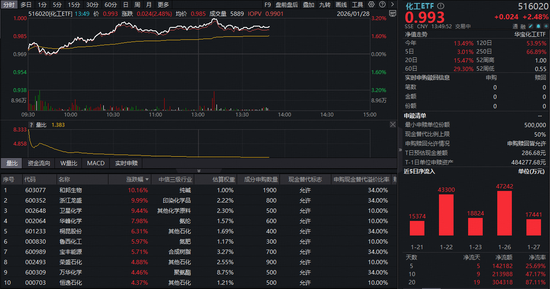
化工板块午后井喷,两股涨停!化工ETF(516020)盘中涨超3%,机构:化工景气周期或超预期
Xin Lang Cai Jing· 2026-01-28 06:06
Group 1 - The chemical sector is experiencing a strong upward trend, with the chemical ETF (516020) rising over 2.48% and reaching a peak increase of over 3% during trading [1][7] - Key stocks in the sector include Hebang Biotechnology and Zhejiang Longsheng, both hitting the daily limit, while Satellite Chemical surged over 9% [1][7] - The overall market sentiment indicates that the current chemical sector boom may have more sustainability compared to previous cycles, with expectations for a prolonged upward trend [8][10] Group 2 - Guojin Securities suggests that the chemical sector may undergo a revaluation driven by supply-side policies and the current mismatch between China's chemical industry status and operational conditions, indicating a high probability of recovery [9] - The market may be underestimating the impact of liquidity on the sector, which is characterized by being at the bottom of the cycle, with an upward trend in fundamentals and attractive valuations [9] - Guohai Securities highlights that leading companies in the global chemical sector have established solid cost and efficiency advantages, entering a long-term upward performance phase [10] Group 3 - There are four key opportunities in the chemical sector: low-cost expansion, improving market conditions, new materials, and high dividends [10] - The chemical ETF (516020) tracks the CSI sub-sector chemical industry index, covering popular themes such as AI computing power, anti-involution, robotics, and new energy [10] - Investors can also consider the chemical ETF linked funds (Class A 012537/Class C 012538) for more efficient exposure to the chemical sector [10]


招银国际每日投资策略-20260128
Zhao Yin Guo Ji· 2026-01-28 05:56
Group 1: Market Overview - The Hang Seng Index closed at 27,127, up 1.35% for the day and 5.84% year-to-date [1] - The Hang Seng Financial Index rose by 2.51% for the day and 5.88% year-to-date, indicating strong performance in the financial sector [2] - Southbound capital recorded a net sell of 635 million HKD, with notable sell-offs in China Mobile, Zijin Mining, and SMIC, while Tencent and Longi Green Energy saw significant net buying [3] Group 2: Company Analysis - Sanofi - Sanofi's collaboration with Pfizer on the 707/PF'4404 (PD-1/VEGF) has advanced rapidly, with plans to initiate four global Phase III clinical trials by 2026 covering five major indications [4] - The dual antibody PD-(L)1/VEGF is expected to become a cornerstone in next-generation tumor immunotherapy, with Sanofi leveraging its internal pipeline for competitive advantage [5] - Sanofi's robust pipeline includes multiple candidates, with the potential for early assets to be licensed out as clinical data matures [6] Group 3: Financial Projections - The target price for Sanofi is set at 37.43 HKD, based on a DCF model with a WACC of 10.11% and a perpetual growth rate of 2.0% [7] - The company is estimated to have net cash of approximately 13 billion HKD, supporting its growth and development initiatives [7]

海目星:25 年业绩预告点评:25Q4 业绩扭亏,多领域持续发力-20260128
GUOTAI HAITONG SECURITIES· 2026-01-28 05:45
Investment Rating - The investment rating for the company is "Buy" [6][19] Core Views - The company's performance in 2025 is under pressure, but it is expected to turn profitable in Q4 2025, indicating a potential inflection point. The company has a sufficient order backlog and is expanding in non-lithium sectors, which may lead to improved performance in the future [2][12]. Financial Summary - Total revenue for 2023 is projected at 48.05 billion, with a decrease to 45.25 billion in 2024, followed by a further decline to 43.72 billion in 2025. However, revenue is expected to rebound to 60.12 billion in 2026 and 74.82 billion in 2027, reflecting a growth rate of 37.5% and 24.4% respectively [4][13]. - The net profit attributable to the parent company is forecasted to be 322 million in 2023, dropping to -163 million in 2024 and -857 million in 2025, before recovering to 483 million in 2026 and 803 million in 2027 [4][13]. - Earnings per share (EPS) is expected to be 1.30 in 2023, dropping to -0.66 in 2024 and -3.46 in 2025, then recovering to 1.95 in 2026 and 3.24 in 2027 [4][13]. - The return on equity (ROE) is projected to be 13.7% in 2023, declining to -5.1% in 2024 and -36.5% in 2025, before improving to 17.1% in 2026 and 22.1% in 2027 [4][13]. Market Data - The current stock price is 64.01, with a target price set at 88.22, indicating a potential upside [6][7]. - The market capitalization is approximately 15.86 billion, with a total share count of 248 million [7][8]. Summary of Business Outlook - The company is experiencing pressure due to cyclical fluctuations in downstream industries, but it is expected to achieve profitability in Q4 2025. The recovery is supported by a significant increase in orders, particularly in the lithium battery sector, with new orders amounting to approximately 4.42 billion, a year-on-year increase of 117.5% [12][13]. - The company is diversifying its business across multiple sectors, including photovoltaic technology and solid-state batteries, which are anticipated to contribute to future growth [12][13].

紫光股份AI远征:以时间换空间的战略博弈与长期价值
Cai Fu Zai Xian· 2026-01-28 05:25
Core Insights - The company is strategically positioning itself for the AI era by sacrificing short-term profits for long-term value accumulation, evidenced by a 31.41% year-on-year revenue growth to 77.32 billion yuan in the first three quarters of 2025 [1] Strategic Anchors - The strategic acquisition of Xinhua San in 2016 marked a pivotal transformation for the company, involving nearly 35 billion yuan in investment over ten years, enabling entry into the AI computing power sector [2] Transformation and Competitive Advantage - Post-acquisition, the company has evolved from a network equipment specialist to a full-stack solution provider for the AI era, mastering the entire "cloud-network-security-computing-storage-end" chain, which is rare in the domestic digital infrastructure sector [3] Time for Space - The current phenomenon of "increasing revenue without increasing profit" reflects the company's strategic investment phase, with a net profit margin dropping to 2.23% despite significant revenue growth [4] Market Share Strategy - In the critical window of the AI computing arms race, prioritizing market share over short-term profitability is key, with low-margin customized AI server orders helping the company integrate into the mainstream AI ecosystem [5] White Box Opportunities - The rapid growth of the customized AI server market presents unique opportunities, akin to a "white box market," characterized by limited single-item profit margins but substantial and fast-growing market size [6] Scale as a Competitive Moat - Scale itself serves as a competitive moat in the computing infrastructure sector, with increasing demand for customized computing solutions as AI applications penetrate various industries [7] Global Competitiveness - The company's international performance validates its global competitiveness, with Xinhua San's international business revenue soaring by 60.25% year-on-year in the first half of 2025, significantly outpacing overall revenue growth [9] Technical Reserves - A key support for the company's long-term value is its substantial technical reserves, with a significant portion of revenue continuously invested in R&D to establish technological advantages in critical areas [11] Ecological Synergy - The company's potential lies in its industrial ecological synergy system, enabling it to provide end-to-end solutions from hardware infrastructure to software platforms and industry applications [13] Future Release - The company is transitioning from an investment phase to a harvest phase, with the demand for efficient, reliable, and green computing solutions expected to grow rapidly, benefiting firms with deep technological accumulation [15]
