
PPI

Search documents
北京大学国民经济研究中心-CPI、PPI点评报告:受春节错位影响,CPI增速下行
Bei Da Guo Min Jing Ji Yan Jiu Zhong Xin· 2025-03-14 09:54
Investment Rating - The report does not explicitly provide an investment rating for the industry Core Insights - The CPI growth rate for February 2025 is -0.7%, a decrease of 1.2 percentage points from January 2025, indicating a significant decline due to the timing of the Spring Festival [20][24] - The PPI for February 2025 decreased by 2.2% year-on-year, reflecting ongoing insufficient demand and economic pressure, despite a slight narrowing of the decline compared to January [20][51] - The report suggests that the current economic structure adjustments and insufficient effective demand require further stimulus to stabilize the economy [51][64] Summary by Sections CPI Analysis - The CPI year-on-year growth rate for February 2025 is -0.7%, down from 0.5% in January, with a month-on-month decrease of 0.2% [20][24] - The decline in CPI is attributed to the Spring Festival's timing and a warm winter that increased the supply of fruits and vegetables, suppressing price increases [26][28] - Food prices showed a significant year-on-year decline, with fresh vegetables down 12.6% and overall food prices down 3.3% [29][32] PPI Analysis - The PPI year-on-year decline of 2.2% in February 2025 is a slight improvement from January, indicating persistent low demand and economic pressure [20][51] - The report highlights a divergence in price trends between traditional industries and high-tech sectors, with black metal prices down 10.6% and non-ferrous metal prices up 9.5% [51][64] - The PPI for production materials decreased by 2.6%, while living materials saw a decline of 1.2%, reflecting ongoing economic challenges [56][59] Future Outlook - The report anticipates a potential increase in CPI in 2025 due to "stabilizing growth and promoting consumption" policies, but warns of persistent economic pressures and insufficient internal demand [64] - The PPI may see slight increases in 2025 due to global economic recovery and low base effects, but domestic economic pressures remain significant [64]
2月物价数据点评:春节错月拖累通胀,政策将加快落地
CDBS· 2025-03-13 01:47
Investment Rating - The report indicates a focus on expanding domestic demand as a key priority in the government's work report, suggesting a potential for policy implementation to accelerate in the future [3][16]. Core Insights - February CPI decreased by 0.7% year-on-year, which was weaker than the market expectation of -0.4%, while PPI fell by 2.2%, also below the expected -2.1% [3][11]. - The decline in CPI was primarily influenced by the high base effect from the previous year due to the Spring Festival, with a new impact contributing a 0.1% increase when excluding this effect [11][16]. - The report highlights that food prices were weaker than seasonal trends, with a notable decrease in fresh vegetable prices by 12.6% year-on-year [11][12]. - The government aims to address insufficient domestic demand and weak consumption by implementing policies promptly to stimulate recovery in demand and a moderate rebound in prices [3][16]. Summary by Sections CPI Analysis - February CPI's year-on-year decline was driven by the Spring Festival's timing and a high base from the previous year, with food prices showing a significant drop [11][12]. - The report notes that the service CPI and core CPI both turned negative for the first time in four years, indicating weak demand and consumption [15][16]. PPI Analysis - February PPI's year-on-year decline of 2.2% was attributed to seasonal factors, abundant coal supply, and fluctuations in international oil prices [17]. - The report suggests a potential for short-term PPI recovery due to proactive fiscal policies and improving funding rates for construction projects [17][18].
宏观点评报告:春节错月影响CPI同比负增长-2025-03-12
British Securities· 2025-03-12 06:36
Investment Rating - The industry is rated as "Outperform the Market," indicating a positive outlook with expectations that the industry index will outperform the CSI 300 index in the next six months [21]. Core Insights - The report highlights a significant decline in the Consumer Price Index (CPI) for February, which fell by 0.7% year-on-year, marking the first negative growth since January 2024. This decline is attributed to various factors, including a high base effect from the previous year's Spring Festival [2]. - The Producer Price Index (PPI) also saw a year-on-year decrease of 2.2% in February, with production material prices dropping by 2.5%. The report suggests that the PPI decline may continue to narrow as industrial demand recovers [2]. - The report anticipates that with the implementation of consumption promotion policies, the CPI is expected to rebound, despite the current negative growth [2]. Summary by Sections Macro Research - February CPI decreased by 0.7% year-on-year, with food prices down by 3.3% and non-food prices down by 0.1%. The CPI also fell by 0.2% month-on-month [2]. - The PPI decreased by 2.2% year-on-year and 0.1% month-on-month, with significant drops in production material prices [2]. - The report notes that the industrial production is gradually recovering, and the PPI's year-on-year decline may continue to narrow [2]. Price Trends - The report provides insights into various price trends, including a notable decrease in fresh vegetable prices by 3.8% month-on-month due to warmer weather and a drop in pork prices by 1.9% [2]. - The report also mentions that prices in the new energy and artificial intelligence sectors are experiencing upward trends, with certain metal prices increasing [2].
蔡含篇:受春节错位影响,CPI增速下行
Bei Da Guo Min Jing Ji Yan Jiu Zhong Xin· 2025-03-12 06:23
Investment Rating - The report does not explicitly provide an investment rating for the industry Core Insights - The CPI growth rate has significantly declined due to the misalignment of the Spring Festival, indicating a potential bottom for the year [6][9] - The PPI continues to remain low, reflecting persistent insufficient demand and ongoing economic pressure, necessitating further economic stimulus [6][25] - Future price performance may improve, but the issue of insufficient demand remains a concern [37] Summary by Sections CPI Analysis - In February 2025, the CPI year-on-year growth was -0.7%, a decrease of 1.2 percentage points from January 2025, and a month-on-month decline of 0.2% [6][9] - The significant drop in CPI is attributed to the timing of the Spring Festival, which affects consumer demand patterns [9][11] - Warm winter weather has led to an abundant supply of fruits and vegetables, further suppressing CPI growth [11][13] PPI Analysis - The PPI year-on-year decline was 2.2% in February 2025, a slight narrowing from January, indicating ongoing low demand and economic pressure [25][30] - The report highlights a divergence in price trends between traditional industries and high-tech sectors, with black metal prices down 10.6% and non-ferrous metal prices up 9.5% [25][30] - The PPI remains at historical lows, necessitating continued "stability growth" policies to stimulate demand [26][30] Non-Food Price Trends - Non-food prices showed a year-on-year decline of -0.1% in February, with service prices down 0.4% [19][22] - The report notes a significant drop in prices for household services and tourism, reflecting reduced consumer demand post-Spring Festival [19][22] - Overall, non-food prices exhibited mixed trends, with some categories increasing while others decreased [22][23] Future Outlook - The report suggests that CPI growth may see a slight increase in 2025 due to "stability growth" and consumption promotion policies, but underlying economic pressures remain [37] - PPI growth may also rise slightly in 2025, influenced by global economic recovery and low base effects, although domestic economic challenges persist [37]
中债策略周报2025.3.3-2025.3.9-2025-03-11
Zhe Shang Guo Ji· 2025-03-11 11:07
Key Points Summary Group 1: Market Performance Review - The bond market experienced a significant rise in yields across all maturities, with the 10-year and 30-year government bonds increasing by 6 basis points to 1.79% and 1.98% respectively, while the 1-year government bond remained stable at 1.59% [3][10][13]. Group 2: Economic Fundamentals and Monetary Policy - In January-February, exports grew by 2.3% year-on-year, a notable decline from the previous reading of 10.7%, primarily due to "export rush" overstretching demand and high base effects [6][36]. - The Consumer Price Index (CPI) fell sharply by over 1 percentage point to -0.7% in February, influenced by the Spring Festival timing, with the adjusted CPI reflecting weak domestic demand at 0.1% [6][46]. - The People's Bank of China (PBOC) conducted a net withdrawal of 881.3 billion yuan this week, with reverse repos totaling 777.9 billion yuan and maturing repos at 1.6592 trillion yuan [44]. Group 3: Market Outlook - The bond market is expected to face challenges due to the current economic conditions, with a defensive strategy and tactical trading being recommended as optimal approaches [6][46]. - Two main strategies are suggested: first, focusing on certificates of deposit and short-term bonds as a potential allocation window due to easing liquidity; second, implementing a quick in-and-out strategy for long-term bonds within the identified ranges of 1.7%-1.75% for 10-year bonds and 1.9%-2% for 30-year bonds [6][46]. Group 4: Issuance and Funding Market - The total issuance of local government bonds this week was 217.5 billion yuan, with a net issuance of 208 billion yuan, including 37.6 billion yuan of new general bonds and 13 billion yuan of new special bonds [18]. - The issuance of government bonds reached 398.2 billion yuan, with a net issuance of 358.2 billion yuan [18]. Group 5: Funding Market Conditions - The funding market showed signs of marginal recovery, although prices remained high, with the weighted average rate for R001 fluctuating between 1.74% and 1.81%, down 21 basis points week-on-week [23][25]. - The average daily transaction volume in the interbank pledged repo market increased to 5.72 trillion yuan, recovering to the average level seen in January 2025 [25].
【广发宏观郭磊】如何看2月物价及政策对价格问题的最新表述
郭磊宏观茶座· 2025-03-09 15:38
Core Viewpoint - The article discusses the recent trends in CPI and PPI, highlighting a significant decline in February 2025, with CPI at -0.7% and PPI at -2.2%, indicating a notable pullback after a previous recovery [1][4][5]. Group 1: CPI and PPI Trends - February 2025 CPI decreased by 0.7% year-on-year, lower than the previous value of 0.5%, while PPI was -2.2%, slightly better than the prior -2.3% [5]. - The simulated deflation index, based on the weighted contributions of CPI and PPI, was approximately -1.3%, marking a significant retreat from the recovery seen since October 2024 [4][5]. - The decline in CPI was primarily influenced by a seasonal effect related to the timing of the Spring Festival, which affected food prices and overall inflation metrics [6][7]. Group 2: Factors Influencing CPI - The Spring Festival's timing caused a high base effect, leading to a significant drop in CPI; without this effect, CPI would have shown a slight increase of 0.1% [6][7]. - The prices of fuel and new energy vehicles fell by 5.0% and 6.0% respectively, contributing approximately 0.16 percentage points to the CPI decline [7]. - Historical data indicates that the transportation component of CPI has consistently shown negative year-on-year growth, with a notable increase in the rate of decline since 2023 [7][8]. Group 3: PPI Structural Analysis - PPI showed a mixed performance across sectors, with oil extraction and non-ferrous metallurgy experiencing month-on-month increases, while sectors like black metallurgy and coal mining saw declines [8]. - New industry products, such as photovoltaic equipment and semiconductor materials, experienced year-on-year price drops of 13.0% and 9.7% respectively, continuing to exert downward pressure on overall prices [8]. Group 4: Future Outlook and Policy Signals - The low base effect in March 2025 is expected to provide some relief, with preliminary estimates suggesting a CPI increase of 0.1% and a PPI decrease of -2.2% [9]. - The government has signaled a commitment to addressing low price levels, with a target inflation rate set at around 2%, indicating a proactive policy approach to stimulate moderate price increases [10][11]. - Proposed measures include enhancing macroeconomic policy adjustments, boosting consumption, and stabilizing the real estate and stock markets to foster a positive economic environment [11].



“春节错位”下的“弱通胀”
赵伟宏观探索· 2025-03-09 14:42
Core Viewpoint - The significant drop in inflation readings is attributed to the misalignment of the Spring Festival, and even after excluding this effect, the actual levels remain weak [2][10]. Group 1: CPI Analysis - In February, the CPI decreased by 0.2% month-on-month, influenced by the high base effect from the previous year when the Spring Festival occurred in February [2][10]. - The food CPI fell by 0.5%, with fresh vegetables and pork prices decreasing by 3.8% and 1.9% respectively, reflecting a supply increase due to favorable weather and improved livestock inventory [10][11]. - The core service CPI saw a month-on-month decline of 0.8%, with travel-related prices dropping significantly, including a 22.6% decrease in airfares and a 9.6% drop in tourism prices [3][17]. Group 2: PPI Analysis - The PPI decreased by 0.1% month-on-month in February, with a year-on-year decline of 2.2%, which was below market expectations [12][14]. - The rise in international oil prices contributed positively to the PPI, while coal prices fell significantly, leading to a negative impact on the overall PPI [12][13]. - The low capacity utilization in downstream industries continues to exert downward pressure on the PPI, with expectations of a relative "over-decline" phenomenon in the future [12][13]. Group 3: Future Outlook - The supply-side constraints on inflation are expected to persist in the short term, and the impact of consumption-boosting policies may limit inflation recovery [13]. - In March, the CPI is likely to rebound above zero as the Spring Festival effects dissipate, but the actual recovery may be moderate due to sufficient supply and the "old-for-new" policy suppressing core CPI [13][14]. - The PPI is anticipated to remain under pressure due to low global oil inventories and potential demand suppression from tariff policies, with a projected year-on-year PPI midpoint of -1.2% by 2025 [5][13].
CPI暂回踩,后续易升难降——2月物价数据解读【财通宏观•陈兴团队】
陈兴宏观研究· 2025-03-09 07:44
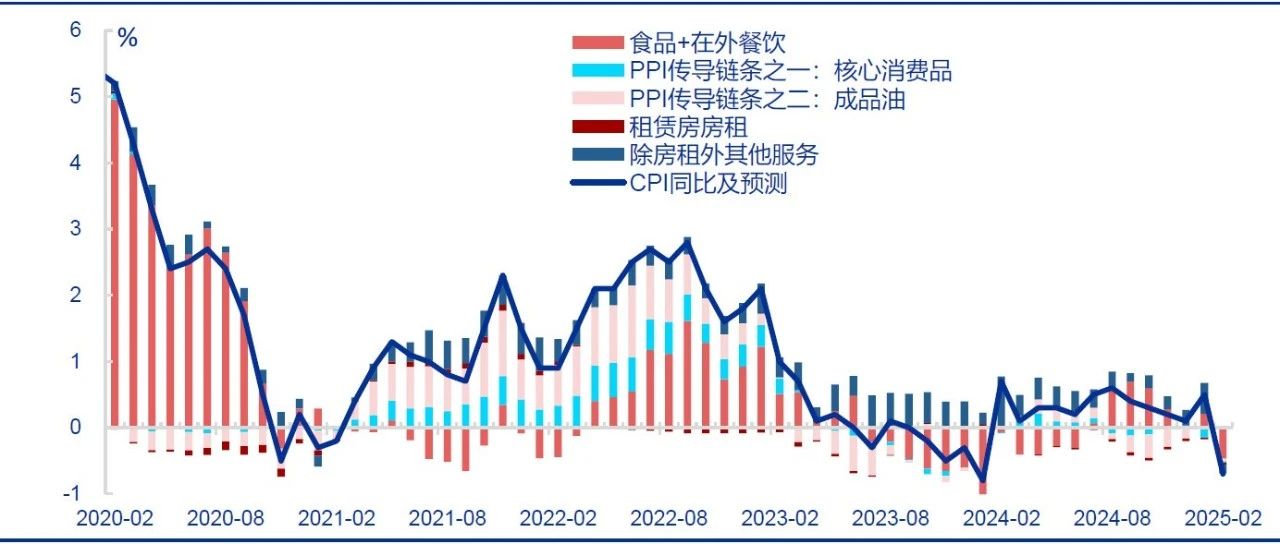
Group 1: CPI Analysis - The CPI year-on-year growth rate decreased to -0.7% in February, down 1.2 percentage points from the previous month, primarily due to the impact of the Spring Festival timing [1][4] - Excluding the Spring Festival effect, the CPI year-on-year increased by 0.1% in February, indicating a moderate recovery in prices [1][4] - Food prices contributed over 80% to the total decline in CPI, with fresh vegetable prices dropping by 12.6% year-on-year [5][6] Group 2: PPI Analysis - The PPI year-on-year decline narrowed to 2.2% in February, with the average for January-February also showing a 2.2% decrease compared to the previous year [2][7] - The main reasons for the PPI decline include the off-peak industrial production season and weak demand for construction materials [2][7] - The prices of production materials fell by 2.5%, while living materials prices decreased by 1.2%, with specific industries like coal processing seeing significant price drops [7][8] Group 3: Market Sentiment and Future Outlook - The PMI data indicated an increase in raw material and finished product price indices, but the PPI only slightly narrowed, suggesting a discrepancy between perceived and actual market conditions [3] - The current policy uncertainty may lead to a cautious approach from enterprises, affecting production enthusiasm [3] - Positive signals from the upcoming Two Sessions may help restore market demand and improve production and demand dynamics [3]

2025年1月价格数据点评:CPI回升但弱于季节性,静待可感可及的政策举措出台
Zhong Cheng Xin Guo Ji· 2025-03-07 05:23
Group 1: CPI and PPI Overview - In January 2025, the Consumer Price Index (CPI) increased by 0.5% year-on-year, up from 0.1% in the previous month, and rose by 0.7% month-on-month, compared to 0.0% previously[2] - The Producer Price Index (PPI) remained at -2.3% year-on-year, consistent with the previous month, and the month-on-month decline slightly widened to -0.2% from -0.1%[2] Group 2: Seasonal and Policy Influences - The January CPI increase was weaker than seasonal expectations, which typically see an average month-on-month rise of 1.1% during the Spring Festival months[3] - Core CPI, excluding food and energy, has shown a continuous increase for four months, indicating some effectiveness of policies implemented since September 2024[3] Group 3: Sector Contributions - Key contributors to the CPI increase included food and beverage, transportation, education, culture, and entertainment, with respective year-on-year growth rates rising by 0.6%, 1.6%, 0.8%, and 0.5%[3] - Service consumption prices, particularly in tourism and household services, outperformed seasonal trends, with increases of 11.6%, 5.7%, and 1.5% month-on-month for various service categories[3] Group 4: Commodity Price Dynamics - Food prices rose by 0.4% year-on-year but were weaker than seasonal performance, with pork prices showing a modest recovery[6] - International crude oil prices increased, contributing approximately 0.1 percentage points to the CPI rise, with domestic gold and gasoline prices up by 3.0% and 2.5% respectively[6] Group 5: Future Outlook - The continuation of price recovery is contingent on effective policy measures and fiscal spending, particularly in infrastructure and industrial demand[11] - The PPI is expected to remain under pressure unless stricter industry regulations are introduced to support supply-side improvements[11]
周报:2025年2月官方PMI数据总体表现中性
AVIC Securities· 2025-03-03 07:36
Manufacturing PMI Insights - The official manufacturing PMI for February 2025 is recorded at 50.2%, an increase of 1.1 percentage points from the previous month, indicating a return above the growth threshold[1] - The average manufacturing PMI for the first two months of 2025 is 49.7%, lower than the average of 50.2% in the last quarter of 2024, suggesting a weaker manufacturing sentiment compared to seasonal norms[1] - The production index and new orders index for February are 52.5% and 51.1%, respectively, indicating that production is expanding faster than demand[2] Economic Trends and Risks - The new export orders index stands at 48.6%, reflecting a slight recovery but still indicating potential risks in external demand due to uncertainties in trade policies[2] - There is a notable divergence in sentiment among manufacturing enterprises, with large enterprises showing a PMI of 52.5%, while medium and small enterprises are at 49.2% and 46.3%, respectively, highlighting a reliance on large firms for recovery[2] - The manufacturing price indices indicate a potential narrowing of PPI declines, with the output price index at 48.5% and the main raw material purchase price index at 50.8%[2] Overall Economic Outlook - The comprehensive PMI average for the first two months of 2025 is 50.6%, down from 51.3% in the last quarter of 2024, suggesting a slower economic recovery trajectory[6] - The construction PMI for February is 52.7%, showing a strong recovery post-holiday, while the service sector PMI is at 50.0%, indicating a decline[5] - The overall economic sentiment remains cautious, with the need for further policy support for small and medium enterprises highlighted as crucial for sustained recovery[2]