
人民币国际化

Search documents
离岸观澜|中国主权债券闪耀卢森堡 离岸债市场开启多元发展新篇章
Xin Hua Cai Jing· 2025-11-22 06:02
Core Viewpoint - The recent issuance of €4 billion sovereign bonds by the Chinese Ministry of Finance in Luxembourg, which was oversubscribed by 25 times, highlights the strong international confidence in China's sovereign credit and marks a significant step in the internationalization of the Renminbi [1][2]. Group 1: Bond Issuance Details - The €4 billion sovereign bonds were issued in two maturities: €2 billion for 4 years at an interest rate of 2.401% and €2 billion for 7 years at 2.702%, with the 7-year bonds seeing a subscription rate of 26.5 times [2]. - The investor composition was diverse, with European investors accounting for 51%, Asian investors 35%, Middle Eastern investors 8%, and U.S. offshore investors 6% [2]. Group 2: Strategic Implications - The choice of Luxembourg as the issuance location is seen as a move to deepen engagement with European financial institutions and to establish a pricing system for euro-denominated bonds, signaling China's commitment to opening its capital markets [2]. - The bonds are fully managed in Hong Kong's Central Moneymarkets Unit (CMU) and are dual-listed on the Hong Kong Stock Exchange and the Luxembourg Stock Exchange, showcasing a strategic collaboration between the two financial hubs [2]. Group 3: Market Evolution - The issuance in Luxembourg represents a strategic shift in the offshore Renminbi market from a focus on Asia to a more diversified approach that includes Europe, reflecting the accelerated internationalization of the Renminbi [3]. - Since 2015, the People's Bank of China has designated offshore clearing banks in major European cities, indicating rapid development of the Renminbi offshore market in Europe [3]. Group 4: Investor Sentiment - The high subscription rates indicate strong real demand from a variety of investors, including central banks, sovereign funds, and asset managers, rather than short-term speculative interest [4]. - The offshore bond market's evolution has led to a shift in pricing dynamics, moving from attractive yields to pricing based on core sovereign asset values, aligning more closely with U.S. Treasury yields [4]. Group 5: Product Innovation - The offshore Renminbi bond market has seen significant growth, with the issuance of various products including green bonds and sustainable development bonds, enhancing the flexibility of Renminbi assets [6]. - The establishment of mechanisms like the "Bond Connect" has facilitated cross-border investment, creating a dual-flow mechanism that addresses the challenges of Renminbi circulation [6]. Group 6: Future Outlook - Future issuance of offshore bonds will need to consider factors such as U.S. Treasury volatility and geopolitical risks, which could impact pricing and investor sentiment [7]. - The ongoing efforts by China to stimulate domestic economic growth and the potential for U.S. interest rate cuts may enhance the long-term investment appeal of Chinese assets [7].
张明:特朗普2.0对国际货币体系的影响及中国应对
Sou Hu Cai Jing· 2025-11-22 05:51
Core Viewpoint - The current international monetary system faces significant structural flaws, including the broad "Triffin Dilemma," increasing spillover effects of U.S. domestic policies, and the trend of dollar "weaponization," which severely limits its stability and sustainability [2][8]. Group 1: Structural Flaws in the International Monetary System - The broad "Triffin Dilemma" remains unresolved, as the U.S. must continuously provide dollar liquidity to meet international demand, which undermines the dollar's credit foundation [9]. - The spillover effects of U.S. domestic policies have intensified, exposing the asymmetry of the current monetary system, where U.S. monetary and fiscal policies significantly impact emerging markets and developing countries [10]. - The trend of dollar "weaponization" has increased, with the U.S. using financial sanctions and the SWIFT system for geopolitical purposes, leading to a fragmentation of the international monetary system [11]. Group 2: Impact of Trump 2.0 on the International Monetary System - Trump 2.0 policies challenge the post-war international monetary system through debt tools, a retreat from multilateralism, and a focus on digital currencies, potentially leading to a restructuring of the global financial system [13][15]. - The U.S. is attempting to externalize its debt burden by encouraging trade partners to convert short-term U.S. debt into long-term bonds, which could undermine the status of U.S. Treasury bonds as a safe asset [17][18]. - The cancellation of the U.S. Agency for International Development (USAID) weakens the global aid network, potentially diminishing the dollar's soft power and its role as a global reserve currency [20]. Group 3: The Rise of the Renminbi and Digital Currencies - The internationalization of the renminbi is progressing rapidly, supported by initiatives like the Belt and Road Initiative and the Asian Infrastructure Investment Bank, although it is unlikely to replace the dollar's dominance in the short term [5]. - The Trump administration's support for cryptocurrencies may reshape the global monetary system, with private cryptocurrencies potentially gaining institutional status and challenging traditional fiat currencies [6][25]. - The emergence of a "new dollar cycle" through stablecoins is seen as a way to supplement traditional financial markets with digital dollar liquidity, enhancing the dollar's position in the digital economy [25][28]. Group 4: Future Directions of the International Monetary System - The international monetary system is entering a transformation phase, potentially evolving into a multi-polar, regionalized, and digitized structure, with the dollar, euro, and renminbi as key currencies [30][31]. - The regionalization of the monetary system is becoming more pronounced, with the dollar, euro, and renminbi emerging as three major currency poles, reflecting structural adjustments in global supply chains [33]. - Digitalization is reshaping the competitive logic of the international monetary system, with the U.S. aiming to establish a digital dollar hegemony through stablecoins and cryptocurrency regulations [34].

对我们出口增长50%!该国只收人民币与黄金,美元欧元已被逐一排除
Sou Hu Cai Jing· 2025-11-21 22:09
这个国家就是俄罗斯。根据俄罗斯联邦海关署发布的最新数据,2024年俄罗斯对华出口额达到1115亿美 元,同比增长50.8%。更有意思的是,这些贸易往来中,人民币结算的比例已经超过了90%,黄金结算 占比约5%,美元和欧元的使用几乎降到了零。 我们来看看这个变化是怎么发生的。2022年2月以来,俄罗斯面临西方制裁,美元和欧元的使用受到了 严重限制。俄罗斯央行发布的报告显示,截至2024年12月,俄罗斯外汇储备中人民币占比已经达到 32.8%,成为第一大外汇储备货币,超过了黄金的31.2%。 昨天晚上刷新闻的时候,看到一个让人颇为意外的消息。我们楼下开超市的老张兴奋地跟我说:"你知 道吗?现在有些国家做生意专门要人民币,美元都不要了!"老张这话听起来有点夸张,我仔细查了查 资料,发现确实有这样的趋势。有个国家最近宣布,在贸易结算中只接受人民币和黄金,美元和欧元都 被排除在外,而且对华出口还增长了50%。 中俄贸易的增长趋势很明显。中国海关总署数据显示,2024年中俄双边贸易额达到2401亿美元,同比增 长26.3%,创历史新高。中国已经连续14年成为俄罗斯第一大贸易伙伴国。 人民币国际化进程在加速。中国人民银行公 ...
俄油每卖一桶倒贴4美元?天然气六折对我们抛售,为什么俄罗斯亏钱也要卖?
Sou Hu Cai Jing· 2025-11-21 18:14
Core Insights - The significant drop in Russian Urals crude oil prices to $36 per barrel and liquefied natural gas (LNG) prices being offered at a 40% discount indicates a severe crisis in Russia's energy exports, driven by sanctions and market pressures [1][3][5]. Group 1: Price Dynamics - By the end of 2025, the price difference between Russian Urals crude oil and Brent crude oil reached $23.5, with Urals priced at $36 and Brent at approximately $60 [1]. - Russian LNG prices for exports to China were reported to be at a 60% discount compared to market prices, allowing China to save over 1.4 billion yuan monthly on energy procurement [1]. Group 2: Sanctions Impact - The U.S. imposed a financial blockade on Russia's energy sector in October 2025, targeting major oil companies and freezing their global assets, which severely restricted Russia's ability to conduct energy trade [3]. - The sanctions led to a significant reduction in shipping and insurance support for Russian oil, resulting in approximately one-third of Russia's maritime crude oil (around 1.4 million barrels per day) being stranded [3]. Group 3: Market Shrinkage - Following the U.S. sanctions, India, a major buyer of Russian oil, ceased imports, and the EU aimed to reduce Russian oil imports to nearly zero, exacerbating the crisis [5]. - Attacks on Russian energy infrastructure have further diminished domestic refining capacity by 30%, crippling the transportation chain [5]. Group 4: Economic Pressures - Russia's energy sector faces immense pressure to maintain production despite losses, as halting operations incurs higher long-term costs due to equipment depreciation and maintenance [7]. - Energy revenues account for 35% of the Russian federal budget, making it critical for sustaining the economy and military expenditures [10]. Group 5: China's Position - China has emerged as a preferred buyer of Russian energy, leveraging its diversified energy supply sources to negotiate lower prices [12]. - The Chinese strategy includes prioritizing discounted LNG from Russia while focusing on higher-quality Siberian ESPO crude oil, leading to a doubling of imports from Russia in August 2025 [12]. Group 6: Infrastructure and Trade Changes - China is tying energy procurement to the development of Arctic shipping routes and expanding pipeline systems, which could significantly increase gas supply from Russia [14]. - The settlement mechanism for energy transactions between China and Russia has shifted, with over 65% of transactions now conducted in yuan and rubles, reducing reliance on the dollar [14]. Group 7: Global Market Reactions - The drop in Russian energy prices has prompted Middle Eastern oil producers to lower their prices to maintain competitiveness in the Asian market [16]. - European countries are facing internal conflicts regarding energy imports from Russia, with some nations increasing imports despite sanctions [16]. Group 8: Regional Developments - Central Asian countries are seeking to reduce their economic dependence on Russia, with initiatives to build regional infrastructure [18]. - Russia is attempting to establish new export routes through the International North-South Transport Corridor, although progress is hindered by financial and political challenges [18].
“2025第一财经金融价值年会”聚焦全球动荡中的中国经济新确定性
第一财经· 2025-11-21 16:13
Core Insights - The global economy is seeking a new balance amid downward pressures and structural challenges, with geopolitical conflicts and supply chain restructuring posing significant tests [3] - The "2025 First Financial Value Annual Conference" focused on key topics such as the internationalization of the RMB, new trends in the Chinese economy, and paths to enhance household consumption [3][4] Group 1: RMB Internationalization - China is entering a "dual investment" phase, balancing "bringing in" and "going out" investments, amid a backdrop of global trade adjustments and rising geopolitical risks [5][7] - Since the Belt and Road Initiative, China's outbound direct investment (ODI) has rapidly increased, surpassing foreign direct investment (FDI) in 2015, with a significant diversification of trade partners [7] - The internationalization of the RMB is expected to accelerate during the 14th Five-Year Plan, with breakthroughs in trade settlement, payment systems, and reserve allocation, although it remains mismatched with China's economic scale [7][9] Group 2: Economic Growth and Consumption - The new quality productivity, driven by technological innovation and deep integration with the industrial chain, is becoming a core variable in China's economic growth [9][11] - There is potential for an increase in household consumption over the next five years, but challenges such as income structure, family burdens, and aging population must be addressed [11][13] - Solutions to enhance consumption include systemic reforms, stabilizing the real estate and capital markets, and improving service supply and market regulation [13] Group 3: Market Trends and Investment Opportunities - The global economy is at a crossroads, with rising gold prices reflecting market uncertainty and diverging monetary policies reshaping global asset allocation [15] - The contribution of real estate to the economy has decreased to about 10%, while the stock market benefits from emerging industries and economic recovery [17] - Long-term investment opportunities remain in sectors like innovative pharmaceuticals, with the stock market's upward trend expected to continue [17][18]

“2025第一财经金融价值年会”聚焦全球动荡中的中国经济新确定性
Di Yi Cai Jing· 2025-11-21 15:12
Group 1 - The global economy is seeking a new balance amid downward pressures and structural challenges, with geopolitical conflicts and supply chain restructuring posing significant tests [1] - The "2025 First Financial Annual Financial Value Conference" held in Shanghai focused on key topics such as the internationalization of the RMB, new trends in the Chinese economy, and paths to enhance household consumption [1] - The conference highlighted influential figures in the financial industry who have significantly impacted industry transformation and market research [1] Group 2 - Three key trends are shaping the current global landscape: deep adjustments in globalization, the rise of protectionism, and the integration of technology with the economy [2] - China is entering a "dual investment" phase, balancing both inbound and outbound investments [2] Group 3 - Since the Belt and Road Initiative, China's outbound direct investment (ODI) has rapidly increased, surpassing foreign direct investment (FDI) in 2015 and maintaining a leading position in most years [3] - The structure of China's trade partners has diversified, with exports to the US, EU, and ASEAN decreasing from 50.8% in 2019 to 45.5% in 2024, while exports to Belt and Road countries have risen to approximately 47% [3] Group 4 - The internationalization of the RMB is expected to accelerate during the 14th Five-Year Plan, with significant breakthroughs in trade settlement, payment systems, and reserve allocation over the past 16 years [3][5] - The necessity for RMB internationalization has increased due to changes in the global trade landscape and rising dollar credit risks [5] Group 5 - The new core variable of China's economy is the new quality productivity, driven by technological innovation and deep integration with the industrial chain [5] - The contribution of real estate to the economy has decreased to about 10%, while the stock market is benefiting from emerging industries and economic recovery [12] Group 6 - The long-term trend of the Chinese stock market remains upward, with investment opportunities in sectors such as innovative pharmaceuticals, new energy vehicles, semiconductors, and artificial intelligence [12] - The conference included discussions on wealth growth in a low-interest-rate environment, emphasizing a shift from single yield pursuit to long-term stable allocation strategies [12][13]
2025第一财经金融价值年会与会嘉宾金句集锦
Di Yi Cai Jing· 2025-11-21 12:08
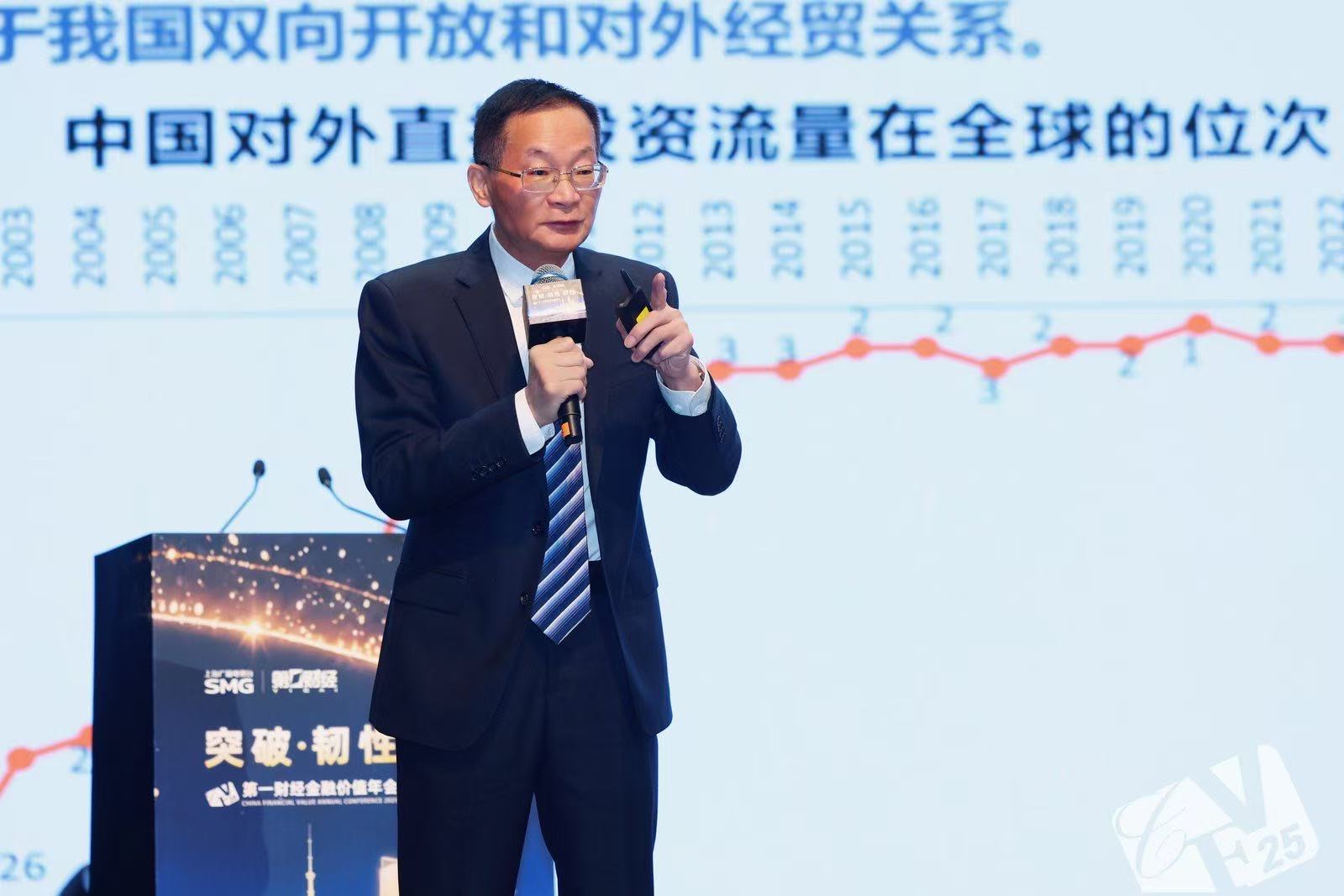
第一财经总经理汪钧:在这样一个复杂多变的环境中,世界迫切需要一种在丰富经验基础上形成的新的 全球金融方案,这对于中国来说,既是挑战更是机会。 中欧国际工商学院经济学与金融学教授、中国首席经济学家论坛研究院院长盛松成: 中国已进入"双向 投资"阶段,引进来和走出去同时发展,中国贸易伙伴也日趋多元化,人民币汇率中长期或稳中有升, 更有利于中国双向开放和对外经贸关系。 广开首席产业研究院院长兼首席经济学家、中国首席经济学家论坛理事长连平:在"十五五"期间,人民 币国际化应加快推进。过去16年来,人民币在贸易、支付、结算、储备等领域使用提升明显,但与中国 经济体量仍不匹配。当前国际环境复杂,贸易战、美元信用风险上升、去美元化加速,都使加快人民币 国际化更具必要性和现实条件。 清华大学国家金融研究院院长、清华大学五道口金融学院副院长田轩:发展新质生产力要有包容个性和 容忍失败的氛围,崭新的创投组织形式,"不太积极"的二级市场,完善健全的法治环境,稳定的宏观政 策导向。 粤开证券首席经济学家、研究院院长罗志恒:推动居民消费率明显提高,短期要构建支持名义经济增速 回升的宏观政策框架,中长期可改革制度,包括构建消费导向型的宏 ...

特朗普最后的豪赌,停摆危机前邀中国接盘,中方7590亿美债是筹码
Sou Hu Cai Jing· 2025-11-21 11:49
Group 1 - The U.S. government faced significant fiscal pressure, leading to a 43-day shutdown, the longest in history, affecting federal employees and economic data [1][5] - The national debt reached $38 trillion, with interest payments consuming nearly 20% of the federal budget, prompting the Trump administration to seek negotiations with China regarding U.S. Treasury holdings [1][3] - The shutdown resulted in an estimated GDP loss of $7 to $14 billion, and despite a temporary funding bill being passed, liquidity issues remained unresolved [5][9] Group 2 - China has been reducing its holdings of U.S. Treasuries since the trade disputes began in 2018, with holdings dropping from $768.6 billion in December 2024 to $700.5 billion by September 2025 [3][7] - The Trump administration proposed tariff reductions on certain Chinese goods in exchange for China halting its restrictions on rare earth exports and increasing purchases of U.S. debt, but China did not commit to these terms [3][7] - The ongoing trend of de-dollarization and increased cooperation with ASEAN and EU indicates a shift in China's economic strategy, moving away from reliance on U.S. debt [7][11] Group 3 - The U.S. economy is experiencing rising inflation post-shutdown, complicating Federal Reserve policy decisions, while the debt is projected to increase further, leading to expanded fiscal deficits [9][13] - The international landscape remains uncertain, with Trump's strategy to stabilize the financial market through negotiations with China facing challenges as China seeks to diversify its reserves and reduce U.S. debt exposure [11][13] - The future of U.S. financial stability and the dollar's dominance will depend on how these geopolitical and economic dynamics evolve [11][13]

特朗普开始着急了,中国手握3万亿外储却发40亿美债,两个原因
Sou Hu Cai Jing· 2025-11-21 11:22
Core Viewpoint - The issuance of $4 billion in sovereign bonds by China in Hong Kong is a strategic move to test its creditworthiness against that of the U.S., showcasing confidence in China's economic potential and providing a new safe asset option for global capital [1][3][40] Group 1: Bond Issuance and Market Response - China successfully issued $4 billion in sovereign bonds, attracting a total subscription of $118.2 billion, nearly 30 times the issuance amount [5][11] - The 5-year bonds saw a subscription rate of 33 times, indicating strong global investor interest [5][11] - The interest rates for the 3-year and 5-year bonds were set at 3.646% and 3.787%, respectively, which, while slightly higher than U.S. Treasury rates, reflect minimal risk premium due to the overwhelming demand [11][14] Group 2: Strategic Implications - The bond issuance serves to position China's credit on par with U.S. credit, allowing international investors to assess the relative risks of lending to China versus the U.S. [11][14] - This move is seen as a challenge to the U.S. dollar's dominance, especially in light of recent geopolitical tensions and the potential for the dollar to be weaponized [18][22] - The bonds come with a unique repayment option, allowing repayment in RMB or physical assets, which mitigates the risk of U.S. financial sanctions [20][22] Group 3: Economic and Geopolitical Context - The issuance is part of a broader strategy to provide low-cost financing to developing countries, particularly in Africa and South America, while allowing them to repay in RMB, thus reducing their exposure to currency risk [26][30] - This strategy encourages trade with China and the use of RMB in international transactions, potentially increasing the currency's global circulation [35][38] - The growing trade relationship with Africa, which has surpassed ASEAN as China's largest trading partner, exemplifies the effectiveness of this approach [37][40]
平安证券首席经济学家:央行三季度货币政策执行报告释放多个积极信号
Sou Hu Cai Jing· 2025-11-21 11:11
Core Viewpoint - The People's Bank of China (PBOC) has released the "Monetary Policy Implementation Report for the Third Quarter of 2025," indicating multiple adjustments in policy expression, regulatory focus, and framework transformation, reflecting a precise grasp of the current economic and financial situation and clarifying future policy directions [1] Group 1: Monetary Policy Transmission Efficiency - The core expression of monetary policy shifted from "strengthening counter-cyclical adjustment" in the second quarter to "maintaining ample liquidity" in the third quarter, with market liquidity remaining reasonably abundant despite no reserve requirement ratio (RRR) or interest rate cuts [2] - The interbank money market rate DR001 has remained stable around the policy rate, while DR007 has operated at a level 10 basis points above the policy rate, indicating effective regulatory outcomes [2] - The report shows enhanced confidence and determination in monetary policy, emphasizing a stable and relatively loose environment while reducing the urgency of short-term counter-cyclical adjustments [2] Group 2: Transformation of Monetary Policy Framework - The report emphasizes maintaining exchange rate flexibility, strengthening expectation guidance, and preventing excessive exchange rate fluctuations, with an accelerated pace for the internationalization of the Renminbi and capital account convertibility [3] - Key highlights of the monetary policy framework transformation include optimizing intermediate variables, transitioning to a price-based regulatory framework, and enhancing the linkage between asset and liability interest rates for banks [3] Group 3: Structural Measures - The report introduces three new structural measures aimed at addressing developmental shortcomings: optimizing carbon reduction support tools, improving financial support mechanisms for post-poverty alleviation, and researching personal credit repair support policies to unlock consumer potential [4] - These measures reflect a targeted approach in structural monetary policy tools to address key areas and weaknesses in the economy [4]