
宠物经济

Search documents
烟台父子卖宠物零食,悄悄挣下70亿
2 1 Shi Ji Jing Ji Bao Dao· 2025-07-07 03:39
Core Viewpoint - The article highlights the growth and expansion of Zhongchong Co., a leading player in the pet food industry, particularly under the leadership of its founder, Hao Zhongli, who has made significant investments and strategic moves to enhance the company's market position and global footprint [1][4][22]. Company Overview - Zhongchong Co. has invested over 800 million yuan in New Zealand, acquiring the high-end pet food brand ZEAL and establishing three production bases [1]. - The company started from pet snack OEM and now owns several brands, including Wanpi and Zhenzhi, with 22 production bases globally [3][22]. - The stock price of Zhongchong Co. has increased nearly 80% since the beginning of the year, indicating strong market performance [4]. Financial Performance - From 2022 to 2024, Zhongchong's revenue is projected to rise from 3.248 billion yuan to 4.465 billion yuan, while net profit is expected to grow from 106 million yuan to 394 million yuan, nearly quadrupling [7]. - The company's gross margin was 29.13% last year, which is lower than its competitor, Guobao Pet, at 42.32% [10][11]. - The company has improved its domestic gross margin to 35.18% through product restructuring and the introduction of high-margin products [11]. Market Strategy - Zhongchong Co. focuses on the mid-to-high-end market, leveraging a "domestic brand + cost performance" strategy [9]. - The company has shifted from an OEM model, which contributed 58% of its revenue, to a self-operated sales model, with over 68% of revenue coming from overseas [14]. - The company has established a strong online presence, with e-commerce channels accounting for approximately 70% of total pet sales in China [17]. Marketing and Branding - The company employs various marketing strategies, including collaborations with celebrities and social media influencers, to enhance brand visibility [18]. - In 2022, online sales of its proprietary brands accounted for 60% of domestic revenue, while offline sales made up 40% [19]. Research and Development - Zhongchong Co. invested 72.68 million yuan in R&D last year, a year-on-year increase of over 50%, representing 1.63% of total revenue [20]. Global Expansion - The company has established 22 production bases worldwide, including in the U.S., Canada, and New Zealand, and products are sold in 85 countries [22][23]. - The U.S. factory, built with an investment of 28 million USD, became profitable in its first year of operation [21]. - The company plans to expand its production capacity in North America, with a second factory expected to be completed by 2026 [24].
农林牧渔行业点评:行业引导破除“内卷式”竞争,优质低成本龙头或受益
Hua Yuan Zheng Quan· 2025-07-03 03:01
Investment Rating - The industry investment rating is "Positive" (maintained) [1] Core Viewpoints - The report emphasizes the need to break the "involutionary" competition in the agricultural sector, suggesting that high-quality, low-cost leading companies may benefit from this shift [3] - The report highlights the importance of technological innovation and the integration of agricultural resources to create a sustainable ecosystem that empowers farmers and drives continuous innovation [6][7] - The report anticipates that the pig farming market, valued at trillions, will see opportunities for technology-driven enterprises that can navigate the challenges of the industry [6] Summary by Sections Production Capacity - As of May, the national breeding sow inventory was 40.42 million heads, a year-on-year increase of 1.15% and a month-on-month increase of 0.1% [5] - The Ministry of Agriculture and Rural Affairs is focusing on stabilizing pig prices and controlling production capacity among leading enterprises [5] Market Performance - The price of live pigs reached a new high of 15.08 yuan/kg on July 1, attributed to a reduction in supply and the release of previous weight reduction pressures [7] - The white-feathered chicken market is experiencing a contradiction of "high capacity, weak consumption," but overall industry growth is expected to continue [8] Investment Recommendations - The report suggests that leading companies in the seed industry, particularly those with advanced research capabilities, are likely to see sustained performance growth [11] - The pet economy is highlighted as having strong consumer resilience and significant growth potential, with a favorable market structure [10] Industry Trends - The report notes that the agricultural industry is moving towards a model that emphasizes biotechnology, smart equipment, and low-carbon agriculture as key areas for future development [7] - The feed industry is characterized as a service-oriented sector with opportunities and risks, requiring companies to balance scale and flexibility [9]
趋势研判!2025年中国智能喂食器行业产业链图谱、产业环境、市场规模及未来前景:城镇宠物主智能产品接受度不断提升,行业迎来广袤发展空间[图]
Chan Ye Xin Xi Wang· 2025-07-03 01:22
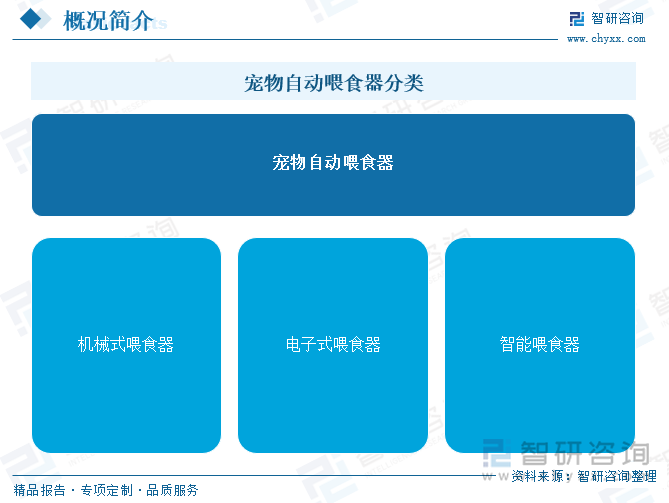
Core Insights - The pet automatic feeder market in China is experiencing significant growth, with the market size increasing from 2.197 billion yuan in 2021 to 2.643 billion yuan in 2024, representing a global market share increase from 12.67% to 13.47% during the same period [1][12][10] - The rise in pet ownership and the increasing affection pet owners have for their pets are driving the demand for smart pet products, particularly automatic feeders, which are becoming essential for modern pet care [1][12] Industry Overview - Pet automatic feeders are categorized into mechanical, electronic, and smart feeders, with smart feeders gaining popularity due to their automation and added features such as remote monitoring and health analysis [1][6] - The market for pet products in China has expanded significantly, with the pet economy reaching a scale of 300.2 billion yuan by 2024, driven by the increasing number of urban pet owners [6][10] Market Status - The automatic pet feeder market is projected to grow to 3.858 billion yuan by 2028, with the market share expected to rise to 14.61% globally [12][10] - Smart feeders currently account for approximately 15% of the pet automatic feeder market, indicating a trend towards more advanced feeding solutions [14][12] Competitive Landscape - Major players in the smart feeder market include international brands like PetSafe and Petmate, which dominate the high-end segment, while domestic brands like Xiaopei focus on cost-effective solutions [16][12] - Companies such as Donis and Tianyuan Pet are actively expanding their product lines to include smart feeding solutions, reflecting the competitive nature of the market [18][20] Development Trends - Technological advancements in AI, IoT, and big data are expected to enhance the functionality of smart feeders, allowing for personalized feeding plans and remote monitoring capabilities [22][24] - The demand for smart feeders is anticipated to grow as pet owners increasingly prioritize their pets' health and quality of life, particularly in urban areas [23][24]




宠物险市场“蓝海”下,“成本高”与“赔得少”之困
Di Yi Cai Jing· 2025-07-02 12:09
Core Insights - The pet insurance market is experiencing rapid growth, with some companies reporting premium growth rates exceeding 100% in the past two years, driven by the increasing willingness of pet owners to invest in their pets' health [1][6] - Despite the growth potential, the industry faces significant challenges, including high claims costs for insurers and dissatisfaction among consumers regarding policy limitations and low payouts [1][7][8] - The need for a standardized regulatory framework in the pet insurance industry is urgent, as current issues stem from the lack of regulation in the pet medical market and inadequate product design [1][12] Industry Overview - The pet economy is booming, with the number of pet dogs and cats in China expected to exceed 120 million by 2024, and the urban pet consumption market projected to surpass 300 billion yuan [2] - The average medical expenses for pet owners have increased, with average costs for treating dogs and cats reported at 2,786 yuan and 2,390 yuan respectively in 2023, up from 2,460 yuan and 2,287 yuan in 2022 [3] Market Dynamics - The pet insurance market in China has grown from 210 million yuan in 2017 to 3.37 billion yuan in 2021, with a compound annual growth rate of 100.4% [6] - Despite high growth rates, the penetration rate of pet insurance in China remains below 1%, indicating significant room for expansion compared to countries like Sweden and Japan, where penetration rates are approximately 40% and 10% respectively [6] Consumer and Insurer Perspectives - Consumers express dissatisfaction with pet insurance due to perceived limitations and low compensation, with complaints about inadequate payouts being common [7][8] - Insurers report high claims costs, with some companies operating at a loss, attributing this to the high cost of claims and the prevalence of fraud in the industry [8][9] Regulatory and Standardization Efforts - There is a growing recognition of the need for a collaborative approach to establish a regulatory framework for the pet insurance industry, involving insurance platforms, veterinary hospitals, and academic institutions [12] - Efforts are underway to create standardized medical practices and insurance product designs to improve transparency and reduce costs for consumers [12][13]


粤开市场日报-20250701
Yuekai Securities· 2025-07-01 08:41
Market Overview - The A-share market showed mixed performance today, with the Shanghai Composite Index rising by 0.39% to close at 3457.75 points, while the Shenzhen Component Index increased by 0.11% to 10476.29 points. However, the Sci-Tech Innovation 50 Index fell by 0.86% to 994.80 points, and the ChiNext Index decreased by 0.24% to 2147.92 points. Overall, 2628 stocks rose, 2542 fell, and 247 remained unchanged across the market [1]. - The total trading volume in the Shanghai and Shenzhen markets was 14660 billion, a decrease of 208.42 billion compared to the previous trading day [1]. Industry Performance - Among the Shenwan first-level industries, sectors such as comprehensive, pharmaceutical biology, banking, non-ferrous metals, public utilities, and building materials led the gains, while computer, retail, telecommunications, media, power equipment, and real estate sectors experienced declines [1]. Sector Highlights - The top-performing concept sectors today included China Shipbuilding System, innovative drugs, antibiotics, vitamins, generic drugs, low-priced stocks in the ChiNext, hydropower, biotechnology, advanced packaging, superhard materials, pet economy, CRO, medical material exports, selected banks, and brain-computer interfaces [1].
创新消费场景,宠物经济热潮涌动
Zhong Guo Chan Ye Jing Ji Xin Xi Wang· 2025-06-30 23:43
Group 1: Industry Overview - The pet economy in China is experiencing rapid growth, with the urban pet consumption market expected to exceed 300 billion yuan in 2024, driven by a slight increase in pet numbers to over 120 million [2][3] - The pet food market is a significant segment, with dog consumption reaching 155.7 billion yuan (up 4.6%) and cat consumption at 144.5 billion yuan (up 10.7%) [2] - The overall pet industry is projected to reach 1.15 trillion yuan by 2028, indicating a strong growth trajectory [2] Group 2: Consumer Behavior - Consumers are increasingly willing to spend on pets, with a shift from basic needs to quality-oriented purchases, as evidenced by significant sales growth in pet essentials during major shopping events [2][3] - The demand for pet products is evolving, with a notable increase in high-frequency consumables such as pet food and hygiene products [2][3] Group 3: Corporate Strategies - Major brands are entering the pet market, with companies like Nike and Adidas launching pet apparel lines, reflecting the growing interest in pet fashion [4][5] - Food giants are also expanding into the pet food sector, with companies like Yili and Tongwei investing in pet food production to meet rising consumer demands for healthier options [5] Group 4: Market Trends - The pet economy is closely linked to urbanization and digitalization, with a growing trend towards premium and specialized pet services, including pet-friendly travel options [6][7] - The industry is witnessing a shift towards professional pet care services, addressing the cleaning and health management needs of pet owners [5][6] Group 5: Financial Performance - Several publicly listed pet companies reported significant revenue growth in Q1 2025, with Zhongchong Co. achieving a 25.41% increase in revenue [7][8] - Analysts remain optimistic about the pet sector, highlighting the potential for continued growth driven by product innovation and market expansion [8]
农林牧渔行业周报:宠物保持高景气度,生猪板块布局底部-20250630
Guohai Securities· 2025-06-30 13:32
Investment Rating - The report maintains a "Recommended" rating for the agriculture, forestry, animal husbandry, and fishery industry [1][61]. Core Views - The report highlights that the pig price may experience a turning point due to seasonal factors and policy changes, suggesting a bottoming out phase for the sector [2][12]. - The poultry sector is seeing price declines, but there are signs of marginal improvements in the cycle [3][24]. - The animal health sector is expected to see performance recovery, and there are investment opportunities in the pet medical industry [4][35]. - The planting sector is witnessing a week-on-week rebound in grain prices [5][43]. - The feed sector is experiencing price fluctuations, with a general downward trend [6][46]. - The pet economy is thriving, with domestic brands gaining strength [7][51]. Summary by Sections Pig Industry - The average pig price is currently fluctuating between 14-15 CNY/kg, with a notable increase in average weights compared to previous years [11][12]. - The report recommends focusing on companies with low costs and strong financial health, such as Wens Foodstuffs, Muyuan Foods, and Juxing Agriculture [12][61]. Poultry Industry - The poultry prices are declining, with the white feather chicken price at 3.48 CNY/jin, showing a slight decrease [24][25]. - The report recommends companies like San Nong Development and Yisheng Livestock, while suggesting to pay attention to He Feng and Minhe Livestock [25][61]. Animal Health - The animal health sector is expected to recover, supported by the profitability of the pig farming industry [35][36]. - The pet medical market is projected to grow, with a market size of approximately 840 billion CNY, representing 28% of the pet industry [4][35]. Planting Sector - Grain prices are showing a week-on-week increase, with corn priced at 2353 CNY/ton and wheat at 2446 CNY/ton [43][44]. - The report suggests focusing on companies involved in genetically modified seeds, such as Suqian Agricultural Development and Longping High-tech [43][61]. Feed Sector - Feed prices are experiencing a downward trend, with pig feed at 3.36 CNY/kg [46][47]. - The report recommends Hai Da Group and suggests paying attention to He Feng [47][61]. Pet Industry - The pet market is expected to reach a scale of 300.2 billion CNY in 2024, with a growth rate of 7.5% [51][52]. - The report recommends companies in the pet food sector like Guobao Pet and Zhongchong Co., and in the pet medical sector, it recommends Ruipu Biological [55][61].


长城证券-β隐匿下的_平衡木”策略——基于景气度线索以及行业趋势-250630-去水印
Great Wall Securities· 2025-06-30 12:49
Group 1 - The overall revenue growth of the A-share market shows a recovery trend, with a year-on-year growth rate of -0.18% for the entire A-share market and 0.65% for the non-financial and non-oil sectors in Q1 2025, indicating a significant improvement compared to Q4 2024 [21][28] - The growth rate of revenue for the ChiNext board reached 7.89% in Q1 2025, maintaining positive growth since December 2022, while the STAR Market experienced a decline of 7.24% due to the downturn in the photovoltaic industry [21][28] - The net profit growth for the entire A-share market turned positive in Q1 2025, with a year-on-year increase of 1.49%, compared to a decline of -0.89% in Q4 2024, indicating a significant recovery in profitability [28][36] Group 2 - The financial and real estate sectors are experiencing a divergence, with the real estate sector continuing to weaken, while brokerage firms benefit from the deepening of capital market reforms, showing a year-on-year revenue growth of 22.08% and a net profit growth of 83% [3][59] - The upstream materials sector shows resilience, particularly in the non-ferrous metals segment, which saw a net profit increase of 37.9% year-on-year, driven by geopolitical risks and a weakening dollar [3][59] - The steel industry is facing challenges with excess capacity, leading to a significant decline in profits for the rebar segment, while the plate segment benefits from equipment renewal policies, showing a notable improvement in net profit growth [3][59] Group 3 - The midstream manufacturing sector is witnessing a transition between old and new driving forces, with the engineering machinery sector experiencing a revenue increase of 9.88% driven by domestic demand recovery, while exports are negatively impacted by shrinking overseas demand [4][61] - The smart manufacturing and automation sectors are emerging as growth drivers, with industrial robot production increasing by 51.5% year-on-year and the gross profit margin of new energy equipment recovering to 18.7% [4][61] - The consumer sector is highlighting structural opportunities, with the home appliance sector benefiting from "old-for-new" policies, achieving a net profit growth of 10.14% in Q1 2025 [4][61] Group 4 - The innovative drug sector is driven by business development (BD) transactions, with a net profit growth rebound to 7.54% in Q1 2025, supported by domestic medical insurance expansion and breakthroughs in overseas clinical trials [5][63] - The TMT and AI industry chains are characterized by high investment, with the optical module segment benefiting from the global computing power competition, resulting in a net profit increase of 114.5% year-on-year [4][63] - The AI industry chain is experiencing a slowdown in revenue growth, with a decrease to 3.25% in Q1 2025, although the pace of domestic substitution is accelerating [4][63]
农业行业2025年中期投资策略:大畜牧养殖板块有望迎来景气共振,新消费乘势而上
Minsheng Securities· 2025-06-30 09:56
Group 1: Beef Industry - The beef cycle in China is undergoing significant changes, with a long-term trend of price increases due to lower production capacity compared to consumption growth. The high profitability cycle in beef farming is leading to aggressive expansion downstream, but this has resulted in substantial losses since July 2023. The industry is characterized by low concentration and severe information asymmetry, similar to the pig farming industry before the African swine fever outbreak. Once capacity is effectively cleared, supply-demand mismatches and price elasticity may exceed expectations [3][57]. - China's beef production capacity is not proportional to its beef output, with a significant gap between live cattle production and beef yield. In 2024, China is projected to produce 520 million live cattle but only 779 million tons of beef, indicating inefficiencies in production practices [19][24]. - The beef import dependency in China has increased significantly, with imports rising from 601,000 tons in 2016 to 2,915,000 tons in 2024, reflecting a compound annual growth rate (CAGR) of 21.8%. This has amplified the impact of imports on domestic beef pricing [24][25]. Group 2: Swine Industry - The swine industry is expected to experience a short-term decline in prices due to an oversupply of pigs, with the national breeding sow inventory remaining stable but limited growth. The Ministry of Agriculture has mandated a halt to the expansion of breeding sows, which will impact supply dynamics in the second half of 2025 [87][89]. - The supply of piglets is expected to increase, leading to higher market pressures in the second half of 2025. However, potential outbreaks of diseases in the autumn and winter could lead to a temporary decrease in supply, which may cause prices to rise in 2026 [89][92]. - The average asset-liability ratio of listed pig farming companies has improved from 73.9% to 61.6% between Q2 2023 and Q1 2025, indicating a recovery in financial health among leading firms in the industry [99]. Group 3: Animal Health Industry - The animal health sector is expected to benefit from improvements in efficiency and cost management, despite an oversupply in the breeding industry. The demand for veterinary drugs is anticipated to rise as pig prices recover, which will positively impact upstream animal health companies [84][90]. - The industry is transitioning from a focus on scale to an emphasis on quality, with the development of vaccines against diseases like African swine fever becoming a critical catalyst for growth in the animal health sector [90][92]. Group 4: New Consumption Trends - The pet consumption market in China is steadily growing, with the overall market size expected to reach 300.2 billion yuan in 2024, reflecting a year-on-year growth of 7.5%. The pet cat market is particularly strong, with a growth rate of 10.7% [59][62]. - Domestic brands are gaining popularity among pet owners, with a significant increase in preference for local products over foreign brands. This trend is driven by cost advantages and effective marketing strategies during major shopping events [72][79]. - The demand for pets as companions is rising due to demographic changes, including an aging population and declining marriage rates, which is expected to further boost the pet industry [67][68].
源飞宠物(001222):深度研究报告:深耕宠物牵引用具,自主品牌发展可期
Huachuang Securities· 2025-06-30 07:19
Investment Rating - The report gives a "Buy" rating for the company with a target price of 26.5 CNY per share [1][8]. Core Views - The company is focused on the pet leash market and aims to develop its own brands, which are expected to grow significantly in the future. The company has established strong customer relationships with international retailers such as Petco and Walmart, and has recently launched several domestic brands [6][7]. - The financial outlook is positive, with projected revenue growth and a return to profitability after a period of adjustment due to inventory issues. The company is expected to benefit from both domestic and international markets, with a strong emphasis on brand development [6][32]. Summary by Sections Company Overview - The company, Yuanfei Pet, was established in 2004 and has focused on the research, production, and sales of pet products and snacks. It has built a solid customer base, including major international retailers [13]. - The company has undergone three development phases, with a recent focus on domestic brand expansion and product innovation [14]. Financial Analysis - Projected total revenue for 2024 is 1.31 billion CNY, with a year-on-year growth of 32.2%. The net profit attributable to shareholders is expected to be 164 million CNY, reflecting a growth of 30.2% [2]. - The company’s revenue is expected to continue growing, with estimates of 1.61 billion CNY in 2025 and 1.82 billion CNY in 2026, alongside a steady increase in net profit [8]. Market Analysis - The overseas market for pet leashes is robust, with increasing demand driven by the perception of pets as family members. The domestic pet food market remains the largest segment, with a strong trend towards health-oriented and functional products [6][56]. - The global pet market is experiencing growth, particularly in the U.S. and Western Europe, where the demand for pet products continues to rise [56]. Competitive Positioning - The company has established a strong foundation in overseas markets, with key partnerships with major retailers. It is also enhancing its production capabilities through new factories in Bangladesh and domestic locations [9][32]. - The company is focusing on developing its own brands, which are expected to gain traction in the market, supported by a strong marketing strategy and product differentiation [9][19]. Profitability Forecast - The company anticipates a gradual recovery in profitability, with net profits projected to reach 242 million CNY by 2027. The earnings per share (EPS) are expected to increase from 0.86 CNY in 2024 to 1.27 CNY in 2027 [2][8]. - The report highlights the importance of monitoring the performance of new brands and the impact of marketing expenditures on profitability [47].