自主可控

Search documents
A股后续资金面怎么看?
2025-09-07 16:19
Summary of Key Points from Conference Call Records Industry Overview - The A-share market is currently driven by liquidity rather than economic fundamentals, similar to the early stages of the 2019 bull market [1][3] - The adjustment in the market is attributed to profit-taking and micro-structural deterioration, not a signal of the end of the bull market [1][3] Core Insights and Arguments - **Liquidity and Market Performance**: The recent rise in the stock market is primarily influenced by liquidity and leverage, with a significant shift of household savings into the equity market [2][4] - **Foreign Capital Inflow**: There is a notable increase in foreign capital entering the A-share market, with data indicating a rapid inflow of active foreign investments [4][22] - **Long-term Market Outlook**: The likelihood of the bull market ending due to liquidity tightening is low, as expectations of a Federal Reserve rate cut have been largely priced in [5][23] - **Sector Focus**: Long-term themes include AI and economic inflation rebalancing, while short-term opportunities may arise from style rebalancing in sectors like consumer goods and innovative pharmaceuticals [7][24] Important but Overlooked Content - **Policy Impact**: Recent domestic policies focus on anti-involution and consumer spending, with supply-side measures in the polysilicon industry and demand-side policies promoting consumer spending [8][9] - **Consumer Support Measures**: Specific government initiatives include subsidies for cultural and sports events, and plans for free preschool education, which are expected to stimulate consumption [9][10] - **Price Governance Innovations**: The new pricing law, which includes cost investigations, is expected to have a significant long-term impact on market dynamics [11] - **Technological Policy Developments**: New regulations aimed at attracting foreign tech talent and promoting AI development indicate a strategic focus on innovation [12] Investment Directions - **Investment Opportunities**: Recommended investment directions include hard currencies, gold, and resource assets, particularly industrial metals, as well as sectors with defensive attributes and low short-term valuations [24][30] - **Real Estate Market Dynamics**: The influx of capital into the stock market may initially lead to a decline in real estate investments, but could eventually result in a rebound in property prices as the stock market stabilizes [28] Financial Sector Insights - **Brokerage Sector Performance**: The brokerage sector is expected to benefit significantly from increased market liquidity and the influx of household funds, with historical data suggesting potential for substantial gains [25][27] - **Market Activity Indicators**: Recent data shows a significant increase in trading volumes and new account openings, indicating heightened retail investor interest [25][27] Conclusion - The A-share market is poised for potential upward movement due to strong liquidity and foreign capital inflows, despite short-term volatility. Key sectors and investment themes are emerging, driven by both domestic policy support and global economic trends.
川仪股份20250907
2025-09-07 16:19
Summary of the Conference Call for Chuan Yi Co., Ltd. Industry and Company Overview - The conference call focuses on Chuan Yi Co., Ltd., a company in the automation instrumentation industry, particularly in smart control valves, actuators, and transmitters, which contribute nearly 70% of its revenue [2][3][6]. - The company has faced challenges in maintaining market share since 2022 due to industry pressures but is expected to benefit from domestic substitution and self-control policies, leading to accelerated growth in new market shares [2][4]. Core Points and Arguments 1. **Market Position and Growth Potential**: - Chuan Yi's market share has not improved since 2022, but the company is poised for faster growth in new market shares due to emerging demand driven by domestic substitution and self-control policies [2][4]. - The company has significant growth potential in the nuclear power sector and control valve market, with a current market share of approximately 8% compared to leading companies like Sinopec and CNOOC, which hold around 3% [11]. 2. **International Cooperation and Support**: - International partnerships provide Chuan Yi with support in technology, products, and materials, enhancing its competitiveness and order acquisition from central state-owned enterprises [2][4][16]. - The experience and subsidiary network of Guojiji Group are expected to significantly increase Chuan Yi's overseas revenue [2][4][17]. 3. **Financial Performance and Future Outlook**: - Despite a projected profit decline in the first half of 2024-2025, the company's profit only slightly decreased by 7% when excluding the impact of the Ganges joint venture, with a recovery in gross margin reported [7][9]. - The downstream refining and chemical industries are showing signs of capital expenditure recovery, driven by national policies promoting the replacement of outdated facilities, which presents new market opportunities for Chuan Yi [2][9]. 4. **Sales Strategy and Challenges**: - Chuan Yi employs a two-tier sales strategy, where some products are produced by subsidiaries but ultimately sold under the parent company, complicating the accurate tracking of revenue contributions from different product categories [6]. 5. **Industry Characteristics and Competitive Landscape**: - The instrumentation industry is characterized by high technical requirements and customization, with a focus on suppliers' reliability and project experience, making companies with diverse product offerings and comprehensive solutions more competitive [8][10]. Additional Important Insights - Chuan Yi's historical performance shows a robust revenue and profit trajectory until 2022, after which it faced industry-wide pressures, but recent reports indicate a stabilization in revenue and profit margins [9]. - The company is well-positioned to become a leading player in the industry, with potential for significant market share growth domestically and internationally, especially with the backing of Guojiji Group [12][14]. - The current recommendation for Chuan Yi is based on the expectation of an industry upturn, driven by policy support for modernization and the company's strategic positioning as a self-controlled optimal choice [20]. This summary encapsulates the key points discussed in the conference call, highlighting Chuan Yi's market position, growth potential, financial outlook, and strategic initiatives.

北交所策略专题报告:北交所融资余额新高后中枢上移显韧性,融资数据成情绪风向标
KAIYUAN SECURITIES· 2025-09-07 10:11
Group 1 - The financing balance of the Beijing Stock Exchange (BSE) reached a new high of 7.364 billion yuan as of September 4, 2025, indicating strong market resilience and investor confidence [1][9][22] - The financing balance of the BSE has shown a consistent upward trend, with significant increases observed during three market rallies in November 2023, September 2024, and February 2025 [1][11][14] - The proportion of financing balance to market capitalization for the BSE is 1.17%, significantly lower than that of the Sci-Tech Innovation Board (2.90%) and the Growth Enterprise Market (3.49%), suggesting potential for future growth in financing [1][14][15] Group 2 - The BSE's average daily trading volume reached 35.971 billion yuan, a 7.82% increase from the previous week, reflecting improved liquidity in the market [2][26][28] - The BSE 50 Index closed at 1,618.18 points with a TTM PE ratio of 79.12, indicating a solid valuation level [2][27][29] - The top three companies by financing balance on the BSE are Jinbo Biological, Better Ray, and Shuguang Digital, with financing balances of 327 million yuan, 270 million yuan, and 230 million yuan respectively [18][22][23] Group 3 - The report highlights the performance of various sectors, with the TTM PE ratios for high-end equipment, information technology, new chemical materials, consumer services, and pharmaceutical biology being 46.83, 110.99, 51.38, 63.12, and 48.25 respectively [2][37][39] - The report suggests focusing on technology growth, self-sufficiency, anti-involution, and energy storage sectors following the release of semi-annual reports [2][41][42] - The report indicates that the number of companies with a TTM PE ratio exceeding 45 has increased, with 158 companies now in this category, reflecting a shift in valuation structure [2][31][35]

北交所周观察第四十二期:2025H1公募基金北交所持仓市值环比+76%,主动权益大幅增配稀缺性标的
Hua Yuan Zheng Quan· 2025-09-07 08:41
Group 1 - In the first half of 2025, 635 public funds held a total market value of 22.4 billion yuan in companies listed on the Beijing Stock Exchange, representing a 76% increase compared to the previous period [2][9][11] - The proportion of public fund holdings in the Beijing Stock Exchange reached a historical high of 0.37%, up 0.15 percentage points from the previous period, indicating increasing attention from public funds towards this market [11][12] - The number of public funds holding Beijing Stock Exchange companies has doubled compared to the previous year, with significant contributions from both index funds and non-theme active equity funds [12][9] Group 2 - Active equity funds have shown a significant concentration in leading and scarce sectors, with Jinbo Biological leading with a 31% allocation, reflecting a shift towards mid-cap stocks with growth potential [17][20] - The top 15 companies in active equity fund holdings accounted for 75% of the total allocation, indicating a trend towards focusing on high-quality stocks with reasonable valuations and strong growth prospects [17][20] - The active equity fund allocation in the beauty care sector surged to 31%, overtaking the power equipment sector as the largest allocation, highlighting a structural shift in investment focus [22][20] Group 3 - The Beijing Stock Exchange 50 Index has rebounded with a weekly increase of 2.79%, suggesting a positive outlook for the market [2][20] - The average price-to-earnings (PE) ratio for the Beijing Stock Exchange A-shares rose to 56 times, with daily trading volume recovering to 36 billion yuan [2][36][37] - The number of new companies registered and submitted for IPOs on the Beijing Stock Exchange indicates a normalization of new stock issuance processes [2][4]
海天精工(601882):25Q2营收微增,期待需求景气修复
Changjiang Securities· 2025-09-07 03:13
Investment Rating - The investment rating for the company is "Buy" and is maintained [7]. Core Views - The company achieved a revenue of 1.663 billion yuan in H1 2025, a year-on-year decrease of 0.92%. The net profit attributable to shareholders was 237 million yuan, down 19.27% year-on-year. The net profit excluding non-recurring items was 212 million yuan, a decrease of 17.57% year-on-year. In Q2 2025, the revenue was 923 million yuan, a slight increase of 0.10% year-on-year, while the net profit attributable to shareholders was 138 million yuan, down 15.34% year-on-year [5][10]. - Despite short-term performance pressures, the company is expected to benefit from structural opportunities such as policy advantages, self-sufficiency, and overseas expansion in the medium to long term. The company is steadily advancing its research, production, and sales system layout, anticipating a recovery in performance [10][11]. Summary by Sections Financial Performance - In H1 2025, the company reported a revenue of 1.663 billion yuan, a decrease of 0.92% year-on-year. The net profit attributable to shareholders was 237 million yuan, down 19.27% year-on-year, and the net profit excluding non-recurring items was 212 million yuan, a decrease of 17.57% year-on-year. For Q2 2025, the revenue was 923 million yuan, a slight increase of 0.10% year-on-year, while the net profit attributable to shareholders was 138 million yuan, down 15.34% year-on-year [5][10]. Industry Outlook - The machine tool industry is undergoing a critical transformation and upgrade phase, with market demand expected to continue recovering. In H1 2025, the machine tool industry in China achieved a revenue of 493.3 billion yuan, a year-on-year decline of 1.7%. The metal cutting machine tool sector saw a revenue increase of 13.8% year-on-year, with a total profit of 5.6 billion yuan, up 33.0% year-on-year [10]. Strategic Initiatives - The company is focused on consolidating its leading product advantages and expanding its product line. In 2024, it successfully developed several new machine tool series and key components, significantly enhancing product performance and automation capabilities. The company is also increasing its R&D investment to improve product performance and understanding of key industries, aiming for import substitution and accelerated development of core components [10][11].

【深度】解读半导体投资的下一个黄金十年:设备与材料的行业研究框架
材料汇· 2025-09-05 13:19
Core Viewpoint - The article emphasizes that investing in the semiconductor industry requires deep understanding and calm analysis rather than mere enthusiasm for "domestic" labels. It highlights the internal divisions within the industry and the need for companies to be both offensive and defensive to survive and thrive in a competitive landscape [2][5][53]. Group 1: Company Capability Dimension - Companies must be "dual-capable monsters," excelling in both new technology development to capture high-profit segments and in old product iteration to maintain stable cash flow through cost reduction and deep service [6]. - The survival of companies will hinge on their ability to continuously deliver profits, which serves as the ultimate test of their business narratives [6]. Group 2: Downstream Demand Dimension - Downstream demand is split into two distinct tracks: advanced process (≤28nm) driven by a "technology arms race" with exponential growth characteristics, and mature process (>28nm) driven by stable demand from sectors like electric vehicles and IoT, representing the current fertile ground for investment in China [6][36]. - Investment strategies must differentiate between paying for "dreams" (advanced processes) and "grain" (mature processes) [6]. Group 3: Domestic Substitution Dimension - Domestic substitution is driven by geopolitical pressures, leading to a non-linear, "stair-step" replacement rhythm where each external sanction creates new opportunities for domestic manufacturers [6][34]. - Key investment decisions should focus on identifying which segments require immediate substitution and which are more gradual, with a focus on certainty versus growth potential [6]. Group 4: Equipment and Materials Market Insights - The semiconductor equipment market is characterized by high barriers to entry and significant capital requirements, with the investment in equipment for advanced processes skyrocketing from approximately $3 billion for 28nm to $16 billion for 3nm [29]. - The market is highly concentrated, dominated by major players like AMAT and ASML, indicating substantial opportunities for domestic players to capture market share [28][29]. Group 5: Challenges and Opportunities - The rapid pace of technological iteration presents challenges, but also opportunities for latecomers to leapfrog established players by adopting new technologies [22]. - The increasing complexity and cost of manufacturing processes necessitate a focus on yield management, which will elevate the value of measurement and inspection equipment [24]. Group 6: Current State of Domestic Substitution - Current domestic substitution rates show that cleaning equipment and CMP have surpassed 20%, while areas like lithography and measurement remain below 5%, indicating significant potential for growth in these challenging segments [42]. - The R&D expenditure in the equipment sector is projected to exceed 10 billion in 2024, reflecting a 42.5% increase, underscoring the commitment to building technological barriers [42]. Group 7: Material Market Dynamics - The materials market in China is the largest globally, yet the production value does not match its market share, presenting a significant opportunity for growth [46]. - The complexity of materials, particularly in manufacturing, poses challenges for domestic substitution, as it requires extensive technical expertise and long-term quality management [49].

港股收盘(09.05) | 恒指收涨1.43% 新能源方向爆发 有色、医药股等重拾升势
Zhi Tong Cai Jing· 2025-09-05 09:09
Market Overview - The Hong Kong stock market rebounded strongly, with the Hang Seng Index rising 1.43% to close at 25,417.98 points, and a total trading volume of 299.945 billion HKD [1] - The Hang Seng Tech Index increased by 1.95%, while the Hang Seng China Enterprises Index rose by 1.34% [1] - The overall weekly performance showed a cumulative increase of 1.36% for the Hang Seng Index [1] Foreign Investment Trends - The Cathay Pacific Haitong overseas strategy team indicated that under the backdrop of the Federal Reserve potentially restarting interest rate cuts, there is a possibility of unexpected foreign capital inflow into the Hong Kong stock market [1] - Foreign investment in Hong Kong stocks is particularly favoring technology and financial sectors [1] Sector Performance Blue-Chip Stocks - Xinyi Solar (00968) led blue-chip stocks with a 7.54% increase, closing at 3.71 HKD, contributing 1.89 points to the Hang Seng Index [2] - Other notable performers included China Biologic Products (01177) up 6.2% and Hang Lung Properties (00101) up 6.13% [2] New Energy Sector - The new energy sector, including solar and energy storage, saw significant gains, with companies like China Innovation Aviation (03931) rising 18.37% and New Special Energy (01799) up 17.28% [3][4] - The Ministry of Industry and Information Technology's recent action plan aims to guide the orderly layout of the photovoltaic and lithium battery industries, indicating potential for industry recovery [3][4] Innovative Pharmaceuticals - The innovative drug sector rebounded, with companies like Three-San Pharmaceutical (01530) increasing by 18.24% [4] - The upcoming World Lung Cancer Conference (WCLC) is expected to showcase significant contributions from Chinese scholars, highlighting the growth in the pharmaceutical sector [5] Gold Stocks - Gold stocks collectively rose, with Shandong Gold (01787) increasing by 5.87% [5] - The market anticipates a continued rise in gold prices, driven by high demand and traditional consumption peaks [5] Employment Data Impact - Recent ADP data indicated an increase of 54,000 jobs in the U.S. for August, which was below market expectations, reinforcing the likelihood of interest rate cuts by the Federal Reserve [6] - The market is closely watching the upcoming U.S. non-farm payroll data for further insights [6] Chip Sector Recovery - The semiconductor sector saw a rebound, with notable increases in stocks like Innodisk (02577) up 8.52% and SMIC (00981) up 4.82% [6][7] - The Ministry of Industry and Information Technology's action plan emphasizes support for AI chips and other critical technologies, indicating a focus on domestic production and innovation [7] Notable Stock Movements - Tianyue Advanced (02631) reached a new high, closing up 18.24% [8] - Goldwind Technology (02208) reported a 41.46% year-on-year revenue increase, reflecting strong market performance [9] - Chow Tai Fook (06168) surged 16.58% amid rising gold prices and seasonal demand [10] - Huya Technology (01860) saw a 9% increase, driven by significant revenue growth attributed to AI-driven systems [11] - Zhongshen Construction (02503) experienced a drastic decline of 72.36% following a poor financial report [12]
港股收盘 | 恒指收涨1.43% 新能源方向爆发 有色、医药股等重拾升势
Zhi Tong Cai Jing· 2025-09-05 08:58
Market Overview - The Hong Kong stock market rebounded strongly, with the Hang Seng Index rising 1.43% to close at 25,417.98 points, and a total trading volume of HKD 299.95 billion [1] - The Hang Seng Tech Index increased by 1.95%, while the Hang Seng China Enterprises Index rose by 1.34% [1] - The overall weekly performance showed a cumulative increase of 1.36% for the Hang Seng Index and 0.23% for the Hang Seng Tech Index [1] Foreign Investment Trends - The Cathay Pacific Haitong overseas strategy team indicated a potential unexpected return of foreign capital to Hong Kong stocks due to the Federal Reserve's renewed interest rate cuts [1] - The focus of foreign investment is particularly on technology and financial sectors [1] Sector Performance Blue-Chip Stocks - Xinyi Solar (00968) led blue-chip stocks with a 7.54% increase, contributing 1.89 points to the Hang Seng Index [2] - Other notable performers included China Biologic Products (01177) up 6.2% and Hang Lung Properties (00101) up 6.13% [2] New Energy Sector - The new energy sector, including solar and storage, saw significant gains, with companies like China Innovation Aviation (03931) rising 18.37% and New Special Energy (01799) up 17.28% [3][4] - The Ministry of Industry and Information Technology's action plan aims to promote high-quality development in the photovoltaic sector and address low-price competition [4] Innovative Pharmaceuticals - The innovative drug sector rebounded, with companies like 3SBio (01530) increasing by 18.24% [4][5] - The total value of outbound licensing agreements for domestic innovative drugs reached USD 84.53 billion, a 73.2% increase from the previous year [5] Gold Stocks - Gold stocks collectively rose, with Shandong Gold (01787) increasing by 5.87% [6] - The market anticipates a rise in gold prices, with Goldman Sachs predicting potential prices nearing USD 5,000 per ounce [6] Semiconductor Sector - Semiconductor stocks experienced a rebound, with notable increases in companies like InnoCare Pharma (02577) and SMIC (00981) [6] Government Initiatives - The Ministry of Industry and Information Technology and the State Administration for Market Regulation released a plan to stabilize growth in the electronic information manufacturing industry, focusing on high-performance AI servers and chip technology [7]
恒坤新材IPO:以自主创新开启半导体关键材料国产化新格局
Sou Hu Cai Jing· 2025-09-05 08:42
Core Viewpoint - Xiamen Hengkang New Materials Technology Co., Ltd. has successfully passed the IPO review for the Sci-Tech Innovation Board, marking its entry into the capital market and highlighting its role in the semiconductor industry chain security in China [2][4]. Company Overview - Hengkang New Materials specializes in key materials for integrated circuits, particularly in photolithography and precursor materials, with products used in advanced NAND, DRAM storage chips, and logic chips below 90nm [2][3]. - The company has achieved mass production of several products, including SOC, BARC, KrF photoresists, and i-Line photoresists, and has successfully replaced foreign products from companies like JSR, Shin-Etsu, and DuPont [2][3]. Financial Performance - Revenue from self-produced products is projected to grow from 124 million yuan to 344 million yuan from 2022 to 2024, reflecting a compound annual growth rate (CAGR) of 66.89% [2]. - Revenue from introduced products has remained stable between 170 million to 200 million yuan, indicating strong industry understanding and supply chain collaboration [2]. Market Landscape - The domestic photolithography materials market is expected to reach 12.19 billion yuan in 2023 and grow to 31.92 billion yuan by 2028, with a CAGR of 21.2% [4]. - The precursor materials market is also robust, with silicon-based precursors projected to reach 7.26 billion yuan and metal-based precursors expected to exceed 10 billion yuan by 2028, with a CAGR of over 30% [4]. Strategic Initiatives - The IPO proceeds will be used for technology development, product line expansion, quality enhancement, and promoting innovation across the supply chain [4]. - The company aims to provide customized solutions for clients and actively expand into overseas markets, striving to become a leading domestic and internationally advanced enterprise in integrated circuit key materials [4][5]. Innovation and R&D - Hengkang New Materials has obtained 89 patents, including 36 invention patents, and has a core team of experts in wafer processing and materials science [3]. - The company has completed significant national research projects and is involved in addressing critical areas in semiconductor technology, contributing to the self-sufficiency of the industry [3].

创业板指涨超5%,沪指收复3800点,全市场超4500只个股上涨,新能源产业链全面爆发-股票-金融界
Jin Rong Jie· 2025-09-05 06:13
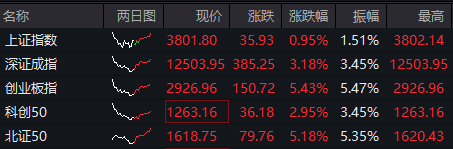
Market Performance - The ChiNext Index surged over 5%, while the Shanghai Composite Index recovered above 3800 points, closing at 3801.80, up 0.95% [1] - The Shenzhen Component Index rose by 3.18% to 12503.95, and the ChiNext Index increased by 5.43% to 2926.96 [1][2] - The total trading volume in the Shanghai and Shenzhen markets reached 17792.77 billion, with over 4500 stocks rising [1] Sector Performance - The new energy industry chain experienced a significant rally, becoming the main focus of the market [2] - Solid-state battery concept stocks collectively surged, with the sector rising by 5.57% [2] - Lithium battery electrolyte concept stocks increased by 7.66%, while lithium battery concept stocks rose by 5.69% [2] - Energy storage concept stocks also saw a rise of 5.61%, with photovoltaic and energy storage sectors continuing to strengthen [2] Investment Insights - Analysts from Everbright Securities noted that the market has undergone adjustments, with high-position stocks seeing significant capital outflow, suggesting a potential stabilization and recovery [3] - CITIC Securities highlighted a sensitive period of style switching in the market, advising investors to remain patient and avoid excessive trading [3] - Recommendations include focusing on stable cash flow and reasonably valued stocks, while monitoring two key variables: northbound capital flow and market volume changes [3] Economic Analysis - Li Chao, chief economist at Zheshang Securities, discussed the macro mechanisms behind the recent stock market rally, emphasizing that declining interest rates are a crucial factor [4] - Despite potential short-term adjustments, the long-term growth potential remains strong, particularly in hard technology sectors such as robotics, semiconductors, and new energy [4]