关键矿产储备

Search documents
有色金属基础周报:AI泡沫的担忧再次浮现,有色金属整体弱势调整-20260209
Chang Jiang Qi Huo· 2026-02-09 07:10
Report Industry Investment Rating No relevant information provided. Core Viewpoints of the Report - This week, macro factors continued to dominate the financial market. Concerns about the AI bubble resurfaced, leading to a sharp decline in global markets, including stocks, precious metals, and non - ferrous metals. However, Shanghai copper rebounded due to news of increased state purchases and then declined again with the external market, finally stabilizing at around 100,000 [4]. - The copper market's sharp decline was mainly driven by sudden panic in the macro - level, and some factors that previously pushed copper prices to new highs have changed. But copper will remain a focus of global strategic resource competition, and its structural shortage may continue. Before the Spring Festival, copper prices may stabilize after a rapid release of risks [4]. - The aluminum market shows mixed trends. Alumina production capacity has some fluctuations, and electrolytic aluminum supply is increasing unexpectedly. The demand of downstream enterprises is weakening, and the inventory is accumulating [4]. - The zinc market is in a situation of weak supply and demand. Zinc prices are expected to fluctuate in the short term due to macro - sentiment disturbances and pre - holiday capital outflows [4]. - The lead market has sufficient supply and weak demand. Affected by the decline in precious metal prices, lead prices hit a new low in 2026. After the pre - holiday profit - taking of short - selling funds in precious metals, the market may stabilize [4]. - The nickel market has a strong support at the mine end, but the demand is weak, and the inventory is accumulating. It is expected to maintain a volatile trend [5]. - The tin market has a tight supply of tin ore, and the downstream demand maintains rigid procurement. It is expected to continue to fluctuate, and attention should be paid to the supply resumption and downstream demand [5]. - The industrial silicon and polysilicon markets are affected by production cuts on both the supply and demand sides, and are expected to fluctuate [5]. - The lithium carbonate market is affected by factors such as mine risks and changes in supply and demand. It is expected to continue to fluctuate in the power demand off - season [5]. Summary by Relevant Catalogs 1. Macro - **Economic data of the current week (2/2 - 2/8)**: China's January RatingDog manufacturing PMI was 50.3, higher than the previous value; the eurozone's January manufacturing PMI was 49.5; the US January ISM manufacturing PMI was 52.6, reaching a new high since February 2022; the US January ADP employment increase was 22,000, lower than expected; the US January ISM services PMI was 53.8, reaching a new high since 2024 [12][13][15][17][18]. - **Policy and news**: China's Non - ferrous Metals Industry Association proposed to include copper concentrates in the national reserve; US President Donald Trump plans to invest $12 billion in strategic key mineral reserves [14][16]. - **Next - week economic data calendar (2/9 - 2/15)**: It includes data such as China's January M1 and M2 money supply year - on - year, the US January NFIB small business optimism index, and the US January unemployment rate [20]. 2. Copper - **Market review**: Shanghai copper first rebounded and then declined, and finally stabilized at around 100,000. The copper market was mainly affected by macro factors and inventory changes [4]. - **Key data tracking**: It includes LME copper spot/three - month spread, Shanghai copper inter - period spread curve, COMEX institutional positions, and global visible copper inventory [30][33]. 3. Aluminum - **Market review**: Shanghai aluminum showed a trend of rising and then adjusting, with the overall upward trend temporarily maintained [37]. - **Key data tracking**: It includes 6063 aluminum rod inventory, alumina port inventory, aluminum bauxite port inventory, electrolytic aluminum social inventory, electrolytic aluminum cost and profit, and alumina production cost and profit [41][42][43][45]. 4. Zinc - **Market review**: Shanghai zinc showed a trend of rising and then adjusting, with the upward trend of shock temporarily unchanged [50]. - **Key data tracking**: It includes Shanghai Futures Exchange zinc inventory/warehouse receipts, global visible zinc inventory, 0 zinc ingot premium, zinc forward curve, and zinc - related product prices [52][53][58][59]. 5. Lead - **Market review**: Shanghai lead showed a downward trend of shock, with overall range fluctuations [65]. - **Key data tracking**: It includes Shanghai Futures Exchange lead inventory/warehouse receipts, global lead inventory, lead forward curve, lead spot premium, and LME lead (spot/three - month) spread [67][70][74]. 6. Nickel - **Market review**: Shanghai nickel fell from a high level and was under pressure from the lower edge of the upper shock area [78]. - **Key data tracking**: It includes Shanghai Futures Exchange nickel inventory, LME nickel global inventory, high - nickel iron and Jinchuan nickel plate prices, nickel and nickel sulfate prices, and stainless steel inventory [81][82][87][88][90][91][92]. 7. Tin - **Market review**: Shanghai tin continued to decline after rising, and was temporarily supported by the lower trend line [95]. - **Key data tracking**: It includes tin futures closing prices, Shanghai tin premium, tin smelting profit, LME tin (spot/three - month) spread, tin - related product prices, Shanghai Futures Exchange tin inventory, and LME tin inventory [98][99][100][101][104]. 8. Other Metals (Gold, Silver, etc.) - **Trend analysis**: Shanghai gold rebounded after falling from a high level, maintaining an overall upward trend; Shanghai silver fell again after a rebound, breaking through the previous low, and the trend weakened; platinum and palladium showed wide - range fluctuations; industrial silicon showed wide - range fluctuations and broke through the lower limit of the range; alumina showed small - range fluctuations; polysilicon showed small - range fluctuations and stabilized; aluminum alloy showed small - range fluctuations and the downward trend changed; stainless steel and lithium carbonate fell from high levels, and the upward trend changed [109][111][112][114][116][118][119][122].
铜周报:产业政策提振,宏观扰动持续-20260209
Chang Jiang Qi Huo· 2026-02-09 06:28
Report Title - Copper Weekly Report: Industrial Policy Boosts, Macroeconomic Disturbance Continues [1] Report Date - February 9, 2026 [1] Report Investment Rating - Not mentioned in the report Core Viewpoints - Last week, Shanghai copper fluctuated and declined. As of February 6, it closed at 100,100 yuan/ton, with a weekly decline of 3.45%. The shortage of the ore end has not been substantially repaired, and the spot processing fee of copper concentrate continues to remain at a historical low. The China Nonferrous Metals Industry Association is studying to include copper concentrates with large trading volumes and easy liquidity into the reserve scope. The LME-COMEX arbitrage space has narrowed, and LME copper inventories have reached a high level. Domestic copper inventories have continued to accumulate. The decline in copper prices during the week and pre-holiday stockpiling have driven downstream purchases. With Kevin Warsh being nominated as the next Fed Chairman, the uncertainty of the Fed's monetary policy is strong. The strengthening of the US dollar index combined with pre-holiday profit-taking sentiment is expected to cause copper prices to fluctuate widely at high levels. It is recommended to reduce trading positions before the holiday and closely monitor changes in domestic and foreign inventories [5][11] Summary by Directory 1. Main Viewpoints and Strategies 1.1 Last Week's Market Review - Shanghai copper fluctuated and declined last week. As of February 6, it closed at 100,100 yuan/ton, with a weekly decline of 3.45% [5] 1.2 Supply Side - The shortage of the ore end has not been substantially repaired, and the spot TC of copper concentrate remains low. As of February 6, the domestic copper concentrate port inventory was 442,000 tons, with a week-on-week decline of 18.33% and a year-on-year decline of 32.62%. As of February 6, the spot smelting fee of copper concentrate was -$51.13/ton, continuing to reach a historical low. In January 2026, China's electrolytic copper production was 1.1793 million tons, a year-on-year increase of 16.32%. Affected by the "good start" of some enterprises, the production increased compared with December. At the same time, the strong sulfuric acid price combined with the rising precious metal prices led to less production reduction pressure in January. Due to the decrease in production days in February, the production is expected to decline [8][36] 1.3 Demand Side - The copper foil production rate increased against the trend, and the production rate of refined copper rods increased with the decline in copper prices. In December, the production rates of copper strips, copper rods, and copper tubes were 68.21%, 52.74%, and 68.84% respectively. At the new high of copper prices, the terminal enterprises' ability to accept high-priced raw materials was severely insufficient, and the order volume decreased significantly. In December, the copper foil production rate was 88.2%. The copper foil industry's production rate has increased for the 8th consecutive month, and the energy storage industry continues to be booming. Downstream traditional year-end rush to support demand remains high. As of February 5, the weekly production rate of domestic major refined copper rod enterprises was 69.07%, a month-on-month decrease of 0.47 percentage points and a year-on-year increase of 51.32 percentage points. The limit-down of copper prices during the week triggered downstream concentrated bottom-fishing purchases. Orders from the enameled wire and cable industries soared. Downstream enterprises placed concentrated orders on the day of the limit-down, and the single-day order volume doubled. The production of refined copper rods exceeded expectations [9][40] 1.4 Inventory - Domestic copper inventories continued to accumulate, and LME and COMEX copper inventories reached high levels. As of February 6, the copper inventory on the Shanghai Futures Exchange was 24.89 tons, a week-on-week increase of 6.83%. As of February 5, the SMM copper inventory in the country's mainstream areas was 335,600 tons, a month-on-month increase of 4.03% compared with January 29, and a year-on-year increase of 62,700 tons. The domestic inventory continued to accumulate. As of February 6, the LME copper inventory was 183,300 tons, a week-on-week increase of 4.74%, and the LME deliverable copper inventory reached an 11-month high. The COMEX copper inventory was 589,100 short tons, a week-on-week increase of 1.97%, and the COMEX copper inventory continued to accumulate [10][47] 1.5 Strategy Suggestion - Fundamentally, the shortage of the ore end has not been substantially repaired, and the spot processing fee of copper concentrate continues to remain at a historical low. The China Nonferrous Metals Industry Association is studying to include copper concentrates with large trading volumes and easy liquidity into the reserve scope, which boosts market sentiment. As the Spring Festival approaches, the production rates of downstream enterprises gradually decline, and the overall demand weakens. Domestic copper inventories have continued to accumulate. The decline in copper prices during the week and pre-holiday stockpiling have driven downstream purchases. It is expected that the inventory pressure at home and abroad will further increase after the holiday. The LME-COMEX arbitrage space has narrowed, and LME copper inventories have reached a high level. With Kevin Warsh being nominated as the next Fed Chairman, the uncertainty of the Fed's monetary policy is strong. The strengthening of the US dollar index combined with pre-holiday profit-taking sentiment is expected to cause copper prices to fluctuate widely at high levels. It is recommended to reduce trading positions before the holiday and closely monitor changes in domestic and foreign inventories [11] 2. Macroeconomic and Industrial Information 2.1 Macroeconomic Data Overview - The US ISM manufacturing PMI in January reached a new high since February 2022. According to data released on Monday, the Institute for Supply Management (ISM) manufacturing PMI index soared from 47.9 in the previous month to 52.6, far exceeding the expected 48.5. An index above 50 means economic activity expansion, and the latest reading also exceeded all survey expectations of economists by the media. US manufacturing activity unexpectedly expanded in January at the fastest pace since 2022, mainly boosted by robust growth in new orders and output. The employment index reached a one-year high but remained in the contraction zone. The prices paid index reached a four-month high [16] - Trump plans to invest $12 billion to stockpile critical minerals. US President Donald Trump is preparing to launch a strategic critical minerals stockpiling plan worth a total of $12 billion, aiming to protect US manufacturers from supply chain shocks by establishing a commercial inventory mechanism and further strengthen national industrial security. According to media reports, this plan called "Project Vault" will provide a $10 billion loan through the US Export-Import Bank, combined with $1.67 billion in private capital, to purchase and store minerals for automobile manufacturers, technology companies, and other manufacturing giants. This will be the first such stockpiling project in the US private sector, not only setting a record in scale but also operating in a similar mode to the country's strategic petroleum reserve [17] - The US ADP employment in January increased by 22,000, lower than the expected 45,000. On February 4, according to data released by the ADP Research Institute, the US private sector added 22,000 new jobs in January, far lower than the market expectation of 45,000 and also lower than the revised previous value (the increase in December was revised down from 41,000 to 37,000). If not for the surge of 74,000 jobs in the education and healthcare services industries, the overall employment might have declined. By industry, many sectors showed a contraction trend. Among them, the professional and business services industry significantly reduced 57,000 positions, and the manufacturing industry also cut 8,000 jobs. The report continued the weak trend since the end of 2025, indicating that the employment market remained in a stalemate of "low recruitment, low layoffs" [17] - The US ISM services PMI in January reached a new high since 2024. Data released by the US Institute for Supply Management (ISM) on Wednesday showed that the services PMI index in January was 53.8, the same as in December and also the same as the highest level since October 2024, better than expected. An index above 50 indicates that the US service industry, which accounts for the largest proportion of the economy, is in an expansion state. US service enterprises achieved the strongest continuous growth momentum since 2024 in January. With the recovery of business activities, the expansion momentum of the service industry increased [18] 2.2 Industrial Information Overview - Chile's copper production in December 2025 decreased by 4.7% year-on-year. Data released by the Chilean National Statistics Institute (INE) showed that Chile's copper production in December 2025 decreased by 4.7% year-on-year to 540,221 tons. The country's manufacturing output in December increased by 0.1% year-on-year [20] - Capstone Copper restarted its Mantoverde copper-gold mine during a continuous strike. According to foreign media on February 2, Canadian mining company Capstone Copper announced on Monday that although a strike by a union representing nearly 22% of its employees was still ongoing, its Mantoverde copper-gold mine in northern Chile had resumed operations. The company reiterated in a document submitted to the Australian Stock Exchange on February 1 that it expected the mine's operating capacity during the strike to remain at 50% to 75% of the normal production level. Previously, union employees rejected Capstone's latest salary proposal, causing the strike that began in January to continue to ferment, and the strike is still ongoing, and the dispute between the two sides has thus escalated. In 2025, the Mantoverde mine produced 62,308 tons of copper concentrate and 32,807 tons of cathode copper, accounting for about 0.4% of global copper production [20] - The Nonferrous Metals Industry Association will cooperate with relevant departments to strictly control new ore copper smelting projects. At the press conference on the economic operation of the nonferrous metals industry in 2025 held by the China Nonferrous Metals Industry Association, Deputy Secretary-General Duan Shaofu of the China Nonferrous Metals Industry Association said that the industry will solidly promote the governance of copper smelting capacity. Currently, more than 2 million tons of copper smelting projects have been stopped in China, and the excessive growth momentum of copper smelting capacity has been effectively curbed. The industry association will continue to cooperate with relevant national departments to strictly control new ore copper smelting projects and improve the situation of the increasing external procurement ratio from the source [20] - Anglo American's copper production in 2025 decreased by 10% year-on-year, and it lowered its copper production targets for 2026 - 2027. According to foreign media on February 5, the latest report released by Anglo American showed that in the fourth quarter of 2025, the company's copper production was 169,500 tons, a year-on-year decrease of 14%. This was due to the lower ore grades of the Quellaveco and Collahuasi mines. The annual copper production in 2025 was 695,000 tons, a year-on-year decrease of 10%, at the lower end of its production guidance range. Anglo American simultaneously adjusted its medium- and long-term copper production guidance, lowering its 2026 copper production target from 760,000 - 820,000 tons to 700,000 - 760,000 tons, slightly adjusting the 2027 target from 760,000 - 820,000 tons to 750,000 - 810,000 tons, and setting the 2028 target at 790,000 - 850,000 tons [20] - The strike at the Mantoverde copper mine in Chile ended, and Capstone Copper will resume full production. According to foreign media on February 5, Canadian mining company Capstone Copper announced on Friday that the largest union at its Mantoverde copper-gold mine in Chile had approved a new three-year labor contract, and the one-month-long strike officially ended. The company has reached an agreement with all four unions at the mine, and the mine will gradually resume full production from the current capacity of about 55%. In 2025, the Mantoverde mine produced 62,308 tons of copper concentrate and 32,807 tons of copper cathode, accounting for about 0.4% of global production. Capstone Copper holds a 70% stake in the Mantoverde mine, and Japan's Mitsubishi Materials Corporation holds the remaining 30% [20] 3. Spot and Futures Market and Positioning 3.1 Premiums and Discounts - The decline in copper prices led to an increase in downstream purchases, and the contango widened under the suppression of high copper prices. The spot discount continued to converge slightly. As the Spring Festival approached and downstream enterprises stockpiled, the spot supply was tight, and Shanghai copper changed from a discount to a premium. - The LME copper 0 - 3 remained at a discount, the New York - London copper price difference turned negative, and the arbitrage window for transporting copper from the Shanghai Futures Exchange to the LME opened. The LME deliverable copper inventory has reached an 11-month high [24] 3.2 Domestic and Foreign Positions - As of February 6, the trading volume of Shanghai copper futures was 175,306 lots, a week-on-week decrease of 21.36%; the average daily trading volume of Shanghai copper during the week was 318,363 lots, a week-on-week decrease of 20.75%. Both the trading volume and trading volume of Shanghai copper decreased significantly. - As of January 30, the net long position of LME copper investment companies and credit institutions was 1,782.99 lots, a week-on-week decrease of 78.17%. As of February 3, the net long position of COMEX copper asset management institutions was 55,923 contracts, a week-on-week decrease of 3.61% [26] 4. Fundamental Data 4.1 Supply Side - The shortage of the ore end has not been substantially repaired, and the spot TC of copper concentrate remains low. As of February 6, the domestic copper concentrate port inventory was 442,000 tons, with a week-on-week decline of 18.33% and a year-on-year decline of 32.62%. As of February 6, the spot smelting fee of copper concentrate was -$51.13/ton, continuing to reach a historical low. - In January 2026, China's electrolytic copper production was 1.1793 million tons, a year-on-year increase of 16.32%. Affected by the "good start" of some enterprises, the production increased compared with December. At the same time, the strong sulfuric acid price combined with the rising precious metal prices led to less production reduction pressure in January. Due to the decrease in production days in February, the production is expected to decline [36] 4.2 Downstream Production Rates - In December, the production rates of copper strips, copper rods, and copper tubes were 68.21%, 52.74%, and 68.84% respectively. At the new high of copper prices, the terminal enterprises' ability to accept high-priced raw materials was severely insufficient, and the order volume decreased significantly. In December, the copper foil production rate was 88.2%. The copper foil industry's production rate has increased for the 8th consecutive month, and the energy storage industry continues to be booming. Downstream traditional year-end rush to support demand remains high. - As of February 5, the weekly production rate of domestic major refined copper rod enterprises was 69.07%, a month-on-month decrease of 0.47 percentage points and a year-on-year increase of 51.32 percentage points. The limit-down of copper prices during the week triggered downstream concentrated bottom-fishing purchases. Orders from the enameled wire and cable industries soared. Downstream enterprises placed concentrated orders on the day of the limit-down, and the single-day order volume doubled. The production of refined copper rods exceeded expectations [40] 4.3 Inventory - As of February 6, the copper inventory on the Shanghai Futures Exchange was 24.89 tons, a week-on-week increase of 6.83%. As of February 5, the SMM copper inventory in the country's mainstream areas was 335,600 tons, a month-on-month increase of 4.03% compared with January 29, and a year-on-year increase of 62,700 tons. The domestic inventory continued to accumulate. - As of February 6, the LME copper inventory was 183,300 tons, a week-on-week increase of 4.74%, and the LME deliverable copper inventory reached an 11-month high. The COMEX copper inventory was 589,100 short tons, a week-on-week increase of 1.97%, and the COMEX copper inventory continued to accumulate [47]
天齐筹资70亿元,盛新吞下亚洲最大锂矿
Xin Lang Cai Jing· 2026-02-05 12:24
Core Viewpoint - The establishment of the U.S. critical minerals "vault" plan signals an intensifying competition for resource control in the new energy industry, leading to increased mergers and acquisitions in the lithium mining sector [2][7]. Group 1: Company Actions - Tianqi Lithium announced plans to dispose of shares in certain affiliated companies and is pursuing a combination of H-share placement and convertible bond financing, aiming to raise approximately 58.6 billion HKD (around 52 billion RMB) [2][9]. - The company intends to sell up to 20.21 million shares of Zhongchu Innovation and up to 3.566 million shares of Chile's SQM, with an estimated total value of around 1.9 billion RMB [9]. - Tianqi's financing and share disposal could result in a total capital increase of approximately 7.1 billion RMB, which will be used for project development, acquisition of quality lithium assets, and general corporate purposes [9][12]. Group 2: Market Context - The recent actions by Tianqi and Shengxin Lithium are occurring against the backdrop of the U.S. launching its critical minerals reserve plan, which is expected to change the pricing logic of lithium as a strategic asset rather than just a cyclical commodity [2][9]. - Shengxin Lithium plans to acquire the remaining 13.93% stake in Huirong Mining for 1.2597 billion RMB, achieving 100% control over the company, which is significant for securing lithium resources [9][12]. - The Huirong lithium mine is noted for having a confirmed lithium oxide resource of 989,600 tons and an average grade of 1.62%, making it one of the largest hard rock lithium mines in Asia [13]. Group 3: Financial Metrics - Tianqi's asset-liability ratio is approximately 30.5% as of Q3 2025, indicating a low level of debt following a debt crisis in 2019-2020 [10]. - The valuation of Huirong Mining shows a significant increase, with an asset book value of 1.034 billion RMB and an assessed value of 9.216 billion RMB, resulting in an appreciation rate of 791.31% [13]. Group 4: Industry Trends - The trend of resource control is not limited to domestic companies; for instance, Ganfeng Lithium acquired the remaining 40% stake in Mali Lithium for 342.7 million USD to enhance control over the Goulamina lithium mine [14]. - The geopolitical tensions are pushing critical minerals from market discussions into national strategic considerations, which may affect future investment decisions in the sector [14].


金价铜价盘中走低,有色金属ETF基金(516650)跌破6%
Xin Lang Cai Jing· 2026-02-05 03:15
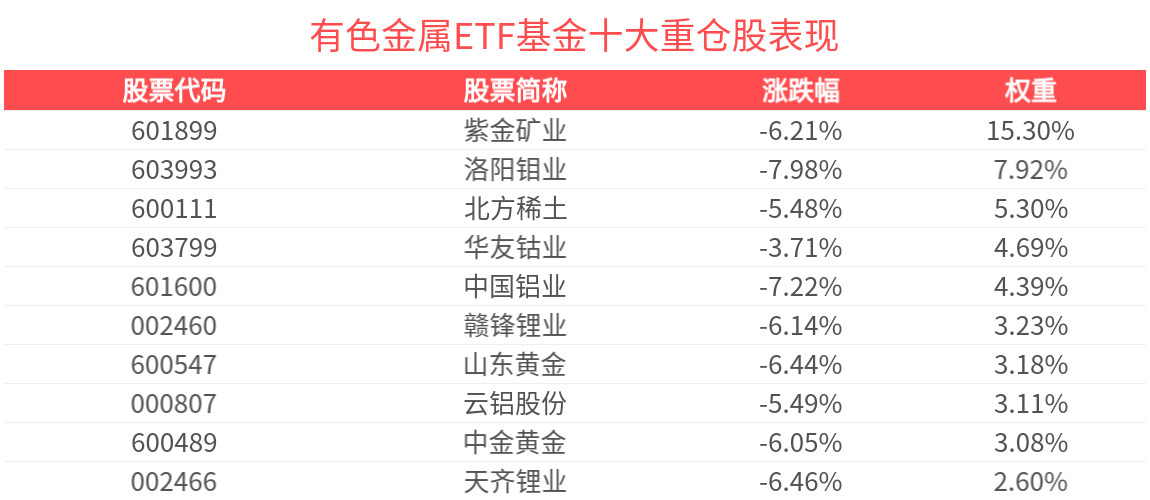
Group 1 - Gold and copper prices have declined, with COMEX gold futures dropping below $4950 and COMEX copper prices falling to $5.82. The non-ferrous metal ETF fund (516650) decreased by 6.07%, with stocks like Silver Holdings and Hunan Gold hitting the daily limit down, while companies such as Luoyang Molybdenum, Northern Copper, and Zhongfu Industrial also saw declines. However, the non-ferrous metal ETF fund has increased by 16.69% over the past month as of February 4, 2026 [1] - The Vice Secretary-General of the China Nonferrous Metals Industry Association, Duan Shaofu, announced the need to improve the copper resource reserve system during a press conference on the economic operation of the non-ferrous metals industry in 2025. Additionally, the U.S. has initiated a $12 billion critical mineral reserve plan ("Project Vault") to mitigate supply chain risks, which includes over 50 critical minerals identified by the U.S. Geological Survey, such as rare earths, lithium, and copper [1] - According to China International Capital Corporation (CICC), inventory replenishment is supporting copper prices, with strong demand for low-priced copper as downstream inventories are low. The upcoming spring peak season, combined with tight supply conditions and low TC/RC levels, is expected to further tighten copper supply and potentially increase copper prices [1] Group 2 - The non-ferrous metal ETF fund closely tracks the CSI segmented non-ferrous metal industry theme index. As of January 30, 2026, the top ten weighted stocks in the CSI segmented non-ferrous metal industry theme index (000811) include Zijin Mining, Luoyang Molybdenum, Northern Rare Earth, China Aluminum, and Huayou Cobalt, with these ten stocks accounting for 51.85% of the total weight [2] Group 3 - The following stocks in the non-ferrous metal ETF fund experienced declines: Zijin Mining (-6.21%, 15.30% weight), Luoyang Molybdenum (-7.98%, 7.92% weight), Northern Rare Earth (-5.48%, 5.30% weight), Huayou Cobalt (-3.71%, 4.69% weight), China Aluminum (-7.22%, 4.39% weight), Ganfeng Lithium (-6.14%, 3.23% weight), Shandong Gold (-6.44%, 3.18% weight), Yun Aluminum (-5.49%, 3.11% weight), Zhongjin Gold (-6.05%, 3.08% weight), and Tianqi Lithium (-6.46%, 2.60% weight) [3]
关键矿产“金库计划”启动,稀土ETF嘉实(516150)聚焦稀土产业链投资机遇
Xin Lang Cai Jing· 2026-02-05 03:08
Group 1 - The core viewpoint of the news highlights the decline of the China Rare Earth Industry Index by 4.45% as of February 5, 2026, with leading stocks such as Jinfeng Technology and China Aluminum experiencing significant drops [1] - The U.S. plans to initiate a critical mineral reserve project, the "Treasury Plan," which reinforces the long-term premium logic of rare earths as "strategic metals" [1] - Research institutions believe that the strategic position of global rare earth resources is continuously improving, marking the entry of the rare earth industry into a new era of high-quality development [1] Group 2 - On the supply side, quota controls and regulatory policies are expected to strengthen the rigid logic of supply, while on the demand side, emerging fields such as electric vehicles, humanoid robots, and low-altitude economy are anticipated to drive long-term high growth in demand [1] - It is projected that starting in 2026, the global supply-demand gap for rare earths will continue to expand, with prices expected to remain stable or increase, leading to sustained improvement in the profitability of the industry chain [1] - CITIC Securities' research report recommends strategic allocation value in the rare earth industry chain due to these favorable conditions [1] Group 3 - The China Rare Earth Industry Index closely tracks the performance of listed companies involved in rare earth mining, processing, trading, and applications, reflecting the overall performance of the rare earth industry [2] - As of January 30, 2026, the top ten weighted stocks in the index include Northern Rare Earth, Jinfeng Technology, Xiamen Tungsten, and China Aluminum, collectively accounting for 61.43% of the index [2] Group 4 - The Rare Earth ETF by Jiashi (516150) serves as a convenient tool for investors to gain exposure to the domestic rare earth industry chain [3] - Investors can also utilize the Jiashi Rare Earth ETF Connect Fund (011036) to seize investment opportunities in the rare earth sector [4]
被中国杀手锏打痛,特朗普开启120亿美元新计划,开启稀土争夺战
Sou Hu Cai Jing· 2026-02-04 20:49
Core Points - The "Treasury Plan" is a strategic mineral reserve project signed by President Trump, totaling $12 billion, aimed at establishing a strategic reserve of critical minerals for U.S. manufacturers to mitigate supply chain disruption risks, particularly in response to China's rare earth control during the 2025 U.S.-China trade conflict [1][3] Group 1: Plan Overview - The plan is financed by a $10 billion loan from the Export-Import Bank of the United States, along with approximately $2 billion in private capital, covering critical minerals such as rare earths, copper, and lithium [3] - The goal is to create a 60-day emergency mineral reserve, with participation from major companies like General Motors, Boeing, and Google [3] - The operational mechanism allows companies to withdraw minerals from the reserve at predetermined prices, helping them avoid price volatility without needing to stockpile [5] Group 2: Market Context - As of 2024, the U.S. is entirely reliant on imports for 12 critical minerals, with over 50% import reliance for an additional 29 minerals, highlighting vulnerabilities in the U.S. critical mineral supply chain [5] - The plan's funding structure indicates that the $10 billion loan is for 15 years, significantly larger than previous transactions by the Export-Import Bank [7] Group 3: Technical Challenges - The main challenges for the "Treasury Plan" include the need for technology and capacity expansion in rare earth separation and refining, where China currently holds a dominant position [9] - China accounts for over 90% of global rare earth refining capacity and holds 85% of patents in heavy rare earth separation technology [9] Group 4: Military and Industrial Implications - Rare earths are critical for military applications, with over 78% of materials used in U.S. military equipment sourced from China [11] - The 2025 export control measures by China on rare earths have significantly impacted U.S. industries, including automotive and high-tech sectors, leading to price surges in rare earth elements [11] Group 5: Broader Industry Movements - The U.S. government has been actively investing in domestic rare earth producers, with significant funding directed towards companies like Mountain Pass Materials and American Lithium [12] - The global distribution of rare earth resources is heavily skewed towards China, which holds about 23% of global reserves but supplies over 90% of the market [14][16]

120亿美元,特朗普公布“金库计划”
Xin Lang Cai Jing· 2026-02-04 04:03
Group 1 - The core initiative is the launch of a $12 billion critical mineral reserve project named the "Treasury Plan," aimed at supporting manufacturers and reducing reliance on Chinese rare earths [1] - The funding for the "Treasury Plan" includes approximately $2 billion in private capital and $10 billion in loans from the Export-Import Bank of the United States, targeting procurement and storage of critical minerals like rare earths, gallium, and cobalt [1] - The project is similar to the existing Strategic Petroleum Reserve but focuses on minerals essential for products such as smartphones, batteries, and jet engines [1] Group 2 - The plan currently involves participation from over a dozen companies, including General Motors, Stellantis, Boeing, Corning, and Google, with commodity traders expected to handle raw material procurement [1] - The objective is to establish a 60-day emergency mineral reserve, with initial work already underway [1] - However, there are concerns regarding the effectiveness of the plan, as the U.S. is heavily reliant on imports for 12 key minerals and over 50% for 29 others, indicating that the plan may not lead to immediate changes in dependency on China [2] Group 3 - Analysts express skepticism about the long-term impact of the "Treasury Plan," suggesting that while it may stabilize the U.S. market, it is not a quick fix for reducing reliance on China in the critical minerals sector [2] - Challenges include the limited sources for rare earths, particularly heavy rare earths, which may not be sufficiently met by U.S. and allied production [2] - The real difficulties in rebuilding the rare earth supply chain lie in acquiring technology and expanding production capacity, which are complex issues not easily resolved through simple actions [2]
贵金属日评-20260204
Jian Xin Qi Huo· 2026-02-04 01:21
1. Industry Investment Rating - No investment rating information is provided in the report 2. Core Viewpoints - The long - term upward driving force of precious metals remains unchanged. Investors are advised to go long after the downward momentum of precious metals weakens. However, due to the large influx of investment funds and high price volatility recently, investors are advised to reduce positions to avoid short - term risks. Also, be vigilant against the medium - term risk of the Fed tightening monetary policy to end the precious metals bull market [4][6] 3. Summary by Directory 3.1 Precious Metals Market Quotes and Outlook 3.1.1 Intraday Market - After three consecutive days of sharp adjustments in the precious metals market due to the nomination of a hawkish Fed chair candidate by Trump and the easing of the US - Iran conflict risk, the precious metals sector rebounded. On February 3, Asian session, London gold returned above $4,900 per ounce. This was because the internal adjustment risk was fully released, attracting some bottom - fishing funds, and the Trump administration announced the launch of the Vault Project, boosting the strategic value expectation of key minerals [4] 3.1.2 Medium - term Market - Trump's confirmation of the next Fed chair candidate eliminated the market's hedging demand for this uncertainty. The hawkish stance of the candidate also alleviated concerns about the loss of US fiscal discipline, so the precious metals correction was reasonable. The previous sharp rise in precious metals also needed a large retracement. However, the hawkish stance has no fundamental impact on the long - term bull market of gold and may mainly compress the duration of the medium - term bull market. It is bullish for silver, platinum, and palladium compared to gold. The report maintains the view that gold will rise in the medium and long term, and silver, platinum, and palladium will be stronger than gold in the medium term [6] 3.1.3 Domestic Precious Metals Market Quotes | Contract | Previous Closing Price | Highest Price | Lowest Price | Closing Price | Change Rate (%) | Open Interest | Change in Open Interest | | --- | --- | --- | --- | --- | --- | --- | --- | | SHFE Gold Index | 1,008.88 | 1,099.95 | 1,034.88 | 1,095.29 | 8.56 | 315,593 | 3,738 | | SHFE Silver Index | 24,549 | 21,659 | 20,313 | 20,979 | - 14.54 | 583,536 | - 65,359 | | GZFE Platinum Index | 550.99 | 575.14 | 539.71 | 570.52 | 3.54 | 31,822 | - 1,995 | | GZFE Palladium Index | 412.91 | 449.05 | 413.73 | 448.62 | 8.65 | 11,715 | - 526 | [5] 3.2 Precious Metals Market - related Charts - The report provides multiple charts including Shanghai gold and silver futures indexes, London gold and silver spot prices, the basis of Shanghai futures indexes to Shanghai Gold Exchange T+D, gold and silver ETF holdings, gold - silver ratio, and the correlation between London gold and other assets. All data sources are from Wind and the Research and Development Department of CCB Futures [8][10][16] 3.3 Main Macroeconomic Events/Data - Trump reached a trade agreement with India, reducing the US tariff on Indian goods from 50% to 18%. India will lower trade barriers, stop buying Russian oil, and buy from the US and Venezuela. The US will revoke the 25% punitive tariff, and India promises to buy over $500 billion of US products [17] - Trump is about to launch a strategic key mineral reserve plan called the Vault Project with an initial capital of $12 billion, integrating $2 billion of private funds and a $10 - billion loan from the US Export - Import Bank [17] - The US manufacturing activity expanded for the first time in a year in January. The ISM's January PMI rebounded to 52.6, breaking through the 50 mark for the first time in 12 months and reaching the highest level since August 2022. The new orders sub - index jumped from 47.4 in December to 57.1 in January, the highest since February 2022 [17] - Iran and the US will restart nuclear negotiations in Turkey on Friday. US envoy Witkoff and Iranian Foreign Minister Araghchi will meet in Istanbul, and representatives from Saudi Arabia, Egypt and other countries will also participate [18]
特朗普公布120亿美元“金库计划”,效用有待观察
Huan Qiu Shi Bao· 2026-02-03 22:57
Core Viewpoint - The U.S. has launched a $12 billion critical mineral reserve project, named the "Treasury Plan," aimed at supporting manufacturers and reducing dependence on Chinese rare earths [1][2]. Group 1: Project Overview - The "Treasury Plan" includes approximately $2 billion in private capital and $10 billion in loans from the U.S. Export-Import Bank to help manufacturers procure and store critical minerals [1]. - The project is designed to create a 60-day emergency mineral reserve, similar to the existing Strategic Petroleum Reserve, focusing on rare earths, gallium, and cobalt [2]. Group 2: Participation and Impact - Several companies, including General Motors, Stellantis, Boeing, Corning, and Google, are already involved in the project, with commodity traders expected to handle raw material procurement [2]. - The plan allows participating manufacturers to make procurement commitments and secure inventory, shielding them from price fluctuations of critical materials [2]. Group 3: Market Dependency and Challenges - In 2024, the U.S. is projected to rely entirely on imports for 12 critical minerals, with over 50% import reliance for an additional 29 minerals [2]. - Analysts express skepticism about the plan's immediate effectiveness in reducing U.S. dependence on China, noting that the supply of rare earths is limited and the project may face procurement challenges [3]. Group 4: Future Considerations - The operational framework and mechanisms of the "Treasury Plan" are still unclear, and its long-term impact on the market and on China remains to be seen [3]. - The U.S. faces significant challenges in rebuilding its rare earth supply chain, particularly in acquiring technology and expanding production capacity, which are complex issues not easily resolved [3].
日本称在深海挖到含稀土淤泥,中方回应
券商中国· 2026-02-03 07:53
Group 1 - Japan has successfully excavated rare earth-rich sediment from the deep sea, indicating advancements in its resource exploration efforts [2] - The U.S. is expected to launch a critical mineral reserve program with an initial funding of $12 billion, aimed at reducing dependence on China for rare earth resources [3] - China's stance on maintaining the stability and security of the global critical mineral supply chain remains unchanged, emphasizing the collective responsibility of all parties involved [3]