
美联储降息节奏

Search documents
品种观点参考—金融期货股指板块:宝城期货股指期货早报(2026年2月25日)-20260225
Bao Cheng Qi Huo· 2026-02-25 01:31
Group 1: Report Industry Investment Rating - Not provided Group 2: Core Viewpoints of the Report - The short - term view of IH2603 is volatile, the medium - term view is volatile, and the intraday view is bullish, with an overall view of volatile consolidation due to the rising expectation of policy benefits [1]. - For IF, IH, IC, and IM, the intraday view is bullish, the medium - term view is volatile, and the reference view is volatile consolidation. The core logic is that the stock indexes oscillated and consolidated yesterday, with a trading volume of 2218.2 billion yuan in the Shanghai, Shenzhen, and Beijing stock markets, an increase of 219.2 billion yuan from the previous day. After the holiday, liquidity flows back to the stock market, and near the two - sessions policy window, market risk appetite has recovered. The long - term upward core logic of the stock indexes is still solid, but short - term volatility is mainly due to uncertainties in trade situation, concerns in the US stock market, and uncertainty of the Fed's interest - rate cut rhythm [5]. Group 3: Summary by Related Catalogs Variety Viewpoint Reference - Financial Futures Stock Index Sector - For IH2603, short - term: volatile; medium - term: volatile; intraday: bullish; view reference: volatile consolidation; core logic: rising expectation of policy benefits [1]. Main Variety Price Market Driving Logic - Financial Futures Stock Index Sector - Variety: IF, IH, IC, IM; intraday view: bullish; medium - term view: volatile; reference view: volatile consolidation. The trading volume of the Shanghai, Shenzhen, and Beijing stock markets was 2218.2 billion yuan, an increase of 219.2 billion yuan from the previous day. After the holiday, liquidity flows back to the stock market, and near the two - sessions policy window, market risk appetite has recovered. The long - term upward core logic of the stock indexes is still solid, but short - term volatility is mainly due to uncertainties in trade situation, concerns in the US stock market, and uncertainty of the Fed's interest - rate cut rhythm [5].
当前行情如何布局?紧握“政策+景气”双主线,规避这一外部风险
Sou Hu Cai Jing· 2026-02-03 04:42
Core Viewpoint - The A-share market shows a strong performance driven by high-end manufacturing and hard technology sectors, while the Hong Kong market exhibits a divergence with weak technology stocks, indicating a structural differentiation influenced by macroeconomic and policy factors [1][2][3]. Group 1: A-share Market Performance - Major A-share indices, except for the Sci-Tech 50, recorded gains, with the Shenzhen Component Index leading at +0.93% and a total trading volume of 1.604 trillion yuan [1]. - The top gainers in A-shares include sectors such as defense and military (+3.71%), machinery equipment (+2.58%), and power equipment (+2.15%), while traditional sectors like banking and oil & gas saw declines [1][2]. Group 2: Hong Kong Market Dynamics - The Hong Kong market displayed a mixed performance, with the Hang Seng Index nearly flat and the Hang Seng Tech Index dropping by 1.48%, highlighting a contrast with the A-share market [1]. - The weakness in Hong Kong's technology stocks is attributed to their offshore market nature, influenced by both domestic fundamentals and global liquidity expectations, particularly regarding the U.S. Federal Reserve's interest rate policies [3]. Group 3: Sector Insights - The rise of the defense and military sector is linked to increased geopolitical uncertainties and expectations for accelerated equipment procurement under the "14th Five-Year Plan," providing long-term visibility and certainty [2]. - The demand for new energy infrastructure under the "dual carbon" goals and recent government initiatives for large-scale equipment updates are expected to inject substantial growth into related industries [2]. Group 4: Market Outlook - The main investment themes in the A-share market remain intact, focusing on policy-driven and growth-oriented sectors like military, high-end manufacturing, and new energy [4]. - In the Hong Kong market, the valuation pressures on technology stocks are likely to persist until clearer overseas policy signals or stronger mainland economic data emerge to boost risk appetite [4].
[2月2日]指数估值数据(金银大跌,A股回到4星级;《红利指数基金投资指南》荣登榜首)
银行螺丝钉· 2026-02-02 12:45
Core Viewpoint - The recent significant declines in gold and silver prices have led to increased volatility in global stock markets, with concerns about high valuations and potential changes in U.S. monetary policy impacting investor sentiment [1][4][24]. Group 1: Market Movements - London gold experienced a maximum drawdown of 21%, while silver saw a maximum drawdown of 41% [1]. - The global stock market exhibited considerable fluctuations due to the sharp decline in commodity prices [4][27]. - A-shares and Hong Kong stocks faced substantial declines, with the market closing around the 4.00 star level [5][12]. Group 2: Valuation Concerns - Gold and silver were previously identified as overvalued, with recent price drops marking the fastest decline in 40 years [2][3]. - The high valuations of commodities were driven by significant inflows of capital, leading to the highest valuation levels in 30 years [20]. - The market is currently experiencing a rotation, with some sectors like consumer goods showing resilience while others, particularly small-cap stocks, are underperforming [11][36]. Group 3: Economic Indicators - The volatility in the markets is partly attributed to concerns over the potential for the Federal Reserve to slow down interest rate cuts, which could tighten global liquidity [24][29]. - The recent appointment of a hawkish Federal Reserve nominee has heightened these concerns [23]. Group 4: Investment Strategies - The company has paused subscriptions for actively managed and enhanced index products to mitigate risks associated with chasing high valuations [14][40]. - Investors are advised to manage their exposure to high-valuation assets and consider taking profits where appropriate [42]. - Maintaining a balanced portfolio with a focus on low-valuation assets is recommended, with a suggested limit of 15-20% exposure to any single industry [44].


瑞郎创阶段新低避险
Jin Tou Wang· 2026-01-27 02:41
Core Viewpoint - The USD/CHF exchange rate has been on a downward trend since the beginning of 2026, breaking key support levels and reaching new lows, driven by the safe-haven appeal of the Swiss franc and diverging monetary policies between the US and Switzerland [1][2]. Group 1: Exchange Rate Dynamics - As of January 27, 2026, the USD/CHF traded at 0.7774, with a daily decline of 0.22%, and a trading range of 0.7760-0.7782. On January 26, it fell significantly to a low of 0.7740, marking a single-day drop of 0.4358% [1]. - The Swiss franc has maintained a stable performance against the euro, fluctuating around the 0.93-0.94 range, indicating a strong independent trend compared to other major currencies [1]. Group 2: Monetary Policy Divergence - The Swiss National Bank (SNB) has maintained a 0% policy interest rate, with a high threshold for reintroducing negative rates, expected to remain until at least the second half of 2027. In contrast, the Federal Reserve is anticipated to cut rates by 50 basis points in 2026, with the first cut likely in June [2]. - The narrowing interest rate differential between the US and Switzerland has diminished the attractiveness of USD yields, prompting a shift of funds towards the Swiss franc [2]. Group 3: Central Bank Interventions - The SNB's foreign exchange interventions are crucial in managing the exchange rate, particularly to mitigate the impact of a strong franc on export-oriented sectors like watchmaking and pharmaceuticals [2]. - Market consensus suggests that the SNB may reduce intervention efforts if the USD/CHF falls below 0.79, while a rebound above 0.80 could trigger increased intervention [2]. Group 4: Economic Fundamentals - Switzerland's economic indicators show weak inflation, with January CPI rising only 0.1% year-on-year and December PPI declining 1.8%. The manufacturing PMI is below the growth threshold, with GDP growth expected to slow to 1.0% in 2026 [2]. - The reduction of US tariffs on Swiss goods from 39% to 15% has improved the trade balance, partially offsetting pressures from a sluggish economic recovery [2]. Group 5: Technical Analysis - The bearish trend for USD/CHF is solid, with daily candles consistently closing lower. Key support is at 0.7740, and a break below this level could lead to a decline towards the psychological level of 0.7700 [3]. - The short-term outlook for USD/CHF is likely to remain bearish, influenced by global risk sentiment, SNB intervention actions, and the pace of Fed rate cuts [3].
黄金时间·观点:2026年金银走势或主要关注四大主题
Xin Hua Cai Jing· 2026-01-15 03:36
Core Viewpoint - The article highlights the significant performance of gold and silver in 2025, with gold prices increasing by over 65% and silver prices rising by 150%. Investment banks are optimistic about gold potentially challenging $5,000 per ounce and silver reaching $100 per ounce in 2026, driven by four key themes in the precious metals market [1]. Group 1: Key Themes - **Theme 1: Trump Market** Trump's statements and policies directly impact the dollar's performance. If he reignites trade disputes that could harm the U.S. economy and weaken the dollar, it would create a favorable environment for gold and silver investments. The upcoming change in the Federal Reserve chairmanship in May 2026, appointed by Trump, could also lead to significant interest rate cuts, benefiting precious metal prices [2]. - **Theme 2: Federal Reserve Rate Cuts** The expectation of rate cuts by the Federal Reserve is closely tied to inflation and employment data. If these indicators suggest economic weakness, the likelihood of rate cuts increases, prompting a shift of funds into gold and silver markets for risk aversion [3]. - **Theme 3: De-dollarization and Central Bank Gold Purchases** The ongoing global trend of de-dollarization, exacerbated by the Russia-Ukraine conflict and the U.S. debt exceeding $36 trillion, is leading central banks and financial institutions to increase their gold and silver holdings. Market concerns over U.S. fiscal discipline and potential dollar crises often precede price surges in precious metals. Additionally, the Chinese New Year is a peak time for gold purchases, warranting close attention [4]. - **Theme 4: Geopolitical Risks and Industrial Demand for Silver** Geopolitical risks significantly drive gold and silver prices, especially events involving U.S. intervention that raise concerns about fiscal deficits. Silver's industrial applications in technology sectors, such as chips and electric vehicles, also enhance its demand. Changes in China's rare earth policies could further influence silver prices in 2026 [5]. Group 2: Price Projections - The article suggests that if the aforementioned themes persist, the long-term projections for gold could reach $10,000 per ounce and for silver $300 per ounce, indicating a strong potential for price appreciation in the precious metals market [5].
中金预测美通胀:2025 - 2026年或补偿性上涨,建议增配商品
Sou Hu Cai Jing· 2026-01-13 01:47
Core Viewpoint - The article predicts a compensatory rise in U.S. inflation in the CPI data for December 2025, January 2026, and April 2026 due to statistical errors in inflation calculations [1] Group 1: Inflation Predictions - The analysis suggests that recent strong U.S. inflation may lead the Federal Reserve to slow down its interest rate cuts [1] - This potential slowdown could result in a marginal tightening of global liquidity, increasing uncertainty in major asset classes in both China and the U.S. [1] Group 2: Investment Recommendations - The article advises increasing allocation to commodities as a hedge against risks associated with inflation and liquidity shocks [1] - It suggests that if U.S. inflation and liquidity shocks lead to corrections in assets such as Chinese and U.S. stocks, gold, and U.S. Treasuries, investors should consider buying on dips [1]
2025年12月美国就业数据点评:非农不温不火,市场继续分化
Tebon Securities· 2026-01-11 12:41
Employment Data Summary - In December 2025, the U.S. added 50,000 non-farm jobs, below the expected 60,000[2] - The unemployment rate decreased to 4.4%, lower than the expected 4.5%[2] - Total employment growth for 2025 was only 584,000, the weakest annual growth since 2020[2] Labor Market Insights - The number of unemployed individuals in December was 1.9 million, showing a year-on-year increase of 397,000[2] - The labor force participation rate was 62.4%, a slight decrease of 0.1% month-on-month[2] - The report indicates that the decline in the unemployment rate may be due to individuals giving up on job searches, with 6.2 million people not in the labor force but wanting to work[2] Sector Performance - Employment in the food service and bar industry rose by 27,000, with an average monthly increase of 12,000 jobs in 2025, up from 11,000 in 2024[2] - The healthcare sector added 21,000 jobs, with an average monthly increase of 34,000 in 2025, down from 56,000 in 2024[2] - Retail jobs decreased by 25,000 in December, with little change in average monthly employment for 2025 compared to 2024[2] Federal Reserve Outlook - The probability of the Federal Reserve maintaining current interest rates in January 2026 is over 95%, with a 95.6% chance according to CME models[2] - Market expectations for interest rate cuts have cooled, with June 2026 being the most likely time for a rate cut[2] Asset Market Reactions - Major asset classes showed limited volatility, with the 2-year U.S. Treasury yield around 3.53% and the dollar index rising above 99[2] - U.S. stock indices experienced gains, while gold prices returned to $4,500 per ounce[2] - The lack of consistent patterns in asset performance suggests minimal impact from the employment data, with prices continuing to follow their own trends[2] Economic Monitoring Recommendations - Increased attention is recommended for Q1 2026 economic data due to current asset classes being in a "awkward" position[2] - The performance of the Nasdaq since October 2025 indicates a narrowing trading range, suggesting a potential directional shift is approaching[2] - The ability of traditional economic sectors to drive growth amid declining AI investment expectations will be crucial for market dynamics[2] Risk Factors - Risks include unexpected intensification of U.S.-China tensions, geopolitical crises, and greater-than-expected global economic pressures[12]
海外周报20251228:黄金价格再创历史新高,后市怎么看?-20251228
Soochow Securities· 2025-12-28 09:58
Gold Price Outlook - Gold prices reached a historic high of $4,550 per ounce, with an annual increase of 72.73%, making it one of the best-performing asset classes[2] - Short-term market risk appetite may negatively impact gold prices due to expectations of rising interest rates from U.S. fiscal and monetary policies[2] - Central bank demand for gold, driven by U.S. dollar credit risks, is expected to support a long-term upward trend in gold prices[2] Economic Indicators - The U.S. GDP growth rate for Q3 2025 was reported at 4.3%, significantly exceeding the consensus forecast of 3.3%[3] - The strong GDP growth was primarily driven by robust consumer spending and a reduction in inventory drag, indicating economic resilience rather than overheating[3] - The 10-year U.S. Treasury yield decreased by 1.93 basis points to 4.127%, while the 2-year yield fell by 0.44 basis points to 3.478%[3] Market Reactions - Following the GDP report, U.S. stock markets experienced gains, with the S&P 500 and Nasdaq rising by 1.40% and 1.22%, respectively[3] - The dollar index declined by 0.59% to 98.02, reflecting a shift in market sentiment[3] - Gold prices increased by 4.48% over the week, closing at $4,533 per ounce[3] Risk Factors - Potential risks include unexpected policy actions from Trump and excessive rate cuts by the Federal Reserve, which could lead to inflationary pressures[4] - Prolonged high interest rates may trigger liquidity crises in the financial system[4]
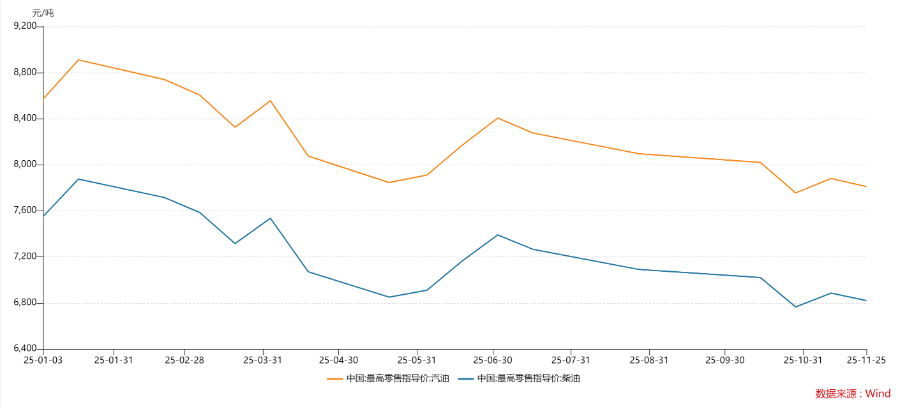
今晚加满一箱92号汽油将少花2元
2 1 Shi Ji Jing Ji Bao Dao· 2025-12-08 09:51
Core Points - The National Development and Reform Commission announced a reduction in domestic gasoline and diesel prices by 55 yuan per ton, effective from December 8 at 24:00, marking the eleventh price cut of the year [1] - The price adjustments will lead to a decrease in consumer fuel costs, with specific reductions of 0.04 yuan for 92 gasoline, 0.05 yuan for 95 gasoline, and 0.05 yuan for 0 diesel [1] Summary by Category Consumer Impact - For private car owners, filling a 50L tank of 92 gasoline will cost approximately 2 yuan less [3] - For a vehicle that runs 2000 kilometers per month with an average fuel consumption of 8L per 100 kilometers, the fuel cost will decrease by about 6 yuan before the next price adjustment [3] - In the logistics sector, a heavy truck running 10,000 kilometers per month with a fuel consumption of 38L per 100 kilometers will see a reduction of around 89 yuan in fuel costs before the next price adjustment [3] Market Analysis - According to Zhuo Chuang Information, the current pricing cycle has been influenced by mixed market factors, including occasional disturbances in Europe and increased oil inventory in the U.S., leading to a narrow fluctuation in oil prices [3] - The analysis indicates that the market should pay attention to the Federal Reserve's interest rate cuts, as a weakening dollar may support long-term oil price increases, while short-term international oil prices are expected to maintain a strong trend [3] - The next price adjustment window is scheduled for December 22 at 24:00 [3]

金价4200美元附近盘整 黄金或继续震荡上行
Jin Tou Wang· 2025-12-08 06:01
Group 1 - The core viewpoint of the articles indicates that gold prices are experiencing an upward trend, supported by technical indicators and market conditions, with potential for further increases in the near future [1][3]. - The recent U.S. core PCE price index for September recorded a year-on-year increase of 2.8%, which is below market expectations of 2.9%, suggesting a slowdown in consumer spending prior to the government shutdown [2]. - Consumer confidence in the U.S. has shown improvement, with the Michigan University consumer sentiment index rising from 51 in November to 53.3 in December, indicating a potential positive outlook for consumer behavior [2]. Group 2 - Technical analysis suggests that gold prices are currently consolidating within an upward wedge pattern, with significant support around the $4000 level, indicating strong market support [3]. - A breakthrough above $4260 could trigger a move towards the $4380 resistance level, with the potential for a strong upward movement if this level is surpassed [3]. - The market is observing a bullish structure forming, which indicates that positive momentum is strengthening, and the gold market remains in a favorable position for further gains [3].