
进口成本

Search documents
液化石油气大涨超8%,能化普跌下LPG为何能逆势大涨?
对冲研投· 2026-03-20 08:20
Core Viewpoint - The liquefied petroleum gas (LPG) market has shown strong performance despite a general decline in the energy and chemical sector, driven by geopolitical tensions in the Middle East and rising import costs [4][5][11]. Price Performance - The LPG main contract opened at 6492 yuan/ton, reached a high of 6752 yuan/ton, and closed at 6735 yuan/ton, marking an increase of 8.44% with a daily fluctuation of 5.73% [4][5]. Trading Volume and Positioning - The total trading volume for the contract was 228,842 lots, significantly up from 113,700 lots the previous day, indicating a doubling in trading activity. However, the open interest decreased by 34.87% to 19,800 lots, reflecting profit-taking by long positions [3][4]. Market Position - The overall energy and chemical sector experienced declines, with significant drops in other commodities, while LPG emerged as the only gainer, highlighting its independent performance amid broader market weakness [4][5]. Core Drivers of Price Increase - The primary drivers for LPG's price increase include: - Escalation of geopolitical conflicts in the Middle East, leading to supply disruption risks [5][6]. - A significant drop in shipping traffic through the Strait of Hormuz, resulting in a practical halt in LPG exports from the region [5][6]. - Rising import costs, with the price index for imported propane increasing by 7.13% and butane by 2.45% in the week of March 9-15 [6][7]. Supply and Demand Dynamics - Supply-side constraints are evident, with domestic LPG production declining and international supply from the Middle East facing disruptions. The average monthly LPG export from the Middle East is 3.2 to 3.3 million tons, primarily to China and India, which cannot be easily replaced [7][8]. - Demand remains stable, with an increase in residential gas consumption and a recovery in chemical sector demand, particularly from the Qingdao Jineng PDH facility [8][9]. Inventory Situation - As of March 19, the LPG port inventory was 2.3238 million tons, a slight increase of 2.26% from the previous period, indicating manageable inventory levels despite a small accumulation [9]. Future Outlook - The LPG market is expected to maintain its strong position due to ongoing geopolitical risks, supply constraints, and rising import costs. Key variables to monitor include the evolution of the Middle East situation and potential changes in domestic supply and demand dynamics [11][12].


美豆表现强势,豆粕震荡运行
Hua Tai Qi Huo· 2026-03-13 05:21
Group 1: Report Industry Investment Rating - The investment rating for both the粕类 (bean meal and rapeseed meal) and corn sectors is neutral [3][6] Group 2: Core Views of the Report - For the粕类 market, the current downstream oil mill bean meal inventory, although somewhat depleted, remains at a relatively high level in recent years. Influenced by rising international shipping costs and fertilizer prices, the Brazilian soybean premium has strengthened. Supported by import costs and factors such as the oil - meal ratio, domestic bean meal prices are running on the strong side. Future attention should be paid to port clearance, US soybean exports, and macro - events [2] - In the corn market, deep - processing enterprises are raising prices to replenish inventories, which supports corn prices. However, previous snow and rain affected transportation. Northern port corn prices are firm, while southern buyers are cautious. Some substitute grains are diverting demand. With wheat and aged rice not yet being auctioned in large quantities, the overall corn supply is not loose. The arrival of substitute grains will provide some supply, and future attention should be on policy - related auctions and grain sales [4][5] Group 3: Summary by Related Catalogs 1. 粕类 (Bean Meal and Rapeseed Meal) Market News and Important Data - Futures: The closing price of the bean meal 2605 contract was 3054 yuan/ton, a change of - 14 yuan/ton (- 0.46%) from the previous day; the rapeseed meal 2605 contract was 2492 yuan/ton, a change of + 12 yuan/ton (+ 0.48%) from the previous day [1] - Spot: In Tianjin, the bean meal spot price was 3380 yuan/ton, up 60 yuan/ton from the previous day, with a spot basis of M05 + 326, up 74 from the previous day; in Jiangsu, it was 3250 yuan/ton, unchanged from the previous day, with a spot basis of M05 + 196, up 14 from the previous day; in Guangdong, it was 3350 yuan/ton, up 30 yuan/ton from the previous day, with a spot basis of M05 + 296, up 44 from the previous day. In Fujian, the rapeseed meal spot price was 2530 yuan/ton, up 30 yuan/ton from the previous day, with a spot basis of RM05 + 38, up 18 from the previous day [1] - Market Information: From March 1 - 7, Brazil's soybean exports were 3.71 million tons, and the estimated monthly exports were 16.47 million tons, higher than the previous estimate of 16.09 million tons and a 4.7% increase from the same period last year. The Rosario Grain Exchange in Argentina maintained its 2025/26 soybean production forecast at 48 million tons [1] 2. Corn Market News and Important Data - Futures: The closing price of the corn 2605 contract was 2396 yuan/ton, a change of + 1 yuan/ton (+ 0.04%) from the previous day; the corn starch 2605 contract was 2723 yuan/ton, a change of + 5 yuan/ton (+ 0.18%) from the previous day [3] - Spot: In Liaoning, the corn spot price was 2150 yuan/ton, unchanged from the previous day, with a spot basis of C05 + 24, down 1 from the previous day; in Jilin, the corn starch spot price was 2800 yuan/ton, unchanged from the previous day, with a spot basis of CS05 + 77, down 5 from the previous day [3] - Market Information: The French Agricultural Bureau's monthly report showed that the estimated 2025/26 soft wheat production in France was 33.331 million tons, the same as the previous month's forecast and a 30.0% increase year - on - year. Exports to third - countries were adjusted down by 100,000 tons to 7.1 million tons, a 103.1% increase year - on - year. Ending stocks were adjusted up by 340,000 tons to 3.39 million tons, a 36.8% increase year - on - year [3]
长江期货粕类油脂周报-20260209
Chang Jiang Qi Huo· 2026-02-09 05:12
1. Report Industry Investment Rating No relevant content provided. 2. Core Viewpoints of the Report - In the short - term, both soybeans and soybean meal lack positive drivers, and prices are under pressure. However, planting and import costs support the lower prices. They are expected to continue to move within a range. In the medium - term, the listing of Brazilian soybeans will put pressure on the premium price, and the decline in import costs will drag down soybean meal prices. From May to July, soybean meal prices are expected to reach their annual lows. In the long - term, prices will rise slightly due to increased import costs and potential weather disturbances during the US soybean planting and growth stages, but the upside is still limited [9]. - For oils, after the previous decline caused by capital outflows and macro - sentiment, the panic in the market has been released. However, the previous positive news has been gradually digested, and the pre - Chinese New Year stocking has ended, so the upward momentum has weakened. It is expected that the oils will move in a high - level shock pattern. Among them, palm oil is supported by the expected inventory reduction in Malaysia in January, potential production cuts in Indonesia, and the spill - over effect of the US biodiesel policy; soybean oil is supported by strong US soybean exports and biodiesel consumption, the release of the US biodiesel policy, and the drought risk in Argentina, and is expected to perform relatively strongly among the three oils. Rapeseed oil will perform relatively weakly due to the continuous increase in rapeseed purchases and the start of processing Australian rapeseed, which will improve the supply - demand situation [80]. 3. Summary by Relevant Catalogs 3.1 Soybean Meal 3.1.1 Period and Spot Market - As of February 6, the spot price in East China was 3020 yuan/ton, with a monthly decline of 40 yuan/ton. The M2605 contract closed at 2735 yuan/ton, down 32 yuan/ton week - on - week. The basis price was 05 + 280 yuan/ton, down 10 yuan/ton. Affected by the China - US trade agreement, the price of US soybeans rose above 1100 cents/bushel, while the Brazilian premium weakened significantly, with the price dropping to 110 cents/bushel. The soybean meal 05 contract fluctuated in the range of [2700, 2800]. Import costs supported the lower price, but the abundant domestic arrivals after April and the decline in Brazilian soybean import costs limited the upside [9][11]. 3.1.2 Supply - The monthly US soybean yield remained at 53 bushels/acre, but the US soybean stock - to - use ratio increased due to insufficient demand. Brazil has entered the harvesting stage, with a strong expectation of a bumper harvest. However, southern Brazil and Argentina are facing periodic high - temperature and drought conditions, which put pressure on soybean growth. Overall, the expectation of a bumper harvest in South America is strong, and the supply - demand pattern remains loose. In China, the arrivals from February to March decreased, and the inventories of soybeans and soybean meal entered the seasonal destocking stage. However, due to the high pre - existing soybean inventory and the improvement from the March soybean auction in China, the supply - demand tightening was limited, and the supply - demand situation remained in a tight balance [9]. 3.1.3 Demand - Currently, the demand for soybean meal remains high. The high inventory of pigs and poultry, combined with the good cost - effectiveness of soybean meal and a good proportion in the formula, support the demand for soybean meal. The soybean inventory of national oil mills continued to decline to 635.5 million tons, a decrease of 23.49 million tons from the previous week, a decrease of 3.56%, and an increase of 196.52 million tons compared to the same period last year, an increase of 44.77%. The soybean meal inventory of national oil mills increased against the trend to 93.04 million tons, an increase of 3.18 million tons from the previous week, an increase of 3.54%, and an increase of 44.98 million tons compared to the same period last year, an increase of 93.59% [9]. 3.1.4 Cost - The cost of Brazilian soybeans in the 2025/26 season is 950 cents/bushel (calculated at a real exchange rate of 5.6). Calculated at an exchange rate of 7, a premium of 100 cents, and an oil - meal ratio of 3.0, the domestic cost of soybean meal from May to August is 2600 yuan/ton. Calculated at a premium of 180 cents from July to September, the import cost of Brazilian soybeans rises to 2730 yuan/ton. The planting cost of US soybeans in the 2025/26 season is 1000 cents/bushel. Calculated at a premium of 230 cents, the domestic import cost of US soybeans is 2970 yuan/ton. In terms of import crushing profit, the crushing profit of Brazilian soybeans has risen to around 100 yuan/ton, and the profit level is at a relatively good level in the same period of history [9]. 3.2 Oils 3.2.1 Period and Spot Market - As of the week of February 6, the palm oil main 05 contract fell 214 yuan/ton to 9026 yuan/ton compared to the previous week. The 24 - degree palm oil in Guangzhou fell 180 yuan/ton to 9080 yuan/ton compared to the previous week. The palm oil 05 basis rose 34 yuan/ton to 54 yuan/ton compared to the previous week. The soybean oil main 05 contract fell 180 yuan/ton to 8102 yuan/ton compared to the previous week. The fourth - grade soybean oil in Zhangjiagang fell 150 yuan/ton to 8620 yuan/ton compared to the previous week. The soybean oil 05 basis rose 30 yuan/ton to 518 yuan/ton compared to the previous week. The rapeseed oil main 05 contract fell 236 yuan/ton to 9144 yuan/ton compared to the previous week. The third - grade rapeseed oil in Fangchenggang fell 410 yuan/ton to 9720 yuan/ton compared to the previous week. The rapeseed oil 05 basis fell 174 yuan/ton to 576 yuan/ton compared to the previous week [80][82]. 3.2.2 Palm Oil - MPOB will release the January report on the 10th. According to high - frequency data, the production of Malaysian palm oil decreased and exports increased in January. The market estimates that the inventory in that month will drop to 2.89 - 2.91 million tons. February is still in the traditional production - reduction season in Southeast Asia, and it is expected that the production and inventory of palm oil in Indonesia and Malaysia will continue to decline. Currently, the international soybean - palm oil price spread has rebounded, and palm oil has a stronger cost - effectiveness than soybean oil, which is beneficial to palm oil exports. However, the inventory of Malaysian palm oil in December was still as high as 3.05 million tons, with a large inventory pressure and a long way to go for destocking. After the pre - Chinese New Year stocking in China ended, the import demand declined, which suppressed the upside. In the short - term, it is expected that the Malaysian 05 contract will fluctuate at a high level. Pay attention to the performance around the 4150 support level. In China, China accelerated palm oil purchases before the Indonesian tax increase in March, and it is expected that the palm oil arrivals in February will increase significantly. Coupled with the general market demand in winter, the destocking speed of palm oil is limited. As of the week of January 30, the domestic palm oil inventory decreased slightly to 701,400 tons [80]. 3.2.3 Soybean Oil - On the US soybean side, after the China - US leaders' call, Trump said that China plans to increase the US soybean purchase target for this year to 20 million tons, higher than the previous target of 12 million tons, which is expected to further improve US soybean exports. The US Treasury Department issued the proposed 45Z rule, which improved the unfavorable situation of the lack of a guiding subsidy framework in the US biodiesel industry and is beneficial to the biodiesel demand for US soybean oil. On the South American side, due to the previous drought, some consulting agencies slightly lowered the soybean production forecast for Argentina in the 2025/26 season, which is a positive factor. However, there is a risk that the US biodiesel policy may fall short of market expectations after its implementation in March. The soybean production in Brazil in the 2025/26 season is expected to reach a record 178 - 180 million tons and will gradually enter the market after February to compete with US soybeans. It is expected that the rainfall in Argentina will improve in the next 1 - 2 weeks, which will limit the development of the drought. Therefore, the risks of the biodiesel policy, the selling pressure from Brazil, and the rainfall in Argentina will limit the further rebound of US soybeans. In the short - term, the US soybean 03 contract will continue to rebound. After breaking through the 1100 - cent mark, pay attention to the performance at the 1120 - 1130 resistance level. In China, although the current inventories of soybeans and soybean oil are still high, the inventories of foreign - funded oil mills are relatively low. Moreover, the market is worried about the seasonal decrease in soybean arrivals from January to March, which is beneficial to inventory destocking. As of the week of January 23, the soybean oil inventory decreased to 946,800 tons [80]. 3.2.4 Rapeseed Oil - Recently, there are market rumors that China has purchased 10 ships of about 650,000 tons of Canadian rapeseed after the China - Canada negotiations, which will arrive in China from March to May. Therefore, although Canadian Prime Minister Carney said that there is currently no plan to reach a free - trade agreement with China, there is still a high possibility that China will reduce the import tariff on Canadian rapeseed to 15% in March. If the reduction of the Canadian rapeseed tariff to 15% is implemented, the crushing profit of Canadian rapeseed will improve significantly, and it will enter the mills for crushing and flow into the domestic market. In addition, the two ships of Australian rapeseed that arrived earlier have also started to enter the mills for crushing. Therefore, although the current spot supply - demand situation of rapeseed products in China is still tight, and the inventories of rapeseed and rapeseed oil are at a low level, with the crushing of Australian rapeseed, the arrival of Canadian rapeseed from March to May, and China's continued purchase of Russian rapeseed oil, it is expected that the tight supply - demand situation of rapeseed products in China will gradually ease from February, putting pressure on rapeseed oil prices. As of the week of January 30, the domestic rapeseed oil inventory was 246,000 tons, with limited room for further destocking [80].
宏观金融类:文字早评2026/01/13星期二-20260113
Wu Kuang Qi Huo· 2026-01-13 00:53
1. Report Industry Investment Rating No relevant content provided. 2. Core Viewpoints of the Report - For stocks, with the entry of incremental funds at the beginning of the year, the financing scale has increased significantly, and the market trading volume has rapidly expanded. In the long - term, the policy support for the capital market remains unchanged. Strategically, the idea of buying on dips is recommended [4]. - For bonds, the improvement of economic expectations may put pressure on the bond market, but the sustainability of economic recovery momentum needs to be observed. The central bank's attitude of caring for funds remains, and the bond market is expected to be volatile and weak [8]. - For precious metals, if the silver price stabilizes, it will continue a new upward trend, and the driving force for the gold price remains strong. It is recommended to pay attention to the support of gold and silver prices around the BCOM and tariff adjustment nodes and buy on dips after short - term negative factors end [10]. - For non - ferrous metals, most metal prices are expected to be volatile. For example, copper prices are expected to fluctuate and consolidate in the short term; aluminum prices are expected to remain high; zinc and lead prices are expected to fluctuate widely following the sentiment of the non - ferrous sector [13][15][18]. - For black building materials, steel prices are expected to continue to fluctuate at the bottom; iron ore prices are expected to fluctuate at a relatively high level; glass and soda ash markets are generally weak; coking coal and coke prices are expected to fluctuate in a range [32][34][37]. - For energy and chemicals, different products have different trends. For example, rubber is recommended to be treated neutrally; the valuation of heavy - quality oil products is raised; methanol has the feasibility of buying on dips; urea is recommended to take profits on rallies [55][57][59]. - For agricultural products, the short - term trend of hog prices is expected to be stable or slightly rising, and different trading strategies are recommended for different contract periods; egg prices are expected to be stable or rising, and different strategies are also recommended for different contract periods [79][80][81]. 3. Summary by Relevant Catalogs 3.1 Macro - financial 3.1.1 Stock Index - **Market Information**: China Chamber of Commerce for Import and Export of Machinery and Electronic Products promoted a "soft landing" of the EU's anti - subsidy case on electric vehicles; Lihong No.1 completed its first sub - orbital flight test; Brain - Machine Haihe Laboratory completed the first "space brain - machine interface experiment"; prices of multiple non - ferrous and precious metal futures reached new highs [2]. - **Basis Ratio of Stock Index Futures**: Different ratios are provided for IF, IC, IM, and IH contracts in different periods [3]. - **Strategy Viewpoint**: With incremental funds entering at the beginning of the year, the financing scale has increased significantly, and the market trading volume has rapidly expanded. In the long - term, the policy support for the capital market remains unchanged. Strategically, the idea of buying on dips is recommended [4]. 3.1.2 Treasury Bonds - **Market Information**: On Monday, the closing prices of TL, T, TF, and TS main contracts changed by 0.30%, 0.07%, 0.05%, and 0.00% respectively. The Canadian Prime Minister will visit China, and the National Development and Reform Commission and other departments issued relevant policies on government investment funds [5]. - **Liquidity**: The central bank conducted 861 billion yuan of 7 - day reverse repurchase operations on Monday, with a net investment of 361 billion yuan [6][7]. - **Strategy Viewpoint**: The improvement of economic expectations may put pressure on the bond market, but the sustainability of economic recovery momentum needs to be observed. The central bank's attitude of caring for funds remains, and the bond market is expected to be volatile and weak [8]. 3.1.3 Precious Metals - **Market Information**: Shanghai gold rose 1.31%, and Shanghai silver rose 7.23%. The US federal prosecutor launched a criminal investigation into Fed Chairman Powell, which impacted the Fed's independence [9]. - **Strategy Viewpoint**: If the silver price stabilizes, it will continue a new upward trend, and the driving force for the gold price remains strong. It is recommended to pay attention to the support of gold and silver prices around the BCOM and tariff adjustment nodes and buy on dips after short - term negative factors end [10]. 3.2 Non - ferrous Metals 3.2.1 Copper - **Market Information**: Silver prices were strong, and the domestic equity market strengthened, driving copper prices to rise. LME copper inventory decreased, and domestic electrolytic copper social inventory increased [12]. - **Strategy Viewpoint**: The Fed's interest - rate cut expectation has weakened, and short - term sentiment may cool down. The copper mine supply is in a tight pattern, and copper prices are expected to fluctuate and consolidate in the short term [13]. 3.2.2 Aluminum - **Market Information**: The general atmosphere of bulk commodities was strong, and aluminum prices fluctuated and rose. LME aluminum inventory decreased, and domestic aluminum ingot and aluminum rod social inventories increased [14]. - **Strategy Viewpoint**: The high - level fluctuations of precious metals and non - ferrous metals have increased, and short - term sentiment may cool down. Aluminum prices are expected to remain high [15]. 3.2.3 Zinc - **Market Information**: The Shanghai zinc index rose, and LME zinc also increased. Zinc ingot social inventory decreased slightly [16][17]. - **Strategy Viewpoint**: The zinc price has a large room for catch - up compared with copper and aluminum. It is expected to fluctuate widely following the sentiment of the non - ferrous sector [18]. 3.2.4 Lead - **Market Information**: The Shanghai lead index rose, and LME lead also increased. Lead ingot social inventory increased [19]. - **Strategy Viewpoint**: The lead price is approaching the upper edge of the long - term oscillation range, and it is expected to fluctuate widely following the sentiment of the non - ferrous sector [19]. 3.2.5 Nickel - **Market Information**: Nickel prices rebounded, and the prices of nickel ore and nickel iron also changed accordingly [20]. - **Strategy Viewpoint**: The oversupply pressure of nickel is still large, and it is expected to fluctuate widely in the short term. It is recommended to wait and see in the short term [20][21]. 3.2.6 Tin - **Market Information**: Tin prices rose significantly. The supply in Myanmar is gradually recovering, and the demand is mainly for rigid needs [22]. - **Strategy Viewpoint**: The tin market demand is weak, and the supply is expected to improve. It is recommended to wait and see. The price is expected to fluctuate following the market risk preference [22]. 3.2.7 Carbonate Lithium - **Market Information**: The spot index of carbonate lithium rose, and the futures price also increased [23]. - **Strategy Viewpoint**: The "rush to export" effect has increased the demand expectation, but the rapid rise may increase the callback risk. It is recommended to wait and see or try with a light position [23]. 3.2.8 Alumina - **Market Information**: The alumina index rose, and the inventory continued to accumulate [24]. - **Strategy Viewpoint**: The mine price is expected to decline, and the alumina market continues to face over - capacity. It is recommended to wait and see and consider shorting on rallies [25]. 3.2.9 Stainless Steel - **Market Information**: The stainless steel main contract price was stable, and the social inventory decreased [26]. - **Strategy Viewpoint**: The optimistic expectation of Indonesia's RKAB supports the price. The price is expected to remain high and volatile in the short term [27]. 3.2.10 Casting Aluminum Alloy - **Market Information**: The price of casting aluminum alloy rose, and the inventory increased slightly [28]. - **Strategy Viewpoint**: The cost is strong, and the supply is disturbed. The price is expected to remain high in the short term [29]. 3.3 Black Building Materials 3.3.1 Steel - **Market Information**: The prices of rebar and hot - rolled coil increased, and the inventory of rebar increased slightly while that of hot - rolled coil decreased slightly [31]. - **Strategy Viewpoint**: The steel price is expected to continue to fluctuate at the bottom. It is necessary to pay attention to the de - stocking of hot - rolled coil and relevant policies [32]. 3.3.2 Iron Ore - **Market Information**: The iron ore main contract price rose, and the port inventory continued to accumulate [33]. - **Strategy Viewpoint**: The overseas iron ore shipment is in the off - season, and the iron ore price is expected to fluctuate at a relatively high level. It is necessary to pay attention to the steel mill's replenishment and iron - making rhythm [34]. 3.3.3 Glass and Soda Ash - **Market Information**: The glass main contract price decreased slightly, and the inventory decreased. The soda ash main contract price increased, and the inventory increased [35][37]. - **Strategy Viewpoint**: The glass price is expected to fluctuate, and it is recommended to wait and see. The soda ash market is generally weak [36][37]. 3.3.4 Coking Coal and Coke - **Market Information**: The prices of coking coal and coke rose. The spot prices of coking coal and coke also changed [38]. - **Strategy Viewpoint**: The commodity market sentiment is positive, but the fundamental support for the price is limited. The price is expected to fluctuate in a range [40][41]. 3.3.5 Manganese Silicon and Ferrosilicon - **Market Information**: The prices of manganese silicon and ferrosilicon rose. The spot prices also changed [42]. - **Strategy Viewpoint**: The future market trend is mainly affected by the overall market sentiment and cost factors. It is recommended to pay attention to manganese ore and "dual - carbon" policies [45]. 3.3.6 Industrial Silicon and Polysilicon - **Market Information**: The price of industrial silicon rose slightly, and the price of polysilicon decreased. The inventory of industrial silicon may increase, and the supply of polysilicon may be adjusted [46][48]. - **Strategy Viewpoint**: Industrial silicon is expected to face inventory pressure, and polysilicon is expected to be weak and volatile. It is necessary to pay attention to relevant policies and production plans [47][49]. 3.4 Energy and Chemicals 3.4.1 Rubber - **Market Information**: The rubber price fluctuated and rebounded. The tire start - up rate had marginal fluctuations, and the inventory increased [51][53]. - **Strategy Viewpoint**: The overall commodity atmosphere is positive, but the rubber seasonality is weak. A neutral strategy is recommended, and short - selling can be considered if the price falls below a certain level [55]. 3.4.2 Crude Oil - **Market Information**: The main contract price of INE crude oil rose, and the inventories of refined oil products changed [56]. - **Strategy Viewpoint**: The Latin American geopolitical situation does not have enough positive impact on the overall oil price, but the valuation of heavy - quality oil products is raised [57]. 3.4.3 Methanol - **Market Information**: The regional spot prices of methanol changed, and the main contract price decreased [58]. - **Strategy Viewpoint**: The current valuation of methanol is low, and it has the feasibility of buying on dips [59]. 3.4.4 Urea - **Market Information**: The regional spot prices of urea changed slightly, and the main contract price increased [60]. - **Strategy Viewpoint**: The import window has opened, and it is recommended to take profits on rallies [62]. 3.4.5 Pure Benzene and Styrene - **Market Information**: The prices of pure benzene and styrene rose. The inventory of pure benzene increased, and the inventory of styrene decreased [63]. - **Strategy Viewpoint**: The non - integrated profit of styrene can be long - bought before the first quarter [64]. 3.4.6 PVC - **Market Information**: The PVC main contract price rose, and the inventory increased [65]. - **Strategy Viewpoint**: The domestic PVC market has a pattern of strong supply and weak demand. It is recommended to short on rallies [66]. 3.4.7 Ethylene Glycol - **Market Information**: The ethylene glycol main contract price rose, and the inventory increased [67]. - **Strategy Viewpoint**: The ethylene glycol market needs to increase production cuts to improve the supply - demand pattern. It is necessary to beware of rebound risks [68]. 3.4.8 PTA - **Market Information**: The PTA main contract price rose, and the inventory decreased [69]. - **Strategy Viewpoint**: The PTA is expected to enter the Spring Festival inventory - accumulation stage. It is recommended to pay attention to long - buying opportunities on dips [70]. 3.4.9 p - Xylene - **Market Information**: The p - xylene main contract price rose, and the inventory decreased [71][72]. - **Strategy Viewpoint**: The p - xylene load is high, and it is recommended to pay attention to long - buying opportunities following the crude oil price [73]. 3.4.10 Polyethylene (PE) - **Market Information**: The PE main contract price rose, and the inventory increased [74]. - **Strategy Viewpoint**: The PE price may be supported, and it is recommended to long - buy the LL5 - 9 spread on dips [75]. 3.4.11 Polypropylene (PP) - **Market Information**: The PP main contract price rose, and the inventory situation was complex [76]. - **Strategy Viewpoint**: The PP price may bottom out in the first quarter of next year [77]. 3.5 Agricultural Products 3.5.1 Hogs - **Market Information**: The domestic hog price was mixed, and the price may stabilize or rise slightly [79]. - **Strategy Viewpoint**: The short - term hog price may support the futures price, but in the medium - term, supply pressure exists. Different trading strategies are recommended for different contract periods [80]. 3.5.2 Eggs - **Market Information**: The national egg price mostly rose, and the price is expected to be stable or rise [81]. - **Strategy Viewpoint**: The short - term egg price may support the futures price, but in the medium - term, supply pressure exists. Different trading strategies are recommended for different contract periods [82]. 3.5.3 Soybean and Rapeseed Meal - **Market Information**: The protein meal futures price fluctuated. The import cost of soybeans may have a bottom, but the fundamental situation is weak [83][84]. - **Strategy Viewpoint**: It is recommended to wait and see in the short term due to the combination of long - and short - term factors [84]. 3.5.4 Oils and Fats - **Market Information**: The oil futures price fluctuated. The palm oil inventory in Malaysia increased, and the domestic three - major oil inventories were at a relatively high level [85][86]. - **Strategy Viewpoint**: The current fundamental situation is weak, but the long - term expectation is optimistic. The oil price may be close to the bottom [86]. 3.5.5 Sugar - **Market Information**: The Zhengzhou sugar futures price fluctuated. The spot price of sugar decreased slightly [87]. - **Strategy Viewpoint**: The international sugar price may rebound after February, and it is recommended to wait and see in the short term [89]. 3.5.6 Cotton - **Market Information**: The Zhengzhou cotton futures price decreased. The cotton supply and demand situation changed [90]. - **Strategy Viewpoint**: The cotton price may fluctuate after rising. It is recommended to wait for a callback to buy [91].
农产品早报2025-12-29:五矿期货农产品早报-20251229
Wu Kuang Qi Huo· 2025-12-29 00:39
1. Report Industry Investment Rating - No relevant information provided 2. Core Viewpoints - For soybeans and soybean meal, the bottom of import costs may have emerged, but upward space requires greater production cuts. With large domestic inventories and fewer near - month purchases, the de - stocking speed is expected to accelerate, and soybean meal is expected to fluctuate [3]. - For palm oil, the Q1 inventory outlook depends on production and export data. If production is high and exports are weak, prices may decline; if production is low, prices may rise. Short - term operations based on high - frequency data are recommended [6]. - For sugar, international sugar prices may rebound after the northern hemisphere's harvest in February next year. Domestic sugar prices may continue to rebound in the short term as import supplies decrease [10]. - For cotton, the market has anticipated the reduction in Xinjiang's cotton planting area. With a balanced supply - demand relationship and positive expectations, the price trend is strong. It is recommended to wait for a pull - back to go long [13]. - For eggs, the spot market has improved expectations but is still under pressure. The futures market is in a state of weak reality and strong expectations. It is recommended to sell on rallies for the near - term and pay attention to long - term upside pressure [16]. - For pigs, short - term spot prices may remain strong, but the supply - demand tightness is structural. The strategy is to sell on rallies for the near - term and pay attention to long - term downside support [19]. 3. Summary by Related Catalogs Soybean and Soybean Meal 行情资讯 - Last Friday, CBOT soybeans opened higher and then fell. Domestic soybean meal spot prices dropped by 10 yuan/ton over the weekend. MYSTEEL expects this week's soybean crushing volume at oil mills to be 2.0644 million tons, up from last week's 1.8404 million tons. The feed enterprise inventory days were 9.45 days last week, up 0.22 days [2]. - Forecasts show more rain in major Brazilian soybean - growing areas in the next two weeks, while rainfall in Buenos Aires Province, Argentina, remains low [2]. 策略观点 - The bottom of soybean import costs may have emerged, but upward space requires greater production cuts. With large domestic inventories and fewer near - month purchases, the de - stocking speed is expected to accelerate, and soybean meal is expected to fluctuate [3]. Palm Oil 行情资讯 - SPPOMA data shows that Malaysian palm oil production decreased by 9.12% in the first 25 days of December. Ship - loading data indicates mixed trends in exports [4]. - India's vegetable oil imports decreased by about 11% month - on - month and 28% year - on - year in November [4]. - Indonesia plans to fine palm oil growers and miners $8.5 billion for forest encroachment [4]. - Last Friday, domestic oils continued to rebound, with better Malaysian palm oil export data and Indonesia's fine plan being positive factors, but high production and low exports limited the market [4]. 策略观点 - The Q1 inventory outlook depends on production and export data. If production is high and exports are weak, prices may decline; if production is low, prices may rise. Short - term operations based on high - frequency data are recommended [6]. Sugar 行情资讯 - On Friday, Zhengzhou sugar futures prices fluctuated strongly. The May contract closed at 5,285 yuan/ton, up 16 yuan/ton or 0.3% [8]. - In November 2025, China imported 440,000 tons of sugar, a year - on - year decrease of 90,000 tons. From January to November 2025, the cumulative import was 4.34 million tons, a year - on - year increase of 380,000 tons [9]. - In November, Brazil's central - southern region had a 21.08% year - on - year decrease in sugarcane crushing and a 32.94% decrease in sugar production [9]. - As of December 15, India's cumulative sugar production was 7.79 million tons, a year - on - year increase of 1.72 million tons [9]. 策略观点 - International sugar prices may rebound after the northern hemisphere's harvest in February next year. Domestic sugar prices may continue to rebound in the short term as import supplies decrease [10]. Cotton 行情资讯 - On Friday, Zhengzhou cotton futures prices rose with increased positions. The May contract closed at 14,535 yuan/ton, up 280 yuan/ton or 1.96% [12]. - In November 2025, China imported 120,000 tons of cotton, a year - on - year increase of 10,000 tons. From January to November 2025, the cumulative import was 900,000 tons, a year - on - year decrease of 1.6 million tons [12]. - As of December 26, the spinning mill operating rate was 64.7%, down 0.5 percentage points week - on - week, up 2.3 percentage points year - on - year, and down 6.7 percentage points from the five - year average [12]. - The national commercial cotton inventory was 5.17 million tons, a year - on - year increase of 100,000 tons [12]. 策略观点 - The market has anticipated the reduction in Xinjiang's cotton planting area. With a balanced supply - demand relationship and positive expectations, the price trend is strong. It is recommended to wait for a pull - back to go long [13]. Eggs 行情资讯 - Over the weekend, domestic egg prices were stable or rising. The price in Heishan increased by 0.1 yuan to 2.8 yuan/jin, while that in Guantao remained at 2.82 yuan/jin. Egg prices may rebound slightly recently but may fall after the New Year's Day [15]. 策略观点 - The spot market has improved expectations but is still under pressure. The futures market is in a state of weak reality and strong expectations. It is recommended to sell on rallies for the near - term and pay attention to long - term upside pressure [16]. Pigs 行情资讯 - Over the weekend, domestic pig prices rose significantly. The average price in Henan increased by 0.56 yuan to 12.42 yuan/kg, and that in Sichuan increased by 0.67 yuan to 12.71 yuan/kg. Pig prices are expected to be stable or rising today [18]. 策略观点 - Short - term spot prices may remain strong, but the supply - demand tightness is structural. The strategy is to sell on rallies for the near - term and pay attention to long - term downside support [19].
五矿期货农产品早报-20251210
Wu Kuang Qi Huo· 2025-12-10 00:42
Report Industry Investment Rating No relevant content provided. Core Viewpoints - The cost of imported soybeans may have reached its bottom, but the upside space requires greater production cuts. Soybean meal is expected to trade in a range. [5] - The short - term inventory build - up of palm oil may reverse in the fourth quarter and the first quarter of next year. It is recommended to try a buy - on - dips strategy. [9] - The international sugar price may lack significant improvement until the first quarter of next year. It is advisable to take a short - term wait - and - see approach. [13] - Zhengzhou cotton is unlikely to have a unilateral trend. [17] - The egg futures contracts may be overvalued, and attention should be paid to the upside pressure. [20] - For hog futures, it is recommended to maintain a reverse spread strategy, gradually shifting from shorting near - term contracts to longing far - term contracts. [23] Summary by Categories Soybean and Soybean Meal - **Market Conditions**: On Tuesday, CBOT soybeans declined. The USDA monthly report was almost the same as the previous forecast. The domestic soybean meal spot price dropped by 10 yuan, with the East China price at 3000 yuan/ton. The purchase and pick - up of soybean meal were good. MYSTEEL estimated the soybean crushing volume of oil mills this week to be 2.05583 million tons, down from 2.2116 million tons last week. The domestic soybean and soybean meal inventories decreased last week. [2] - **Weather and Planting**: Brazil's main soybean - growing areas are forecast to have more rainfall in the next two weeks, with a planting rate of 94%. Argentina's main producing areas are expected to have less rainfall. The global soybean inventory - to - sales ratio is still relatively high year - on - year. [3] - **Import and Supply**: The estimated annual production of new global soybeans has been marginally lowered, and the supply has decreased compared to the 24/25 season. The domestic soybean inventory is at a relatively high level in history, and the soybean meal inventory is large, but the de - stocking season is approaching. [5] Palm Oil - **Market Conditions**: In November, Malaysia's palm oil exports decreased significantly compared to the previous month, and the production showed a mixed trend. On Tuesday, domestic oils closed lower. [6] - **Strategy**: The production of palm oil in Malaysia and Indonesia has exceeded expectations this year, suppressing the market. However, due to seasonal factors, it is recommended to try a buy - on - dips strategy. [9] Sugar - **Market Conditions**: On Tuesday, the Zhengzhou sugar futures price fluctuated. The closing price of the May contract was 5247 yuan/ton, up 3 yuan/ton or 0.06% from the previous trading day. The spot prices of sugar in different regions remained stable. [11] - **Production**: As of December 7, 2025/26, 56 sugar mills in Guangxi had started production, with a daily cane - crushing capacity of 425,000 tons, down 112,500 tons year - on - year. In the first half of November, the sugar production in the central - southern region of Brazil increased year - on - year, and India's sugar production also increased significantly. [12] - **Strategy**: It is expected that the production of major sugar - producing countries will increase in the new season, and the global sugar supply - demand relationship will shift from shortage to surplus. It is advisable to take a short - term wait - and - see approach. [13] Cotton - **Market Conditions**: On Tuesday, the Zhengzhou cotton futures price fluctuated, with the closing price of the May contract at 13,725 yuan/ton, unchanged from the previous trading day. The spot price of cotton decreased slightly. [15] - **Supply and Demand**: As of December 5, the spinning mill operating rate was 65.3%, down 0.2 percentage points from last week. The national commercial cotton inventory was 4.47 million tons, up 150,000 tons year - on - year. The global cotton production in the 2025/26 season is expected to increase. [16] - **Strategy**: Zhengzhou cotton is unlikely to have a unilateral trend due to the lack of strong drivers and the pressure of hedging. [17] Eggs - **Market Conditions**: Most egg prices in the country were stable, with a few rising. The average price in the main producing areas increased by 0.02 yuan to 3.01 yuan/jin. The market inventory was low, and the demand in the sales areas was good. [19] - **Strategy**: The egg futures contracts may be overvalued, and attention should be paid to the upside pressure. [20] Hogs - **Market Conditions**: Domestic hog prices were half stable and half rising. The supply and demand were in a stalemate, with the supply basically stable and the demand increasing only in the southwest region. [22] - **Strategy**: It is recommended to maintain a reverse spread strategy, gradually shifting from shorting near - term contracts to longing far - term contracts. [23]
广发期货《农产品》日报-20251209
Guang Fa Qi Huo· 2025-12-09 07:00
1. Report Industry Investment Ratings No information about industry investment ratings is provided in the reports. 2. Core Views 2.1 Oil and Fat Industry - Malaysian BMD crude palm oil futures are in a volatile adjustment. There are concerns about inventory growth and weak December exports. It is oscillating around 4,100 ringgit, waiting for the MPOB supply - demand report. Domestic Dalian palm oil futures may weaken under the influence of Malaysian palm oil, with a possible decline to seek support at 8,500 yuan. - The market expects an increase in the US soybean ending inventory, which pressures CBOT soybeans and affects CBOT soybean oil. The decline of BMD palm oil also drags down CBOT soybean oil. Domestically, the decline of international related varieties has a greater impact on Dalian soybean oil. Factory开机率 has decreased, but the inventory change is not significant due to limited downstream demand [1]. 2.2 Pig Industry - Spot prices show signs of stabilizing and rebounding. Although large - scale enterprises still have significant sales pressure, the increasing demand for southern curing and the potential entry of secondary fattening may support prices. However, the overall large - scale production increase pattern remains unchanged. - The futures market is affected by a positive macro - atmosphere. Bullish funds are actively entering the market, and the futures may maintain a slightly stronger trend in the short term [3]. 2.3 Meal and Bean Industry - The US soybean price is in a correction, and China's policy - based procurement is uncertain. The domestic meal market remains in a loose pattern, and the single - side price is under pressure. The key lies in whether US soybean purchases can meet the domestic arrival volume in March. The market outlook is weak, but the basis may strengthen [6]. 2.4 Sugar Industry - ICE raw sugar futures slightly increase, but the sufficient supply and weak demand in the spot market suppress the upward movement of futures prices. Brazil's sugar exports in early December increased. India's sugar production has increased significantly, and the overall raw sugar price is in a bearish pattern. The domestic sugar price is expected to be in a volatile and weak trend [9]. 2.5 Corn and Corn Starch Industry - In the northeast region, the price is stable due to the support of inventory replenishment and policy procurement. In the north - central region, prices are firm due to the shortage of high - quality grains. On the demand side, some deep - processing enterprises are in deficit, and feed enterprises have low enthusiasm for long - term inventory building. The futures price may decline slightly in the short term, but the decline may be limited [11]. 2.6 Cotton Industry - ICE cotton futures closed lower. Traders are cautious before the USDA monthly supply - demand report. US cotton export sales increased significantly in the week ending November 6. Domestically, the hedging pressure on Zhengzhou cotton is increasing, but the rigid demand from the industrial downstream and the good profit situation of textile enterprises may limit the downward space. The cotton price may fluctuate within a range in the short term [15]. 2.7 Egg Industry - The supply side still has significant pressure, with a high inventory of laying hens and slow decline. The demand side lacks obvious positive factors, but the positive market sentiment provides some support. Egg prices are expected to be weak with limited downward space [19]. 3. Summary by Related Catalogs 3.1 Oil and Fat Industry 3.1.1 Price Changes - **Soybean Oil**: The spot price in Jiangsu remained unchanged at 8,600 yuan, the futures price (Y2601) decreased by 0.44% to 8,230 yuan, and the basis increased by 10.78% to 370 yuan. - **Palm Oil**: The spot price in Guangdong decreased by 0.57% to 8,690 yuan, the futures price (P2601) decreased by 0.73% to 8,706 yuan, and the basis increased by 46.67% to - 16 yuan. - **Rapeseed Oil**: The spot price in Jiangsu decreased by 1.00% to 8,960 yuan, the futures price (OI601) decreased by 1.21% to 9,502 yuan, and the basis increased by 4.30% to 388 yuan [1]. 3.1.2 Spread Changes - **Inter - delivery Spread**: The soybean oil 01 - 05 spread increased by 6.45% to 198 yuan, the palm oil 01 - 05 spread decreased by 50.00% to 4 yuan, and the rapeseed oil 01 - 05 spread increased by 8.06% to 228 yuan. - **Cross - variety Spread**: The spot soybean - palm oil spread increased by 35.71% to - 90 yuan, the 2601 soybean - palm oil spread increased by 1.76% to - 670 yuan, the spot rapeseed - soybean oil spread decreased by 7.19% to 1,290 yuan, and the 2601 rapeseed - soybean oil spread decreased by 5.92% to 1,272 yuan [1]. 3.2 Pig Industry 3.2.1 Futures Indicators - The price of the main contract of live pigs 2605 increased by 1.27% to 11,955 yuan/ton, and the price of 2603 increased by 2.71% to 11,385 yuan/ton. The 3 - 5 spread increased by 20.83% to - 570 yuan. The main contract positions increased by 81.80% to 151,512, and the number of warehouse receipts remained unchanged at 108 [3]. 3.2.2 Spot Indicators - Spot prices in different regions showed mixed trends. The daily slaughter volume of sample points increased by 0.07% to 217,041 heads, the weekly white - strip price remained unchanged at 18.21 yuan, the weekly piglet price remained unchanged at 17.00 yuan/kg, the weekly sow price remained unchanged at 32.47 yuan, the weekly slaughter weight increased by 0.46% to 129.82 kg, the weekly self - breeding profit decreased by 13.31% to - 168 yuan/head, the weekly purchased - pig breeding profit decreased by 4.25% to - 259 yuan/head, and the monthly fertile sow inventory decreased by 1.12% to 3,990 million heads [3]. 3.3 Meal and Bean Industry 3.3.1 Price Changes - **Soybean Meal**: The spot price in Jiangsu decreased by 0.65% to 3,040 yuan, and the futures price (M2605) decreased by 1.52% to 2,778 yuan. - **Rapeseed Meal**: The futures price (RM2605) decreased by 1.47% to 2,342 yuan. - **Soybean**: The warehouse receipt of Harbin soybeans remained unchanged at 15,766 [6]. 3.3.2 Spread Changes - The soybean meal 05 - 09 spread decreased by 2.61% to - 3 yuan, the rapeseed meal 05 - 09 spread increased by 4.35% to - 66 yuan, the spot oil - meal ratio increased by 0.66% to 2.83, and the 2605 soybean - rapeseed meal spread decreased by 1.80% to 436 yuan [6]. 3.4 Sugar Industry 3.4.1 Futures Market - The price of sugar 2601 increased by 0.64% to 5,337 yuan/ton, the price of 2605 increased by 0.21% to 5,244 yuan/ton, and the ICE raw sugar main contract increased by 0.07% to 14.83 cents/pound. The 1 - 5 spread increased by 32.86% to 93 yuan/ton. The main contract positions decreased by 8.69% to 289,716, the number of warehouse receipts increased to 181, and the effective forecast increased by 714.21% to 1,490 [9]. 3.4.2 Spot Market - Spot prices in Nanning remained unchanged at 5,360 yuan, and in Kunming decreased by 0.37% to 5,320 yuan. The basis in Nanning decreased by 8.66% to 116 yuan, and in Kunming decreased by 28.97% to 76 yuan. The import price of Brazilian sugar (within quota) decreased by 0.37% to 4,079 yuan, and (outside quota) decreased by 0.39% to 5,168 yuan [9]. 3.4.3 Industry Situation - National sugar production increased by 12.03% to 1,116.21 million tons, sales increased by 9.17% to 1,048.00 million tons, the national sales ratio decreased by 2.60% to 93.90%, and the industrial inventory decreased by 41.20% to 68.21 million tons. Sugar imports increased by 37.50% to 55.00 million tons [9]. 3.5 Corn and Corn Starch Industry 3.5.1 Corn - The price of corn 2601 decreased by 1.48% to 2,261 yuan, the basis increased by 97.14% to 69 yuan, the 1 - 5 spread decreased by 144.44% to - 4 yuan. The northern - southern trade profit decreased by 20.41% to 39 yuan, the import profit decreased by 15.13% to 314 yuan, the number of remaining vehicles in Shandong deep - processing enterprises in the morning decreased by 13.64% to 399, the positions decreased by 2.25% to 2,354,124, and the number of warehouse receipts remained unchanged at 57,705 [11]. 3.5.2 Corn Starch - The price of corn starch 2601 decreased by 1.51% to 2,549 yuan, the basis increased by 1950.00% to 41 yuan, the 1 - 5 spread decreased by 40.74% to - 38 yuan, the 01 spread between starch and corn decreased by 1.71% to 288 yuan, the Shandong starch profit decreased by 25.00% to 6 yuan, the positions decreased by 2.52% to 333,585 [11]. 3.6 Cotton Industry 3.6.1 Futures Market - The price of cotton 2605 increased by 0.04% to 13,725 yuan/ton, the price of 2601 remained unchanged at 13,750 yuan/ton, the ICE US cotton main contract decreased by 0.33% to 63.74 cents/pound. The 5 - 1 spread increased by 16.67% to - 25 yuan. The main contract positions decreased by 1.75% to 489,062 hands, the number of warehouse receipts increased by 1.62% to 2,753, and the effective forecast increased by 8.02% to 3,004 [15]. 3.6.2 Spot Market - The Xinjiang arrival price of 3128B decreased by 0.17% to 14,847 yuan, the CC Index of 3128B decreased by 0.09% to 15,009 yuan, and the FC Index of M: 1% decreased by 0.08% to 12,843 yuan [15]. 3.6.3 Industry Situation - Commercial inventory increased by 28.7% to 468.36 million tons, industrial inventory increased by 0.9% to 93.96 million tons, imports decreased by 10.0% to 9.00 million tons, and the bonded - area inventory decreased by 1.8% to 32.20 million tons [15]. 3.7 Egg Industry 3.7.1 Futures and Spot Prices - The price of the egg 01 contract increased by 1.15% to 3,153 yuan/500KG, and the price of 02 increased by 0.80% to 3,038 yuan/500KG. The egg - producing area price increased by 0.41% to 2.98 yuan/FT, the basis decreased by 15.45% to - 178 yuan/500KG, and the 1 - 2 spread increased by 11.65% to 115 yuan [19]. 3.7.2 Related Indicators - The price of laying hens increased by 5.56% to 2.85 yuan/feather, the price of culled chickens increased by 1.58% to 3.86 yuan/FT, the egg - feed ratio increased by 3.90% to 2.40, and the breeding profit increased by 20.35% to - 22.62 yuan/feather [19].
豆粕库存快速积累 价格或震荡偏弱
Qi Huo Ri Bao· 2025-12-03 00:56
Group 1 - The domestic soybean meal market is currently experiencing a complex interplay of bullish and bearish factors, with tight U.S. soybean supply but a generally loose global soybean supply [2] - The USDA has lowered U.S. soybean yield, production, and ending stocks, with the stocks-to-use ratio dropping to a three-year low of 6.74%, despite some recovery in Chinese purchases of U.S. soybeans [2] - Global soybean inventory is projected to decrease to 122 million tons for the 2025/2026 season, but this still represents a year-on-year increase of 1.1%, indicating a shift from accumulation to moderate destocking [2] Group 2 - The La Niña phenomenon may introduce complexities for South American soybean growth, with Brazil's soybean planting progress lagging behind last year, yet yield forecasts remain high [3] - Argentina's soybean planting is significantly delayed due to flooding, and if adverse weather persists into December, the estimated production of 48.5 million tons may face downward revision [3] Group 3 - China's port soybean inventory remains high, with a year-on-year increase of 292.95 million tons, reaching 9.425 million tons as of November 21 [4] - Market expectations indicate that China will import 8 million tons and 7.5 million tons of soybeans in November and December, respectively, with total imports expected to exceed 110 million tons in 2025 [4] - Even without U.S. soybean imports, domestic soybean supply is expected to remain ample through the fourth quarter due to high inventory levels [4] Group 4 - Domestic oil mills are operating at high capacity, with weekly soybean crushing volumes around 2.3 million tons, leading to a significant increase in soybean meal inventory [5] - As of November 21, soybean meal inventory reached 1.1515 million tons, a year-on-year increase of 38.11 million tons, reflecting a 49.47% rise [5] - Despite stable demand from livestock and poultry, cautious purchasing behavior from feed companies limits the growth of soybean meal consumption [5] Group 5 - The cost of imported soybeans is providing strong support for soybean meal prices, with high premiums for Brazilian soybeans and a rebound in U.S. soybean futures prices [6] - The overall global soybean supply remains loose, but high import costs are limiting the downside potential for soybean meal prices [6] - Future price movements will depend on South American weather conditions and developments in U.S.-China trade relations [6]
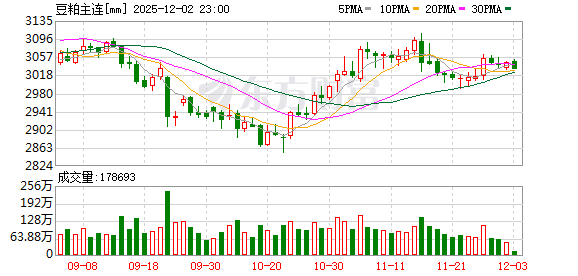
农产品早报2025-11-19:五矿期货农产品早报-20251119
Wu Kuang Qi Huo· 2025-11-19 01:27
Group 1: Report Overview - The report is the Agricultural Products Morning Report on November 19, 2025, from Wukuang Futures [1] Group 2: Soybean and Bean Meal Market Information - On Tuesday, CBOT soybeans first rose and then fell. The price of US soybeans reached 1070 cents per bushel, hitting the cost line and triggering a correction. Brazilian soybean premiums fell by 3 - 6 cents per bushel. The cost of imported soybeans fluctuated. The domestic soybean meal spot price decreased slightly by 20 yuan per ton, with the price in East China reported at 2990 yuan per ton. The trading and pick - up of soybean meal were both good. MYSTEEL estimated that the soybean crushing volume of domestic oil mills this week would be 2.3492 million tons, compared with 2.0776 million tons last week. Soybean and soybean meal inventories decreased week - on - week last week but remained high year - on - year [2] - In the next two weeks, the areas in the Brazilian soybean - producing regions with less rainfall in the early stage are expected to receive rainfall, and the sowing is expected to proceed smoothly. As of last Thursday, the planting progress had reached 71%. The USDA monthly report lowered the global new - crop soybean production by about 4.1 million tons and the ending inventory by 2 million tons, tightening the global soybean balance sheet marginally. The US soybean production was lowered by about 1.3 million tons, but the US soybean exports were lowered by 1.36 million tons, resulting in only a 280,000 - ton reduction in US soybean inventory. The US soybean futures price thus corrected at high levels [3] Strategy View - The bottom of the import cost of soybeans may have emerged, but the upward space may require greater production cuts. The current domestic soybean and soybean meal inventories are at high levels, and the crushing margin is under pressure. However, as the de - stocking season approaches, there is some support. Soybean meal is expected to trade in a range [5] Group 3: Oils Market Information - According to ITS and AMSPEC data, Malaysia's palm oil exports from November 1 - 10 decreased by 9.5% - 12.28% compared with the same period last month, and the exports in the first 15 days decreased by 10%. SPPOMA data showed that Malaysia's palm oil production in the first 5 days of November increased by 6.8% month - on - month, decreased by 2.16% in the first 10 days compared with the same period last month, and was expected to increase by 4.09% in the first 15 days. The US Department of Agriculture reported that exporters sold 792,000 tons of soybeans to China for delivery in the 2025/2026 season. Domestic oils fluctuated on Tuesday and rose at night. The expectation of seasonal de - stocking supported the market, and the EPA's proposal for higher biodiesel usage in 2026 than expected also had an impact. The domestic spot basis was stable [7] Strategy View - The higher - than - expected palm oil production in Malaysia and Indonesia has suppressed the palm oil market, but the recent improvement in Malaysian palm oil exports has provided some support. The sustainability of this support needs to be observed. Palm oil may reverse the current situation of inventory accumulation in the fourth quarter and the first quarter of next year. If Indonesia's high production does not continue, the de - stocking time may come earlier. It is recommended to view palm oil as range - bound, and turn to a bullish view if there are signals of production decline [8][10] Group 4: Sugar Market Information - On Tuesday, the Zhengzhou sugar futures price continued to fall. The closing price of the January contract was 5407 yuan per ton, a decrease of 51 yuan per ton or 0.93% from the previous trading day. In the spot market, Guangxi sugar - making groups had no quotes for old sugar; Yunnan sugar - making groups' new sugar was quoted at 5630 yuan per ton, a decrease of 20 yuan per ton from the previous trading day; the mainstream quotation range of processing sugar mills was 5750 - 5870 yuan per ton, a decrease of 0 - 20 yuan per ton from the previous trading day. The International Sugar Organization predicted that there would be a 1.63 - million - ton surplus in the 2025/26 sugar season, compared with a 2.92 - million - ton deficit in the 2024/25 season. It is expected that the global sugar production will increase by 3.15% to 181.77 million tons in the 2025/26 season, while consumption will only increase by 0.6% to 180.14 million tons. In October 2025, China imported 750,000 tons of sugar, an increase of 213,200 tons year - on - year. From January to October 2025, China imported 3.9054 million tons of sugar, an increase of 473,700 tons or 13.8% year - on - year. As of now, 325 sugar mills in India have started production, an increase of 181 compared with the same period last year. The sugarcane crushing volume reached 12.8 million tons, an increase of 3.7 million tons compared with the same period last year; the sugar production reached 1.05 million tons, an increase of 340,000 tons; the average sugar yield was 8.2%, an increase of 0.4 percentage points compared with the same period last year [11][12] Strategy View - Recently, the strengthening of import controls on syrup and premixed powder has driven up the Zhengzhou sugar futures price, but the external market is still weak. Since August this year, due to the significant increase in the proportion of sugarcane - made sugar, the cumulative sugar production in the central - southern region of Brazil has exceeded that of last year, leading to a continuous decline in the raw sugar price. With the expected increase in production in the northern hemisphere's major producing countries in the 2025/26 season, the upward space for raw sugar is limited, and the import profit has reached a five - year high. It is recommended to look for opportunities to short at high prices [13] Group 5: Cotton Market Information - On Tuesday, the Zhengzhou cotton futures price fluctuated and fell. The closing price of the January contract was 13,395 yuan per ton, a decrease of 50 yuan per ton or 0.37% from the previous trading day. In the spot market, the China Cotton Price Index (CCIndex) 3128B was reported at 14,789 yuan per ton, a decrease of 12 yuan per ton from the previous trading day. The basis between the CCIndex 3128B and the Zhengzhou cotton main contract (CF2601) was 1394 yuan per ton. In October 2025, China imported 90,000 tons of cotton, a decrease of 20,000 tons year - on - year. From January to October 2025, China imported 780,000 tons of cotton, a decrease of 1.61 million tons or 67.36% year - on - year. According to the USDA's latest monthly supply - demand report, the global cotton production in the 2025/26 season was revised up by 520,000 tons to 26.14 million tons compared with the September estimate. The US cotton production was revised up by 190,000 tons to 3.07 million tons; the Brazilian production was revised up by 110,000 tons to 4.08 million tons; the Indian production remained at 5.23 million tons; the Chinese production was revised up by 220,000 tons to 7.29 million tons. As of the week of November 14, the spinning mill operating rate was 65.6%, an increase of 0.2 percentage points from last week, a decrease of 4.6 percentage points from the same period last year, and a decrease of 7.4 percentage points from the five - year average. The national commercial cotton inventory was 3.28 million tons, an increase of 370,000 tons year - on - year [15][16] Strategy View - Fundamentally, the downstream demand is weak, and the operating rate of the downstream industry chain has declined significantly compared with the same period in previous years. There is also significant selling - hedging pressure due to this year's domestic bumper harvest. However, the previous decline in the futures price has digested some negative factors. The market currently lacks strong driving forces, and the cotton price is expected to continue to trade in a range in the short term [17] Group 6: Eggs Market Information - The national egg price was stable to lower yesterday. The average price in the main producing areas decreased by 0.08 yuan to 2.84 yuan per catty. The price in Heishan decreased by 0.1 yuan to 2.7 yuan per catty, and the price in Guantao remained unchanged at 2.64 yuan per catty. The supply remained stable, the downstream demand was generally weak, and there was a small amount of inventory pressure. Traders were conservative, and the short - term bearish sentiment was mild. The egg price is expected to be stable to lower today [20] Strategy View - The futures price rebounded earlier than the spot price due to market expectations of a turnaround in the egg - laying hen inventory and increased demand after the temperature drop. The far - month contracts were relatively strong, but the spot price did not rise as expected, leading to an increase in the premium. The futures price fluctuated due to market sentiment. In the short term, the focus is on the strength of demand. The futures price is expected to trade in a range before the spot price realizes the seasonal increase. The near - month contracts are about the premium/discount game, and the far - month contracts reflect the expectation of production capacity reduction. In the medium term, as demand weakens and the focus returns to supply, pay attention to the upper resistance and look for opportunities to short on rebounds [21] Group 7: Pigs Market Information - The domestic pig price was mainly stable with some minor increases yesterday. The average price in Henan increased by 0.09 yuan to 11.62 yuan per kilogram, and the average price in Sichuan increased by 0.02 yuan to 11.27 yuan per kilogram. Farmers were reluctant to sell, and the supply of large - sized pigs was normal. The downstream had difficulty in purchasing at low prices. The pig price is expected to be stable to higher today [23] Strategy View - The current rebound in the pig price is mainly driven by frozen pork storage and second - fattening. The subsequent supply will, together with the basic supply and future pre - supply, create a bearish pattern of high slaughter volume and large pig weight before the Spring Festival. In the context of oversupply, the general direction of the futures price is to short on rebounds. However, the current pattern of low prices and high open interest has formed, and there is a possibility of a rebound in the short term. Considering the large near - term supply and the expectation of production capacity reduction in the long term, the first - recommended strategy is the reverse spread, followed by shorting on rebounds [24]
农产品早报2025-11-14:五矿期货农产品早报-20251114
Wu Kuang Qi Huo· 2025-11-14 01:55
Report Industry Investment Rating No relevant content was found. Core View of the Report - Soybean meal is expected to rise in the short - term following the import cost, with the profit from oil extraction recovering, which will stimulate vessel bookings. In the medium - term, the expectation of a loose global soybean supply remains unchanged, and the strategy is still to sell on rallies [4]. - For palm oil, it is recommended to view it with a sideways perspective. If there are signals of a decline in production, a bullish approach can be adopted [8]. - For sugar, it is advisable to wait for the weakening of the rebound momentum and then look for opportunities to short [10]. - Cotton prices are expected to continue to fluctuate in the short - term [13]. - Egg prices are expected to be mainly firm in the short - term, and it is recommended to wait and see or conduct short - term trading. In the medium - term, pay attention to the upper resistance and wait for opportunities to short [17]. - For live pigs, the current strategy first recommends reverse spreads, and second, wait for rallies to short [19]. Summary by Related Catalogs Soybean and Soybean Meal - **Market Conditions**: Overnight, CBOT soybeans rose slightly. The USDA has resumed data release and announced the schedule for the soybean sales report. The Brazilian soybean planting rate as of last Thursday reached 61% of the expected level, lower than 67% in the same period last year. In the next two weeks, rainfall in the southeastern part of the Brazilian soybean - producing area will be uneven and scarce, while it will be normal in other areas. The domestic soybean inventory is at the highest level in history, and the soybean meal inventory is large [2]. - **Strategy**: The import cost is mainly in a volatile state. It is expected that soybean meal will rise in the short - term following the import cost, with the profit from oil extraction recovering. In the medium - term, the strategy is still to sell on rallies as the global soybean supply is expected to be loose [4]. Oils - **Market Conditions**: From November 1 - 10, the export volume of Malaysian palm oil decreased by 9.5% - 12.28% compared with the same period last month. The production in the first 5 days of November increased by 6.8% month - on - month, and from November 1 - 10, it decreased by 2.16% compared with the same period last month. India's palm oil, soybean oil, and sunflower oil imports in October all decreased compared with September. Indonesia plans to start road tests on vehicles using biodiesel with a 50% palm oil content in early December and implement the "B50" mandatory measure in the second half of next year. Domestic oils showed a divergent trend on Thursday, with palm oil being weak and rapeseed oil being strong [6]. - **Strategy**: It is recommended to view palm oil with a sideways perspective. If there are signals of a decline in production, a bullish approach can be adopted [8]. Sugar - **Market Conditions**: On Thursday, the Zhengzhou sugar futures price rebounded. The production of sugar in the central - southern region of Brazil in the second half of October is expected to increase by 7.8% to 1.92 million tons. Datagro has lowered its forecast for the global sugar market surplus in the 2025/26 season [9]. - **Strategy**: It is advisable to wait for the weakening of the rebound momentum and then look for opportunities to short [10]. Cotton - **Market Conditions**: On Thursday, the Zhengzhou cotton futures price continued to fluctuate. As of November 7, the spinning mill operating rate was 65.4%, showing a decline. On November 12, the Xinjiang machine - picked cotton purchase index remained unchanged, while the hand - picked cotton purchase index decreased [12]. - **Strategy**: Cotton prices are expected to continue to fluctuate in the short - term [13]. Eggs - **Market Conditions**: The national egg price was generally stable with a slight decline yesterday. The supply is sufficient, and the market demand is average [15]. - **Strategy**: Egg prices are expected to be mainly firm in the short - term, and it is recommended to wait and see or conduct short - term trading. In the medium - term, pay attention to the upper resistance and wait for opportunities to short [17]. Live Pigs - **Market Conditions**: The domestic live pig price continued to decline yesterday. The demand side shows no sign of improvement, and the upstream breeding side is reluctant to sell at low prices [18]. - **Strategy**: The current strategy first recommends reverse spreads, and second, wait for rallies to short [19].