
M1 - M2剪刀差

Search documents
2月金融数据快报
Guo Tou Qi Huo· 2026-03-16 11:35
Group 1: Report Core View - In February, the new social financing scale was 2.38 trillion yuan, a year-on-year increase of 14.61 billion yuan. The year-on-year growth rate of social financing stock was 8.2%, the same as last month and the same as the same period last year. The year-on-year increase in new social financing in February was mainly supported by corporate credit. Government bond financing increased by 140.36 billion yuan, a decrease of 29.03 billion yuan compared with the same period last year [3]. - In terms of short - and long - term structure, in the new credit in February, short - term loans and bill financing increased by 9.57 billion yuan. Bill financing decreased by 20.43 billion yuan year - on - year, indicating a decline in the demand for "bill padding". New short - term corporate loans were 60 billion yuan, a year - on - year increase of 27 billion yuan, and new long - term corporate loans were 89 billion yuan, a year - on - year increase of 35 billion yuan. Both short - term and long - term loans in the household sector showed a decreasing trend, indicating insufficient consumer and leverage - adding momentum among residents [3]. - In terms of currency, at the end of February, the balance of broad money (M2) was 349.22 trillion yuan, a year - on - year increase of 9.0%. The balance of narrow money (M1) was 115.93 trillion yuan, a year - on - year increase of 5.9%. The balance of currency in circulation (M0) was 15.14 trillion yuan, a year - on - year increase of 14.1%. The M1 - M2 scissors gap narrowed slightly from - 6.9% in the same period last year to - 3.1%, narrowing by 1 percentage point compared with last month, reflecting an increase in capital activity [3]. Group 2: Data Comparison | Indicator | February 2026 | January 2026 | December 2025 | | --- | --- | --- | --- | | Year - on - year growth rate of social financing stock (%) | 8.2 | 8.2 | 8.3 | | Year - on - year growth rate of RMB loan balance | 6.1 | 6.1 | 6.3 | | Social financing increment (billion yuan) | 237.92 | 722.08 | 220.75 | | RMB loans | 84.84 | 490.16 | 98.04 | | Foreign currency loans | - 0.35 | 4.68 | - 6.75 | | Entrusted loans | - 1.81 | - 1.92 | 3.08 | | Trust loans | 3.09 | - 0.04 | 6.79 | | Undiscounted bills | - 17.55 | 62.93 | - 14.92 | | Corporate bonds | 15.21 | 50.33 | 15.41 | | Government bonds | 140.36 | 97.64 | 68.33 | | Corporate stocks | 4.54 | 2.91 | 5.59 | | M2 (%) | 9.0 | 9.0 | 8.5 | | M1 (%) | 5.9 | 4.9 | 3.8 | | M0 (%) | 14.1 | 2.7 | 10.2 | [4]
M2同比增长加速至9%,剪刀差收窄反映流动性改善
Xin Lang Cai Jing· 2026-02-20 05:14
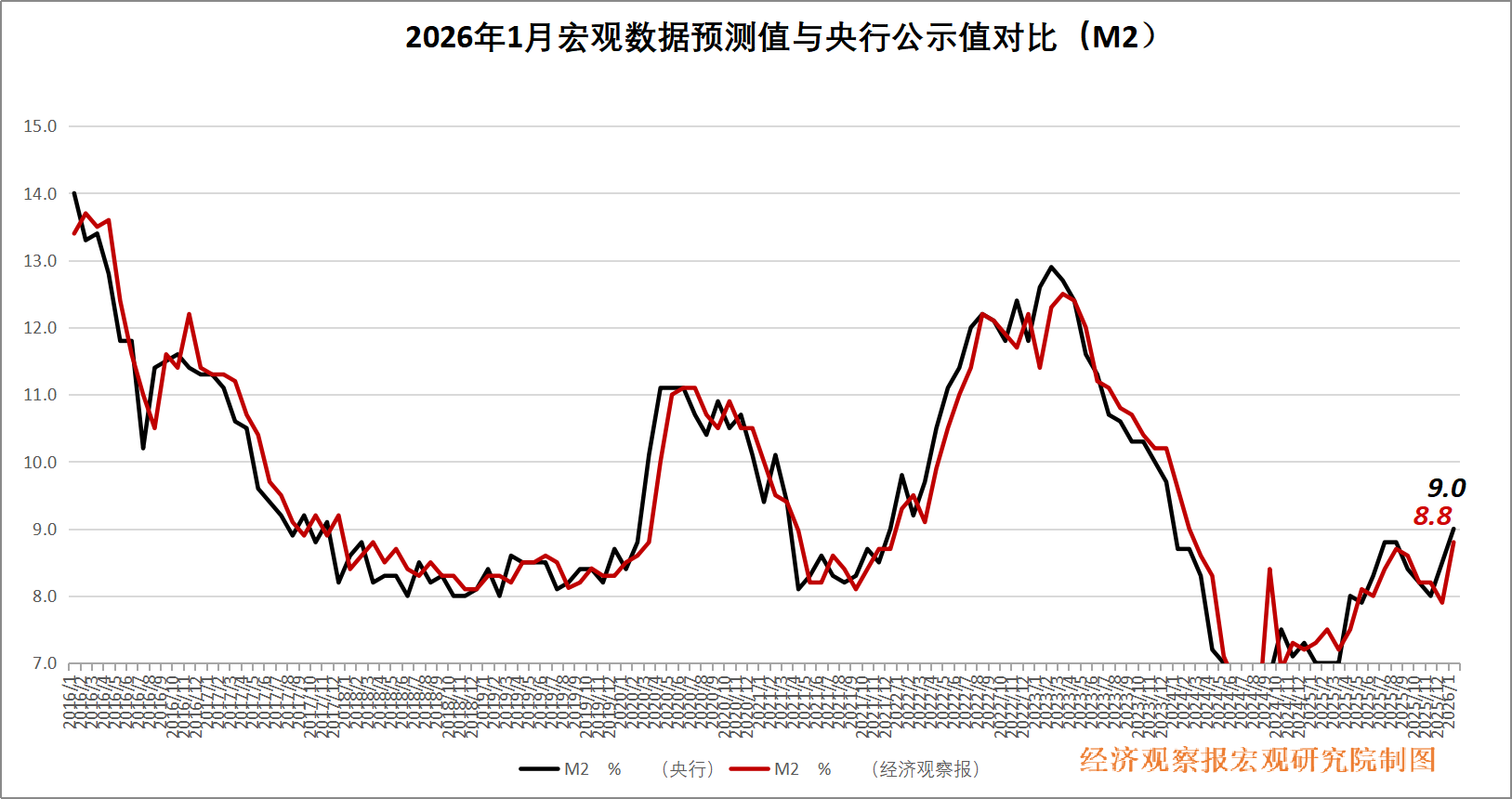
Core Insights - The economic data for January 2026 indicates a moderate recovery, but structural differentiation issues remain a concern, necessitating more policy efforts to maintain year-on-year price increases [1] Economic Indicators - January CPI growth rate decreased from 0.8% to 0.2%, while core CPI increased by 0.3% month-on-month [1] - PPI year-on-year narrowed from -1.9% to -1.4% [1] - Manufacturing PMI fell from 50.1% to 49.3% [1] - New RMB loans amounted to 4.71 trillion yuan, with a year-on-year decrease of 420 billion yuan [1] Monetary Supply - M2 year-on-year growth rate rose to 9.0%, with a balance of 347.19 trillion yuan at the end of January, an increase of 0.5 percentage points from the previous period [1] - The M1 - M2 spread narrowed by 0.6 percentage points, indicating a faster recovery in M1 growth, which reflects an acceleration in the activation of demand deposits [1] Financial Sector Dynamics - Increased deposits in non-bank financial institutions and accelerated "deposit migration" contributed to the generation of deposits, supported by government bond financing converting into corporate and household deposits [1] - The positive market conditions in the capital market also supported the expansion of broad money supply [1] Policy Implications - There is a need to remain vigilant regarding inflation expectations and asset bubbles, ensuring that M2 growth aligns with nominal GDP [1] - Policy coordination is required to boost domestic demand [1]

经观月度观察|价格温和修复 提振经济仍需政策协同
Jing Ji Guan Cha Bao· 2026-02-20 04:25
Core Viewpoint - The economic recovery is moderate, but structural differentiation remains a concern, necessitating more policy support to maintain year-on-year price increases [1] CPI - The CPI year-on-year growth rate decreased from 0.8% to 0.2%, while the core CPI increased by 0.3% month-on-month, indicating early signs of inflation recovery [3] - The improvement in consumer demand is supported by ongoing consumption promotion policies, with prices for household goods and daily necessities continuing to rise [3] PPI - The PPI year-on-year rate narrowed from -1.9% to -1.4%, with a month-on-month increase of 0.4% [4] - Input factors, such as rising international metal prices and geopolitical risks, are contributing to price increases in domestic industries [4] PMI - The manufacturing PMI fell to 49.3, down 0.8 percentage points from the previous month, with all five sub-indices declining [5] - The decrease is attributed to year-end rush production and the upcoming Spring Festival, affecting supply and demand [5] Credit - New RMB loans totaled 4.71 trillion yuan in January, with a year-on-year decrease of 420 billion yuan [7] - Short-term loans showed improvement, while medium and long-term loans for enterprises weakened, indicating a lack of robust demand [7] M2 - M2 growth accelerated to 9% year-on-year, up from 8.5%, driven by increased deposits from non-bank financial institutions [8] - The narrowing gap between M1 and M2 growth rates reflects improved liquidity transmission to the real economy [8]
11月居民存贷数据透露这些信号
Di Yi Cai Jing Zi Xun· 2025-12-14 12:31
Core Insights - The financial data for November indicates a significant divergence in credit demand, with corporate loans increasing while household credit demand remains weak [2][11]. Group 1: Loan Data Overview - In November, new RMB loans totaled 390 billion yuan, a year-on-year decrease of 190 billion yuan, falling short of market expectations [3][4]. - Corporate loans increased by 610 billion yuan, a year-on-year rise of 360 billion yuan, with short-term loans contributing significantly [3][4]. - Household loans decreased by 206.3 billion yuan, a year-on-year decline of 476.3 billion yuan, indicating a weakening demand for consumer credit [4][5]. Group 2: Corporate Loan Dynamics - Corporate short-term loans rose by 100 billion yuan, while medium to long-term loans saw a decrease of 400 billion yuan year-on-year [3][4]. - The decline in medium to long-term loans is attributed to ongoing economic pressures and reduced investment growth [3][11]. - Corporate bond financing has increased, potentially substituting for loan demand, further impacting medium to long-term loan growth [3][11]. Group 3: Household Loan Trends - Cumulatively, household loans added only 533.3 billion yuan in the first eleven months, accounting for just 3.5% of total new credit, down from 13.9% in the same period last year [5][11]. - The weak household credit demand reflects subdued consumer spending and ongoing adjustments in the real estate market [5][11]. - Factors such as the timing of consumption events and the impact of previous subsidy policies have contributed to the current state of household loans [5][11]. Group 4: Deposit Trends - In November, RMB deposits increased by 1.41 trillion yuan, a year-on-year decrease of 760 billion yuan, with all sectors showing reduced growth [6][8]. - Non-bank deposits experienced a significant slowdown, indicating a shift in household funds towards equity markets due to stock market volatility [6][7]. - The M1-M2 "scissors difference" expanded to -3.1%, highlighting weak demand for real economy financing [8][9]. Group 5: Future Outlook - The current financing demand structure, characterized by weak household demand, increasing corporate loans, and strong government financing, is expected to persist for one to two more quarters [10][12]. - Corporate financing is anticipated to grow due to factors such as export growth and government investment expansion, while household credit growth may remain stable due to ongoing challenges in the labor market and real estate sector [12].

11月居民存贷数据透露这些信号
第一财经· 2025-12-14 12:22
Core Viewpoint - The financial data for November indicates a significant divergence in credit demand, with corporate financing showing resilience while household demand remains weak, leading to a complex financing landscape in the economy [3][14]. Group 1: Loan Data Analysis - In November, new RMB loans totaled 390 billion, a year-on-year decrease of 190 billion, falling short of market expectations [5][6]. - Corporate loans increased by 610 billion, a year-on-year rise of 360 billion, with short-term loans up by 100 billion and medium to long-term loans down by 400 billion [6][14]. - Household loans decreased by 206.3 billion, a year-on-year drop of 476.3 billion, with short-term loans down by 215.8 billion and medium to long-term loans up by 100 billion [6][7]. Group 2: Deposit Trends - In November, RMB deposits increased by 1.41 trillion, a year-on-year decrease of 760 billion, with household deposits up by 670 billion and non-financial corporate deposits up by 645.3 billion [10][11]. - Non-bank deposits showed a unique trend, with a total increase of 800 billion, a year-on-year decrease of 1 billion, indicating a shift in residents' funds towards equity markets [9][11]. Group 3: Economic Implications - The M1-M2 gap widened to -3.1%, reflecting weak demand for real economy financing, with M2 growth at 8% and M1 growth dropping to 4.9% [12][13]. - The current financing landscape is characterized by weak household demand, increasing corporate loans supported by bill financing, and a government sector capable of accelerating bond issuance to stimulate the banking system [14][15]. - Experts predict that the financing demand pattern of "weak households, increasing enterprises, and strong government" may persist for one to two more quarters, with corporate financing expected to grow due to positive factors like export growth and government investment [15][16].

非银存款增长打破年内规律,11月居民存贷数据透露哪些信号?
Di Yi Cai Jing· 2025-12-14 11:44
Core Insights - The overall financial data for November fell short of expectations, with corporate lending acting as a stabilizing force while household credit demand weakened further [1][2][11] Group 1: Corporate Lending - In November, new RMB loans totaled 390 billion yuan, a year-on-year decrease of 190 billion yuan, which was below market expectations. Corporate lending increased by 610 billion yuan, a year-on-year increase of 360 billion yuan [2][3] - Corporate short-term loans rose by 100 billion yuan, with year-on-year and month-on-month increases of 110 billion yuan and 290 billion yuan, respectively. However, medium to long-term loans decreased year-on-year by 40 billion yuan [3][4] - The reliance on bill financing and short-term loans indicates a lack of effective financing demand from the real economy, with corporate bond financing also providing an alternative to loans [3][11] Group 2: Household Lending - Household loans decreased by 206.3 billion yuan in November, a year-on-year decline of 476.3 billion yuan, reflecting weak consumer demand and ongoing adjustments in the real estate market [4][5] - Cumulatively, household loans added only 533.3 billion yuan in the first eleven months, accounting for just 3.5% of new credit, compared to 13.9% in the same period last year [4][5] - The decline in household credit is attributed to weak consumption demand and the ongoing adjustment in the real estate market, with short-term loans under pressure despite a temporary improvement during the "Double 11" shopping festival [5][11] Group 3: Deposit Trends - In November, RMB deposits increased by 1.41 trillion yuan, a year-on-year decrease of 760 billion yuan, with household deposits rising by 670 billion yuan but still down 120 billion yuan year-on-year [6][9] - Non-bank deposits showed a significant slowdown, indicating a shift of funds from deposits to financial assets due to market volatility [6][8] - The M1-M2 "scissors difference" expanded to -3.1%, reflecting weak demand for real economy financing, with M2 growth at 8% and M1 growth dropping to 4.9% [9][10] Group 4: Economic Outlook - The current financing demand landscape is characterized by weak household demand, increasing corporate lending, and strong government financing capabilities, which may persist for one to two more quarters [11][12] - Future policies are expected to focus on enhancing consumer demand through increased social spending, stabilizing employment, and improving income levels, which may eventually support household credit growth [12]
瑞达期货股指期货全景日报-20251120
Rui Da Qi Huo· 2025-11-20 09:13
Report Summary 1. Report Industry Investment Rating - Not provided in the given content 2. Core View of the Report - A - share major indices closed down collectively, with small - and medium - cap stocks weaker than large - cap blue - chips. The Shanghai Composite Index fell 0.4%, the Shenzhen Component Index fell 0.76%, and the ChiNext Index fell 1.12%. The trading volume of the Shanghai and Shenzhen stock markets declined slightly, and over 3800 stocks fell. The economic fundamentals in October showed a significant decline in domestic imports and exports, fixed investment, social retail, and industrial added value above designated size. The fixed investment declined for 7 consecutive months, and social retail declined for 5 consecutive months. The real estate market continued to decline rapidly. The M1 - M2 scissors gap ended its 5 - month upward trend. The 11 - month LPR remained unchanged for the 6th consecutive month, indicating a prudent monetary policy and a low possibility of significant reserve requirement ratio cuts and interest rate cuts this year. In the current macro - data, performance, and policy vacuum period, the market is expected to show a random walk, and stock index futures will remain volatile [2] 3. Summary by Relevant Catalogs 3.1 Futures Contract Price and Spread - IF main contract (2512) was at 4539.2, down 31.6; IF sub - main contract (2511) was at 4558.0, down 28.8. IH main contract (2512) was at 3002.6, down 14.8; IH sub - main contract (2511) was at 3008.6, down 14.8. IC main contract (2512) was at 7000.0, down 59.6; IC sub - main contract (2511) was at 7063.4, down 63.0. IM main contract (2512) was at 7263.6, down 35.2; IM sub - main contract (2511) was at 7347.6, down 41.6. The IF - IH current - month contract spread was 1549.4, down 16.0; the IC - IF current - month contract spread was 2505.4, down 27.8. The IM - IC current - month contract spread was 284.2, up 10.4; the IC - IH current - month contract spread was 4054.8, down 43.8. The IM - IF current - month contract spread was 2789.6, down 17.4; the IM - IH current - month contract spread was 4339.0, down 33.4 [2] 3.2 Futures Seasonal Spread - IF current - quarter minus current - month was - 51.8, down 0.6; IF next - quarter minus current - month was - 97, down 2.6. IH current - quarter minus current - month was - 13.0, down 1.4; IH next - quarter minus current - month was - 23.4, down 1.6. IC current - quarter minus current - month was - 242.0, down 0.8; IC next - quarter minus current - month was - 448.4, up 4.2. IM current - quarter minus current - month was - 312.4, up 9.2; IM next - quarter minus current - month was - 540.6, up 11.2 [2] 3.3 Futures Net Positions of Top 20 Holders - IF top 20 net positions were - 22,242.00, down 2488.0; IH top 20 net positions were - 13,615.00, down 598.0. IC top 20 net positions were - 24,823.00, up 1777.0; IM top 20 net positions were - 34,271.00, up 1773.0 [2] 3.4 Spot Price and Basis - The spot price of CSI 300 was 4564.95, down 23.3; the IF main contract basis was - 25.8, down 2.7. The spot price of SSE 50 was 3008.3, down 12.1; the IH main contract basis was - 5.7, up 3.7. The spot price of CSI 500 was 7062.0, down 60.8; the IC main contract basis was - 61.9, up 6.0. The spot price of CSI 1000 was 7340.4, down 46.8; the IM main contract basis was - 76.8, up 12.2 [2] 3.5 Market Sentiment Indicators - A - share trading volume was 17,226.35 billion yuan, down 200.31 billion yuan. Margin trading balance was 24,979.40 billion yuan, down 47.70 billion yuan. North - bound trading volume was 1912.86 billion yuan, down 268.87 billion yuan. Reverse repurchase had a maturity of - 1900.0 billion yuan and an operation volume of + 3000.0 billion yuan. Main funds were - 513.07 billion yuan, down 592.44 billion yuan. The proportion of rising stocks was 22.66%, up 0.69%. Shibor was 1.364%, down 0.056%. IO at - the - money call option closing price was 25.00, down 16.40; IO at - the - money call option implied volatility was 15.55%, up 1.19%. IO at - the - money put option closing price was 12.60, up 0.60; IO at - the - money put option implied volatility was 15.55%, up 1.06%. CSI 300 index 20 - day volatility was 14.42%, up 0.06%. Volume PCR was 60.45%, down 11.30. Position PCR was 78.46%, down 1.21. The Wind market strength of all A - shares was 3.40, up 0.10; the technical aspect was 2.70, up 0.60. The capital aspect was 4.20, down 0.30 [2] 3.6 Industry News - The Fed's October policy meeting minutes showed serious differences among policymakers when cutting interest rates last month. Many officials thought it "might be appropriate" to keep interest rates unchanged for the rest of 2025, while some officials said another rate cut in December "was likely appropriate" if the economy performed as expected. There was almost unanimous agreement to stop the quantitative tightening (QT) of balance - sheet reduction. Some were worried about the disorderly decline of the stock market. The People's Bank of China announced on November 20 that the 1 - year LPR was 3.0% (unchanged from the previous time), and the over - 5 - year LPR was 3.5% (unchanged from the previous time) [2] 3.7 Key Data to Focus On - At 21:30 on November 20, pay attention to the US September non - farm payroll data, unemployment rate, and labor participation rate [3]
10月社融数据点评:资金活化延续回升趋势
Yong Xing Zheng Quan· 2025-11-18 05:58
1. Report Industry Investment Rating No specific industry investment rating is provided in the given content. 2. Core Viewpoints - On November 13, 2025, the central bank announced the financial statistics for October 2025. M2 increased by 8.2% year - on - year, M1 increased by 6.2% year - on - year. The stock of social financing scale at the end of October 2025 increased by 8.5% year - on - year, and the cumulative increase in social financing scale in the first ten months of 2025 was 30.9 trillion yuan, 3.83 trillion yuan more than the same period last year [1][12]. - The year - on - year growth rate of social financing in October was 8.50%, with the growth rate falling for three consecutive months. New social financing was 81.5 billion yuan, 58.08 billion yuan less than the same period last year. Government bond financing slowed down, and credit demand was weak [2][13]. - M1 declined, and the gap between M1 and M2 widened slightly. However, the M1 - M2 gap has been narrowing overall this year, which is an important signal of capital activation and can boost the sentiment of the equity market in the short term [3][25]. 3. Summary by Relevant Catalogs 3.1 Social Financing Data Validates Bond Market Space - **Social Financing Growth Rate and Composition**: The year - on - year growth rate of social financing in October was 8.50%, with the growth rate falling for three consecutive months. New social financing was 81.5 billion yuan, 58.08 billion yuan less than the same period last year. Government bond net financing was 48.93 billion yuan, 56.02 billion yuan less than the same period last year. New RMB loans decreased by 2.01 billion yuan, 31.66 billion yuan more than the same period last year. In direct financing, corporate bond net financing was 24.69 billion yuan, 14.82 billion yuan more than the same period last year, and non - financial enterprise domestic stock financing was 6.96 billion yuan, 4.12 billion yuan more than the same period last year. The new non - standard financing decreased by 10.85 billion yuan, 3.58 billion yuan less than the same period last year [2][13]. - **Credit Demand**: New RMB loans by financial institutions in October were 22 billion yuan, 28 billion yuan less than the same period last year. Corporate loans increased by 35 billion yuan, 22 billion yuan more than the same period last year, with obvious bill impulse, and corporate medium - and long - term loans increased by 3 billion yuan, 14 billion yuan less than the same period last year. Resident loans decreased by 36.04 billion yuan, 52.04 billion yuan more than the same period last year, indicating weak demand in the real estate market [2][14]. 3.2 M1 - M2 Spread and Capital Activation - **M1 and M2 Trends**: In October, M2 increased by 8.20% year - on - year, down 0.2 percentage points, and M1 increased by 6.20% year - on - year, with the growth rate down 1.0 percentage point compared with the previous value. The absolute value of the M1 - M2 gap widened slightly to 2.00pct, but it has been narrowing overall this year, which is a signal of capital activation and can boost the equity market sentiment in the short term. The growth rate difference between social financing and M2 in October was 0.30pct [3][25]. - **Deposit Changes**: In October, household deposits decreased by 134 billion yuan, 77 billion yuan more than the same period last year; non - financial enterprise deposits decreased by 108.53 billion yuan, 35.53 billion yuan more than the same period last year; fiscal deposits increased by 72 billion yuan, 12.48 billion yuan more than the same period last year; non - banking financial institution deposits increased by 185 billion yuan, 77 billion yuan more than the same period last year, which may promote further capital activation [3][25]. 3.3 Investment Advice - **Equity Market**: The recent narrowing of the M1 - M2 gap is an important signal of capital activation, which can boost the equity market sentiment in the short term, but the sustainability of the rebound depends on fundamental improvement and policy coordination [4][35]. - **Bond Market**: The social financing data in October shows that the growth rate of social financing has declined. The data verifies the uncertainty of the economic recovery. The bond yield has declined recently, and there is still some room for further decline. In 2026, the central bank's monetary policy will continue the "moderately loose" tone. For the bond market, investors are advised to mainly conduct band operations on interest - rate bonds, pay attention to the structural opportunities of green bonds and technology bonds in credit bonds, dynamically adjust the stock - bond ratio, and pay attention to elastic assets such as pro - cyclical convertible bonds [4][38].
10月金融数据“信贷弱、社融稳”,M1增速维持高位凸显资金活力
Hua Xia Shi Bao· 2025-11-14 07:11
Core Viewpoint - The financial data for October indicates a continued decline in credit growth, while social financing and M2 growth remain relatively high, reflecting strong financial support for the real economy [2][3]. Group 1: Financial Data Overview - In October, new RMB loans amounted to 220 billion, with a month-on-month decrease of 1.07 trillion and a year-on-year decrease of 280 billion, leading to a loan growth rate of 6.5%, the lowest on record [6][7]. - The total social financing scale at the end of October was 437.72 trillion, with a year-on-year growth of 8.5% [8]. - M2 growth was 8.2% year-on-year, slightly down by 0.2 percentage points from the previous month, while M1 grew by 6.2% year-on-year [3][4]. Group 2: Loan and Financing Structure - The M1-M2 spread was 2%, indicating a solid trend of funds being converted into demand deposits, reflecting good activity in corporate operations and personal consumption [4][5]. - The structure of financing is shifting, with non-loan financing methods now accounting for over half of the total social financing increment, indicating a diversification in corporate financing channels [9]. Group 3: Future Outlook - There may be a new round of reserve requirement ratio cuts and potential interest rate reductions by the central bank before the end of the year, aimed at directing financial resources towards key sectors such as technology innovation and small enterprises [10].

宏观日报:上游原材料价格分化-20251114
Hua Tai Qi Huo· 2025-11-14 05:52
Industry Overview Upstream - Prices of aluminum and copper in the non - ferrous metals sector have rebounded; international oil prices and liquefied natural gas prices are fluctuating [2] Midstream - In the chemical industry, PX prices are rising, while the operating rates of PTA and polyester are low; power plant coal consumption has decreased [3] Downstream - In the real estate sector, the sales of commercial housing in second - and third - tier cities have seasonally increased slightly; in the service industry, the film box office is in the off - season, and the number of domestic flights has seasonally increased slightly [3] Macroeconomic Events Production Industry - China is designing a new rare - earth export licensing system, and the Ministry of Commerce will carry out export control work on rare - earth related items in accordance with laws and regulations [1] Service Industry - In the first ten months of 2025, the cumulative increase in social financing scale was 30.9 trillion yuan, 3.83 trillion yuan more than the same period last year; RMB loans increased by 14.97 trillion yuan. At the end of October, M2 balance was 335.13 trillion yuan, a year - on - year increase of 8.2%; M1 balance was 112 trillion yuan, a year - on - year increase of 6.2%; M0 balance was 13.55 trillion yuan, a year - on - year increase of 10.6%. The narrowing gap between M1 and M2 indicates positive signals such as increased business activity and improved consumer demand [1] Key Industry Price Indicators | Industry | Indicator | Price | YoY | | --- | --- | --- | --- | | Agriculture | Spot price of corn | 2161.4 yuan/ton | 0.40% | | | Spot price of eggs | 6.5 yuan/kg | 1.25% | | | Spot price of palm oil | 8710.0 yuan/ton | 0.11% | | | Spot price of cotton | 14819.5 yuan/ton | - 0.29% | | | Average wholesale price of pork | 18.1 yuan/kg | - 0.60% | | Non - ferrous metals | Spot price of copper | 87301.7 yuan/ton | 1.59% | | | Spot price of zinc | 22618.0 yuan/ton | 0.63% | | | Spot price of aluminum | 21933.3 yuan/ton | 2.60% | | | Spot price of nickel | 121150.0 yuan/ton | - 0.03% | | | Spot price of aluminum | 17606.3 yuan/ton | 1.51% | | Ferrous metals | Spot price of rebar | 3133.0 yuan/ton | 0.00% | | | Spot price of iron ore | 794.7 yuan/ton | - 0.08% | | | Spot price of wire rod | 3302.5 yuan/ton | - 0.08% | | | Spot price of glass | 14.0 yuan/square meter | - 1.06% | | Non - metals | Spot price of natural rubber | 14883.3 yuan/ton | 1.82% | | | China Plastics City Price Index | 772.0 | - 0.58% | | Energy | Spot price of WTI crude oil | 58.5 dollars/barrel | - 1.86% | | | Spot price of Brent crude oil | 62.7 dollars/barrel | - 1.28% | | | Spot price of liquefied natural gas | 4206.0 yuan/ton | - 1.91% | | | Coal price | 834.0 yuan/ton | 1.21% | | Chemical | Spot price of PTA | 4591.6 yuan/ton | 0.67% | | | Spot price of polyethylene | 6988.3 yuan/ton | 0.02% | | | Spot price of urea | 1630.0 yuan/ton | 2.03% | | | Spot price of soda ash | 1214.3 yuan/ton | 0.89% | | Real estate | Cement price index | 136.4 | - 0.16% | | | Building materials composite index | 112.3 points | 0.42% | | | Concrete price index | 90.8 points | - 0.14% | [38]