大金融

Search documents
港股节后表现不一,A股影响几何?
Sou Hu Cai Jing· 2026-02-20 14:46
最近港股市场分化得让人摸不着头脑:有的板块借着消息单日大涨超20%,有的却在热门行情里突然跳水。身边有朋友看到AI应用股走强就追进去,结果刚 买就遇上震荡;还有人看到互联网科技股普跌,慌慌张张割了肉,转头就看着其他相关板块涨起来。其实很多人都陷入了同一个主观误区:把新闻消息直接 等同于涨跌信号,凭着直觉追涨杀跌,却从来没思考过,消息背后到底是谁在主导交易。今天就结合真实的市场情况和量化大数据,聊聊怎么跳出这种直觉 陷阱,建立更靠谱的投资思维。 图里的橙色柱体是「机构库存」数据,它反映的是机构资金有没有积极参与交易。消息出来后,虽然股价先涨后跌,但「机构库存」数据从消息公布第三天 就开始活跃,甚至在股价调整的时候,数据还在不断增加——这说明机构资金一直在积极参与,所谓的"利空下跌"只是表面的诱骗。我们的直觉之所以错, 是因为把消息当成了结果,却没意识到,消息只是机构用来博弈的工具,真正决定走势的是机构的交易态度。二、利好兑现反而跌,真的是"见光死"吗? 还有更反直觉的情况:有只个股公布中报,净利润暴增8倍,妥妥的超级利好,但股价反而跌了近10%。当时行情整体火爆,身边有人觉得这是"黄金坑", 赶紧抄底,结果套了 ...

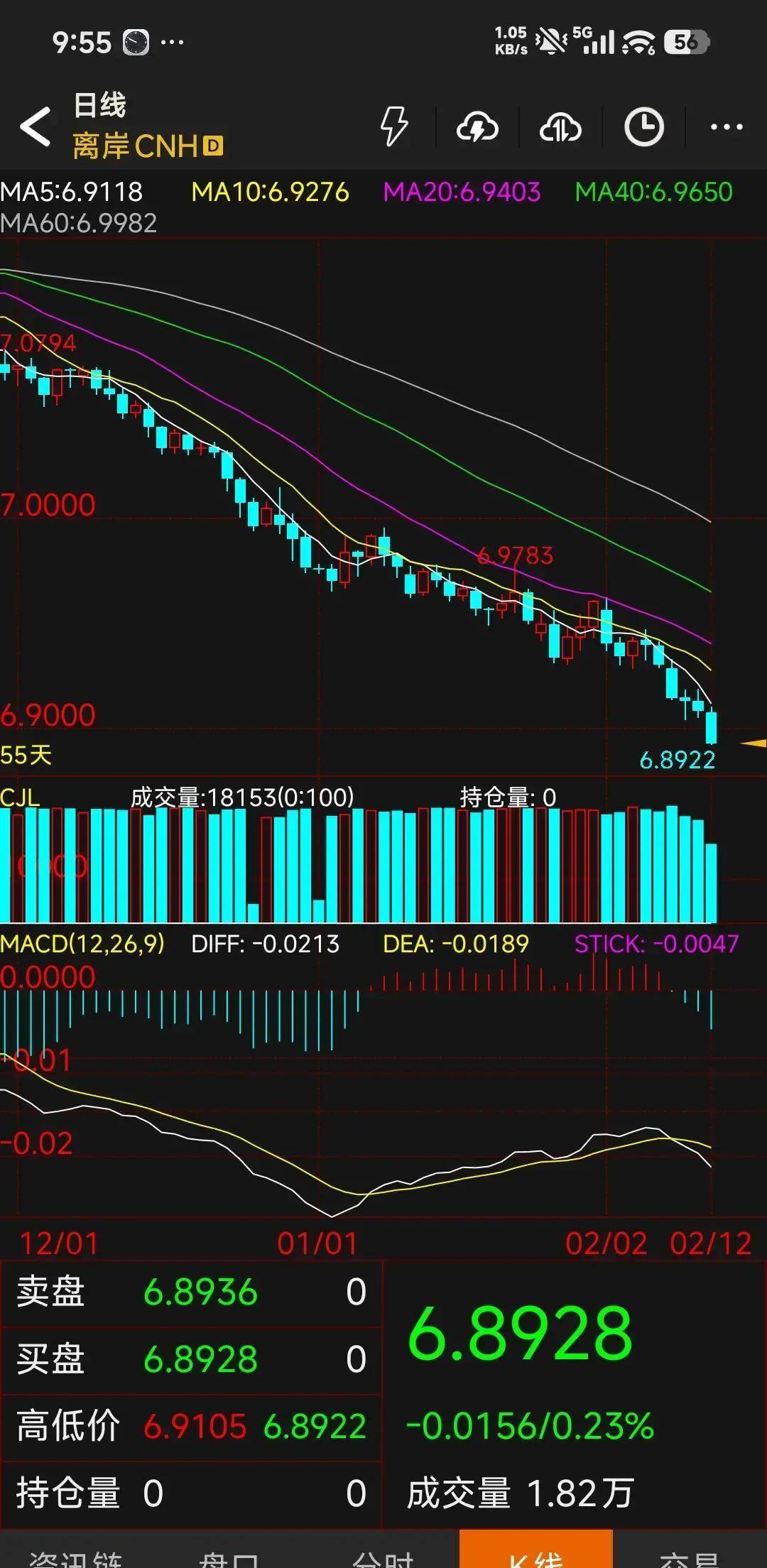
离岸人民币破6.89!三股力量推升A股,四大板块暗藏玄机
Sou Hu Cai Jing· 2026-02-14 05:12
Core Viewpoint - The offshore RMB has strengthened significantly, breaking the 6.89 mark, driven by reduced expectations for Fed rate hikes, continuous foreign capital inflow, and steady improvement in the Chinese economy, making RMB a focal point in the market [1] Group 1: Aviation Industry - The aviation sector is highly sensitive to exchange rates, with costs for aircraft, fuel, and parts typically settled in USD; RMB appreciation reduces financial burdens for companies [4] - China National Airlines, China Southern Airlines, and China Eastern Airlines benefit from this appreciation, with China National Airlines' USD debt constituting 60% of its liabilities, leading to significant profit increases with every 1% rise in RMB [4] - China Southern Airlines, due to its large fleet, sees even more pronounced profit increases, while China Eastern Airlines also experiences improved profitability from reduced fuel costs and exchange gains [4] Group 2: Paper Industry - The paper industry is directly impacted by RMB appreciation, as pulp prices are closely tied to USD, with over 60% of pulp imported; a stronger RMB effectively lowers raw material costs [4] - Companies like Sun Paper, which has a high self-sufficiency rate, can see immediate profit increases with slight RMB appreciation, while others heavily reliant on imports, such as Hengda New Materials, benefit significantly from reduced cost pressures [4] Group 3: Outbound Tourism - The outbound tourism sector reacts quickly to exchange rate changes; a stronger RMB makes international travel, including flights and accommodations, more affordable, increasing consumer interest [5] - China Duty Free Group stands out as a major beneficiary, with rising demand for duty-free shopping, while China Youth Travel Service also benefits from improved product value and increased orders due to RMB appreciation [5] Group 4: Financial Sector - The financial sector is an indirect beneficiary of RMB strength, attracting foreign capital, particularly from funds focused on long-term asset allocation [5] - Major banks like Industrial and Commercial Bank of China maintain stable profits, while retail banks like China Merchants Bank see increased foreign holdings; China Ping An benefits from the appreciation of overseas investments when converted to RMB [5] Group 5: Market Sentiment and Future Outlook - The recent RMB appreciation signals a shift in investor sentiment, moving from passive observation to active evaluation of Chinese asset safety and value [6] - The sustainability of this appreciation and its ability to translate into real profits for companies remains uncertain, but if it continues, sectors like aviation, paper, tourism, and finance could enter a new valuation cycle [7] - The market's response to the RMB's strength reflects a broader confidence returning, with questions about how long this confidence can last and its potential impact on corporate earnings [7]
早盘直击|今日行情关注
申万宏源证券上海北京西路营业部· 2026-01-26 02:10
Group 1 - The core viewpoint of the article emphasizes the transition of the spring market, focusing on performance improvement and growth [1] - The market has shown significant differentiation, with large-cap blue-chip stocks under pressure while small and mid-cap stocks have performed actively [1] - The financial sector has experienced adjustments, while cyclical industries have led in gains, indicating a typical characteristic of the spring market's transition phase [1] Group 2 - Last week, the market experienced fluctuations with a decrease in trading volume, averaging around 27 billion yuan, which is a notable decline from the previous week [1] - The Shanghai Composite Index rebounded slightly, with volatility decreasing and returning above the five-day moving average after mid-week [1] - The ratio of the CSI 2000 to the CSI 300, after normalization, reached 1.51, continuing to rise and setting a new high [1]

报告:下周看好军工板块的投资者比例大幅提高,环比提升6个百分点
Zheng Quan Shi Bao Wang· 2026-01-11 11:09
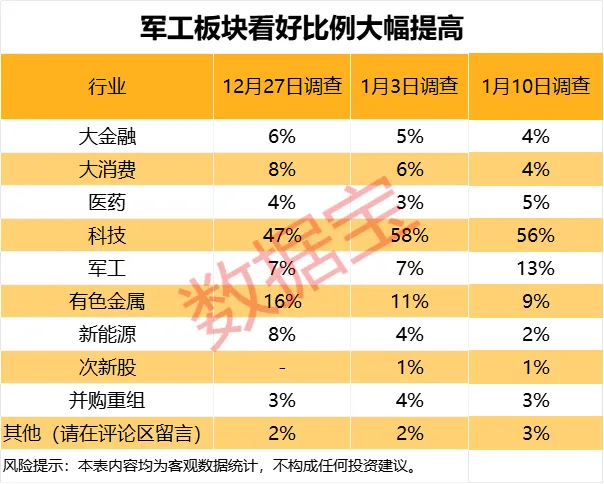
Group 1 - The overall profit effect among investors is positive, with 88% reporting profits, and 55% of those making profits within 10% [1] - Approximately 3% of investors are currently in cash, while about 46% are fully invested or using margin, indicating a slight increase in investment positions [1] - 29% of investors chose to increase their positions this week, a 6 percentage point increase from the previous week, reflecting optimism towards the market [1] Group 2 - The A-share market continues to rise, with investor confidence recovering, although the Shanghai Composite Index is at a near ten-year high, leading to some skepticism about the upward momentum [1] - 43% of investors believe the market will "rise and break through 4200 points" next week, while 46% expect "sideways fluctuations" [1][3] - Only 7% of investors are bearish, predicting the market will "fall below 4000 points" [1][3] Group 3 - The proportion of investors optimistic about the military industry has significantly increased, rising by 6 percentage points [2] - In the latest survey, the technology sector remains the most favored, with 56% of investors expressing confidence [2] - Other sectors such as large finance, large consumption, and new energy have seen a decline in investor optimism [2]
投资大家谈 | 摩根资产管理中国权益投资团队2026展望
点拾投资· 2026-01-10 11:00
Core Viewpoint - The article emphasizes the potential for value re-evaluation in Chinese equity assets, particularly in the context of structural opportunities arising from macroeconomic shifts and technological advancements such as AI and lithium battery industries [2][6][12]. Group 1: Market Outlook - The Chinese equity market is at a critical juncture of transitioning from old to new growth drivers, with significant structural opportunities emerging from sectors like AI, high-end manufacturing, and new energy [2][6]. - Morgan Asset Management's China equity team focuses on long-term investment value through in-depth industry research, aiming to provide sustainable alpha for investors [2][6]. Group 2: Investment Strategies - Investment Director Du Meng believes that the future of Chinese equity assets is likely to see a value re-evaluation, driven by international investors reassessing the allocation value of Chinese assets [6][12]. - The investment strategy includes a focus on AI as a major industry trend, with a dynamic approach to participation and adjustment based on ongoing developments [6][12]. Group 3: Sector-Specific Insights - The lithium battery industry is viewed positively for 2026 due to a balanced supply-demand state, new demand from energy storage, and attractive valuations as profit margins are currently low [8][12]. - The AI industry is recognized as a significant trend, with expectations of sustained capital expenditure growth and a focus on companies with strong technological barriers and high order visibility [12][16]. Group 4: Consumer and Financial Sectors - The consumer sector is expected to show structural opportunities, particularly driven by younger generations' spending habits, which differ significantly from previous generations [12][35]. - The financial sector is anticipated to benefit from favorable policies aimed at building a strong financial system, with specific attention to the potential of brokerage and insurance companies [33][35]. Group 5: ETF and Index Investment - The global trend towards index investing continues to grow, with significant inflows into ETFs, particularly in the Asia-Pacific region, where China's ETF market is rapidly expanding [39][40]. - Morgan Asset Management's strategy in the ETF space focuses on providing differentiated solutions and enhancing investor experience through a "boutique" approach [40].

时隔近4个月 A股成交额历史第6次突破3万亿
2 1 Shi Ji Jing Ji Bao Dao· 2026-01-09 07:56
Group 1 - The A-share market has entered a strong bullish phase, with the Shanghai Composite Index rising 0.92% and surpassing the 4100-point mark for the first time in 10 years, achieving a 16-day consecutive increase [1] - The market's trading volume has significantly increased, with the A-share market's turnover exceeding 3 trillion yuan for the first time in nearly four months, indicating a surge in investor sentiment [2] - Economic expert Pan Helin suggests that the current rise in A-shares is driven by the appreciation of the RMB, leading to a global capital inflow, and that this bullish trend is within a reasonable range [2] Group 2 - Pan Helin notes that while the bull market may experience fluctuations, the overall stock market will remain strong until the global economic boom cycle ends, indicating a structural bull market [3] - Certain popular sectors are expected to continue reaching new highs, while less favored sectors may need to wait for market rotation opportunities [3]
时隔近4个月,A股成交额历史第6次突破3万亿
21世纪经济报道· 2026-01-09 07:18
Market Overview - The A-share market experienced a strong rally on January 9, with all three major indices rising. The Shanghai Composite Index increased by 0.92%, surpassing the 4100-point mark for the first time in 10 years, marking a 16-day consecutive rise [1] - The ChiNext Index rose by 0.77%, driven by surges in AI application themes, particularly in the film, short drama, and gaming sectors. Other leading sectors included commercial aerospace, humanoid robots, and small metal concepts, while the photovoltaic and large financial sectors weakened [1] Trading Volume and Investor Sentiment - Since the beginning of 2026, the market has maintained a trading volume exceeding 2.5 trillion yuan for four consecutive trading days, with today's half-day volume surpassing 2 trillion yuan, indicating a rapid increase in investor sentiment [3] - Historical data shows that such high trading volumes are rare in A-share history, with only six instances of daily trading volumes exceeding 3 trillion yuan. The most recent occurrence was on October 8, 2024, with a volume of 34,835.43 billion yuan [3][4] Market Dynamics and Economic Analysis - Economist Pan Helin stated that the current performance of the A-share market indicates a transition into a full bull market phase, driven by the appreciation of the yuan and the return of global capital. He noted that the upward trend in A-shares is still within a reasonable range compared to global markets [9] - Pan further analyzed that once trading volumes exceed 3 trillion yuan, market sentiment will likely push the market higher. This phase of growth may be less correlated with earnings and value, representing a typical characteristic of a bull market [9] Structural Characteristics of the Bull Market - Despite the bullish trend, Pan cautioned that fluctuations may occur during the bull market, with potential for short-term adjustments. However, the overall market is expected to remain strong until the end of the global economic prosperity cycle [10] - The current bull market is characterized as structural, with certain popular sectors likely to continue reaching new highs, while less popular sectors may need to wait for market rotation opportunities [10]

【机构策略】短期内题材板块呈现结构性分化是大概率事件
Zheng Quan Shi Bao Wang· 2026-01-09 01:33
Group 1 - The A-share market experienced fluctuations with strong performance in sectors such as aerospace, shipbuilding, internet services, and power equipment, while energy metals, securities, insurance, and non-ferrous metals lagged behind [1] - Key factors supporting the market include increased attractiveness of RMB assets, expectations for early-year credit issuance, and positive changes in corporate profit structures driven by advanced manufacturing and overseas enterprises [1] - The domestic monetary policy is expected to maintain a stance of "moderate easing," with the market anticipating that the Federal Reserve will continue its rate-cutting cycle into 2026, leading to a more accommodative global liquidity environment [1] Group 2 - The A-share market continued to show a mixed trend, with large-cap stocks underperforming while small-cap stocks and thematic investments, particularly in commercial aerospace and brain-computer interface sectors, performed well [2] - The market is likely to experience structural fluctuations, with profit-taking from previous gains and a supportive environment for a "slow bull" market, suggesting a focus on mainline sectors and careful management of rotation rhythms [2] - The market remains in a healthy adjustment phase, with the CSI 1000 and Sci-Tech 50 indices outperforming others, and the overall trend for the Shanghai Composite Index remains strong as long as it does not fall back below historical trendline pressures [2]
“15连阳”下分化加剧 A股短期何去何从?
Xin Lang Cai Jing· 2026-01-08 16:56
Market Overview - The A-share market showed a mixed performance on Thursday, with the Shanghai Composite Index experiencing a slight decline of 0.07% to close at 4082.98 points, while the Shenzhen Component and ChiNext Index fell by 0.51% and 0.82%, closing at 13959.48 points and 3302.31 points respectively [1] - The total trading volume in the Shanghai and Shenzhen markets reached 28.265 billion yuan, a decrease of 55.2 billion yuan compared to Wednesday [1] - Despite the overall decline, over 3700 stocks rose, with more than 110 stocks hitting the daily limit [1] Market Sentiment - The market is experiencing increased divergence, with the Shanghai Composite Index managing to maintain a "15 consecutive days of gains" despite fluctuations, leading to heightened discussions about the sustainability of this trend and potential short-term technical adjustments [1][2] - The combination of market divergence and shrinking trading volume has amplified cautious sentiment among investors [2] Economic Data Impact - January is traditionally a "data verification period" for the A-share market, with upcoming releases of key macroeconomic data such as PMI, social financing, and consumption expected to influence market volatility [2] - If the economic data underperforms, it may exacerbate short-term fluctuations and trigger technical adjustments; conversely, better-than-expected data could provide new momentum for the ongoing rally [2] Technical Analysis - The market is currently in a phase of adjustment, with all three major indices showing slight declines, yet still maintaining a trading volume above 2.8 trillion yuan [3] - There is a notable divergence between large-cap and small-cap stocks, with significant activity in sectors like commercial aerospace, brain-computer interfaces, and AI applications, while large financials and materials sectors are facing corrections [3] Investment Strategy - Investors are advised to manage their positions carefully and respond rationally to market conditions, rather than engaging in panic selling or chasing high-flying stocks [3] - A recommended strategy is to maintain a position size of around 50-60%, reducing leverage and exposure to high-volatility stocks to mitigate potential risks [3]
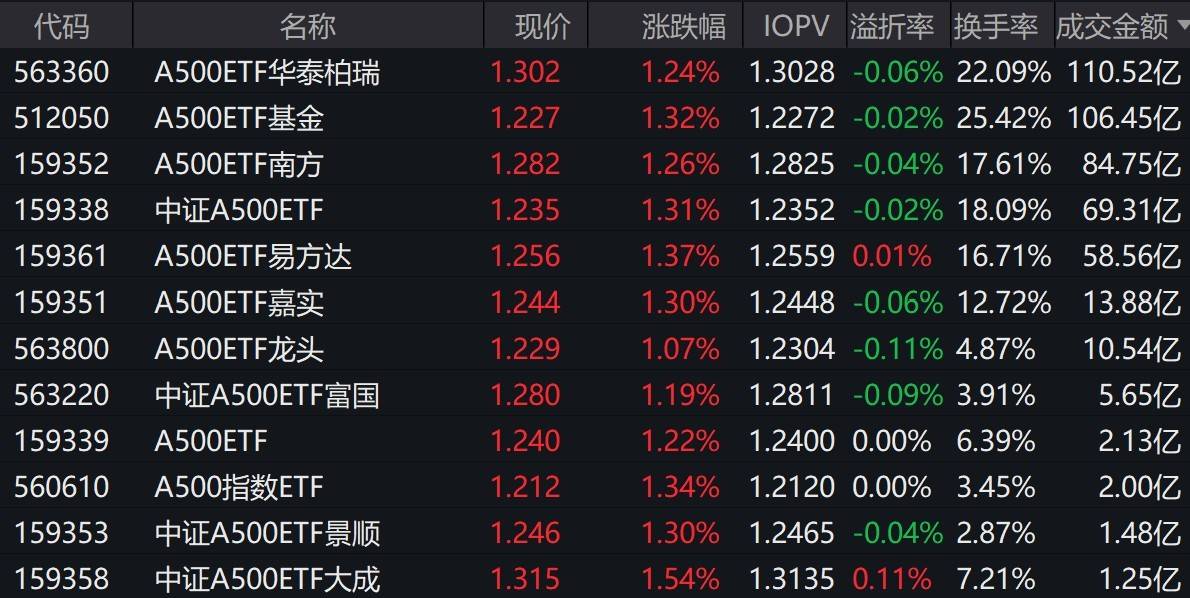
沪指再创十年新高,中证A500指数上涨1.24%,2只中证A500相关ETF成交额超106亿元
Sou Hu Cai Jing· 2026-01-06 03:58
Core Viewpoint - The Shanghai Composite Index opened higher and rose over 1%, reaching a ten-year high, while the CSI A500 Index increased by 1.24% [1] Market Performance - The A500 ETF tracking the CSI A500 Index rose by over 1% by the morning close, with 12 related ETFs having a trading volume exceeding 100 million yuan, and 2 surpassing 10.6 billion yuan [1] - Specific A500 ETFs such as Huatai-PB and A500 Fund had trading volumes of 11.05 billion yuan and 10.65 billion yuan respectively [1] Sector Analysis - The brain-computer interface concept continued to show strong performance, while the financial sector also strengthened, and the non-ferrous metals sector was active [1] - Conversely, the computing hardware concept experienced a decline [1] Economic Outlook - Analysts from brokerage firms suggest that the A-share bull market is expected to continue due to resilient overseas economic conditions, likely ongoing dollar liquidity easing, and domestic policies maintaining a "double easing" tone [1] - The ongoing "anti-involution" trend is expected to boost price expectations, with technology growth remaining the long-term market focus [1]